RSS Feed

Tag Archives: Short film

July 11

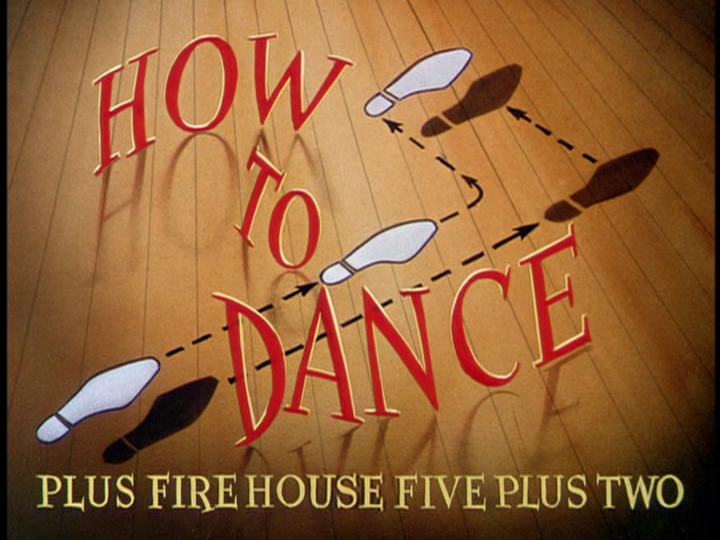
July 11, 1953 – The Goofy Short Film How to Dance is Released to Theaters
vlcsnap-2013-07-11-11h19m54s146

“Even today, dancing is still enjoyed by many, but there are those who have become so inhibited, they no longer have the ability or instinct to dance away their cares.”

On July 11, 1953, the Goofy short film How to Dance was released to theaters. This short features an animated cameo of the Dixieland jazz band Firehouse Five Plus Two, comprised of Disney artists, including Nine Old Men members Ward Kimball and Frank Thomas. It was directed by Jack Kinney, with story by Milt Schaffer and Dick Kinney.

The short opens with an explanation of dance, from the early days of rain dancing to dancing with a romantic aspect. The audience is then taken to a modern restaurant, where all the tables are empty, save for Goofy’s, as everyone else is already on the dance floor. Goofy refuses to dance, watching everyone else have a good time while he makes excuses. He then decides once and for all to learn how to dance, and grabs an instructional book while turning on a record. He then places cutouts on the ground to help him follow the steps, but they are blown away by the wind. Goofy accidentally kicks his neighbor as he tries to follow the steps, which results in getting punched.
Goofy borrows a dressmaker's dummy to teach himself how to dance, with disastrous results

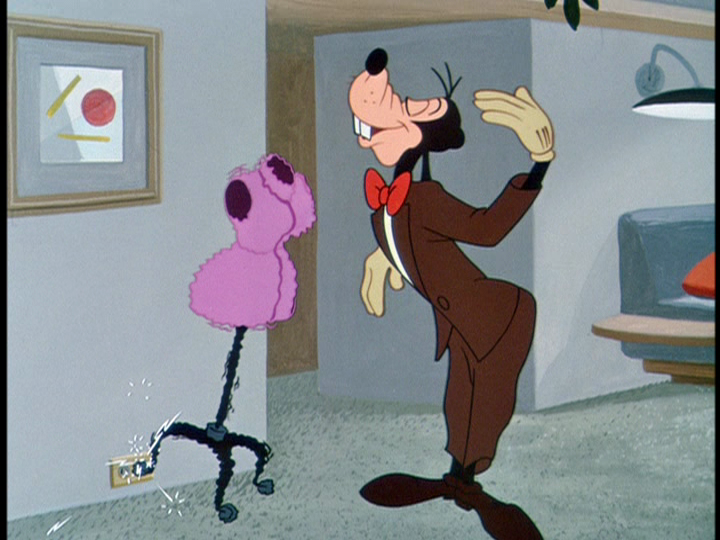
Goofy borrows a dressmaker’s dummy to teach himself how to dance, with disastrous results

Goofy then borrows a dressmaker’s dummy from a neighbor, and treats it like a date. In the beginning, things go smoothly, but the wheels on the dummy send Goofy spinning out of control. The wheels then get lodged in an electrical socket, and when Goofy resumes dancing with the dummy, he is shocked enough to send him into a spin, and the dummy explodes. Finally, Goofy decides to attend a dancing school, where he is trained in several styles of dance. As the days fly by, Goofy is able to become a master of dance. He attends a dance hall, and asks a lady to dance. As the band Firehouse Five Plus Two begins to play a lively jazz song, Goofy is caught in the middle of the crowd, punched and elbowed from all directions. He sinks into the dancing crowd as they continue to dance to the fast paced rhythm.
July 9

Posted on

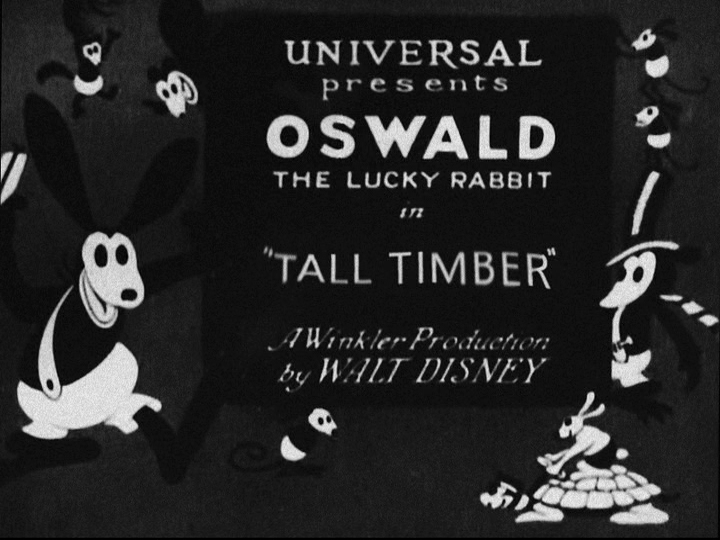
July 9, 1928 – The Oswald the Lucky Rabbit Short Film Tall Timber is Released to Theaters

vlcsnap-2013-07-09-12h45m09s73

On July 9, 1928, the Oswald the Lucky Rabbit short film Tall Timber was released to theaters. It is the twenty-third Oswald short done by Disney, and the last surviving short known to exist.

Oswald is whistling a tune as he paddles down a river in a canoe. He narrowly avoids rocks as he rails down some rapids helplessly, but eventually finds his way back to peaceful waters. As he does, a flock of ducks fly overhead, and he pulls out his gun to shoot. A duck stands on the edge of the gun, and notices that the gun is jammed. It sneaks into the gun and knocks the bullet out, peering at Oswald as his eyes are closed in determination. Oswald finally frees the trigger, only to find that the hammer has hit the duck on the head. He angrily pulls the duck out and kicks at it to make it fly away. Another duck approaches as Oswald tries to shoot again, and once again, the gun is jammed. As Oswald yells at this duck, the duck takes Oswald by the nose and pulls it out, sending it flying back to Oswald’s face and knocking the rabbit down. Oswald brings his nose back to its proper length, and loads the gun while the duck laughs. The duck is able to send the bullet flying into the canoe, springing a leak. Oswald attempts to stop his canoe from overflowing with water, and sends the stream back into the pond. As he tries to find the duck one more time, he finds the creature camped out on his head. Unfortunately, the duck escapes just in time, and Oswald knocks himself in the head with the butt of his gun, sending him and his canoe down to the bottom of the pond.

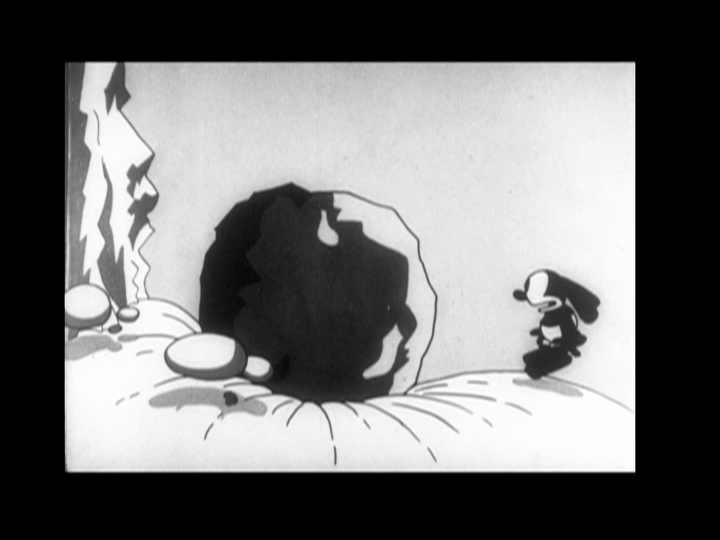
After his fall, Oswald narrowly misses being hit by a boulder, but is chased by it down a hill

After his fall, Oswald narrowly misses being hit by a boulder, but is chased by it down a hill

Oswald finds what he thinks is a rock to stand on, and is alarmed when the “rock” rises out of the water, revealed to be a moose. He holds onto the moose for dear life, and the moose sends Oswald flying over the edge of a cliff. Oswald grabs a branch on his way down, but sees a huge boulder being supported by the branch, which is now falling thanks to Oswald’s weight. Oswald tries to outrun the boulder once they both fall, but runs into a tree and is flattened by the boulder. As he tries to fix himself, three bears run through the forest and stop at two maple trees, where the two cubs start drinking the syrup from the taps attached to these trees. Meanwhile, Oswald uses another boulder to help return him to his plump self, but finds that he has become even more round, and rolls over to where the bears are, knocking into one of the cubs. The cubs fight over Oswald, and stretch him back to normal. As one of the cubs torments Oswald, they flee to a rock. Oswald grabs the rock to climb up, unaware that he has actually grabbed the mother bear. Oswald is chased by the bear into a cave, where a fight ensues, and the mama bear leaves without her fur, hiding her undergarments in shame. Oswald walks out in a nice new fur coat, puts on a top hat, and lights a cigar triumphantly.

July 7

Posted on

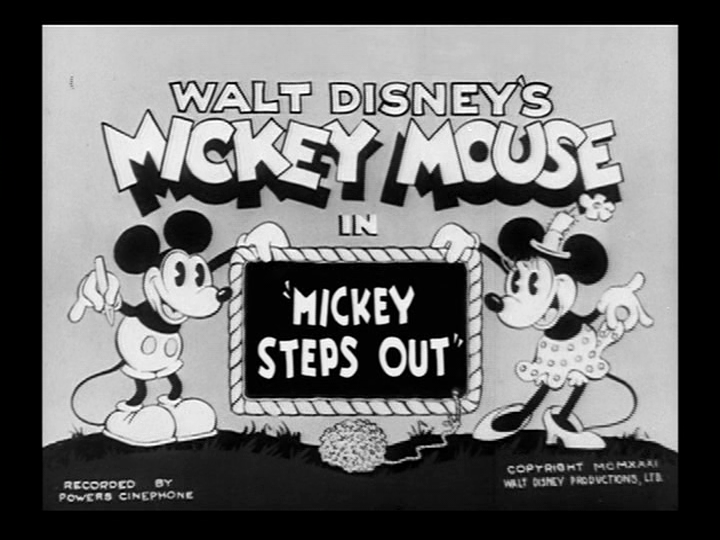
July 7, 1931 – The Mickey Mouse Short Film Mickey Steps Out is Released to Theaters

vlcsnap-2013-07-07-05h57m32s76

“Go on home, Pluto! Go on back!”

On July 7, 1931, the Mickey Mouse short film Mickey Steps Out is released to theaters. The short contains some dated humor in the form of “blackface,” which was common at the time, particularly as an imitation of popular vaudeville performer Al Jolson, who wore blackface and sang his popular song “Mammy.” This short was directed by Burt Gillett.

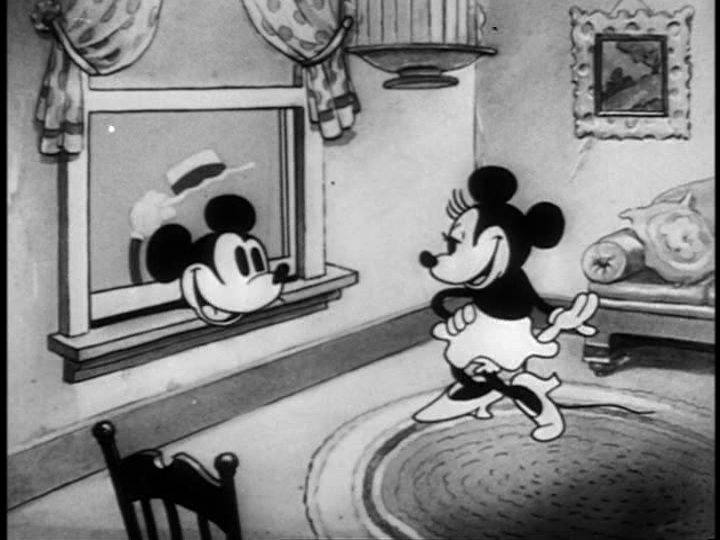
Mickey is gleefully preparing for his date with Minnie Mouse, putting on his hat and grabbing his cane before stepping out of his house. Unfortunately, Pluto rushes up behind him and accidentally pushes the mouse into a puddle of mud. Angry, Mickey sends Pluto back to his doghouse and ties up leash before he heads out again. Pluto, however, finds Mickey, dragging his doghouse behind him, and pushes Mickey into a puddle of mud again. Just as Mickey is about to yell at Pluto, he hears Minnie playing piano and singing inside her house. He peers through the window and begins to accompany her with her bird by whistling. Mickey is standing on Pluto’s backside to reach the window, but when a cat appears at the corner of Minnie’s fence, Pluto takes off like a shot, leaving Mickey stuck in the window as it shuts on his neck.

Minnie greets Mickey as he is trapped in her window

Minnie greets Mickey as he is trapped in her window

Minnie and Mickey trade greetings when she sees him in the window. When she opens the window to free him, he falls to the ground, but as Minnie begins to worry, he appears at the door, greeting her again. She plays a lively song on the piano, and Mickey begins to dance. Outside, Pluto chases the cat around Minnie’s laundry line, when the cat dives into the house, with Pluto in pursuit. The two run into the piano and begin to fight, with Pluto taking the player piano sheet with him as they resume the chase in the house. Mickey tries and fails to stop them, and are soon taken along on the chase. The cat dives into the stove, and Pluto runs into it, breaking it and spreading soot all over the house. The short ends with the cat using the lid of the stove to hit Pluto over the head.

July 3

Posted on

July 3, 1942 – The Pluto Short Film The Sleepwalker is Released to Theaters

vlcsnap-2013-07-03-04h49m18s39

On July 3, 1942, the Pluto short film The Sleepwalker was released to theaters. It was directed by Clyde Geronimi.

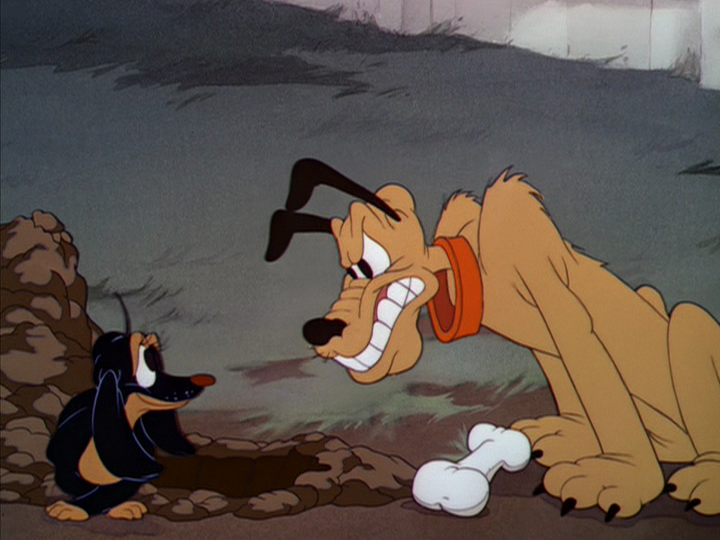
Pluto is sleeping in his doghouse, with a large bone sitting in his food bowl. From a hole in the fence nearby, a female dachshund observes the bone, drooling. She wanders in and tries to take it from the sleeping Pluto, and as he wakes, he growls and chases after the hungry female. He returns home after chasing her away, and she begins to cry. Once again, Pluto falls asleep, but begins to sleepwalk, taking the bone over to the dachshund. She is surprised to see him, but happy to receive the bone. Later, when Pluto wakes up (with no recollection of giving away his bone), he finds it missing, and angrily goes to retrieve it, breaking her food bowl in the process.

Pluto has several angry confrontations with the dachshund, unaware that he is the one giving her the bone

Pluto has several angry confrontations with the dachshund, unaware that he is the one giving her the bone

As he walks away, he falls asleep and sleepwalks back to her, dropping off the bone again. She happily begins to dig a hole for the bone, but when Pluto wakes up again, she quickly digs it back out and hands it back. In a fit of rage, Pluto destroys her doghouse, and in the destruction, finds that the hungry dachshund has a litter. The puppies play with Pluto, and he realizes with guilt what he has done, particularly when it starts to rain. He offers them his doghouse and his collection of bones, which they accept happily. The dachshund gives Pluto a large kiss for his kindness, and he curls up under some newspapers to keep dry, happy about his good deed.

June 30

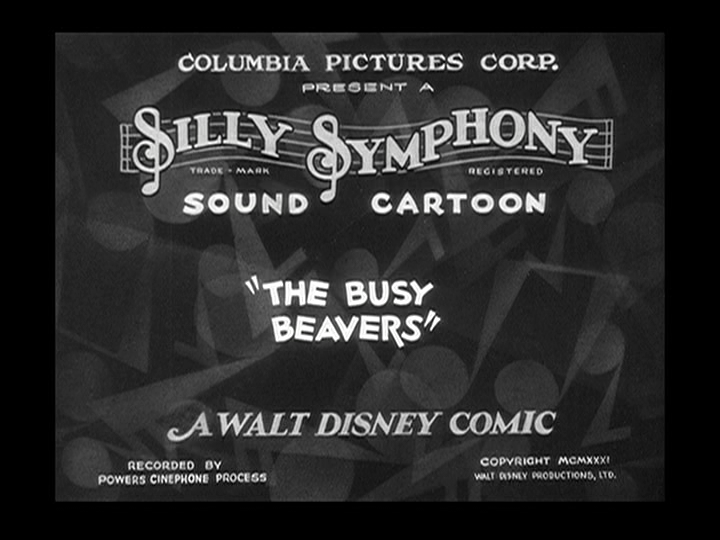
June 30, 1931 – The Silly Symphony The Busy Beavers is Released to Theaters

vlcsnap-2013-06-30-11h29m38s196

On June 30, 1931, the Silly Symphony The Busy Beavers was released to theaters. It was directed by Wilfred Jackson.

A group of beavers are diligently working together to build their dam, dancing while they work. As one gathers twigs, he accidentally disturbs a moose, thinking the antlers are twigs to use. Others mix up mud for use, while others use whatever they have on hand to create this dam. Two beavers go around chopping down trees marked for use, and when a pair of caterpillars find that their home has been marked, they quickly remove the “X,” leaving their home unscathed.

A storm quickly approaches, and the beavers scramble for cover in their dam. One little beaver, on his way home, finds a leak in the dam. He goes to plug the leak, when another one appears, followed by more. He is unable to cover them all with his own hands, and starts crying out for more help. A raincloud appears over the dam and dumps its contents into the mountains, with the water taking out everything in its path, including the recent work done by the beavers. As the animals try to scramble to safety, the young beaver quickly cuts down a large tree to stop the flow of the water. He achieves the feat, but is seemingly killed in the process. However, he appears from the top of the tree, unscathed, and is regarded as a hero for saving the day.

June 29

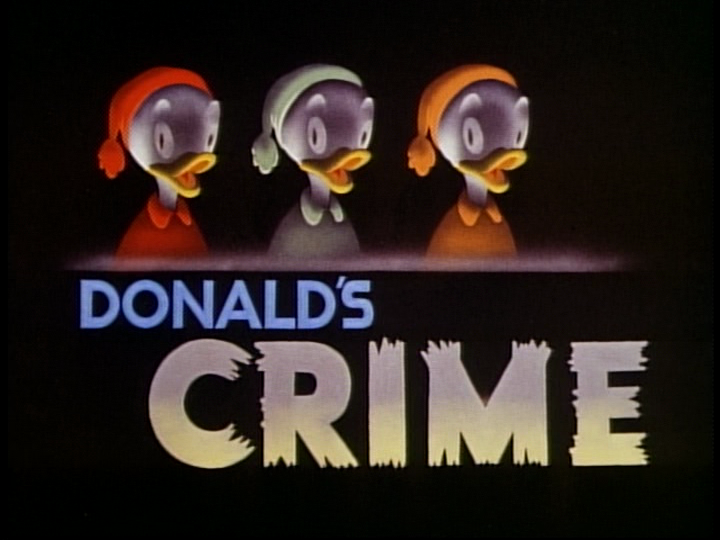
June 29, 1945 – The Donald Duck Short Film Donald’s Crime is Released to Theaters

vlcsnap-2013-06-29-18h13m08s255

“Gotta date with Daisy, Daisy, Daisy…she’s my sweetie gal!”

On June 29, 1945, the Donald Duck short film Donald’s Crime was released to theaters. The film was nominated for an Academy Award, but lost to the Tom and Jerry short film Quiet Please! It was directed by Jack King, with story by Ralph Wright.

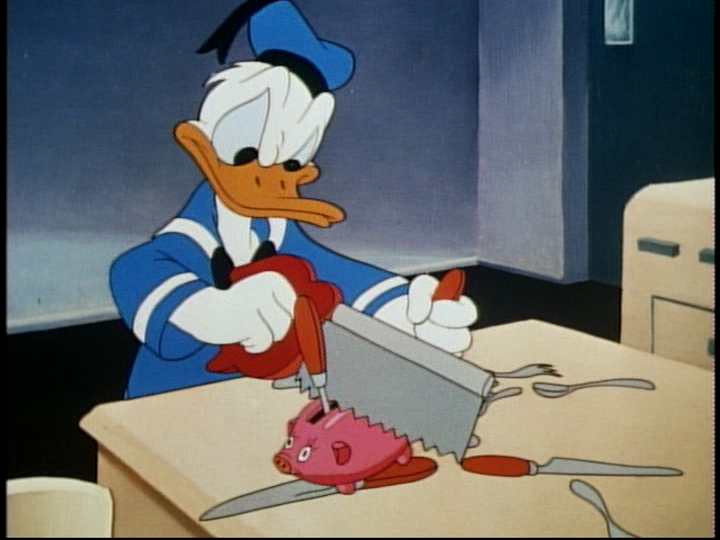
Donald is excitedly preparing for his date with Daisy, when he realizes at the last minute that he’s broke. He spies his nephews’ piggy bank sitting on the table, and hears a voice telling him that it’s the answer to his problem. He tries to resist, knowing it would be wrong, but the voice keeps telling him that no one will know, and he should take it. He gives in to temptation, just as his nephews start playing around his feet. They ask him what he’s doing, and he demands that they go to bed as he tries to hide the piggy bank. They quickly run upstairs, saying their prayers for Daisy and Uncle Donald before they fall asleep.

Donald breaks out his tools to try and get the money while leaving the bank in one piece

Donald breaks out his tools to try and get the money while leaving the bank in one piece

Donald uses every tool he can to get the money out of the bank, but the bank breaks, leaving him with all of the money. He suddenly hears the nephews calling for him, and he runs upstairs, sweating with guilt. He thinks they are on to him, until he hears them ask for a kiss goodnight. He feels like a skunk for stealing their money, but soon forgets it as he takes Daisy out for a night on the town. After he brings Daisy home, he floats away on a cloud after she give him a kiss goodnight and calls him a big shot. The voice he heard before boosts his ego, before bringing back all of the guilt from before. The guilt gets the best of him as he starts to act like he’s a gangster, with the police after him wherever he goes.

He runs around town before spotting his own face on a wanted poster, with a reward of $100, dead or alive. As he pulls the poster from the post, another one is posted behind it, with the reward increasing to $500. The more he pulls the posters, the higher the reward, until the zeros start to circle around. He flees again and ends up in a blind alley, and thinks he’s in jail, pulling on the bars of the door in front of him, when a sign falls on his head. He looks up to see that he’s at the service entrance of a café, and there is help wanted inside. He decides to take up the job and pay back the money for the nephews. However, when he finds he’s paid them one nickel too many, the nephews spot him trying to get the money out, and they throw a tantrum while he fidgets nervously.

June 25

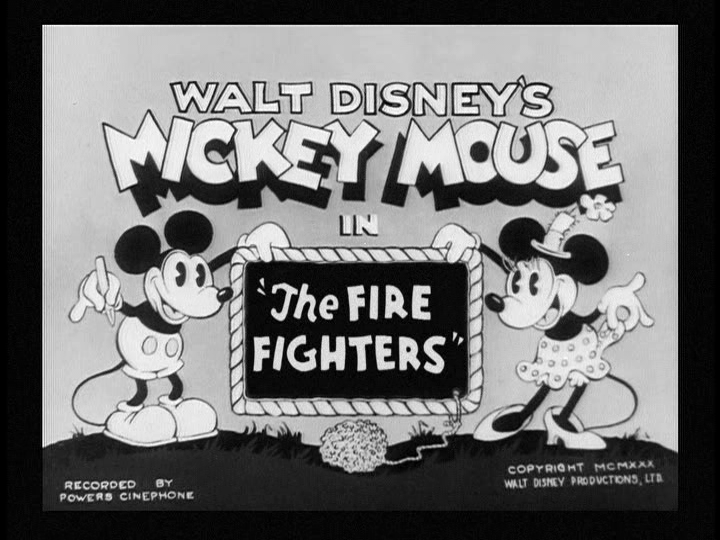
June 25, 1930 – The Mickey Mouse Short Film The Fire Fighters is Released to Theaters

vlcsnap-2013-06-25-06h09m04s92

“Fire! Fire! Fire!”

On June 25, 1930, the Mickey Mouse short film The Fire Fighters was released to theaters. The short was directed by Burt Gillett.

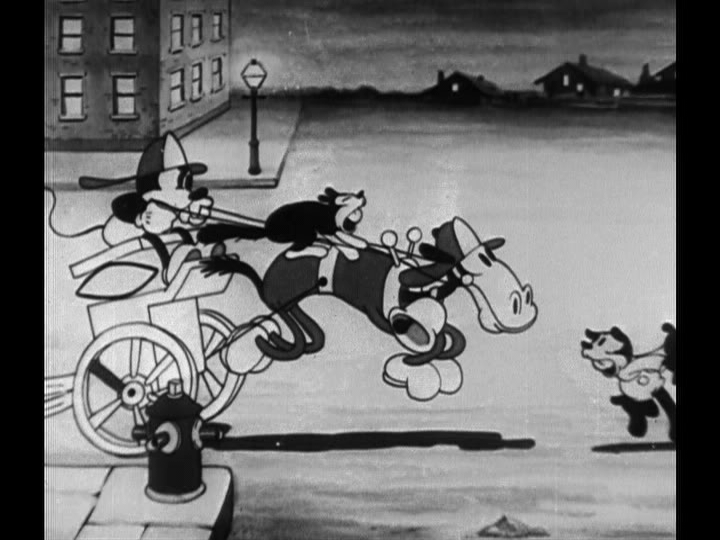
It’s a quiet night at the firehouse, with all the fireman asleep in their beds, including Fire Chief Mickey. Suddenly, someone comes running down the road, shouting out that there’s a fire, with a building seen burning in the distance. The bell sounds the alarm, and the firemen quickly rouse themselves and head out, except for Horace Horsecollar, who finally wakes up and rushes to follow the rest of the team. Using a cat to sound the fire engine alarm, the firemen speed out into the night, with Mickey leading the charge. Unfortunately, most of the fire engine and team get left behind as they travel over some rocky terrain.

Mickey arrives triumphantly on the scene to put out the fire

Mickey arrives triumphantly on the scene to put out the fire

The burning building begins to sway side to side, with people jumping out in all directions before scrambling to safety. The citizens of the city cheer as they see the firemen approaching, although when Mickey turns around, he is rather annoyed at finding he is the only one there. He grabs his fire hose and attaches it to the closest hydrant, and sets off to take out fire. The hydrant doesn’t seem to work, so Mickey milks all the water out that he can into a bucket and runs to the building, not realizing that he’s spilled all of the water most of the way there. He tries again, a bit more carefully, although he spills the water before it can hit the flames. Meanwhile, Horace has been taking water from a nearby pond and using it to put out the flames on the first floor.

Up at the top of the building, Minnie Mouse, who seems to have been asleep, opens her eyes and screams for help before she is consumed by smoke. Mickey, alarmed, bravely runs into the building, but is soon chased out by flames. He uses the ladder of the apartment building next door to jump into a pair of pants left on the clothing line, then pulls himself close to the burning building to catch Minnie as she falls out of the window from exhaustion. The flames break the clothing line apart, but the pants act as a parachute to send them safely to the ground. The two kiss and embrace.

June 23

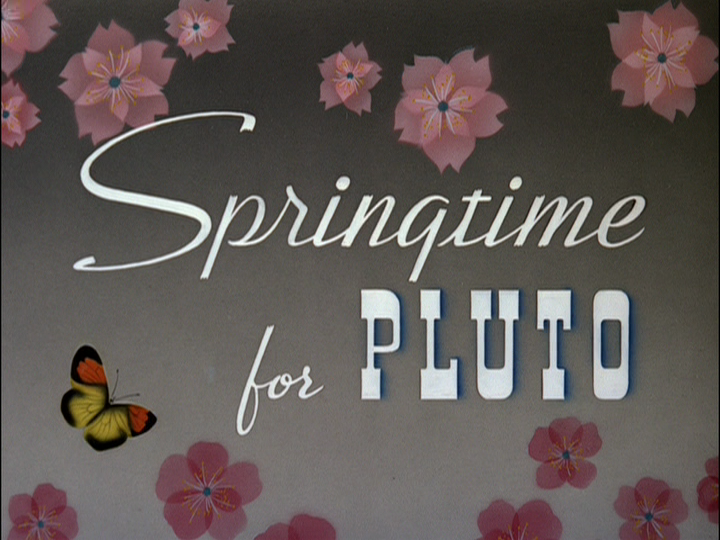
June 23, 1944 – The Pluto Short Film Springtime for Pluto is Released to Theaters

vlcsnap-2013-06-23-08h08m17s38

“Spring! Spring! Sweet, scented spring! Loveliest time of year!”

On June 23, 1944, the Pluto short film Springtime for Pluto was released to theaters. This was the first short directed by Charles Nichols, who would go on to have a long history of directing at the Disney Studios, including many of the Pluto shorts. Pluto’s allergy to goldenrod is seen here, which was used as a major plot point in the 1948 short film Bone Bandit (see April 30th entry for more details). The story for this short was written by Nick George and Eric Gurney.

The Spirit of Spring, appearing in the guise of a faun, skips through the winter surroundings, changing them into spring as he plays his panflute. He tries to wake Pluto, who follows the spirit in a dreamlike state, before realizing that spring is indeed there, and decides to explore the area. He watches as all signs of spring appear, including bluebirds and lambs, and hears the caterpillar sing a song about spring. The caterpillar then uses Pluto’s tail as a perch for his cocoon, and when she emerges as a beautiful butterfly, Pluto blushes at how beautiful she is. Unfortunately, as he tries to imitate her dancing, he disturbs a bee hive, and the entire swarm of bees chase after him, only stopping after Pluto dives into a patch of poison ivy to escape them.

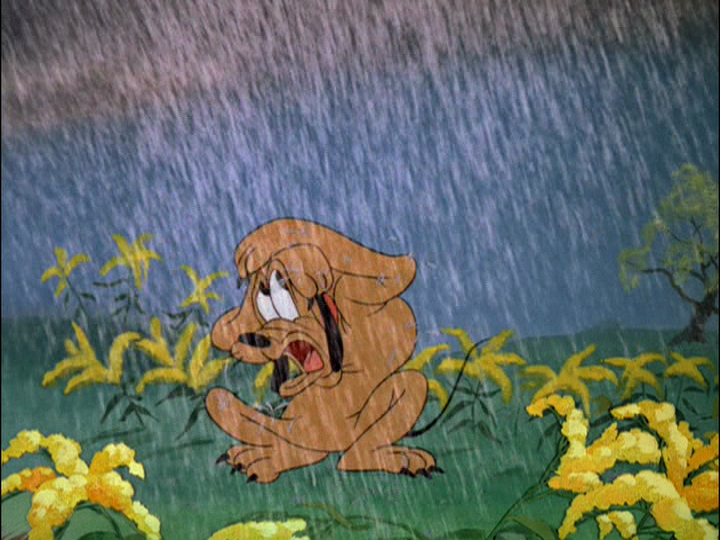
Just as things couldn't get worse for Pluto, it begins to rain heavily

Just as things couldn’t get worse for Pluto, it begins to rain heavily

When Pluto realizes what he’s jumped into, he starts writhing around as he starts to itch, sneezing when he ends up in a patch of goldenrod. It then begins to rain, and as Pluto tries to find shelter, he continues to sneeze so violently that he is thrown back several paces. It then begins to hail just as Pluto makes his way back to his doghouse. Pluto and his house have been ravaged by the time the storm ends, and as the Spirit skips by, Pluto stalks out of the broken shack, chasing after the fleeing Spirit.

June 21

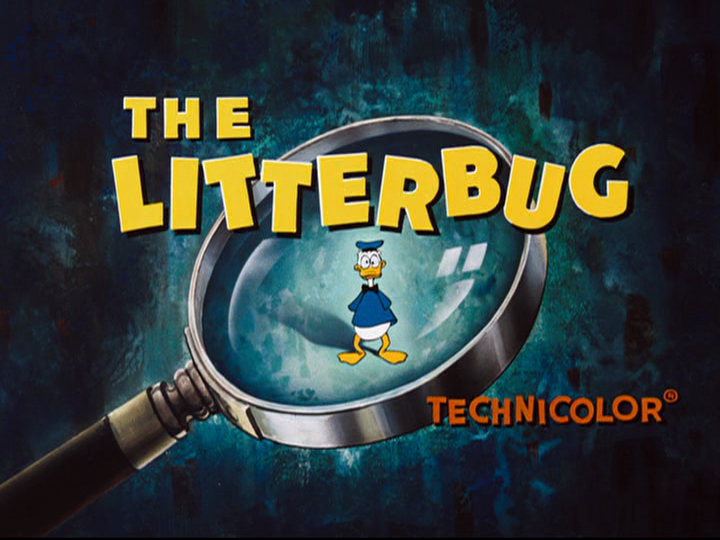
June 21, 1961 – The Donald Duck Short Film The Litterbug is Released to Theaters

vlcsnap-2013-06-21-07h36m38s211

“Still, we have no cause to be smug, for we’ve invented no poison, nor drug to settle the score with one pest we abhor and contemptibly call the ‘Litterbug.’”

On June 21, 1961, the Donald Duck short film The Litterbug was released to theaters. This was the last Donald Duck short ever made. Huey, Dewey, and Louie also make a cameo in this short. The short was directed by Hamilton Luske, with story by Bill Berg and Lance Nolley.

The short begins with several live-action shots of litter, before turning to the book Pest Control by Dr. D.D. Tee, who narrates. He runs through a few pests, including mosquitoes and termites, and how we have been able to stop their destruction. There is one pest, the doctor warns, that we have been unable to stop: the litterbug. Donald plays the part of the litterbug, leaving trash wherever he goes. When the season changes to spring, Donald (multiplied enough to fill a neighborhood) is seen cleaning his house, dumping trash on his neighbor’s lawn. The doctor then moves on the types of litterbugs, starting with the “unconscious carrier.” As Donald walks down the street, he leaves his trash everywhere, oblivious to what he is doing. As Donald starts smoking cigarettes and lighting matches, his careless tossing of the lit matches sets fires all over town.

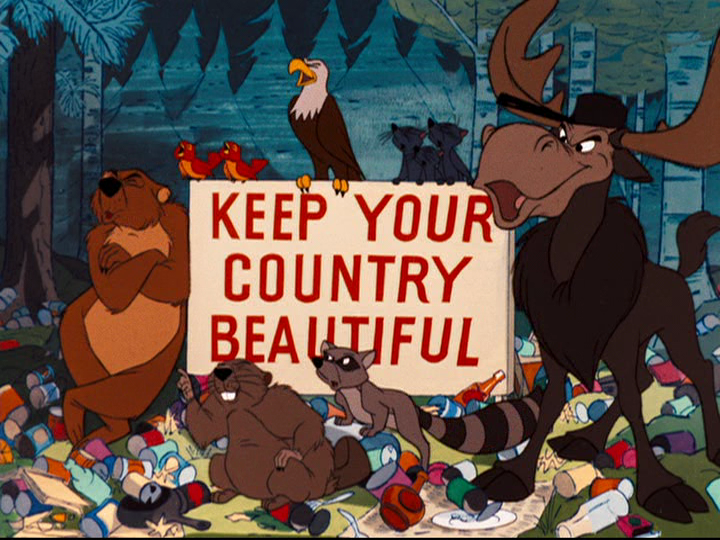
The animals are less than pleased about the condition these litterbugs have left the environment in

The animals are less than pleased about the condition these litterbugs have left the environment in

The next type of litterbug is the “sports bug.” Donald runs out of a stadium game, carrying snacks and several other items, throwing his trash around in excitement, mimicking various sports actions, including bunting and punting. The narrator then moves on to the “sneak bug,” who hides his trash in various places, like mailboxes and potted plants. He then talks about children, who start innocent, but let their true littering nature soon shine through. We observe Donald’s nephews on the playground, leaving their trash from their lunches all over the ground. After this, Donald and his nephews travel for the summer, leaving trash everywhere, from the mountains to the beaches. When all the tourists leave their holiday destinations, they leave mountains of trash in their wake. As Donald trashes the mountains, all of the animals start singing a song about the shame of littering. However, as the short ends and we pull away from the book, we see that Dr. D.D. Tee is no different, with piles of litter surrounding his desk.

June 20

June 20, 1936 – The Mickey Mouse Short Film Moving Day is Released to Theaters

vlcsnap-2013-06-20-07h25m39s62

“Too late! I’m selling your furniture, see?”

On June 20, 1936, the Mickey Mouse short film Moving Day was released to theaters. This short is one of the many that showcased all three leading Disney stars, although was credited only to Mickey. Goofy sings a snippet of his theme song, “The World Owes Me a Living.” The short was directed by Ben Sharpsteen, and stars Walt Disney as Mickey, Clarence Nash as Donald, Pinto Colvig as Goofy, and Billy Bletcher as Pete.

Mickey and Donald are pacing the floor nervously, staring at their calendar as it announces that their rent is six months overdue. As they pace, a loud knocking and ringing of their doorbell alerts the duo, and they run to hide. Finally, Mickey screws up the courage to open the door, and Sheriff Pete bursts in, holding a notice to dispossess. Mickey and Donald stutter that they’ll get the money to pay it, but Pete tells them that it’s too late, then uses Donald’s bill to light his match for his cigar. After Pete leaves, Donald throws a tantrum, but leaps to hide in an umbrella when someone knocks on the door. Outside, the knocking is just Pete nailing a sign to the house with his bare hands, announcing that there will be a sheriff’s sale of everything inside that day.

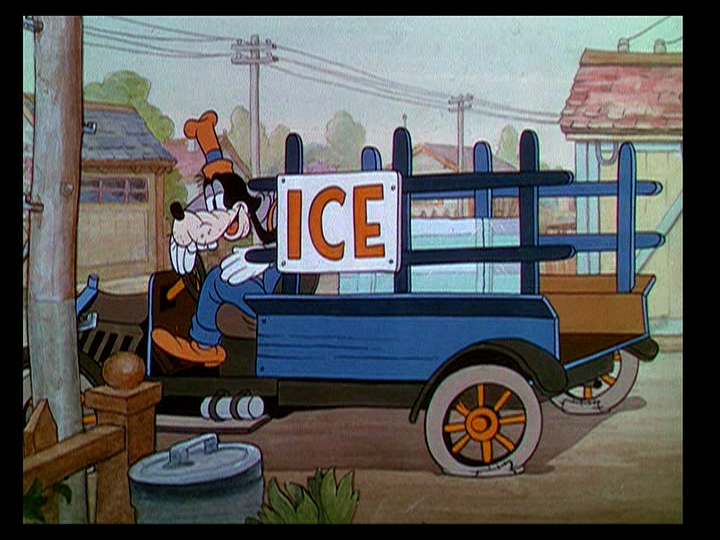
Goofy arrives as the ice delivery man

Goofy arrives as the ice delivery man

On the other side of the house, the ice delivery man Goofy pulls up in his truck and attempts to bring in a block of ice. When he calls out that he’s here, Mickey and Donald immediately shush him, and then decide they need to pack everything in a hurry and move. Mickey has trouble with over-packing a suitcase, and Goofy battles a piano that refuses to stay on his truck. Goofy and the piano chase each other around the house, with the piano purposefully trying to escape. Meanwhile, Mickey and Donald frantically pack, and when Donald shoves a plunger into a pipe to stop the air from escaping, the air builds up and sends the plunger flying onto Donald’s tail. Donald hears the plunger handle knocking against the floor and is confused by the sound, but once he sees the stuck plunger, he tries in vain to remove it. After finding himself attached to a cord on the ceiling, he finally gets unstuck from the plunger, but lands in a fishbowl. The plunger then lands itself on Donald’s head.

Goofy continues to tease the piano, which finally flies in and sends him flying into the refrigerator. He is undettered by this, however, and sits in the fridge door, enjoying a large piece of watermelon. Donald, at the same time, has managed to remove the plunger from his head, but is still stuck fast to the fishbowl. He uses a pair of suspenders to try and free himself, and when he does, he is sent flying into the pipe he tried to stop up with the plunger. After being filled with air, Donald flies around the house, crashing into Mickey’s packed suitcase, along with many other fragile items. Pete hears the commotion from outside the house and hurriedly enters, angrily demanding the trio to sit down. The three are blown into the wall from the force of Pete’s voice, causing the gas from the pipe to grow in intensity. When Pete tries to light his match for his cigar, the house explodes, leaving Pete stuck in the bathtub. Although Donald laughs at the sheriff’s predicament, he throws a tantrum when he finds that, once again, the plunger is stuck to his tail.