RSS Feed

Tag Archives: Short film

December 30

December 30, 1928 – The Mickey Mouse Short Film The Gallopin’ Gaucho is Released to Theaters
vlcsnap-2015-12-30-16h00m51s24

“Help!”

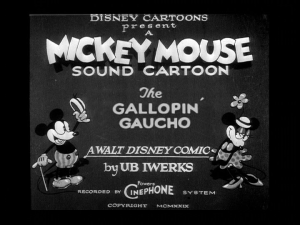
On December 30, 1928, the Mickey Mouse short film The Gallopin’ Gaucho was released to theaters. It was the second Mickey Mouse short film released by Disney, as well as the second film created; the film was created before Steamboat Willie, but was originally created as a silent film, much like the Oswald shorts. After the success of Steamboat Willie, The Gallopin’ Gaucho was given a sound track. The short also parodies the Douglas Fairbanks film The Gaucho, which had been a hit the previous year. The short was directed by Walt Disney, with Walt voicing Mickey and Minnie.

Mickey is seen riding an ostrich across the desert before arriving at Cantino Argentino. He hops in the window and watches Minnie dancing while posters issuing a reward for his capture grace the walls. Minnie entices him to dance and, after having a beer, he dances the tango with her. Mickey twirls her into the arms of Pete, and she screams for help. Mickey challenges Pete, but is thrown off as Pete grabs his donkey and rides away with Minnie. Mickey calls for his ostrich, which has gotten rather inebriated. Nevertheless, Mickey rides his ostrich in hopes of saving Minnie, though at one point the ostrich ends up riding Mickey. Mickey follows Pete down a cliff after reviving his ostrich in a bucket of starch, and follows the villain into a building. Mickey manages to fashion a rope from his tail and is able to get to the top floor, only to find Minnie chained up. Pete and Mickey engage in a sword fight, with Mickey emerging triumphant. He saves Minnie, and the two ride off together on the back of Mickey’s ostrich.
December 27

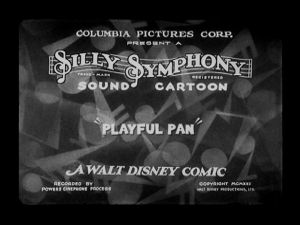
December 27, 1930 – The Silly Symphony Playful Pan is Released to Theaters

vlcsnap-2015-12-27-17h01m48s5

On December 27, 1930, the Silly Symphony Playful Pan was released to theaters. The short was inspired by the tale of the Greek god Pan, a god of nature. It was directed by Burt Gillett.

Pan appears on a rock and starts playing his flute, causing the fish to dance around him. As he continues to play his pan flute, the flowers also begin to dance around at his command. He begins to play around an apple tree, calling all the worms to attention. They begin to dance around as he changes his tune. The trees and clouds begin to join in as well, with one of the clouds creating lightning so bad that it cuts a tree in half and starts a fire in the forest. The animals flee as the forest quickly burns, though many try to douse the flames and save their families. One of the raccoons alerts Pan, who rushes to the scene and puts the fire under his musical spell. He leads them into the river like a pied piper and they put themselves out. Pan cheers and disappears after saving the forest.

December 25

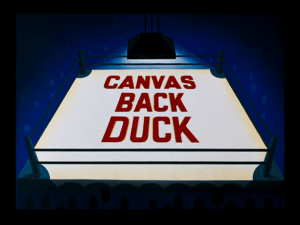
December 25, 1953 – The Donald Duck Short Film Canvas Back Duck is Released to Theaters

vlcsnap-2015-12-25-14h03m48s236

“Okay, boys, break it up. What’s the beef?”

On December 25, 1953, the Donald Duck short film Canvas Back Duck was released to theaters. It was directed by Jack Hannah, with story by Jack Kinney and Bill Berg.

Donald is attending a carnival with his nephews, and decides to try one of the “test your strength” machines. He hits the bell and, after his nephews cheer him on, he decides to try another one. After winning several with ease, Donald’s confidence is up, as is the nephews. What they don’t realize is that they’ve been hustled by a little boy, who tells the nephews that his uncle could beat up Donald. Donald laughs at the boy’s assertion, though he is intrigued when he sees the sign that promises $500 should he stay 3 rounds in the ring with Peewee Pete. The boys then spot the ruse – the “boy” is actually Pete’s manager, with Pete being a massive boxer. The boys try to warn Donald, but it’s no use, and all they can do is prepare for the worst. When the bell rings, Donald sets out, but once he spots Pete, he faints. Donald gets a grip and starts the fight, though his fighting consists of dodging and hiding. The boys manage to ring the bell early for the end of the first round, but when round two starts, it’s back to dodging and other trickery. The boys then give Donald a rigged boxing glove full of nails and horseshoes, but what knocks Pete out is a simple tap to his glass jaw. Donald wins the match, and leaves with nothing more than a black eye.

December 21

December 21, 1945 – The Donald Duck Short Film Old Sequoia is Released to Theaters

vlcsnap-2015-12-21-17h47m25s242

“If Old Sequoia goes, you go!”

On December 21, 1945, the Donald Duck short film Old Sequoia was released to theaters. It was directed by Jack King, with story by Homer Brightman.

The short begins at a national park, where the tree Old Sequoia proudly stands. Two beavers are chopping down trees close to Old Sequoia at a rapid pace, unbeknownst to Donald, who is snoozing away in the ranger station. He nearly falls from the post when he receives a call, and is lectured about the trees in his park. The lead ranger threatens him, and Donald rushes to his task. He spies the beavers near Old Sequoia and chases after them as fast as he can. The beavers manage to trip him up, then set their sights on Old Sequoia. Donald manages to trap them with his shotgun, just as the phone rings. He is lectured again by his boss, and he sprints back to guard Old Sequoia. He realizes that the beavers have gotten into the tree to chop it down, and poor Donald can only watch as sawdust comes out of the tree. He attempts to put the sawdust back in the tree, and only ends up making the tree implode. The tree, left standing by a tiny stand, threatens to fall, with Donald just barely able to keep it propped up. Unfortunately, the tree falls, taking the ranger station with it. Donald receives one final call from his boss, informing him he is fired.

December 17

December 17, 1931 – The Silly Symphony The Ugly Duckling is Released to Theaters

vlcsnap-2015-12-17-17h30m55s117

On December 17, 1931, the Silly Symphony The Ugly Duckling was released to theaters. The short was based on the short story by Hans Christian Andersen, and was one of the only Silly Symphonies remade in color; the color version was also the last Silly Symphony, and won an Academy Award for Best Cartoon of 1939. The 1931 short was directed by Wilfred Jackson.

A hen is sound asleep in her nest, when her chicks start to hatch. The last egg, however, is of a duck, and the hen is alarmed to find a duckling in her nest. She escorts her chicks far away from the duckling, and the poor ducking is upset at being abandoned. When the chicks steal his food and dismiss him, he is upset. The constant abandonment causes him to cry, but he tries to find a new mother within the farm. He cries by the side of a pond, until he spies a tornado sweeping through the farm. He tries to warn the hen and her chicks, and does so just in time, though they kick him out of their hiding place. The chicks are swept up into the air and land into the rushing river, much to the hen’s dismay. The duckling, exhibiting an ability to swim, goes after the chicks and manages to save them just in the nick of time. The chicks and the hen embrace him as one of their own, and he quacks happily.

December 16

December 16, 1949 – The Donald Duck Short Film Toy Tinkers is Released to Theaters

vlcsnap-2015-12-16-17h54m00s144

“Prepare to defend yourselves!”

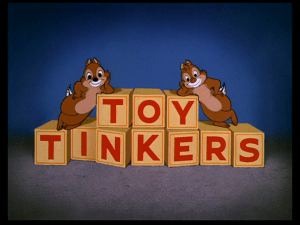
On December 16, 1949, the Donald Duck short film Toy Tinkers was released to theaters. The sixteen mm release of the film gave it another title of Christmas Capers. The short was directed by Jack Hannah, with story by Harry Reeves and Milt Banta.

It’s a beautiful winter’s night, and Chip and Dale are sound asleep in their log when Chip is awakened by Donald chopping down a Christmas tree. Chip wakes up Dale, and the two follow Donald home, where they spy all sorts of Christmas goodies through the window. Chip devises a plan to get inside and unnoticed, and the two start collecting the nuts they spotted inside. Dale gets a bit distracted after taking a hat and cane from a teddy bear, and starts playing with the toys. Donald notices the two stealing the nuts, and decides to play a prank on the while reclaiming the nuts; the chipmunks are much smarter than Donald, however, and the two groups go back and forth trying to one-up the other. The two engage in a war, throwing ornaments at each other, but eventually, Donald raises the white flag of surrender while the boys make off with the nuts and the toys.

December 14

December 14, 1951 – The Donald Duck Short Film Bee on Guard is Released to Theaters

vlcsnap-2015-12-14-18h48m17s186

“How are you, buzz buzz?”

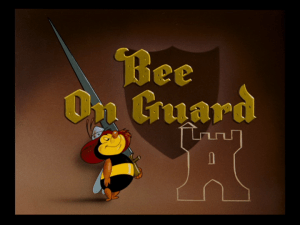
On December 14, 1951, the Donald Duck short film Bee on Guard was released to theaters. It was directed by Jack Hannah, with story by Nick George and Bill Berg.

A tall tree trunk has been turned into a castle hive for bees, and they set out to gather what they need to produce honey, leaving one bee behind to guard the castle. The bees set to work in Donald’s nearby garden, and he becomes excited about the prospect of honey. He follows them back to the hive and attempts to take the honey, but is thwarted by the lone guard. He heads home to create a giant bee costume, then attempts to trick the guard into believing he’s a part of the hive after the bees depart again. While the guard is occupied, he steals the honey from the hive and “flies” away. The rest of the bees return, and find the honey missing and the guard asleep. The guard is booted from the hive, and finds a trail of honey leading to Donald’s house. Discovering the ruse, the guard attacks Donald, and the other bees watch as the two duel. The other bees cheer when the guard wins the fight, and he is honored within the hive.

December 13

December 13, 1926 – The Alice Comedy Alice’s Brown Derby is Released to Theaters

ABD

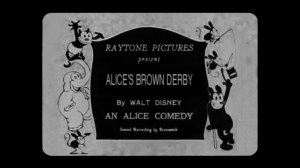
On December 13, 1926, the Alice Comedy Alice’s Brown Derby was released to theaters. The short film starred Margie Gay as Alice, and was the 39th comedy produced. As evidenced by the title, the short features another horse race, with Julius trying to win against a cheating Pete who uses a mechanical horse.

December 10

December 10, 1937 – The Donald Duck Short Film Donald’s Ostrich is Released to Theaters

vlcsnap-2015-12-10-17h25m51s182

“Hey, what’s the big idea?”

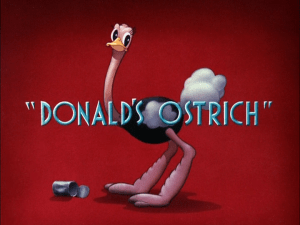
On December 10, 1937, the Donald Duck short film Donald’s Ostrich was released to theaters. It was directed by Jack King.

Donald is listening to a shrill radio opera while at work, and quickly changes the channel, finally finding something he can dance to. The train arrives, dumping its packages on the platform – and on Donald – and is surprised to find one containing an ostrich, which gives him a kiss. The ostrich comes with a label: her name is Hortense, and she must be fed and watered, with a post script warning that she eats anything. Hortense continues to flirt with Donald, though Donald will have nothing of it. When Donald crashes into a stack of milk jugs, Hortense is left to her own devices, and starts eating what she can find, including an accordion, an alarm clock, and some balloons. The mix of the contents gives her the hiccups, and she starts hiccuping into a hose, which gives Donald a cause for concern. He works on curing her hiccups by scaring her with a tuba, but it only causes her hiccups to worsen. Hortense then eats the radio, which is set to a murder mystery. Each hiccup she has causes the station to change, and she reacts with each broadcast. Donald attempts to extract the radio, but pulls out the accordion first. Hortense, reacting to a racing broadcast, crashes in the station, and Donald unfortunately comes down with a case of the hiccups after yelling at Hortense.

December 9

December 9, 1933 – The Silly Symphony The Night Before Christmas is Released to Theaters

vlcsnap-2015-12-09-17h38m48s12

“Twas the night before Christmas, and all through the house not a creature was stirring, not even a mouse.”

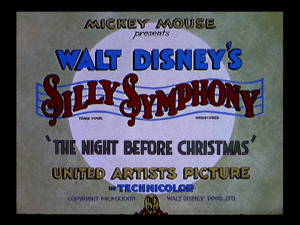
On December 9, 1933, the Silly Symphony The Night Before Christmas was released to theaters. It was a sequel to the 1932 Silly Symphony Santa’s Workshop, and was also known as Santa’s Toys. The short was directed by Wilfred Jackson.

In a small house, decorated for Christmas, several children are tucked into bed, waiting for Santa’s arrival. Santa soon arrives and makes his way effortlessly down the chimney, and sets up a tree for the toys. The toys then march out of his bag and make their way to their places under the tree. A group of toy soldiers uses cannons to decorate the tree with ornaments, while a toy plane wraps a garland of tinsel around the tree. Santa laughs merrily as he fills the stockings, and the toys celebrate the completion of a decorated tree. The children wake up and peek at Santa and the toys, and accidentally give themselves away when one boy sneezes. Santa quickly heads up the chimney, and the kids start playing with all their new toys. After hearing sleigh bells, the children look outside to see Santa flying off into the night.