RSS Feed

Tag Archives: Donald Duck

June 26

June 26, 1959 – The Donald Duck Featurette Donald in Mathmagic Land is Released to Theaters.
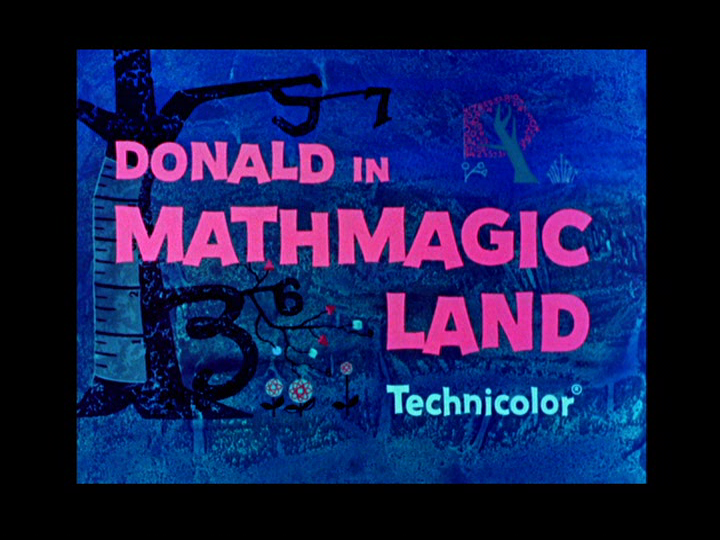
“By golly! You do find mathematics in the darndest places!”

On June 26, 1959, the featurette Donald in Mathmagic Land was released to theaters. This Academy Award-nominated short would go on to become one of the most popular educational films ever released by Disney. It was also shown on the first program of Walt Disney’s Wonderful World of Color, introduced by Professor Ludwig von Drake, who played the True Spirit of Adventure in the featurette. The story was written by Milt Banta, Bill Berg, and Dr. Heinz Haber, and starred Clarence Nash as the voice of Donald.

Donald, dressed in a hunter’s outfit, enters a dark room with his gun and looks around, remarking on how strange this all seems to be. He follows a trail of numbers, and finds the creature making the markings is a walking pencil, who challenges Donald to a game of tic-tac-toe, which Donald loses. He continues to walk, surprised by the square roots he runs into. He calls out hello to anyone who will hear him, and the voice of the narrator greets him. The narrator informs Donald that he is in Mathmagic Land, the land of great adventure, and that he, the narrator, is the True Spirit of Adventure. The spirit tells Donald he will take him on a journey through the wonderland of mathematics.
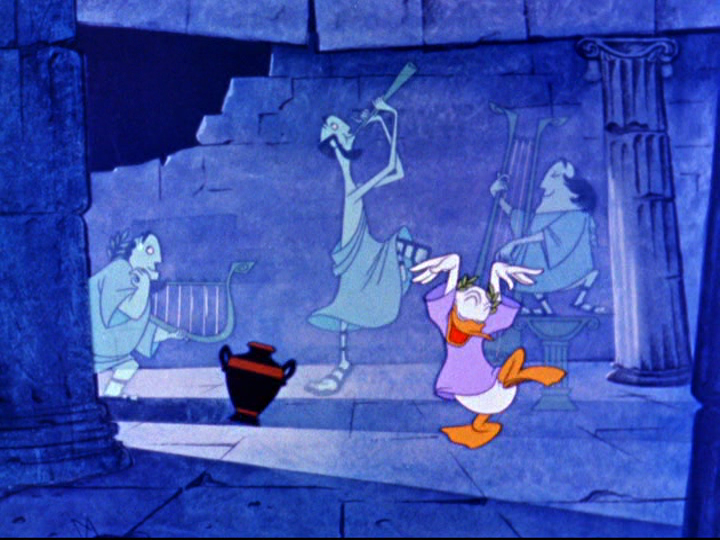
Donald having a jam session with the Pythagoreans, while learning that without math, there would be no music

As Donald storms away, saying math is for eggheads, the spirit informs Donald that without “eggheads,” there would be no music. He takes Donald back in time to Ancient Greece to meet Pythagoras, the father of mathematics and music. Donald is still confused, so the spirit shows Donald how music is full of mathematics. The first example shown is a harp, demonstrating how an octave is created. Donald and the spirit then sneak in on a meeting of the Pythagoreans, who are playing music in their meeting. Donald interrupts them, saying they need to play something with a beat. The Pythagoreans, the spirit explains, helped create the music we know and love today. As the spirits of the Pythagoreans disappear, Donald is left with a surprise – he is made a member of the Pythagoreans.

The segment then moves to another Pythagorean discovery: the pentagram, filled with mathemagic. The first concept explained is the golden section, then we move to the golden rectangle, which the pentagram creates many times over. The Greeks believed the golden rectangle to be a natural law of beauty. The spirit then shows how the pentagon, another Pythagorean shape, is found in nature, before moving on to other shapes found in nature.
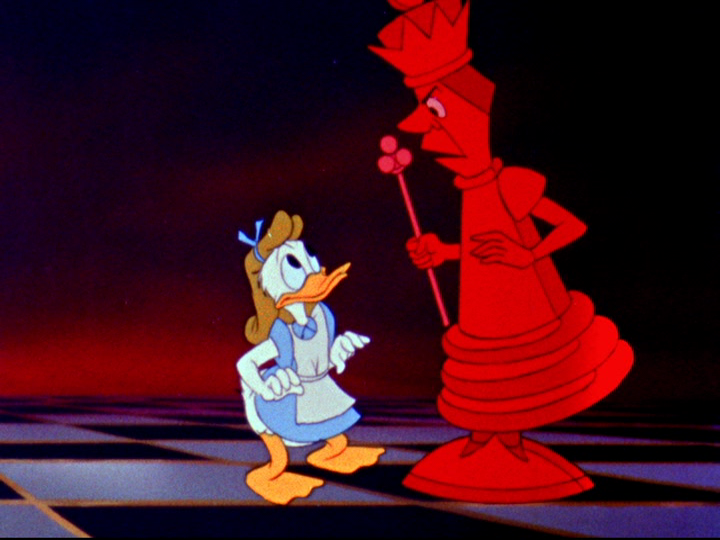
Donald plays the part of Alice when being taught the mathematical principles of the game of chess

Donald, who is enjoying his adventure so far, is delighted to hear that one can find mathematics in games, as well. The spirit begins with the game of chess, explaining it with the concept of Alice in Wonderland, with Donald playing the part of Alice. After a slight adventure with the chess pieces, Donald is able to watch a game in safety, but is bored by it. The spirit then begins to list sports with a geometric field, like baseball and football. The game that gets Donald really excited, however, is billiards. The spirit then shows an expert playing three-cushion billiards, and the mathematics used to get the perfect shot.

The spirit then tries to get Donald to play a game with his mind, only to find that Donald’s mind was completely cluttered with antiquated ideas, bungling, false concepts, and superstitions. He cleans out Donald’s mind, then has Donald think of a perfect circle, and puts a triangle in it. When asked what he sees, Donald sees a sphere. The spirit then has Donald take one thing and see how many items he can come up with using those shapes. Donald is then taken to a hall filled with doors, with most of them open. Some of the doors Donald discovers are locked, to which the spirit replies that they are the doors of the future, with the key being mathematics. The short then ends with the Galileo quote: “Mathematics is the alphabet with which God has written the universe.”
June 21

June 21, 1961 – The Donald Duck Short Film Donald and the Wheel is Released to Theaters

“Well, frost me, Poppa, can it be your intention, to bat your choppers over nothing more than a wheel? Your brain is all tied up in a sling to think a wheel is such a great thing.”

On June 21, 1961, the Donald Duck short Donald and the Wheel was released to theaters. The story was written by Bill Berg, with songs and rhymes by Mel Leven, music by Buddy Baker, and direction by Hamilton S. Luske. It stars the vocal talents of The Mellomen (Bill Cole, Bill Lee, Thurl Ravenscroft, and Max Smith), with Ravenscroft and Smith as the father and Junior, and Clarence Nash as the voice of Donald Duck.

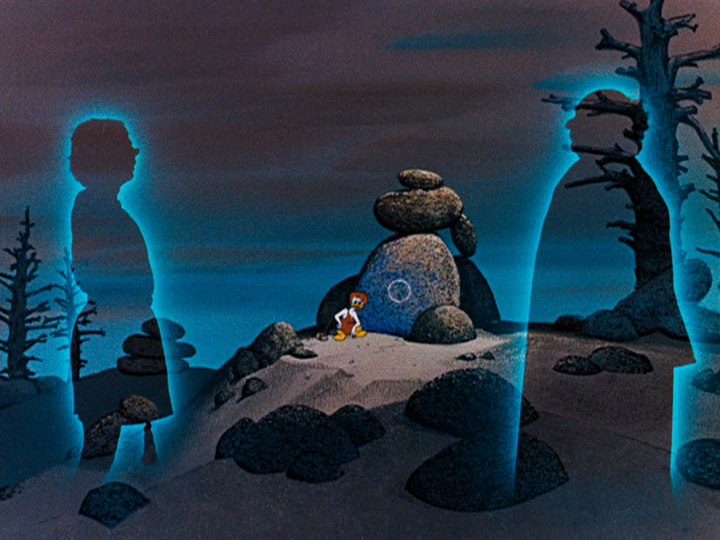
This educational short begins with two “spirits of progress” watching a piece of wood rolling around like a wheel. Junior, the younger of the spirits, asks his dad why he’s so impressed with the wheel. His father claims it to be the greatest invention of all time, to which Junior scoffs. When his father challenges him to name something better than the wheel, Junior accepts the challenge, but every invention he names is only possible thanks to the wheel. The father takes his son back in history to meet the inventor of the wheel.

The Spirits of Progress start to tell Caveman Donald about the great invention of the wheel

Back in the caveman age, we see a prehistoric Donald Duck, who, after a run-in with a tiger, is inspired to create the wheel. The spirits try to explain to Donald what a wheel is used for, but Donald seems to not be able to understand. Donald finally asks them who they are, and they explain to him that they are the “spirits of progress,” there to help him with his great invention. The first example they give him is attaching two wheels to his sled, making it easier for him to cart around.

The song at that point goes through the evolution of the wheel, with Donald also donning the attire of each time period being sung about. Steam is soon added to the idea of the wheel, with trains and automobiles lauded in song, and Donald involved in comic situations with each passing period. Finally, after a massive pile-up on the highway, Donald angrily declares he’d rather walk.

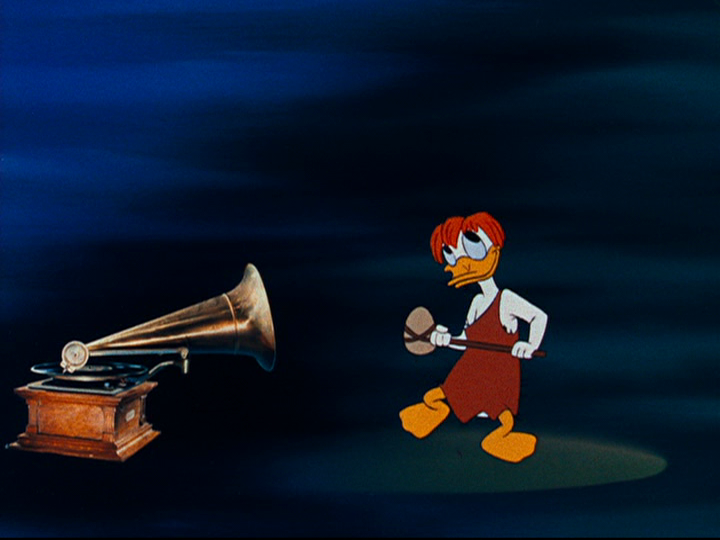
Caveman Donald dances to the music from the gramophone, a more “practical” example of the use of wheels

They go back to Donald’s time, trying to take another approach with how important the wheel is. When they try to explain that the world is round, Donald insists that the world is flat. Junior takes over this time, trying to explain the rotation of the Earth, the moon, and all the planets in the solar system. The demonstration continues with gears to show how wheels keep things working. For a more “practical” example, they begin with a music box, moving to the gramophone, then the jukebox, which features Donald dancing with a live-action dancer.

The spirits, however, push a little too hard with how important the wheel will be, showing wheels in everything he will use in his day. When they claim that he’s about to create a great invention, Donald tells them “Oh, no! I’m not going to be responsible for that!” The spirits are consoled with the fact that although Donald didn’t invent the wheel, someone eventually did.

June 9

Posted on

June 9, 1934 – The Silly Symphony The Wise Little Hen Premieres in Theaters

“Who, me? Oh, no! I’ve got a bellyache!”

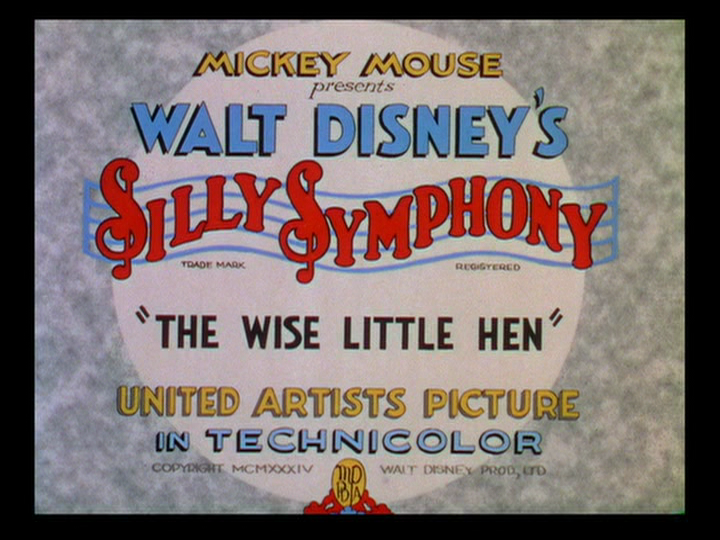
On June 9, 1934, the Silly Symphony The Wise Little Hen premiered in theaters. It was based on the folk tale The Little Red Hen, and was directed by Wilfred Jackson. It is notable for the debut of Donald Duck, voiced by Clarence “Ducky” Nash; it also stars Florence Gill as the Wise Little Hen, and Pinto Colvig as Peter Pig.

“There once was a wise little hen, who worried now and then, for fear that she’d be found in need when winter came again,” begins the narration in song for the short. The hen is seen stepping out her front door while all of her chicks play in the yard. With a basket of corn under her arm, she sets out to plant the kernels, and decides to ask her neighbors to help her plant her corn. She first stops at Peter Pig’s house, where Peter is playing an accordion and dancing a jig. But when she asks him for help, Peter feigns a stomachache and starts moaning. When she’s not looking, Peter sneaks a smile to the audience.

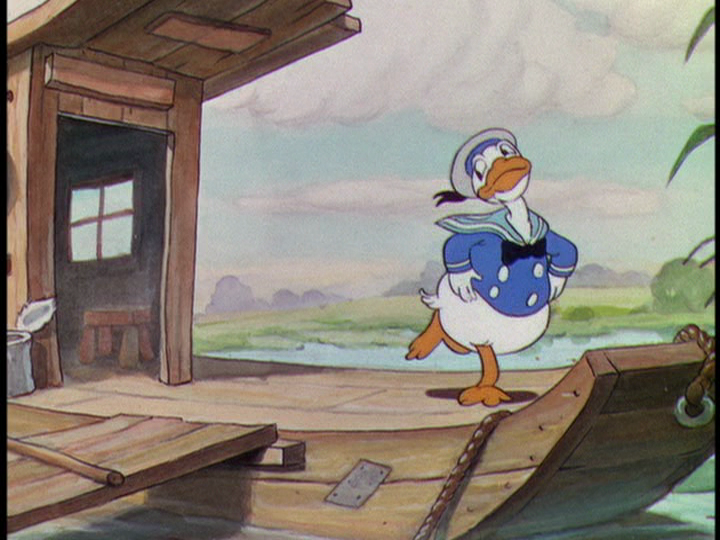
The first appearance of Donald Duck

Upset, but not discouraged, the hen moves on to Donald Duck’s houseboat, where he is also seen jovially dancing. When she asks for help, Donald also feigns a stomachache and begins to moan, also giving the audience a smile when she isn’t looking. Again, she is saddened by this, but decides she’ll just have to do it alone. With the help of her chicks, they dig the rows and plant the corn kernels.

The corn soon sprouts, and the hen and her chicks are excited to see how their crop has grown. She decides to visit Peter Pig and Donald Duck, to ask if they will help her harvest her crop. She finds the two at the “Idle Hour Club,” dancing and singing. When she asks for their help, once again, the two fake stomachaches, and go into their clubhouse, moaning. Part of their clubhouse wall falls down, revealing the two shaking hands and laughing at their supposed deception.

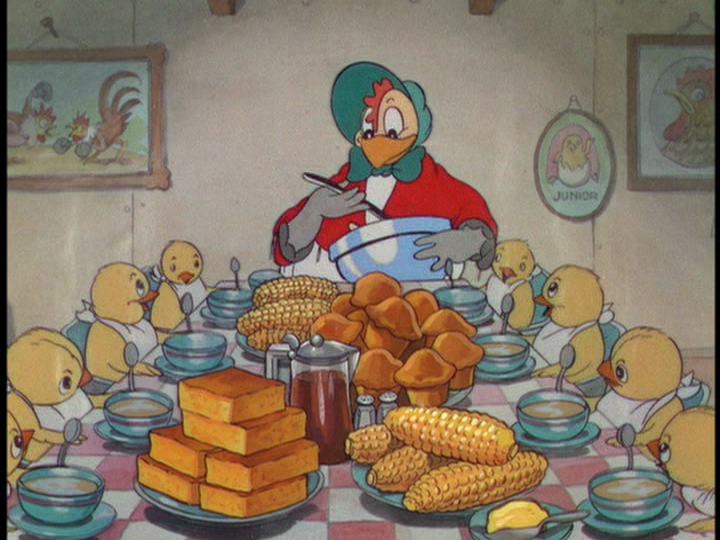
The hen and her chicks enjoying their corn feast that they alone planted and harvested

The hen winks at her chicks, getting an idea. She goes out and harvests her corn, and is soon seen at her oven, cooking and preparing many corn dishes. The entire family is shown around the dinner table, with the table piled high with delicious food, and everyone eating heartily. The Wise Little Hen looks out to see the pig and the duck dancing once again, and they feign stomachaches the moment they spot her, with more symptoms, like seeing spots. The hen asks them if they’ll help her eat her corn, and when they readily agree, she hands them a bottle of castor oil – for tummy aches. The singing narrators let us know that “she’ll eat the corn herself,” with Donald and Peter seen kicking each other for their foolishness.

June 8

Posted on

June 8, 1951 – The Donald Duck Short Test Pilot Donald Premieres in Theaters

“Get out of there, stupid. It belongs to him!”

On June 8, 1951, the Donald Duck short film Test Pilot Donald premiered in theaters. This was the 10th short in which Donald had to deal with the antics of Chip and Dale. The short was directed by Jack Hannah, with story by Bill Berg and Nick George, and music by Paul Smith.

A red airplane is zooming through the clouds, and Donald is seen manning the controls, getting ready for a dive. He successfully completes the dive, then checks off his list that the plane is able to maneuver well. As the camera pans back, the audience sees that Donald is only manning a model airplane while camping out in the middle of a park. He sets the plane in for a landing on a pillow, and showers the model with affection.

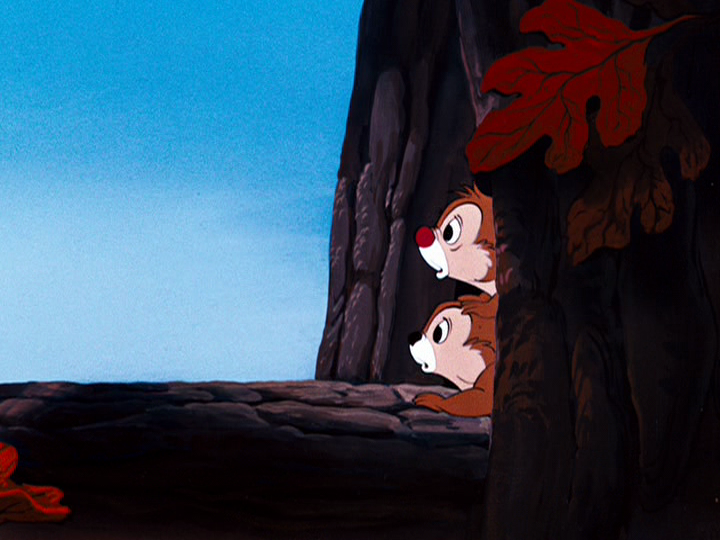
The pair scurries for cover when the model starts to fly a little too close to their tree

From a nearby tree, Chip and Dale are seen admiring the airplane, too, although they scurry for cover when it seems that the plane gets too close to their branch. The plane does eventually get stuck in the tree, with Donald angrily trying to get it free from the branches. As Donald tugs on the string, smoke shoots out of the tail, flying directly into the chipmunks’ hiding place. Dale comes out and, seeing the plane sitting there, decides that this is his chance to fly the plane.

Dale scrambles to the cockpit, only to have Chip pull on his tail. He points out that the plane belongs to Donald, who is still vigorously pulling on the string. Dale doesn’t care, and when Chip isn’t looking, Dale climbs in and starts playing around in the cockpit, when one button causes the plane to shoot off, leaving Chip stunned. Donald just thinks he got it loose, unaware that Dale is flying around happily, pretending he is a real pilot. He steps out of the cockpit and sits out on the wing, with Chip covering his eyes, thinking that Dale could fall at any second.

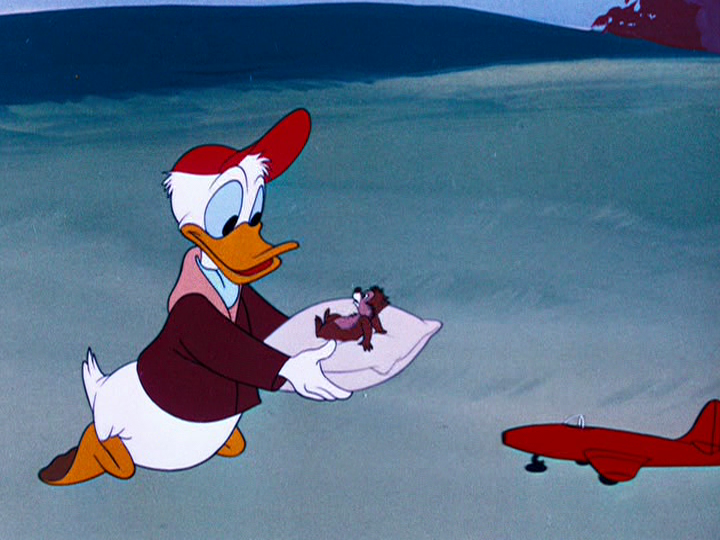
Donald is rather surprised that his plane doesn’t come in for the safe landing, but Dale does instead

Dale finally looks down to see the danger he’s in, scrambles back into the cockpit, and tries to stop the plane. Donald is confused as to why his plane is running around strangely, and when he holds the pillow out for the plane, Dale ends up tumbling out onto the pillow, much to the surprise of Donald. Donald is immediately infuriated, but soon becomes saddened to see his plane is damaged.

As he fixes the wheel, Dale takes a look inside the engine, and begins to fix the model from the inside. Donald is surprised by this, and shuts Dale inside the plane, annoyed that the critter had the nerve to mess with his model. He then plays a prank on Dale, sending the chipmunk shooting out the tailpipe into a pitcher, where Donald keeps him trapped. Chip runs down from his perch to free his best friend, but is still mad that Dale did something so foolish.

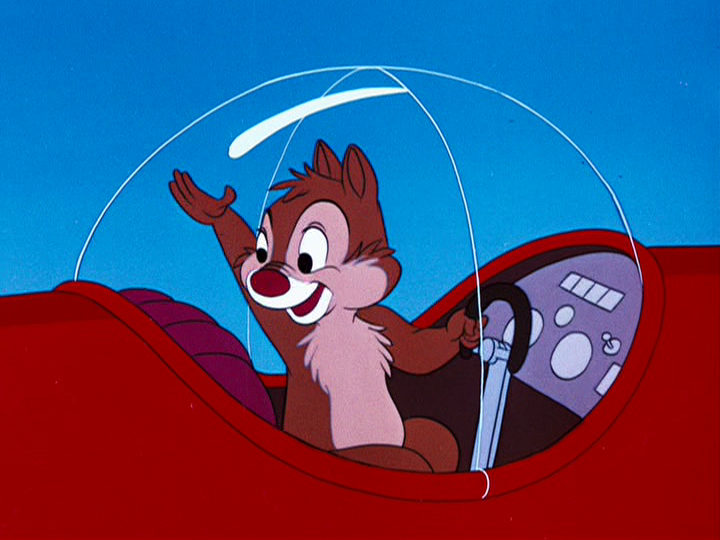
Dale gives his pal a wave as he flies past, unintentionally causing Chip more misery than joy at the situation

As Chip tries to free Dale, Dale digs his way out and gets back in the plane, taking off as Donald tries to fix it. He begins to fly around wildly, waving at Chip as he passes by and sends him flying over the grass. Donald can only watch as his plane has been taken hostage, and flees as he realizes that Dale is going to use him for target practice. Chip just gives up and goes back to his tree while Donald decides to seek revenge.

As Chip continues to taunt the duck, Donald uses a fishing rod to catch the plane and pull it to a stop. Dale, caught, continues to fight, and ends up taking Donald “water skiing” across the pond, while Chip just looks on, frustrated at his friend’s antics. Donald finally catches up with the plane in the air, but Dale parachutes out, leaving the plane without a pilot. The fishing rod gets caught around the top of a building, leaving Donald to fly around in circles for hours, all through the night. Dale points this out as the chipmunks try to sleep, but Chip is still aggravated at his friend’s stupidity.

June 3

Posted on

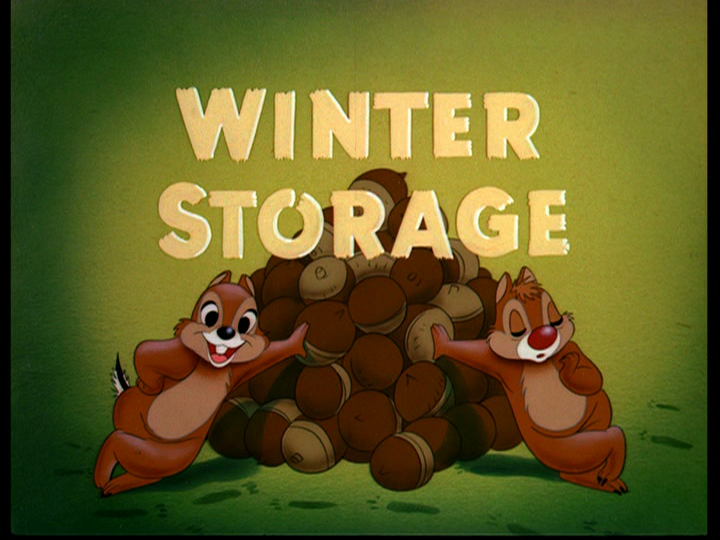
June 3, 1949 – The Donald Duck Short Winter Storage is Released to Theaters

“Oh boy, oh boy! I finally got them!”

On June 3, 1949, the Donald Duck short film Winter Storage was released to theaters. It features Chip and Dale as Donald’s adversaries, their third short with Donald. It was directed by Jack Hannah, with the story by Bill Berg and Nick George, and music by Oliver Wallace. It featured Clarence Nash as the voice of Donald, and James MacDonald as the voices of Chip and Dale.

It’s autumn in the woods, and Chip is busy, storing nuts in a giant oak tree for the approaching winter. According to his calendar, it’s October 7th, and he hasn’t gotten very far with his collection. He passes by a matchbox in the tree that seems to be snoring, and opens it to find Dale fast asleep. Chip kicks the matchbox out onto the main branch, and Dale quickly sets to work picking the acorns from the tree. As Chip collects, he is suddenly thrown off stride by an acorn cap hitting his head.

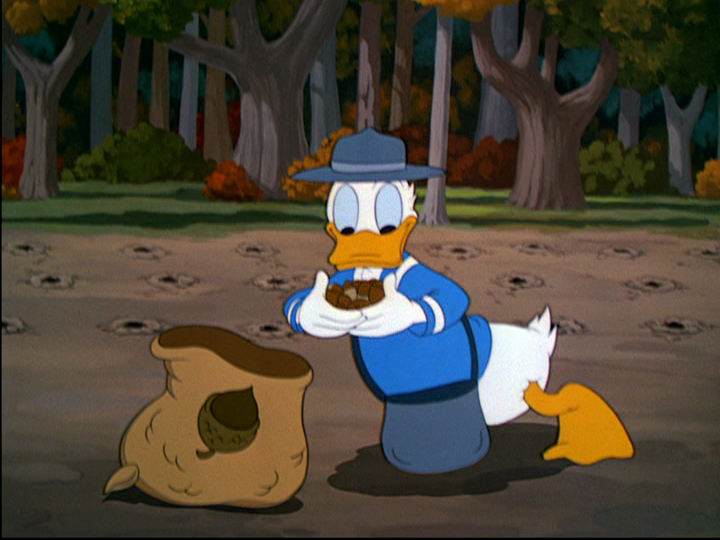
Donald with his bag of acorns to plant in the area

Chip storms out to ask Dale where the acorn went, and Dale points to the tree – every acorn is gone, save for their caps. Chip grabs Dale and pulls him to the calendar, explaining that they have to collect enough food before December 1st, otherwise it will be an awful winter. He then begins to pace, wondering what they’re going to do about their food problem. The pair hears a strange sound outside, and rush out to see Donald standing near their tree, holding a map marking an area that needs to be seeded. With him is a giant bag of acorns used for planting.

The pair becomes excited, and they rush down the tree, digging up the acorns Donald has planted, intending to them back to their food pile. Dale, being a bit slow-witted, decides to replant the acorns, following Donald’s example. When Chip finds out what Dale has done, he gives him a good hard kick before coming up with the next plan: following the acorn bag and collecting the nuts. Dale, however, pulls a loose string from the bottom of the acorn bag and lets all the nuts spill out over Chip, who is not the least bit amused.

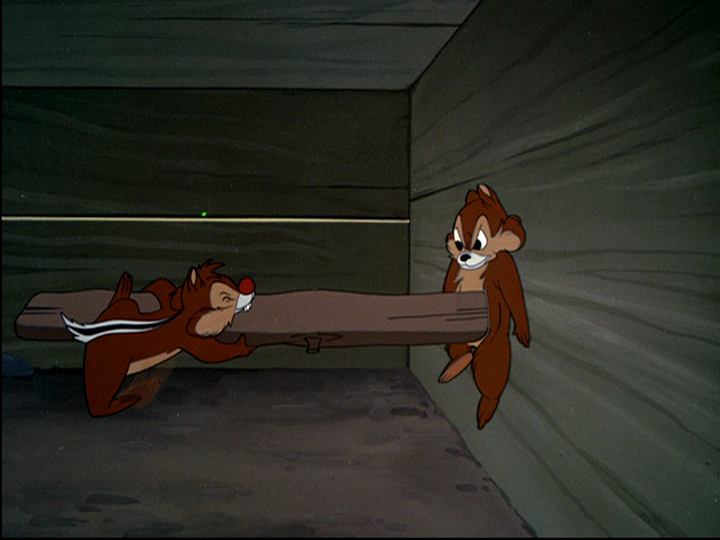
Although he has the best intentions, Dale accidentally traps both of them in the box again

Donald looks to see that his bag is entirely empty, and spots the two chipmunks creeping away with all the acorns in their own bag. He carefully follows them and sets out a trap to catch them, after taking the bag back, but Chip is able to spot the trick. However, Dale unwittingly gets Chip caught in the box, and when Chip makes a successful attempt to free himself, it’s Dale that gets both of them trapped inside.

As Donald rushes over to see his capture, the two dig into the dirt and tunnel out of the box, only to find themselves under it again when Donald has moved it. The two begin to argue, and Donald looks under the box to see his capture. He moves the box away, just observing their little quarrel, wondering if they’ll notice that they are, this time, free. The two face away from each other, silent, and Donald provokes the fight again by pulling Chip’s tail. This causes their argument to become physical, but Dale accidentally ends up punching Donald in the eye.

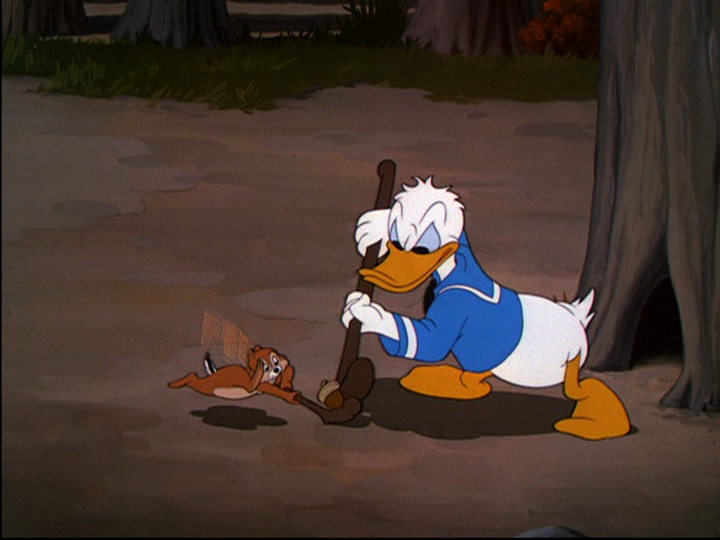
Donald begins to play a game of hockey with the pair with the stolen acorns

The two critters escape and make their way back to the tree with more acorns, and Donald hot on their tails. They begin to play a game of hockey with Donald, trying to shoot the nuts into the hole at the base of the tree. A sudden avalanche of nuts, directed by the chipmunks, approaches, and Donald has no time to prepare. The poor duck is knocked out, and seemingly driven mad, and the two chipmunks are happy they have enough food for the winter.

May 21

Posted on

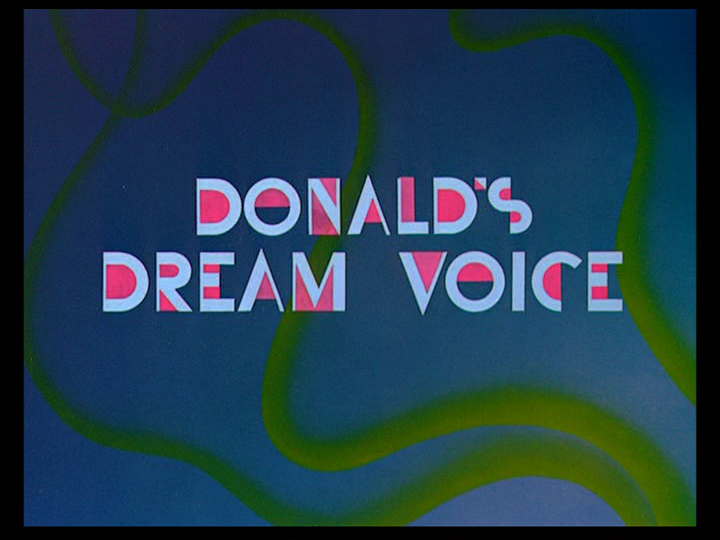
May 21, 1948 – The Donald Duck Short Film Donald’s Dream Voice Premieres in Theaters

“I can talk…I can talk! I can talk! Oh, boy! I can talk!”

On May 21, 1948, the Donald Duck short Donald’s Dream Voice was released to theaters. It was directed by Jack King, with a story by Roy Williams, and features Clarence Nash as the voice of Donald Duck, Leslie Denison as the suave voice of Donald Duck, and Ruth Clifford as Daisy Duck. The suave voice of Donald is a case of topical humor; he sounds like screen actor Ronald Coleman, who was very popular with audiences of the ’40s.

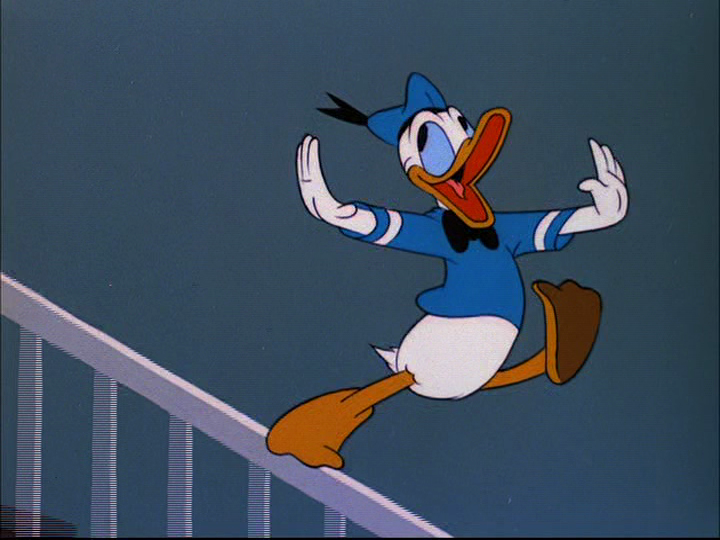
The short begins with Donald going door to door, peddling brushes. At the first door, the owner of the house tells Donald that he can’t understand him, and demands that he leave, which makes Donald angry, but he lets it dissipate before he knocks on the door of the next house. Unfortunately, the lady of the house hears Donald and slaps him for “using such language in [her] presence.”

Donald is elated at the support that he receives from Daisy

Donald is next seen looking rather defeated at Daisy’s house, but she insists that he not give up, as she has faith in him. She kisses him and encourages him to try again, and Donald excitedly cartwheels out of the house, determined once more to try. Again, much to Donald’s dismay, he is misunderstood and sent packing by the owner of the house. Humiliated and angry, Donald continues to walk the city streets, until he passes a peddler selling “voice pills” for only 10 cents. Donald doesn’t believe it, but is willing to try anything once, so he buys a box.

Donald tries a pill, and instantly, his voice changes to sound like Ronald Coleman. Shocked, he tests it out a bit before bursting into rapturous praise. He begins to rush home to tell Daisy, when he decides to instead go sell his brushes, come home to her as a success, and ask her to marry him – although the pill wears off before he can actually state the last part of his plan. Popping in another pill, he completes the statement.

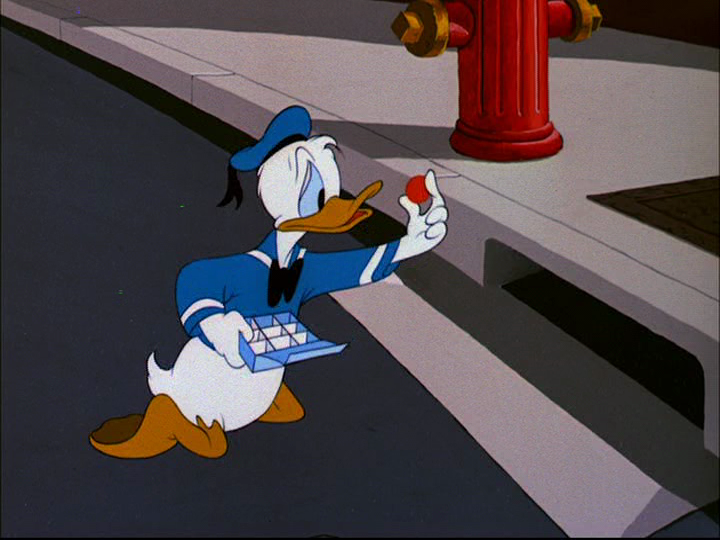
Donald holding the only pill he managed to save

With his new voice, Donald approaches a house, where the woman who lives there remarks on his fine, forceful voice and she can’t help but buy several brushes. Suddenly, several hands appear waving money, wishing to buy brushes from the duck with the amazing voice. Donald then runs home, popping in another pill as the other one wore off. As he runs, he trips on the sidewalk, and the pills pop out of his pocket and fly into the sewer, save for one that Donald manages to retrieve. With only one left, he decides he has to save it for the moment he proposes to Daisy.

Arriving at Daisy’s house, Donald is ready to ask the question when the pill wears off. Grabbing the last remaining pill, it slips from his hand and bounces down the sidewalk, falling into a sewer hole. A large, thug-like man emerges from the hole, with the pill safely in the top of his hat. Donald follows the man, trying to get the pill, but the man yells at Donald, informing him that he hates people. Donald then tries the approach of grabbing the pill from the man’s hat through a nearby window, but accidentally grabs the man’s nose.

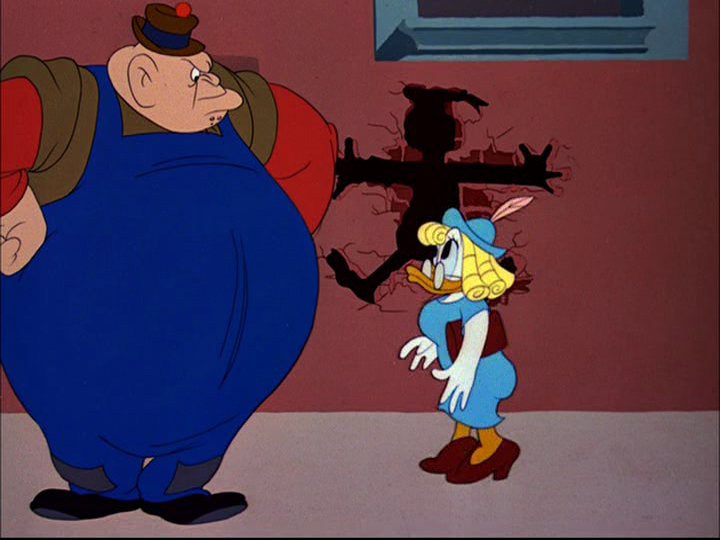
Donald’s last resort when it comes to retrieving his pill

As a last ditch effort, Donald walks by, dressed as a woman, hoping the man will lift his hat in a polite greeting. He does so, and as the pill bounces away, Donald quickly slips down the street and races after the pill as he turns the corner. The pill bounces into a farmyard labeled “no trespassing,” and Donald watches in horror as it slips into a cow’s open mouth. The duck bursts into the fenced in yard and starts screaming at the cow, when the cow, now with the voice of Ronald Coleman, tells him to shut up and that the sign says “no trespassing.” As Donald tries to get the pill back, the cow informs him that he can’t understand a word the duck says, causing Donald to fly into a rage.

May 18

Posted on

May 18, 2004 – The Third Wave of the Walt Disney Treasures is Released

Image Credit: Wikipedia

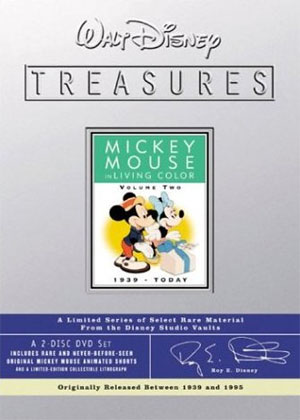
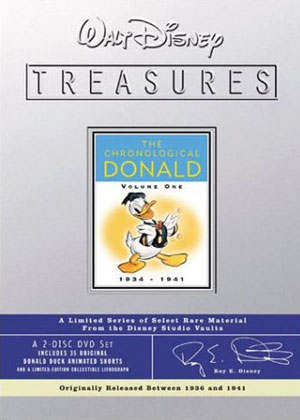
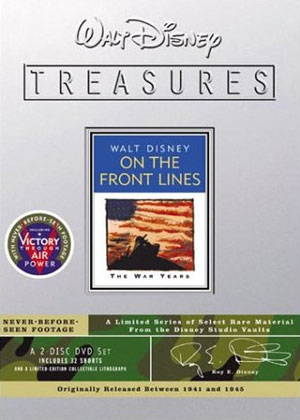
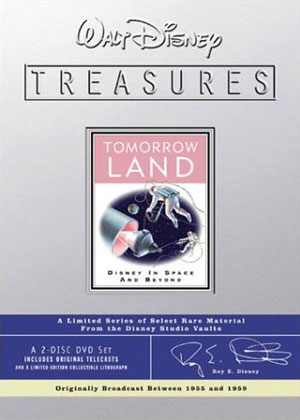
On May 18, 2004, Disney’s video distribution company, Buena Vista Home Entertainment, released the third wave of the popular Walt Disney Treasures. This set included Mickey Mouse in Living Color, Volume Two; The Chronological Donald; On The Front Lines; and Tomorrow Land. Although this wave was supposed to be released in December, as the other two were, the release had to be delayed to meet the demand of the popularity of the sets. As with the other two waves, the third set was introduced by film critic Leonard Maltin, who also provides commentary for the more politically incorrect works, known as the works “In the Vault.”

Mickey Mouse in Living Color. Image Credit: wikipedia

Mickey Mouse in Living Color, Volume Two is the second of the Mickey Mouse color short collections, and the fourth Mickey Mouse collection in all. The first disc gives the shorts from 1939 to the last Mickey Mouse short film in 1953, with bonus features including The Sorcerer’s Apprentice from Fantasia, Mickey and the Beanstalk from Fun and Fancy Free, as well as an Easter egg of Walt Disney performing the voice of Mickey for the short Mr. Mouse Takes a Trip. Disc two shows the modern revival of Mickey Mouse, which includes Mickey’s Christmas Carol, The Prince and the Pauper, and Runaway Brain. The bonus features are numerous on this disc, and include an interview with the voices of Mickey and Minnie (Wayne Allwine and Russi Taylor), an interview with Disney animators Mark Henn and Andreas Deja, and clips from the Walt Disney anthology series that use Mickey as an example of animation techniques.

The Chronological Donald. Image credit: wikipedia

The Chronological Donald is the first set of Donald Duck short films, which begins with the Silly Symphony The Wise Little Hen in 1934 on disc one, and ends with the 1941 short Chef Donald on disc two. The disc one bonus features include a clip from the film The Reluctant Dragon, where the voice of Donald, Clarence Nash, is heard performing with Florence Gill, the voice of Clara Cluck. Disc two includes a mini-biography about Clarence Nash, and how his unusual voice inspired the creation of Donald Duck, as well as another clip from The Reluctant Dragon, where Donald is explaining to Robert Benchley how animation comes to life.

On the Front Lines. Image credit: wikipedia

On the Front Lines is a collection of all the propaganda, educational shorts, and films released when the Disney Studios were taken over during World War II. Disc one includes mostly the short films, including the shorts where Donald is drafted into the army. In the vault, there are four films: Der Fuehrer’s Face (a propaganda film where Donald believes he lives in a land occupied by Nazis), Education for Death (a chilling film based on the book by Gregor Ziemer), Reason and Emotion (a humorous look about how people needed to keep their emotions in check during wartime), and Chicken Little (a horrifying update to the children’s story). Disc two is of the film Victory Through Air Power, which Walt Disney created to send a message to the American people that the war could be won through the use of aviation and long-range bombing. This DVD set is the first release of the film since its rerelease in 1944. This disc also includes some training shorts, behind the scenes documentaries of the film Victory Through Air Power, galleries of insignias and posters created during wartime, and an interesting interview with long-time Disney employee John Hench, who recounts his time at the studio after the attack at Pearl Harbor.

Tomorrow Land. Image credit: wikipedia

The last set in this wave is Tomorrow Land, which pulls together episodes from the anthology series about space and the future, with many of these episodes directed by Nine Old Men member Ward Kimball. The first disc has three episodes: Man in Space, Man and the Moon, and Mars and Beyond. The second disc includes Eyes in Outer Space, Our Friend the Atom, and EPCOT, a look at the Florida Project Walt Disney planned, which was to be a Tomorrowland type theme park. Bonus features include interviews with author Ray Bradbury and long-time employee Marty Sklar, as well as an Easter egg of the Sherman Brothers singing “There’s a Great Big Beautiful Tomorrow” with Walt, as the song was featured at the General Electric Pavilion at the 1964 World’s Fair.

May 9

Posted on

May 9, 1947 – The Donald Duck Short Film, Sleepy Time Donald, is Released to Theaters

“I must humor him. I mustn’t wake him, or it would be fatal.”

On May 9, 1947, the Donald Duck short film, Sleepy Time Donald, was released to theaters. The short was directed by Jack King, with story by Roy Williams, and starred Clarence Nash as the voice of Donald Duck, and Gloria Blondell as the voice of Daisy Duck. This is one of those rare shorts that, while Donald’s name is in the title, Daisy gets more of the starring role, with great results.

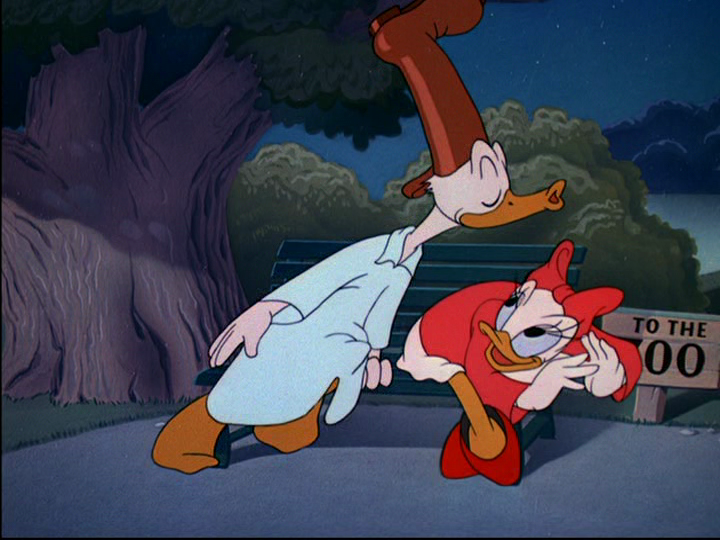
The scene opens with Donald fast asleep in his suburban home, when suddenly he rises from his bed, places a boot on his head, and sleepwalks to Daisy Duck’s house. Daisy wakes up, alarmed, but becomes puzzled when Donald walks right past her and out the other door, only to turn around and ring the doorbell. Daisy leaps out of bed and throws on a date-night outfit before answering the door for her “date.”

As Donald tries to kiss Daisy, she begins to play hard-to-get

Deciding that she needs to “humor” Donald, she opens the door and greets him, and Donald asks if he’s on time for their date. Daisy giggles as she reassures him he is, and then she is seen being escorted to the zoo. There’s a moment where she wonders if he’s going to kiss her, and she ducks when he tries to, and begins to play hard to get with him. She tricks him into kissing a tree branch, with Donald thinking it’s her arm. He then slips an engagement ring on the branch, with Daisy swooning at his romantic gestures. As he lets the branch go, the ring catapults into the monkey’s pen, with the female monkey giving the male a big kiss. Unfortunately for her, Daisy slips the ring away from the pair, causing the female monkey to deck the male.

Daisy admires the ring on her hand, noticing just a bit too late that Donald has sleepwalked into the lion’s cage, narrowly missing being eaten. After the zoo, Donald walks up the side of a building, with Daisy watching in horror on the ground. She calls out his name, and he only motions for her to join him. She tells him that her way is the shorter way; he shrugs and decides she’s right, although he continues to walk on the side of the building as they continue down the street, with Daisy trying to prevent him from getting into trouble as best she can.

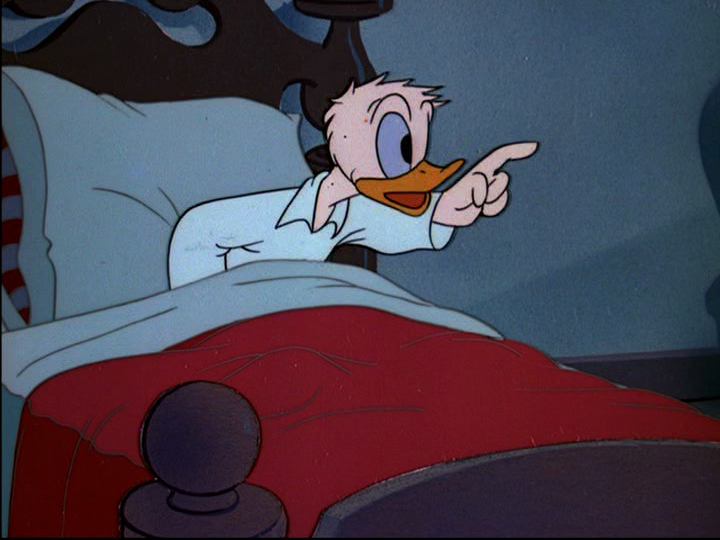
Donald wakes and accuses Daisy of sleepwalking

Donald continues his sleepwalking by walking straight into traffic. Daisy flips the traffic sign to a stop so Donald won’t get hit by a car, causing a massive pile-up. Finally, she decides to make him think that they’re boarding a boat as she leads him back to his house and gets him back into bed. As she tries to slip out, Donald wakes up and accuses her of walking in her sleep. She argues with him that she has not been walking in her sleep, but Donald laughs, until Daisy hits him over the head with his boot, causing him to sleepwalk back into bed and fall fast asleep.

May 6

Posted on

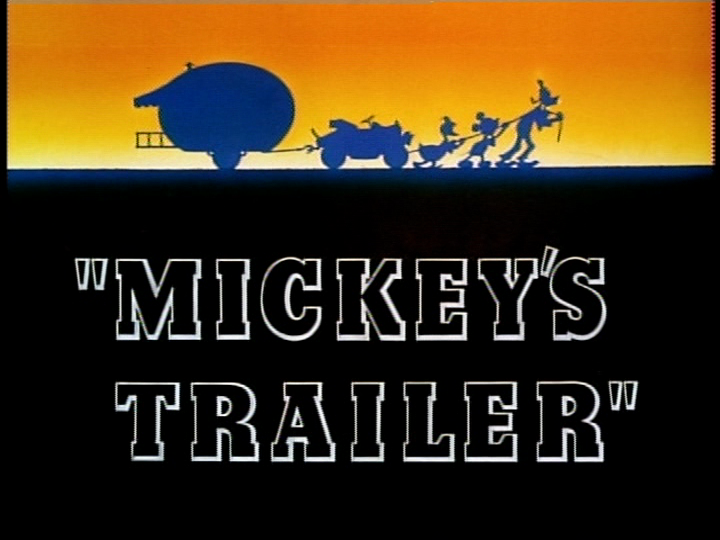
May 6, 1938 – The Mickey Mouse Short Film Mickey’s Trailer Premieres in Theaters

“The worst is over – it’s all downhill from here!”

On May 6, 1938, the Mickey Mouse short Mickey’s Trailer was released to theaters. The short was directed by Ben Sharpsteen, and stars Walt Disney as the voice of Mickey Mouse, Clarence Nash as the voice of Donald Duck, and Pinto Colvig as the voice of Goofy. The short features many mechanical gags that are reminiscent of the early Mickey Mouse shorts.

The audience first sees Mickey’s trailer, in front of a picturesque background of the mountains. The door opens, and Mickey steps out in his nightgown, excited at the prospect of a beautiful day. He pulls a lever next to him, and the whole trailer begins to rattle as he goes back inside. Suddenly every bit of the trailer, from the white picket fence to the “lush green lawn”, folds back into the trailer. A car rolls out of the side, with Goofy sleeping in it; He awakens and slips into the front seat and gets ready to drive. The “picturesque” scenery folds up behind them and slips into the trailer, leaving behind a view of the city dump, with some refineries for good measure in the distance.

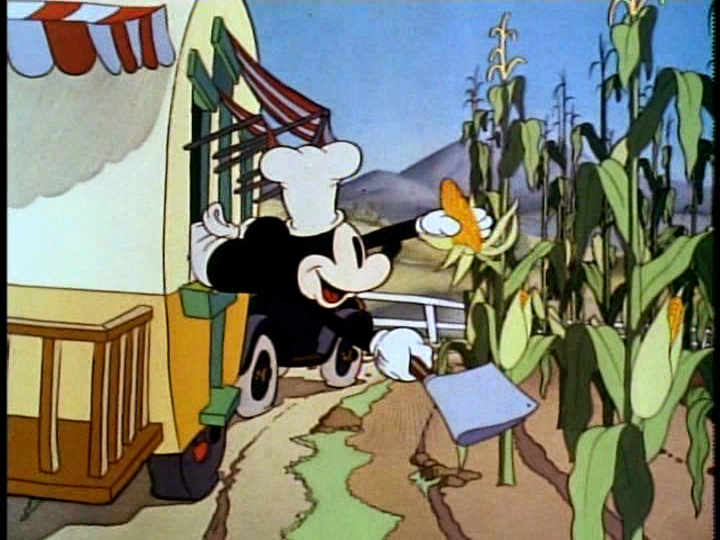
Mickey snatching some corn from a nearby field

As Goofy drives the trailer on a dirt road, he begins to sing “She’ll Be Comin’ Round the Mountain.” Inside the trailer, Mickey begins to fix breakfast, grabbing water from a nearby waterfall for the coffee, cutting some corn from nearby stalks, and, with Goofy tempting it with some hay, getting some milk from a wandering cow. Also inside the trailer is Donald, fast asleep on the top bunk. The alarm clock goes off, which is rigged to pull away his covers and force him to get up. Slowly he tries, but ends up falling back asleep. Mickey, from the kitchen, pushes a button, which turns the bedroom into a bathroom, and Donald excitedly enters the bathtub and begins to sing a nonsensical song as some robins watch at the window.

Mickey pushes another button, and the bathroom becomes a dining room, and Mickey sounds the alarm for breakfast. Goofy leaves his post as driver to get his food – with the car driving into an area marked with a “road closed” sign. As the car stumbles over several bumps in the road, each bump makes part of Goofy’s breakfast disappear. He watches Mickey and Donald enjoy their corn on the cob, and as he reaches for a cob, he accidentally sticks his fork in a light socket, which pops all the kernels from the cob. So he has popcorn for breakfast.

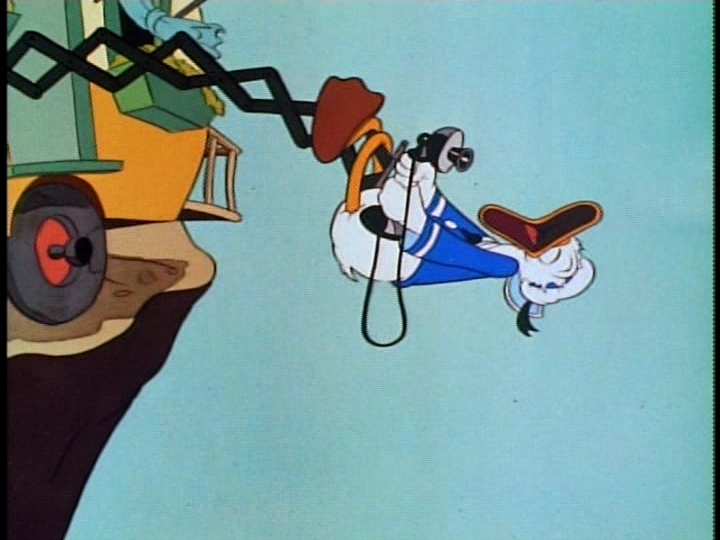
Donald clings to the phone for dear life as he is projected through the window

Mickey finally notices that there is nobody in the car, and turns to Donald, asking who is driving. Goofy responds that he is, and it suddenly dawns on him that he should be in the car driving. When he dives out the window to get back in the driver’s seat, he unwittingly knocks the connector loose from the trailer, sending Donald and Mickey flying the other way on the perilous path. Inside, the pair are knocked about as they continue sliding backwards on the one-way path. A truck slowly climbs its way up the mountain pass, but they fortunately miss it as the trailer uses the fence as a track. Donald tries to use the phone to call for help, only to have to cling to it for dear life as he is outside the window.

Just as the two think they’ve avoided trouble after a curve, they hear the sound of a train, and look out to see it fast approaching the bridge. Donald’s kneels to pray. They narrowly miss the train as they cross the bridge; both breathe a sigh of relief, only to see that they’ll be coming across it again, and again they narrowly miss it. As they fall off a curve and fly down the side of a mountain, they luckily get connected to the car again. Goofy informs them that he got them down safe and sound, unaware of the adventure they had without him.

April 25

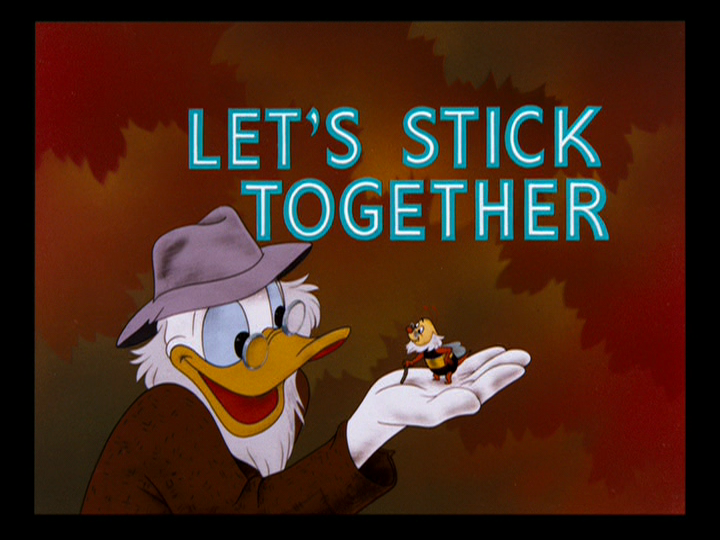
April 25, 1952 – The Donald Duck Short, Let’s Stick Together, is Released to Theaters

“You know, strange as it may seem, I used to be in business with that old duffer.”

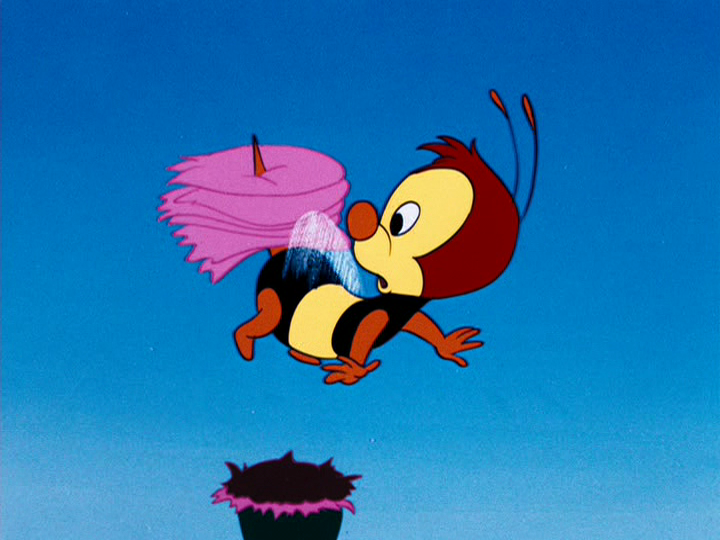
On April 25, 1952, the Donald Duck short, Let’s Stick Together, was released to theaters. It features one of Donald’s many adversaries, Spike the Bee, who made his premiere in the 1948 Donald Duck short, Inferior Decorator. The short was directed by Jack Hannah, with the story by Nick George and Al Bertino. It also stars Clarence Nash as Donald, Bill Thompson as Spike, and voice actress legend June Foray in a cameo as Spike’s wife.

The short opens on a crisp fall day in the park, where an old bee is seen sitting on a ledge of a tree in his rocking chair, smoking a corncob pipe. He is suddenly startled as something lands into the ground in front of him. As the camera pans out, we see that the item belongs to an elderly Donald Duck, who is picking up trash in the park. He sits down on a bench to rest, and the bee laughs, narrating to the audience how he knows Donald, and taking the audience with him as he reminisces.

Spike discovers that his stinger is part of his secret talent

The flashback begins with Spike looking at the want ads in an abandoned newspaper. Just as he picks out what he thinks is the perfect job, the paper is snatched out from under him, flipping him into the air and dropping him harshly on the ground. Annoyed, Spike flies up to perch on a flower to look at his “attacker.” He then spies Donald, who is picking up the trash in the park, and gets an idea: he can use his stinger to pick up trash, and calls it his “hidden talent.” Excited by this discovery, he flies around Donald and shows the duck that he can help pick up trash. Donald is impressed, but is confused when Spike pushes Donald to the bench, letting him know he won’t be needed.

Spike makes quick work of the trash, and brings Donald part of a cigar he’s found. Donald pats Spike on the head and begins to relax while Elderly Spike relays to the audience that this was the beginning of a beautiful friendship. The next day, the two went into business together, beginning at a local carnival. Donald is seen selling balloons for 10 cents a balloon, and after he sells them, he sends Spike out to pop them, forcing the children to buy from Donald again. Spike is distracted, however, by an ad for a balloon dancer, and slips inside, popping the balloons that cover the girl. She lets out a shriek, and Spike flies out again, shrugging.

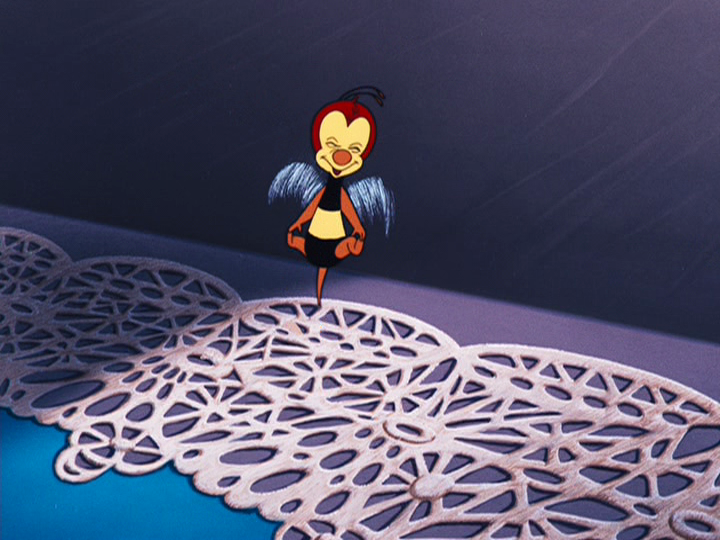
Spike working on creating a lace pattern

The next job the two held was a tattoo parlor, with Donald using Spike’s stinger for a needle. Donald is impressed with Spike’s work, and they move on to other projects, including making socks, lace, monogrammed handkerchiefs, and even fancy curtains. Soon, as Spike tells us, they were in full production mode. As the orders kept coming in, Spike became more and more fatigued. He pleads with Donald to let him have a vacation, and Donald surprises him with a greenhouse full of flowers, complete with a lady bee as well. Falling in love makes Spike work harder than ever, only he destroys everything by stitching hearts everywhere.

Donald, seeing as how everything has been vandalized, cries out that he’s ruined, and glares at the lovesick bee before trying to swat the lady bee. Spike runs to protect his lady, and decides to sting the duck in the tail. It was the end of their partnership, and Spike and his lady “have been happy all these years,” Spike tells the audience. The audience hears the truth, however, as Spike’s lady begins to scream at him for lounging around. Spike decides to join Donald once again in their partnership, and the two hobble down the road together.