RSS Feed

Tag Archives: Academy Award winning

December 21

December 21, 1937 – Snow White and the Seven Dwarfs Premieres at the Carthay Circle Theater

vlcsnap-2012-12-20-19h13m23s224

“Walt Disney, who created these lovable characters, brings to motion pictures a new medium for a greater art. And it looks like a ‘Snow White’ Christmas for all!”

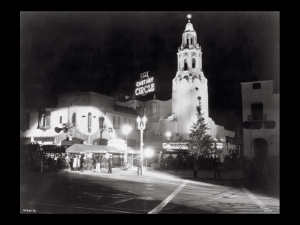
On December 21, 1937, after beginning production in 1934, Walt Disney’s first full-length animated feature film, Snow White and the Seven Dwarfs, premiered at the Carthay Circle Theater in Los Angeles, California. Many of those who attended had called the film “Walt’s Folly;” many celebrities also attended the premiere, including Shirley Temple, Marlene Dietrich, Mary Pickford and Douglas Fairbanks, Ginger Rogers, Clark Gable and Carole Lombard, and Charlie Chaplin. There were even actors in dwarf costumes, and a special appearance by Mickey and Minnie Mouse, and Donald Duck. Life size replicas of the dwarfs’ cottage were created for the event. The film received a standing ovation, and grossed more than $8 million, which was quite a feat at the time, since a movie ticket cost about 10 cents. Snow White was the highest grossing film of all time, until it was surpassed by Gone With the Wind. The film was generally released on February 4th, 1938.

December 8

December 8, 1916 – Director and Disney Legend Richard O. Fleischer is Born

Image credit: wikipedia

Image credit: wikipedia

“I called my father in New York that night and told him the story. He said, ‘Of course you must take that job without any question. Just do one thing. Give a message to Walt from me, tell him that he’s got great taste in directors.’”

On December 8, 1916, Richard O. Fleischer was born in Brooklyn, New York. Son of famous animator and producer Max Fleischer (Betty Boop, Popeye), Richard grew up around the entertainment field and attended the Yale School of Drama before joining the New York RKO-Pathe News, where he wrote newsreel commentaries and directed wartime documentaries. Soon after, he moved to Hollywood, where he directed several film noirs, including Bodyguard and The Clay Pigeon. In 1952, after he directed The Happy Time, starring Bobby Driscoll, he got a call from the Walt Disney Studios, asking him to direct the new live-action film, 20,000 Leagues Under the Sea. The film was a great success for the studio, as well as for Fleischer. After its release, he went on to direct such classics as Doctor Dolittle and Tora! Tora! Tora! He was inducted as a Disney Legend in 2003, and passed away of natural causes in 2006.

December 3

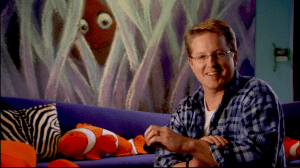
December 3, 1965 – Director, Screenwriter, Producer, and Voice Actor Andrew Stanton is Born

 vlcsnap-2012-12-02-16h59m56s255

“Without meaning to, I sort of made this epic journey that takes you all over the ocean. That meant every set piece had to be different. The look of being underwater is actually quite simple from a technical standpoint. It was just really tough to dial all the different ingredients just right.”

On December 3, 1965, Andrew Stanton was born in Rockport, Massachusetts. As a child, he wanted to be a comic-book artist, which evolved into wanting to become an animator. He attended the famed California Institute of the Arts, and in 1990, he was the second animator to join Pixar Animation Studios; he and Pete Docter were the ninth and tenth employees hired by the young animation studio. He soon began working as a designer and writer on Pixar’s first film, Toy Story. The time spent on Toy Story was rather tense, as the writers were given comments and notes from Jeffery Katzenberg, whose big push was to make the main characters more “edgy;” in following these notes, the film was no longer Pixar’s, and the character of Woody was stripped of all charm. Disney shut down the production, and the Pixar team quickly began rewriting the film they wanted to make, with Stanton sequestering himself in a small office, only to emerge with new pages of script. The film went on to be a success, with Andrew Stanton, along with Joss Whedon, Alec Sokolow, and Joel Cohen garnering an Academy Award Nomination for Best Original Screenplay.

Stanton would go on to co-direct and co-write A Bug’s Life, co-write Toy Story 2, and co-write and Monsters, Inc., before being tapped to direct his first feature film, Finding Nemo. It became highest grossing animated feature on its release (before being taken over by Toy Story 3), and Stanton was awarded the Academy Award for Best Animated Feature.  Stanton’s next major project was 2007’s Wall-E, which he directed and co-wrote. Similar to Finding Nemo, Stanton wanted to pick a setting that would challenge the animators, this time choosing space. The film was another success, winning the Academy Award for Best Animated Feature. After Wall-E, Stanton mostly executively produced several short films for Pixar, and co-wrote Toy Story 3. In 2012, Stanton’s project John Carter was released; he directed and co-wrote the film, adapting it from A Princess of Mars by Edgar Rice Burroughs. Unfortunately, the film received mixed critical reviews, and just barely made back its budget. However, Stanton announced that his next project is back at Pixar, working on a sequel to his hit film, Finding Nemo.

November 28

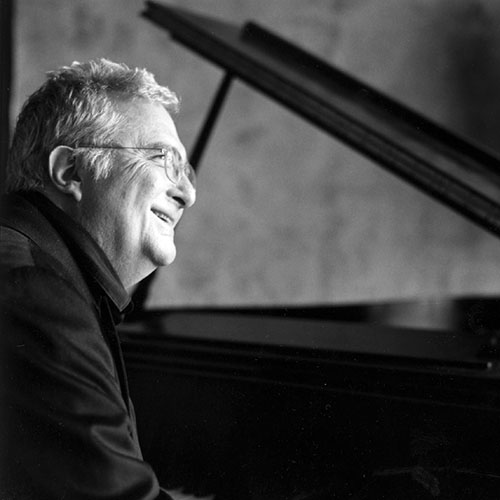
November 28, 1943 – Composer and Disney Legend Randy Newman is Born

Image credit: randynewman.com

“I’ve always admired Carl Stalling and the other composers who specialized in music for cartoons, and I wanted to do one myself.”

On November 28, 1943, composer Randall Stuart Newman was born in Los Angeles, California. As a child, he and his family lived in New Orleans until they moved back to Los Angeles when he was 11. Newman came from a noted musical family; three uncles were Hollywood film-score composers: Alfred Newman, Lionel Newman, and Emil Newman. Randy became a professional songwriter at the age of 17, and in 1962, he released his first single, “Golden Gridiron Boy.” The single did poorly, and Newman decided to concentrate on songwriting and arranging instead of performing. His big break came as the B-side to The Fleetwoods’ hit single “Lovers By Night, Strangers By Day,” with a song titled “They Tell Me It’s Summer.” In 1970, Newman had a critical success with his sophomore album 12 Songs; in 1977, he scored a hit with the unlikely song, “Short People.”

Newman began his work with Disney and Pixar when Disney tapped him to compose the film Toy Story. He wrote the hit song, “You’ve Got A Friend In Me,” for the film. His success with the film led to other animation composing jobs for Disney/Pixar, including James and the Giant Peach, A Bug’s Life, Toy Story 2, Monsters, Inc., Cars, and The Princess and the Frog. He was nominated for, and won, an Academy Award for the song “If I Didn’t Have You” for the film Monsters, Inc.; and won the Academy Award for the song “We Belong Together” from Toy Story 3.He has earned at least one Oscar nomination for each animated film he has worked on. Newman was inducted as a Disney Legend in 2007.

November 25

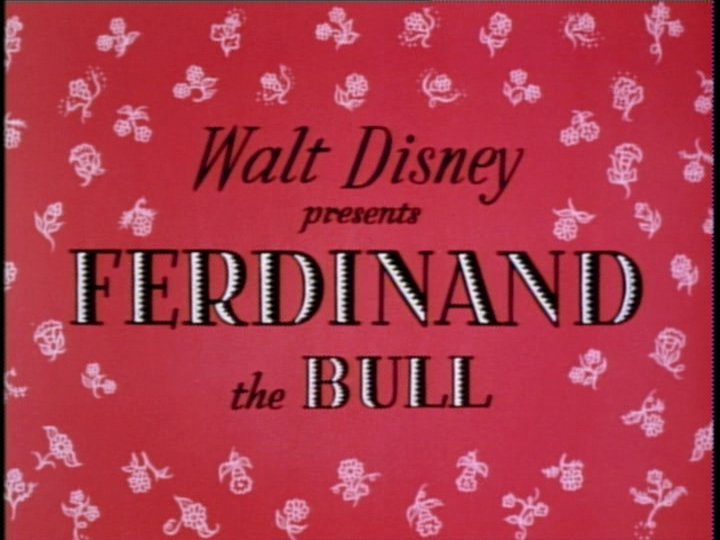
November 25, 1938 – The Special Short Film Ferdinand the Bull is Released to Theaters

“All the other little bulls he lived with would run, and jump, and butt their heads together, but not Ferdinand.”

On November 25, 1938, the special short film Ferdinand the Bull was released to theaters. The short was based on the book The Story of Ferdinand by Munro Leaf, with illustrations by Robert Lawson. Ferdinand the Bull won the Academy Award for Best Cartoon of 1938. It was directed by Dick Rickard, and narrated by Don Wilson; Milt Kahl provided the voice of Ferdinand’s mother, while Walt Disney provided the voice for Ferdinand. Several members of Disney staff were caricatured as characters at the bullfight; Walt himself was caricatured as the matador.

The short opens in Spain, introducing the little bull Ferdinand, who much preferred to sit in the pasture and smell the flowers rather than butt heads with the other little bulls. His mother worried about him, but Ferdinand was quite content under his cork tree. As the years went by, Ferdinand grew to be big and strong, but never dreamed of fighting in the bullfights like the others.

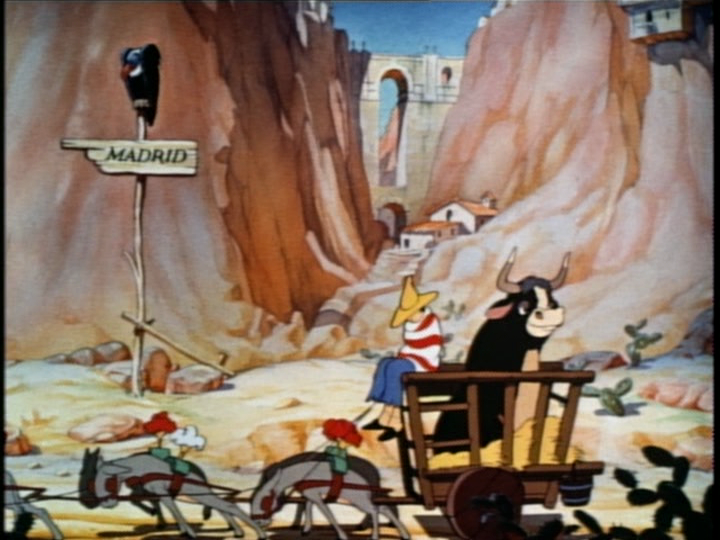
After displaying a fierce reaction to the bee sting, Ferdinand is carted to Madrid to fight the matador

One day, a group of men came to pick the biggest, strongest, and toughest bull to fight in Madrid. Ferdinand ignored them and went to sit under his tree, but accidentally sat on a bee. His surprised, fierce reaction to the bee’s sting convinces the men that Ferdinand is the strong, tough bull they are looking for, and they cart him off to Madrid.

Ferdinand’s bullfight opens with much fanfare. The matador appears in the ring to great applause, ready to do battle with the bull. Unfortunately for the matador, Ferdinand is not in a fighting mood. As the matador flees from Ferdinand’s approach, everyone is surprised to see the bull sniff a bouquet of flowers that has been tossed into the ring. The matador is furious that Ferdinand won’t be fierce, and tries any approach he can to get a reaction from the flower-loving bull. After revealing a daisy flower tattooed on his chest, Ferdinand gives the matador a kiss. Frustrated, the men in charge cart Ferdinand back to his little area under the cork tree, letting him remain and smell the flowers.

November 22

November 22, 1991 – The 30th Animated Feature Film, Beauty and the Beast is Generally Released to Theaters
“Tale as old as time, song as old as rhyme, Beauty and the Beast.”

On November 22, 1991, the 30th animated feature film, Beauty and the Beast, was generally released to theaters, after a New York premiere on November 13. The film was based on the French fairy tale La Belle et la Bête, written by Jeanne-Marie le Prince de Beaumont. The idea to use the fairy tale as an animated feature goes all the way back to the 1930s, with Walt Disney originally showing interest after the success of Snow White and the Seven Dwarfs.The project was resurrected during the beginning of the period known as the Disney Renaissance and was the first Disney animated feature to use a screenwriter for the script; the first treatment had the film set in Victorian France, with no musical numbers. However, in 1989, this treatment was scrapped, forcing everyone to start from scratch. Gary Trousdale and Kirk Wise were asked to direct, and the team of Alan Menken and Howard Ashman were asked to write the music for the film. The film stars Paige O’Hara as Belle, Robby Benson as the Beast, Richard White as Gaston, Jerry Orbach as Lumiere, David Ogden Stiers as Cogsworth, Angela Lansbury as Mrs. Potts, Rex Everheart as Maurice, and Bradley Michael Pierce as Chip.

The film would go on to win enormous accolades from the critics, and until 2009, was the only animated feature to be nominated for the Academy Award for Best Picture.The music from the film was the last project that the team of Ashman and Menken, as Ashman passed away from AIDS-related complications before the film was finished. The film was dedicated in his honor. The team won two Oscars : one for Best Original Score, and one for Best Original Song for the title song, sung by Angela Lansbury (Mrs. Potts). The film was so successful that it was made into a Broadway musical in 1994; a song originally cut from the film, “Human Again,” was reinstated in the musical, and was placed back in the film when the film was rereleased on DVD in 2002.
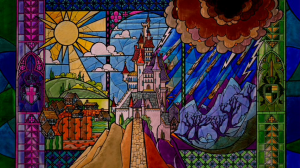
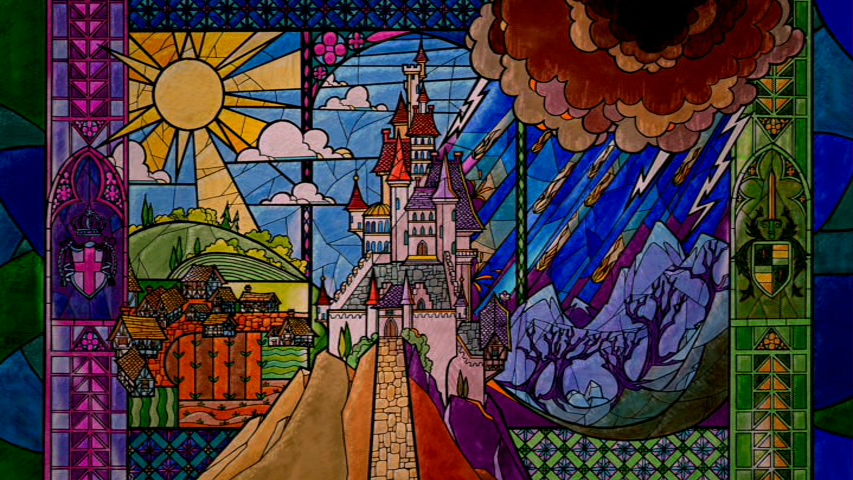
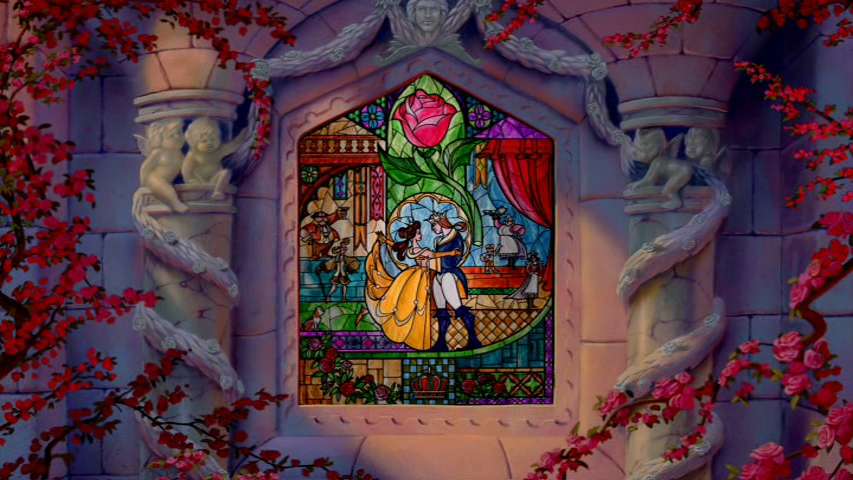
A powerful curse was placed over the castle, after an enchantress realized that the prince who lived there did not know how to love

The film begins with the story of the Prince, who turned an old beggar woman away from his door when she offered him a rose in exchange for shelter. The beggar woman was actually an enchantress who, after seeing there was “no love in his heart,” punished him for his cruelty by turning him into a beast. The Beast hid himself away from the world, with only a magic mirror to let him observe the outside. The rose the enchantress had offered was a magic rose, which would bloom until his 21st birthday. If he could learn to love, and earn love in return by then, the spell over the castle and the Prince would break; if not, he was doomed to remain a beast. The Prince grew weary over the years, as he wondered “who could ever learn to love a beast?”

Dawn breaks over a nearby provincial village, and Belle is seen walking to town, wishing to find something more than the “provincial life.” The townspeople remark how odd she is, as she has her head up in the clouds, and loves to read and imagine. Belle is pursued by Gaston, the hero of the village, and incredibly vain to boot. The only reason Gaston pursues Belle is because she is considered “the most beautiful girl in town,” although all the townspeople think she and her father, the inventor Maurice, are rather peculiar. Belle constantly turns down Gaston’s advances. She arrives home after another ambush by Gaston, and the two cheer each other up, with Maurice finally getting his invention to work. He heads off to the fair with his invention, but ends up lost in the woods, stumbling across the beast’s castle, and being sent to the dungeon by the Beast himself.
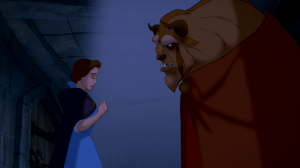
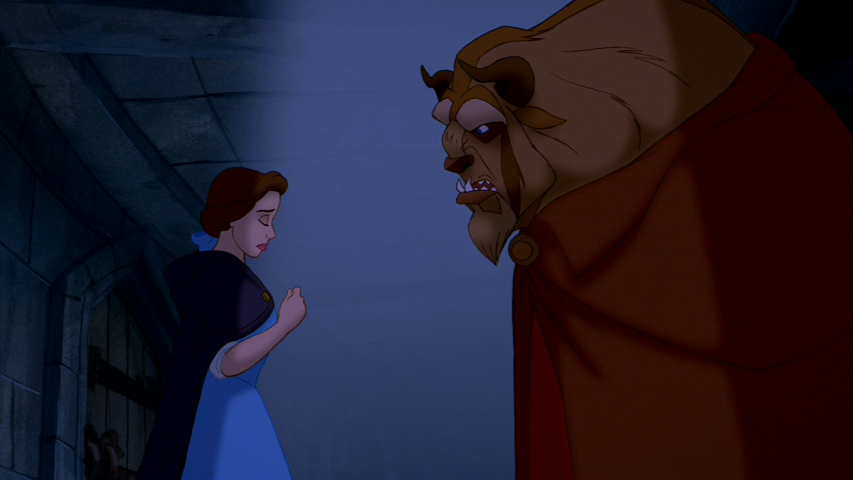
Belle offers her life to the Beast in exchange for her father’s

Belle is ambushed by Gaston once again, who sets up a wedding for the two without her knowledge. After she rebuffs him again, her father’s horse, Philippe, arrives home; seeing her father has gone missing, she has Philippe take her to the castle. She tries to find her father, with the servants secretly leading the way, and finds him sick and locked in a cell. She comes across the Beast, and offers her life in exchange for her father’s. Although her father objects, she remains firm in her offer. The Beast tries to make Belle comfortable, with everyone in the castle hoping she will be the one to break the spell. Maurice, having been taken back to town, tries to get the townsfolk to help him retrieve Belle, but they all consider his pleas as the ramblings of a madman. This gives Gaston an idea to finally get Belle to marry him, which he and his henchman, Lefou, prepare to implement.

The Beast and Belle have a difficult time adjusting, as the beast has a problem with his temper. He warns Belle never to enter the West Wing, but when she does, he loses his temper, and she flees from the castle. She is attacked by wolves in the woods, but is soon saved by the Beast. As he lays injured from the fight, Belle is tempted to continue to run, but helps him back to the castle, as thanks for saving her life. She tends to his injuries, and the two come to a new understanding. Back in town, Gaston is beginning to set his plan in motion: have Maurice committed to the insane asylum, with Belle’s agreement to marry him the only way to prevent Maurice’s incarceration.
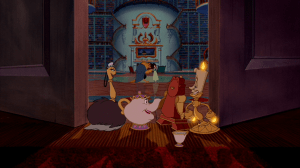
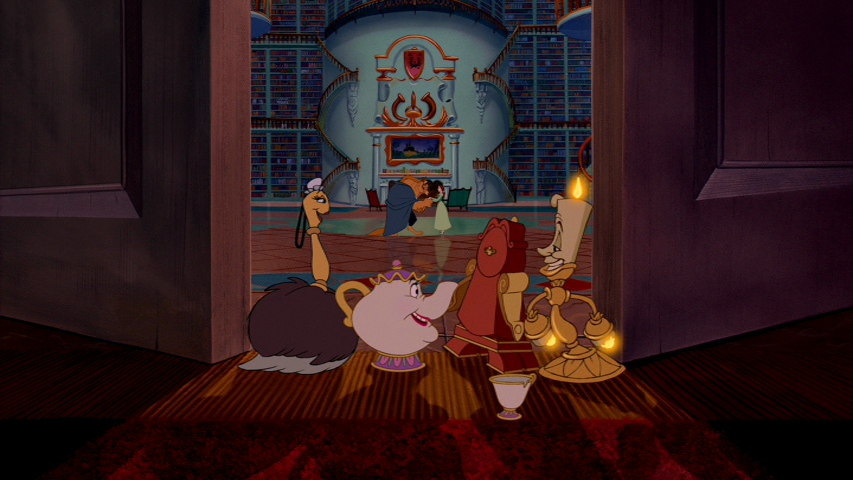
The servants are excited about the growing feelings between the Beast and Belle, hoping that Belle will help them break the spell

The Beast is starting to feel something for Belle, and wishes to do something nice for her. He surprises her with his grand library, which he says is all for her. She is truly touched by his gesture, and the two begin to grow closer. The servants plan an elaborate dinner and dance for the two, which they hope will culminate in the beast confessing his feelings to Belle. Although the evening is a success, and Belle is happy at the castle, she still misses her father. The Beast gives her his magic mirror to see him, and when she sees that her father is sick and traveling alone in the woods to find her, she asks to go help him. The Beast, having fallen in love with Belle, lets her go, also giving her the magic mirror to be able to see him at any time. Belle reaches her father in time and brings him home, only to have the town gather around their house to watch Maurice be carted away to the asylum. When Belle proves the existence of the beast with the magic mirror, Gaston realizes that the Beast is a romantic rival for Belle, and vows to rid the village of the Beast.

The town locks Maurice and Belle in their root cellar and set off the kill the Beast. Luckily Chip, the child of one of the servants, has stowed away in Belle’s bag and frees the two, and the two quickly make their way to the castle. Inside the castle, the servants gear up for a fight with the villagers. When they warn the Beast, he says to let them come, as he is still heartbroken that he let Belle go. Gaston searches for the Beast, and is angered when the Beast refuses to put up a fight. When the Beast hears Belle’s cry, his strength is renewed, and he dangles Gaston from the roof. Having a change of heart, he orders Gaston to leave, then climbs to the balcony where Belle is waiting. Without warning, Gaston stabs the Beast in the side, but loses his grip and plummets to his death.
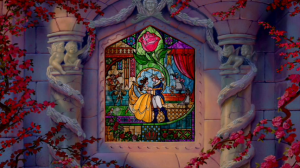
The spell breaks when Belle confesses her love, and everyone lives happily ever after

The Beast lies dying on the balcony, telling Belle that he was happy to see her one last time. As he drifts away, Belle confesses her love right as the last petal on the enchanted rose falls. As everything thinks all is lost, suddenly, the Beast transforms back into the Prince. Belle, confused, doesn’t believe it when he says it’s still him, until she looks into his eyes. The spell is broken all over the castle, and everyone lives happily ever after.
November 5

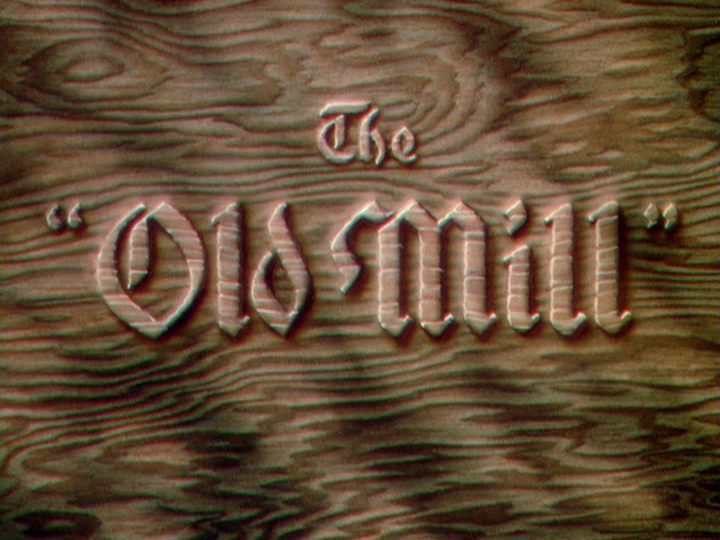
November 5, 1937 – The Silly Symphony The Old Mill is Released to Theaters

On November 5, 1937, the Silly Symphony The Old Mill was released to theaters. The short film is notable for being the first film to use the multi-plane camera, which helped create a new three-dimensional look to the Disney films. The film won an Academy Award for Best Cartoon; Disney also took home a special Scientific and Technical Class II plaque for the design and application of the camera.

An old mill stands abandoned at the side of a pond at sunset, while all the animals around head to their nests for the day. A pair of bluebirds have made a nest in the old cogs, waiting for their eggs to hatch. Many animals have made the mill their home, from mice, to owls and bats. Out in the pond, frogs peek out from their lily pads and begin to croak, until they are interrupted by the sound of crickets. Fireflies also appear in the night, with one of the frogs anxious to eat one. As he does, his stomach glows from the firefly.

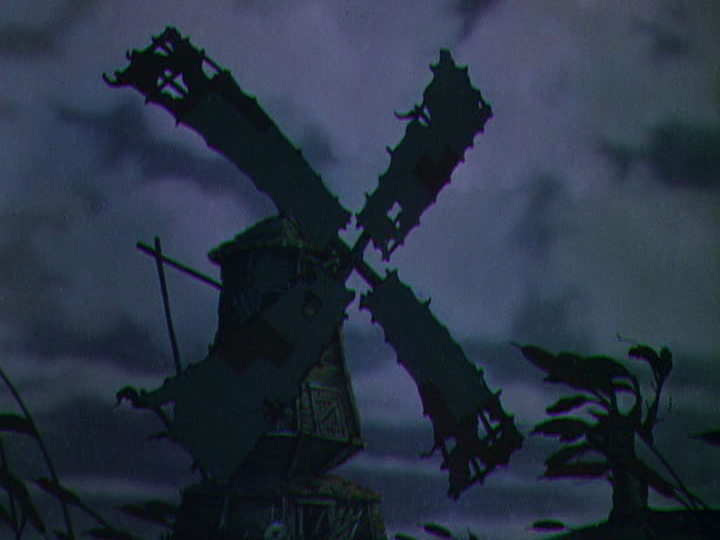
The windmill begins to spin again as storm clouds gather and the wind picks up ferociously

Suddenly, the wind begins to howl, and the windmill starts to turn. The bluebird who made her home in the cogs can’t bear to leave her eggs – luckily, the cog she is sitting under is missing, and she and the eggs ride through unharmed. The storm grows stronger, with the rain dripping through the leaky roof and open windows. A pair of doves sit together, weathering the storm on an open ledge. A group of mice shiver after the lightning strikes. Parts of the mill begin to fall apart. Without warning, the mill is struck by lightning, shifting it from its base.

The storm settles, and the bats return to the mill as dawn approaches. The bluebirds’ eggs have hatched, and mother and father return with food. As life returns to normal, the animals begin their day once again in the abandoned mill on the side of the peaceful pond.

October 1

October 1, 1935 – Actress, Singer, and Disney Legend Julie Andrews is Born

“I know that I am blessed and unbelievably lucky to be asked to do [Mary Poppins], at a time in my life when the next break was just a big question mark and suddenly, there was Mary Poppins and Walt.”

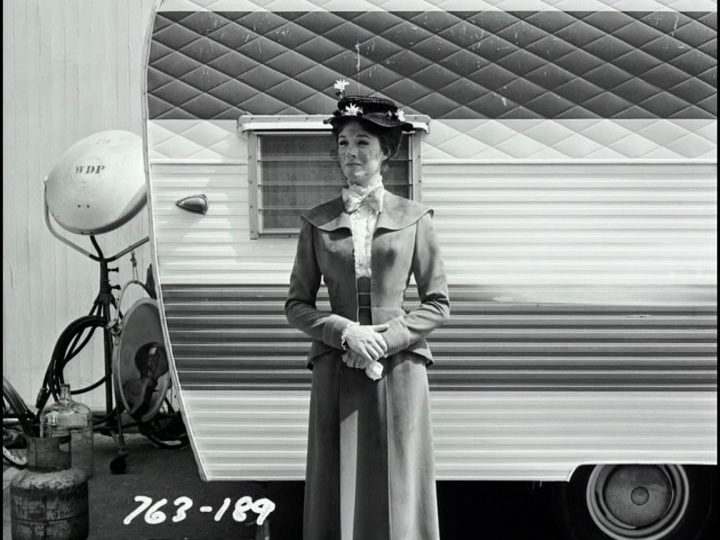
On October 1, 1935, actress and singer Julie Andrews (born Julia Elizabeth Wells) was born in Walton-on-Thames, England. During World War II, Andrews’ mother and father separated, with Andrews’ mother joining Ted Andrews in entertaining the troops through the Entertainments National Service Association; they soon married, and Julie was sent to live with her mother and step-father. Julie took private voice lessons with Madame Lilian Stiles-Allen, working on her amazing vocals, which ranged five octaves. At age 12, Andrews sang at the London Hippodrome, which soon led to many other opportunities on the sate, including Cinderella and The Boy Friend, as well as one of her most well-known roles as Eliza Doolittle in My Fair Lady.

Walt Disney was in the audience one night while Andrews performed as Queen Guinevere in the Broadway production of Camelot. After the performance, he went backstage and offered her the lead role in his new feature film, Mary Poppins. She agreed tentatively, as there was a chance that she would be in the film version of My Fair Lady; when the role of Eliza went to Audrey Hepburn, Andrews began the work on Mary Poppins. The film was a success, and made Andrews a star, with her winning an Academy Award and a Golden Globe for her performance. She starred in several high-profile films after this, including The Sound Of Music, which garnered her another Golden Globe, and a nomination for another Academy Award.

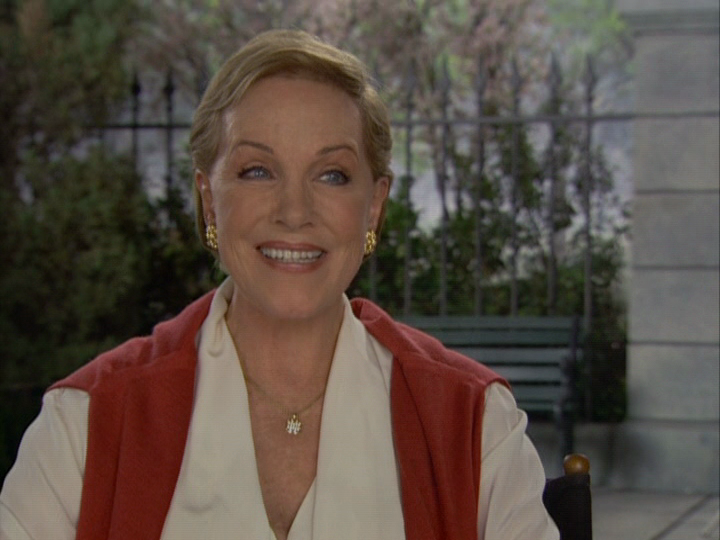
Andrews is best known for playing the title character in Disney’s Mary Poppins, a role that won her the Academy Award for Best Leading Actress

In 1991, Andrews was named a Disney Legend. In 2001, Andrews returned to Disney films by playing the role of Queen Clarisse Marie Renaldi in their adaptation of the Meg Cabot series The Princess Diaries, as well as the sequel The Princess Diaries II. In 2005, Andrews was named the Official Ambassador of Disneyland’s 50th Anniversary, promoting the celebration and the park with several events.

July 30

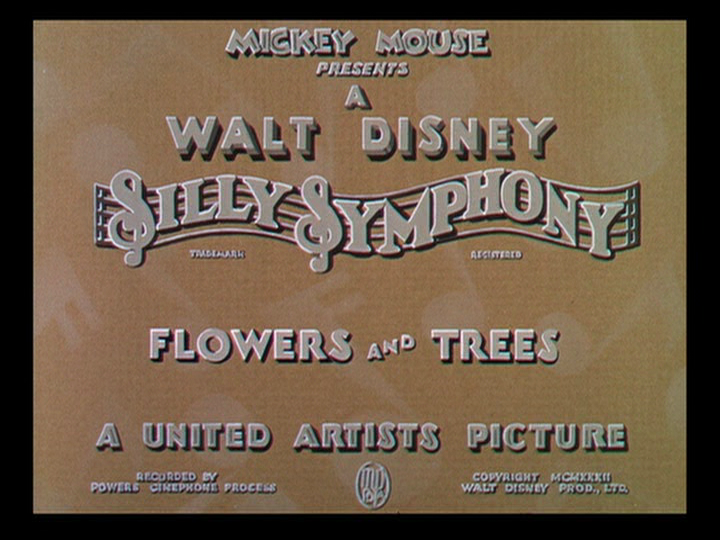
July 30, 1932 – The Academy Award Winning Silly Symphony Flowers and Trees is Released to Theaters

On July 30, 1932, the groundbreaking Silly Symphony Flowers and Trees was released to theaters. The short was directed by Burt Gillett, and became a landmark in Disney animation. Originally conceived in black and white, the short was scrapped at great cost to the studio to be redone in the new Technicolor process. Walt Disney signed an exclusive deal with Technicolor that gave him alone the rights of the process for two years, and after this short, all of the Disney shorts would be released in color. This process helped enhance the quality of Disney’s films, and Flowers and Trees would be awarded an Academy Award for Best Cartoon; at the same ceremony, Walt would be awarded a special Academy Award for the creation of Mickey Mouse.

One spring morning, the trees and flowers wake to the sound of a bird’s chirping, stretching in the morning light. One pair of trees in particular is enjoying the day, while an old stump scares the bird that tries to wake him. One tree begins to play a harp for his love, a beautiful young tree, who dances gracefully to the music while flowers dance around her. The flowers then bring her closer to her love and dance around them before making a heart shaped wreath on the ground. The male tree places it around the female’s head.

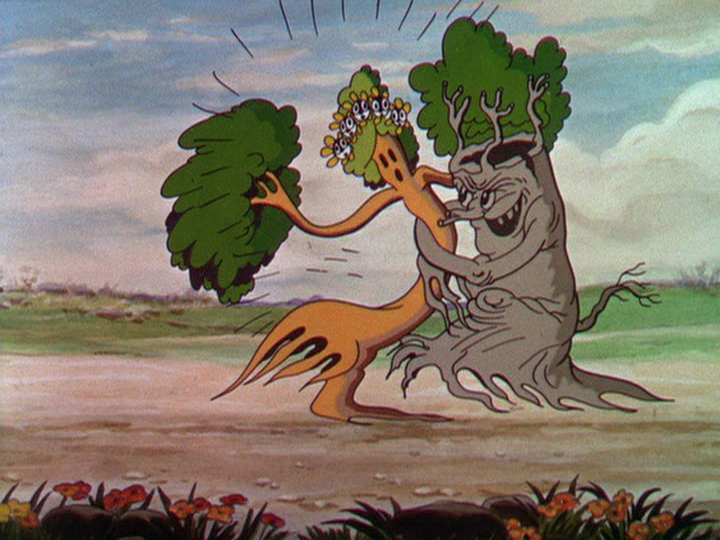
The female tree is captured by the stump, and she struggles in vain to escape

She continues to dance, unaware she is being pursued by the jealous, cranky old stump. He grabs her for his own, and the young male tree saves her before beginning a sword fight with the stump. The old stump is defeated, and decides to set the young male tree on fire. The male tries to stomp out the blaze, but to no avail. The plants that can run begin to flee, while others try to help put out the flames. The stump watches will glee as he sees the young couple being engulfed in flames, but soon finds himself victim of the blaze as well.

The flames being to grow in intensity, and the birds flock together to create a hole in the clouds that causes rain to fall and put out the fire. What’s left of the stump is found on the road, a victim of his own plan to destroy the couple, with his vultures swarming around the remains. After the storm clears, the male tree, proposes to the female, and the flowers sound the wedding bells.

June 12

June 12, 1928 – Disney Legend and Songwriter Richard M. Sherman is Born

“I was all of seventeen in a terrible, terrible depression, and I decided to take a walk. And as I walked, I was hearing music, and I was wondering, ‘Where is this music coming from?’ And I realized it was coming from my own head. So I darted back to the apartment where we had a little piano, and started picking it out on the piano. There was this feeling I had. I’d never done that before…and my father said, ‘What are you doing here? What is this?’ and I said, ‘This is something I felt, I had to say it. This is what I feel.’” – Richard M. Sherman

Born on June 12, 1928, Richard M. Sherman was the youngest son of Rosa and Al Sherman, the latter a songwriter in what was known as “Tin Pan Alley,” an area in New York City that published popular music that dominated the market from the late 19th century to the early 20th century. The Shermans moved to Beverly Hills, California, in 1937. Richard’s interest in music developed in school, where he studied several instruments, including the flute, the clarinet, the piccolo, and the piano.

In 1958, Richard teamed up with his brother Robert, writing the song “Tall Paul” for Disney star Annette Funicello. It was a top-ten hit, eventually peaking at #7 on the Billboard Hot 100 chart, which caught the attention of Walt Disney. He contacted the Sherman Brothers and hired them to write for the Disney Studios as staff songwriters. The brothers wrote several songs for Disneyland, including their most well-known song “it’s a small world (after all).” They reached their greatest success with the film Mary Poppins, writing the hits “Feed the Birds,” “Supercalifragilisticexpialidocious,” and the Oscar winning “Chim Chim Cher-ee.” The brothers worked for Walt Disney until his death in 1966, and left the company in 1982 after writing songs for Epcot.

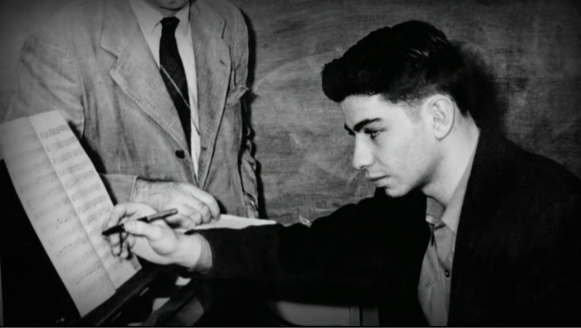
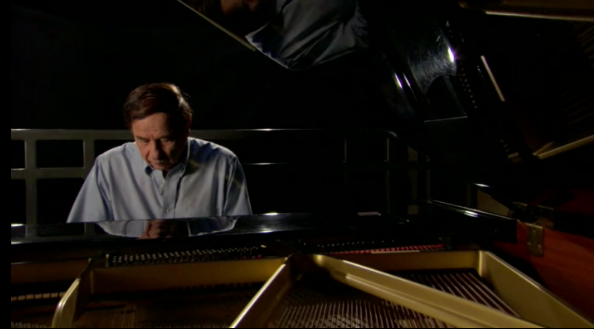
Richard playing one of his compositions in the documentary The Boys: The Sherman Brothers Story

The brothers worked on many projects outside of Disney, including the songs for the film Chitty Chitty Bang Bang and Charlotte’s Web, as well as the hit song “You’re Sixteen,” notable for being a Top Ten hit twice, first by Johnny Burnette in 1960 and Ringo Starr in 1973. Although the brothers had their greatest successes as a team, individually they have contributed greatly to the fields of music and literature. Richard released a CD in 2010 called “Forgotten Dreams,” a compilation of his piano compositions. One of his compositions, titled, “Make Way for Tomorrow Today,” was used in the movie Iron Man 2. The brothers were honored in 1990 as Disney Legends, and were awarded the National Medal of Arts in 2008. As Richard once put it, “We both really didn’t necessarily want to be songwriters. What I wanted to be was a great symphonic composer.” The brothers’ life story was chronicled in the 2009 documentary The Boys: The Sherman Brothers’ Story, which told the tale of how they ended up bound together and delighted the children of the world with their fantastical songs.