RSS Feed

Tag Archives: Academy Award Nominated

October 20

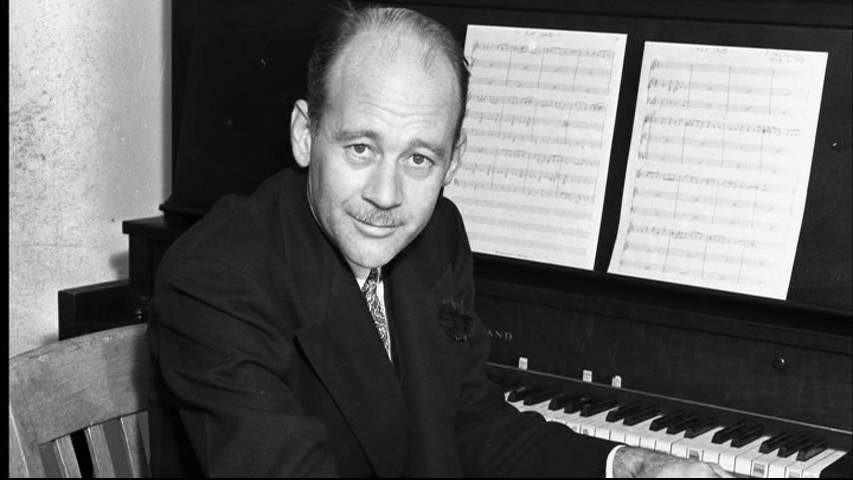
October 20, 1901 – Composer and Disney Legend Frank Churchill is Born

“I began writing musical scores for these animated cartoons to get away from the cost of using stock music. Being a reader of fables, they furnish most of the ideas which I put to music.” – Frank Churchill

On October 20, 1901, film composer and Disney Legend Frank Churchill was born in Rumford, Maine. A gifted musician from an early age, he had his first professional job at 15, accompanying silent films at a theater in California. Although enrolled at the University of California, Los Angeles in pre-med, he dropped out to pursue his passion for music. Churchill joined the Walt Disney Studios in 1930, and eventually scored nearly 65 short films. He is most known for the song “Who’s Afraid of the Big Bad Wolf?” from the Silly Symphony The Three Little Pigs. The song sold more than three quarters of a million copies.

Churchill was asked to develop the songs for Snow White and the Seven Dwarfs; he earned an Academy Award nomination for the film’s score, and created the classic songs “Whistle While You Work,” “Heigh-Ho,” and “Someday My Prince Will Come.” He received another two nominations for his work on Dumbo, one for the score, and one for Best Song for “Baby Mine,” co-written with Ned Washington. He would also receive nominations for Bambi, one for score, and one for the song “Love is a Song,” co-written with Larry Morey. Churchill passed away on May 14, 1942 of a self-inflicted gun shot; he was inducted as a Disney Legend in 2001.

October 18

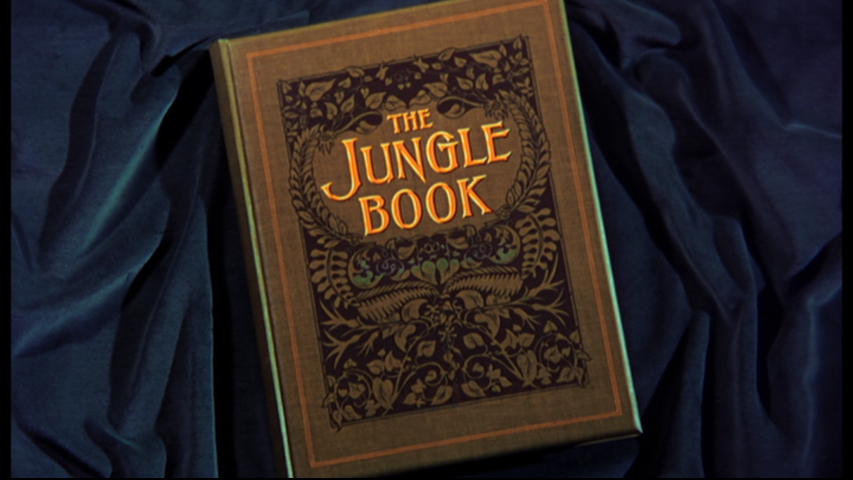
October 18, 1967 – The 19th Animated Feature Film, The Jungle Book, is Released to Theaters
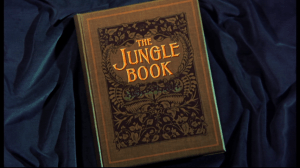
“As an animator, [The Jungle Book is] probably the greatest film in terms of character development and how characters play against one another. The animators poured their whole heart and soul into every scene in that movie.” – Animator Glen Keane

On October 18, 1967, the 19th animated feature, The Jungle Book, was released to theaters. The film was based on the book of the same name by Rudyard Kipling, and was the last film which Walt Disney supervised; Disney passed away during its production. The movie was also known for the vultures being a caricature of the famous band The Beatles, as Disney wanted them to be in the film, but they turned him down due to scheduling conflicts and John Lennon’s disgust with the idea; the vultures did remain in the film without The Beatles’ involvement. The film was directed by Wolfgang Reitherman, and stars Phil Harris as Baloo, Sebastian Cabot as Bagheera, Bruce Reitherman as Mowgli, Louis Prima as King Louie, George Sanders as Shere Khan, and Sterling Holloway as Kaa.

Storyman Bill Peet was the one that suggested Kipling’s book to Disney as an animated feature, making the point that the company could do more stories with more interesting characters. Although Peet usually ran a one-man show when it came to story, and Disney liked the story sketches he was seeing for Jungle Book, Disney wanted to have more hands-on involvement in the story process after the let-down of Peet’s last project, The Sword in the Stone. The two could not reach an agreement on the film, and Peet left the studio. The story was then given to Larry Clemmons for his first writing on an animated feature film. “…[H]e launched into how he wanted to tell the story,” Richard Sherman recalled. “And he said, ‘But I want it to be fun. I want this to be a fun story; an adventure with fun. No mysterious…none of this heavy stuff…and I want to have a little heart in it, too.’”
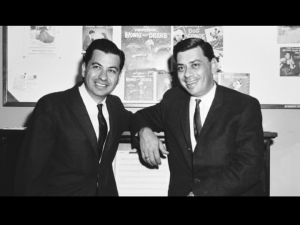
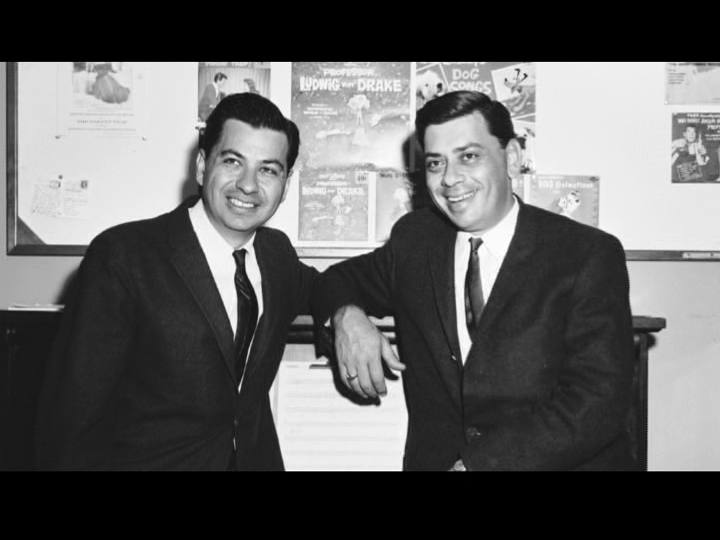
The songwriting team of the Sherman Brothers, who were brought in to write the songs for “The Jungle Book” when Walt Disney came in to rewrite the story

The music for the film is considered one of the greatest soundtracks of Disney animation. The first songs written for the film followed Peet’s darker version of the story, and was done by Terry Gilkyson. When the story went through its rewrite, the Sherman Brothers were brought in to write new songs that were more upbeat and help to progress the story. The only song to survive from Terry Gilkyson was the one that would go on to be nominated for an Academy Award: “The Bare Necessities.” One of the songs that the Sherman Brothers had written for Mary Poppins was retooled to be used for the character of Kaa, called “Trust in Me.” The film was scored by George Bruns, who was well known for writing for Davy Crockett.

The story opens with narration from Bagheera, a black panther, who stumbles upon a basket upon a riverbank in India. Inside, he finds a baby; taking pity on the poor orphan child, he places him with a wolf that had recently had cubs. The mother adopts the child, who is named Mowgli, and raises him alongside her litter. Ten years later, the wolves find out that Shere Khan, a Bengal tiger, will be returning to the jungle and killing anyone who dares protect Mowgli. Bagheera offers to take Mowgli to the man village for his own safety, although the boy is determined to stay in the jungle. While the pair rest in a tree for the night, a python named Kaa appears, who attempts to hypnotize the boy and devour him. Luckily, Bagheera wakes up and interrupts Kaa, with Mowgli sending the python flying out of the tree.
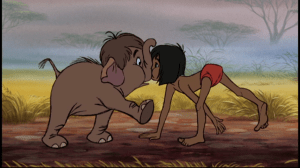
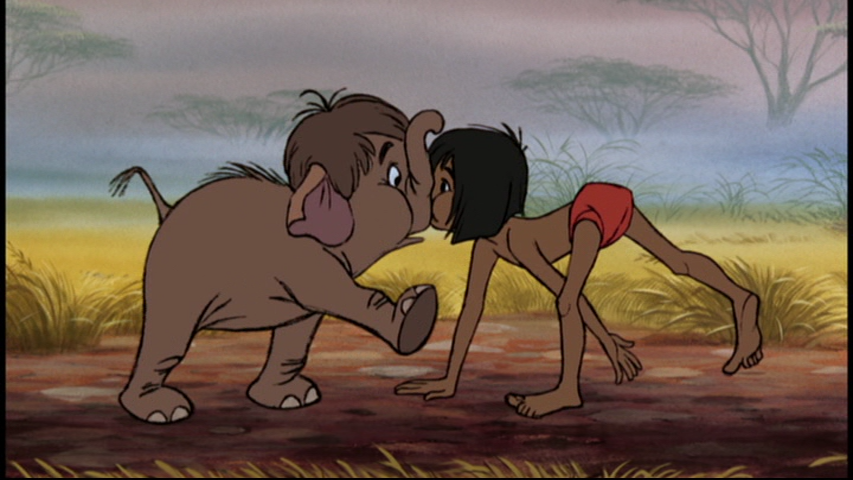
Mowgli meets up with the members of Colonel Hathi’s elephant pack, and hopes that by becoming a member, he can remain in the jungle

The next morning, Mowgli attempts to join Colonel Hathi’s elephant pack, but is quickly intercepted by Bagheera. The two get into an argument about Mowgli’s wish to remain in the jungle, which ends with Bagheera leaving Mowgli to fend for himself. As Mowgli wanders the forest, he comes across Baloo, who aims to teach Mowgli how to fight. When he tries to teach the boy how to roar, Bagheera believes the boy to be in trouble and rushes back to help. Baloo shows Mowgli the carefree life of the jungle, which only makes Mowgli more certain that he will never go back to the village. Unfortunately, just as Baloo and Mowgli begin to bond, a gang of monkeys capture Mowgli to take him back to their leader, King Louie, an orangutan.

Mowgli is brought to the ancient ruins where King Louie lives, and King Louie promises to help the boy remain in the jungle if Mowgli tells him the secret of how to make fire. Baloo, entranced by the music the monkeys are playing, disguises himself so he can sneak in and take Mowgli away. In the ensuing fight over Mowgli, the ruins fall apart, leaving King Louie without a kingdom. That night, Bagheera convinces Baloo that the best thing for Mowgli is to be taken back to the man village, so he doesn’t get killed by Shere Khan. Baloo is torn with what to do, as he loves Mowgli like he was his own cub. When Baloo tries to explain the situation, Mowgli accuses Baloo of breaking his promise and runs away. Bagheera enlists the help of Colonel Hathi to help find Mowgli before Shere Khan shows up, but Shere Khan is seen eavesdropping and is even more determined to kill the boy.
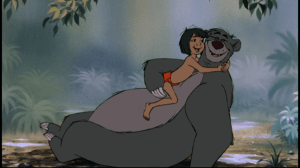
 

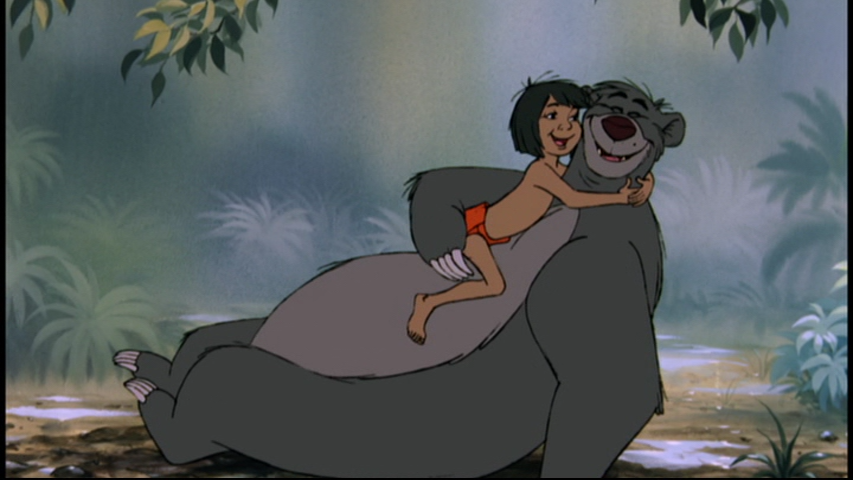
After the fight with Shere Khan, Mowgli gives Baloo a hug, with all being forgiven

As Mowgli wanders the jungle, he runs across Kaa again, who is still hungry. He hypnotizes the boy, but his plans are again interrupted, this time by Shere Khan, and Mowgli escapes. Depressed, he finds a place to sit as a storm fast approaches, and meets a group of vultures who agree to be his friends. Shere Khan finally catches up with Mowgli, scaring the vultures away. Baloo, having finally found the boy, rushes in to save him during the storm, with the vultures returning to create a diversion. When a nearby tree is struck by lightning, Mowgli grabs a flaming branch and ties to it Shere Khan’s tail. The tiger’s only fear is fire, and he flees when he is unable to remove the flaming branch. Baloo and Bagheera still maintain that Mowgli should be taken to the village, but Mowgli remains adamant that he should stay in the jungle. His mind changes, however, when he spies a beautiful girl near the river’s edge. He follows her, helping her carry her water pot. Although Baloo is saddened to lose the boy, Bagheera reminds him that Mowgli will be safe with his own kind, and the two dance off into the sunset together.
September 23

September 23, 1938 – The Mickey Mouse Short The Brave Little Tailor is Released to Theaters

“I’ll be seeing you…I hope.”

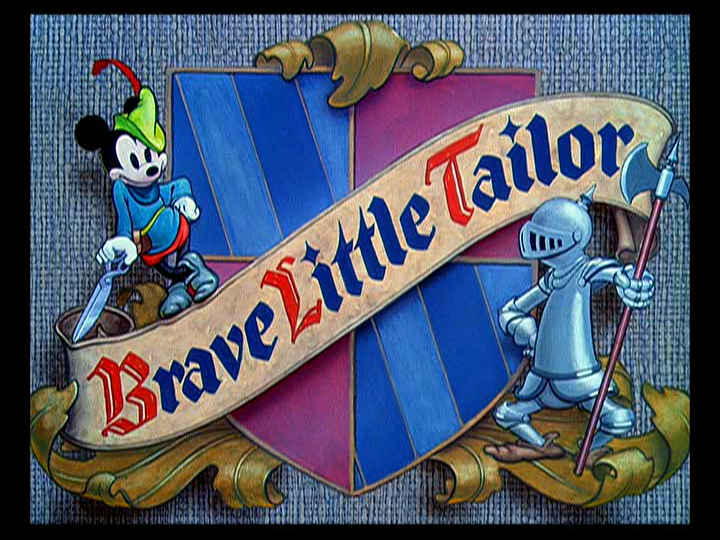
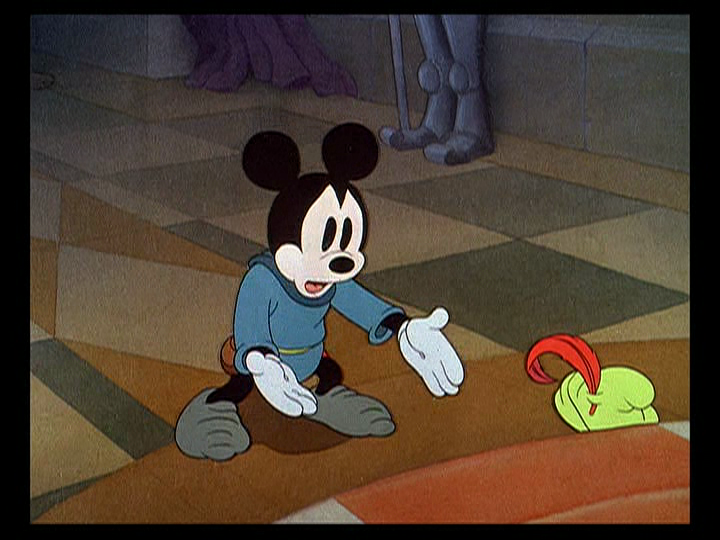
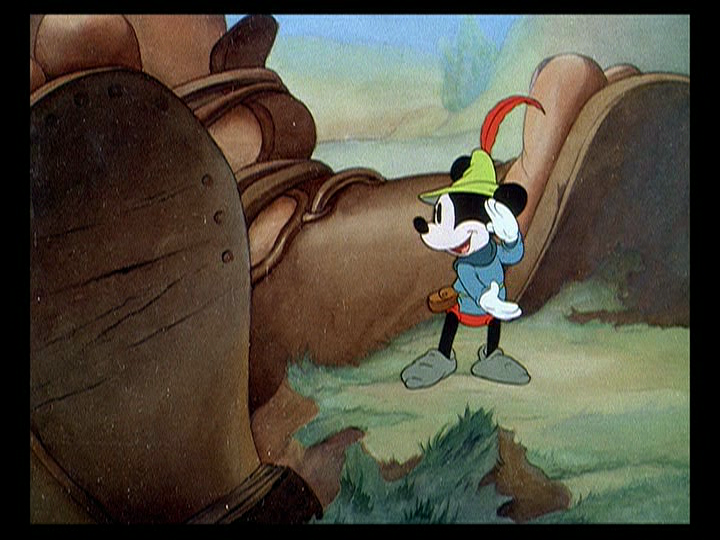
On September 23, 1938, the Mickey Mouse short film The Brave Little Tailor was released to theaters. It was based on the fairy tale The Valiant Little Tailor told by the Brothers Grimm, with Mickey taking on the role of the tailor. It was nominated for an Academy Award at the 11th Academy Awards in 1939, but lost to another Disney short, Ferdinand the Bull. It was directed by Bill Roberts, and stars Walt Disney as Mickey Mouse and Eddie Holden as the king.

The short begins with the sound of nervous chatter between the villagers, scared that the giant that has been tormenting them is on the loose. The camera then pans over to the tailor shop, where Mickey is patching up a piece of clothing while being bothered by a swarm of flies. He finally takes two flyswatters and manages to swat all seven flies with one hit. Outside his window, one villager asks two others if they’ve ever killed a giant. Mickey then bursts open his window and proclaims he’s killed “seven with one blow” leaving the villagers to assume that he’s killed seven giants. The rumor spreads like wildfire, making its way up to the king.

Mickey pleads with the king after being asked to be the Royal High Killer of the Giant

Mickey is soon presented to the king, who asks to hear his story. Mickey acts out the story of killing the flies in a dramatic fashion – still not explicitly stating that they were flies, not giants – amazing the entire court. The king then appoints Mickey as the Royal High Killer of the Giant, greatly surprising Mickey. The king promises to present Mickey with a great sum of money, but Mickey stutters that he can’t kill the giant; he only accepts when offered the hand of Princess Minnie.

Mickey is soon off to face the giant, with the entire kingdom cheering him on. Although he puts on a brave front, he admits quietly that he doesn’t know how to catch a giant. As he sits and mopes, the giant soon approaches, stealing a farmer’s crops, destroying a farmer’s well to drink the water, and stealing a farmer’s stove to light a cigarette made from the farmer’s hay. Mickey, who had been hiding in the hay, is found by the giant, and soon springs into action, using his skills as a tailor to tie up the giant and cause him to trip.

Mickey vanquishes the giant, and looks on proudly at his work

In the end, Mickey has vanquished the giant, and the kingdom holds a festival, with the sleeping giant powering the amusements with his snoring as he is kept under heavy chains. Mickey and Minnie kiss while riding the merry-go-round, and the king lets out an excited whoop as his kingdom is once again safe.

August 1

August 1, 1958 – The Special Short Film Paul Bunyan is Released to Theaters

“A job that needed a great big man, Paul Bunyan was the one.”

On August 1, 1958, the special short film Paul Bunyan was released to theaters. The short was directed by Les Clark, with the story adapted by Lance Nolley and Ted Berman, and voices provided by the Mellomen. The short was also nominated for an Academy Award for Best Short Subject (Cartoon) at the 31st Academy Awards.

The story of Paul Bunyan begins with his arrival in a small town on the coast of Maine, when lumberjack Cal McNab looks inside a cradle that has been left in right on the edge of town and sees a giant baby inside. The whole town adopts the baby and names him Paul Bunyan, and everyone pitches in to make his clothes and feed him. Paul quickly grows up in the town, attending school and playing with the boys of the town at the swimming hole. One Christmas, the town gave Paul a giant axe, and he took to cutting timber “like a duck takes to water.” Paul provides his town with enough timber to last a lifetime, and the town grows quickly, becoming too crowded for Paul. One morning, he leaves a note for the town, thanking them for everything, and letting them know he was looking for more room. Cal ends his part of the tale stating that the whole town was going to miss Paul.

Paul saves Babe, who is so grateful, he remains as Paul’s pet and best friend

The next part of the story is told by straw boss Chris Crosshaul, who meets Paul in the Midwest. Paul is seen cutting timber as fast as he can, and stomps the stumps back into the ground before leaving for more room and more trees to cut. As Paul leaves, he runs into the worst blizzard the country had ever seen, with the flames freezing when he tries to light a fire. In the middle of his task, he hears a sound in the distance, and sees a large ox frozen in the snow. The ox has turned blue from the cold. He thaws the ox out, and the ox, grateful for Paul’s help, becomes Paul’s pet, “Babe.” The two continue their travels in the storm, leaving behind them many tracks that filled with water and became the land of 10,000 lakes. They continue to chop down trees, dig the Missouri River to send the logs down to the sawmill, and build Pike’s Peak to view other parts of the country left to chop down. According to Crosshaul, Paul and Babe also created the Grand Tetons and Yellowstone Falls through their roughhousing.

The last chapter of the story is told by river foreman Shot Gunderson. The day Paul arrived at his camp, the camp was in trouble: they could get timber in the river, but the river was too windy and the logs couldn’t get to the mill. With Paul and Babe’s help, the river is pulled straight, and the logs go directly to the sawmill. One day, a traveling salesman comes to town, demonstrating a steam-powered chainsaw, which promises to chop down trees faster than regular chopping. A competition is set between the man versus machine, and the two set to work on the day. Unfortunately for Paul, the machine beats Paul by 1/4th inch, and discouraged, walks away from town. Gunderson tells the audience, however, not to feel sorry for Paul and Babe, as they’re in Alaska, creating the Northern Lights thanks to their roughhousing.

July 17

July 17, 1943 – The Film Victory Through Air Power is Released to Theaters

“Our country in the past has struggled through many storms of anguish, difficulty, and doubt. But we have always been saved by men of vision and courage, who opened our minds and showed us the way out of confusion.”

On July 17, 1943, the feature film Victory Through Air Power was released to theaters. The film was based on the book of the same name by Maj. Alexander P. de Seversky, who also served as the on-screen narrator of the film. De Seversky’s book explains how long-range air power could defeat the enemy during World War II. Walt Disney, like many who read the book, was impressed with the material, and it became one of his most ambitious projects. He used the film to educate and send a message to the public rather than to entertain, as at the time the film was released, an Allied victory was anything but certain. H.C. Potter was hired as the live-action director, and David Hand was the Animation Supervisor, with Art Baker as the animation sequence narrator. Critics did not like the film, and RKO, Disney’s film distributor, did not want to release it, so Disney released it through United Artists. The film was nominated for an Academy Award for Best Scoring of a Dramatic or Comedy Picture.

Although the film was not popular with critics, it did the job of presenting the idea of air power to win the war. “[T]he most important response to the movie came from Winston Churchill,” film critic Leonard Maltin explained. “When [Churchill] flew to Quebec for an Allied conference, and learned that President Roosevelt hadn’t seen the movie, he and Air Marshal Tedder prodded him until he ordered that a print be sent to him. H.C. Potter was told by Walt that it was only after Roosevelt saw Victory Through Air Power, that our country made the commitment to long-range bombing. And that, after all, was the reason that Walt committed to making this movie in the first place.”

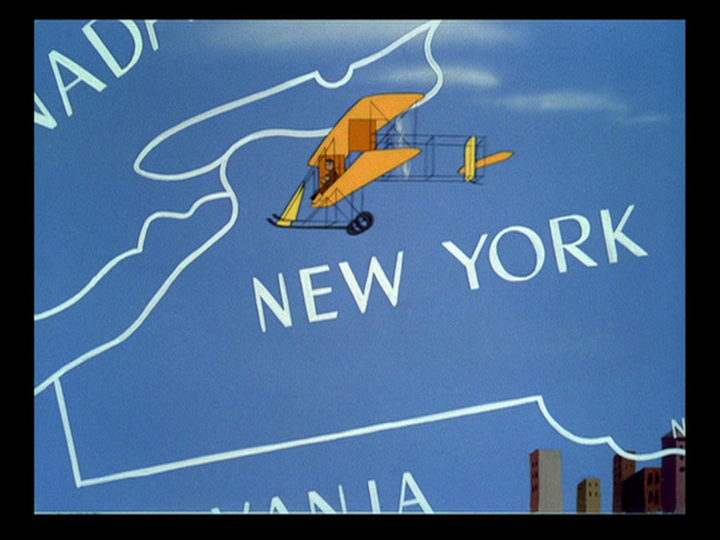
The animated sequence shows the progression of air power, including the first trans-continental flight

The film begins with newspaper clips from past years, beginning with 1919, where men have tried to convince the public about air warfare, and how defense depends on an air army. The film is then dedicated to Billy Mitchell, who was a pioneer in the fight for air power, and the brave airmen of the United States military. The audience then sees the history of flight in an animated sequence, beginning with Orville and Wilbur Wright, and leading into the first air corps, the first aircraft carrier, and the first trans-continental flight. When World War I began, aircraft was used only for observation service, until the installation of the machine gun turned the plane into a weapon. The bomber would soon develop from this idea.

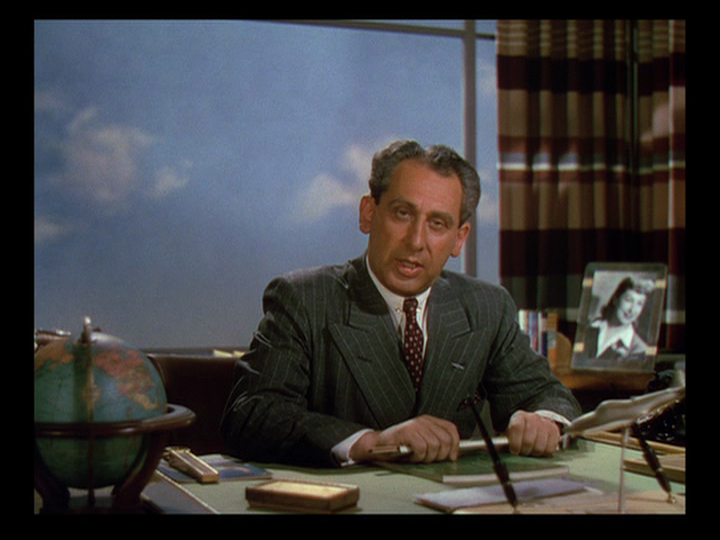
1939 brings about a new war, and American aviation is ready to meet the challenge of the Axis powers. This then leads to the introduction of Maj. de Seversky and his book, Victory Through Air Power. De Seversky began his military education in Russia at age 10, graduating as a lieutenant, and seeking service in 1914. He became a pilot and was assigned flying duties, but was shot down on a night flying mission, resulting in the loss of his right leg at the tender age of 22. Nevertheless, de Seversky became a strong proponent of air power, and the leading ace of air warriors. In 1918, he came to the US and worked for the United States Army, becoming a major in the U.S. Army when he became a citizen in 1928.

Maj. Alexander de Seversky, who explains to the audience why air power is an absolute necessity to win the war

De Seversky begins his speech to the audience, warning that it’s only a matter of time until the U.S. has its share of civilian casualties, thanks to the advances of air power by other countries. He also declares that everyone must understand the strategy of war. There were formerly two ways to destroy the enemy: one was to destroy the enemy’s entire army to grab their source of power, the other was to sink their navy and enforce a blockade. With the airplane, there is no safe place: the plane can attack quickly over the heads of the enemy forces. Those that could foresee the usefulness of air power were considered crazy and ignored. An example is then shown of how England was supposed to attack the Nazis via sea forces, and the French were to attack via the land. Hitler, however, came in with air power, which allowed him and the Nazi forces to take over France. “Only when it was too late,” de Seversky warns the public, “did the French realize that their whole plan of defense was futile.” The British thought they could stop the Nazis through a blockade, only to find their battleships destroyed by bombers. The Royal Air Force grew out of this tragedy, ready to attack Hitler’s air troops. “As long as a nation controls its own skies, it cannot be invaded,” de Seversky tells us as the moral of the British story.

The audience is then shown the first real battle between air power (Nazis) and sea power (British Navy) over the island of Crete. Crete became the first territory to be conquered completely through air power. This then leads to Pearl Harbor, and how American troops left themselves unprotected against the air power of the Japanese troops, because the American troops were instead prepared for traditional naval warfare. De Seversky explains that the Japanese were imitating the German blitzkrieg, and were able to capture most of the Pacific. American armed forces finally realized that no place on Earth was safe without gaining control of the skies above. The success of American victory through air power demanded two things: to produce a vast amount of weapons of endless variety, and to deliver this equipment to battlefronts all over the face of the Earth.

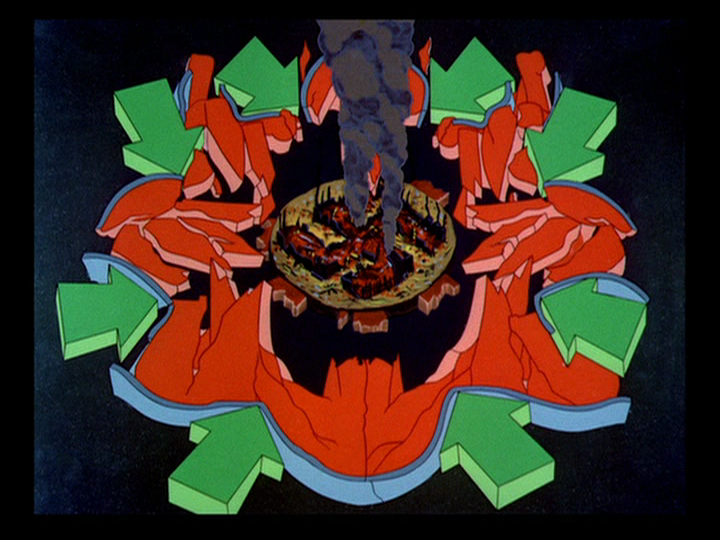
Animated sequences are used through the film to illustrate de Seversky’s points; this image shows how American air power can cut Hitler off at the source, allowing troops to invade

The audience is then introduced to another problem to consider: the transportation of these weapons. America is able to transport across the country with no problem, but gets caught in the slow speeds of shipping to overseas locations. Americans also have to contend with the German submarines. The audience is warned that if Americans fight only on the surface of the Earth, Hitler has all the advantage. Air power would give American forces an advantage and the ability to cut off Hitler’s power at the source. Success will also depend on supply lines, and where American air bases are located. The film ends with a patriotic look at how American forces can use air power and airmen’s skills to win the war. “America should not hesitate to place its destiny in the hands of [the airmen],” de Seversky explains, “for with the strategy of air power, they will make the enemy fight on our terms, against the weapons of our choosing, at our time, but on his soil.”

July 3

Posted on

July 3, 1914 – Disney Legend and Composer George Bruns is Born

“George was big and easy-going, but he worked very hard and produced a seemingly endless string of fresh melodies and haunting scores.” – Animators Frank Thomas and Ollie Johnson.

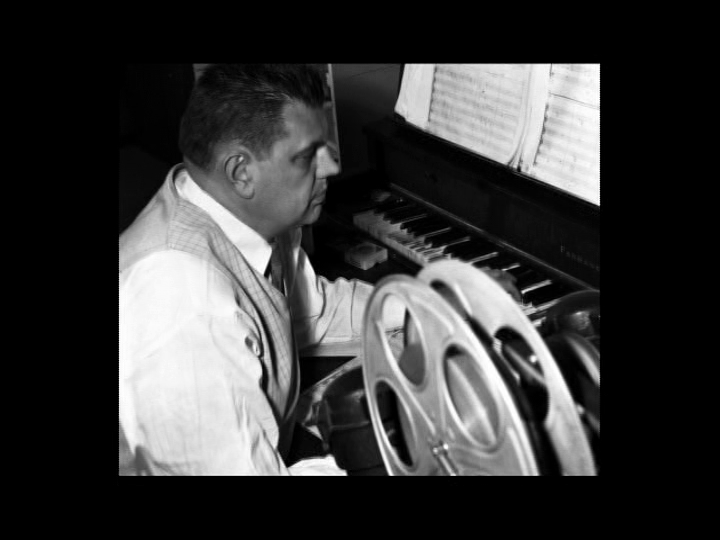
On July 3, 1914, George Bruns was born in Sandy, Oregon. He was taking piano lessons by age six; by high school he could play the tuba and trombone proficiently, and he later was able to play 12 more instruments well. Bruns attended Oregon State University, and moved to Los Angeles, California, in 1950. There, he began his conducting career for Capitol Records and UPA Studios. Bruns got his big break in 1953, when Walt Disney hired him personally to score the feature Sleeping Beauty, which would earn him his first of four Academy Award nominations while at the Disney Studios. Bruns was then asked to compose a piece for the upcoming television series about Davy Crockett. This piece would become Bruns’ most well known composition, skyrocketing to the top of the Hit Parade for six months and selling more than eight million records.

Bruns continued to score Disney films for 22 years, with films including The Absent-Minded Professor, 101 Dalmatians, The Jungle Book, Robin Hood, and The Love Bug. He would earn three other Academy Award nominations for the first live-action musical for the studio, Babes in Toyland; for the 1963 animated film The Sword in the Stone; and for the song “Love” from Robin Hood. Bruns continued to score pieces for the Disney television serials; the theme for Zorro gave him another hit, selling a million records. After contributing to more than 200 projects, Bruns retired from Disney in 1975 and returned to Oregon to continue to compose and to teach at Lewis and Clark College. Bruns passed away on May 23, 1983, in Portland, Oregon. In 2001, he was honored as a Disney Legend.

June 26

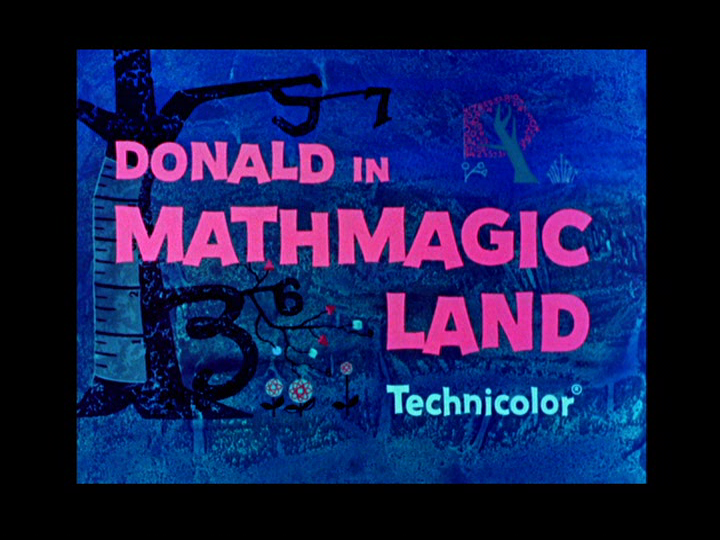
June 26, 1959 – The Donald Duck Featurette Donald in Mathmagic Land is Released to Theaters.

“By golly! You do find mathematics in the darndest places!”

On June 26, 1959, the featurette Donald in Mathmagic Land was released to theaters. This Academy Award-nominated short would go on to become one of the most popular educational films ever released by Disney. It was also shown on the first program of Walt Disney’s Wonderful World of Color, introduced by Professor Ludwig von Drake, who played the True Spirit of Adventure in the featurette. The story was written by Milt Banta, Bill Berg, and Dr. Heinz Haber, and starred Clarence Nash as the voice of Donald.

Donald, dressed in a hunter’s outfit, enters a dark room with his gun and looks around, remarking on how strange this all seems to be. He follows a trail of numbers, and finds the creature making the markings is a walking pencil, who challenges Donald to a game of tic-tac-toe, which Donald loses. He continues to walk, surprised by the square roots he runs into. He calls out hello to anyone who will hear him, and the voice of the narrator greets him. The narrator informs Donald that he is in Mathmagic Land, the land of great adventure, and that he, the narrator, is the True Spirit of Adventure. The spirit tells Donald he will take him on a journey through the wonderland of mathematics.

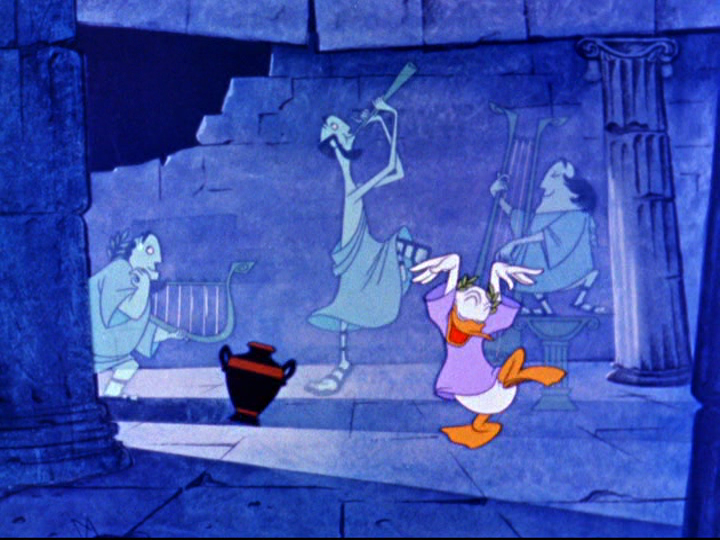
Donald having a jam session with the Pythagoreans, while learning that without math, there would be no music

As Donald storms away, saying math is for eggheads, the spirit informs Donald that without “eggheads,” there would be no music. He takes Donald back in time to Ancient Greece to meet Pythagoras, the father of mathematics and music. Donald is still confused, so the spirit shows Donald how music is full of mathematics. The first example shown is a harp, demonstrating how an octave is created. Donald and the spirit then sneak in on a meeting of the Pythagoreans, who are playing music in their meeting. Donald interrupts them, saying they need to play something with a beat. The Pythagoreans, the spirit explains, helped create the music we know and love today. As the spirits of the Pythagoreans disappear, Donald is left with a surprise – he is made a member of the Pythagoreans.

The segment then moves to another Pythagorean discovery: the pentagram, filled with mathemagic. The first concept explained is the golden section, then we move to the golden rectangle, which the pentagram creates many times over. The Greeks believed the golden rectangle to be a natural law of beauty. The spirit then shows how the pentagon, another Pythagorean shape, is found in nature, before moving on to other shapes found in nature.

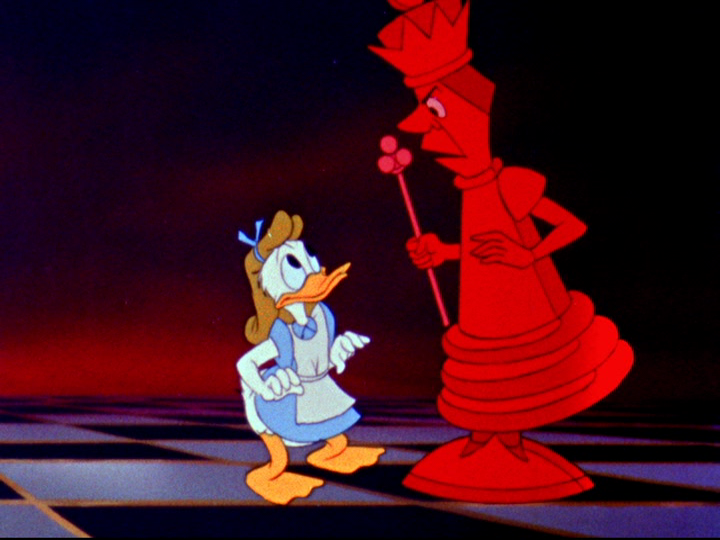
Donald plays the part of Alice when being taught the mathematical principles of the game of chess

Donald, who is enjoying his adventure so far, is delighted to hear that one can find mathematics in games, as well. The spirit begins with the game of chess, explaining it with the concept of Alice in Wonderland, with Donald playing the part of Alice. After a slight adventure with the chess pieces, Donald is able to watch a game in safety, but is bored by it. The spirit then begins to list sports with a geometric field, like baseball and football. The game that gets Donald really excited, however, is billiards. The spirit then shows an expert playing three-cushion billiards, and the mathematics used to get the perfect shot.

The spirit then tries to get Donald to play a game with his mind, only to find that Donald’s mind was completely cluttered with antiquated ideas, bungling, false concepts, and superstitions. He cleans out Donald’s mind, then has Donald think of a perfect circle, and puts a triangle in it. When asked what he sees, Donald sees a sphere. The spirit then has Donald take one thing and see how many items he can come up with using those shapes. Donald is then taken to a hall filled with doors, with most of them open. Some of the doors Donald discovers are locked, to which the spirit replies that they are the doors of the future, with the key being mathematics. The short then ends with the Galileo quote: “Mathematics is the alphabet with which God has written the universe.”

March 9

March 9, 1955 – Man in Space Premieres on the Disneyland Television Show

“One of man’s oldest dreams has been the desire for space travel, to travel to other worlds.” – Walt Disney

On March 9, 1955, audiences watching the Disneyland Television Show saw a different kind of episode, called Man in Space. The first installment of the Tomorrowland segments of the show, Man in Space was directed and produced by Ward Kimball (see March 4th entry), who had written the episode with William Bosche, and features guests Werner von Braun, Willy Ley, and Heinz Haber, who were major scientists associated with space exploration. It was so well received that President Dwight D. Eisenhower asked for a copy to present to the Pentagon, and this helped push the space program into the forefront of the public imagination. In 1956, an edited version of Man in Space was nominated for an Academy Award for Best Short Subject (Documentary), after it was released to theaters on a double bill with Davy Crockett and the River Pirates.

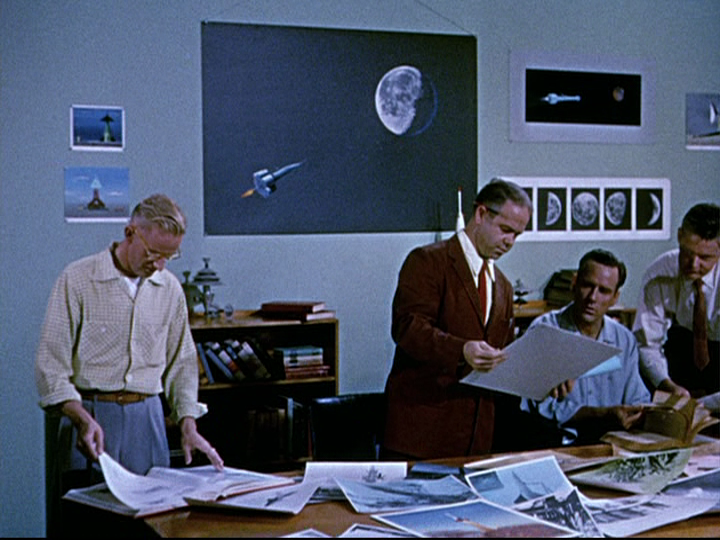
Ward Kimball (C) looking at mock-ups and prototypes in the design room

As the Man in Space episode opens, the audience is taken to a design room, where men are hard at work designing prototypes of rockets and developing methods of space travel. Walt explains that the creative talents of the Disney Studios are working with engineers and scientists to make the dream of interplanetary travel a reality. “In working with engineers and scientists,” director and producer Ward Kimball explains, “we have found that there are many different opinions as to how we will eventually cross the space frontier.” The one common point between these opinions, though, is that it will be a rocket-powered ship heading into space. Kimball then leads the viewers into a history of rocketry, beginning with China in the 13th century.

The rocket was not a modern invention, Kimball points out; the Chinese invented it at the battle of Kai-fung-fu in 1232. A brief animation segment shows two Chinese men shooting rockets at each other from far distances, with each rocket increasing in size. Kimball then jumps forward 500 years to Sir Isaac Newton and his often paraphrased “for every action force, there is always an equal but opposite reaction force.” Kimball makes this clearer by using the example of the family dog when it sneezes. The segment also shows a few examples of rocket propulsion experiments, including a steam-powered rocket, and notes that designers ultimately stuck with gunpowder-powered designs.

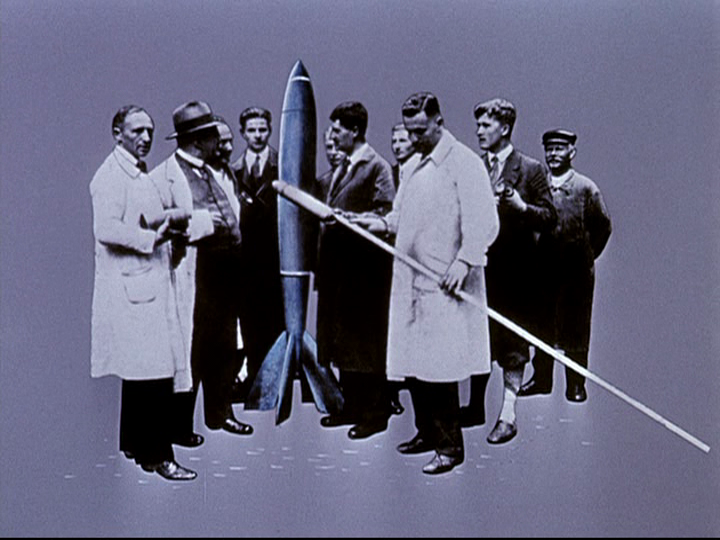
A stylized photograph of one of the early German societies dedicated to the study of rocket science

In 1865, Jules Verne published From the Earth to the Moon, which again piqued people’s interest in flying into space. Verne’s story inspired the French filmmaker Georges Melies to create the first space-travel film in 1902. Kimball shows the audience this silent film, and continues with a history of the different kinds of fuels used to power small rockets that could one day be used to send men to space. Rocket frenzy was highly evident in the 1920s and ’30s, with rockets attached to any possible vehicle. Around this time, a new society in Germany was founded, with the mission of scientifically exploring the possibility of space travel. The German army took a keen interest, and used the society’s findings to create rocket missiles and one of the forerunners of a spaceship, known as the V-2. After WWII, 75 of these V-2 rockets were taken to the U.S. for study in its newly developed rocket program.

Kimball then introduces rocket historian Willy Ley to explain how rocket firing works. Ley begins by showing a model of a rocket motor and explaining to Disney artists how it works. An animated sequence explains how the motor continues to work in space where there is no oxygen. Ley asks the animators to create a sketch of a three-stage rocket to help him explain how it would work. The animators ask some very interesting questions as Ley uses the chalkboard to help his explanations, but the section is not overly technical, so the audience is still be able to understand well.

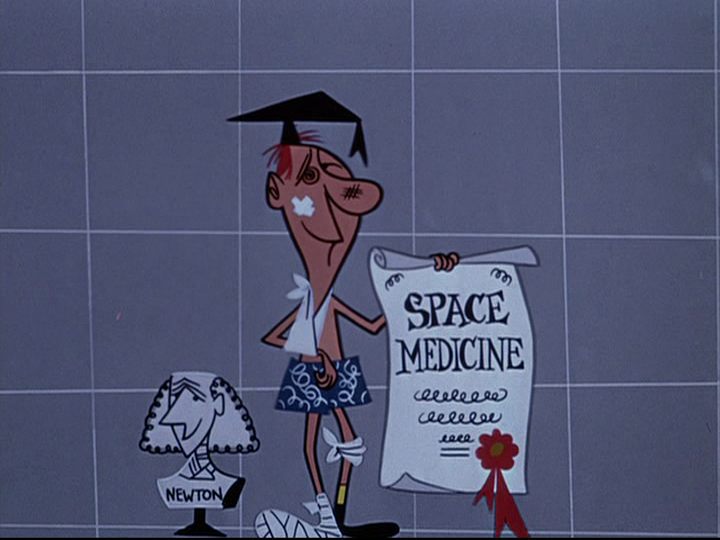
The "ordinary man" example, after going through rigorous (and humorous to the audience's perspective) training, passes the space medicine course

In the next segment of Man in Space, Kimball describes a new field of science known as space medicine, or how man will react physically and mentally in space, and introduces the expert in this field, Dr. Heinz Haber. Haber pulls down a screen to set the stage for another animated segment, this time of the “common man” who will be sent into space. As we follow this common man through his daily routine in space, Kimball’s special brand of humor keeps things light.

In the third segment of the episode, Kimball explains the two problems of space flight: building a rocket ship, and preparing and training the men to travel into outer space. Kimball then introduces Dr. Wernher von Braun, the chief of the Army’s guided missile division, who was the overall director of development for the original V-2 rocket. Von Braun is seen explaining to two other men the problems of space travel. Looking at some similar present-day situations can help come up with solutions, von Braun says. He gives a few examples of the current research, with testing performed on the ground in simulated atmospheres. The tests that von Braun describes are then presented in an animated sequence narrated by Dick Tufeld, best known as the voice of the robot in the television show, Lost in Space. The animated short ends with an accomplished mission into space, with the next goal of getting man to the moon, then the planets, and then to what lies beyond.