RSS Feed

Tag Archives: 1950s

March 3

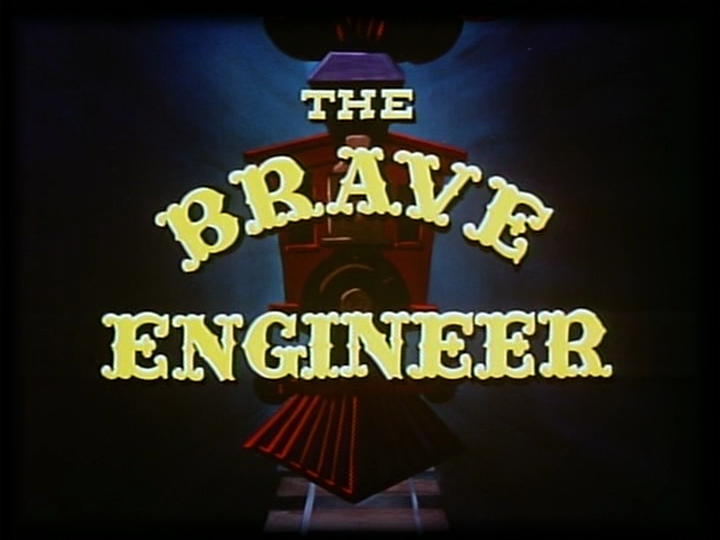
March 3, 1950 – The Special Cartoon, The Brave Engineer, is Released to Theaters

“Ah, ‘tis morning, and all the trains in the railroad yard are fast asleep. All except Casey’s. His engine is slow asleep.”

 On March 3, 1950, The Brave Engineer, a  special short subject cartoon, was released to theaters. Based on the “Ballad of Casey Jones,” by T. Lawrence Seibert and Eddie Newton, the short tells the story of engineer Casey Jones, who will stop at nothing to deliver the mail on time. The ballad was based on a real-life engineer, John Luther “Casey” Jones, who died stopping a train and saving many lives in the process. The story was adapted by Dick Kinney and Dick Shaw, with the musical score by Ken Darby, and stars the vocal talents of Jerry Colonna (also known for playing the March Hare in Disney’s Alice in Wonderland) and The King’s Men singers.

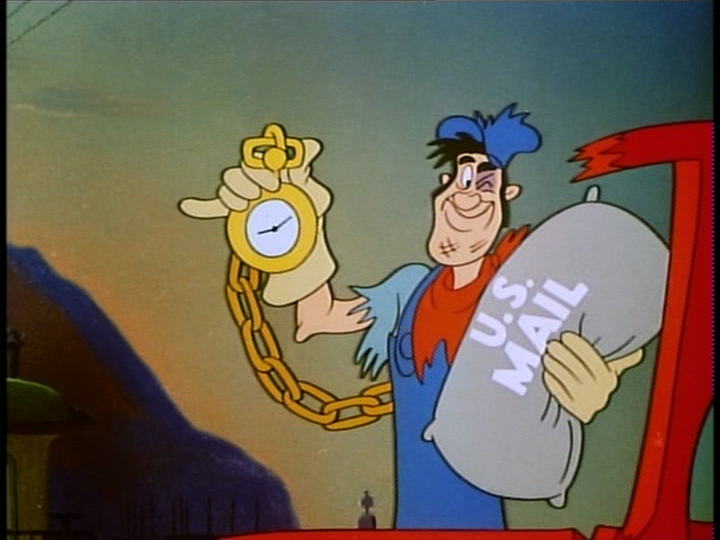
Casey checks his watch for the time, only to realize he's already late

The sun rises over the railroad yard, and the camera zooms in on Casey Jones’ engine, as Casey slowly wakes up, and is alarmed by the time shown on his stopwatch. Once signaling he’s ready, Casey takes off like a shot, with the track switches moving as rapidly as possible to match Casey’s speed. Casey’s many close calls cause his poor brakeman to collapse in exhaustion and nerves.

Casey first problem on his route to deliver the mail is a flood that has been building up for five or six weeks. Considerably slowed by the rain, Casey climbs on the roof of the train and paddles with a shovel, but despite his efforts, the western mail is “exactly eight hours late.” When the train emerges from the flood, it is covered by the roof of a house, with an attached laundry line, but it quickly rids itself of the burden and the excess water, and immediately speeds ahead to its next destination.

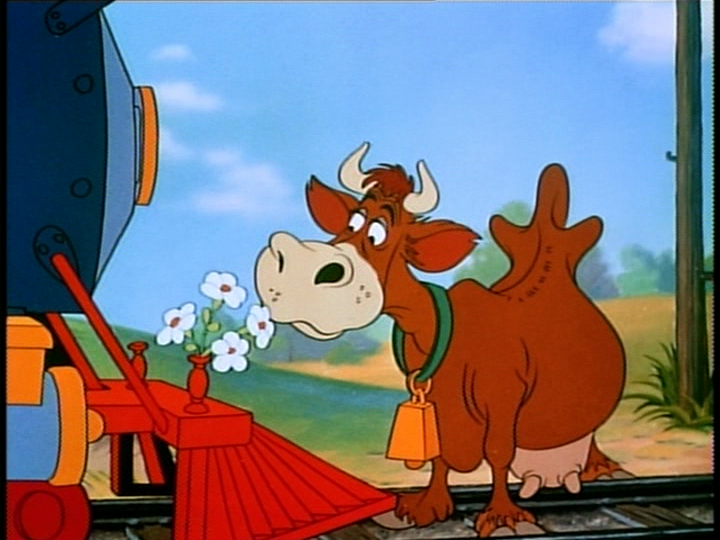
Close call for the cow

Unfortunately, it is not smooth sailing for Casey, as there is a cow standing in the middle of the tracks. Casey brakes hard, and the train stops just inches from the cow. Casey screams at the cow to move, pulling out his stopwatch and proclaiming that he’s late. Offended by Casey calling her “old cow” and “bossy,” the cow saunters off as slowly as she possibly can. Casey barely waits for her to clear the tracks before he speeds past her, leaving the cow clutching a telephone pole for dear life.

Casey is feverishly shoveling coal into the engine when his next problem arises: a bandit has just tied a helpless maiden onto the tracks. Casey climbs out to the front of the engine and scoops up the girl, with the bandit cursing him. Casey continues to up his speed, although he realizes, as he travels around a mountain track, he’s going too fast. As he travels through a tunnel, the audience sees another bandit getting ready to blow up the train tracks. The dynamite explodes just as Casey travels over the bridge, but Casey’s engine doesn’t give up, and just climbs up the steep sides of the mountain.

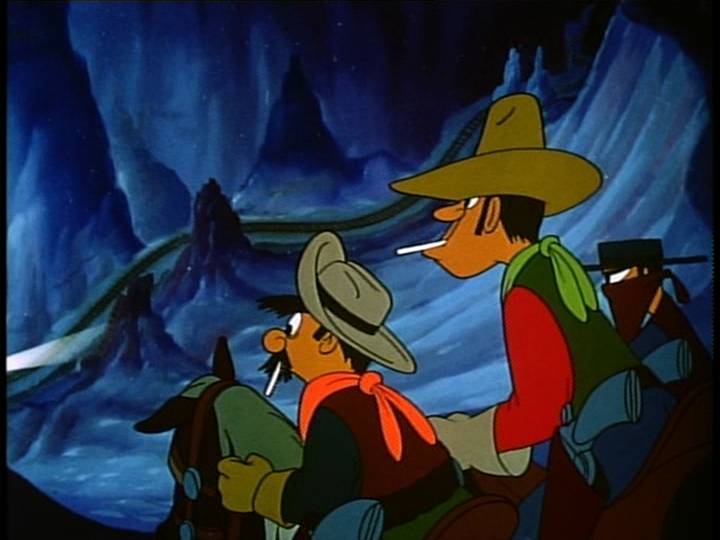
A gang of bandits, lurking in the shadows, watching Casey's train

As the train speeds through a tunnel, a gang of bandits lurk in the shadows, ready to jump the train and rob it. Still shoveling coal, Casey doesn’t notice that the robbers are now in the engine, guns drawn, until one is nearly shoveled into the furnace. Angered by this new interruption, Casey attacks the gang with his shovel. He continues to battle the bandits almost nonchalantly as he keeps on shoveling more coal into the engine. He successfully beats the gang, but he’s alarmed to see how late he is when he looks at his watch.

Desperate to make it on time, Casey shovels the coal into the furnace crazily, causing the engine to overheat. After running out of coal, Casey throws anything he can into the furnace, still overheating until gears and gauges explode. The train begins to fall apart, with Casey trying to hold it all together, and the tracks melt. While otherwise occupied, the brave engineer doesn’t notice another train coming toward him on the same track. Casey’s train is heading toward it like a bullet, and the conductor of Casey’s train runs to warn Casey, but Casey can’t hear him, and the trains collide in a cloud of black smoke.

Casey makes it through his sheer determination...and a lot of luck

The mailman waiting at the station thinks Casey is not going to make the stop today, when all of a sudden, the last remaining pieces of Casey’s train appear, with Casey holding the mail. According to Casey’s watch, Casey made it “On Time…Almost.”

March 2

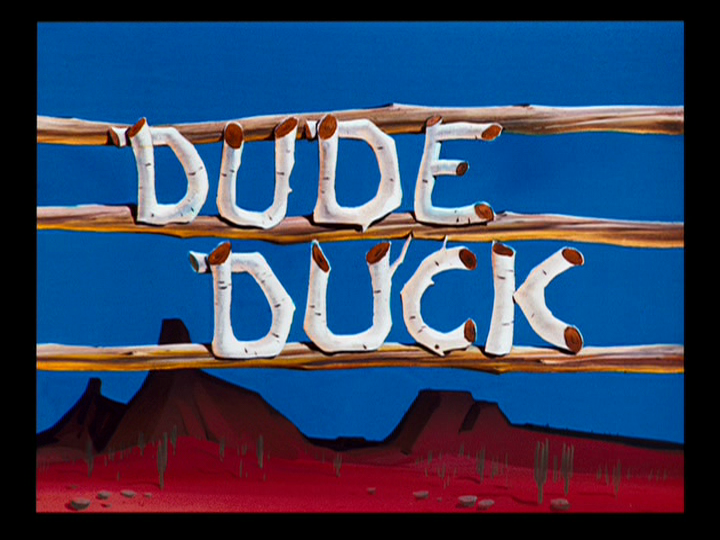
March 2, 1951 – The Donald Duck Short Film, Dude Duck, is Released to Theaters

“D. Duck, Rover Boy, number six.”

 On March 2nd, 1951, the new Donald Duck short, Dude Duck, was released to theaters. In this short, Donald takes his vacation at a dude ranch, but ends up assigned to a horse that does not want him as a rider. As with many of the shorts featuring Donald and an animal, there is a lot of humor in the mutual animosity between the duck and the horse. The short was directed by Jack Hannah, with story by Ralph Wright and Riley Thompson, and stars Clarence Nash as the voice of Donald.

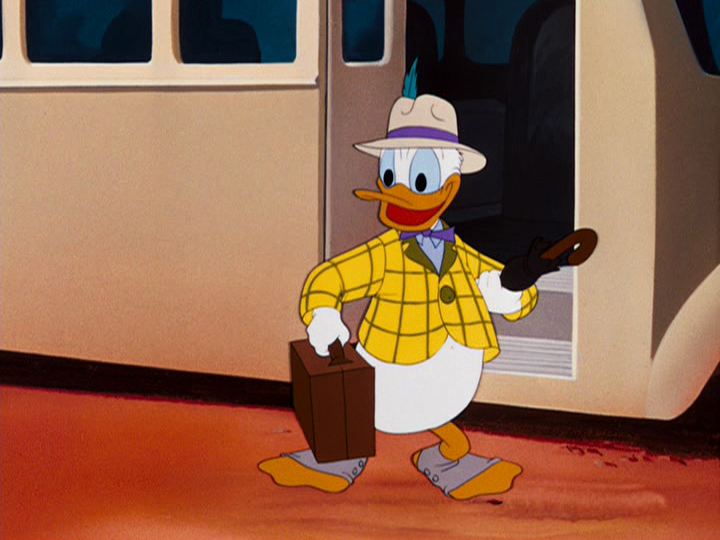
Donald steps off the bus, admiring his surroundings

The audience is taken to the Bar-None Dude Ranch, where the horses are seen relaxing in their stalls, except for one playing horseshoes with his own shoes, whose name is Rover Boy. A bus horn sounds, and a group of beautiful women step out excitedly, ready for their vacation, which causes Rover Boy to wolf whistle and quickly put his shoes back on. Donald is the last to step off the bus, and slowly begins to explore the ranch.

Meanwhile, Rover Boy is busily primping, hoping one of the girls will pick him as her steed. They take little notice of him, however; no matter how much he whistles and pounds his hooves on the fence for their attention. Soon, all the girls are off riding, while Rover Boy stands at the fence, visibly upset.

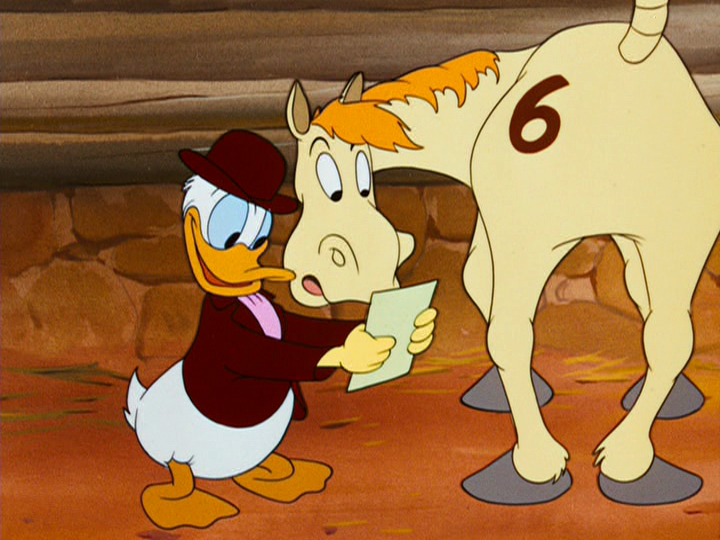
Donald has found his horse - Rover Boy can't believe Donald's his rider

He soon hears whistling, and looks up to see Donald, who is dressed in formal riding gear. Donald approaches Rover Boy, and he studies Donald’s outfit before bursting into peels of laughter. Donald doesn’t seem to notice, but instead walks in the gate and reads the sheet with his name and assigned horse. The horse stops laughing, alarmed that Donald is his assigned rider. He attempts to hide, unsuccessfully, but Donald insists that they get going.

Now desperate to be rid of Donald, Rover Boy fakes an injured leg and a broken back, as well as having no teeth, a horrible cough, heart palpitations, and ultimately, death. Donald rushes to grab some water to help revive the horse, only to have the horse quickly move out of the way as he throws the water. Donald senses something’s amiss, and pulls an apple from his pocket to tempt the horse. Rover Boy tries to fight the temptation of the treat, but ends up taking it from Donald’s hand, chewing it as he still feigns death. Donald then pulls a trumpet from his coat, and the horse quickly is revived, standing in race position. Donald pulls out a starter’s pistol and fires it, and Rover Boy takes off like a shot, before realizing that he gave up his ruse, causing Donald to begin to laugh.

Donald then throws down the saddle and points the gun at his steed, ordering him to put on the saddle. Rover Boy refuses, and Donald begins shooting at the creature’s feet, causing him to jump around the yard. Quickly, he puts on the saddle, and Donald twirls the gun, thinking he’s won, until the gun slips from his finger, leaving only a metal ring. The horse, seeing an opportunity, takes off the saddle. Donald tries to threaten him again, only to find his gun is gone.

"Moo."

Undeterred, Donald grabs a lasso and begins to chase Rover Boy behind some hay bales, but stops when he sees that Rover Boy has attached bull horns to his hair, and gives his pursuer a haughty “Moo.” He whispers in Donald’s ear, presumably telling him where his “horse” has gone, and Donald races on, until he realizes he’s been duped.

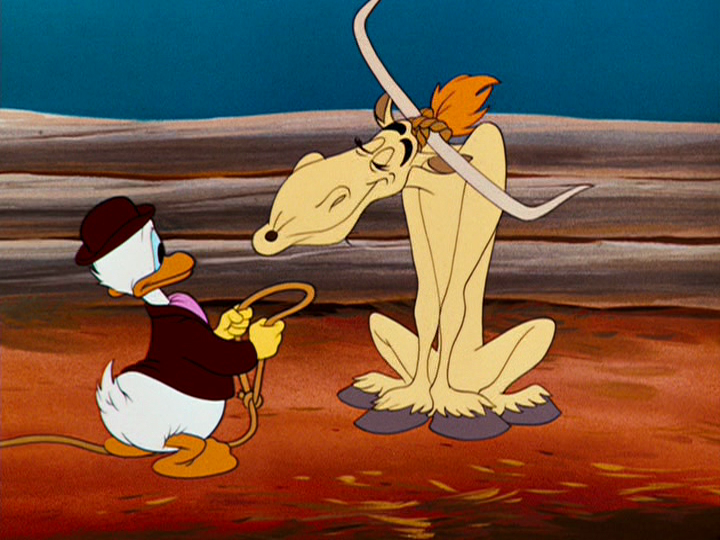
Thoroughly frustrated at this point as only Donald can be, he pursues the horse again, with Rover Boy hiding behind some other hay bales and pretending that he’s gone galloping off. Donald almost falls for it, until he looks down and sees the horse. Thinking fast, Donald stands behind the other side of the bales and laments that the horse got away from him, and he’d better go home, then pretends to walk away. The horse falls for this easily, and begins to laugh, thinking he’s gotten rid of the duck. He is then alarmed at the sound of galloping, and a woman’s voice (which the audience is able to see is Donald doing a spot-on imitation) asking for that “big beautiful number 6.” Excited, Rover Boy races out, only to be caught in Donald’s lasso. Calmly, Donald ties the other end of the rope to a post and waits, while the horse is still running wildly.

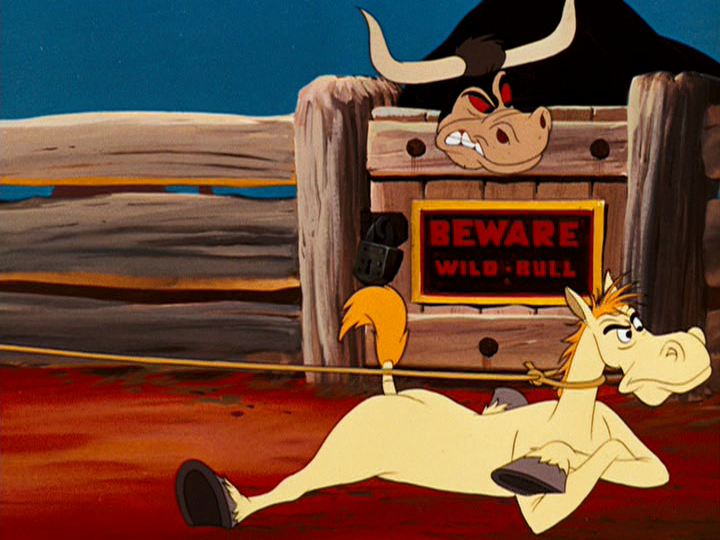
Rover Boy comes up with an evil scheme as he passes the bull pen

Rover Boy is suddenly pulled to a stop, falls to the ground, and can only say, “Oh, no.” Donald laughs at this situation and begins to pull the horse in; unfortunately, the horse passes by the wild bull pen, giving him a wicked idea. We see the horse run to the fence, quietly observing his little plan, while Donald still blissfully pulls on the rope. The horse tilts the bull’s horns in the direction of Donald’s tail, and with Donald giving the rope one final pull, the audience sees only Rover Boy’s reaction, but hears Donald give out a loud scream, and a whistle that indicates the duck shot straight up into the air. He lands on the now saddled bull and rides off into the old west, just as he wanted to in the first place.

February 13

February 13, 1957 – The Disneyland Episode Tricks of Our Trade Premieres on ABC

“Before our eyes, we have seen an entire industry grow literally from the ground up. And this growth was no accident. It was painstakingly built, step by step, by men with pioneering spirit, who loved this puzzling new art form, and believed in its future.”- Walt Disney.

On February 13, 1957, audiences were treated to a different kind of episode of Disneyland: one that focused on how animated films were able to capture things as realistically as they did. With our host, Walt Disney, we are taken through the “tricks of the trade,” where he explains some of the then-commonplace animation principles, as well as some of technical advances made in the studio, and why they needed to be created. The examples given are obviously staged, but they give the audience a great example of the process used to come to a solution. Animation examples are from Snow White and the Seven Dwarfs, Bambi, and Fantasia. The episode was written by animation veteran Dick Huemer and directed by Wilfred Jackson. It also includes cameos of four of the famed Nine Old Men: Frank Thomas, Ollie Johnston, Marc Davis, and Milt Kahl. The episode refers to the book, The Art of Animation, which was the book that inspired John Lasseter to want to be an animator (please see the January 12th entry for more information).

“Because the animated cartoon comes to life on the screen, it belongs in the field of the motion picture,” Walt explains, as he opens up the episode. “But because it is drawn and painted, it is also one of the graphic arts, like painting. As a matter of fact, it is often referred to as the last of the graphic arts.” Disney then goes to his desk and shows the audience the book The Art of Animation, which was written by Bob Thomas about the Disney Studios. Disney turns to chapter eight, entitled Tricks of Our Trade, and explains that the pupils were their own teachers when it came to the principles of animation. “They had to be, because no one in the world could give them the answer to what they wanted to know,” Disney says, adding that their overall question was: How could animation be improved?

The animators in a classroom after hours, learning more about their own medium by one of their own

The first segment shown is of a group of animators watching a film of overweight comedian Billy House performing a two-step. The animators note that an overweight man moves differently, and that the human body does not move all in one piece. When the film is slowed down, there are many details they recognize that cannot be seen at normal speed. We then see the animators use what they saw to create an animation of the dwarf Happy doing the two-step dance, with the animation principles of weight, contact, follow-through, squash and stretch, and overlapping actions being used effectively. Disney points out while it’s true that thoughts and emotions can be expressed through pantomime, who a character is and what they think can best be revealed by dialogue. The trick of using dialogue is shown through a clip from Show White and the Seven Dwarfs, where Snow White identifies which dwarf is which.

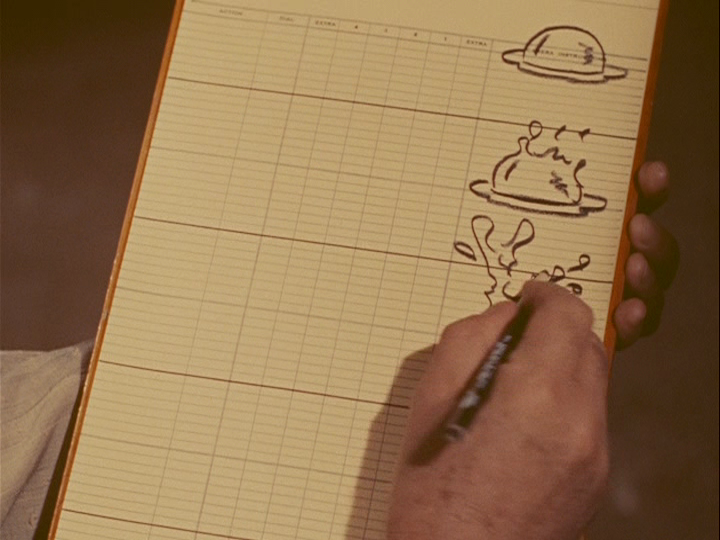
Dan MacManus sketching on an exposure sheet, trying to see how many frames it wll take to draw before the animator can draw the bubble bursting

The next animation technique we look at is effects animation: the trick of making the cartoon characters more believable by using extremely realistic animation of incidental action. There are many clips of animators watching various actions—including a baseball thrown through a window, or a bubble being blown from a pipe—and Disney explains that animating breakage required tremendous attention to detail. This leads into a clip of the earthquake from The Rite of Spring sequence in Fantasia. Continuing with that sequence, we see three effects animators looking at a tub of orange-colored mud, trying to solve three different problems for the creation of earth sequence in The Rite of Spring. Joshua Meador, head of the experiment, uses color chalks and pastels to render the sketch that would give an overall impression of the sequence. Jack Boyd’s assignment is to establish the individual action of a pair of bubbles, verifying his findings with the 2-drawing flipping action. Dan MacManus’s job is to see exactly how many drawings it would take to animate the bursting of a bubble, using an exposure sheet and a stopwatch. The audience then sees the clip from The Rite of Spring in its entirety.

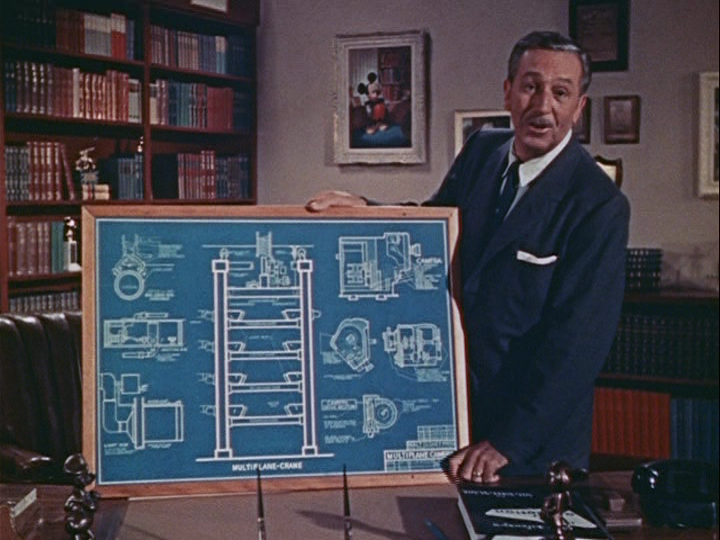
Walt with a blueprint of the Multi-Plane Camera, a Walt Disney Studios invention. Coincidentally, Ub Iwerks had created his own version at his own studio, only it was a horizontal camera

Walt pulls out a picture, calling it a different kind of drawing, which “also came out of our school of self-improvement here at the studio.” The blueprint is of the multi-plane camera, which was first used to great success in the Silly Symphony The Old Mill. Disney explains that the old process for animated films was fairly simple in construction and operation, but the biggest problem was that any dimension the character brought with him or her into the scene disappeared when the character left the frame. Another example used was a painting of a house on a moonlit night, and when the camera zoomed in on the scene, everything got larger, including the moon, which does not happen in reality. The use of the multi-plane camera shows the audience the big difference it makes in that scene. The audience next sees the opening scene of Bambi, and how the multi-plane camera works to give realism to the forest.

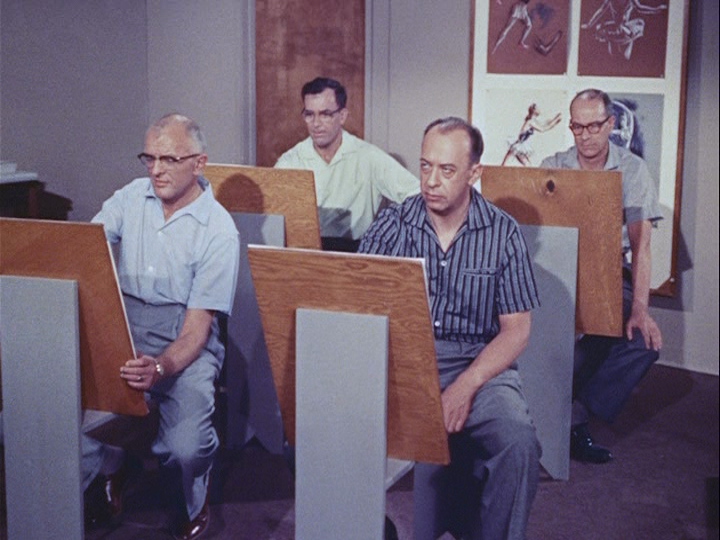
Four of the famous Nine Old Men, studying ballet moves. From Far Left: Milt Kahl, Frank Thomas, Marc Davis, and Ollie Johnston

“Perhaps the thing that distinguishes animated cartoons more than anything else is the trick of caricature,” Disney says. He tells the audience the story of the animation of Dance of the Hours from Fantasia, which involved the use of a live-action model to help the animators see the ballet movement of the dance. The ballet dancer they used was Helene Stanley, who was also the live-action model for Cinderella and Aurora in Sleeping Beauty. In this segment, we see the four of the famous Nine Old Men as they study Stanley’s movements. Kahl discovers that he may not be getting the kick right. Davis asks Stanley to perform it again, and as she does, Kahl makes a comment that the kick should be higher “in order to get all that weight off the ground. She’s no cream puff, you know.” Davis agrees, adding, “Yeah, that is a lot of beef.” These comments grab Stanley’s attention, but she keeps dancing. Thomas steps forward with his drawing and asks if he’s made the trunk too long: at this point, the audience sees that the drawings are those of the animals in the Fantasia sequence, although Stanley still thinks they are talking about her. Kahl responds to Thomas, “Oh, no, that’s what gives it that goofy look. Trunk’s way out of proportion to the rest of her body…it wouldn’t hurt to make [her legs] good and hairy.” These comments finally get the best of Stanley, who grabs her hat and cape and runs to the door, before turning around and seeing the animals they’ve been animating, and laughs before returning to the stage. The episode ends with the ballet segment from Fantasia, with all elephants, ostriches, and hippos.

The episode is wonderful for those who are fans of animation, and wish to see a dramatic look at how the animators were able to teach themselves and develop the new techniques to create better animation. Similar to “lessons learned” when creating computer animation in this generation, this highly recommended episode shows how the animators really had to, and did, step up to blaze a new trail.

February 9

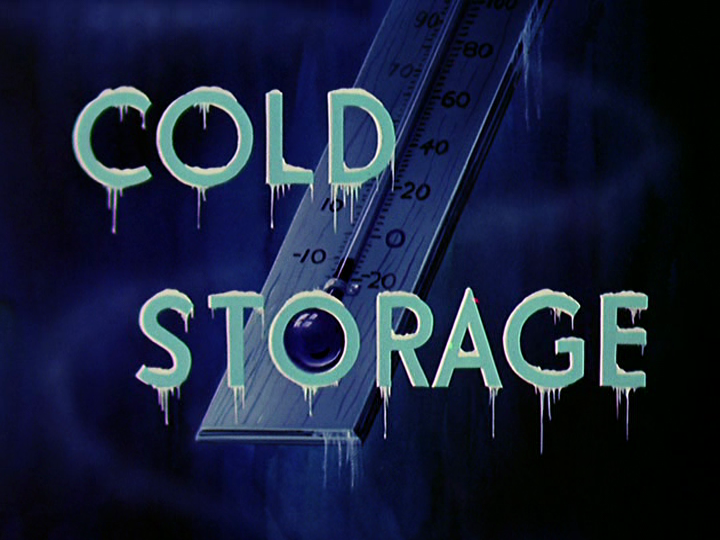
February 9, 1951 – Pluto Short Film Cold Storage is Released to Theaters

On February 9, 1951, the Pluto short film, Cold Storage, was released. The short was directed by Jack Kinney, with the story by Dick Kinney and Milt Schaffer. It was the 46th Pluto short released, the first in 1951, which was the last year of the Pluto short films.

The scene opens on a pond in winter, where a stork is shivering in the cold as his feet are frozen in the pond. He manages to extract himself, and is on the search for somewhere warm to stay, when he spies a doghouse. He quickly takes over, preparing to hibernate. Unfortunately, just as he has found a place to stay, a shivering Pluto makes his way into the yard, hoping to get warm inside his doghouse. He tries to fall asleep in the house, only to find that the stork has pushed him back out into the cold.

Pluto wakes up, alarmed to find himself in the elements again, and attempts to walk back inside. The cunning stork, however, lifts the doghouse so the sleepy Pluto walks right through it without noticing. Pluto, alarmed again at being outside, runs around to the entrance to once again get warm and as he settles down, the house gets up (thanks to the stork) and walks away. Pluto’s anger grows as he finds he cannot enter his own doghouse, no matter how hard he tries. He sees that the house seems to be moving on its own, and fears he’s become ill or crazy.

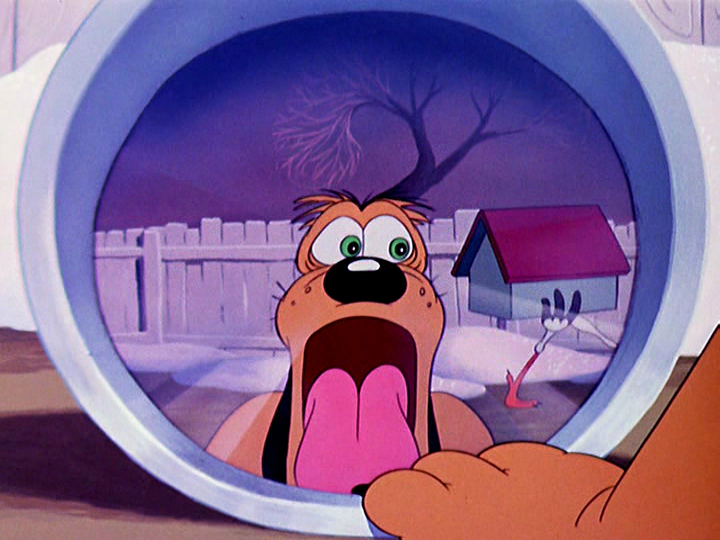
Pluto, checking to see if he's sick, ends up seeing his house walk across the yard

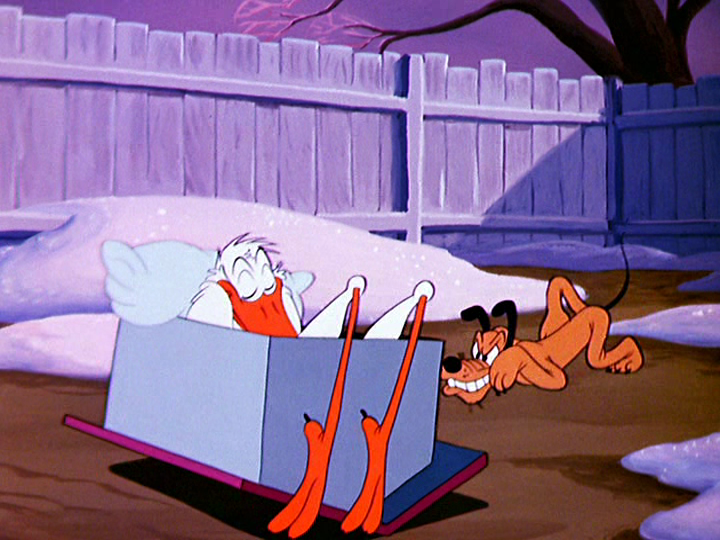
As Pluto checks his vitals, he notices in the reflection of his bowl that the house seems to have sprouted legs and is moving across the yard. He goes into attack mode, but is stopped when the stork’s beak appears in the doorway. As he watches the stork take a drink from the water bowl, Pluto can’t take it any more and begins to bark profusely at the intruder. The stork replies by stepping on Pluto’s snout, silencing the poor pup. As Pluto looks around for his house, he is alarmed to see that the stork has decided to fly away, house and all. When the stork perches on the fence, Pluto knocks him into the yard, only to discover that the stork is now using the house as a cradle, and lulls himself to sleep singing “Rock-a-Bye-Baby.”

As the stork lulls himself to sleep, Pluto decides to implement a sneak attack

Pluto begins to sneak up on the stork, but the stork is unfazed by the dog, until Pluto attacks him. After Pluto thinks he’s won the fight, he goes inside the doghouse and settles on the pillow, hoping to finally get to sleep. The “pillow,” however, has other plans, walking outside the house and dropping Pluto into the frozen pond. Another fight ensues between the stork and the dog, with each fighting for dominance. Suddenly, the sun bursts out from behind the clouds, quickly signaling the beginning of spring. Just as the two were fighting to get in the doghouse, now the two are fighting to get out, as the temperature rises to an uncomfortable level. Fortunately for Pluto, he is able to come up with a compromise that allows both of them to find relief from the heat..

February 5

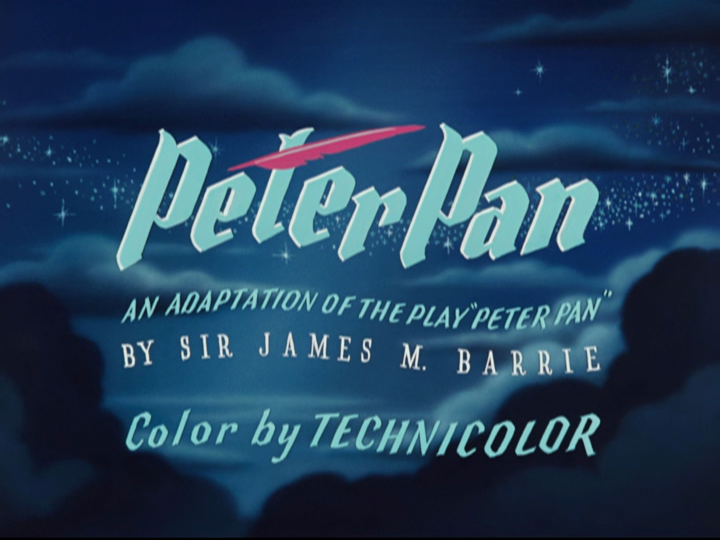
February 5, 1953 – Peter Pan is Released to Theaters
“The Disney version of Peter Pan has another interesting first: it’s the first time a boy was shown as Peter Pan. There’d been a tradition, from the time of Maude Adams on the stage…of women playing Peter Pan. But it was…a tradition that was broken by Walt Disney by showing Peter Pan as a boy. Now, it’s an animated boy, but was really a boy’s voice and he was depicted as a boy, which is what he’s supposed to be.” – Leonard Maltin, Film Critic.

The road to Peter Pan’s release on February 5, 1953, was a long one: production started as early as 1935, with Walt planning to make it his second animated film after Snow White and the Seven Dwarfs. Disney acquired rights to Sir James M. Barrie’s play from the Great Ormond Street Hospital in London (to which Barrie had bequeathed the copyright) in 1939, but the advent of World War II halted production of the film.

In the 1950s, Disney decided it was time to bring the film back into production. Starring Bobby Driscoll as Peter, Kathryn Beaumont as Wendy, Hans Conried as Captain Hook and Mr. Darling, and Bill Thompson as Mr. Smee, the film was directed by Hamilton Luske, Clyde Geronimi, and Wilfred Jackson.

Disney first learned of the story of the boy who never grew up when he saw a touring production of Peter Pan in 1913, and he later starred as Peter Pan in a local production of the play. With almost two decades in development at Disney, the story went through many different treatments, ranging from a first, very dark version—much darker than the original play, and more sinister than a typical Disney feature—to the final product. Disney was determined to release Peter Pan as an animated feature. “The cartoon method gave us many advantages over the stagecraft of Barrie’s day,” Disney once said, “which no amount of pixie dust could cure.” Through animation, many of the play’s conventions could be abandoned: Nana could be shown as a dog instead of a person in a dog costume, the characters could fly realistically without any visible wires or tricks, and the biggest change of all, Tinker Bell was a fully formed physical character, rather than a speck of light traveling across the screen. Through the casting of Bobby Driscoll as the title character, Disney was also able to present Peter as the boy he was supposed to be, rather than a woman playing a young boy. The film was a success upon its first run in 1953, and was rereleased several times in theaters, with its first video release in 1990.
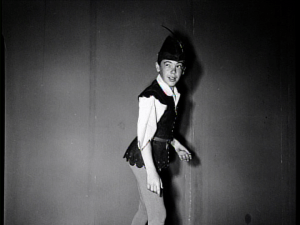
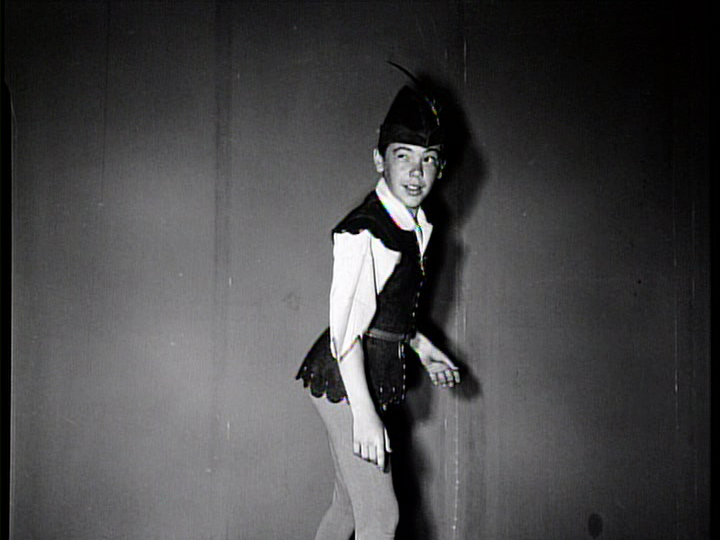
Bobby Driscoll, voice of Peter Pan, dressed for the live-action reference film

Although the actors are only heard on screen as the characters, they actually had to film a second, live-action version of the film for the animators to study. The actors dressed up and performed various scenes to show the animators the action taking place and the small, yet significant, details with each action, such as a turn of the head or how Captain Hook  would hang from a cliff by one hand. “The audience always got confused when we talked about live-action help,” animator Frank Thomas explained, “and we’d say, ‘Well, an artist needs a model, you gotta have something to guide you.’ But it’s also very helpful in little ways of a guy turning and looking back over his shoulder, how far did he turn his head. And you find if you’ve got the real person do it, you saw their arm here would come out as he’d turn, or have something come up to his chin, or some little thing you hadn’t thought of. And very often, that would make the scene come alive.”
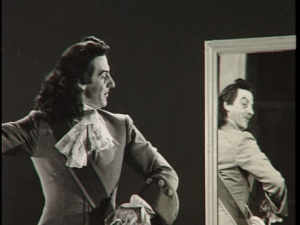
Hans Conried as Captain Hook, in a live-action reference still

Frank Thomas was assigned the role of animating Captain Hook, with Milt Kahl animating Peter Pan, and Marc Davis designing and animating Tinker Bell, a character with no lines. “She’s a pure pantomime character, which in itself I think is rather interesting,” Marc Davis said. The various story sketches of Tinker Bell over the years changed in little details, but throughout all the concept drawings, she was a representation of the current ideal of feminine beauty. One persistent rumor is that Tinker Bell was based on Marilyn Monroe. Monroe was just beginning her career when Peter Pan was in production; the Disney animators wouldn’t have been aware of her enough to base a character on her. The actual person who stood in as the live reference model for the pixie was actress Margaret Kerry, who won the role after performing the scene where Tinker Bell preens in a mirror, only to be alarmed at the size of her hips. “They knew that I had the imagination that they needed,” Kerry said, speaking of her audition.

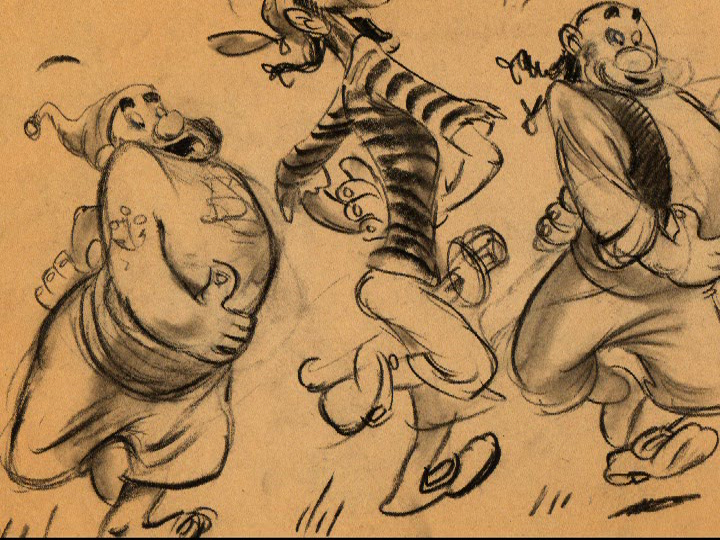
The music of Peter Pan is rather interesting, as many songs were used but ended up on the cutting room floor. One song that is still heard throughout the score, although the actual song was cut, is the crocodile’s theme, also known as “Never Smile at a Crocodile,” which would later go on to be used in a first season episode of The Muppet Show, starring Sandy Duncan. The most famous song from the film, “The Second Star to the Right,” was actually not written for the film; on the contrary, the song was written for Alice in Wonderland, and was known as “Beyond the Laughing Sky.” Another song that was written, but eventually replaced, was known as “The Pirate Song,” which had been storyboarded and demo recorded. The song was sung by the pirates as they try to convince the Lost Boys to join Captain Hook’s crew. The song was eventually replaced by “The Elegant Captain Hook,” which was a shorter song, but has a bit more of a jolly feeling around it.
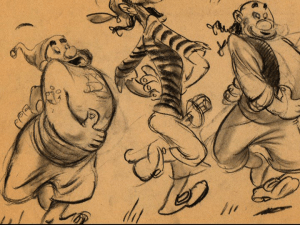
A storyboard picture from the cut song "The Pirate Song," which was replaced by "The Elegant Captain Hook"

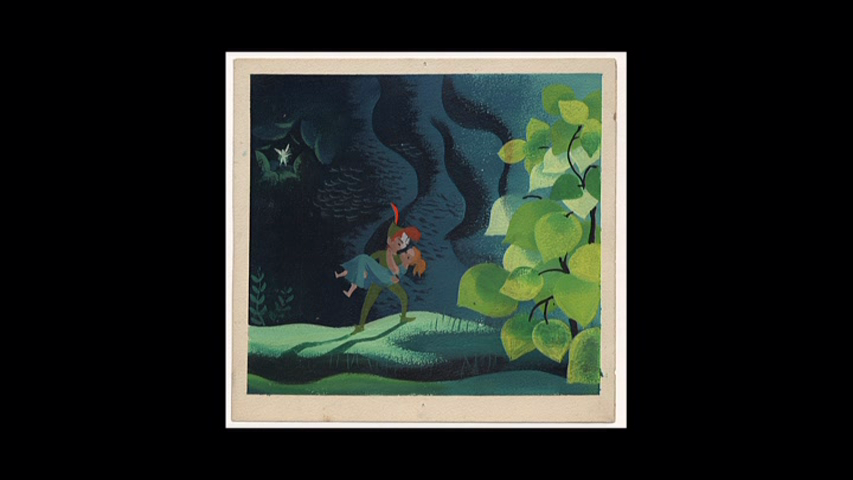
The color stylings went through many artists’ hands during the development process. In the 1930s and 1940s, renowned British artist David Hall created beautiful watercolor treatments of the story; he also did extensive work on Alice in Wonderland for the studio. The color styling that is the final film, however, was the work of Disney artist Mary Blair. Her concept art not only influences the color pallet of the film, but also helped identify the moods of certain scenes, including the scene in Mermaid Lagoon where the skies suddenly darken upon the arrival of Captain Hook. Blair’s art for this film was so popular that Disney released a pin set of images from her concept art to honor the 50th anniversary of the film in 2003.
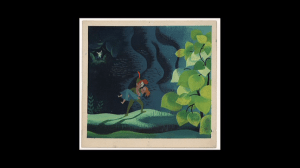
An example of concept art by Disney artist Mary Blair. Notice the color stylings of the characters, and how they compare with the color palate of the film

The story begins with a look at the Darling family, and the narrator explains what each member thinks of the story of Peter Pan. Mary Darling, the mother, believes Peter to be the spirit of youth. George Darling, the father, “Well, Mr. Darling was a practical man,” the narrator informs us. John and Michael Darling believe that Peter is a real person, making him the hero in all of their nursery games. Wendy Darling, the eldest child, not only believes in Peter Pan, but is also regarded as the expert on Peter and all of his adventures. And Nana, the nursemaid, “being a dog, kept all her opinions to herself, and viewed the whole affair with a certain…tolerance.” Mr. Darling, annoyed by Wendy’s constant stories of Peter Pan, decides that it’s time for her to grow up, and that this night would be her last in the nursery. Wendy doesn’t want to leave, especially since Nana has stolen Peter Pan’s shadow, and Wendy wants the nursery window left unlocked in case Peter returns to retrieve it. A worried Mrs. Darling tries to diffuse the situation, and as she and Mr. Darling rush off to a party, her fears are confirmed—the audience sees Peter on the roof of the Darling house.
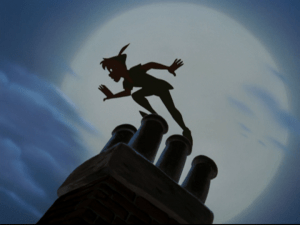
The most famous image of Peter perched on the roof of the Darling's house

When the children are asleep, Peter enters the nursery and searches for his shadow. Tinker Bell, Peter’s companion, finds it in a drawer, and as it escapes, she is trapped inside. Peter’s pursuit of his shadow around the room turns into a brawl that wakes Wendy. When she sees him trying (and failing) to reattach his shadow with soap, she offers to sew the shadow back on. As she sews, she asks how he lost his shadow in the first place. Peter replies that he comes by the house to listen to the stories. When Wendy tells him that there will be no more stories because she has to grow up and leave the nursery, an angry Peter decides that the only course of action is to take her away to Never Land, where she can continue telling stories to him and the Lost Boys. Thrilled, Wendy offers to give Peter a kiss – an action that causes an alarmed Tinker Bell to finally break out of the drawer and attack Wendy, pulling her hair. As Peter tries to catch Tinker Bell, he accidentally wakes Michael and John, who, excited about the prospect of playing games and fighting pirates, beg to go to Never Land too. Peter agrees to take them all, and teaches them how to fly with faith, trust, and a little bit of pixie dust, and off they go into the London night sky.

The audience’s first view Never Land is a pirate ship, where the crew is sitting restless, wishing that Captain Hook would give up his silly pursuit of Peter Pan and take them back to open waters to pillage and plunder again. Hook instead comes up with a plan to capture the Indian princess, Tiger Lily, and force her to tell them where Peter Pan’s hide out is. In an exchange with his first mate, Mr. Smee, Captain Hook reveals the reason for his pursuit: once when he and Peter Pan were fighting, Peter cut off Hook’s hand (which the pirate has since replaced with a hook) and fed it to a crocodile, who liked the taste of Hook so much that he follows him around hoping to devour the rest of him. Smee tries to talk Hook out of his vendetta, but the moment another crewmember announces sight of Peter Pan, Hook decides to attack him with cannon. Peter orders Tinker Bell to take Wendy and her brothers to safety as he distracts Hook, but Tinker Bell rushes off with other plans.

Tinker Bell finds her way quickly to the hideout of the Lost Boys, and tells them that Peter has sent orders to shoot the fast approaching “Wendy Bird.” Eager to please their leader, the boys rush out and throw various sticks and stones at Wendy, and she falls to the ground. Luckily, Peter arrives just in time to catch her. When the Lost Boys reveal Tinker Bell’s lie, Peter banishes the fairy forever, but makes it a week when Wendy makes a plea on Tink’s behalf. He offers to show Wendy the island, while John leads the Lost Boys on a search for the Indians.
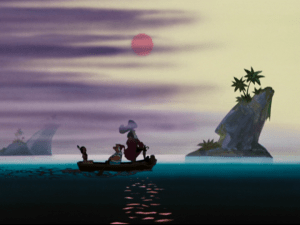
Captain Hook and Smee with the captured Tiger Lily. The coloring was taken from a piece of concept art by Mary Blair

As Peter and Wendy visit the Mermaid Lagoon, they find Hook in a rowboat with the missing princess, and discover that unless Tiger Lily reveals Peter Pan’s hideout, Hook will drown her. Following a sword fight with Hook, which ends with the pirate hanging on a cliff by his hook, with the crocodile waiting impatiently and hungrily below, Peter saves Tiger Lily and takes her back to her camp, with Wendy, forgotten by Peter, trying to fly behind them.

That evening, as Hook sits in his cabin with a horrible cold, humiliated by losing once again to Peter Pan, Smee tells him that “the cook told [him], that the first mate told him, that he heard Pan has banished Tinker Bell.” This reinvigorates Hook, who plans to use Tinker Bell’s jealousy to help him discover Peter Pan’s hideout: “a jealous female can be tricked into anything.” Meanwhile, the Indians are rewarding Peter’s bravery by giving him the name of Chief Little Flying Eagle, and everyone begins to celebrate – all except Wendy, who is sent to go get firewood. Wendy returns to see Tiger Lily flirting with Peter, and she storms away from the party. Tinker Bell, moping nearby, is captured by Smee, who tells her that Hook would like to have a word with her.

Hook tries to charm Tinker Bell, first telling her that he admits defeat and plans to leave Never Land forever, then adding in that Peter has his faults, including bringing Wendy to the island. When he mentions that he knows Wendy has come between Tinker Bell and Peter, she begins to cry, and Hook knows that he has her where he wants her. Under the ruse that the pirates will take Wendy away with them to “save Peter from himself,” Hook tricks Tinker Bell into telling him when Peter is, and then locks her away so she can’t warn Peter of the upcoming attack.
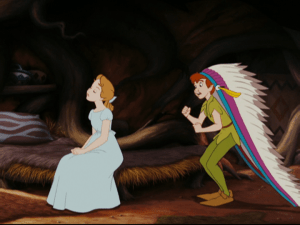
Peter trying to appease Wendy's jealousy after the celebration

Back at the hideout, Wendy, still jealous of Peter’s attention to Tiger Lily, rebuffs him and his show-off attitude. As she gets the Lost Boys ready for bed, she tells her brothers that they will head home in the morning. She tries to act as everyone’s mother, and the Lost Boys decide that they want to return with Wendy, to have a mother as well. An upset Peter tells them that they can leave if they want to grow up, but they can never return to Never Land. Before they can leave, however, they are caught by the pirates and taken to the ship. As the pirates try to convince the Lost Boys to sign up to be pirates, Wendy declares that they will never be pirates—Peter will save them. Hook tells her that a “present” he left in the hideout for Peter (with the tag reading “To Peter with love from Wendy. Do not open till 6 o’clock.”) is a bomb that will blow Peter to smithereens. Upon hearing this, Tinker Bell breaks free from her cell and speeds away to save Peter, managing to tear the bomb away from him as it blows up, destroying his hideout and nearly killing Tinker Bell herself. Peter pleads with her not to die, telling her she means more to him than anything in this world. Hearing the explosion and believing Peter to be dead, Hook makes Wendy walk the plank. The pirates listen for a splash, but when they hear nothing, the entire crew is spooked, believing that their ship is haunted. Peter, alive and well, and joined by Tinker Bell, cuts through Hook’s sails, and the fight to the finish between Hook and Pan begins.
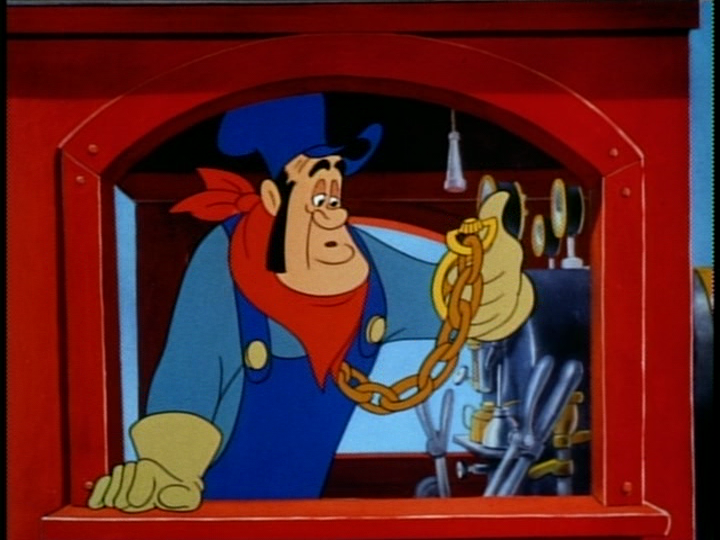
February 1

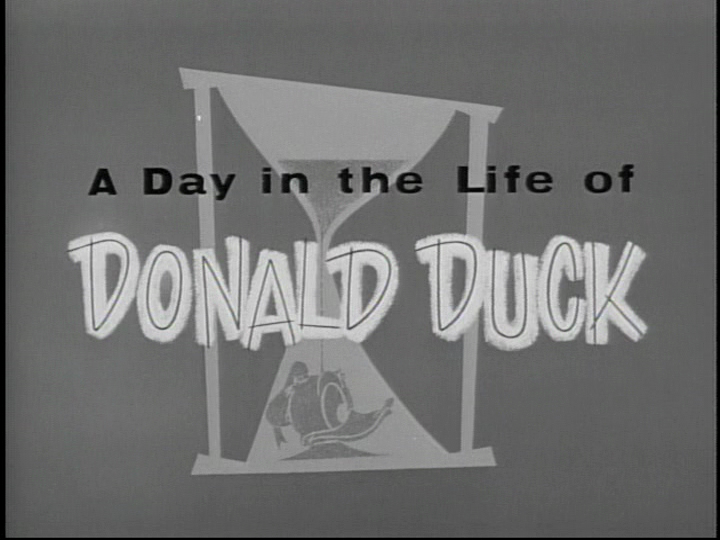
February 1, 1956 – A Day in the Life of Donald Duck Premieres on Disneyland.

“You know something Donald? You’re a big international favorite.”

On February 1, 1956, Disneyland audiences spent A Day in the Life of Donald Duck. As Walt Disney explains in the introduction, there have been so many fan letters to Donald, that he thought the audience might want to spend a day with Donald at the studio. Directed by Jack Hannah, with story by Albert Bertino and Dave Detiege, we see how Donald begins his day, as well as his interactions with Jimmie Dodd, Roy Williams, the Mouseketeers, and the most important person in Donald’s life: his voice, Clarence Nash.

“Donald, like any other average cartoon character, lives a simple, unassuming life in a quiet residential section of Beverly Hills,” Disney tells the audience, showing pictures of the neighborhood. “He resides in a modest little cartoon house. He drives to work in a modest little cartoon car. And if he seems a bit reckless, you must remember that Mr. Duck drives with a cartoon license.” As we see Donald pull into a spot marked “No Parking,” he is immediately confronted by a police officer. Donald, however, folds the car into a tiny packet, tucks it under his hat, and walks to his office.

Donald's "modest" house in Beverly Hills

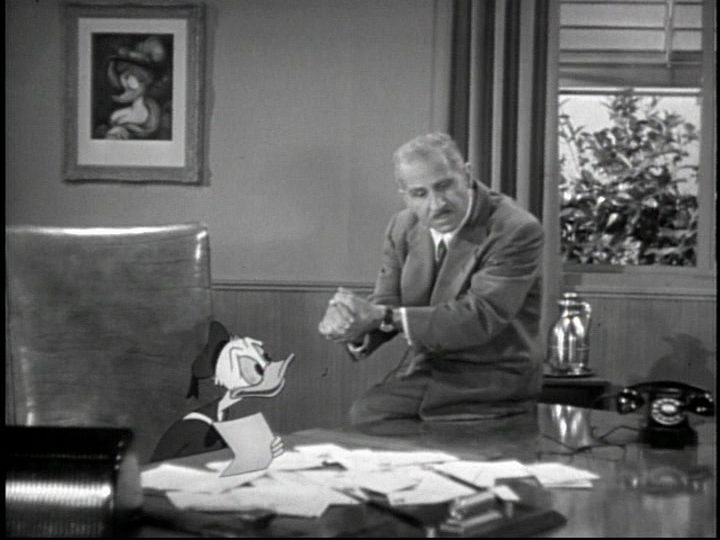
When he arrives at his office, the intercom sounds, and his secretary greets him respectfully as Mr. Duck. Donald responds with, “Just call me Donald, toots. What’s first on my schedule, tootsie?” in keeping with Donald’s personality as a bit of a wolf. She responds that he has fan mail, which he opens eagerly. The letters, however, are not pleasing in Donald’s opinion. One letter openly says, “Dear Donald, I can’t understand a word you say.” This is the last straw in Donald’s opinion, and he demands to speak with his voice, Clarence Nash. Nash comes in with a cheery attitude, which doesn’t change Donald’s mood in the slightest, no matter what Nash does to cheer him up. They end up arguing, with Nash reverting to his Donald Duck voice, even as he pulls out a coonskin cap and starts signing the Davy Crockett theme song. Donald tells him he’s a horrible singer. Nash leaves, with the two still taunting each other, and Donald vows that he’s got to get himself a new voice.

Donald and his voice, Clarence Nash, as Nash shows him a new trick

The next guest to enter is Jimmie Dodd (host of the Mickey Mouse Club), who has written a new song about Donald, inspired by fan art from children all over the world. “They’re so great, they had to have a song written about them,” Jimmie explains, and begins the song, which Donald immediately loves. There are versions of the song sung in different languages with accompanying pictures, including Spanish, French, Italian, and German. The images and tunes are stereotypical for the fifties, but somewhat sweet and fun all the same.

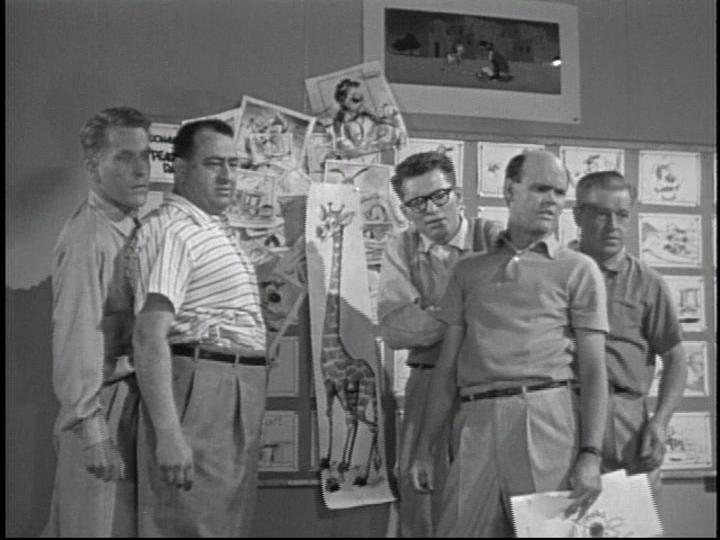
Donald then leaves for an 11 o’clock appointment at the Story Room, and when the storymen hear Donald coming down the hall, they begin to panic, as they fear his temper more than anything. They try to make Donald comfortable, and when they try to show him storyboards for a short entitled Peaceful Day, Donald asks for more birds and butterflies. The storymen overeagerly agree to his requests, to the point that Donald gets annoyed, and demands that there be a short with just him in it. This gets them to thinking, and the audience is then shown the brainstorm: the short, Drip Dippy Donald (originally released March 5, 1948).

The bewildered story team, trying to acquiesce to Donald's requests

Back in his office, Donald receives a call from Walt, who asks him to show the Mousketeers around the studio, as Mickey has remembered that they had never seen it before. Donald eagerly agrees, and runs to meet the Mouseketeers, who surprise Donald by making him an honorary Mouseketeer and giving him his own set of Mickey Mouse ears. As they run around the studio, the kids slip into the Sound Effects Department, closing the door just as Donald is about to get inside, leaving him on the outside as the kids see how sound effects were added to the Donald Duck short, Fire Chief (originally released December 13, 1940). One example they show is when a building is set on fire, the special effects team uses sparklers and crumpled plastic to create the sound of the burning ceiling.

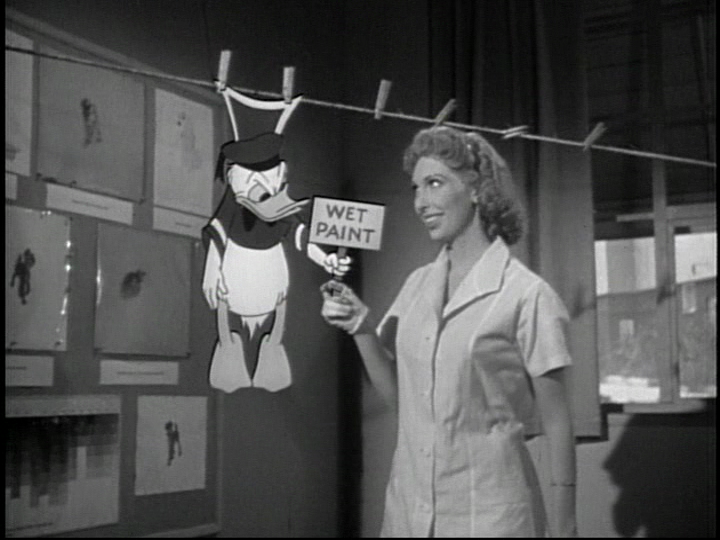
When the short ends, the door opens, and Donald is ready to step inside, until an effects man empties a bucket of water over him, which causes half of Donald’s paint to run. This necessitates a trip to the Ink & Paint Studio, where the painter quickly re-paints Donald and hangs him up to dry, an experience Donald finds quite humiliating. The painter explains that twenty gallons of paint are usually used for a Donald Duck picture, which surprises the kids and causes Donald to remark that he is “very expensive.” She also explains that in one picture, they used just one pint of paint for Donald; the audience is then shown the short The Vanishing Private (originally released September 25, 1942).

Donald and the Painter, with Donald pointing out how humiliating this is for him

After the short, we see the kids with Jimmie Dodd again, singing the new Donald Duck song he wrote. As Donald tries to sing the last line of quacks, he is cut off by Roy Williams, the other host of the Mickey Mouse Club. The kids are excited to see him, and he tells them that he’s practicing drawing the characters. To prove that anyone can draw, Roy asks one of the Mouseketeers to make a scribble on the easel. From her scribble, Roy is able to draw an ostrich. Donald, jealous of the stolen attention, challenges Roy and scribbles on the easel. Roy accepts, and ends up turning Donald’s scribble into a humorous image of Donald Duck. As Donald throws a tantrum and jumps up and down on the teasing picture, the kids flee the room and head into the projection room. “And now, in Donald’s honor – he really is a good scout,” Roy welcomes the kids, “I’d like to dedicate this picture to all you Mouseketeers.” Donald is touched by the tribute, and the audience is then shown the short, Good Scouts (originally released July 8, 1938).

This episode is a must-see for fans of Donald Duck. There are many wonderful gags, and the interaction of Donald with Clarence Nash is enough of a reason to watch. It’s a perfect example of all the temperaments of Donald, with the added bonus of it being set in the real, rather than the cartoon, world.

January 30

January 30, 1959 – The Peter Tchaikovsky Story Premieres on Disneyland

“…for just as Sleeping Beauty was held under an evil spell for a long, long time, just so did an evil spell put Tchaikovsky’s genius to sleep for many years, until something wonderful happened to awaken him to his full powers as a composer.” – Walt Disney

Straight from Fantasyland, audiences were treated on January 30, 1959, with The Peter Tchaikovsky Story, a look at the life of Peter Ilych Tchaikovsky, composer of the ballet Sleeping Beauty, whose score inspired the Disney animators to create the animated feature of the same story. The episode also gave audiences a chance to see early clips from the completed film in widescreen, a first on television. This was also the first television show to be simulcast in stereo. The stereo simulcast required the assistance of radio stations, but unfortunately, this could not be accomplished in all markets. Two versions of this episode were prepared, to accommodate those who would be able to use their stereos. Although the episode was originally shown in black and white, the main story was shot in color. The episode was directed by Charles Barton, and stars Grant Williams as the older Tchaikovsky, Rex Hill as the younger Tchaikovsky, Lilyan Chauvin as Fanny Durbach, Leon Askin as Anton Rubinstein, and Narda Onyx as Desiree Artot. The episode also features Galina Ulanova and the Corps de Ballet of the Bolshoi Theater in a production of Tchaikovsky’s Swan Lake.

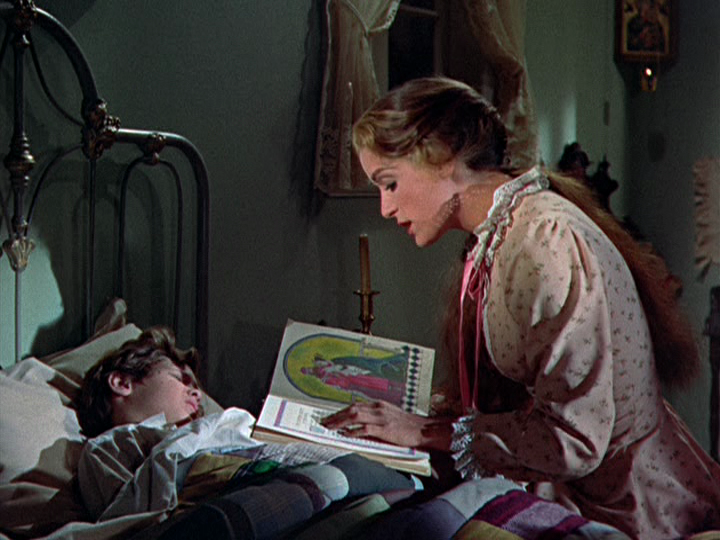
As the narrator relates, Peter Ilych Tchaikovsky was born in Votkinsk, a small provincial town in Russia, in 1840. When we first see Tchaikovsky, his siblings are running around the living room while he sits at the piano, playing. At a young age, he had found happiness in music, particularly the music of Mozart, whom he considered his idol. His mother, however, worried about how much time he spent at the piano, and hired a French governess to teach the children. The governess tries to understand the boy’s love of music, but in the end, she tries to tear him away from the piano to have him play in the sunshine. One evening, Tchaikovsky is troubled by the music that seems to play unending in his head. “Whenever the boy’s soul was stirred,” the narrator explains, “the music would throb in his head until it was almost painful.” The governess hears his painful cries, and decides to soothe him by reading him a story he had never heard before – the story of Sleeping Beauty. Unfortunately, the story did little to put him to sleep; it caused his creative juices to flow, and he snuck down to the piano to compose before being caught by the governess. The next day, Tchaikovsky is dismayed to see that the piano has been locked up, and as he tries to find another way to express the music in his head, he breaks the window after tapping emphatically on it, slicing his hand. His parents allow him to play once more, but this happiness would soon be interrupted.

Young Tchaikovsky (Rex Hill) being read the story of Sleeping Beauty by his governess, played by Lilyan Chauvin

“…contentment was never to be Peter’s fate for very long,” the narrator warns the audience. “Soon, he was to suffer the heaviest blow of his young life. His parents decided to prepare him for a government career at school in St. Petersburg.” Tchaikovsky is seen crying as his mother wishes him farewell, telling him to be a good boy and study hard. As she leaves, the audience is told that Tchaikovsky never saw his mother again, for she died soon after. After this crushing blow, “his musical genius withdrew deep inside him. It went to sleep, like Sleeping Beauty in the fairytale. And, strange to say, like Sleeping Beauty, it would stay dormant for a long time before something wonderful happened to awaken it again.” Seventeen years later, we see Tchaikovsky grown up, working as a lowly copy clerk. He toils away, feeling his life lacks meaning, until he sees an advertisement in the newspaper: the opening of a new conservatory of music, led by the great composer, Anton Rubinstein. This stirs something inside him, and Tchaikovsky decides to enroll in the evening classes for piano and composition.

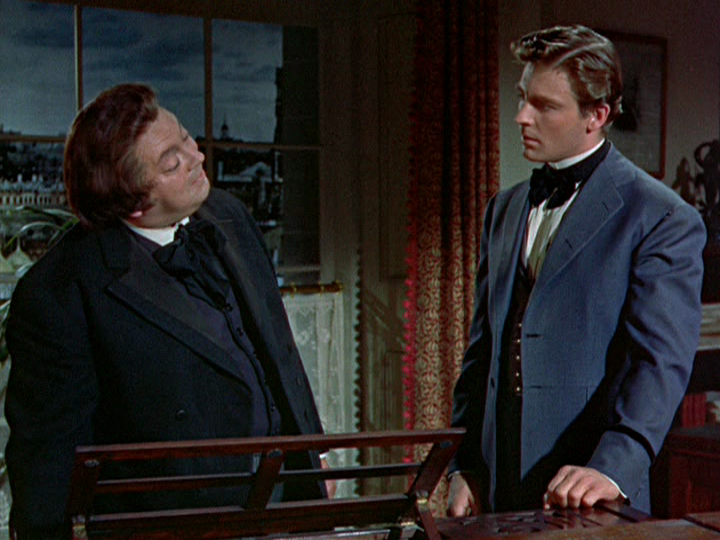
One evening, as he improvises tunes of his own, he is spotted by Rubinstein himself. The composer asks Tchaikovsky if he wishes to make a career of music, to which Tchaikovsky admits he has dreamed of it, but needs to earn his bread. “Bread! Did Bach, Mozart, Beethoven think of bread?” the composer cries. “For music, an artist must be willing to starve.” He gives the young man a test: he plays a theme, and asks him to write variations on it, telling him that not only quality, but quantity counts as well. Inspired, Tchaikovsky works all night on his variations, which unfortunately gets him in trouble at work when he accidentally writes on an official decree with the signature of the prime minister. Immediately dismissed, Tchaikovsky goes back to Rubinstein to submit his variations – all 215 of them. Rubinstein offers to take Tchaikovsky under his wing, an offer Tchaikovsky immediately accepts.

Anton Rubinstein, played by Leon Askin, asks Tchaikovsky, now played by Grant Williams, about his plans in music

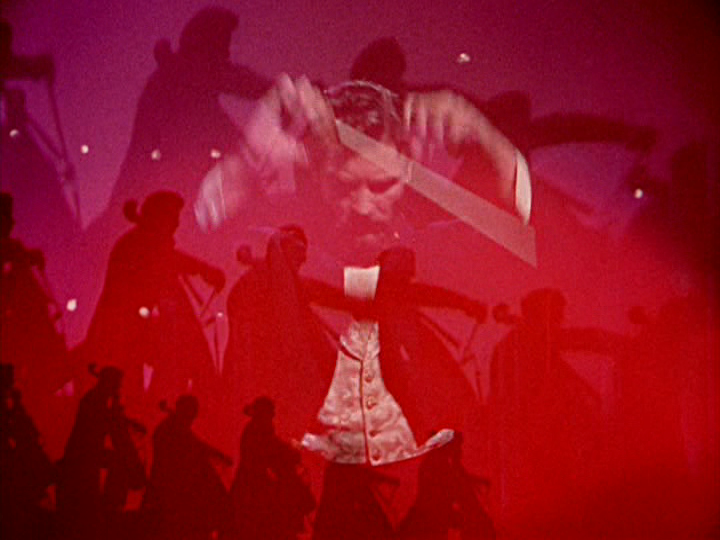
Tchaikovsky’s true awakening, the narrator states, was at a performance of the traveling Italian Opera Company, starring a beautiful soprano named Desiree Artot. To try to win her affections, Tchaikovsky writes her a song, which begins a relationship leading to an engagement between the two. This engagement is broken, however, by a letter from Desiree, addressing Tchaikovsky as her dearest friend and informing him that she has married a man in her troupe. Deeply wounded, he vows to never write another note of music, but this was not to be: his genius was too strong to be shut away again. Instead, his love for Desiree was replaced by a new love for the ballet. His first ballet was entitled Swan Lake, and although Tchaikovsky had great hopes for its success, it was a dismal failure. Unable to handle the criticism, Tchaikovsky fled to Europe. He was unable to find any solace while traveling, and so from Naples, he took a steamer back to Russia, where he was troubled by a dream of a memory. He remembered the time in his childhood when his governess soothed him by reading him a fairytale, and how he immediately set to work composing it. Waking with a start, he rummages through his belongings to find the manuscript of Sleeping Beauty someone had sent him, thinking it would be a good idea for a ballet. Inspired once again, he sat down to compose the entire ballet before arriving back in Russia. “And this time,” the narrator says, “his creation was headed for the bright future that was in store for all his wonderful works.”

Tchaikovsky conducting the Sleeping Beauty Ballet. The orchestra scenes used are actually reused footage from Fantasia

The rest of the episode is basically an advertisement for the upcoming film version of the story of Sleeping Beauty. “Imagine your living room is a theater,” Disney urges the audience, “and your television set is the theater’s wide screen, as we bring you this romantic sequence from Sleeping Beauty.” In fact, two scenes are played for the audience: the Once Upon a Time sequence, and the rescue of Prince Phillip from the evil clutches of Maleficent, which ends as the evil fairy turns into the dragon. “Well, there’s much more to Sleeping Beauty than the few brief scenes we’ve shown you on this program,” Disney reassures us. “But I can tell you this: like all good fairytales, true love does win out.”

Although not a truly accurate depiction of Tchaikovsky’s life, the episode is a rather good watch, especially to capture the excitement of audiences seeing a new technological advancement when it came to movies. This story of Tchaikovsky’s life is a good story, and told well, even though it comes at the cost of the omission of some facts that may not have been suitable for audiences in that time period.

January 26

January 26, 1955 – Davy Crockett Goes to Congress Premieres on ABC.

“Now, again from Davy’s own journal, we’d like to present another story of Davy’s fabulous life. This one is called, ‘Davy Crockett Goes to Congress.’” – Walt Disney.

On the evening of January 26, 1955, the second installment of The Adventures of Davy Crockett premiered on the Disneyland television show on ABC. Shown a little over a month after the first installment, the series continued the Davy Crockett craze that had taken over the youth of America. This episode, entitled Davy Crockett Goes to Congress, was directed by Norman Foster, and written by Tom Blackburn. It stars Fess Parker as Davy Crockett, Buddy Ebsen as Georgie Russel, Basil Ruysdael as Andrew Jackson, William Bakewell as Tobias Norton, and former professional wrestler Mike Mazurki as Bigfoot Mason.

A page from Davy's own journal, as seen in the show, which introduces the story of Davy's political career

The show opens with Davy and his pal Georgie setting out to find a new piece of land to settle. Although they find the perfect spot, Georgie reminds Davy that they need to file a claim for the land. As they approach the settlement, looking for the judge to file their claim, they stumble upon a shooting match. Ever competitive, Davy challenges a man named Bigfoot Mason, wagering $15, the estimated price of the prize cow. They tie with the first round, but with their second shots, Bigfoot believes he won, as it appears that Davy completely missed the target. When it’s discovered that Davy hit the exact spot twice, he makes an unintentional enemy out of Bigfoot. The judge, discovering who Davy is, is thrilled that Davy is in town, as he may be the man that can stop Bigfoot’s schemes. The judge informs Davy and Georgie that Bigfoot and his gang have been running the Indians off of their land and selling it to newcomers who have no idea that the land has been stolen. Davy reminds the judge that there’s a treaty that guarantees the Indians their land, but the judge says that Bigfoot disregards any treaty of that nature. The few people who have tried to stop Bigfoot have disappeared, presumed dead. The judge, knowing Davy’s reputation, asks Davy to be the magistrate and serve a warrant on Bigfoot and his gang. Davy says he’d have to think about it. It doesn’t take long for Davy to decide, as he finds that the Cherokee Charlie Two Shirts has been beaten and run off his land. Davy confronts Bigfoot, and it turns into a no-holds-barred fistfight. Davy emerges victorious, and peace comes over the settlement again as the gang is brought to justice.

During one of the celebrations in town, the judge tells Davy that since the settlement is experiencing a lot of growth, they’ll be getting someone to represent them in Nashville, and the town has picked Davy as the man they want to run for the state legislature. Davy responds, “I’m plumb flutterated by the honor, but, well, I ain’t no politician.” When the judge informs him that his competition is Amos Thorpe – the lawyer who tried to get Bigfoot off, and made a lot of money from the illegal Indian land grabs – Davy considers running. The thing that sets him on his political path, however, is the sad news that his wife, Polly, came down with a fever and died. Consumed by grief and needing a distraction, he decides to run for the spot in the state legislature, proclaiming that he’ll represent the town as honestly as he can. Davy wins by a landslide.

Davy in formal clothes after he's been elected to the state legislature

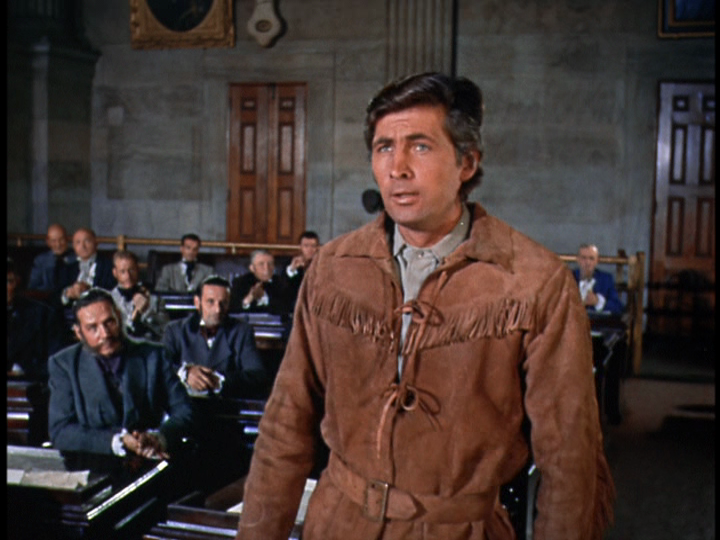
Davy’s political career has been watched closely by his old Major, Tobias Norton, and General Andrew Jackson. Jackson is preparing to run for the presidency, and both he and Norton want Davy to have a seat in Congress. As Jackson puts it to Davy, “I want men I can trust, men I know are with me, men that can get the rest of the country behind me.” Davy responds, “Well, if I was to do what you asked, and I did get in, I wouldn’t be taking orders from you, General. I’d be taking them from them that elected me.” Thanks to a set of books Georgie has been publishing about their adventures together, Davy is able to win the seat in Congress, and surprises the members by showing up in buckskins. Georgie is there to greet him, and Davy tells him off about having to show up as the “king of the wild frontier, thanks to you.” He introduces himself with a strange speech, but promises that he won’t be one of those politicians who doesn’t do anything more than listen, and the next time he stands before them, he’ll “have something to say worth saying.”
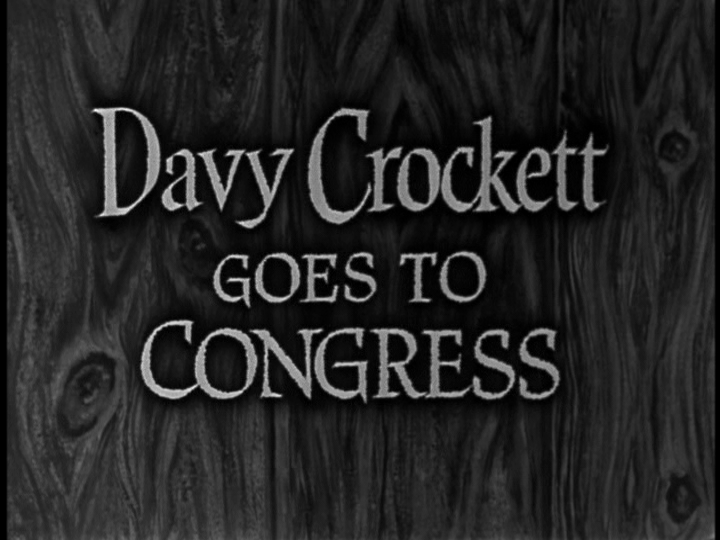
Davy’s career hits a snag when Norton tells Davy he’s to go on a speaking tour, calling it a “great service for the country.” Norton adds that people want to make Davy the next president of the United States. Georgie, ever suspicious of Norton, finds out the truth: Norton sent Davy out of the way so he wouldn’t be able to vote against a bill meant to take away all lands from the Indians. Georgie and Davy race back to Washington, where Davy punches Norton out as the former major tries to stall him, and storms in to Congress, giving the last great speech of his political career.
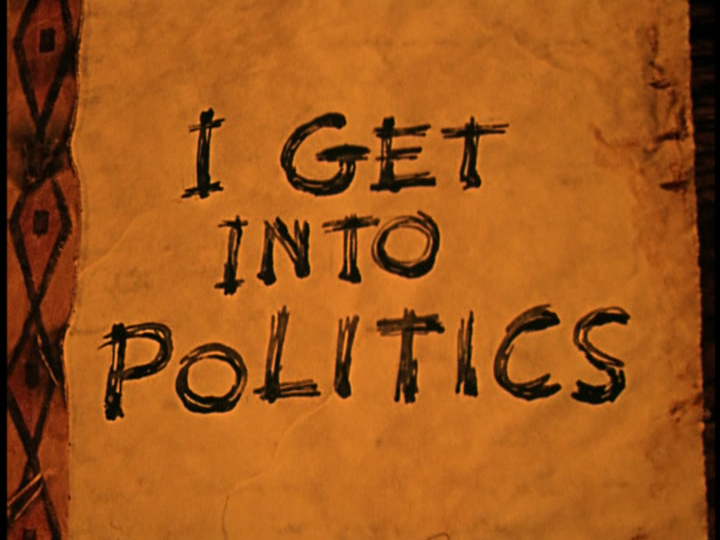
Davy giving a speech in Congress, dressed in his buckskins

Compared to most of the shows on television at the time that featured cowboys and Indians, the Davy Crockett serial was very well made, especially when it came to the matte paintings of Nashville and Washington, D.C., painted by Peter Ellenshaw. Walt Disney sent crews to picturesque areas in North Carolina to do research of the landscape, and it made the serial stand out against all the other shows. There’s also no denying the charm of Fess Parker as Davy Crockett. The last impassioned speech he gives as Congressman Davy Crockett is one that will be remembered.
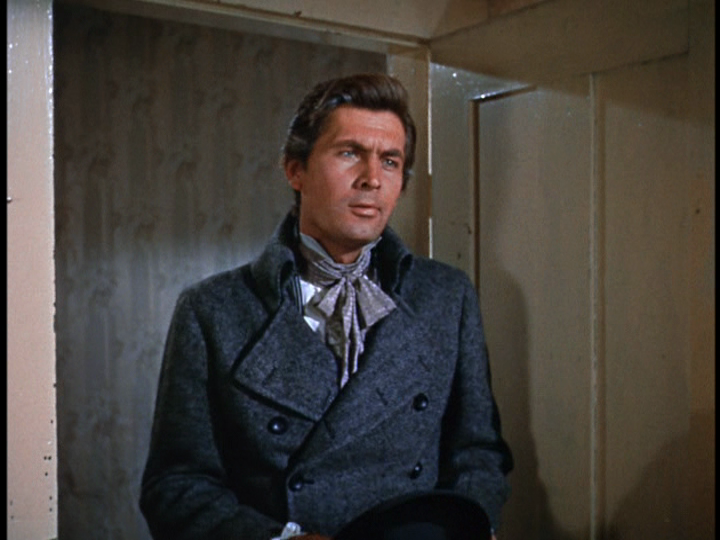
.

January 8

January 8, 1956 – The Mickey Mouse Club Circus Closes in Disneyland

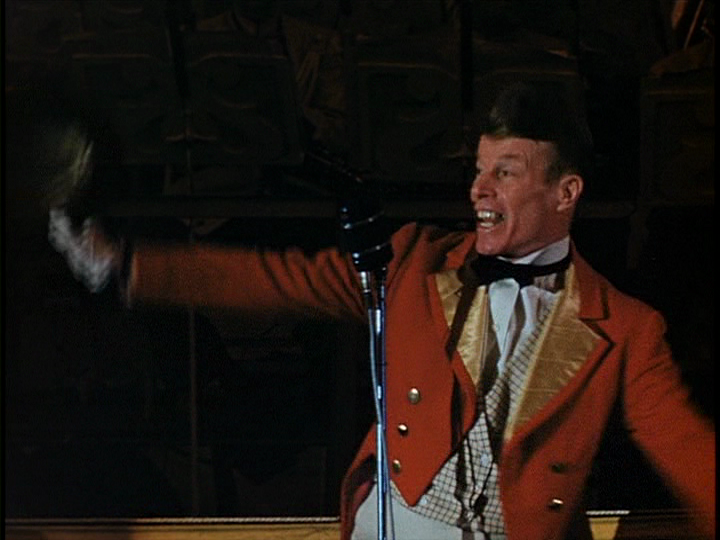
Jimmie Dodd - the Ringleader of the circus

“Fantastic circus. And nobody came. Why? Because they came to see Disneyland.” – Jack Lindquist, Retired Disneyland President

The Mickey Mouse Club Circus—which opened in Disneyland on November 24, 1955—closed on January 8,1956, lasting only one holiday season. Launched almost two months after The Mickey Mouse Club began airing on ABC, the circus grew out of Walt’s lifelong fascination with the Big Top, as shown in his films Dumbo and Toby Tyler, or Ten Weeks with a Circus.

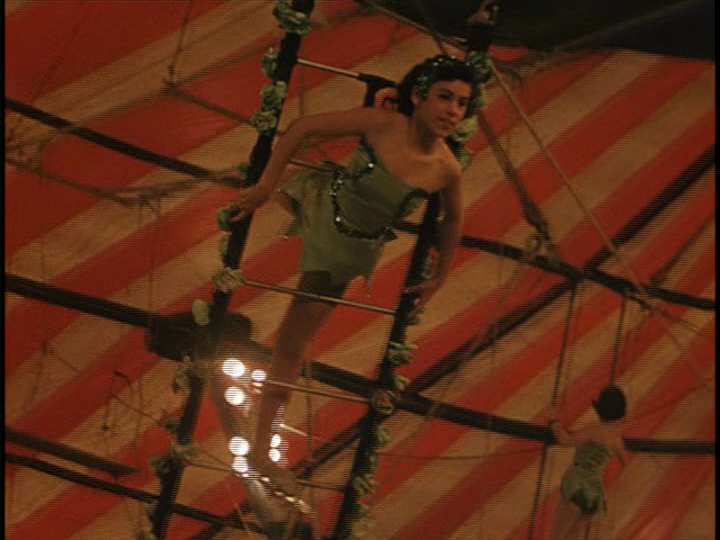
A cast member performing part of the aerial act

The show lasted seventy-five minutes. One of the highlights was an aerial act, led by Mickey Mouse Club member Doreen Tracy. However, during one performance, Tracy forgot her instructor’s warning to never look down, and found herself frozen on top of the platform until a crew member grabbed a ladder to bring her down.

The circus is considered one of Walt’s few failures. Although the cast loved performing the acrobatic stunts, it wasn’t enough to save the show. Eager Mickey Mouse Club fans across the country were not always able to travel to Anaheim to see the cast, and most people who came to Disneyland tended to be more interested in the park’s other features, figuring that they could see a circus back home. After the closing, the tent was then used in Holidayland—ironically, another failed idea of Walt’s—for corporate picnics and other events.

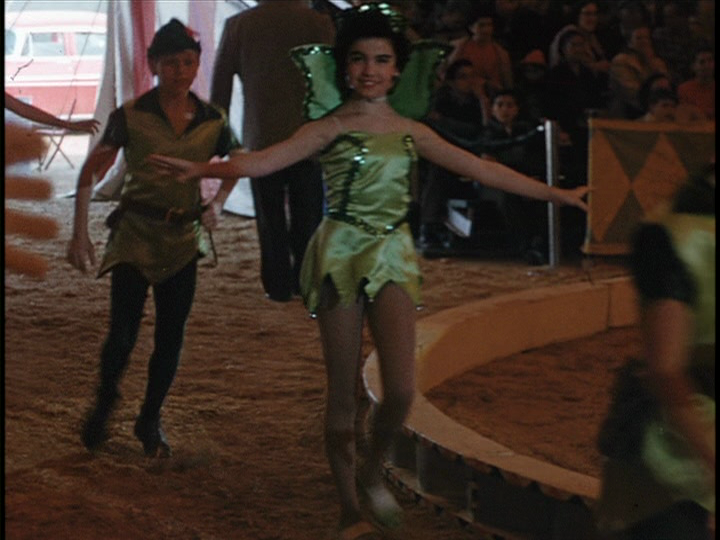
Annette Funicello dressed as Tinkerbell. All the girls wore Tinkerbell costumes, and the boys were dressed as Peter Pan.

Fortunately, the circus closing had no impact on the popularity of The Mickey Mouse Club, and the cast members were able to go on several tours later on, including a trip to Australia in 1959.


January 6

January 6, 1950 – Pluto’s Heart Throb Released to Theaters


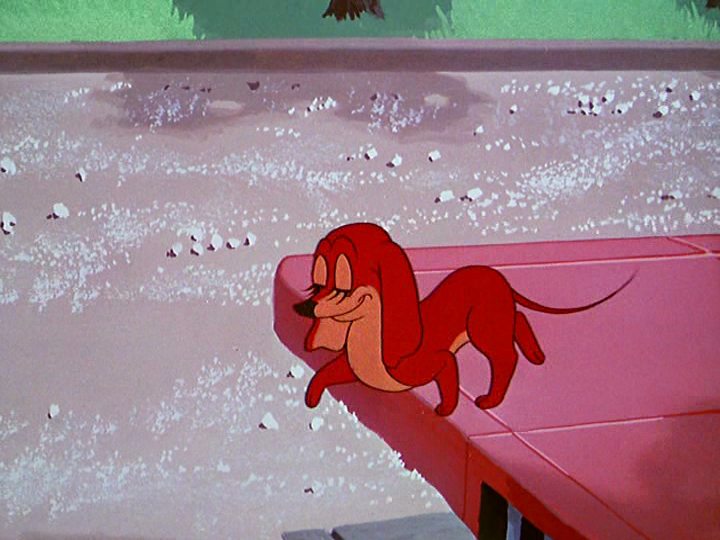
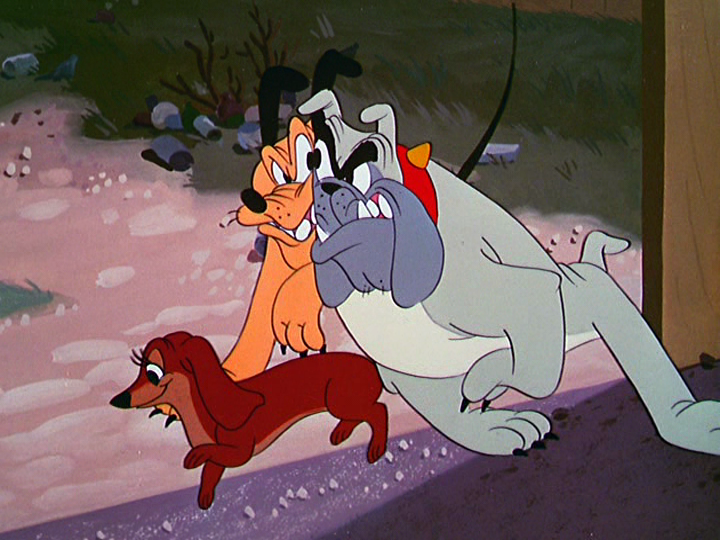
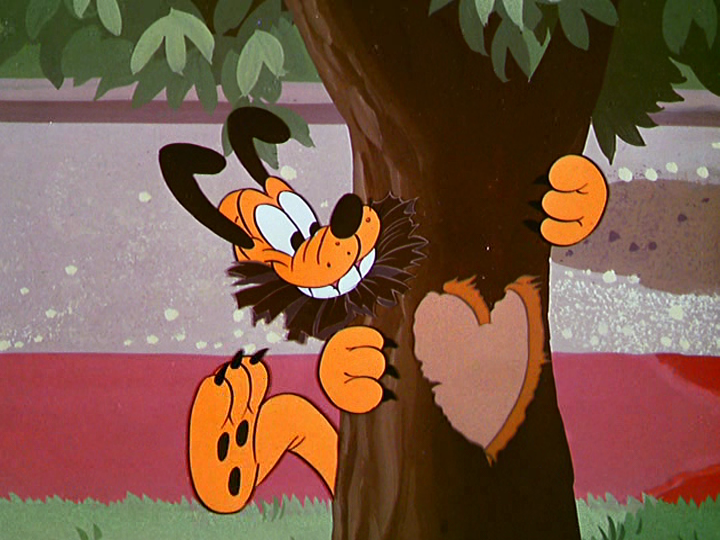
In this 1950 short film—directed by Charles Nichols, with story by Roy Williams and music by Oliver Wallace—Pluto tries to win the affections of Dinah, a dachshund, but has to compete against a bulldog named Butch. Although Butch tries to convince Dinah that he and Pluto are friends, he will stop at nothing to attack Pluto when Dinah isn’t looking.

Dinah the Dachshund

Dinah first appeared in the 1942 short The Sleep Walker, replacing Pluto’s former romantic interest Fifi the Peke. Butch had been Pluto’s antagonist since the 1940 short Bone Trouble, when Pluto tried to steal his bone. Dinah is often a source of contention between Pluto and Butch as they try to win her fickle affections.

Pluto’s Heart Throb is a prime example of the physical comedy that the Pluto shorts were known for.  In most films Pluto said very little, if anything at all. The physical comedy is exaggerated for comic effect, first seen when Pluto begins to fall for Dinah. The music is synchronized with the actions of the characters, from woodwinds playing in rhythm when Pluto is waving his paw at Dinah, to trumpets when Pluto and Butch are squaring off.

Pluto and Butch square off behind Dinah's back

In the end, the good-natured and steadfast Pluto wins the heart of Dinah (this time), after she sees how Butch has been bullying Pluto, plus Butch is too afraid to save her when she accidentally falls into a pool. This is not one of the standout shorts in Pluto’s library, but it is rather a humorous look at how the good guy can win the girl in the end.

Bonus Fact: Heart throb indeed – there were 183 hearts used in this short.