RSS Feed

Tag Archives: 1930s

December 24

December 24, 1937 – The Mickey Mouse Short Lonesome Ghosts is Released to Theaters
vlcsnap-2012-12-23-19h32m40s223

“Notice! We exterminate all kinds of ghosts! Day and night service.”

On December 24, 1937, the Mickey Mouse short film Lonesome Ghosts was released to theaters. The short made great use of a new invention of the animation department: transparent paint, which helped give the ghosts a more realistic ghastly appearance. The film was directed by Burt Gillett, and stars Walt Disney as Mickey Mouse, Pinto Colvig as Goofy, and Clarence Nash as Donald Duck.

A group of four ghosts in a haunted mansion one winter’s night are bored, until one spots an ad in the paper for a ghost extermination service. Hoping to have new people to scare, they decide to call the service. Meanwhile, at Ajax Ghost Exterminators Headquarters, Mickey, Goofy, and Donald are sitting around the table sleeping when the phone rings. They wake up and scramble to answer it, and readily take the job the ghosts “scare up” for them. The ghosts wait anxiously, and watch with delight as the trio arrives. Mickey and the gang enter the house with trepidation, and hear the ghosts making noises inside.
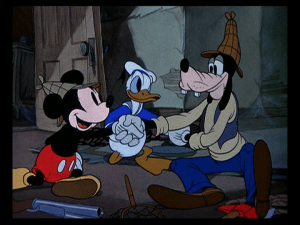
The trio agrees to split up, hoping that they can divide and conquer the ghosts

The trio agrees to split up, hoping that they can divide and conquer the ghosts

Mickey suggests that the three separate and surround the ghosts, and the three go their separate ways. As Mickey goes one way, he meets a ghost that he tries to shoot it with his shotgun, but the ghost sticks his fingers in the barrel, causing the gun to implode. Mickey then chases the ghost around the house, only to be surprised by all four of the ghost residents. The ghosts had meanwhile taken great delight in scaring Donald with loud noises, although he punches one in the kisser.

Goofy is also startled by the ghosts and their noises, and although he tries to convince himself that he is not scared, he runs and hides when he spots them. He spies a ghost in the mirror who imitates every move Goofy makes. Goofy knows something is wrong with his reflection, but he can’t quite put his finger on it. He finally figures it out, but is unable to fight the ghost. While stuck fighting himself in a dresser, the ghosts push him down the stairs, where he crashes into Mickey and Donald, sending them flying into the pantry. The trio and the dresser fly into barrels of molasses and bags of flour, covering the three entirely. As the ghosts come to admire their handiwork, they mistake the flour-covered three as ghosts and flee the mansion in a panic.
December 23

December 23, 1938 – The Silly Symphony Mother Goose Goes Hollywood is Released to Theaters

vlcsnap-2012-12-23-08h44m57s97

“Any resemblance of characters herein portrayed to persons living or dead, is purely coincidental.”

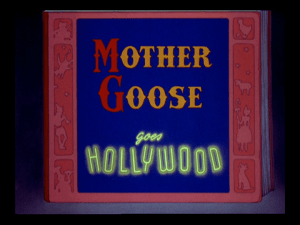
On December 23, 1938, the Silly Symphony Mother Goose Goes Hollywood was released to theaters. The film takes many of the popular actors of the time and caricatures them as characters in Mother Goose stories. The film was nominated for an Academy Award, but lost to Disney’s Ferdinand the Bull. The short was directed by Wilfred Jackson.

The short is presented in book form, going through the pages of a collection of Mother Goose’s stories. The first page opens the short with a parody of the MGM logo, using a goose rather than a lion. The page then flips to the first tale of Little Bo Peep, with Bo Peep being portrayed by Katherine Hepburn. She bemoans the loss of her sheep, then turns the page to reveal Old King Cole (Hugh Herbert) and his court jester, Ned Sparks. His fiddlers are called in, with the fiddlers being none other than the Marx Brothers. Herbert enjoys the show, but Sparks is obviously less than thrilled. Joe Penner, playing a servant, brings in a big bowl, asking if the king wants to buy a duck, with Donald Duck popping out of the bowl and repeating the question. When Herbert quickly closes the bowl, Donald throws a fit.

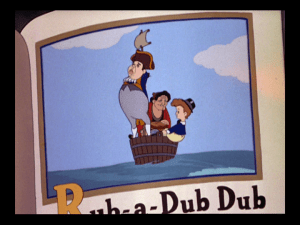
Charles Laughton, Spencer Tracy, and Freddie Bartholomew sit in a tub as they perform the nursery rhyme

Charles Laughton, Spencer Tracy, and Freddie Bartholomew sit in a tub as they perform the nursery rhyme

The page turns to the nursery rhyme, “Rub-a-Dub Dub,” with the three men played by Charles Laughton, Spencer Tracy, and Freddie Bartholomew. Bartholomew falls overboard, and Laughton remarks on this drolly. Tracy quickly retrieves Bartholomew, and Bartholomew gives his thanks before they are all alerted to Katherine Hepburn in a motorized contraption, still searching for her sheep. The three men try to hitch a ride, but are swept overboard as the page turns to Humpty Dumpty, played by W.C. Fields. He pulls down a nearby birds nest, thinking a tiny chickadee is inside, only to find that the nest is occupied by Charlie McCarthy. Charlie continues to taunt Fields, with Fields falling off the wall and into a mushroom, made to resemble an egg cup. The next story is Simple Simon, played by Stan Laurel, who is fishing in an old tin can, using a fish as bait to catch worms. The pieman, played by Oliver Hardy, is whistling nearby, and presents a a pie to Laurel, who refuses it to grab a different one. As Hardy tries the same trick Laurel performed, he ends up destroying all but one pie. When Laurel points this out, Hardy throws the pie at him, missing Laurel, but hitting Hepburn, still searching for her sheep.

See-Saw Margery Daw is the next tale, portrayed by Edward G. Robinson and Greta Garbo. Garbo asks to be alone, with Robinson replying that she asked for it. He steps away from the see-saw, letting Garbo crash to the ground as the page turns to Little Jack Horner. Eddie Cantor, playing Jack, beings singing “Sing a Song of Sixpence.” Several African-American stars begin to poke their heads out of the pie, including Cab Calloway, who leads the others in song as he asks Little Boy Blue (Wallace Beery) to blow his horn. Fats Waller and Stepin Fetchit remark about the boy, until Beery blows it until his face turns purple. The page then turns to reveal a pop-up of the old woman’s shoe, with every Hollwood star in attendance for a big old bash. A few more people show up, including Clark Gable, Edna May Oliver, ZaSu Pitts, Joan Blondell, and George Arliss. Fats Waller plays the piano, with some unnecessary help from the Marx Brothers. Fred Astaire begins to tap dance, inviting Stepin Fetchit to dance. The short ends with Katherine Hepburn still on the search.

December 21

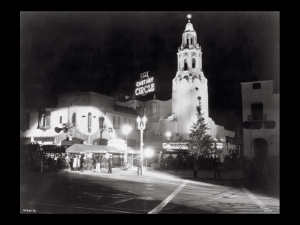
December 21, 1937 – Snow White and the Seven Dwarfs Premieres at the Carthay Circle Theater

vlcsnap-2012-12-20-19h13m23s224

“Walt Disney, who created these lovable characters, brings to motion pictures a new medium for a greater art. And it looks like a ‘Snow White’ Christmas for all!”

On December 21, 1937, after beginning production in 1934, Walt Disney’s first full-length animated feature film, Snow White and the Seven Dwarfs, premiered at the Carthay Circle Theater in Los Angeles, California. Many of those who attended had called the film “Walt’s Folly;” many celebrities also attended the premiere, including Shirley Temple, Marlene Dietrich, Mary Pickford and Douglas Fairbanks, Ginger Rogers, Clark Gable and Carole Lombard, and Charlie Chaplin. There were even actors in dwarf costumes, and a special appearance by Mickey and Minnie Mouse, and Donald Duck. Life size replicas of the dwarfs’ cottage were created for the event. The film received a standing ovation, and grossed more than $8 million, which was quite a feat at the time, since a movie ticket cost about 10 cents. Snow White was the highest grossing film of all time, until it was surpassed by Gone With the Wind. The film was generally released on February 4th, 1938.

December 14

December 14, 1935 – The Silly Symphony Broken Toys is Released to Theaters

vlcsnap-2012-12-13-21h38m34s241

“Boy, what a dump to end up in.”

On December 14, 1935, the Silly Symphony Broken Toys was released to theaters. The short features caricatures of famous actors of the time, including W.C. Fields, Ned Sparks, and Stepin Fetchit. The short was directed by Ben Sharpsteen.

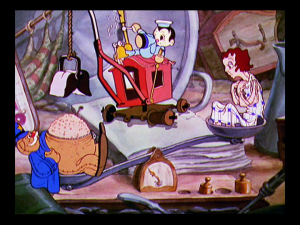
A wheelbarrow rolls to a shallow area marked with a sign that says, “No Dumping.” A pile of trash, including an old sailor doll with a broken leg falls from the wheelbarrow. The sailor doll quickly reattaches his leg and looks around, seeing other broken-down and old toys in the dump. The toys are depressed that no one wants them, but the sailor doll tells them that he knows of a place where they’d all be welcome. Inspired by his words, the toys decide to fix themselves up, and finally leave the dump.

The sailor toy helps remove excess sawdust from one toy to help fill another

The sailor toy helps remove excess sawdust from one toy to help fill another

As the toys dance around helping each other make their repairs, they use the supplies around them to fix each other: a pencil replaces a toy soldier’s leg, and a stamp covers a hole in a rag doll. One little doll has no eyes, so all of the toys band together to give her a set of lovely blue eyes. The sailor, playing doctor, sews her eyes on, and she is thrilled that she is finally able to see. They all climb out of the dump, and the sailor leads them to a house in the nearby village that is the local orphanage, where they know they will be happy and loved.

December 9

December 9, 1931 – The Mickey Mouse Short Film Mickey’s Orphans Premieres in Theaters

vlcsnap-2012-12-08-19h09m26s218

“Aw, isn’t it adorable?”

On December 9, 1931, the Mickey Mouse short film Mickey’s Orphans premiered in theaters. It was the first Disney cartoon with a Christmas theme, and was nominated for an Academy Award for Best Animated Short Film, but lost out to Disney’s Flowers and Trees. The short was directed by Burt Gillett, and stars Walt Disney as Mickey and Marcellite Garner as Minnie.

A mysterious figure trudges through the snow carrying a large covered basket as the carol “Silent Night” is heard in the background. The figure stops at a window of a nearby house and sees Minnie and Mickey preparing for Christmas. The figure leaves the basket on the doorstep and departs. Pluto brings the basket inside and pulls the blanket off to reveal a multitude of orphan kittens, who proceed to explore their new surroundings. Mickey and Minnie take to the kittens, but Pluto is rather suspicious of these invaders.

To entertain the kittens, Mickey and Pluto dress like Santa and a reindeer

To entertain the kittens, Mickey and Pluto dress like Santa and a reindeer

The kittens begin to wreak havoc on the house, pulling on Pluto’s ears and tail, and playing with the hanging light fixtures. Dismayed, Minnie suddenly comes up with an idea that Mickey and Pluto set in motion: Mickey plays Santa Clause to the kittens and Pluto plays the reindeer. The kittens are thrilled with their gifts, and parade around the house like a marching band playing a tune. Some kittens, who received saws and other tools, begin tearing the house apart. They continue to play pranks on Mickey and Pluto, until Minnie reveals the large decorated Christmas tree – which the mischievous kittens proceed to take apart.

November 29

November 29, 1934 – The First Set of Disney Balloon Joins the Macy’s Christmas Parade

Image credit: Disney Parks Blog

“See gigantic balloons designed by none other than Walt Disney, creator of Mickey Mouse himself!”

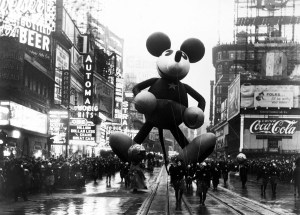
On November 29, 1934, Disney characters made their debut in Macy’s Santa Claus Parade (later renamed the Macy’s Thanksgiving Day Parade). Although Mickey had been a big star since 1928, it wasn’t until 1934 when Disney characters were featured, including Mickey Mouse. The effort of bringing the Disney characters to the parade was due to the efforts of Walt Disney and Tony Sarg of Macy’s.

The Mickey balloon was over 40 feet tall and was held by 25 handlers in Mickey and Minnie Mouse costumes. Balloon Mickey had a giant Macy’s star on his chest in a bit of cross-promotion. Other Disney characters featured were Pluto, the Big Bad Wolf (measuring at 34 feet), one of the Three Little Pigs (measuring at 31 feet), and Horace Horsecollar (measuring at 12 feet).

November 25

November 25, 1938 – The Special Short Film Ferdinand the Bull is Released to Theaters

“All the other little bulls he lived with would run, and jump, and butt their heads together, but not Ferdinand.”

On November 25, 1938, the special short film Ferdinand the Bull was released to theaters. The short was based on the book The Story of Ferdinand by Munro Leaf, with illustrations by Robert Lawson. Ferdinand the Bull won the Academy Award for Best Cartoon of 1938. It was directed by Dick Rickard, and narrated by Don Wilson; Milt Kahl provided the voice of Ferdinand’s mother, while Walt Disney provided the voice for Ferdinand. Several members of Disney staff were caricatured as characters at the bullfight; Walt himself was caricatured as the matador.

The short opens in Spain, introducing the little bull Ferdinand, who much preferred to sit in the pasture and smell the flowers rather than butt heads with the other little bulls. His mother worried about him, but Ferdinand was quite content under his cork tree. As the years went by, Ferdinand grew to be big and strong, but never dreamed of fighting in the bullfights like the others.

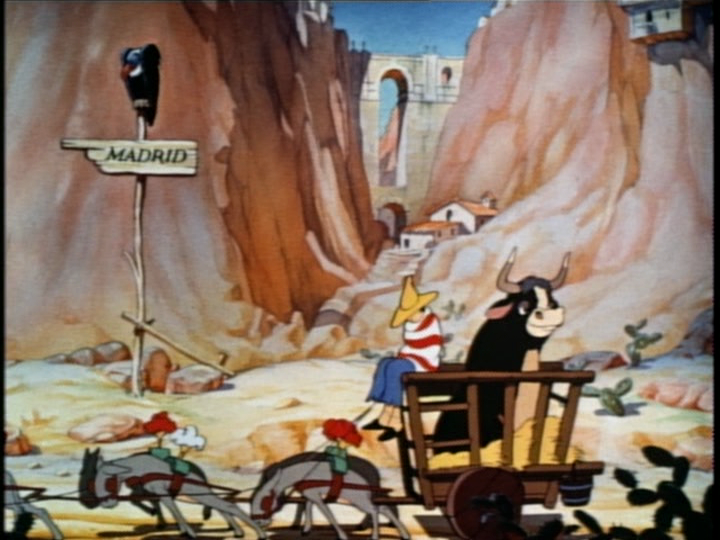
After displaying a fierce reaction to the bee sting, Ferdinand is carted to Madrid to fight the matador

One day, a group of men came to pick the biggest, strongest, and toughest bull to fight in Madrid. Ferdinand ignored them and went to sit under his tree, but accidentally sat on a bee. His surprised, fierce reaction to the bee’s sting convinces the men that Ferdinand is the strong, tough bull they are looking for, and they cart him off to Madrid.

Ferdinand’s bullfight opens with much fanfare. The matador appears in the ring to great applause, ready to do battle with the bull. Unfortunately for the matador, Ferdinand is not in a fighting mood. As the matador flees from Ferdinand’s approach, everyone is surprised to see the bull sniff a bouquet of flowers that has been tossed into the ring. The matador is furious that Ferdinand won’t be fierce, and tries any approach he can to get a reaction from the flower-loving bull. After revealing a daisy flower tattooed on his chest, Ferdinand gives the matador a kiss. Frustrated, the men in charge cart Ferdinand back to his little area under the cork tree, letting him remain and smell the flowers.

November 12

November 12, 1932 – The Mickey Mouse Short Film The Klondike Kid is Released to Theaters

“Guess we’re both nobodys.”

On November 12, 1932, the Mickey Mouse short film The Klondike Kid was released to theaters. The short was directed by Wilfred Jackson, and stars Walt Disney as Mickey Mouse, Marcellite Garner as Minnie Mouse, Pinto Colvig as Goofy and Pluto, and Billy Bletcher as Pierre.

The short opens at the Klondike Bar in the middle of a blizzard, but inside, the atmosphere is merry with many people drinking and dancing. Mickey is playing the piano, and scrapes up the change people throw at him when he finishes. As he gathers the coins, he notices at the window a girl, who faints in the snow. He rescues her, bringing her into the warmth. She begins to cry, and when Mickey asks her name, she responds that she’s just “nobody.” She laughs at his jokes, and warms up to him when he offers her some food.

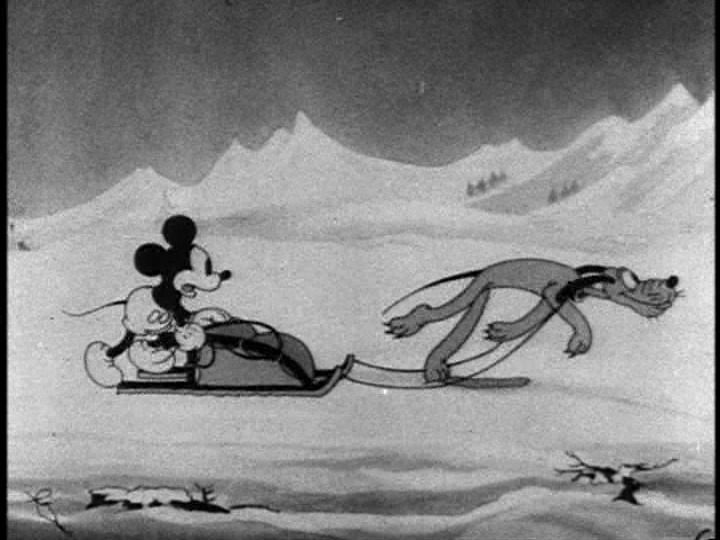
After Pierre kidnaps the girl, Mickey uses Pluto as his sled dog and pursue the villain

The door of the bar bursts open, and in storms Peg Leg Pierre, who attacks Mickey and pins him to the wall before he kidnaps the girl. As she screams in terror, many of the patrons try to help her, but are prevented by an ensuing gunfight. Pierre steals her away, but Mickey frees himself and chases after her. He harnesses Pluto as his sled dog, but Pluto gets the idea of running only after he spots a rabbit to chase. The sled breaks, and Mickey finds himself skiing down the hill into Pierre’s hideout.

Inside Pierre’s cabin, Mickey and Pierre fight and the two are caught in mattress springs. Meanwhile’s Pluto’s rabbit chase ends with him snowballing down the hill and knocking Pierre’s cabin from its foundation. As the short ends, Pierre is knocked out, and Mickey and the girl attempt to kiss, only to kiss Pluto, who pops out of the snow in between them.

November 5

November 5, 1937 – The Silly Symphony The Old Mill is Released to Theaters

On November 5, 1937, the Silly Symphony The Old Mill was released to theaters. The short film is notable for being the first film to use the multi-plane camera, which helped create a new three-dimensional look to the Disney films. The film won an Academy Award for Best Cartoon; Disney also took home a special Scientific and Technical Class II plaque for the design and application of the camera.

An old mill stands abandoned at the side of a pond at sunset, while all the animals around head to their nests for the day. A pair of bluebirds have made a nest in the old cogs, waiting for their eggs to hatch. Many animals have made the mill their home, from mice, to owls and bats. Out in the pond, frogs peek out from their lily pads and begin to croak, until they are interrupted by the sound of crickets. Fireflies also appear in the night, with one of the frogs anxious to eat one. As he does, his stomach glows from the firefly.

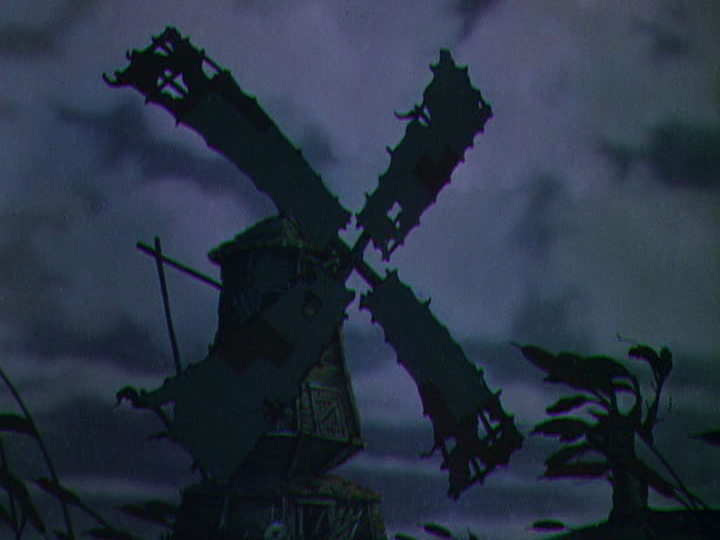
The windmill begins to spin again as storm clouds gather and the wind picks up ferociously

Suddenly, the wind begins to howl, and the windmill starts to turn. The bluebird who made her home in the cogs can’t bear to leave her eggs – luckily, the cog she is sitting under is missing, and she and the eggs ride through unharmed. The storm grows stronger, with the rain dripping through the leaky roof and open windows. A pair of doves sit together, weathering the storm on an open ledge. A group of mice shiver after the lightning strikes. Parts of the mill begin to fall apart. Without warning, the mill is struck by lightning, shifting it from its base.

The storm settles, and the bats return to the mill as dawn approaches. The bluebirds’ eggs have hatched, and mother and father return with food. As life returns to normal, the animals begin their day once again in the abandoned mill on the side of the peaceful pond.

November 3

November 3, 1934 – The Silly Symphony The Goddess of Spring is Released to Theaters

“There once was a time in the long, long ago, when there was joy and laughter everywhere.”

On November 3, 1934, the Silly Symphony The Goddess of Spring was released to theaters. It is known as one of the earliest attempts of human animation for the Disney animators, as they were preparing for the feature film Snow White and the Seven Dwarfs. The short was directed by Wilfred Jackson.

The short opens in a forest on a beautiful spring day, with all the animals frolicking in the sunshine along with several woodland elves. The Goddess of Spring herself, Persephone, also dances by before sitting on her throne of cornucopias. The flowers dance a ballet at her feet before turning themselves into a wreath and resting on her head.

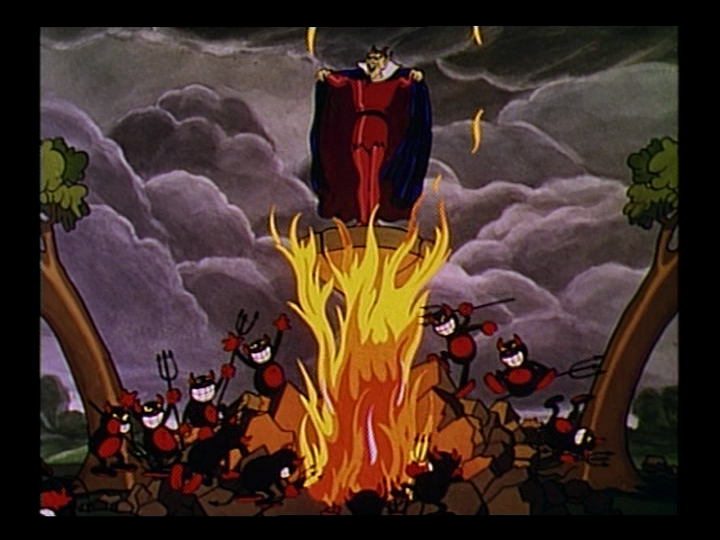
Out of the blue, the Devil bursts out of the ground, coming to claim the goddess as his bride

Suddenly, the skies grow dark, and the Devil bursts out of the ground on top of a column of flame, coming to claim Persephone as his queen. She refuses, but he grabs her and takes her to the underworld. All of Hell is celebrating the Devil’s “marriage,” but Persephone appears visibly miserable. On the surface, it is perpetually winter, with all of the woodland creatures mourning the loss of the goddess.

The Devil tries to tempt Persephone to stop crying with all the treasures of the world, and is angered that she will not stop being sad. He tells her that he will do anything she says, so long as she smiles. She asks to return to her world above, as everything above will die if she doesn’t. He acquiesces on one condition: she must spend half of every year with him below. She agrees to his terms, and is released. Everyone of the surface is overjoyed to see her, especially when she melts the snow and makes the world spring again.