RSS Feed

January 16

January 16, 2003 – Disney’s Aladdin: A Musical Spectacular Opens in Disneyland

The sign for the show at the Hyperion Theater.

“Must I yearn forever to be free, free to climb a tree and ponder, free to wander?” – Jasmine, “To Be Free.”

On January 16, 2003, the first performance of Disney’s Aladdin – A Musical Spectacular premiered in the Hyperion Theater at the Hollywood Pictures Backlot in Disneyland’s California Adventure Park. Based on the 1992 hit animated film, the Broadway-style musical uses many special effects and elaborate puppetry to transfer the essence of the animated film to the live-action stage, including Aladdin and Jasmine’s enchanted carpet ride around the theater. The 45-minute show is one of the more popular events in Disneyland.

The Genie and Aladdin. Note the elaborate steps taken to recreate the Genie in costume.

Many of the film’s elements are retained in this stage production: many of the musical numbers by Alan Menken, Howard Ashman, and Sir Tim Rice are performed, and the show includes a new number with lyrics and music by Alan Menken, entitled To Be Free. A cast recording released in 2003 contains many of the instrumental tracks used throughout the show. The cast on the recording includes Miles Wesley as Aladdin, Dee Dee Magno as Jasmine, and Nick Santa Maria as The Genie.

Thanks to the show’s popularity at Disneyland, Aladdin has begun its journey to other stages, heading toward a Broadway production, if the show does well. A version of the show opened at Seattle’s 5th Street Theater in July, 2011, and another production is scheduled from July 5th through the 13th at The Muny Theater in St. Louis. This new production will include songs by Alan Menken and Howard Ashman that had been cut from earlier drafts of the film.

January 15

January 15, 1943 – Education for Death is Released to Theaters

“He sees no more than the party wants him to; he says nothing but what the party wants him to say; and he does nothing but what the party wants him to do.”

Surely the grimmest film the studio produced during World War II, Education for Death: The Making of a Nazi, was premiered in theaters on January 15, 1943. Based on the bestselling book by Gregor Ziemer, the short was directed by Clyde Geronimi and principally animated by Ward Kimball. It was narrated in English by then-popular radio personality Art Smith; however, the dialogue in the short is in German. This helps to provide a sense of distance between the viewer and the characters, further heightening the fear of the Nazi doctrine in Americans. Disney Legend Joe Grant said that by making the short, the studios hoped to make it “visible to people what was going on. And you couldn’t do it in a better way than with the graphics in a cartoon. It wasn’t a cartoon, it was actually an editorial. I think it did the job.”

The story centers on a young German boy named Hans, and how he grows up in this new Nazi order, becoming a brainwashed believer of the Nazi ideology. The story begins with Hans’ parents standing in front of a soldier, registering their child’s birth. They present birth certificates dating all the way back to their great-grandparents, proving that they are pure Aryan. The mother wishes to name her child Hans, which, fortunately, is not on the forbidden name list (which includes Franklin and Winston as its top two forbidden names). The parents are then given a hereditary passport, with twelve lines, giving them “a subtle hint that Germany needs soldiers.” As a reward for giving birth, the couple is given a copy of Germany’s bestseller, Mein Kampf.

The hereditary passport: note Hans' name at the top, with more room for future names. His mother was expected to produce a large family for Germany's sake.

The next segment is of one of the doctored fairy tales presented to Hans in kindergarten. As this film was shown to general audiences, the animators tried to present at least one moment of humor in this otherwise dark film. The fairy tale in question is the story of Sleeping Beauty, with the Wicked Witch representing democracy, vanquished by the Prince (Hitler) before he wakes the Princess (Germany) with a kiss. The Princess, however, is anything but beautiful; instead, she is portrayed as an obese Wagnerian woman holding a stein and able to sing only the words “Heil Hitler!” “Prince Hitler” is anything but dashing: He struggles to carry Germany and barely manages to plop her on his horse (with a little comedic help). The moral of this story, the narrator tells us, “seems to be that Hitler got Germany on her feet, climbed into the saddle, and took her for a ride.” It could be argued that the comedy was so strong here to show the audience the absurdity of what German children were being taught in schools.

The caricatures of Germany as the Princess, and "Prince Hitler," taking Germany for a ride.

The most emotional part of this short is the classroom scene. The students begin their day giving a pledge to a portrait of Hitler that they will fight, obey, and die for their Fuehrer. The classroom also has portraits of Hermann Goering and Joseph Goebbels (also slightly caricatured for comedic effect, although the effect is very subtle). The teacher then gives the class a lesson in “natural history,” in which a fox chases a rabbit, corners the poor creature, and devours him. When asked what his thoughts are on the subject, Hans answers, “The poor rabbit.” The teacher is furious, calling Hans an idiot, and making him sit in the corner with the dunce cap while the students are encouraged to mock him and laugh at him. The poor boy thinks he has disappointed the Fuehrer and Herren Goering and Goebbels with his answer. The teacher asks for the correct answers, which include:

The world belongs to the strong!

And to the brutal!

The rabbit is a coward and deserves to die! We spit on the rabbit!

These answers fire up Hans, who, when asked again for his opinion, declared tearfully that he hates the rabbit, and that the world has no room for weaklings. “This lesson is the basis for the Nazi creed,” the narrator declares, “for Germany will likewise destroy all weak and cowardly nations.” The film then switches to scenes of book burning and desecration of churches, with the Bible being replaced by Mein Kampf, and the crucifix being replaced with a sword bearing the swastika. The short ends with Hans marching along in Nazi lockstep, and we watch as he grows up, still heiling and marching.. “In him,” we are told, “is planted no seed of laughter, hope, tolerance, or mercy. He sees no more than the party wants him to; he says nothing but what the party wants him to say; and he does nothing but what the party wants him to do.” The soldiers are all seen with blinders, muzzles, and heavy chains around their necks. The ending of this short is one of the bleakest endings ever put on film.

Wearing blinders, muzzles, and chains, these boys have become perfect unquestioning soldiers for the Nazi warped ideology.

The short is highly staged for dramatic impact, using shadows and silhouettes to highlight the threat the party imposed on the characters. The film was meant to shock and appall audiences, and suffice it to say, the animators did their job well. This short is still an effective piece of propaganda—spreading ideas or information to further or damage a cause—meant to show the American public what Nazism was and why we were at war with Germany. While touches of humor provided small breaks between the grim messages, the film still got its point across and served its purpose well.

January 14

January 14, 1905 – Birth of Disney Legend Sterling Holloway.

“To be in the same recording studio with Sterling Hollowway was a great treat. I mean, the man was a consummate artist.” – Paul Winchell, the original voice of Tigger.

In Disney’s animated film history, there is no voice more recognizable than that of Sterling Holloway, whose charming tenor brought to life some of film’s most beloved characters, including his most famous role of the silly old bear, Winnie the Pooh.

Holloway was born on January 14, 1905, in Cedartown, Georgia. At age 15, he left Georgia to attend the American Academy of Dramatic Arts in New York, where he also found work in vaudeville and on the radio. He moved to Hollywood in 1926, working in silent films. With the advent of talking films, many actors found themselves out of a job, but Holloway was saved by his voice, which gained him many roles in comedies. Among the actors Holloway worked with were Fred MacMurray, Clark Gable, Marlene Dietrich, and Dick Powell.

In 1941, Holloway had his first role with the Disney Studios, playing the messenger stork in Dumbo. This led to several other voice roles in the feature films, including adult Flower in Bambi, the Cheshire Cat in Alice in Wonderland, and the narrator of the Peter and the Wolf segment in the package film Peter and the Wolf. He also voiced the character Kaa in The Jungle Book, where he sang the song “Trust in Me.” Holloway also narrated various short films, such as the World War II propaganda short The Pelican and the Snipe, The Little House, and Lambert, The Sheepish Lion. One of his showcase shorts, however, is the 1953 classic, Ben and Me, which received an Academy Award nomination. Holloway played the character Amos, who contributed greatly to Benjamin Franklin’s career.

Holloway with Walt Disney

Holloway’s most beloved role, however, is that of Winnie the Pooh. In 1966, Holloway first voiced the role in the featurette Winnie the Pooh and the Honey Tree, which was later added as a segment in the 1977 film The Many Adventures of Winnie the Pooh. Around the same time, Holloway also made his way onto TV screens, starring in episodes of The Twilight Zone and The Baileys of Balboa. For Disney, he narrated a special called “Christmas at Walt Disney World,” as well as a combination animation and live-action special called “The Restless Sea.”

Holloway was inducted into the Disney Legends on October 22, 1991. On November 22, 1992, Holloway passed away at the age of 87, leaving behind a legacy of beloved Disney film characters.

January 13

January 13, 1930 – The Mickey Mouse Comic Strip is Distributed by King Features Syndicate.

A preview of the Mickey Mouse comic strip.

On January 13, 1930, two newspapers in the United States, the New York Mirror and the Oakland Post-Enquirer, debuted a new comic strip featuring the popular movie character, Mickey Mouse. It was slow to gain popularity, as the strip was an ongoing story, rather than the usual practice of a gag per strip, but it became an enduring classic lasting for decades.

The first eighteen strips were drawn by famed Disney animator Ub Iwerks. Iwerks recalled that Disney’s original ambition was to become a cartoonist, which is likely the reason the early Mickey Mouse cartoons included the byline, A Walt Disney Comic. Disney decided to write the first four months of comics, although Iwerks had been contacted first about creating a comic strip about Mickey. As Joseph Connelly, the President of King Features Syndicate, wrote in a letter that reads almost like fanmail:

“I think your mouse animation is one of the funniest features I have

ever seen in the movies. Please consider producing one in comic strip

form for newspapers. If you can find time to do one, I shall be very

interested in seeing some specimens.”

Iwerks was already spread thin with other projects for the studio, and handed the letter to Walt, claiming it “wasn’t [his] business. Walt made the deal, and I did the drawings for a few strips.” Walt, on the other hand, had this to say when asked about the comic:

“[In 1929 we were looking for] ways to exploit characters like the

Mouse. The most obvious was a comic strip. So I started work on a

comic strip hoping I could sell it to one of the syndicates. As I was

producing the first one, a letter came to me from King Features

wanting to know if I would be interested in doing a comic strip

featuring Mickey Mouse. Naturally, I accepted their offer.”

As with the story of how Mickey Mouse came to be, there were discrepancies between the recollections of Disney and Iwerks. Although it may not be clear through their statements of who was accurate, it seems that Walt was always interested in doing a comic strip, but work had not started before Iwerks received the letter from Connelly.

But Iwerks did animate the strips, and then the project was given to Win Smith for three months. Smith butted heads with Walt over seniority and age; when Walt asked Smith to write the comic as well as animate it, Smith refused, telling Walt that “No goddamn young whipper-snapper’s going to tell me what to do.” Smith quit that day, and the strip was taken over by Floyd Gottfredson.

Floyd Gottfredson

Gottfredson was asked to take over the strip for a few weeks until a replacement was found, but ended up working on the comic for forty-five years, until he retired in 1975. While the early comics were based on the cartoons in theaters, Gottfredson put his own personal spin on the strip, using contemporary events like the Great Depression and World War II as backdrops for heroic adventures in which Mickey battled corrupt politicians and assorted villains to save his friends and country.

The first comic strip, entitled “Lost on a Desert Island,” is very reflective of the attitudes of the period, with exaggerated interpretations of anyone who wasn’t Anglo-Saxon. These clichés were commonplace, used when one didn’t have the time or patience to create a fully-formed character.

The comic itself is a dry run of the adventure comics that lay ahead in the strip’s future, but it is charming for what it is. It begins with Mickey in the barnyard, trying to fly a homemade plane, which is similar to the plot of the 1928 short film, Plane Crazy. Mickey gets the plane to fly (losing Minnie Mouse in the process, who lands to safety using her bloomers as a parachute), but ends up in the middle of a typhoon and crashes on a desert island. Although this is a continuous story, there are gags to end each strip, and it has a real charm about it. If one is able to look past the attitudes of the past that are heavily featured in the strip, it’s a good read overall.

January 12

January 12, 1957 – John Lasseter is Born

“There’s something about John that you kind of get the feeling that [the fact that something’s never been done before] doesn’t matter. I mean, [just because it hasn’t] been done before, doesn’t mean it can’t be done.” – Glen Keane, animator (The Little Mermaid, Tangled)

John Lasseter was born on January 12, 1957, in Hollywood, California, and was raised in Whittier. When he was growing up, cartoons were seen as “kidstuff,” and part of growing up was to leave the childish things behind, but Lasseter refused to shed his love of animation. “I even watched them when it wasn’t cool in high school,” Lasseter reminisced. During his freshman year, Lasseter found a book in the library that would set him on the path of his passion: The Art of Animation, by Bob Thomas. “When I was growing up, I loved cartoons more than anything else. And when I was in high school, I found this book, this old, ratty book, called The Art of Animation. And it was about the Disney Studios and how they made animated films,” Lasseter said. “And it was one of those things that just dawned on me: people make cartoons for a living. They actually get paid to make cartoons. And I thought, ‘That’s what I wanna do.’ Right then, right there, it was like I knew that’s what I wanted to do.”

Soon after reading the book, Lasseter went to the movies to see a re-release of Disney’s The Sword in the Stone, and after seeing it, he proclaimed to his mother, an art teacher, that he wanted to be an animator for Disney. She encouraged his dream, and Lasseter began to send letters and drawings to the studio, receiving letters of support back. In 1975, Lasseter applied to the California Institute of the Arts (CalArts), was accepted into the first program that taught Disney-style character animation, taught by Disney’s great collaborators of the 1930s, the Nine Old Men. Lasseter found himself in an atmosphere where he didn’t have to hide his love of animation anymore, and was surrounded by those who had the same passion. His classmates included Brad Bird (director of The Incredibles), John Musker (co-director of The Little Mermaid), and Tim Burton.

Lasseter's class at CalArts, dated March 1976

There was no denying Lasseter’s talent at CalArts. Two of his student films won back-to-back Student Academy Awards: Lady and the Lamp in 1979, and Nitemare in 1980. His success brought him his dream job: he became a junior animator at the Disney Studios. Animator Glen Keane remarked that it was “. . . so great to meet John. There was this immediate sharing of information of your passion and excitement for animation, and he knew a lot about the history and the past.” To outsiders, Lasseter was touted as a new rising star. But inside the studio, animation had grown dormant. Budget cuts were taking their toll on animated films, leaving Lasseter brokenhearted. “This was not what I always dreamed Disney was,” he remembered.

The turning point came when employees of the studio were shown a screening of the 1982 film Tron. Lasseter and Keane became excited about the potential they saw in the use of computers for animation. They were able to get approval to experiment with a combination of computer background and 2D animated characters, first working on a 30-second test clip based on Maurice Sendak’s Where the Wild Things Are. Soon after, Lasseter got approval to work with his story team on a feature film based on the short story The Brave Little Toaster, which would mark his feature directorial debut. After eight months of development, Lasseter had a pitch meeting with the then-head of the studio, Ron Miller. Miller didn’t react favorably to the story, telling Lasseter that “[t]he only reason to do computer animation is if [they] could do it faster or cheaper.” A few mintues later, Lasseter was called down to a manager’s office with this simple but staggering message: “Well, John, your project is now complete, so your employment with the Disney Studios is now terminated.”

Don Hahn (producer for Beauty and the Beast) remarked, “He got fired, because, honestly, the studio didn’t know what to do with him. Even at that early day, this Disney Studio that he dreamed about working at, turned out to be a really dysfunctional place, in reality. And he was a born director, he was a born leader, and his expectation and passion excelled what the studio was doing then.” In 1983, while attending a computer conference in Long Beach, Lasseter ran into Ed Catmull, a speaker at the conference, and a comrade in the passion for 3D computer animation. Lasseter didn’t have the heart to tell Catmull he’d been fired from Disney, but did admit that Brave Little Toaster had been shelved. This was a great opportunity for them both, as Catmull, then working at Lucasfilm, needed to bring on someone who was a real animator. John was hired on the spot under the title of “interface designer,” so as not to alarm George Lucas, as they weren’t sure he would approve of hiring an animator for the technical team.

The Lucasfilm group.

Lasseter inspired the team to create software that would imitate the squash and stretch technique that had been taught in traditional animation courses. Inspired by the design of Mickey Mouse, as well as the limitations of what the computer could do, Lasseter created a character named Andre, made entirely of geometric shapes. The group at Lucasfilm’s first short film, The Adventures of Andre and Wally B, was premiered at the 1984 SIGGRAPH computer convention, and the crowd went wild over it. Lasseter made his way into the spotlight in 1989, when he and Bill Reeves won Oscars for Best Animated Short Subject for Tin Toy, the first ever awarded to a computer-animated film. “With each subsequent short film,” Steve Jobs explained, “John got more ambitious, and the team got more experience, and the software got better.”

To save Pixar, Lasseter pitched to Disney an idea for a half-hour Christmas special based on the award-winning short. Disney, on the other hand, was trying to lure Lasseter back to direct a feature film. But Lasseter was determined to stay with the struggling company. Eventually, Pixar and Disney reached a deal for a full-length animated feature: a story from a toy’s point of view, done in a 3D plastic world. The Pixar staff was elated, and Lasseter later recalled, “Ignorance is bliss. We did not know what we didn’t know.” After many trials and tribulations, including an entire scrapping of the “jumped-through-Disney’s-hoops” version of the film, Toy Story was released in theaters on Thanksgiving Weekend, 1995. Lasseter was awarded a special achievement Oscar for creating the first computer-animated feature film. The animation community was blown away, and audiences fell in love with the story.

Lasseter being presented with a special achievement Oscar.

Lasseter continued to push his animators with the next film, A Bug’s Life. Determined to beat the “second-product syndrome,” the animators pulled out all of the stops, and A Bug’s Life became the highest grossing animated film of 1998. After the international promotional tour of the film, Lasseter came home for a well-deserved break, while a secondary team began work on a direct-to-video sequel to Toy Story, which would be the first project not supervised by Lasseter. However, the film was not very good, although Disney had said it was good enough to release theatrically, and Lasster was asked to come in and help fix it. Nine months before its release, Lasseter scrapped the entire film over the course of a weekend and rewrote it. Jim Murphy, an animator at Pixar, had this to say about the rewrite: “John came back and pitched the story to the animation department. Just in that pitch, he totally fired everyone up and inspired everyone to really do the impossible.” In the end, Toy Story 2 was another success for Lasseter and Pixar, becoming one of those rare sequels considered as good as, or better, than the first film.

With Disney’s acquisition of Pixar in 2006, Disney finally got Lasseter back, only this time Lasseter was named the Chief Creative Officer of both studios, as well as the Principal Creative Advisor at Walt Disney Imagineering. He has acted in many roles since then, including executive producer for films including WALL-E and Tangled, director for Ponyo and Cars 2, and creative consultant on The Muppets. In 2007, Lasseter was inducted into the American Academy of Arts and Sciences, in honor of all of his achievements in the field of computer animation.

"So it’s become this way of working that the art challenges technology, technology inspires the art."

John Lasseter is one of my heroes, and a true example of why you should never let go of your dreams. There is so much to say on Lasseter’s influence, and it was hard to not start to write the entire history of Pixar, as the two go hand in hand. It’s interesting to see the development of a kid who tried to not be seen going to see a Disney film as a teenager, to one of the most influential people in the field of animation. The amount of dedication he and the other members of Pixar have put in their films, including their focus on story as much as their focus on the medium, is truly inspirational.

January 11

January 11, 1929 – The First Mickey Mouse Club is Formed

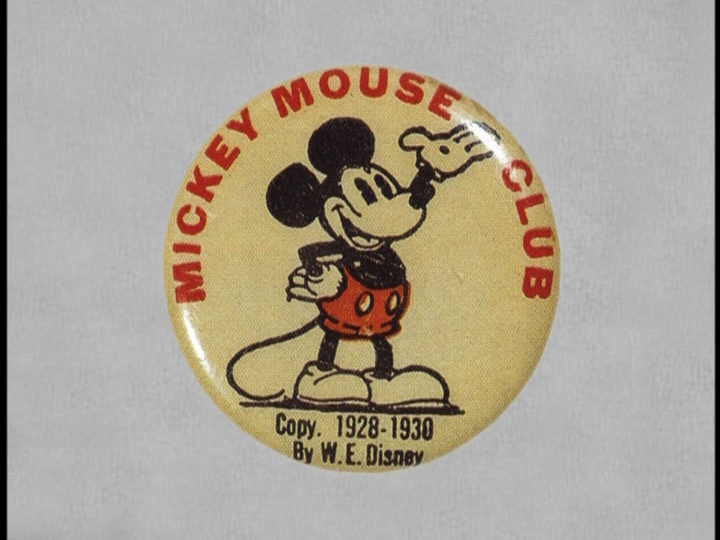
A promotional button from the original club

“Mickey Mice do not swear, smoke, cheat, or lie!”

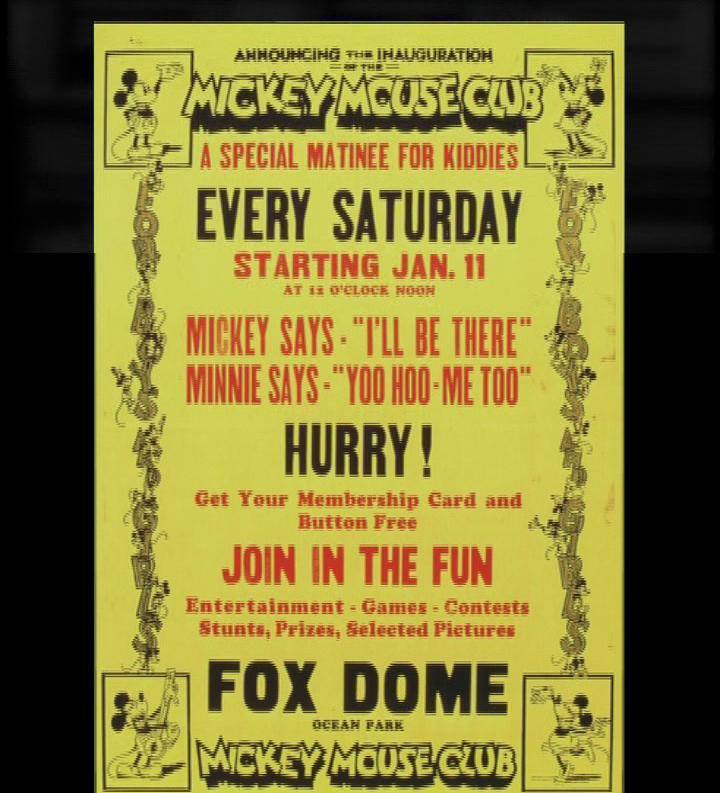
At noon on January 11, 1929, the first Mickey Mouse Club was called to order in the Fox Dome Theater in Ocean Park, California. The club was the idea of the theater’s manager, Harry W. Woodin, which he began during the children’s matinee shows on Saturdays. Soon, these clubs spread like wildfire, and by the height of their popularity in 1932, it was estimated that there were one million members worldwide, with many clubs meeting every week. During club meetings, children would watch Mickey Mouse cartoons, recite the Mickey Mouse credo, and elect a Chief Mickey and Chief Minnie Mouse.

A copy of the original flier for the Fox Dome Theater's first meeting of the Mickey Mouse Club

Intrigued with Woodin’s concept, Walt Disney saw that there were many opportunities for merchandising through the clubs, as well as convincing more children to attend the theater to see new Mickey Mouse shorts. Disney hired Woodin to be the general manager of these club gatherings. Woodin’s job included printing and sending fliers to theaters across the country, instructing them on how to develop the clubs and help local businesses through advertisements in the club bulletins. Business began to boom through the name of Mickey Mouse: Bakeries would offer free Mickey birthday cakes, banks gave away Mickey savings banks, and department stores would give away free Mickey toys to entice customers to look at their more expensive toys. Clubs were formed not only across the United States, but also in England and Canada, among other countries, by 1930. The Odeon Theatre chain in England had 160 clubs with 110,000 members by the peak of the club’s popularity.

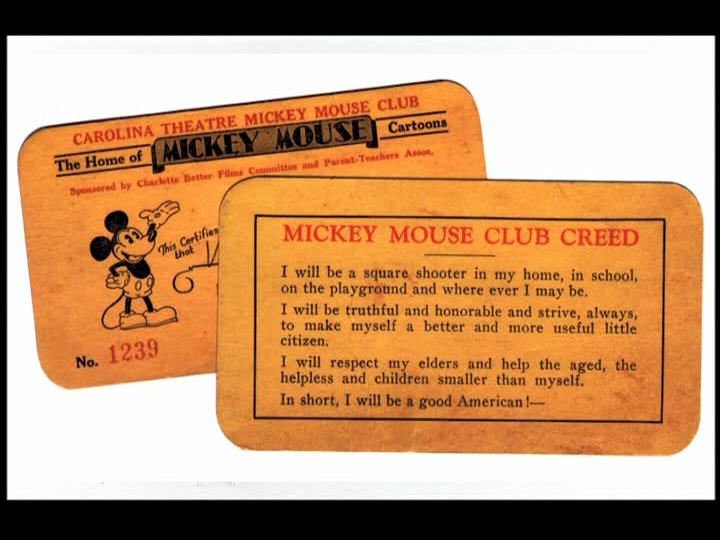
A card with the Mickey Mouse Club Creed

The club itself taught children how to be model citizens. Children would recite, “Mickey Mice do not swear, smoke, cheat, or lie!” Mickey himself would instruct the kids on topics such as how to brush their teeth and wash behind their ears, respect their parents, attend Sunday school, and on the virtues of honesty and honor. The creed of Mickey Mouse Club members was as follows:

I will be a square shooter in my home, in school, on the playground and where ever I may be.

I will be truthful and honorable and strive, always, to make myself a better and more useful little citizen.

I will respect my elders and help the aged, the helpless and children smaller than myself.

In short, I will be a good American!

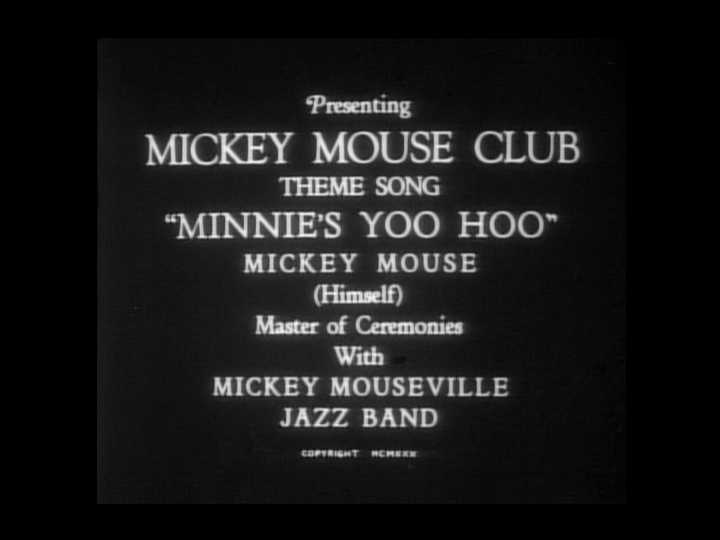
The highlight of these clubs, naturally, was the Mickey Mouse cartoons. To that end, Walt Disney had a special animated short for the club meetings of the club’s theme song, “Minnie’s Yoo-Hoo.” Written by Walt Disney and Carl Stalling, the song was the first Disney song released on sheet music. The animated short that accompanied the song had Mickey singing the first verse, before encouraging the children to sing as the lyrics would show up on the screen.

Title card for the Minnie's Yoo-Hoo short.

Mickey Mouse’s explosive popularity was a big part of American culture in the late ’20s and early ’30s. With the credo recited at these meetings, as well as the lessons Mickey would teach the children, it’s no wonder that Mickey was seen as a positive role model, and parents would object if Mickey was seen doing something reckless, as he did in many of his early shorts. The clubs held steady in their popularity with the Disney stamp of approval until 1935, when the popularity of these clubs began to wane. The clubs did continue unofficially through World War II, with Mickey and friends extolling the importance of planting Victory Gardens and donating old toys for scrap. It would be 23 years until the television version of the Mickey Mouse Club would appear in people’s homes.

January 10

January 10, 1930 – Disney Legend Roy Edward Disney is born.

“Roy was, yes, a Disney, but he was remarkable because he lived his own life and was well-known for sailing around the world. And he certainly took us all on an adventure.” – Don Hahn, Producer of Beauty and the Beast.

Only child of Roy O. Disney (Walt Disney’s brother) and Edna Francis Disney, Roy Edward Disney was born in 1930. He grew up at the studio while his father dealt with the business side of running it. In 1951, Disney graduated from Pomona College with a degree in English, and began working in his uncle’s company in 1954 as an assistant film editor on the True-Life Adventure films. He worked in various roles within the company; as producer, writer, director, and production coordinator for episodes of Walt Disney’s Wonderful World of Color; as a writer for shows such as Zorro; and as a cinematographer for Perri.

In 1967, Disney joined the company’s Board of Directors. Ten years later, he resigned as an executive from the company because of disagreements over corporate decisions, but retained his seat on the Board. In 1984, however, Disney resigned as Chairman of the Board, citing decisions being made over a corporate takeover battle. “And we finally came to the conclusion that we can’t do anything on the inside because I’m the lone voice of dissent on this board,” Disney explained. “So I resigned from the board of directors. And it got enormous amounts of attention.” Indeed, Disney stock jumped 15 percent the week that Disney resigned, topping off at about $58 a share.

Disney’s resignation brought about a shift in the company, with Ron Miller stepping down from his role of CEO. The hostile takeover attempt involved taking the company apart and selling it off piecemeal, but Disney fought against this plan with a group of investors. Disney also helped bring Michael Eisner and Frank Wells to the company as CEO and President of the Walt Disney Company, respectively. Disney then came back to the company as vice chairman and head of the animation department. “I came back to the company in 1984 and, [in a] rather cavalier way at the time, said to Michael [Eisner], ‘Why don’t you let me have the Animation Department, because I may be the only guy right now, with all these new people coming in, who at least understands the process and knows most of the people.’”

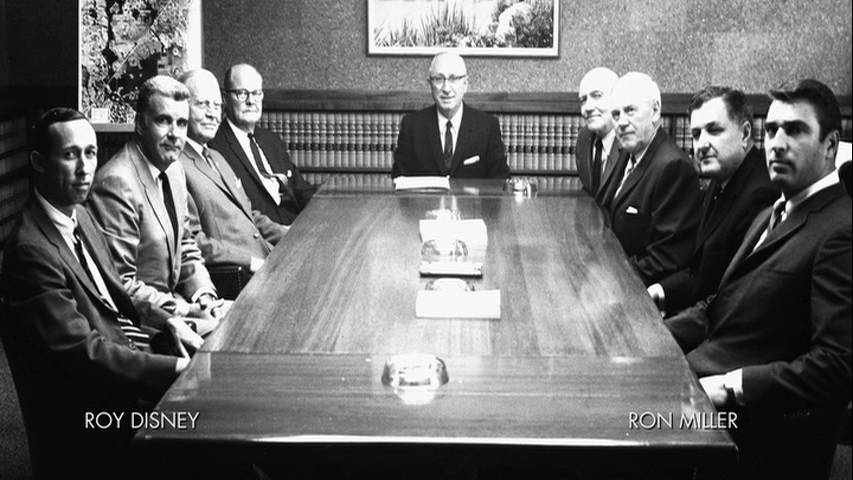
Roy (L) with the Board of Directors.

“We wouldn’t be watching movies from Pixar and Disney, or possibly Dreamworks for that matter, if it weren’t for a few amazing things that Roy Disney did during that time,” Don Hahn remarked. Disney helped to reinvigorate the then-failing Animation Department, beginning with the decision to release one new animated film a year, to helping bring in the Computer Animation Postproduction System (CAPS) to change the way films are animated.

One of Disney’s other projects was a sequel to his uncle’s 1940 film, Fantasia. Walt Disney had always planned to make a sequel, and Disney continued his work, acting as Executive Producer on the project. Production began in 1990, and the film was released in 2000. The film is a combination of the company’s past and its future, a sort of metaphor for Roy E. Disney’s time at the Walt Disney Corporation.

In 2003, Disney once again resigned from the board of directors because of tensions between him and Eisner, citing complaints of Eisner’s style of micromanagement, a refusal to create a successful succession plan, and the perception that Disney had become a soulless conglomerate. Disney then established the website SaveDisney.com to force Eisner out and replace him with new blood. Eisner stepped down on March 13, 2005, and Disney rejoined the company as the non-voting Director Emeritus and consultant.

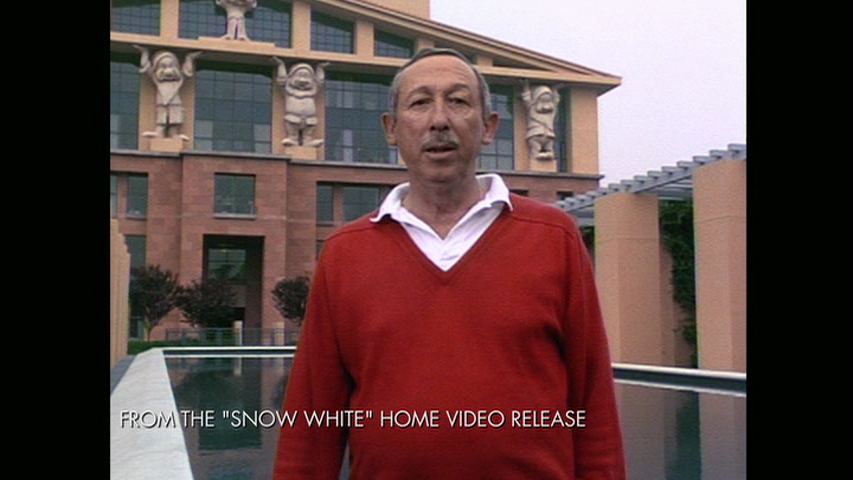
Roy introducing the Snow White home video in 1994.

Peter Schneider, Former President of Walt Disney Animation Studios, had this to say about Disney: “People always talked about Roy as the idiot nephew. That was his nickname. Nothing could be further from the truth. He was smart, unassuming, and powerful. You could easily underestimate him, but you did so at your own peril.” In fact, Disney did a lot to change the company during the period known as the Disney Renaissance. On October 16, 1998, Disney was inducted as a Disney Legend based on his long and varied work with the company. After a long battle with cancer, Disney passed away on December 16, 2009. An animation studio in Burbank was dedicated in his honor on May 7, 2010.

Writer Patrick Pacheco remarked about Disney, “I think he had a lot to prove and I think he proved it…He wasn’t the type of guy to go out and say, ‘Yeah, I’m the guy that did this.’ But on so many levels, he’s the guy that did this.” Disney was able to help change the animation landscape through the simple act of resigning from the board and bringing in Eisner, Wells, and Katzenberg. His dedication to the art of animation and the Disney name truly helped bring the company back from near demise in the late 1980s and the 1990s.

January 9

January 9, 1937– Don Donald is Released to Theaters

Don Donald

“Hi, toots!”

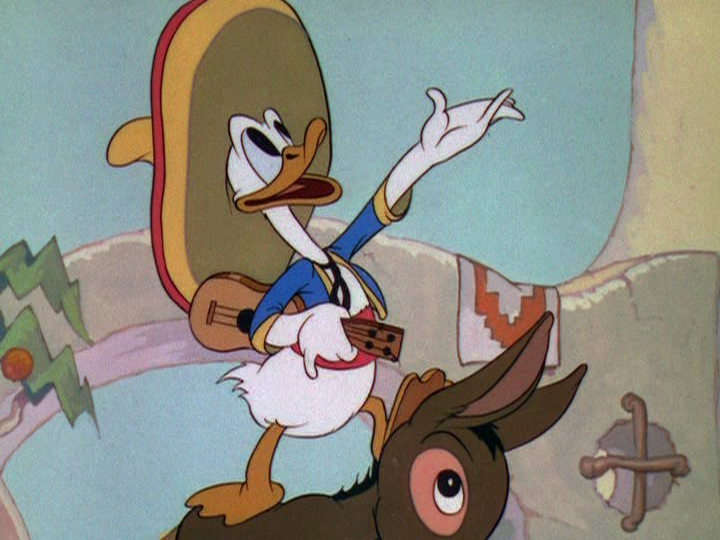
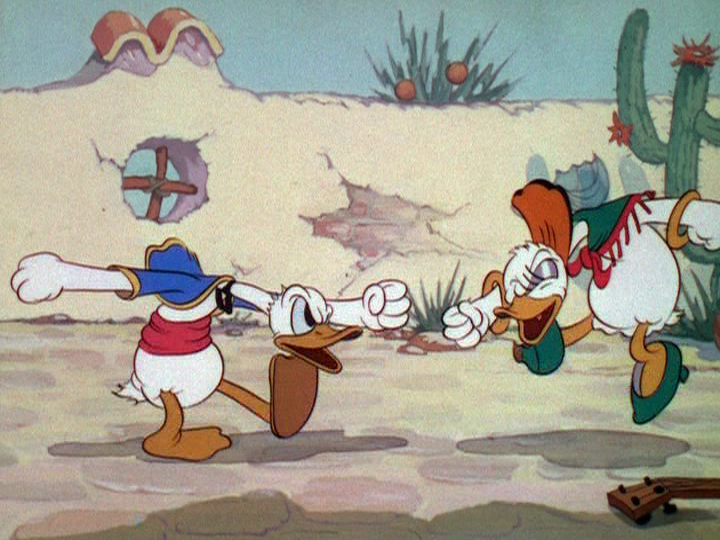
Directed by Ben Sharpsteen and featuring Clarence Nash as the voice of Donald and Donna Duck, this short features Donald riding a burro on his way to visit his girlfriend, Donna. Donna greets him with a Mexican Hat Dance – literally dancing on Donald’s large sombrero – which leads to her dancing while riding on the burro. When the burro bucks Donna off, she shows off a temper that is just as bad as Donald’s.

Donna exhibits the same behavior as Donald when her feathers are ruffled.

Donna is the first iteration of the character Daisy Duck, who will not appear by that name until the short Mr. Duck Steps Out, released in 1940. She is adventurous and short-tempered: When Donald begins to laugh at her misfortune, Donna not only reacts with the same arm-swinging anger that Donald is known for, but hits him over and over with his guitar, before she smashes it right over his head.

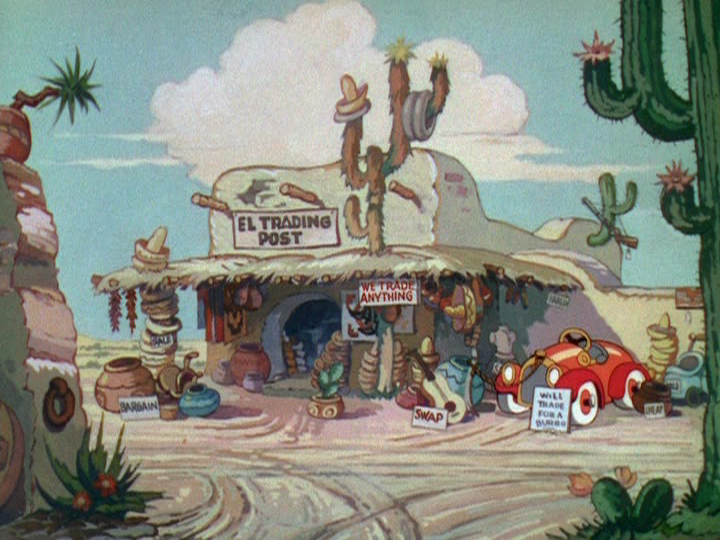
After this altercation with Donna, Donald stumbles upon “El Trading Post” and spies a car with the sign, Will Trade For A Burro. Not one to miss an opportunity, Donald trades the upset burro for the car to impress Donna.

Donald sees El Trading Post, with the car and its sign (R).

Still fuming, Donna is ready to throw a vase over Donald’s head, until she sees the car he’s driving. She immediately jumps down and kisses him, and urges him to take her for a drive. As they pass by the Trading Post, the burro is crying, and finally he breaks free from his bonds and begins to chase the two, catching up to them as trouble begins.

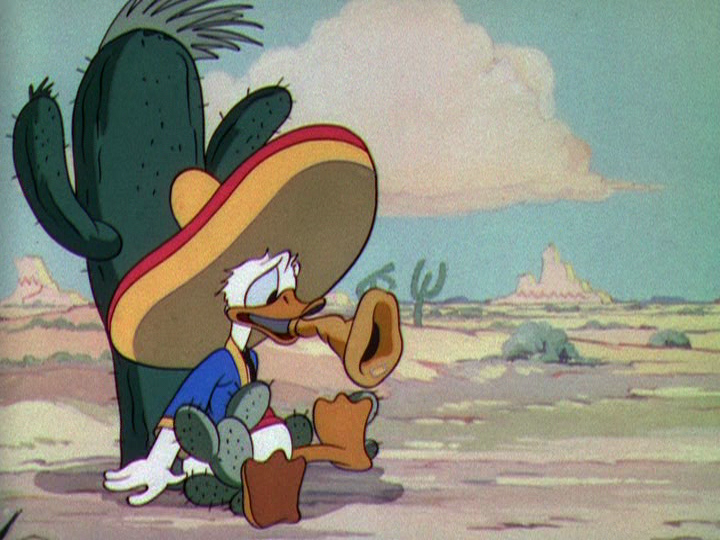
In the desert, the car sputters and breaks down, in the process throwing Donald out and trapping Donna in the back before it crashes, ejecting her. Donald, once again, makes the mistake of laughing at her misfortune, and she throws the car horn at him. She then pulls a unicycle from her purse and wheels away, leaving Donald alone with a horn in his mouth and the burro laughing at him.

Donald, once again, feeling the wrath of Donna.

Like many of the beginning shorts of Donald’s career, Clarence Nash’s pronunciation was still a bit unclear, which has sometimes caused censorship problems. A variation of Donald’s catchphrase, “Hiya, toots!” is used here, and is very understandable. Donald would use this catchphrase often, particularly when speaking to Daisy.

January 8

January 8, 1956 – The Mickey Mouse Club Circus Closes in Disneyland

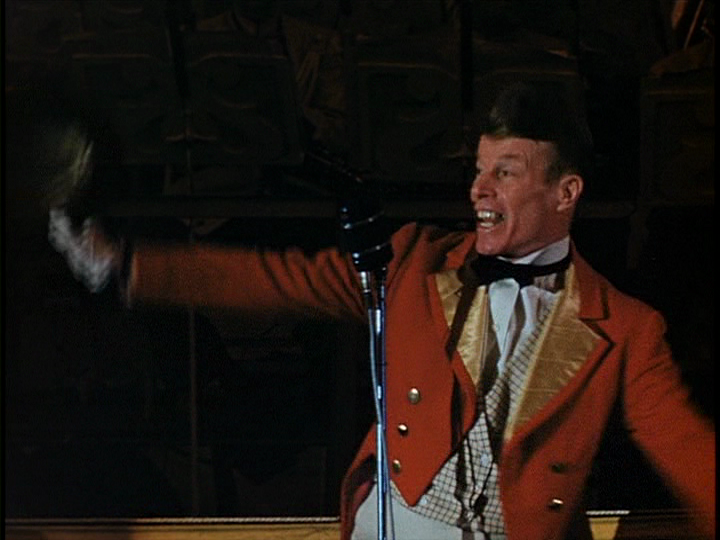
Jimmie Dodd - the Ringleader of the circus

“Fantastic circus. And nobody came. Why? Because they came to see Disneyland.” – Jack Lindquist, Retired Disneyland President

The Mickey Mouse Club Circus—which opened in Disneyland on November 24, 1955—closed on January 8,1956, lasting only one holiday season. Launched almost two months after The Mickey Mouse Club began airing on ABC, the circus grew out of Walt’s lifelong fascination with the Big Top, as shown in his films Dumbo and Toby Tyler, or Ten Weeks with a Circus.

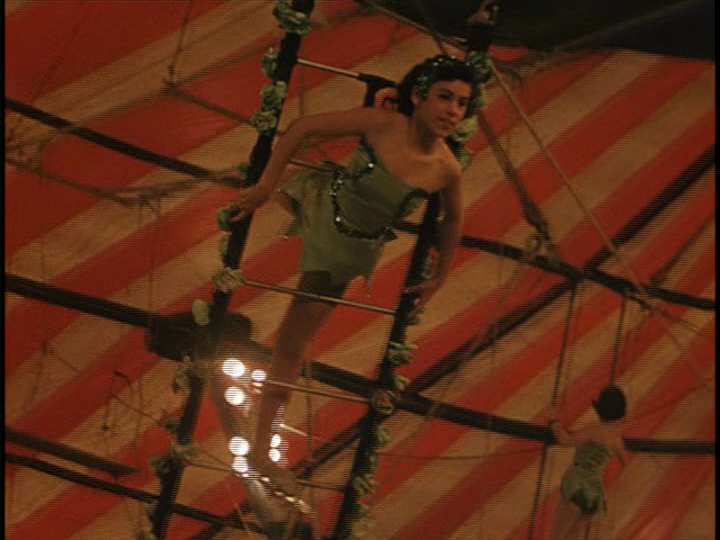
A cast member performing part of the aerial act

The show lasted seventy-five minutes. One of the highlights was an aerial act, led by Mickey Mouse Club member Doreen Tracy. However, during one performance, Tracy forgot her instructor’s warning to never look down, and found herself frozen on top of the platform until a crew member grabbed a ladder to bring her down.

The circus is considered one of Walt’s few failures. Although the cast loved performing the acrobatic stunts, it wasn’t enough to save the show. Eager Mickey Mouse Club fans across the country were not always able to travel to Anaheim to see the cast, and most people who came to Disneyland tended to be more interested in the park’s other features, figuring that they could see a circus back home. After the closing, the tent was then used in Holidayland—ironically, another failed idea of Walt’s—for corporate picnics and other events.

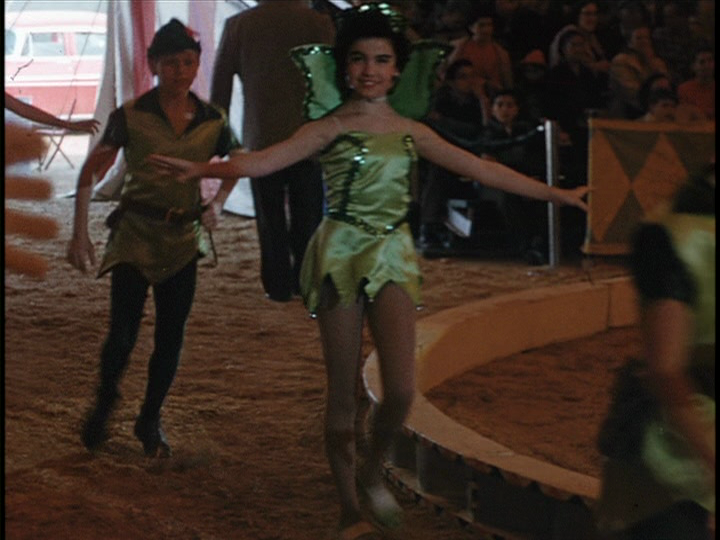
Annette Funicello dressed as Tinkerbell. All the girls wore Tinkerbell costumes, and the boys were dressed as Peter Pan.

Fortunately, the circus closing had no impact on the popularity of The Mickey Mouse Club, and the cast members were able to go on several tours later on, including a trip to Australia in 1959.


January 7

January 7, 1933 – Building a Building Released to Theaters

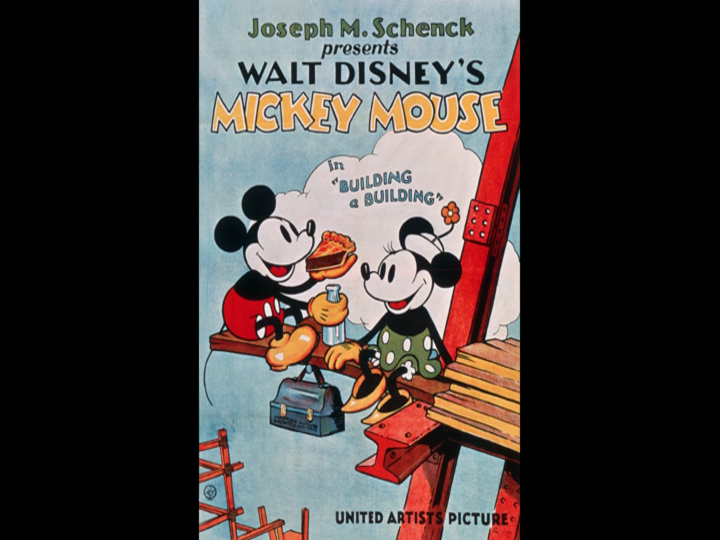
The film poster for the short 'Building a Building'

“Baloney, and macaroni, and a huckleberry pie”

In this 1933 black-and-white short film – directed by David Hand, recorded on R.C.A. Photophone – Mickey is a construction worker on a building site, with Pegleg Pete as his foreman. Minnie comes by selling box lunches for only 15 cents (Pluto makes a cameo, pulling her lunch cart). Her presence soon attracts the attention of plucky young Mickey, who spills dirt and bricks on top of Pete and his blueprints, aggravating Pete’s already short fuse.

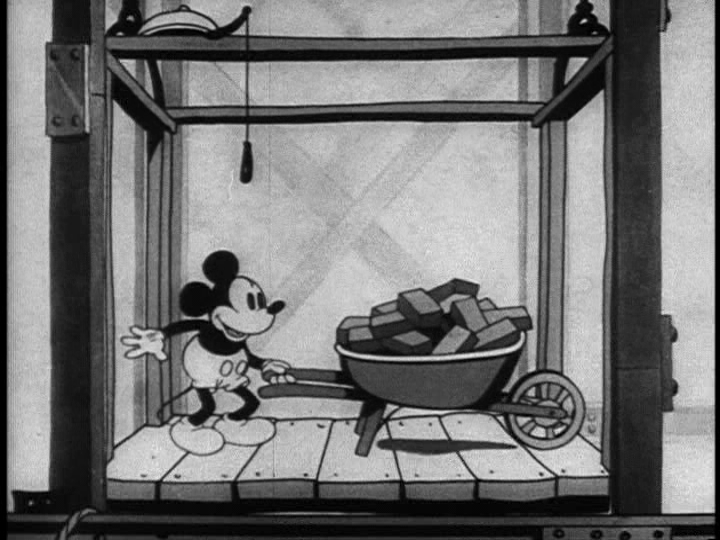
Mickey working on the building - also a good example of the "squash and stretch" method of animation.

Although Mickey’s actions in this era were described more as an homage to silent film star Charlie Chaplin, one can see that there are also nods to the physical comedy stylings of silent film star Harold Lloyd (see Jan. 4th entry – Mickey’s Polo Team), as Mickey falls head over heels – literally – for Minnie Mouse.

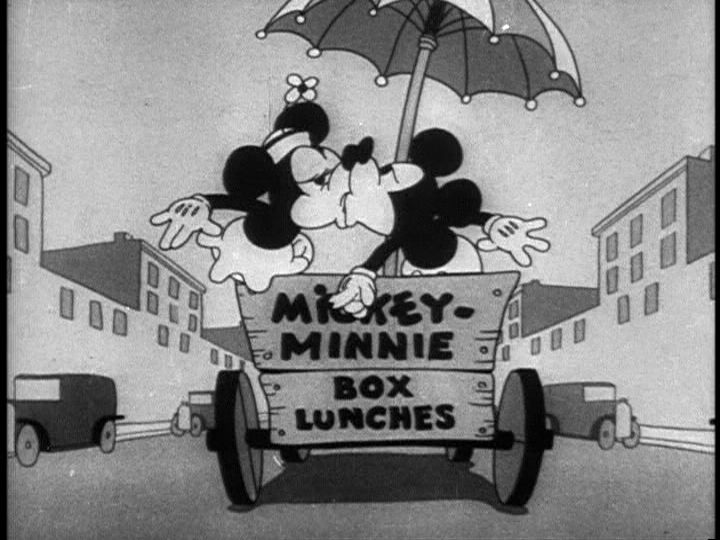
When Pete steals Mickey’s lunch, Minnie feels bad for Mickey and offers him a free lunch, which includes, as she often repeats, “Baloney, and macaroni, and a huckleberry pie,” with a corn cob as well, for only 15 cents, which is about $2.50 today – not a bad price for such a lunch. Not satisfied with stealing Mickey’s lunch, Pete tries to steal Minnie’s affections as well. This does not turn out well for Pete, as Mickey and Minnie use all available resources to outsmart the foreman, before sliding down a chute and riding off in Minnie’s lunch wagon, now co-owned with Mickey. They share a kiss while Pete ends up stuck in a tub of cement.

The kiss as the couple rides off together.

In this short, Pete was voiced by Billy Bletcher, Minnie by Marcellite Garner, and Mickey by Walt Disney. This short is entertaining, especially for the over-the-top physical comedy used to show Mickey’s affections and to outsmart Pete.