RSS Feed

Monthly Archives: May 2012

May 11

Posted on

May 11, 1935 – The Silly Symphony, Water Babies, is Released to Theaters
“…it was inspired by the story Water-Babies, written in 1863 by Charles Kingsley, the great English writer and naturalist.” – Walt Disney

On May 11, 1935, the Silly Symphony Water Babies was released to theaters. It was loosely based on the children’s novel The Water-Babies, A Fairy Tale for a Land Baby by Reverend Charles Kingsley, which was published in 1863. The short was directed by Wilfred Jackson. Merbabies, released in 1938, is considered to be its sequel.

The short opens just as the sun is beginning to rise over a quiet pond. Two birds wake and begin to chirp, flying over the lilypads and trying to rouse the water babies sleeping inside. Once the water babies wake, the jump into the pond and begin to swim away. One baby has decided to remain sleeping, until the flower he’s sleeping in gives him a harsh slap to wake him. With a yawn, and trepidation over the temperature of the water, the baby joins the others as they splash and play around in the pond.
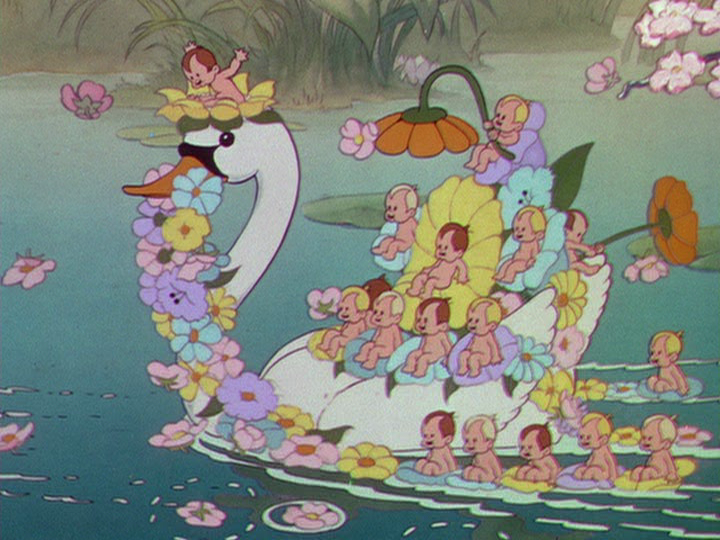
The Water-Babies riding of the back of a swan during a mini parade

As they play, they all hear the trumpets sound and excitedly swim in that direction. A parade has begun, with babies playing flower trumpets and ride on the backs of turtles and swans. Some travel on leaves, and a trio is seen riding on fish. The festival leads the babies to a patch of land where they begin to play in the weeds and with the frogs that live there. Three babies are seen using a spiderweb as a trampoline, and another trio are seen riding bullfrogs as if they were at a rodeo.

Another baby is seen preparing for a bull(frog) fight, pulling down a red petal to use as the red flag. The bullfrog gets his head caught in a flower, and uses the stem as a horn to try and attack the baby. Luckily, the baby sneaks back into the bullfrog’s cage before it can attack him.
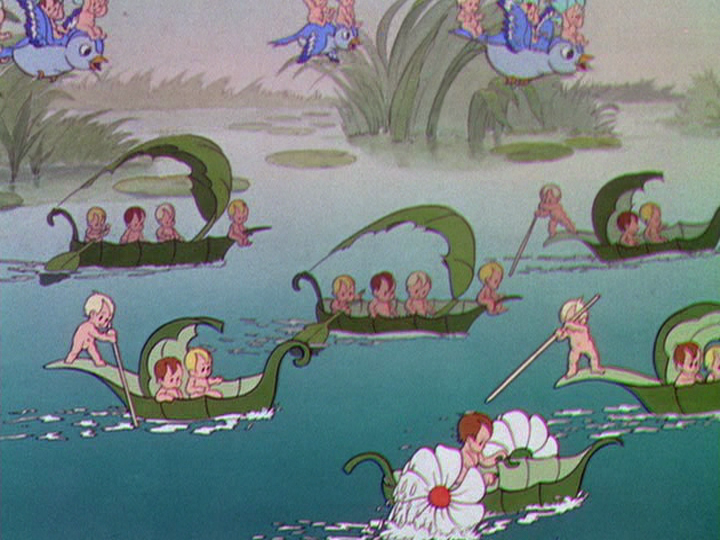
All the Water-Babies heading home after the day’s festivities

The trumpets sound again soon after the fight finishes, and the babies all head back to the pond to travel home at the end of a long eventful day. As the sun begins to set, the babies crawl into their lilypad beds after saying their prayers, and quickly fall asleep as the flower petals close up protectively, leaving the audience with a beautiful moonlit night on the pond.
May 10

Posted on

May 10, 1956 – Disney Legend Paige O’Hara is Born

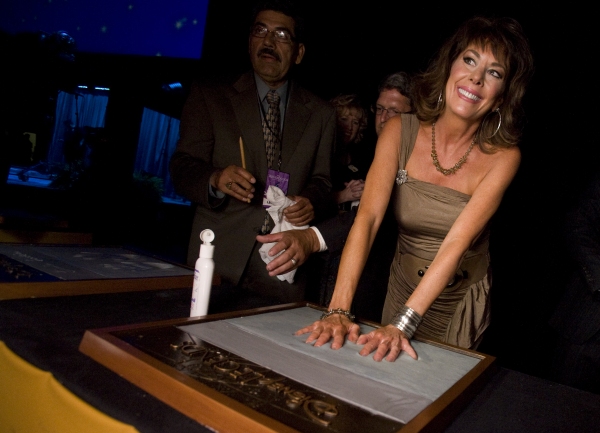
Paige O’Hara at the Disney Legends Awards. Photo credit: broadwayworld.com

“I had been a Disney fanatic from the time I was little. As soon as I heard about [Beauty and the Beast], I called my agent and said, ‘I have to be seen for this…I knew [Belle] was my part. It was just one of those things you know.” – Paige O’Hara

Paige O’Hara, best known as the voice of Belle in the 1991 classic animated film Beauty and the Beast, was born on May 10, 1956, in Ft. Lauderdale, Florida. She made her first professional appearance in the Broadway revival of Showboat as the character Ellie May Chipley. Since then, O’Hara has gone on to star in the title role in The Mystery of Edwin Drood, and Ado Annie in the national tour of Oklahoma.

O’Hara auditioned five times for the part of Belle, and as the film became wildly successful, it thrust O’Hara into the spotlight. She continued to voice the character in two sequels: Beauty and the Beast: The Enchanted Christmas and Belle’s Magical World, as well as voicing the character in the Kingdom Hearts video games. O’Hara was also given a cameo in the 2007 film Enchanted as a character in a soap opera. O’Hara was awarded as a Disney Legend on August 19, 2011. “She was a first, in a lot of ways, for a Disney Princess,” O’Hara has remarked on her character, “and was ahead of her time in the film and for Disney. I think that’s why, almost 20 years later, people still love her.”

May 9

Posted on

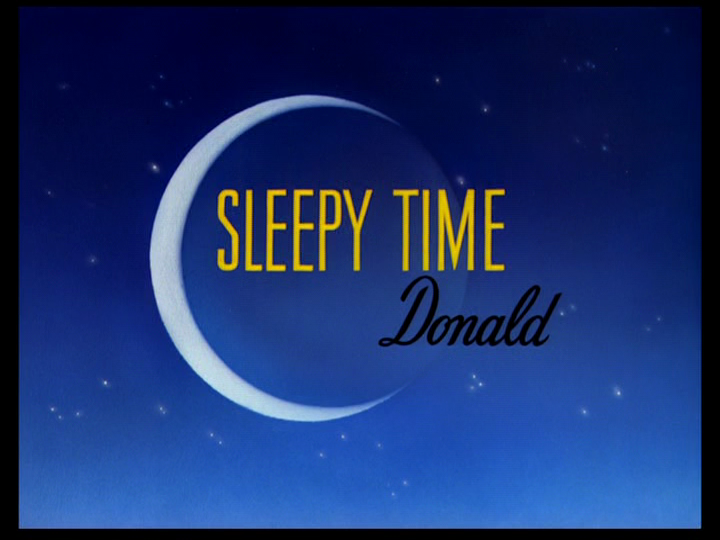
May 9, 1947 – The Donald Duck Short Film, Sleepy Time Donald, is Released to Theaters

“I must humor him. I mustn’t wake him, or it would be fatal.”

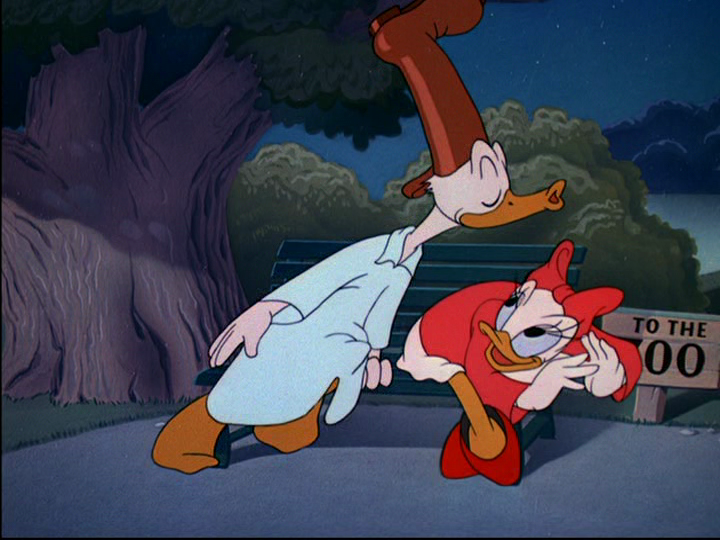
On May 9, 1947, the Donald Duck short film, Sleepy Time Donald, was released to theaters. The short was directed by Jack King, with story by Roy Williams, and starred Clarence Nash as the voice of Donald Duck, and Gloria Blondell as the voice of Daisy Duck. This is one of those rare shorts that, while Donald’s name is in the title, Daisy gets more of the starring role, with great results.

The scene opens with Donald fast asleep in his suburban home, when suddenly he rises from his bed, places a boot on his head, and sleepwalks to Daisy Duck’s house. Daisy wakes up, alarmed, but becomes puzzled when Donald walks right past her and out the other door, only to turn around and ring the doorbell. Daisy leaps out of bed and throws on a date-night outfit before answering the door for her “date.”

As Donald tries to kiss Daisy, she begins to play hard-to-get

Deciding that she needs to “humor” Donald, she opens the door and greets him, and Donald asks if he’s on time for their date. Daisy giggles as she reassures him he is, and then she is seen being escorted to the zoo. There’s a moment where she wonders if he’s going to kiss her, and she ducks when he tries to, and begins to play hard to get with him. She tricks him into kissing a tree branch, with Donald thinking it’s her arm. He then slips an engagement ring on the branch, with Daisy swooning at his romantic gestures. As he lets the branch go, the ring catapults into the monkey’s pen, with the female monkey giving the male a big kiss. Unfortunately for her, Daisy slips the ring away from the pair, causing the female monkey to deck the male.

Daisy admires the ring on her hand, noticing just a bit too late that Donald has sleepwalked into the lion’s cage, narrowly missing being eaten. After the zoo, Donald walks up the side of a building, with Daisy watching in horror on the ground. She calls out his name, and he only motions for her to join him. She tells him that her way is the shorter way; he shrugs and decides she’s right, although he continues to walk on the side of the building as they continue down the street, with Daisy trying to prevent him from getting into trouble as best she can.

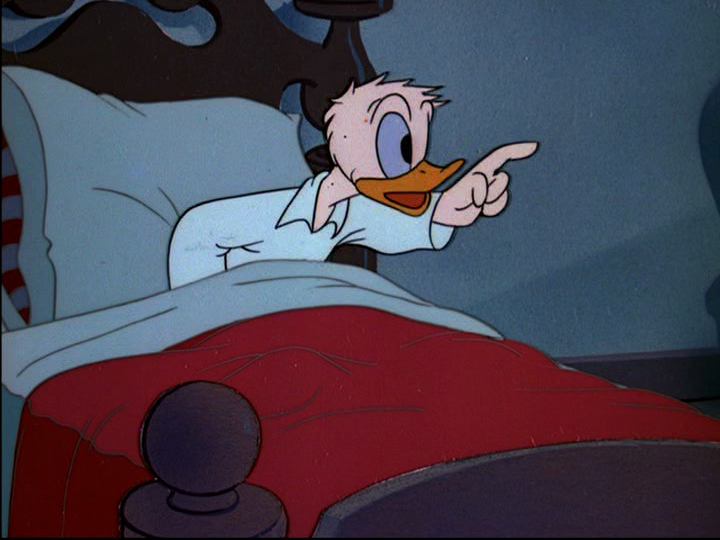
Donald wakes and accuses Daisy of sleepwalking

Donald continues his sleepwalking by walking straight into traffic. Daisy flips the traffic sign to a stop so Donald won’t get hit by a car, causing a massive pile-up. Finally, she decides to make him think that they’re boarding a boat as she leads him back to his house and gets him back into bed. As she tries to slip out, Donald wakes up and accuses her of walking in her sleep. She argues with him that she has not been walking in her sleep, but Donald laughs, until Daisy hits him over the head with his boot, causing him to sleepwalk back into bed and fall fast asleep.

May 8

Posted on

May 8, 1988 – The Television Show Splash, Too, Part Two, Premieres on Television

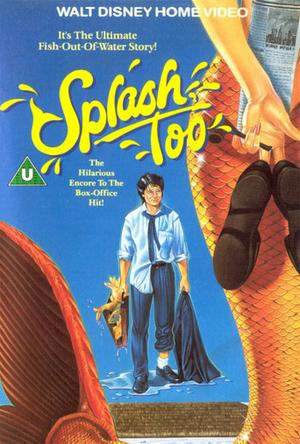
Image Credit: Screened.com

On May 8, 1988, the second half of Splash, Too, premiered on ABC television. The sequel to the successful 1984 film Splash, the special had only one returning cast member: Dody Goodman as Mrs. Stimler. The special starred Todd Warring as Allen Bauer, Amy Yasbeck as Madison, Donovan Scott as Freddie Bauer, and Rita Taggert as Fern Hooten. Splash, Too was also the first motion picture filmed at the new Disney-MGM Studios, and had a production budget of $3.3 million.

Set four years after the original film, Allen and his now-wife, Madison, return to New York City, where Allen’s brother Freddie is dangerously close to losing the family business. While Allen helps his brother, Madison has her own mission: to rescue her friend Salty the dolphin, who is being held captive for scientific experiments. The married couple grows closer as they strive to reach their respective goals.

May 7

Posted on

May 7, 1917 – Actor and Disney Legend David Tomlinson is Born

“…Walt said, ‘Very good, let’s see if we can get him.’ And that’s how it was – it was as simple as that. We knew he had the right personality.” – Richard M. Sherman on casting David Tomlinson.

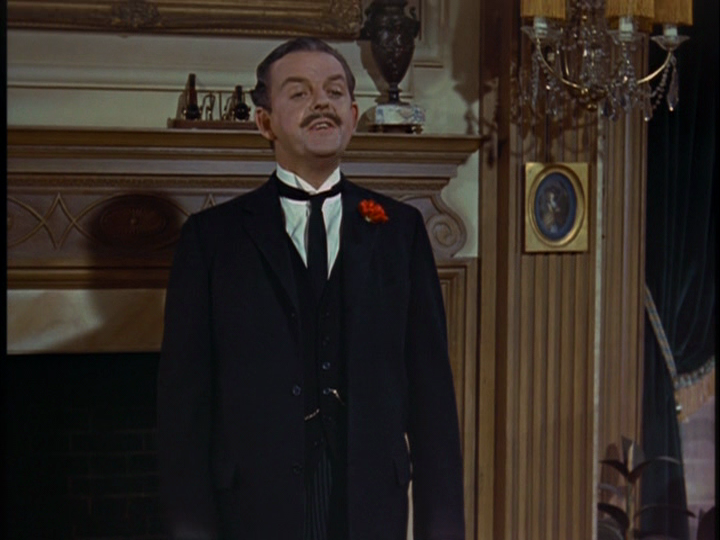
Although David Tomlinson had a prominent career in England, he will always be known to generations of children as Mr. Banks in the film Mary Poppins. Tomlinson was born on May 7, 1917, in Henley-on-Thames, Oxfordshire, England. He began his acting career with amateur stage productions, progressing to a film debut in 1940’s Quiet Wedding. He briefly left acting to serve in the RAF in World War II, but came back after the war ended, although he did not leave behind his love of flying, continuing to pilot planes, much to the chagrin of his neighbors.

Tomlinson was asked to play the part of George Banks in Mary Poppins after many of the members of staff had watched his films. Before the film, he had never sung before, but a bit of polishing soon had him singing on screen like a professional. This role would become his most well known, particularly for the character’s change of heart and song “Let’s Go Fly a Kite.” Tomlinson would go on to star in two other films for the Disney Studios: The Love Bug as the evil Thorndyke, and the professor of magical arts Emelius Brown in Bedknobs and Broomsticks alongside Angela Lansbury. Tomlinson died at the age of 83 in 2000, and was inducted as a Disney Legend in 2002.

May 6

Posted on

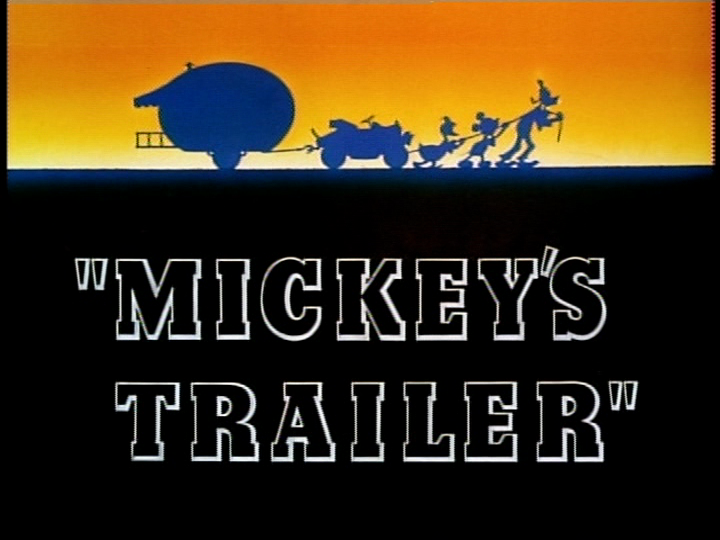
May 6, 1938 – The Mickey Mouse Short Film Mickey’s Trailer Premieres in Theaters

“The worst is over – it’s all downhill from here!”

On May 6, 1938, the Mickey Mouse short Mickey’s Trailer was released to theaters. The short was directed by Ben Sharpsteen, and stars Walt Disney as the voice of Mickey Mouse, Clarence Nash as the voice of Donald Duck, and Pinto Colvig as the voice of Goofy. The short features many mechanical gags that are reminiscent of the early Mickey Mouse shorts.

The audience first sees Mickey’s trailer, in front of a picturesque background of the mountains. The door opens, and Mickey steps out in his nightgown, excited at the prospect of a beautiful day. He pulls a lever next to him, and the whole trailer begins to rattle as he goes back inside. Suddenly every bit of the trailer, from the white picket fence to the “lush green lawn”, folds back into the trailer. A car rolls out of the side, with Goofy sleeping in it; He awakens and slips into the front seat and gets ready to drive. The “picturesque” scenery folds up behind them and slips into the trailer, leaving behind a view of the city dump, with some refineries for good measure in the distance.

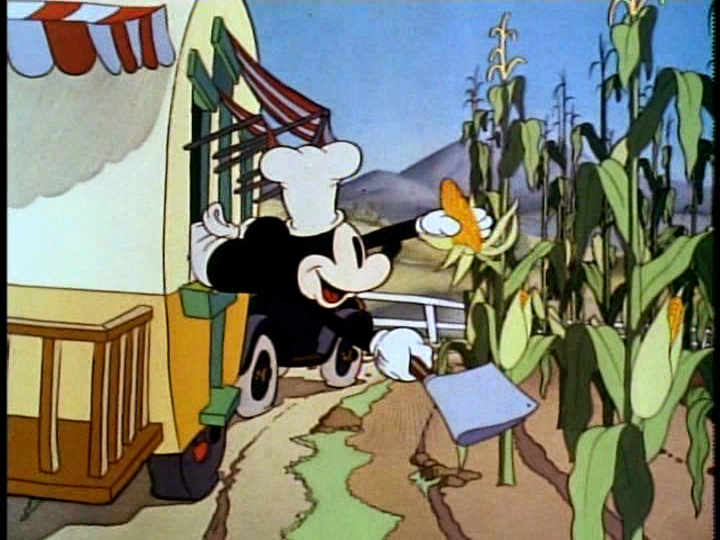
Mickey snatching some corn from a nearby field

As Goofy drives the trailer on a dirt road, he begins to sing “She’ll Be Comin’ Round the Mountain.” Inside the trailer, Mickey begins to fix breakfast, grabbing water from a nearby waterfall for the coffee, cutting some corn from nearby stalks, and, with Goofy tempting it with some hay, getting some milk from a wandering cow. Also inside the trailer is Donald, fast asleep on the top bunk. The alarm clock goes off, which is rigged to pull away his covers and force him to get up. Slowly he tries, but ends up falling back asleep. Mickey, from the kitchen, pushes a button, which turns the bedroom into a bathroom, and Donald excitedly enters the bathtub and begins to sing a nonsensical song as some robins watch at the window.

Mickey pushes another button, and the bathroom becomes a dining room, and Mickey sounds the alarm for breakfast. Goofy leaves his post as driver to get his food – with the car driving into an area marked with a “road closed” sign. As the car stumbles over several bumps in the road, each bump makes part of Goofy’s breakfast disappear. He watches Mickey and Donald enjoy their corn on the cob, and as he reaches for a cob, he accidentally sticks his fork in a light socket, which pops all the kernels from the cob. So he has popcorn for breakfast.

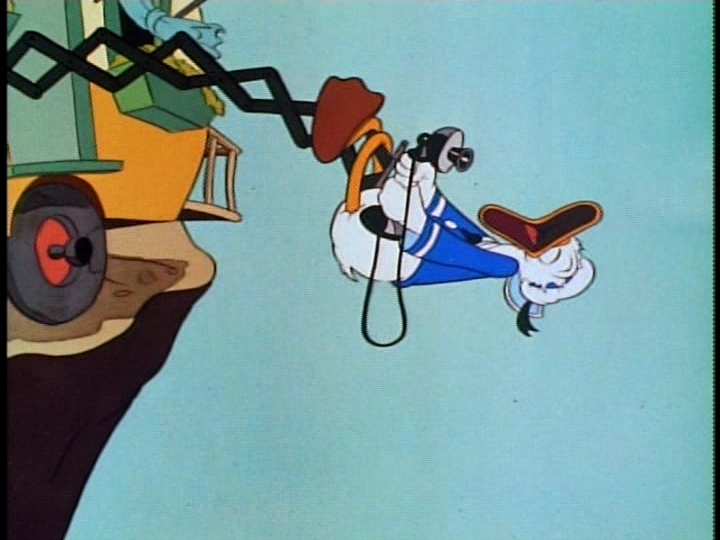
Donald clings to the phone for dear life as he is projected through the window

Mickey finally notices that there is nobody in the car, and turns to Donald, asking who is driving. Goofy responds that he is, and it suddenly dawns on him that he should be in the car driving. When he dives out the window to get back in the driver’s seat, he unwittingly knocks the connector loose from the trailer, sending Donald and Mickey flying the other way on the perilous path. Inside, the pair are knocked about as they continue sliding backwards on the one-way path. A truck slowly climbs its way up the mountain pass, but they fortunately miss it as the trailer uses the fence as a track. Donald tries to use the phone to call for help, only to have to cling to it for dear life as he is outside the window.

Just as the two think they’ve avoided trouble after a curve, they hear the sound of a train, and look out to see it fast approaching the bridge. Donald’s kneels to pray. They narrowly miss the train as they cross the bridge; both breathe a sigh of relief, only to see that they’ll be coming across it again, and again they narrowly miss it. As they fall off a curve and fly down the side of a mountain, they luckily get connected to the car again. Goofy informs them that he got them down safe and sound, unaware of the adventure they had without him.

May 5

Posted on

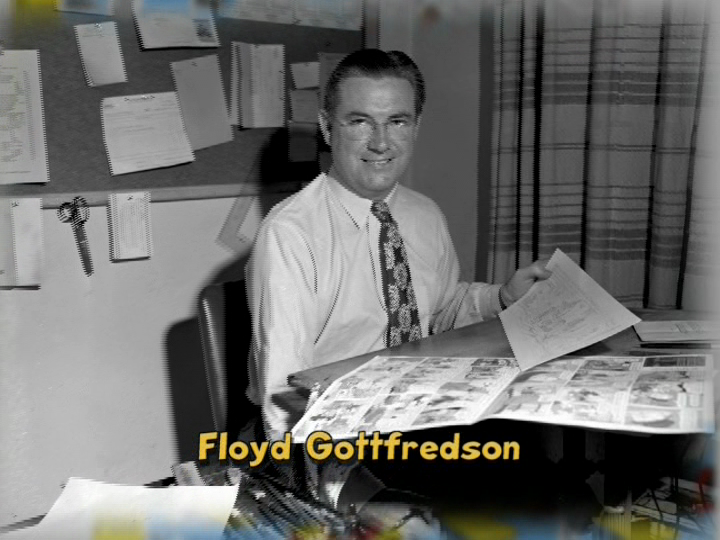
May 5, 1905 – Disney Legend and Cartoonist Floyd Gottfredson is Born

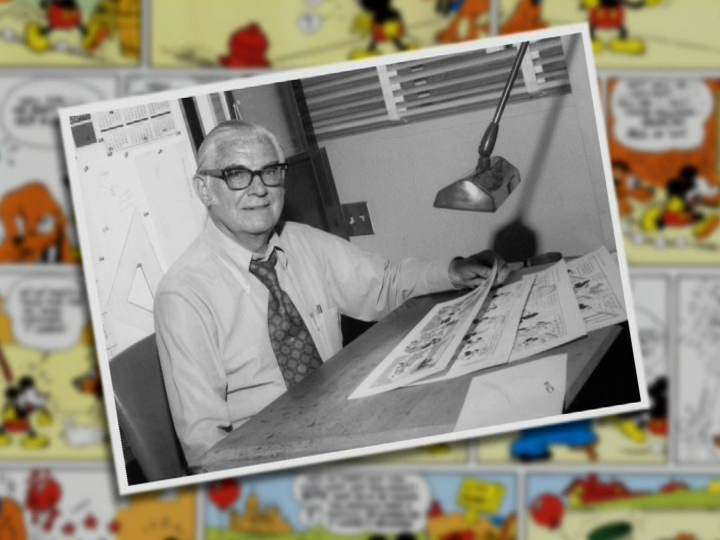
“…since Walt hired me as backup man on the strip, he asked me to take it over. By now I had become very interested in animation and told Walt I’d rather stay in it. So Walt asked me to take over the strip for two weeks until he found another artist to do it. Nothing further was ever said about it, and I continued to draw the Mickey daily for 45 years – until my retirement in October 1975.” – Floyd Gottfredson

Floyd Gottfredson, the man behind the Mickey Mouse comic strip and Mickey’s “second father,” was born on May 5, 1905, in Kaysville, Utah. His interest in drawing came about due to an accident when he was eleven: he went hunting with his cousin one Sunday instead of going to church, and was accidentally shot in the arm. Unable to play with the other children, Gottfredson turned to art, and his talent blossomed under the care of his mother. Although his father disapproved of his son’s artistic ambitions, Gottfredson continued to pursue drawing, not letting his injury slow him down. In 1928, after winning second place in a national cartoon contest, he developed enough confidence to quit his job in Utah and move to Los Angeles to become a newspaper cartoonist. Although unsuccessful in that venture, fate led him to apply to the Disney Studios, where he was hired as an inbetweener.

When Gottfredson began at the Disney Studios, the Mickey Mouse comic was already being worked on by several artists. Although he had expressed interest in working on the strip, Disney talked him out of it, but did give him the job as a back-up man for those animators. By the time Gottfredson was asked to draw the comic, he had become fond of the animation medium and wanted to stay there. Disney asked him to draw the comic for at least two weeks until they found a replacement, which led to Gottfredson drawing the comic until his retirement 45 years later.

A publicity shot for Gottfredson and the comic

Through the Mickey Mouse comic strip, Gottfredson ended up pioneering a new kind of comic: the funny animal adventure story. Although the early strips were basic retellings of the shorts in theaters, Gottfredson soon added his own spin to the stories, telling grand adventures that reflected the issues of the time. Gottfredson also had Mickey, the plucky underdog, pitted against corrupt politicians, mad scientists, and other assorted villains, with Mickey’s goal to protect his friends and his country. He retired from the comic on October 1, 1975, and on July 22, 1986, he died at the age of 81. He was inducted as a Disney Legend in 2003, and was inducted into the Will Eisner Comic Industry Awards Hall of Fame in 2006.

May 4

Posted on

May 4, 1944 – Disney Legend and Current Voice of Minnie Mouse, Russi Taylor, is Born.

“When I was a little girl, I was with my mom and my brother and it was late at night at Disneyland. We had just come off the Mark Twain Riverboat and were getting some popcorn. I looked over and saw Walt sitting on a bench, so we introduced ourselves and shared our popcorn with him. At one point during our chat, he asked me what I wanted to do when I grew up, and I said, ‘I want to work for you!’ So he said, ‘Okay!’ – and now I do!” – Russi Taylor

Russi Taylor was born on May 4, 1944, in Cambridge, Massachusetts, and grew up wanting to work as a movie actress. However, she found the work tedious, and decided to try voice acting, as she had had a good ear for languages and accents ever since she was a child. She auditioned for the role of Minnie Mouse in 1986, and has held the role ever since – longer than any voice actress in the role.

When Taylor was asked in an interview by Leonard Maltin how she got the role of Minnie, Taylor explained that Minnie hadn’t spoken in a long time, and when she was in Mickey’s Christmas Carol, the writers didn’t know that Minnie could speak, which was why she didn’t say anything. In 1986, they decided to give Minnie a comeback, and Taylor auditioned against almost 160 others for the role. She had prepared for the role by listening to Minnie from the cartoons in the ’30s and ’40s, and when asked to improvise as Minnie, Taylor performed the balcony scene from Shakespeare’s Romeo and Juliet.

Taylor (L) with husband, Wayne Allwine, the voice of Mickey Mouse

A prime example of life imitating art, Taylor married Wayne Allwine, the voice for Mickey Mouse, in 1991. They were working on a project for Radio Disney, and one night had dinner together, and soon became inseparable. “It was just a total friendship,” Taylor explained. “The next thing you knew, we were just sort of always together.” She remained married to Allwine until his death in 2009.

Taylor has a broad resume as a voice actress; for Disney, she voiced Huey, Dewey, Louie, and Webby in Ducktales, as well as Drizella and the Fairy Godmother in the Cinderella sequels. Taylor is also the voice of Martin Prince, twins Sherri and Terri, and Üter in The Simpsons, and was the voice of Baby Gonzo in the Muppet Babies series. Taylor was named as a Disney Legend, along with Allwine, in 2008, and continues to voice Minnie in many Disney projects.


May 3

Posted on

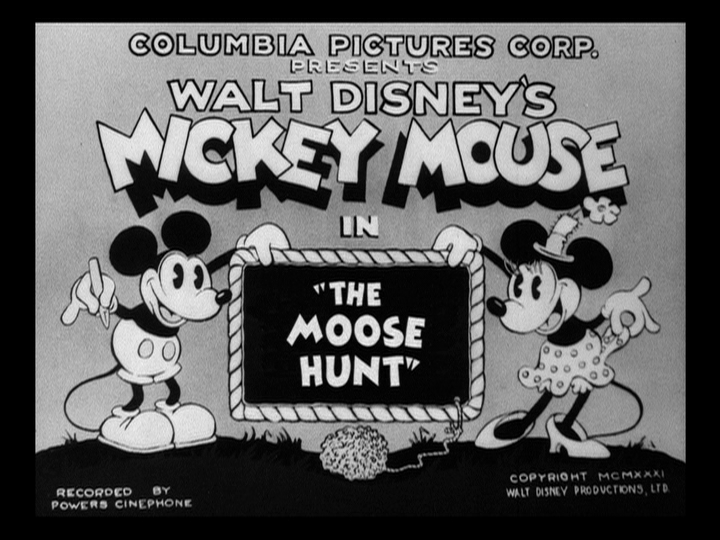
May 3, 1931 – The Mickey Mouse Short The Moose Hunt is Released to Theaters

“Old pal, old pal! What have I done? Oh, what have I done?”

On May 3, 1931, the Mickey Mouse short film The Moose Hunt was released to theaters. It was directed by Burt Gillett, and starred Walt Disney as the voice of Mickey, and Pinto Colvig as the voice of Pluto. This is the first film where Pluto is known by his name.

The short opens with Mickey and Pluto walking in the woods, with Mickey toting a shotgun and whistling “She’ll Be Comin’ ’Round the Mountain.” He trips over a rock, making the shotgun go off, but it doesn’t stop him from dancing down the path. He ends up falling into some tall grass, startling some birds that fly to safety in a tree. When he shoots at the tree, the only thing he’s able to hit are all the leaves. The birds sit safely, singing his song back to him.

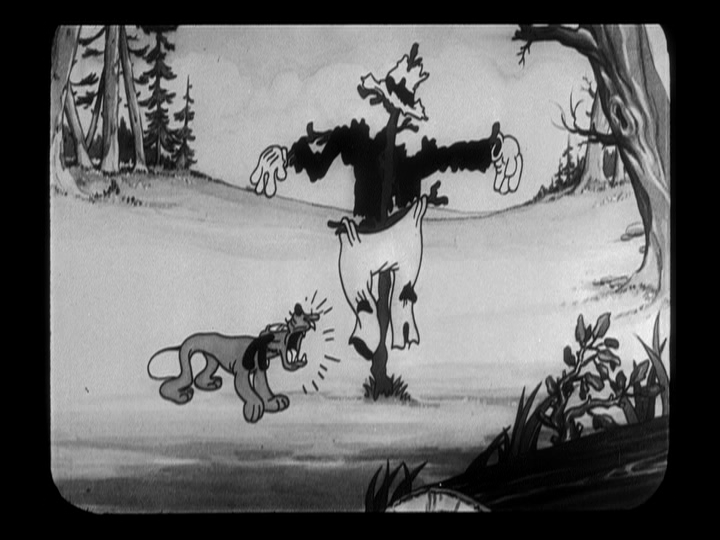
Pluto versus the scarecrow

Pluto, meanwhile, wanders away from Mickey, following a flea that he scratched off. When he comes across a scarecrow, the dog is frightened, and begins to bark at it. When he’s hit by one of the pant legs, Pluto takes off in fear, but ends up sneaking back to sniff and study the scarecrow again. One of the scarecrow’s gloves falls off and lands on Pluto’s tail, startling him and sending him scurrying off in a frenzy.

As Mickey is walking along, Pluto runs up behind him and pushes past, causing the shotgun to go off again as Mickey flies into the air. Pluto ends up flying into a river, with all the fleas he had abandoning ship, only to return once Pluto climbed up onto dry land. He ends up groveling back to an angry Mickey, who glares at him, tapping his foot. The mood quickly changes when Mickey asks Pluto to perform tricks. Mickey grabs a stick and begins to play fetch with Pluto, but unfortunately throws the stick into a pile of branches, and Pluto has to guess which one is the right one. The one he picks, however, makes him look like he has antlers.

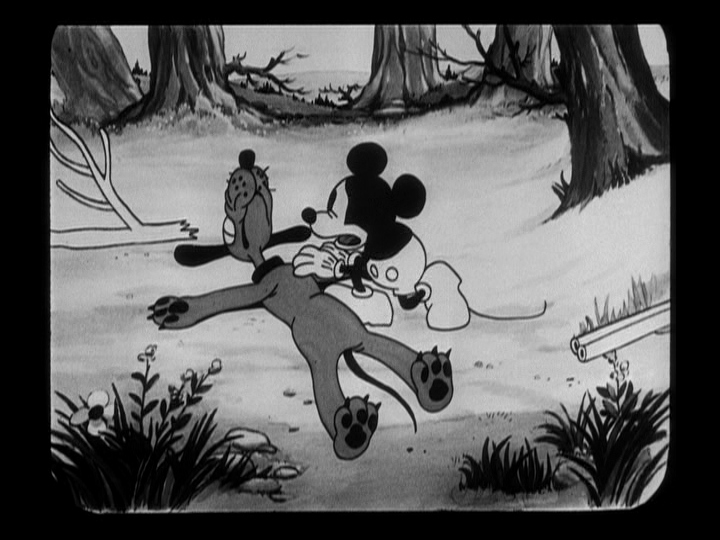
Mickey mourns over the body of his pal, thinking he’s killed him

As Pluto races back to his master, Mickey sees his shadow through the trees, and gets excited. He aims and fires twice, and a loud whimper is heard. As Mickey runs to see his kill, he stops, shocked, observing that the “moose” he shot was in fact his dog. Mickey cries over the body, but the audience sees that Pluto is just pretending to be dead, and he winks at the audience. As Mickey pleads for his dog to be alive and say something, Pluto “revives” and says, “Kiss me.” He then barks, and Mickey happily hugs his friend.

The mood is broken, however, when Mickey hears the call of a moose, and tells Pluto to be quiet. The two carefully sneak along, and Pluto tries to sniff the moose out. Circling around what he thinks are trees, the camera zooms out to show the audience that Pluto has, indeed, found the moose. Continuing to find the scent, Pluto keeps walking, unaware that the moose is copying him and following closely behind. The strange trio is then seen together, with Pluto following Mickey, and the moose following Pluto.

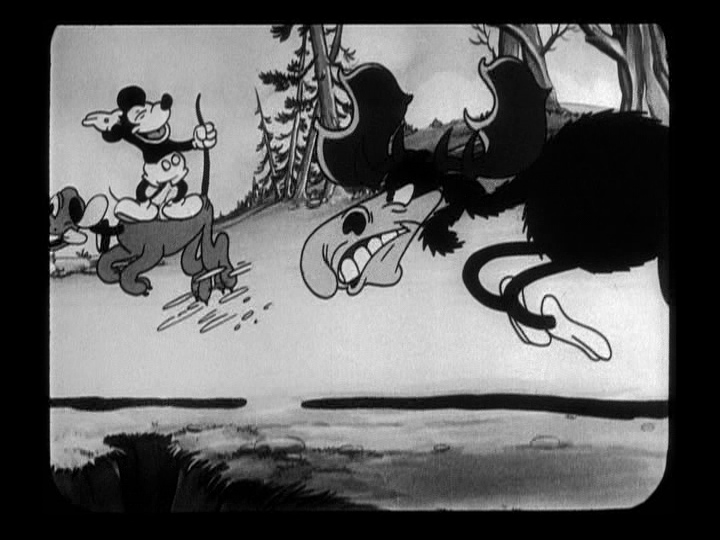
Mickey and Pluto fly away to safety from the clutches of the angry moose

Pluto finally gets the feeling that something strange is going on, and turns to see the moose, causing him to jump in fear. He taps Mickey to get his attention, but Mickey just rebuffs him. Finally, he turns and tries to shoot, only to have his shotgun break into pieces. Mickey and Pluto begin to run for their lives as the moose pursues them, and the day is saved when Pluto uses his ears to help the duo fly away to safety.

May 2

Posted on

May 2, 2009 – The Miley Cyrus and David Archuleta Duet “I Wanna Know You” Premieres on Radio Disney

“I wanna find out what you know, and maybe someday down the road, I’ll sit back and say to myself, yeah, I thought so.”

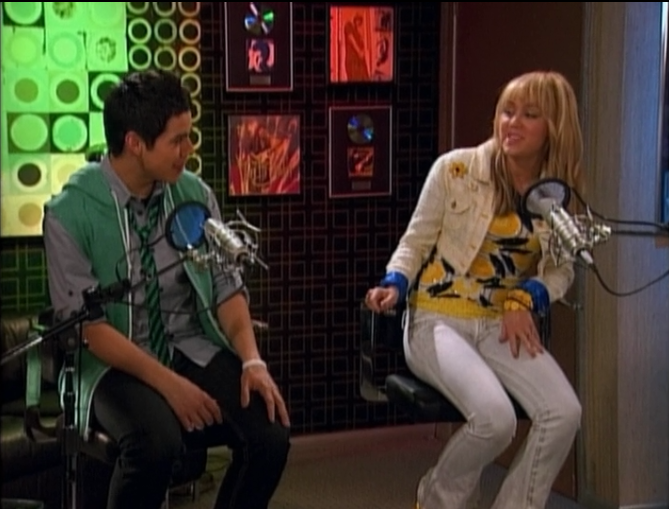
On May 2, 2009, a 6:00 P.M. Eastern Standard Time, Radio Disney had the world premiere of “I Wanna Know You,” sung by Miley Cyrus as Hannah Montana and American Idol contestant David Archuleta. The song was featured in a new episode of Hannah Montana the following day. The song entered the U.S. Singles Top 100 Chart at number 74, and charted for only a week.

David Archuleta guest starred on the episode “Promma Mia” as himself; Hannah agreed to go to the prom with an awkward student named Aaron, but decided to ditch him to sing the duet with Archuleta. In the end, Hannah decides to go back to the prom and fulfill her commitment with Aaron instead. The song was then released on the Hannah Montana 3 soundtrack on July 3, 2009.