RSS Feed

Monthly Archives: February 2012

February 19

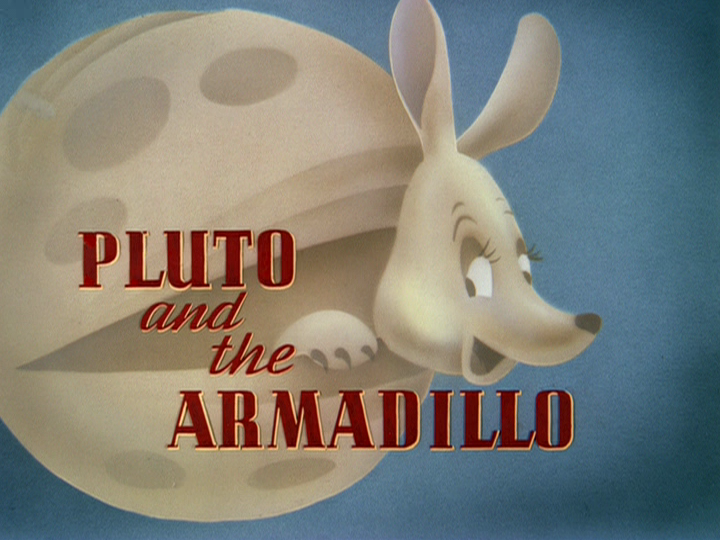
February 19, 1943 – The Mickey Mouse Short Film Pluto and the Armadillo is Released to Theaters

“Down where the mighty Amazon winds its way through the heart of Brazil, we find many strange and exotic species of flora and fauna.”

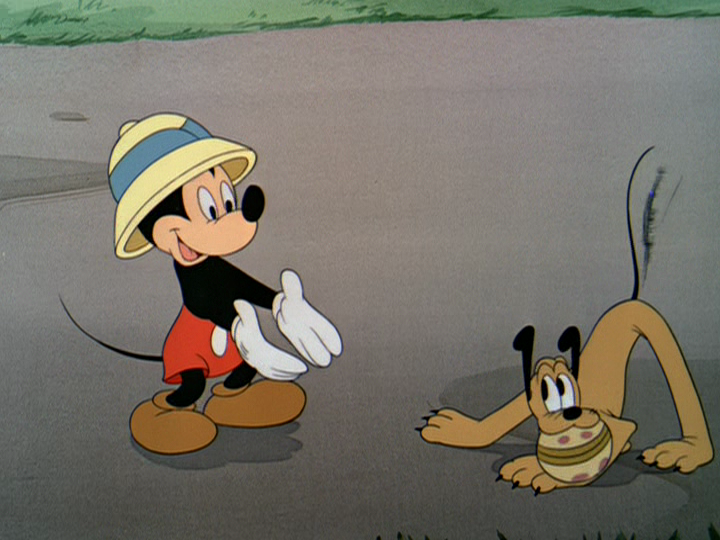
On February 19, 1943, audiences were presented with a new Mickey Mouse short entitled Pluto and the Armadillo. Directed by Clyde Geronimi, the short starred Walt Disney as Mickey Mouse, Pinto Colvig as Pluto, and Fred Shields as the Narrator. Interestingly enough, although listed as a Mickey Mouse short, its main actor is Pluto, and Mickey appears only in two small sections.

Our narrator opens the story by explaining that there are “many strange and exotic species of flora and fauna” near Brazil, and then introduces a hanging armadillo, affectionately nicknamed Tatou. Tatou, the narrator informs the audience, “is a very timid creature, and at the slightest noise, even at the drop of a pin, he snaps into a solid ball, becoming, so to speak, a hard nut to crack.”

Turista Americana and his canine play a game

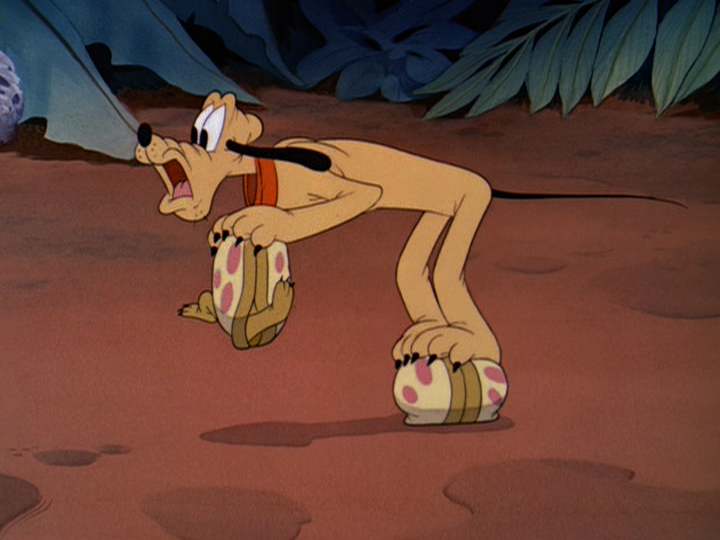
The narrator then moves to the next unusual creature: the turista Americana, or the American Tourist. Mickey and Pluto hop off the Pam Am plane for a fifteen-minute stopover, and Pluto begins to play with a ball that has a strikingly similar design to Tatou’s shell. Mickey throws the ball into some nearby woods, and hits Tatou, who curls up inside his shell. Pluto, thinking Tatou is the ball, goes to retrieve it, but Tatou begins to jump away from Pluto’s mouth. When Pluto gingerly puts out a paw to touch it, Tatou buries himself under ground, then digs a trail away from Pluto, before coming up again and bouncing away from the curious dog and pushing the real ball out from some ferns.

Pluto is confused at the fact that there are now two balls in front of him, and he doesn’t know which one is the one that has been tricking him. Tatou, with a smile on his face, opens his shell slightly to see if Pluto’s still there, and when he gives Pluto a playful wink, Pluto tries to hide while Tatou shuts himself inside again. Although Tatou is being friendly, Pluto’s anger only grows. He tries to capture both of the balls, but the real one is squeezed out of his grasp. Pluto grabs it with his back legs, and both the ball and Tatou begin bouncing as Pluto tries to hold on.

Pluto trying to have a grasp on the situation

Tatou begins to walk away once he slips from Pluto’s grasp, but Pluto rushes around to stop him, determined to find out what exactly this strange creature is. After the two sniff each other out, Pluto determines that he likes Tatou, and the two begin to play a game of underground tag with each other. Tatou hides within a hole, and Pluto, a bit peeved that he ran into some plants and ended up looking like Carmen Miranda, grabs the nearby ball, thinking it’s Tatou, and plays with it rather roughly, causing it to pop. Thinking he’s killed the poor thing, Pluto begins to panic and cry. Tatou, observing from his hiding spot, sees Pluto and starts feeling guilty for making the dog cry. He appears in front of the weeping dog, gives him a lick across the nose, and Pluto instantly cheers at seeing his friend is alive.

The bell is ringing for everyone to get back on the plane, and Mickey is frantically looking for Pluto, who appears to have vanished. He finally spies Pluto and what he thinks is the ball, gathers them up, and drags them onto the plane in the nick of time. As Mickey holds the “ball,” Tatou sticks his head out, startling Mickey, who is very, very confused by the situation as the plane flies away.

February 18

February 18, 1967 – Birth of Disney Legend, Animator, and Current Voice of Donald Duck, Tony Anselmo

“The legacy is in my heart and soul that, I feel that it’s an honor to be the guy who gets to be the keeper of the keys or the carrier, or what have you, of this legacy. I love that so much, that’s so important to me. That’s the best part [about being Donald] for me. It’s fun. It can actually be a lot of work, you know, and you have to do long sessions, especially if there’s a lot of tantrums.”

Born February 18, 1967, in Salt Lake City, Utah, Tony Anselmo loved animation from an early age. “I would write the animators, you know, Frank Thomas, and Ollie Johnston, and Jack [Hannah] about what it took to be a Disney animator,” Anselmo explained, “and they would write back, very generously with advice.” While in high school, he took night classes in figure drawing and acting, and submitted his portfolio to the studio. After Ollie Johnston and Jack Hannah saw it, they sent him to the California Institute of the Arts, where he spent three years studying animation under Hannah’s direction. “At that time, I remember telling people I wanted to be an animator, and they didn’t know what that was,” Anselmo recalled. “Since The Little Mermaid, I think there’s been a popularity of what animation is, and everybody wants to be a part of it, but before that it was a very, sort of a cultish thing, where there were very few of us who knew what Disney animation was, and who those people were, the Nine Old Men and California Institute of the Arts.”

After graduating from CalArts, Anselmo was placed into a training program with famed animator Eric Larson for eight months, studying Disney style animation and being given animation tests. After that, Anselmo became and inbetweener at the studio. Anselmo credits Jack Hannah for his entering the studio; coincidentally, Hannah became the director of the Donald Duck unit under Walt Disney, so the old director of Donald hired the new voice of the duck.

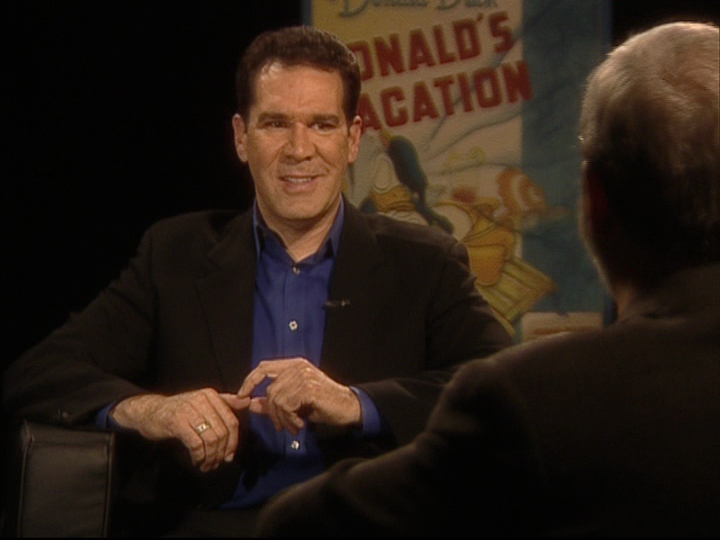
Anselmo being interviewed by Leonard Maltin in 2005

When asked how he became the voice of Donald, Anselmo responded that “It wasn’t anything I actually intended to do, but…it really was a small family, everybody knew everybody. And the first day I was on the lot, I was walking up Dopey Drive, and a man came down the steps of the animation building, five-foot-two and white hair [Clarence Nash, longtime voice of Donald Duck], and he passed me and he goes, ‘Good morning’ [in Donald’s voice], and I, in a split second, I had never met him before, and I had never seen who did Donald’s voice, so to hear that distinctive voice coming out of a man who I hadn’t met before was shocking, but at the same moment it was like, that’s Donald Duck! It would have been like being at MGM and seeing Clark Gable.

“Clarence was a good friend. And, doing voices and being the class clown, Donald was a voice that I couldn’t do. And I asked [Nash], for fun, ‘How do you do that?’ And he showed me, and I couldn’t do it. But I would practice from time to time – any voice person will tell you that the best place to practice is in the car, or in the shower – and one day it kind of clicked in, and I thought, ‘Okay, I think that I did it.’ The next time I saw Clarence I said, ‘Is this it?’ and goes, ‘That’s it!’ But it was just the sound, and there’s much more to it. You know, how to enunciate as much as possible. There’s certain words you use, certain words you try not to use, or you use something that means the same thing.

“It wasn’t until…he was supposed to the Rose Parade. In his fiftieth year, I think Ducky got the attention and the acclaim that he had, I think, always deserved. To celebrate Donald’s fiftieth birthday, he put his hand and footprints at the Chinese Theater, he was on the Tonight Show, the Academy Awards, and he was supposed to do the Rose Parade, and I didn’t know that he was sick; he had gotten leukemia. And I went to the Rose Parade and he wasn’t in the car, and Margie Nash called and said he was in the hospital. So I went to the hospital to visit…and he said, ‘You’re gonna do this.’ It all came at the same time and I thought, ‘You’re dying, and you want me to do that? No, I don’t want you to die, and no, I want you to do this.’

“The odd thing about it was, for a period of about six months before that, I thought it was just because we were friends and he thought it was fun, he would come in my room in the animation building when I was drawing, and he would say, ‘Try this,’ or ‘What would you do if Donald had to be in this situation, what would you say?’ or ‘Say this,’ and I would go, ‘Okay,’ and I thought it was fun. I really didn’t think he was spending the time, you know…I felt like he had taken me under his wing, to use a corny phrase, but I didn’t know why he was spending so much time with me. And it wasn’t until he was ill in the hospital and he told me, that it was like, ‘Oh.’ So, I’m very protective of it. It’s a legacy of not only Clarence and Jack, who were dear friends of mine, who I respected, and miss, but Walt Disney, and a legacy that I wanted to be a part of. It’s something that I watch over and I’m very protective of it, because I want to keep the integrity of not only the sound of it, but the integrity of the personality of Donald, what he does, what he doesn’t do. It’s not just the way Donald sounds, it’s how he reacts to any given situation. He would react differently to the same situation as Mickey or Goofy would act differently.”

In 1990, Anselmo put both of his skills to good use by animating and voicing Donald in Disney’s version of Mark Twain’s The Prince and the Pauper. He continues voicing Donald in various Disney projects, most recently the Kinect Disneyland Adventures game, and has said, “Pending natural disaster, I expect to be doing Donald the rest of my life.” He was named a Disney Legend in 2009 at the D23 Expo in Anaheim.

February 17

February 17, 1934 – Mickey Mouse Short Film Camping Out is Released to Theaters

“Hey, Pop! I was having fun, and a big guy hit me!”

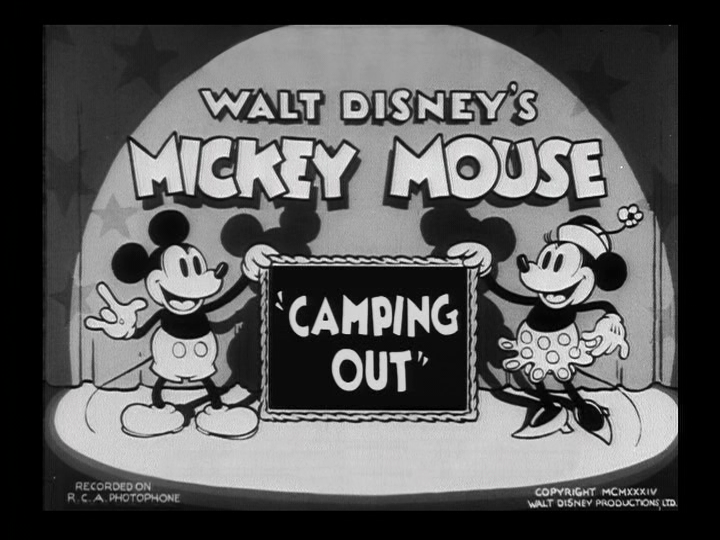
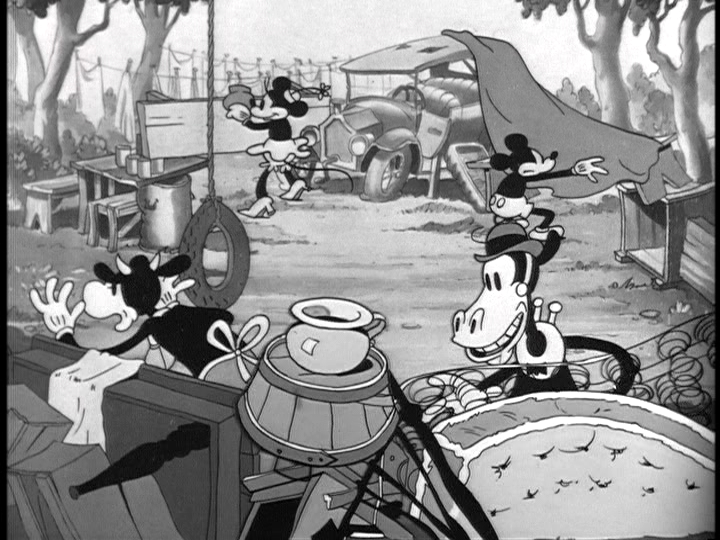
On February 17, 1934, the Disney Studios released the Mickey Mouse Short Camping Out, starring Mickey, Minnie, Horace Horsecollar, and Clarabelle Cow. Before the studio created and realized the individual star power of Mickey, Donald Duck, and Goofy, Mickey and Minnie were usually paired with Horace and Clarabelle, who were the major bit players in the short films of the ’30s. The short was directed by David Hand, with music by Bert Lewis.

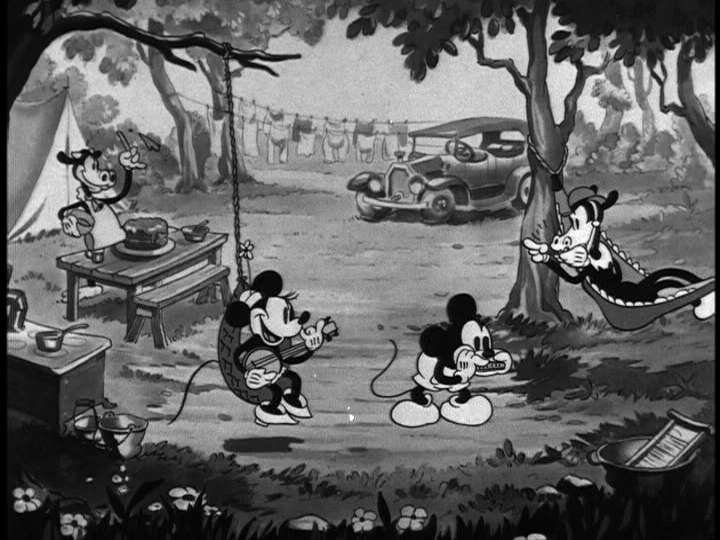
Mickey and the gang relaxing at their summer camp out

The scene opens on a lazy summer day, with the gang playing a joyful tune. Mickey is playing the harmonica, accompanied by Minnie on banjo and Horace on the mouth harp, and Clarabelle is in the background icing a couple of cakes. As they dance and play merrily, a lone mosquito flies into the picture, wanting to join in on the fun and landing on Mickey’s nose. Mickey tries to blow him away, only to end up getting stung on the nose. Angered, Mickey takes a frying pan, planning to squash the mosquito when he gets the chance. It lands on Clarabelle’s cake, and Mickey ends up flattening the cake and sending icing flying all over Clarabelle, while the mosquito flies away unscathed. Upset by Mickey’s ruining her hard work, Clarabelle takes the other cake and shoves it in Mickey’s face.

As Horace laughs at Mickey and Clarabelle, the mosquito sees an opportunity to give Horace a good sting. It winds up and flies like a fighter plane, sending Horace flying into the air from the impact. Horace swings wildly at it, and thinks he finally hit it, until he hears buzzing from inside his hat. When he removes it, he discovers a giant bump on his head from where the mosquito stung him. Completely angry at this point, Horace swats the mosquito, sending it flying to the ground with a bent nose. Shaking his fist in revenge and sobbing, he calls over his father and says that he was just having fun when a big guy hit him. Heroic music plays as the entire swarm of mosquitoes flies to seek vengeance for the poor little mosquito.

Seeing the swarm coming, the gang mans their battle stations

Minnie spies the swarm, cries out in alarm, and the gang sets up their battle stations. Horace decides to spray them with molasses, which effectively stops them and sticks them to a nearby tree. The second batch of molasses-drenched mosquitoes, however, is sent flying back to Horace, hitting him square in the face. Clarabelle takes the old fashioned method with a flyswatter, only to have the mosquitoes grab the netting and tear it apart. Minnie and Mickey team up, with Minnie opening cans of peas, and Mickey filling a bicycle pump with them, then using the pump as a sort of machine-gun with pea pellets. The mosquitoes catch the peas on their noses, causing them to fall to the ground with the weight. The swarm finds a hammer and uses it to remove the peas from their noses, then take to the air again. Horace uses corn to make his own shooter in order to break up the swarm. Believing him to be successful at driving the swarm away, everyone cheers, but the victory is short-lived as the bugs dive bomb the quartet. Horace, however, grabs an umbrella and pulls the gang to safety, with the swarm hitting the umbrella and sticking. Poor Horace is still holding on to the umbrella, and as the swarm flies away, he joins them. Mickey grabs on to try and pull him down, but is also taken away. The umbrella breaks from the weight, and Horace and Mickey crash to the ground.

The mosquitoes free themselves, pull together to form a giant mosquito, and angrily chase after the gang as they run to take refuge in their tent, with the only casualty being Horace’s hat. The swarm continues its attack, with the gang using all of their supplies as best they can to stop the menace. Mickey’s solution is to trap the mosquitoes in the only thing he can find: Clarabelle’s bloomers. As the mosquitoes buzz away, surrendering, the gang cheers at their victory.

February 16

February 16, 1904 – Birth of Song of the South Actor, James Baskett

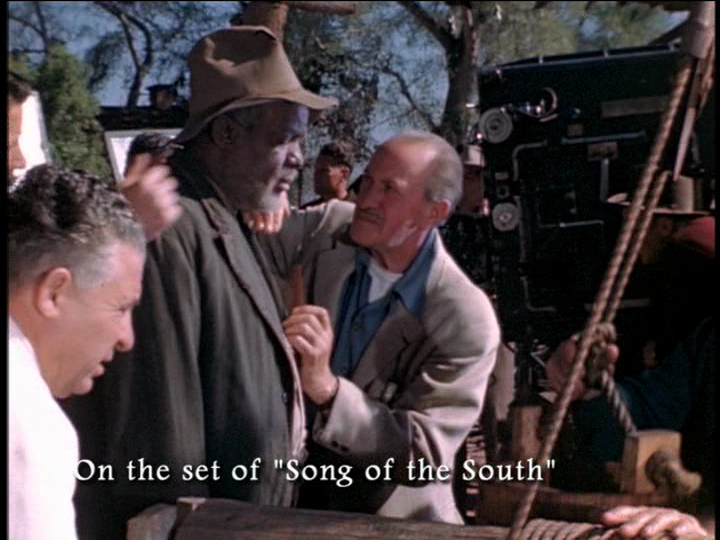
James Baskett (C), preparing for a scene in Song of the South

“[Baskett was] the best actor, I believe, to be discovered in years.” – Walt Disney

On February 16, 1904, James Baskett was born in Indianapolis, Indiana. In 1939, he moved to Los Angeles and had a supporting role in the film Straight to Heaven, followed by more supporting roles in Revenge of the Zombies in 1943 and The Heavenly Body in 1944. In 1944, he was asked to join the Amos ‘n’ Andy radio show, playing the lawyer Gaby Gibson.

In 1945, after spying an advertisement for open auditions, Baskett auditioned for a bit part in Disney’s upcoming film Song of the South, originally called Uncle Remus and based on the Joel Chandler Harris Uncle Remus stories, originally published in 1881. Baskett had little experience in film, but impressed Walt so much that he was offered the lead role of Uncle Remus. Baskett was also the voice of Brer Fox in the animated sequences, and the voice of Brer Rabbit when Johnny Lee was unable to do the voice for a sequence due to another commitment. Film critic Leonard Maltin remarked that Baskett was “ideal as Uncle Remus, eliciting just the right kind of warmth and humor, and later poignancy, from the character.”

After the film’s release, Walt continued to stay in contact with Baskett. This friendship led to Walt lobbying the Academy to give Baskett an Oscar for his portrayal, for Walt said Baskett worked “almost wholly without direction” and had devised the characterization of Remus himself. On March 20, 1948, Baskett was awarded an honorary Academy Award “for his able and heartwarming characterization of Uncle Remus, friend and storyteller to the children of the world, in Walt Disney’s Song of the South.” This made Baskett the first actor in a Disney film to win an Academy Award, as well as the first African-American man to win an Oscar. On July 9, 1948, only a few short months after this victory, Baskett died of heart disease at the age of 44. His wife, Margaret, wrote Walt Disney a thankful letter, telling Walt that he had been a “friend in deed and [we] certainly have been in need.”

Although Song of the South was the only film Baskett appeared in, due to his untimely death in 1948, the role, and film, are an important part of Disney history that should not be forgotten or brushed aside. Baskett, in my opinion, should be honored by Disney as a Disney Legend – without the warmth Baskett presented as Uncle Remus, Zip-a-Dee-Doo-Dah would not have been as memorable as it is now. The film is a victim of selective judgment by the critics: Gone With the Wind is lauded, although it truly does deal with slavery, whereas this film is set in the period of Reconstruction. Baskett’s portrayal of Uncle Remus shows a man who continues to keep a cheerful disposition, no matter what hand life has dealt him, and is truly respected by every other person in the film, from Bobby Driscoll’s Johnny, to Lucile Watson’s Grandmother. The range of emotion Baskett shows, including the dramatic scene after Jonny is attacked by a bull, only adds proof to what Walt told his sister Ruth, that Baskett was one of the greatest actors to be discovered in a long time. Baskett certainly could have achieved a lot had he lived longer, and it is a crime to let his legacy die, along with the technical and artistic merit of Song of the South by hiding this film away from the public. Baskett should be honored as a Disney Legend for his portrayal, plain and simple. He played Uncle Remus the way he should have been played: with warmth, wisdom, and a wonderful human being.


February 15

February 15 1899 – Birth of Disney Legend and Wife of Walt Disney, Lillian Disney

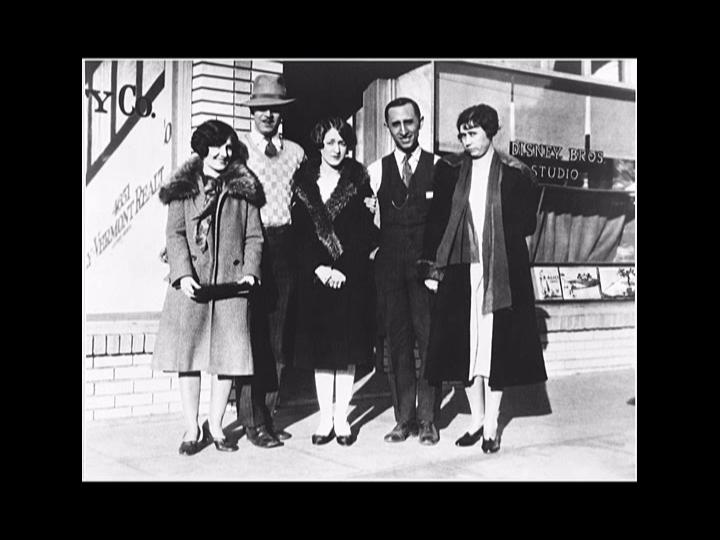
Lillian, far left, stands with Walt, his sister Ruth, Roy, and Roy's wife Edna, in a shot from 1925

“I think my dad fell in love with her almost immediately … she was an independent little lady.” – Diane Disney Miller

Lillian Bounds Disney, wife of Walt Disney, was born in Spalding, Idaho, in 1899 as the tenth and youngest child of the family. In 1923, she traveled to Los Angeles to visit her sister, and a friend of hers recommended her for a job at the Disney Brothers Studio as an ink and paint girl. There was one condition: “Don’t flirt with the boss,” her friend warned her. “He’s all business.” Lillian, however, had no intention of flirting with Walt; this was not a love-at-first-sight romance for either of them, for Walt was too consumed with the business, and Lillian was not impressed with the shabbiness of his clothes. She took the job due to its proximity to her sister’s house and the salary of fifteen dollars a week.

Walt would drive Lillian and another coworker home after long days at the studio. Lillian later said, “When Walt started dropping the other girl off first so he could talk to me, I knew he was interested.” She also admitted that during these rides home, she started to see Walt differently, looking at him “like he was a somebody.” One evening as he dropped her off, he informed her, “I’m going to buy a new suit. When I get it, would it be all right if I called on you?” Lillian said that it would, and when Walt got his new suit in celebration of a check for their films, he arrived at her house and asked her eagerly about the suit. They dated steadily after that, and on July 13, 1925, Walt and Lillian were married. From then on, Lillian worked at the studio only in times of emergency.

One of the major contributions attributed to Lillian involved Walt’s famous creation, Mickey Mouse. While the story of Mickey’s creation has been shrouded in legend and mystery, the one common factor is that Lillian came up with the name for the new character. Walt wanted to name the mouse Mortimer, but Lillian decided that the better name would be Mickey, and he agreed.

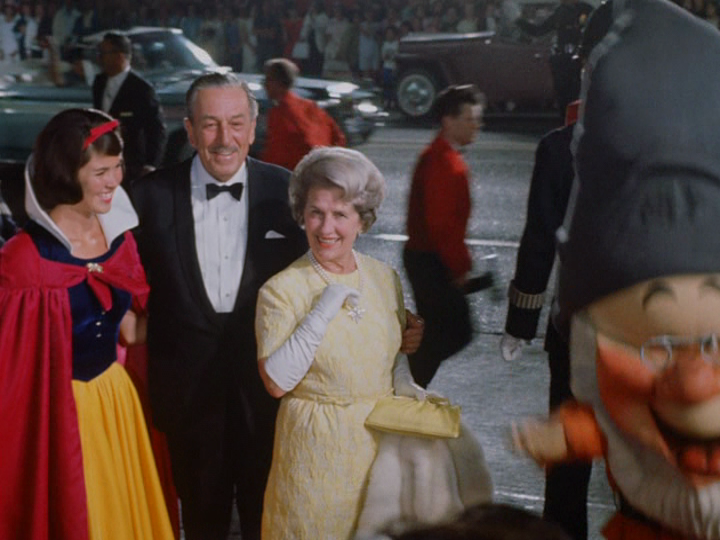
Lillian accompanying Walt to the premiere of Mary Poppins

Lillian was not one to meekly listen to Walt, nor was she one to care about what the press reported about him. Walt once told a reporter that Lillian didn’t care what reporters would say about him. “I keep reporters away from her,” he explained. “She’s given them the lowdown.” Perhaps the success to their long marriage was the fact that Lillian was never overly impressed by Walt and his accomplishments. She did worry when he worked long hours, but overall, she didn’t regard him as a genius, as most people did. Walt, however, would show her affection by either physical actions, such as wrapping an arm around her, or learning how to dance so they could dance together during social functions.

After Walt’s death, Lillian stepped in the public arena to lend support to the Florida Project, which would be renamed Walt Disney World in his honor. She attended the dedication ceremony in 1971, saying, “I think Walt would have approved,” when asked what Walt would have thought of the park. She continued her late husband’s support of education by providing financial gifts to the California Institute of the Arts, particularly to remodel a campus theater in 1993, which was renamed the Walt Disney Modular Theater. In 1987, Lillian announced a $50 million gift to build a symphonic hall for the Los Angeles Philharmonic Orchestra, now known as the Walt Disney Concert Hall. The building was designed by architect Frank Gehry and opened in 2003.

In 1969, Lillian remarried to John L. Truyens, but he unfortunately died in 1981. Lillian herself passed away on December 16, 1997, after suffering a stroke at the age of 98. She was named a Disney Legend in 2003, honoring all of her contributions in support of the company’s growth.

February 14

February 14, 1941 – The Mickey Mouse Short The Little Whirlwind is Released to Theaters

“Well, guess I don’t get the cake, huh?”

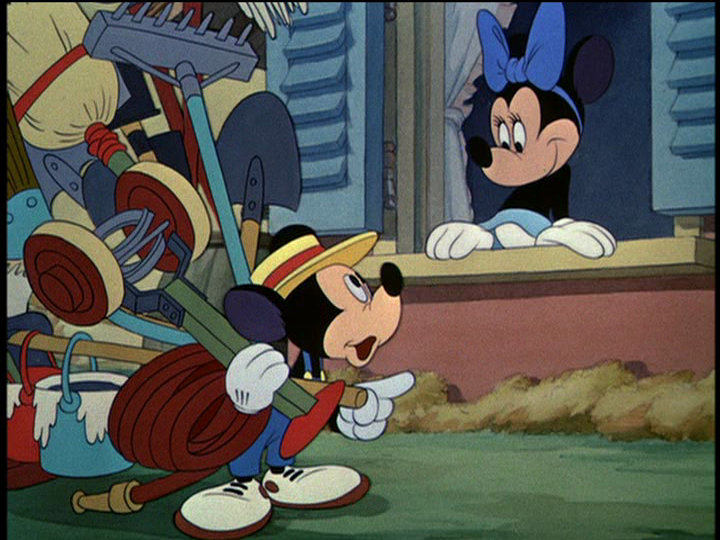
On February 14, 1941, the Mickey Mouse short The Little Whirlwind was released to theaters. Although most shorts that feature Mickey and Minnie are romantic in nature, this short does not feature a romantic plot between the two. This is ironic, as the short was released on Valentine’s Day. Mickey shows up around Minnie’s house and offers to clean her yard in exchange for her freshly made cake, only to have his efforts thwarted by a mischievous little whirlwind. The short was directed by Riley Thomson, with Walt Disney as the voice of Mickey Mouse and Thelma Boardman as the voice of Minnie Mouse.

The short opens with Minnie Mouse in her house, placing her freshly made cake on the windowsill. The scent travels down the road, catching Mickey Mouse’s nose and pulling him toward the window, until Minnie removes the cake and shuts the window, causing Mickey to fall to the ground. He knocks on her window, motioning to the cake she’s made. Angrily, she tells him that she has nothing for loafers, but Mickey offers to clean up her yard. Minnie agrees, but adds that there is to be no more clowning around. Excited about the promise of cake, Mickey grabs all the yard tools he can find, saying, “You won’t know the place when I get through!”

Mickey shows his enthusiasm by gathering every tool he can find

As Mickey begins to rake her leaves with gusto, a little whirlwind begins whirring down the path. Spying Mickey doing his yard work, it decides to have a little fun with him, hiding in the leaf basket and moving it when Mickey’s back is turned. Mickey is slightly confused, but tries to place the leaves in the basket again. Mickey and the basket go back and forth, until Mickey decides the best course of action is to nail it to the ground. He tosses the leaves in, only to have them thrown back at his face as the whirlwind escapes into the air, stealing Mickey’s hat.

After Mickey retrieves his hat, the whirlwind continues to play tricks on him, like stuffing leaves down Mickey’s trousers. As the whirlwind gathers the leaves and has them march behind it, Mickey grabs a bag and sneaks around the back of the house to sneak a surprise attack on the troublemaker. While he is able to capture the whirlwind in the bag, and gives the bag a good kick, the little whirlwind fights back and breaks free, squealing down the road while Mickey chases him. Unfortunately, when we see Mickey again, he’s running away from the wrath of Mama Whirlwind. Thanks to Mickey, Mama Whirlwind tears up the entire countryside as she chases him. Mickey gets caught in Mama Whirlwind, and is then dumped into a fountain before she leaves.

The things a Mama Whirlwind will do to protect her baby obviously include undoing all of Mickey's hard work, and then some

True to Mickey’s word, the yard is unrecognizable now. Minnie finishes decorating the cake, placing a big red cherry on top. She is shocked to see the state of her yard, and calls Mickey a louse. Mickey begins to leave, mentioning off-handedly that he must not get the cake after all. Minnie responds that he does, indeed, get the cake, and when he turns back excitedly, he gets the cake all right – thrown right at his head.

February 13

February 13, 1957 – The Disneyland Episode Tricks of Our Trade Premieres on ABC

“Before our eyes, we have seen an entire industry grow literally from the ground up. And this growth was no accident. It was painstakingly built, step by step, by men with pioneering spirit, who loved this puzzling new art form, and believed in its future.”- Walt Disney.

On February 13, 1957, audiences were treated to a different kind of episode of Disneyland: one that focused on how animated films were able to capture things as realistically as they did. With our host, Walt Disney, we are taken through the “tricks of the trade,” where he explains some of the then-commonplace animation principles, as well as some of technical advances made in the studio, and why they needed to be created. The examples given are obviously staged, but they give the audience a great example of the process used to come to a solution. Animation examples are from Snow White and the Seven Dwarfs, Bambi, and Fantasia. The episode was written by animation veteran Dick Huemer and directed by Wilfred Jackson. It also includes cameos of four of the famed Nine Old Men: Frank Thomas, Ollie Johnston, Marc Davis, and Milt Kahl. The episode refers to the book, The Art of Animation, which was the book that inspired John Lasseter to want to be an animator (please see the January 12th entry for more information).

“Because the animated cartoon comes to life on the screen, it belongs in the field of the motion picture,” Walt explains, as he opens up the episode. “But because it is drawn and painted, it is also one of the graphic arts, like painting. As a matter of fact, it is often referred to as the last of the graphic arts.” Disney then goes to his desk and shows the audience the book The Art of Animation, which was written by Bob Thomas about the Disney Studios. Disney turns to chapter eight, entitled Tricks of Our Trade, and explains that the pupils were their own teachers when it came to the principles of animation. “They had to be, because no one in the world could give them the answer to what they wanted to know,” Disney says, adding that their overall question was: How could animation be improved?

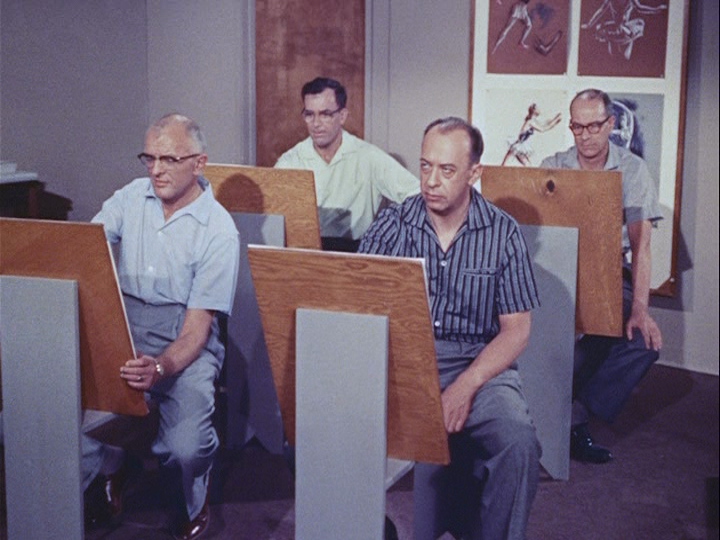
The animators in a classroom after hours, learning more about their own medium by one of their own

The first segment shown is of a group of animators watching a film of overweight comedian Billy House performing a two-step. The animators note that an overweight man moves differently, and that the human body does not move all in one piece. When the film is slowed down, there are many details they recognize that cannot be seen at normal speed. We then see the animators use what they saw to create an animation of the dwarf Happy doing the two-step dance, with the animation principles of weight, contact, follow-through, squash and stretch, and overlapping actions being used effectively. Disney points out while it’s true that thoughts and emotions can be expressed through pantomime, who a character is and what they think can best be revealed by dialogue. The trick of using dialogue is shown through a clip from Show White and the Seven Dwarfs, where Snow White identifies which dwarf is which.

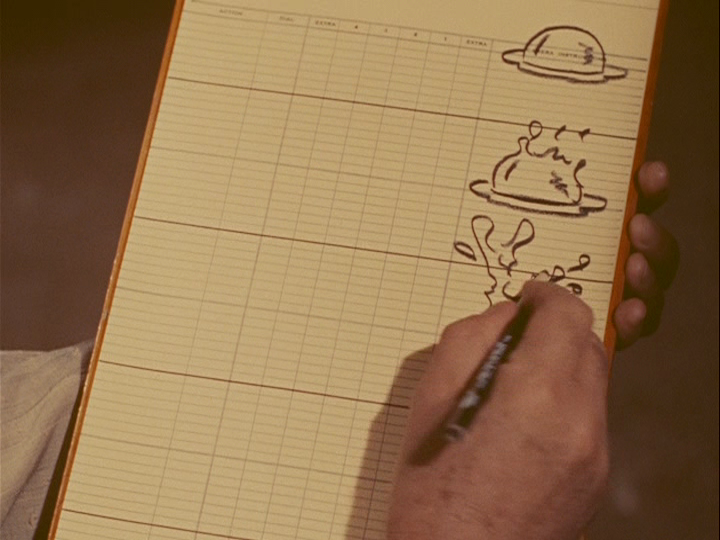
Dan MacManus sketching on an exposure sheet, trying to see how many frames it wll take to draw before the animator can draw the bubble bursting

The next animation technique we look at is effects animation: the trick of making the cartoon characters more believable by using extremely realistic animation of incidental action. There are many clips of animators watching various actions—including a baseball thrown through a window, or a bubble being blown from a pipe—and Disney explains that animating breakage required tremendous attention to detail. This leads into a clip of the earthquake from The Rite of Spring sequence in Fantasia. Continuing with that sequence, we see three effects animators looking at a tub of orange-colored mud, trying to solve three different problems for the creation of earth sequence in The Rite of Spring. Joshua Meador, head of the experiment, uses color chalks and pastels to render the sketch that would give an overall impression of the sequence. Jack Boyd’s assignment is to establish the individual action of a pair of bubbles, verifying his findings with the 2-drawing flipping action. Dan MacManus’s job is to see exactly how many drawings it would take to animate the bursting of a bubble, using an exposure sheet and a stopwatch. The audience then sees the clip from The Rite of Spring in its entirety.

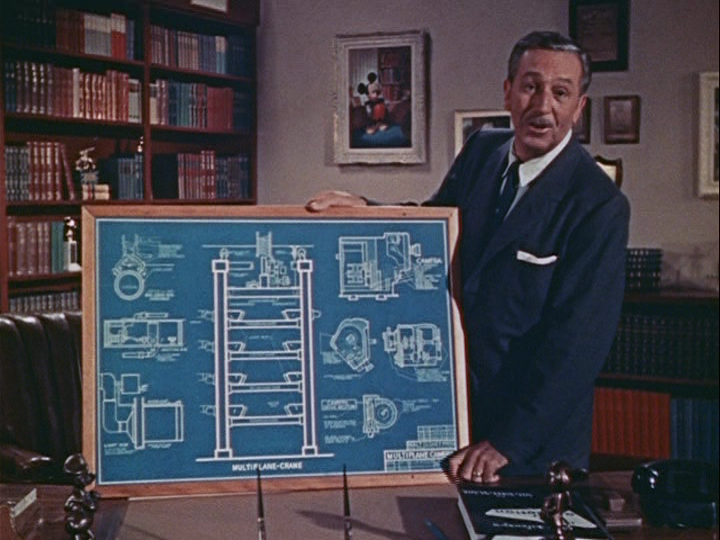
Walt with a blueprint of the Multi-Plane Camera, a Walt Disney Studios invention. Coincidentally, Ub Iwerks had created his own version at his own studio, only it was a horizontal camera

Walt pulls out a picture, calling it a different kind of drawing, which “also came out of our school of self-improvement here at the studio.” The blueprint is of the multi-plane camera, which was first used to great success in the Silly Symphony The Old Mill. Disney explains that the old process for animated films was fairly simple in construction and operation, but the biggest problem was that any dimension the character brought with him or her into the scene disappeared when the character left the frame. Another example used was a painting of a house on a moonlit night, and when the camera zoomed in on the scene, everything got larger, including the moon, which does not happen in reality. The use of the multi-plane camera shows the audience the big difference it makes in that scene. The audience next sees the opening scene of Bambi, and how the multi-plane camera works to give realism to the forest.

Four of the famous Nine Old Men, studying ballet moves. From Far Left: Milt Kahl, Frank Thomas, Marc Davis, and Ollie Johnston

“Perhaps the thing that distinguishes animated cartoons more than anything else is the trick of caricature,” Disney says. He tells the audience the story of the animation of Dance of the Hours from Fantasia, which involved the use of a live-action model to help the animators see the ballet movement of the dance. The ballet dancer they used was Helene Stanley, who was also the live-action model for Cinderella and Aurora in Sleeping Beauty. In this segment, we see the four of the famous Nine Old Men as they study Stanley’s movements. Kahl discovers that he may not be getting the kick right. Davis asks Stanley to perform it again, and as she does, Kahl makes a comment that the kick should be higher “in order to get all that weight off the ground. She’s no cream puff, you know.” Davis agrees, adding, “Yeah, that is a lot of beef.” These comments grab Stanley’s attention, but she keeps dancing. Thomas steps forward with his drawing and asks if he’s made the trunk too long: at this point, the audience sees that the drawings are those of the animals in the Fantasia sequence, although Stanley still thinks they are talking about her. Kahl responds to Thomas, “Oh, no, that’s what gives it that goofy look. Trunk’s way out of proportion to the rest of her body…it wouldn’t hurt to make [her legs] good and hairy.” These comments finally get the best of Stanley, who grabs her hat and cape and runs to the door, before turning around and seeing the animals they’ve been animating, and laughs before returning to the stage. The episode ends with the ballet segment from Fantasia, with all elephants, ostriches, and hippos.

The episode is wonderful for those who are fans of animation, and wish to see a dramatic look at how the animators were able to teach themselves and develop the new techniques to create better animation. Similar to “lessons learned” when creating computer animation in this generation, this highly recommended episode shows how the animators really had to, and did, step up to blaze a new trail.

February 12

February 12, 1993 – Homeward Bound: The Incredible Journey is Generally Released to Theaters

“It’s my responsibility. I had a responsibility to Sassy to love her and protect her, the same as I have to you, and to Peter, and the same as you have to Jamie.”

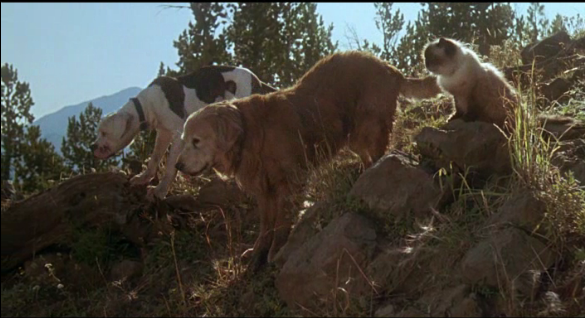
On February 12, 1993, the Walt Disney Studios had their general release of the family film Homeward Bound: The Incredible Journey. The film is a remake of the 1963 Disney film The Incredible Journey, which in turn was based on the best-selling book by Sheila Burnford. The story is of three pets – Chance, an American bulldog puppy; Sassy, a Himalayan cat; and Shadow, a golden retriever – who, afraid they’ve been abandoned by their owners, begin a journey back to their home through the California wilderness. Although the film was set in California, the filming was done in eastern Oregon. In contrast to the original film, the animals in the film speak, although this is one of the rare films were the animals mouths are not made to move in synchronization with what they say. The film stars Michael J. Fox as the voice of Chance (and the narrator of the film), Sally Field as the voice of Sassy, and Don Ameche as the voice of Shadow.  The film also stars Robert Hays as Bob Seaver, Kim Greist as Laura Seaver, Benj Thall as Peter Seaver, Veronica Lauren as Hope Seaver, and Kevin Chevalia as Jamie Seaver. It was directed by Duwayne Dunham, with the screenplay by Caroline Thompson and Linda Woolverton.

The film opens with Chance explaining his past: he was abandoned as a puppy, left to fend for himself on the streets before getting caught and sent to the pound. He was adopted by the newly combined Seaver family (Bob Seaver married Laura, a widow with three children). Chance calls it the place where he got his second chance, and his name; where he was provided with “lots of space, fresh air, plenty of interesting things to explore, and all the underwear [he] could eat.” He introduces the two other pets, Sassy the cat, and Shadow the dog, as well as their humans. Chance explains that the daughter Hope belongs to Sassy, the youngest boy Jamie belongs to Chance (although Chance explains that he doesn’t really need anybody), and Peter, the eldest, belongs to Shadow.
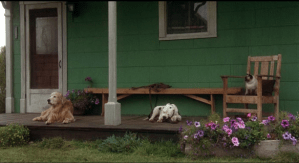
The pets on the porch of Kate's ranch. Shadow (L) eagerly awaits Peter's return, while Chance (M) believes they've been dumped.

The family must go to San Francisco for a little while, leaving the pets behind with a family friend named Kate at her ranch. Peter is not happy with having to leave Shadow behind, asking his new stepfather Bob, “What if he thinks I’ve abandoned him or something?” Bob responds that the time will pass before they know it, and everything will be okay. The pets, however, don’t understand what’s going on: Chance believes they’ve been abandoned, but it doesn’t seem to faze him much, since it had happened to him before. Kate leaves to go on a cattle drive, leaving a note behind for her neighbor about taking care of the pets, but part of the note falls under a table, and the neighbor mistakenly believes Kate took the pets with her. Shadow senses that something is wrong, and decides that he has to get back to Peter. “Something is keeping Peter from coming to me, so I’m gonna go to him,” he explains, and jumps the fence. Sassy follows him reluctantly, and Chance only follows, as he’s been chased by a turkey most of the time on the ranch, and decides to go where it’s turkey-less. “And so began the most perilous journey of our lives,” Chance narrates.

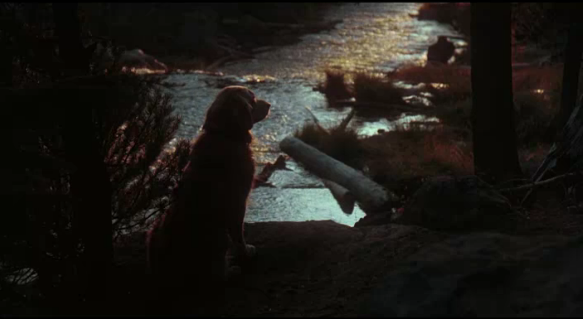
Shadow reassures the two that home is just over the mountain, but when they look over, they notice only more mountains and an expansive wilderness. But they continue, with Chance beginning to admire Shadow’s unwavering faith in Peter. As they begin, they have many brushes with nature, including a skunk and a protective mother bear. When they reach a river, Shadow and Chance have no problem swimming across, but as Sassy tries to climb a log to get to the other side, the log falls, sending Sassy traveling with the current. Although Shadow and Chance race along the riverside and Shadow tries to go into the river to catch her, Sassy ends up going over the waterfall into the rapids. The two dogs wait overnight to see if she’ll come out alive, with Shadow blaming himself for letting Sassy drown. The next morning, Shadow bids Sassy farewell, and the two continue on their journey. A birdwatcher in the woods, however, comes across Sassy washed up on the shore, and takes her in, cleaning her up and feeding her.
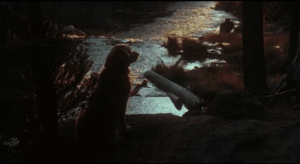
Shadow sits near the waterfall, blaming himself for what he believes is Sassy's death

Kate comes home to find that her neighbor believes she took the pets with her, and panics, having to call the family and let them know that the pets are gone. The children are devastated, and Peter blames Bob for making them go to San Francisco and leave the pets behind. Meanwhile, the two dogs come across their next challenge: a mountain lion has been following their tracks. Inspired by the time Chance used a see-saw to catapult Sassy in the backyard, Shadow comes up with a plan to send the lion flying, throwing it into the river. Their triumphant barking alerts Sassy, who is nearby with the birdwatcher, and she runs in their direction, with the three reuniting.

The three run across a lost little girl in the woods, and decide to watch over her during the night, while a search party wanders around, calling out the little girl’s name. In the morning, Shadow hears their calls and alerts them to where the girl is. The rangers with the search party recognize the pets from the posters Bob has made, and decide to take the pets with them to a nearby animal shelter. They alert the family that the pets have been found, but Chance thinks he’s being sent back to the pound and panics, causing Sassy to escape. She comes back to help Shadow and Chance break out, and they run away just as their family is on their way.

The pets look down on their hometown, relieved that they are so close to their family

The pets see home just over the top of a mountain, and travel through train depot, carefully crossing over the tracks, when Shadow falls into a hole as the beam he walks across breaks. At first Chance and Sassy think he may have died from the fall, but he wakes up and tries to walk, finding out his leg is badly injured. The two try to coax Shadow out of the hole, but the walls are slick with mud, and eventually, with the answer that he’s just too old, Shadow lies back on the ground and gives up. Chance tries to tell him that they need him, but Shadow says the only thing they need is to learn to say goodbye.

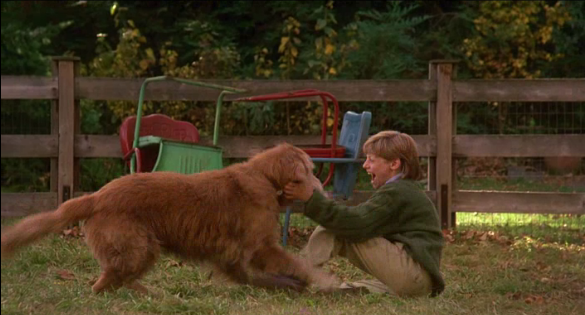
Later, when the family has returned home, still mending from what they believe is their loss, Jamie hears barking in the backyard. He calls out Chance’s name, and Chance comes over the hill, running to Jamie. Sassy appears next, running to Hope. Peter waits for Shadow to appear, but doesn’t see him, and angrily states that Shadow was just too old. Just as he turns to go in the house, a limping Shadow appears, and begins running to make his way back to Peter. Safe and sound, Chance realizes that here, he has the things he never knew he needed: a family, friends, and a home filled with love.
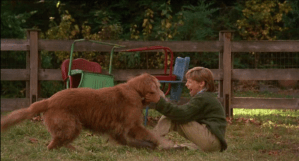
The joyful reunion of Peter and Shadow
February 11

February 11, 1918 – Birth of Disney Legend Blaine Gibson

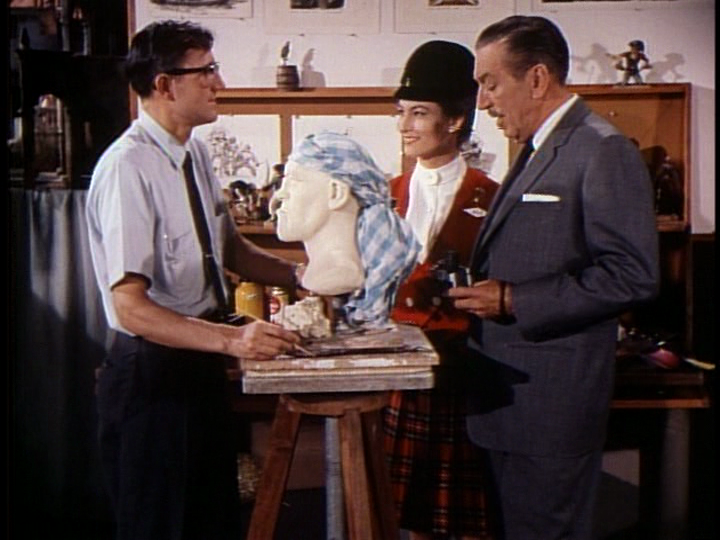
Gibson (L) showing Julie Reihm and Walt Disney one of the scultpures for the Pirates of the Caribbean attraction

“…I was told Walt was expecting me to work on these projects. So I said to myself, ‘what the heck’ and went (to Walt Disney Imagineering). I was never sorry after that.” – Blaine Gibson

Born February 11, 1918, in Colorado, Blaine Gibson joined the Walt Disney studios in 1939, working as an inbetweener and assistant animator. Gibson built up an impressive resume working on the films Fantasia, Bambi, Song of the South, and Peter Pan, just to name a few. Gibson would work on sculpting in his spare time, and when Walt saw an art exhibit with Gibson’s sculptures in 1954, he asked him to help work on special projects for the upcoming Disneyland.

In 1961, after doing part-time work for WED Enterprises, Gibson left the animation arena and began sculpting full time. Gibson ended up heading the sculpture department, working on most of the heads of the Audio-Animatronics characters, including 41 presidents for the Hall of Presidents at Walt Disney World (the last being Bill Clinton), and the pirates for the Pirates of the Caribbean attraction. Gibson makes an appearance in the Wonderful World of Color episode Disneyland 10th Anniversary, showing Disney and Julie Reihm one of the heads of the pirates he’s been working on. Reihm notes that the pirate looks rather angry, to which Gibson responds, “Well, he has to be a tough guy. The pirates were pretty tough.”

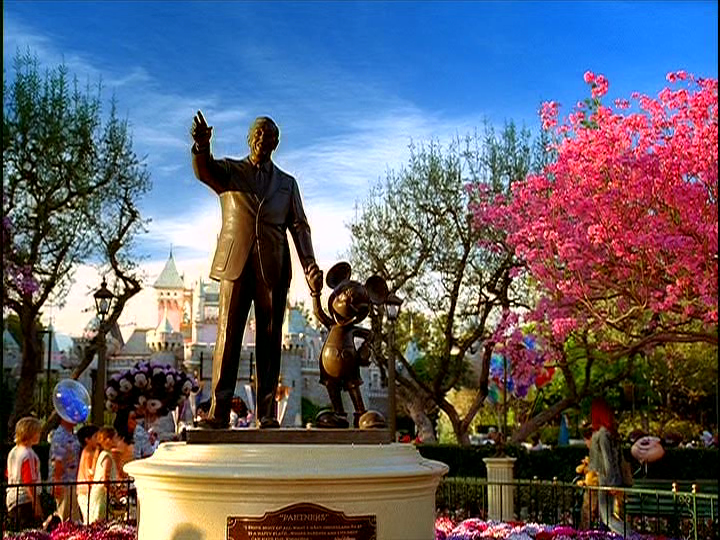
The Partners statue Gibson designed, located in the hub of Disneyland

One of the most recognizable works of Gibson’s is the “Partners” statue in the Central Hub of Disneyland, which depicts Walt Disney holding hands with Mickey Mouse. It was finished in 1993, the same year Gibson was named a Disney Legend, and the statue has become a symbol of Disneyland itself. Gibson retired from the company in 1983, but continues to consult on projects, including The Great Movie Ride in Walt Disney World.


February 10

February 10, 1934 – The Silly Symphony The Grasshopper and the Ants is Released to Theaters

“Oh, the world owes me a living…”

In 1934, the Disney Studios released what was to become another wildly popular Silly Symphony, The Grasshopper and the Ants. Based on the fable by Aesop, it was adapted by William Cottrell, directed by Wilfred Jackson, and starred Pinto Colvig as the Grasshopper. Colvig is better known as the original voice of Goofy, and the song in this short, “The World Owes Me a Living,” would become a theme song for Goofy in later shorts. The song was composed by Larry Morey and Leigh Harline, and was so popular that sheet music for the piece was published. The short is also notable for being the first instance of a character turning blue from the cold. Although this is a common idea these days to show how cold the weather is, the Technicolor process was still new in 1934, therefore any color change to show emotion would have been relatively fresh.

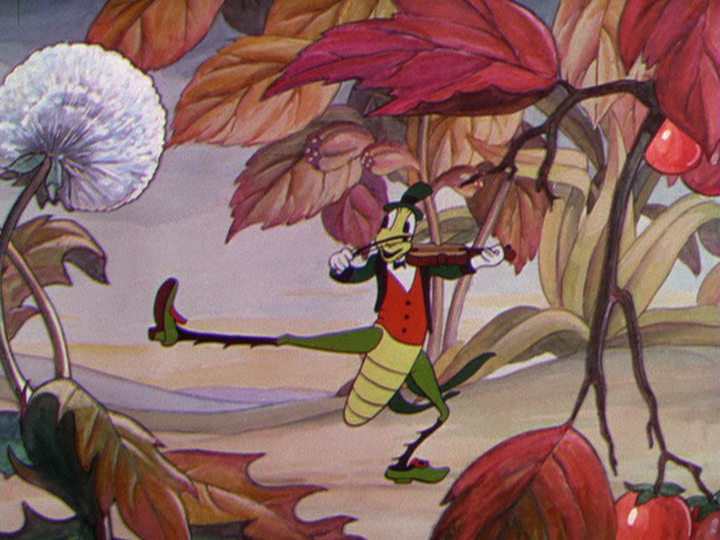
The first shot we see is of the Grasshopper skipping down a flower-filled path, playing his fiddle merrily. As he stops for something to eat and drink, we see that the Grasshopper is actually quite wasteful, taking one bite of a leaf before throwing it away to grab another. He becomes distracted, however, when he sees a hive of ants busily working to store food for the winter, doing such chores as picking off the individual kernels from an ear of corn to chopping up slices of carrots, making it easier to bring the food inside their hollow tree.

The Grasshopper gets a young ant to shirk his work to sing and dance

The Grasshopper begins to laugh at their efforts, and calls over an ant to join him. “Listen,” he tells the ant, “the Good Book says the Lord provides. There’s food on every tree. I see no reason to worry and work, no sir, not me.” With that, he goes into the theme song for this short, “The World Owes Me a Living,” enticing the ant to “play and sing and dance,” to which the impressionable ant agrees, imitating the Grasshopper’s dancing. Unfortunately for the ant, the Queen arrives, shocked to see an ant shirking its duty. The ant, embarrassed at being caught, rushes back to his work at breakneck speed.

The Grasshopper greets the Queen and tries to entice her the way he did the ant, but the Queen is firm. “You’ll change that tune when winter comes and the ground is covered with snow,” she warns him. But the Grasshopper assures her that winter’s a long way off, and begins to sing again. The Queen leaves him to his foolishness, and the Grasshopper continues to sing and dance, and not “spoil his Sunday pants like the other foolish ants.”

The Grasshopper begins to dance his way through the seasons, caring little for the upcoming winter

As he continues to fiddle and dance, the seasons quickly change from summer to autumn, with the leaves beginning to fall. The scene begins to grow more desolate, but the Grasshopper continues to blithely fiddle and dance, unaware that all he considers food is quickly disappearing with the changing of the seasons.

As heavy winds begin to blow, we see the ants finishing up their food gathering, and rushing inside their hollow tree for shelter before it begins to snow. The Grasshopper is seen wandering the snowy fields, searching for any morsel of food, but sadly, the trees are all bare. Finally, he spots one lone leaf on a branch, and just as he is about to grab and devour it, a strong gust of wind swoops in and blows it out of reach. He begins to turn blue from the cold as he keeps walking in the heavy snows, looking for food and shelter. At last, he spies the ants’ tree, and makes his way to the door, spying through the window.

The last piece of food the Grasshopper can find

Inside, every ant is well fed and merry, clinking glasses and enjoying the fruits of their labor. The Grasshopper knocks on the door, but is so weak from hunger and the cold that he faints just before they open the door. The ants carry him inside and warm him while feeding him soup. The Queen makes her way over to the Grasshopper, looking angry at his presence. He tries to make amends for his previous lackadaisical attitude, begging her to not throw him out. “With ants,” she tells him, “just those who work may stay. So take your fiddle.” The Grasshopper, visibly upset, takes his fiddle from her and begins to leave. But the Queen has other ideas: “And play,” she says, giving him the opportunity to earn his keep by entertaining the ants during the long winter. The Grasshopper is more than willing to meet her terms, adding a new verse to his song about his whole change of attitude.