RSS Feed

Tag Archives: Donald Duck

January 5

January 5, 1913 – Animator, Writer, Director, and Disney Legend Jack Hannah is Born

vlcsnap-2013-01-04-20h02m46s143

“He was a character, but he was like a father figure to me, because he really took care of me, not only in just showing me the tricks of the trade, and about Donald, and…Disney animation…he was a kind of rough and tumble kind of guy.” Tony Anselmo, current voice of Donald Duck

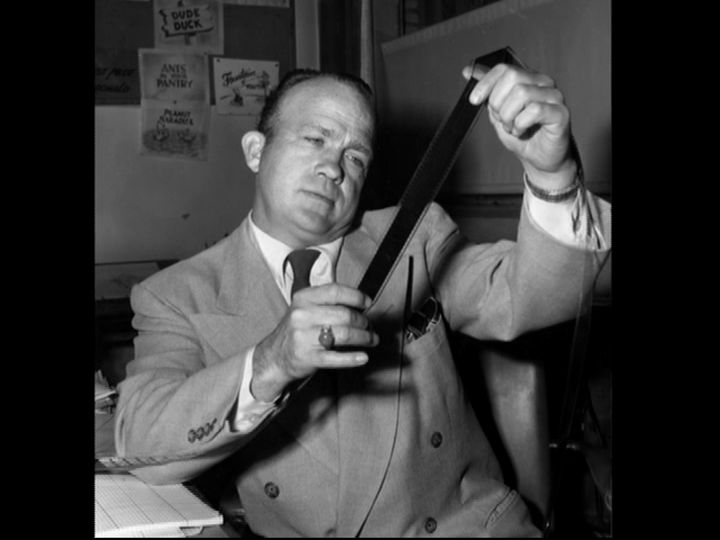
On January 5, 1913, Jack Hannah was born in Nogales, Arizona. In 1931, Hannah moved to Los Angeles, California, studying art at the Art Guild Academy; in 1933, he submitted his portfolio to the Walt Disney Studios, and was hired as an in-betweener and a clean-up artist. His first short film with an animator credit was Gulliver Mickey, and he was also a key animator for the Academy Award-winning short film The Old Mill. His introduction to Donald Duck was the short film Modern Inventions; Hannah would soon be associated with the “Gable of the [Disney] stable.” Hannah moved to the story department in 1939, writing many of the Donald Duck stories. For 27 short films, Hannah worked with Carl Barks, the Donald Duck comic book artist, to help shape the character of Donald in films, including Donald Gets Drafted and Donald’s Vacation. In 1943, he became a director of the short films, introducing new antagonists for Donald, including Chip and Dale. Hannah also introduced Donald to the new medium of television, which includes A Day in the Life of Donald Duck and At Home with Donald Duck.

Although Hannah retired in1959, he was asked in 1975 to help develop a new class at the Disney-founded California Institute of the Arts, the Character Animation programs. In 1992, Hannah was honored as a Disney Legend, credited with developing the personality of Donald Duck in the animated short subjects. He and Carl Barks are considered the “fathers” of Donald Duck. Hannah passed away at age 81 in Burbank, California in 1994.

December 24

December 24, 1937 – The Mickey Mouse Short Lonesome Ghosts is Released to Theaters

vlcsnap-2012-12-23-19h32m40s223

“Notice! We exterminate all kinds of ghosts! Day and night service.”

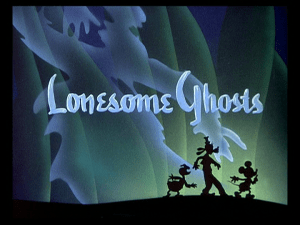
On December 24, 1937, the Mickey Mouse short film Lonesome Ghosts was released to theaters. The short made great use of a new invention of the animation department: transparent paint, which helped give the ghosts a more realistic ghastly appearance. The film was directed by Burt Gillett, and stars Walt Disney as Mickey Mouse, Pinto Colvig as Goofy, and Clarence Nash as Donald Duck.

A group of four ghosts in a haunted mansion one winter’s night are bored, until one spots an ad in the paper for a ghost extermination service. Hoping to have new people to scare, they decide to call the service. Meanwhile, at Ajax Ghost Exterminators Headquarters, Mickey, Goofy, and Donald are sitting around the table sleeping when the phone rings. They wake up and scramble to answer it, and readily take the job the ghosts “scare up” for them. The ghosts wait anxiously, and watch with delight as the trio arrives. Mickey and the gang enter the house with trepidation, and hear the ghosts making noises inside.

The trio agrees to split up, hoping that they can divide and conquer the ghosts

The trio agrees to split up, hoping that they can divide and conquer the ghosts

Mickey suggests that the three separate and surround the ghosts, and the three go their separate ways. As Mickey goes one way, he meets a ghost that he tries to shoot it with his shotgun, but the ghost sticks his fingers in the barrel, causing the gun to implode. Mickey then chases the ghost around the house, only to be surprised by all four of the ghost residents. The ghosts had meanwhile taken great delight in scaring Donald with loud noises, although he punches one in the kisser.

Goofy is also startled by the ghosts and their noises, and although he tries to convince himself that he is not scared, he runs and hides when he spots them. He spies a ghost in the mirror who imitates every move Goofy makes. Goofy knows something is wrong with his reflection, but he can’t quite put his finger on it. He finally figures it out, but is unable to fight the ghost. While stuck fighting himself in a dresser, the ghosts push him down the stairs, where he crashes into Mickey and Donald, sending them flying into the pantry. The trio and the dresser fly into barrels of molasses and bags of flour, covering the three entirely. As the ghosts come to admire their handiwork, they mistake the flour-covered three as ghosts and flee the mansion in a panic.

December 18

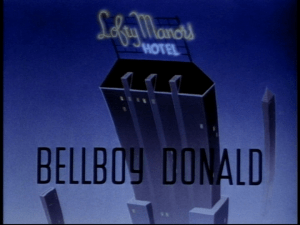
December 18, 1942 – The Donald Duck Short Film Bellboy Donald is Released to Theaters

vlcsnap-2012-12-17-19h14m11s145

“The guest is always right.”

On December 18, 1942, the Donald Duck short film Bellboy Donald was released to theaters. It was directed by Jack King, and stars Clarence Nash as Donald Duck and John McLeish as Pete.

The story opens with Bellboy Donald receiving another lecture on losing his temper with hotel guests from the hotel manager, who threatens to fire Donald if he does it again. The manager gives Donald a pin with the hotel’s motto – the guest is always right – to remind him that his job is at stake.

Shortly after, a guest pulls up to the front of the hotel, and Donald hurries out to serve him. The guest’s son, Junior, immediately begins to torment Donald, but Donald is able to keep his cool, for the time being. As Donald struggles to bring in the bags, Junior comes back to taunt him. Junior drops his banana peel on the walkway, and a bag-laden Donald slips and trips into the hotel.

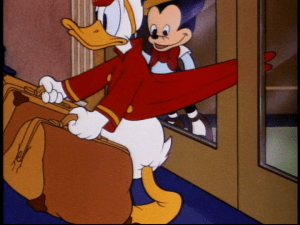
Junior continues his torment of Donald, including closing the elevator doors on Donald's shirt

Junior continues his torment of Donald, including closing the elevator doors on Donald’s shirt

After the mishap with the bags, and accidentally tearing the customer’s luggage, Donald takes the guests to their rooms on the 80th floor. Junior decides to have fun with the elevator, and Donald, on the way. He closes the door on Donald’s shirt, ripping off the duck’s bellboy uniform. Junior continues to cause trouble for Donald, who sees his motto button once again and tries to play it nice with the boy. When Junior pretends to offer Donald a soda, Donald steps in the elevator, only to have the boy start the elevator, dropping down eighty flights, and leaving Donald caught in the air. Having had enough, Donald loses his temper. He asks the manager if he is fired, and when the manager says yes, Donald gives Junior a spanking.

November 11

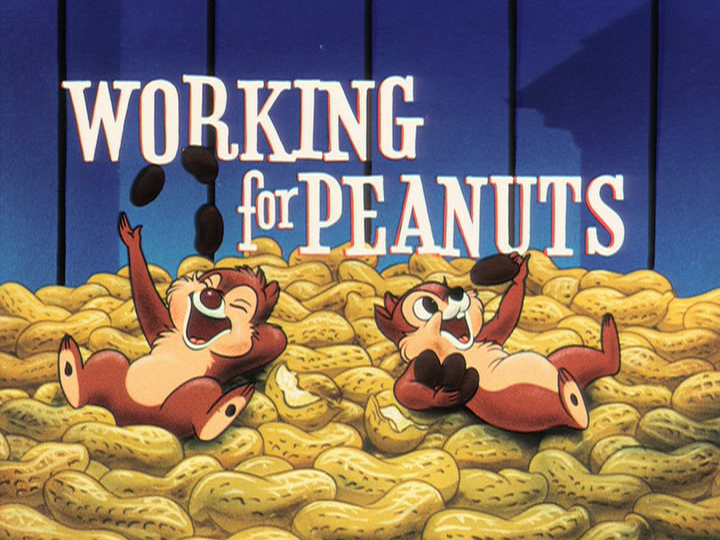
November 11, 1953 – The Donald Duck Short Film Working for Peanuts is Released to Theaters

“I don’t know – let’s open it and see! Look, two nuts!”

On November 11, 1953, the Donald Duck short film Working for Peanuts was released to theaters. Filmed in 3D, it was shown at Disneyland as part of an attraction called 3D Jamboree, and was later shown at Walt Disney World as part of the Magic Journeys attraction. The short was directed by Jack Hannah, with story by Nick George and Roy Williams, and stars Clarence Nash as the voice of Donald Duck.

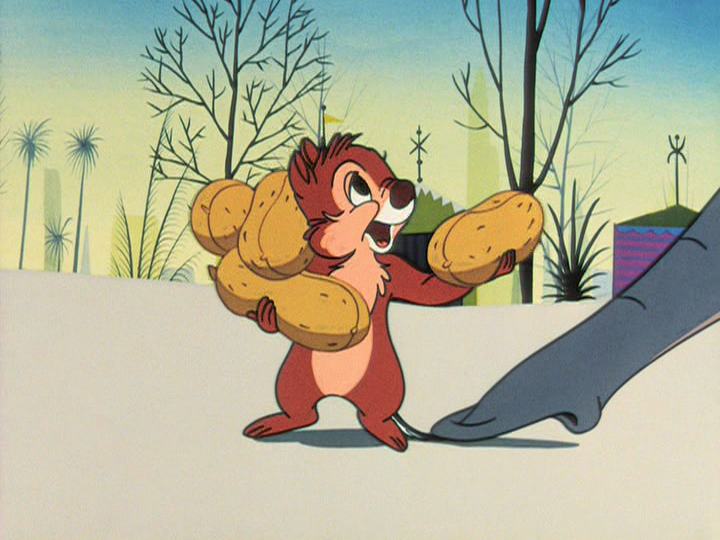
The short begins with Chip and Dale storing acorns in their tree for the winter, when Dale accidentally throws Chip a peanut instead of an acorn. They open up the shell of the nut and are surprised to see two nuts inside. They each take one, and like it so much that they run off to find more. Their search leads them to the zoo, where the crowds are throwing peanuts at the elephant named Dolores; the sight of all the nuts causes the chipmunks to drool. As Dale rushes to grab the nuts, Chip stops him, having caught sight of the caretaker, Donald Duck.

When Dale is caught stealing Dolores’ peanuts, he tries to bribe the elephant with one of the nuts

Once Donald leaves, the two get to work gathering some of Dolores’ peanuts. The elephant is alarmed at their thievery, but sets to work getting her peanuts back. The two can only watch as she uses her trunk to deplete their supply from the tree. As Chip and Dale retaliate, hitting her with a tree branch, Dolores runs to Donald for help. Donald chases after them, but knocks himself unconscious in the process. After Dolores revives Donald, he spies the pair tap dancing, “working for peanuts” as one customer puts it. The chase begins again, with the chipmunks knocking over a bucket of white paint. Seeing Dale drenched in the paint gives Chip an idea.

There’s a knock at the door of the zoo, which Donald opens to reveal a package that contains “genuine albino chipmunks.” The instructions for the creatures include to “feed only select grade A peanuts (and humor them).”  Donald is excited about the find, and gives them a special place to stay. Dolores provides them with a swimming pool, and without thinking, Dale rushes in, losing the paint from his bottom half before Chip is able to pull him from the water. However, they fool Donald and Dolores into thinking Dale is only wearing suspenders, and remain at the zoo, happy and provided with all the peanuts they could ever want.

October 24

October 24, 1941 – The Donald Duck Short Film Donald’s Camera is Released to Theaters


“Shoot nature with a camera instead of a gun!”

On October 24, 1941, the Donald Duck short film Donald’s Camera, was released to theaters. It was directed by Dick Lundy, and stars Clarence Nash as Donald Duck.

The short begins with Donald deciding to take pictures of nature after reading a sign in a store window proclaiming he should “shoot nature with a camera instead of a gun.” He passes by a gun store with several taxidermal animals on display. Angered by this, he resolves to take pictures of wildlife rather than shoot it.

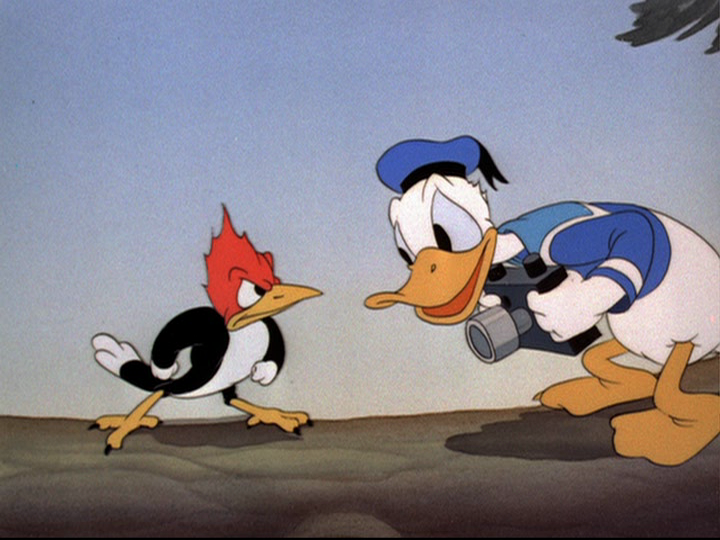
Although Donald is insistent on taking pictures of the forest creatures, the animals aren’t keen on having their likeness captured on film

The wildlife Donald encounters are amused by his camera equipment, and although he tries to get a good picture, he ends up getting nothing but caught in a cave of skunks. Soon after, Donald spies a woodpecker in a nearby tree, and is determined to get a picture. The woodpecker refuses to have his picture taken, and tricks Donald into falling out of the tree. As the woodpecker tries to catch his dinner, Donald hides in a tree stump, and uses toothpaste as a worm decoy. The woodpecker falls for it, swallows the toothpaste, and suddenly starts spouting bubbles.

Donald finally subdues the woodpecker enough to get him to pose, but the bird soon breaks free, steals the camera, and places it in the path of a falling tree. Unable to save his camera, an angry Donald runs back to the gun store, buys all the guns and ammunition he can, and goes on a mission to hunt down the bird for revenge.

October 15

October 15, 1937 – The Mickey Mouse Short Film Clock Cleaners is Released to Theaters

“Hickory dickory dock, the mouse ran up the clock…”

On October 15, 1937, the Mickey Mouse short film Clock Cleaners was released to theaters. The short was directed by Ben Sharpsteen, and stars Walt Disney as Mickey Mouse, Clarence Nash as Donald Duck, and Pinto Colvig as Goofy. The short is also notable for being edited; at one point, Donald yells “Says who?” to the spring mocking him, which was misconstrued in the 90s as Donald cursing. However, the Hays Code, adopted in 1930, would not have allowed such language in the first place.

At the top of a high clock tower, the bell rings three o’clock. Mickey is seen on the clock face, standing on the second hand and cleaning the numbers. Inside, Goofy is seen brushing the gears, and Donald grabs a mop to clean the main spring, even though there are several signs telling him to keep off the mainspring. As he cleans the spring, his mop gets caught, and as he pulls it loose, the spring uncoils, trapping Donald inside.

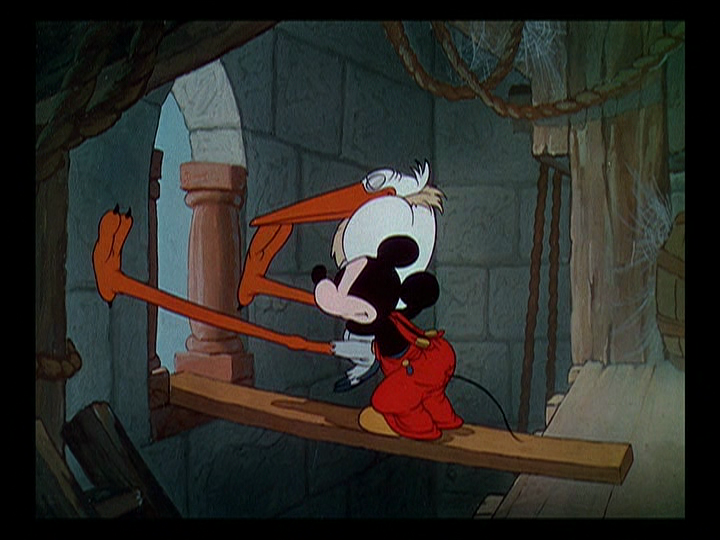
Even while sleeping, the stork is able to outwit Mickey as the mouse tries to throw the stork out of the clock tower

Mickey begins sweeping inside, and hears snoring from nearby gears. He spies a stork asleep in a nest above some gears, and tries to wake it. The stork ignores Mickey, continuing to sleep, and eluding the mouse with every move. The stork then throws Mickey out the window. As this happens, Donald attempts to put the spring back together, only to have it taunt him and knock him into the cogs nearby. Donald is knocked back and forth, and is unable to stop moving his body back and forth after being thrown from the cogs.

Goofy is seen cleaning the bell of the tower, when it strikes four o’clock. He is hit in the head by the mechanical statues that ring the bell, and begins to walk around in a daze. Mickey notices just in time that Goofy is about to fall off the building, and begins to run around after him, preventing him from falling to his doom. Unfortunately, Goofy falls through a missing ring in a ladder, only to be shot back up by a flag pole, sending him and Mickey flying into the clock tower. They land on the main spring, just after Donald finally got it back together, and all three are sent flying into the cogs the Donald was knocked into before, unable to stop their bodies from dancing back and forth from the cog’s motion.

October 10

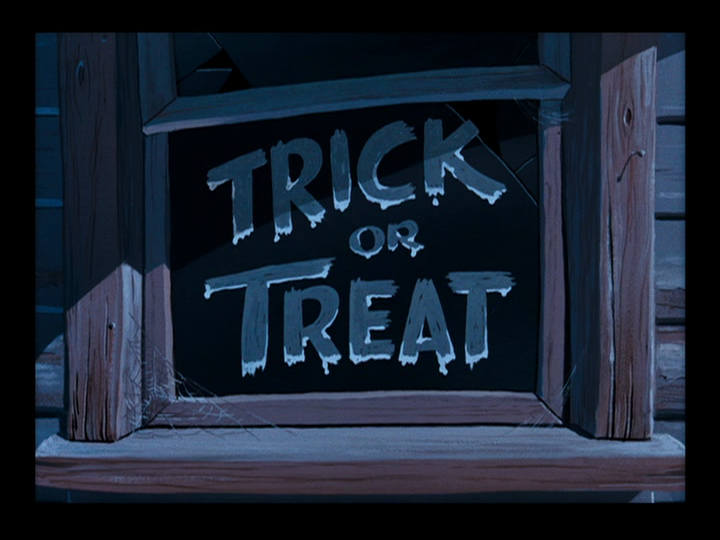
October 10, 1952 – The Donald Duck Short Film Trick or Treat is Released

“Trick or treat, trick or treat, trick or treat, the whole night through, little scalawags with fiendish gags can make it tough on you.”

On October 10, 1952, the Donald Duck short film Trick or Treat was released to theaters. The short was directed by Jack Hannah, with story by Ralph Wright, and music by Paul Smith. It stars Clarence Nash as Donald and the nephews, and June Foray as Witch Hazel.

It’s Halloween night, and a witch is seen flying around in the night sky. She stops to observe Huey, Dewey, and Louie trick or treating, and sees when they ring Donald’s door. Instead of Donald giving them candy, he gives them firecrackers, blowing up their trick or treat bags. He then dumps a bucket of water on them. The witch, named Hazel, feels sorry for the three, and stops in front of them, offering to help get revenge on their uncle. She stops at Donald’s door and receives the same treatment, and decides to resort to some more drastic measures.

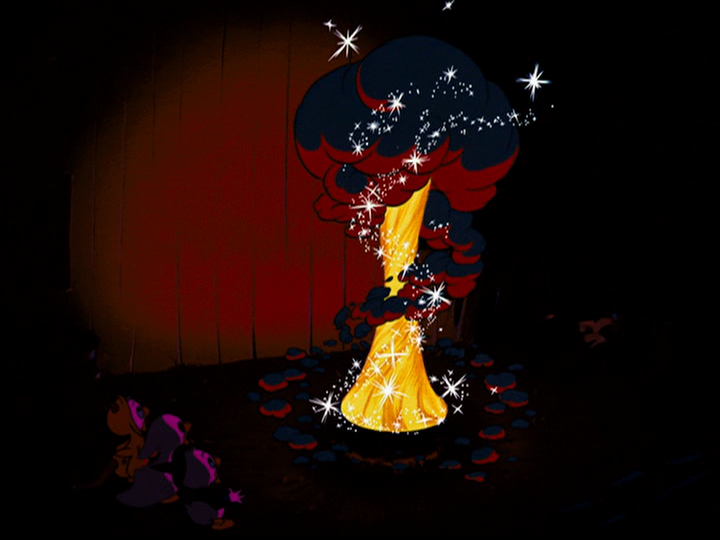
The ingredients of the potion combine, causing a massive explosion

Hazel stands in front of her cauldron, with the nephews putting in all the ingredients she needs. The nephews watch in awe as the potion explodes. Hazel takes some potion with her, and the four of them fly off to Donald’s, with Hazel spraying the potion first on a pumpkin, which comes to life and startles Donald. She then sprays a paintbrush, which begins to paint Donald’s house green. Ghosts then appear at Donald’s door, scaring him before Hazel and the boys dive into the house, using her broom to pin him against the wall and give the boys the treats.

Unfortunately, when Hazel calls Donald a pushover, Donald changes his mind, locks the treats up, and swallows the key. Hazel doesn’t give up so easily, and she casts a spell on Donald’s feet, first causing the feet to kick out the key from Donald. Donald desperately tries to hold on to the key, but Hazel is able to have it released. Although Donald grabs the key at the last second and throws it under the cupboard door, Hazel decides to have Donald’s feet kick the door down – using Donald. The last attempt is successful, and kids have all the treats they want. The nephews wave goodbye to Hazel as she flies away.

September 27

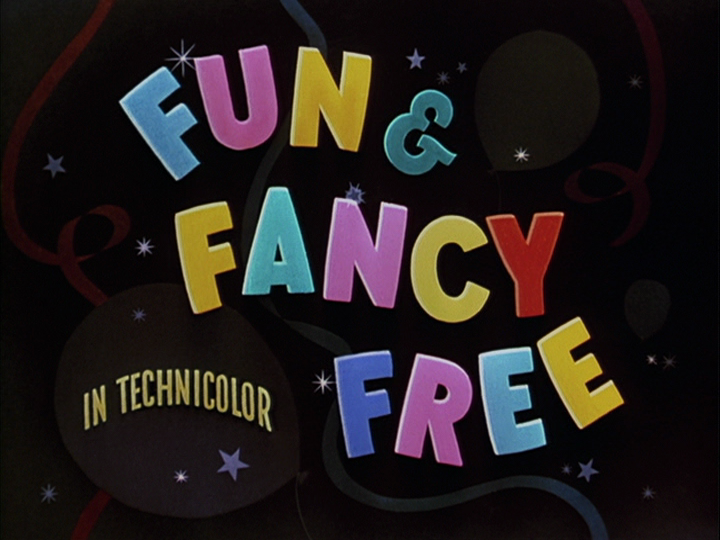
September 27, 1947 – The Ninth Animated Feature Film, Fun and Fancy Free, is Released to Theaters
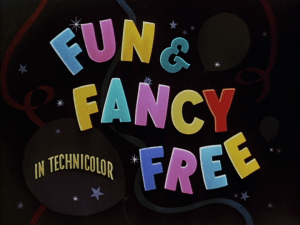
“So if you’d really like to be happy-go-lucky just like me, drown your frowns my friend and you will see, you’ll see, that you’ll be full of fun and fancy-free.”

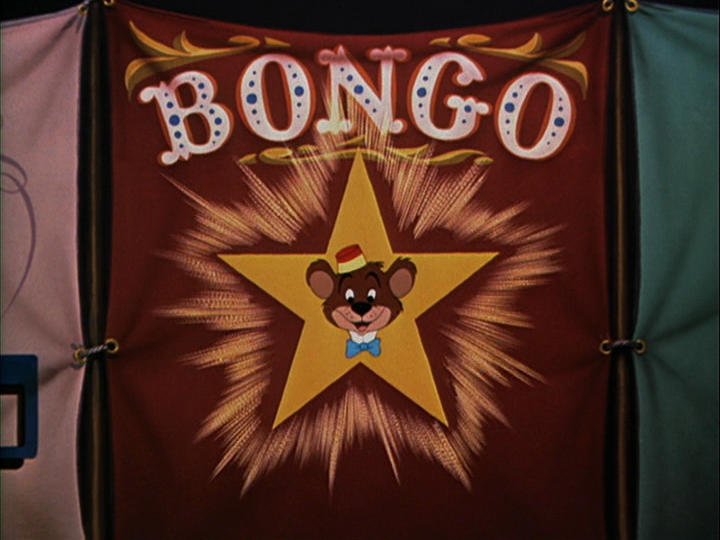
On September 27, 1947, the ninth animated feature film, Fun and Fancy Free, was released to theaters. It was the second package film released by Disney, comprised of two stories: Bongo (written originally by Sinclair Lewis), and Mickey and the Beanstalk, a retelling of the classic tale Jack and the Beanstalk. The two were originally meant to be full-length features of their own. Although Mickey was in the feature film Fantasia, this was the first time Goofy and Donald were also used to carry a feature film. As the story was tightened, many scenes were dropped, including the scene where Mickey receives the magic beans for his cow from none other than Minnie Mouse, playing the queen. The two stories were stopped in development when the country entered World War II. The live action segments were directed by William Morgan, with the animation sequences directed by Jack Kinney, Bill Roberts, and Hamilton Luske. The film included the talents of Anita Gordon, Cliff Edwards, Billy Gilbert, The Kings Men, the Dinning Sisters, and the Starlighters, as well as Edgar Bergen (ventriloquist for Charlie McCarthy and Mortimer Snerd) and Luana Patten. This film also marks the last time Walt Disney voiced the character of Mickey Mouse, as he would have sound effects man Jimmy MacDonald take over the role.

The movie begins with the voice of Jiminy Cricket ringing out, singing about being happy-go-lucky, and begins to sing and dance around a library, expressing his sadness about the whole world worrying about so many things. “But why get so excited,” he asks. “What’s going to be is going to be.” Unfortunately, he runs into a cat that chases him out of the library. He finds himself in a girl’s room, coming across what he calls a “deadpan doll and a droopy bear.” To cheer them up, he puts on a record about the story of Bongo, a musical story sung by Dinah Shore.
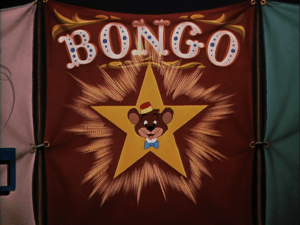
The story of Bongo begins with his days in the circus, where he was the star

Bongo is a circus bear: “he was born in the circus, grew up in the circus; in fact, Bongo was the star of the circus.” Bongo was seen as being able to do it all, with the circus tent packed with fans that wanted to see him perform the greatest of stunts. But although Bongo appeared thrilled with what he was doing, he was a prisoner of the circus, kept in a cage. He spent his nights dreaming of a place where he was free from the circus life. One fateful day, he decides to answer the call of the wild, and escapes from the circus train. Finally free, he explores the woods where he landed, smelling the flowers and leaping over tree roots. Unfortunately, Bongo doesn’t know how to survive in the woods, but he’s still elated to be out in nature. He soon makes friends with the animals of the forest, and they walk around, exploring their surroundings.

Unfortunately, life in the woods is not as pleasant as Bongo thought, as at first he is unable to get to sleep, then finds himself caught in a storm. He becomes discouraged that his dream life wasn’t the way he thought it would be, and even more discouraged that he can’t even catch food like a real bear would. As he tries to catch a fish, he hears the giggle of a young female bear named Lulubelle, and begins to follow her as she flirts with him. The two quickly fall in love, but there is one problem: Lumpjaw, the roughest, toughest, meanest bear in the woods, who wants Lulubelle all to himself. After some mixup, Lulubelle ends up in Lumpjaw’s arms, with Bongo being left heartbroken, as he didn’t understand the way of bears (bears express their love by slapping). Lulubelle sneaks away from the bears to find Bongo, and a fight ensues between Bongo and Lumpjaw, with Bongo using his circus skills to win. Lulubelle and Bongo live happily ever after in love.
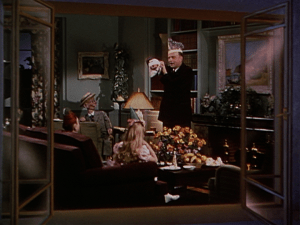
Jiminy decides to attend a party hosted by Edgar Bergen (C), with his puppets Charlie McCarthy and Mortimer Snerd, with Luana Patten as the guest

After the story ends, Jiminy comes across a party invitation for Luana Patten at Edgar Bergen’s house across the way, and decides to attend himself. Bergen is entertaining Luana, Mortimer Snerd, and Charlie McCarthy, and decides to tell the group a story: Mickey and the Beanstalk. He has Luana create a picture in his mind of Happy Valley, where Mickey, Goofy, and Donald live. Happy Valley was a prosperous place, with a magic singing harp residing in its castle, casting a spell of joy over the entire valley. One day, a mysterious shadow appears in Happy Valley, and steals the harp from the castle. Once the harp is stolen, the valley loses its joy and prosperity. The audience is taken inside the cottage of Mickey, Goofy, and Donald, sharing a pitiful meal. Unable to take it anymore, Donald loses his cool, going mad with hunger and desperation. He takes the axe from the wall and decides to kill their beloved cow.

The next day, Mickey decides to take their cow to market, with Goofy and Donald hopeful that they will be able to afford food. When Mickey comes home, however, he informs them that he sold the cow for magic beans. Donald loses his cool again, throwing the beans away. Once the moon hits the spot where the beans fell, however, a giant beanstalk begins to grow, destroying their house in the process and sending the trio sky high. When morning comes, the three are amazed to see a castle in the sky, and decide to explore. After surviving an attack a giant dragonfly, the three reach the castle steps and climb inside. They discover that the banquet table is covered in food, and don’t hesitate to eat the best meal they’ve had in ages. They also discover the harp being held hostage in a treasure box nearby, and she warns them about the giant, as he has the ability to turn himself into anything he wishes.
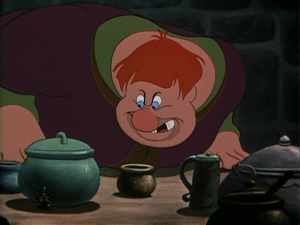
The giant suddenly appears, and looks around the table for the trio

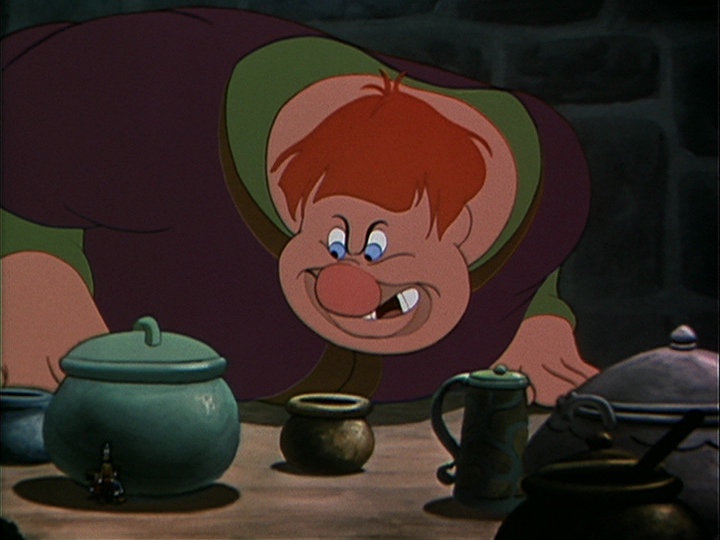
Suddenly, the giant appears, singing a simple song about himself and adding the words, “Fe Fi Fo Fum.” He smells the scent of the trio and searches for them, but gets distracted by the food on the table and begins to eat. He catches Mickey, but with Mickey’s quick thinking, he’s able to escape, tricking the giant into changing into a fly. However, the giant would rather change into a pink bunny rabbit, and when he spies the trio with a flyswatter, he catches them and throws them into the treasure box, keeping the harp out for her to sing him to sleep. With the harp’s help, Mickey is able to free his friends and escape with the harp. The giant wakes up as they begin their escape and chases after the three. When the trio makes it to the bottom of the beanstalk, they grab a saw and begin to chop the beanstalk down, sending the giant tumbling down to earth. Happy Valley is returned to its peaceful and prosperous state.

As Bergen finishes telling the story, he notices that Mortimer begins to cry over the death of the giant. Bergen tries to explain that the giant never existed, and is succeeding until the roof of his house lifts, and the giant appears, asking the group if they’ve seen a mouse. Bergen faints, and the giant leaves, exploring Hollywood for signs of Mickey (and taking the Brown Derby restaurant with him as a new hat).
September 25

September 25, 1942 – The Donald Duck Short Film The Vanishing Private is Released to Theaters

“Did you see a little guy that you can’t see?”

On September 25, 1942, the Donald Duck wartime short film The Vanishing Private was released to theaters. The short was directed by Jack King, written by Carl Barks, and stars Clarence Nash as Donald Duck, and Billy Bletcher as Pete.

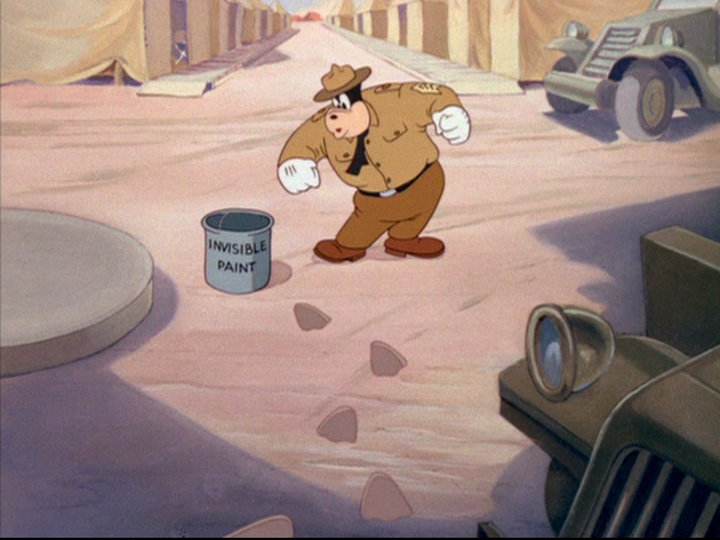
The short opens with Donald painting a cannon with yellow, green, and red stripes with black dots. Sergeant Pete finds him and grabs him, asking what he’s doing there, with Donald responding that he’s a camouflage painter. Pete chastises him, telling him that Donald needs to paint the cannon so that people don’t see it, with Donald responding that he didn’t know. Donald runs off to find some new paint, and wanders into the Experimental Laboratory – Camouflage Corps building. He looks at a particular bucket of paint, which happens to be invisible paint. Amazed at his find, he decides this is the perfect paint to use for his cannon.

Pete gets Donald out of the cannon, not realizing that the bucket of invisible paint is on the other side as Donald falls into it

Pete stops by later after Donald has finished painting the cannon invisible, thinking that Donald has stolen the cannon. He runs into the end of the cannon, alerting Donald, who informs the sergeant that he’ll be right down. Pete cautiously feels around for the end of the cannon, then sends Donald flying out of the other end, straight into the bucket of invisible paint. Donald then runs away, diving into a creek and running into a field of tall flowers, with Pete in hot pursuit. Pete throws some flowers aside, which reveal Donald’s location. Donald quickly brushes the flowers away and runs off.

Having gotten an idea of how to make the duck visible again, Pete grabs more flowers and begins throwing them everywhere, as Donald skips around a tree singing “Here We Go ’Round the Mulberry Bush.” Just as Pete imitates him, throwing flowers around, the General pulls up in his car and clears his throat to get Pete’s attention. Pete asks if he’s seen someone he can’t see, and the General, alarmed, shakes his head.

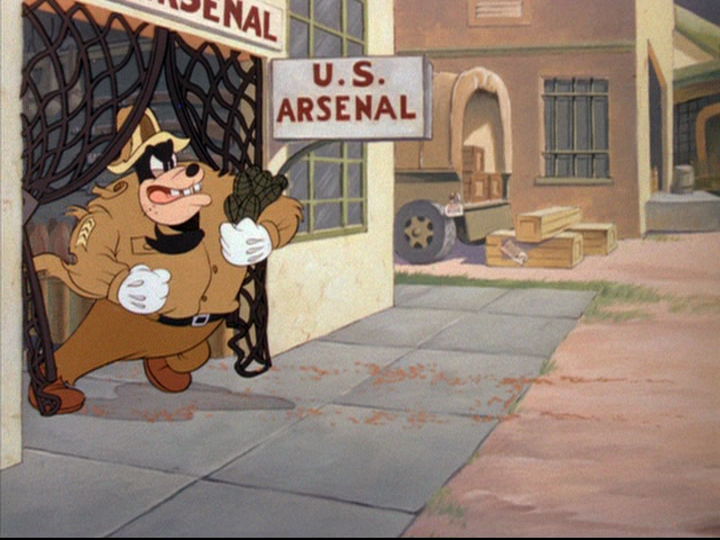
After flying into the arsenal, Pete decides that violence is the only way to catch the invisible duck

Meanwhile, Donald continues to cause mischief, grabbing a batch of pies from an open window and shoving one in Pete’s face. He leads the sergeant in a chase all around the camp, sending Pete flying into the arsenal, grabbing as many grenades as he can carry and throwing them around madly. The General tries to stop him, but Pete ends up blowing the both of them up when he drops all the grenades. Pete is then seen in solitary confinement, sitting in a padded cell with a straight jacket on. He implores Donald, his now-visible guard, to tell the General that he’s not crazy, to which Donald answers, “Do you think I’m crazy?”

September 12

September 12, 1936 – The Mickey Mouse Short Film Donald and Pluto is Released

“So! There you are! Come on out of there!”

On September 12, 1936, the Mickey Mouse short Donald and Pluto was released to theaters. Although it was released as a Mickey Mouse short, Mickey never appears; Donald’s series wouldn’t begin until the 1937 short Don Donald. This short also shows the new design of Donald, which was a much rounder figure with a shorter bill. The short was directed by Ben Sharpsteen, and stars Clarence Nash as Donald, and Pinto Colvig as Pluto.­

Donald Duck is working as a plumber, using a magnet to grab his tools as he stays perched on a platform near the pipes. Pluto is hanging around the area, trying to chew on a bone, when Donald startles him by using the magnet to pull out his hammer from underneath the dog. As Donald angrily attacks the pipes with his hammer, he knocks the magnet to the floor, which attracts Pluto’s bone. As Pluto tires to release the bone, he ends up accidentally swallowing the magnet, and his bowl with the bone stick to his behind.

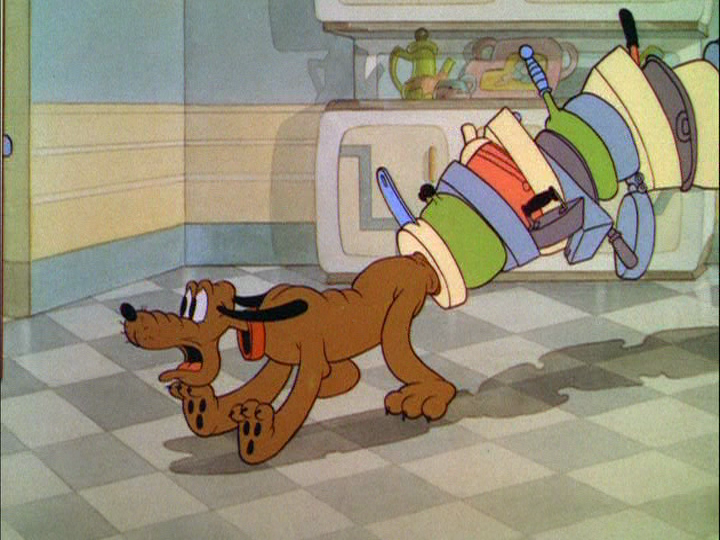
Pluto gives the term “magnetic personality” a whole new meaning when the magnet he swallowed begins attracting anything metal nearby

As Pluto tries to chase the bone attached to his rear, he accidentally knocks over the platform Donald stands on, sending the duck crashing to the floor. Pluto escapes to the kitchen, but as soon as he thinks he’s safe, the magnet inside begins to attract all the pots and pan, flying out of their cupboards and latch on to Pluto’s rear end. Pluto battles with his bowl and the magnet inside, unable to stop anything metal from latching on to him, which includes a rather traumatizing attack with an alarm clock.

As Pluto runs back to the basement to free himself from the metal objects, the magnet inside attracts the nails from Donald’s ladder, which causes Donald to fall from the ladder and land in the washing machine. When he is sent through the wringer, the hammer he holds is pulled by the forces of the magnet, and it’s all Donald can do to hold on as Pluto runs frightened up the stairs. When Pluto reaches the top, he is able to knock off the bowl, hammer, and Donald, but Donald chases after the dog, waving the hammer wildly.

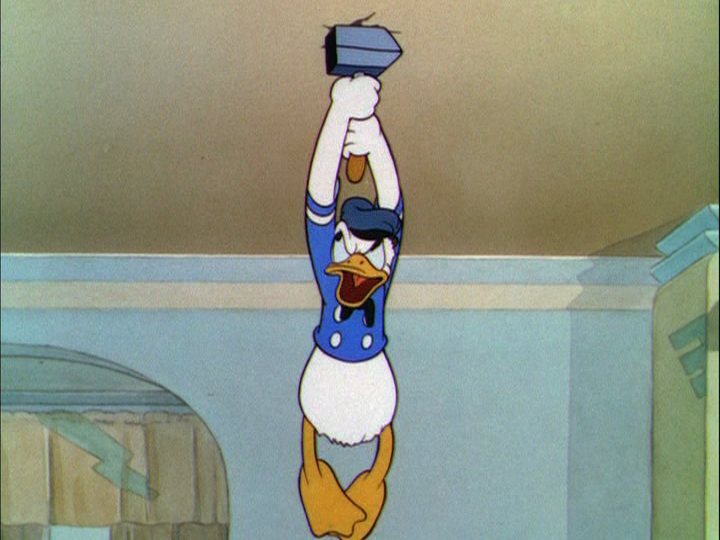
While Pluto sits on the roof, Donald’s hammer is attracted to the magnet still in Pluto, and clings to the hammer for dear life he is dragged across the ceiling

Pluto escapes to the roof and sits, relieved as he thinks it’s over. However, Donald is standing right under where Pluto sits, and the magnet pulls Donald up to the ceiling, attached to the force of the magnet. As Pluto struggles to move, Donald is dragged across the ceiling of the house. Donald tries in vain to release the ladder, as Pluto tries just as hard to release his backside. As they both fall down the basement stairs in the end, Pluto is able to cough out the magnet; it is pulled to the boiler, trapping Donald by the neck, and covering him with all of his tools and Pluto’s dish.