RSS Feed

Tag Archives: Animator

October 21

October 21, 1911 – Artist and Disney Legend Mary Blair is Born

“When I think of dreams, like as a kid, I see Mary Blair-like colors…like Cinderella herself, just this innocence and a purity, a sincerity…” – Animator Glen Keane

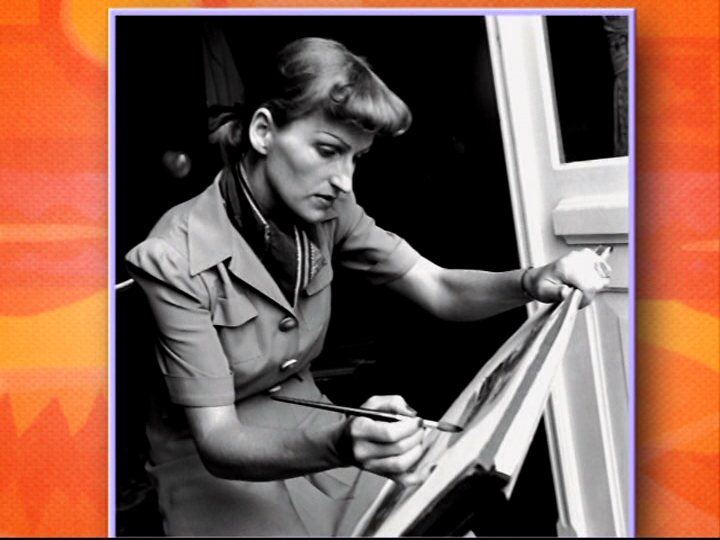
On October 21, 1911, Mary Robinson Blair was born in McAlester, Oklahoma, with her family moving to San Jose, California when she was seven. Blair’s talents were noticed early, and she was awarded a scholarship to the Chouinard Art Institute in Los Angeles. There, she would meet her husband, Lee Blair. She and Lee began to look for work as artists during the height of the Depression, and eventually found work at Metro-Goldwyn-Mayer’s animation studio. Lee eventually found a job at the Disney Studios, and Mary joined him in 1940, with everyone fascinated with Mary’s use of color in her work. Her first pieces of work were preliminary sketches for the feature film Dumbo.

In 1941, Blair and her husband were selected to be a part of a goodwill tour of South America with Walt Disney and his wife, which included several other notable Disney employees, including Frank Thomas (animator), Herb Ryman (layout and camera), Norm Ferguson (producer), and Bill Cottrell (story). The group would do research for a series of feature films that would hopefully offer friendship to South America before they were taken over by Nazi and Fascist influence. Blair’s work during this trip helped to shape her artistic style, and she was named the art supervisor for Saludos Amigos! and The Three Caballeros. One short that clearly shows Blair’s style was The Little House, released in 1952 [see August 8th entry]. The tone of pivotal scenes in the feature films she worked on were conveyed through her use of color in her concept art. Animator Andreas Deja recalled, “Marc Davis once said, ‘Mary Blair could put colors together like nobody else. She was better than Matisse.’”

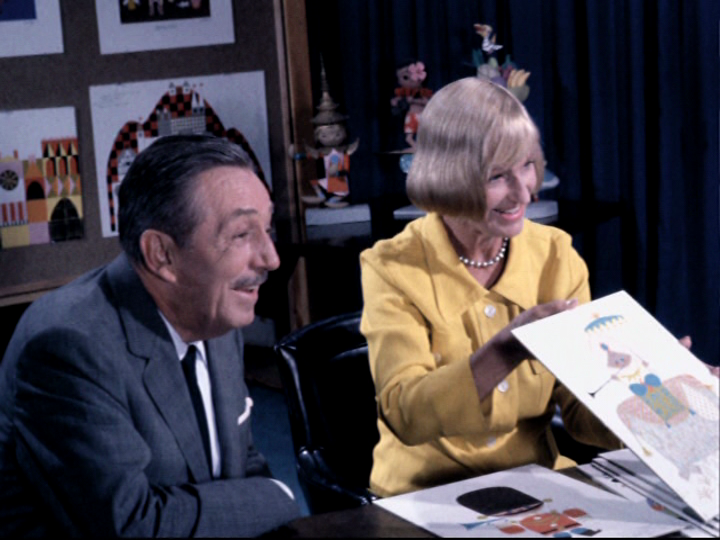
Walt was always captivated by Blair’s concept art and use of color, and asked her to come back to help create the look of the attraction It’s a Small World

Blair’s color use would be used to style such films as Song of the South, Make Mine Music, Melody Time, So Dear to My Heart, The Adventures of Ichabod and Mr. Toad, Cinderella, Alice in Wonderland, and Peter Pan. She left the studio in 1953, just after Peter Pan, to try other fields of animation, including children’s book illustrations. However, in 1963, Walt Disney asked her to come back to help design the look of a new attraction that would premiere at the 1964 World’s Fair: It’s a Small World. She was also asked to contribute to the design of other exhibits and attractions, including two grand murals, one for Tomorrowland in Disneyland, and one for the Contemporary Resort at Walt Disney World. Blair passed away on July 26, 1978, and was inducted as a Disney Legend in 1991.

October 16

October 16, 1903 – Animator, Director, and Disney Legend Hamilton Luske is Born

Image credit: Disney Insider

“[Luske]’s expertise was evident, especially to Walt, where it mattered most, and it was thus into his lap Snow White, the most plum of all assignments, fell.” – David Johnson

On October 16, 1903, animator, director, and Disney Legend Hamilton S. Luske was born in Chicago, Illinois. Luske joined the Walt Disney Studios in 1931, and his first assignment was the animation of animals for the Mickey Mouse short The Barnyard Broadcast. He was then moved to more prominent assignments, including Max Hare in the Silly Symphony The Tortoise and the Hare, and Jenny Wren in Who Killed Cock Robin? Luske had no formal art education, but he had enough natural talent to give Walt the confidence to hire him as the supervising animator for what was considered Walt’s Folly: Snow White and the Seven Dwarfs. Luske was responsible for the animation of the title character of Snow White. To animate her properly, the technique of using live-action reference footage was soon adopted. Luske’s believable animation helped to make Snow White a box-office smash.

After the success of Snow White, Luske moved to directing during the World War II period, and continued to direct educational films, including Donald in Mathmagic Land and Donald and the Wheel. He also continued to be involved in the feature films as a sequence director on Fantasia, Cinderella, Alice in Wonderland, Peter Pan, Lady and the Tramp, 101 Dalmatians, and the animated sequences in Mary Poppins. Luske also moved into television as the associate producer and director for the Disneyland, Walt Disney Presents, and Walt Disney’s Wonderful World of Color series. Luske passed away on February 18, 1968; he was named a Disney Legend in 1999.

October 8

October 8, 1999 – The Documentary The Hand Behind the Mouse: The Ub Iwerks Story Premieres in Los Angeles, California

“When you talk to people about the history of animation, you say, ‘Oh, and then Ub Iwerks…’ they go ‘Uh, Oob?…What kind of a name is that?’…it’s the name if the guy who first drew Mickey Mouse.” – John Lasseter

On October 8, 1999, The Hand Behind the Mouse: The Ub Iwerks Story premiered in Los Angeles, California. Narrated by Kelsey Grammar, the documentary tells the oft untold story of one of the creators of Mickey Mouse: Ub Iwerks. It was directed and written by his granddaughter Leslie Iwerks, The documentary begins with how to the two worked to make Mickey Mouse, with Iwerks working overnight to create the character’s design.

The documentary takes us through Ub’s life story, beginning in Kansas City, Missouri, and his meeting with a young man named Walter Disney. The two became fast friends, and attempted to start their own business, but it wouldn’t last. Over the years, the two would work together many times, until they finally hit success with the Alice Comedies and Oswald, the Lucky Rabbit, with Ub animating most of the cartoons. After losing their character and co-workers to Charles Mintz, the two created their new character in secret: Mickey Mouse. The success of Mickey Mouse surprised them, as did the success of the Silly Symphonies. The film also explores the breaking of the Disney Iwerks partnership, when Ub left to strike out on his own creatively, with his successes and failures, as well as the new inventions he created to add more life to his animations. Iwerks would return to Disney in 1940, this time in a technical capacity, and would be well known for his achievements in special effects.


September 3

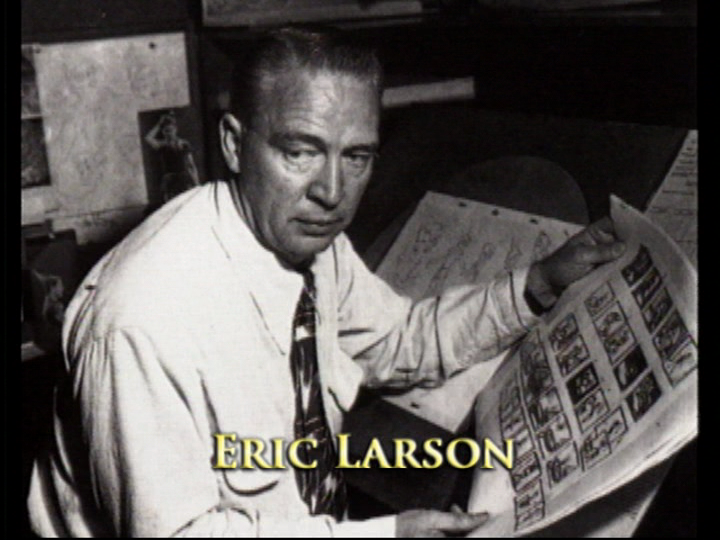
September 3, 1905 – Eric Larson, Disney Legend and Member of Disney’s Nine Old Men, is Born

“No one was more concerned with passing on the Disney legacy than Eric.” – Animator Andreas Deja

On September 3, 1905, animator Eric Larson was born in Cleveland, Utah. After graduating with a journalism major from the University of Utah, he traveled to Los Angeles in 1933, and worked on a radio program called “The Trail of the Viking.” At the same time, he sent some sketches to the Walt Disney Studios, and was soon hired as an assistant animator. He worked on Snow White and the Seven Dwarfs (the “Whistle While You Work” segment), Pinocchio (Figaro), Fantasia (“The Pastoral Symphony”), Dumbo, Bambi (the title character), Cinderella (Cinderella and Prince Charming), Alice in Wonderland (Alice, Dinah, The Cheshire Cat, The Caterpillar, The Queen of Hearts, and the Flamingo), Peter Pan, Lady and the Tramp (Peg and the pound puppies), Sleeping Beauty, 101 Dalmatians (Pongo, Perdita, Colonel, and Tibbs), and The Jungle Book (the Vultures), as well as several shorts, including The Three Little Pigs.

In the 1970s, Larson helped start a recruitment training program to teach a new generation of animators the Disney style of animation. Many famous names went through this program, including Brad Bird, Don Bluth, Tim Burton, Andreas Deja, Mark Henn, Glen Keane, John Lasseter, Burny Mattinson, and Joe Ranft. This program came at a crucial time when the older animators were retiring, and new blood was needed to help revive the studios. Larson continued to contribute to projects at the studio during the 1980s, and retired in 1986, after working for Disney for 52 years. Larson passed away on October 25, 1988, and was inducted as a Disney Legend in 1989.

May 5

Posted on

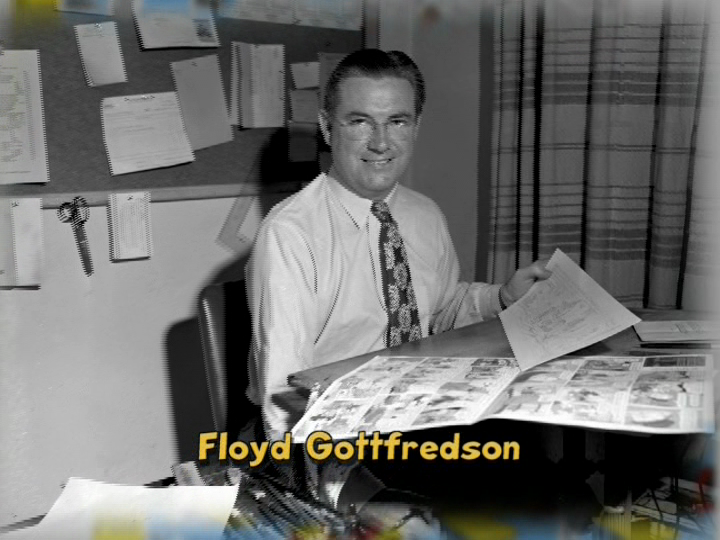
May 5, 1905 – Disney Legend and Cartoonist Floyd Gottfredson is Born

“…since Walt hired me as backup man on the strip, he asked me to take it over. By now I had become very interested in animation and told Walt I’d rather stay in it. So Walt asked me to take over the strip for two weeks until he found another artist to do it. Nothing further was ever said about it, and I continued to draw the Mickey daily for 45 years – until my retirement in October 1975.” – Floyd Gottfredson

Floyd Gottfredson, the man behind the Mickey Mouse comic strip and Mickey’s “second father,” was born on May 5, 1905, in Kaysville, Utah. His interest in drawing came about due to an accident when he was eleven: he went hunting with his cousin one Sunday instead of going to church, and was accidentally shot in the arm. Unable to play with the other children, Gottfredson turned to art, and his talent blossomed under the care of his mother. Although his father disapproved of his son’s artistic ambitions, Gottfredson continued to pursue drawing, not letting his injury slow him down. In 1928, after winning second place in a national cartoon contest, he developed enough confidence to quit his job in Utah and move to Los Angeles to become a newspaper cartoonist. Although unsuccessful in that venture, fate led him to apply to the Disney Studios, where he was hired as an inbetweener.

When Gottfredson began at the Disney Studios, the Mickey Mouse comic was already being worked on by several artists. Although he had expressed interest in working on the strip, Disney talked him out of it, but did give him the job as a back-up man for those animators. By the time Gottfredson was asked to draw the comic, he had become fond of the animation medium and wanted to stay there. Disney asked him to draw the comic for at least two weeks until they found a replacement, which led to Gottfredson drawing the comic until his retirement 45 years later.

A publicity shot for Gottfredson and the comic

Through the Mickey Mouse comic strip, Gottfredson ended up pioneering a new kind of comic: the funny animal adventure story. Although the early strips were basic retellings of the shorts in theaters, Gottfredson soon added his own spin to the stories, telling grand adventures that reflected the issues of the time. Gottfredson also had Mickey, the plucky underdog, pitted against corrupt politicians, mad scientists, and other assorted villains, with Mickey’s goal to protect his friends and his country. He retired from the comic on October 1, 1975, and on July 22, 1986, he died at the age of 81. He was inducted as a Disney Legend in 2003, and was inducted into the Will Eisner Comic Industry Awards Hall of Fame in 2006.

April 7

April 7, 1995 – The Documentary, Frank and Ollie, is Shown at the Cleveland Film Festival

“Seemed like you seldom heard Frank’s name without Ollie’s along with it, or Ollie’s without Frank’s name. It was Frank and Ollie.”

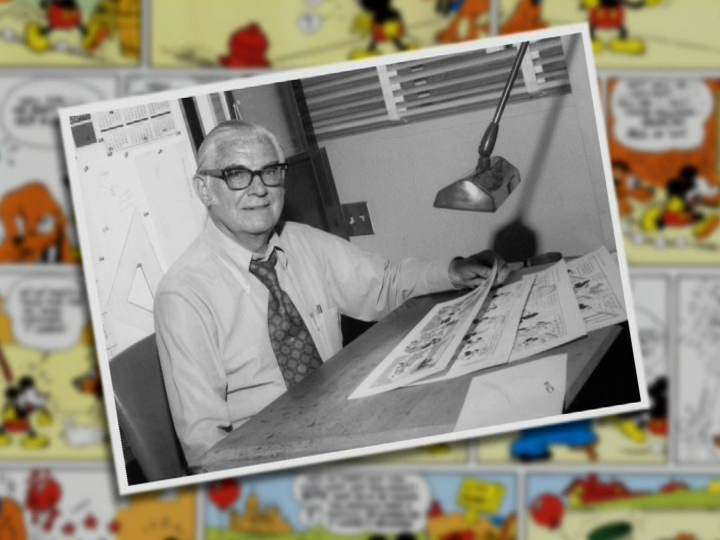
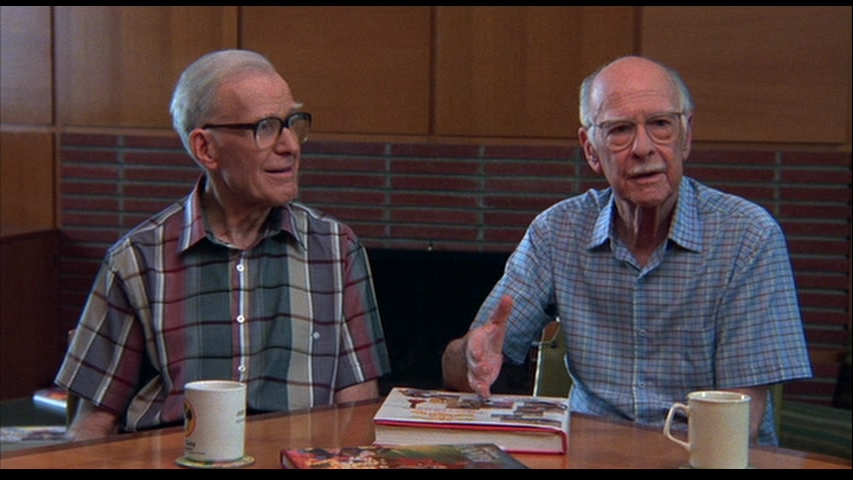
On April 7, 1995, the documentary film, Frank and Ollie, was shown at the Cleveland Film Festival. Written and directed by Frank’s son, Theodore Thomas, it tells the story of Frank Thomas and Ollie Johnston, two members of the elite group of animators at the Disney Studios known as the Nine Old Men.

The documentary is a touching tribute to the friendship of the two, which began at Stanford University in the art department. Through their long tenure at the Walt Disney Studios, the two not only helped pioneer the field of animation, but also used what they learned to help teach other artists, including Brad Bird, who gave them a cameo in The Incredibles. Frank and Ollie goes through their history with the company, from the success of Snow White and the Seven Dwarfs, the studio’s change during World War II, the unexpected death of Walt Disney, and their work on The Jungle Book. The film also shows their daily lives in California, where the two friends were also next-door neighbors.

Frank Thomas (L) and Ollie Johnston, sitting down and discussing their memories at the studio

Frank and Ollie premiered at the Sundance Film Festival on January 22, 1995, and then was shown at the Cleveland Film Festival, with a full release to theaters on October 20, 1995, so that the film could be considered for an Academy Award. The documentary received very good reviews upon release, and captures a rare history of life inside the Disney Studios.

March 24

March 24, 1901 – Birth of Disney Legend, Ub Iwerks
“Ub helped make this art form of animation grow from a novelty, something in the penny arcades, to the art form we know of today. He really laid the groundwork for a lot of the work we do today. Walt and Ub recognized that you could make animation truly three dimensional, and a hundred percent believable.”- John Lasseter

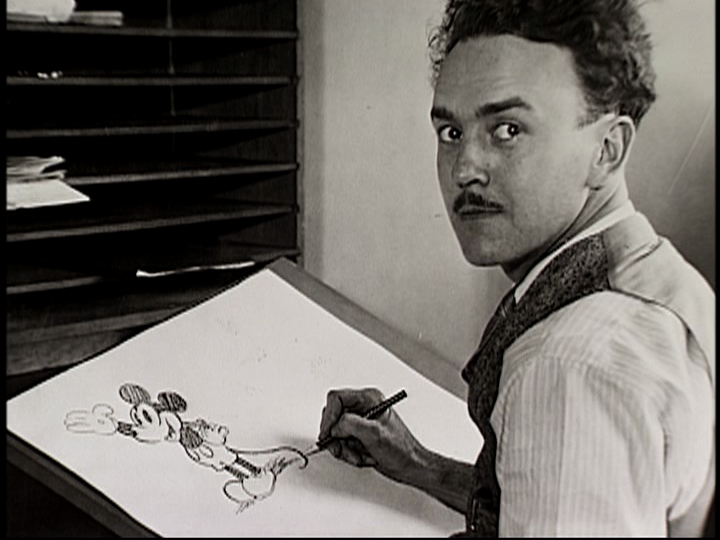
There is so much that there could and should be said about Ub Iwerks. He was a true animation renaissance man, dabbling in all forms of the art form, from creating Mickey Mouse to developing the Xerox Process. Sometimes, however, Ub is overlooked by those who are only casually aware of Disney history. However, you could not have had Walt and Walt’s success without Ub’s hand. As Ub Iwerks is one of my heroes, I hope that this post does him justice – there is a lot more that could be said about this truly remarkable man.

Ubbe Ert Iwwerks was born on March 24, 1901, as an only child of Dutch and German descent. His father, Eert Ubbe Iwwerks, was an amateur inventor, whose inventions no doubt left an impression on young Ub. In the age of progress of his youth, Ub was fascinated with the new idea of bringing moving pictures to life. When Ub was 14, his father abandoned the family, and Ub had to take on the new responsibility of providing for his mother. Ub would never speak of his father again. He worked odd jobs to support the family, and drew in his spare time. At age 18, he enrolled at the Fine Arts Institute, determined to become an artist.
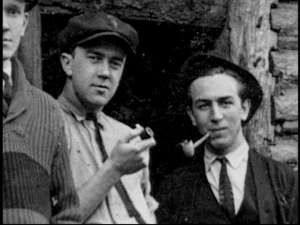
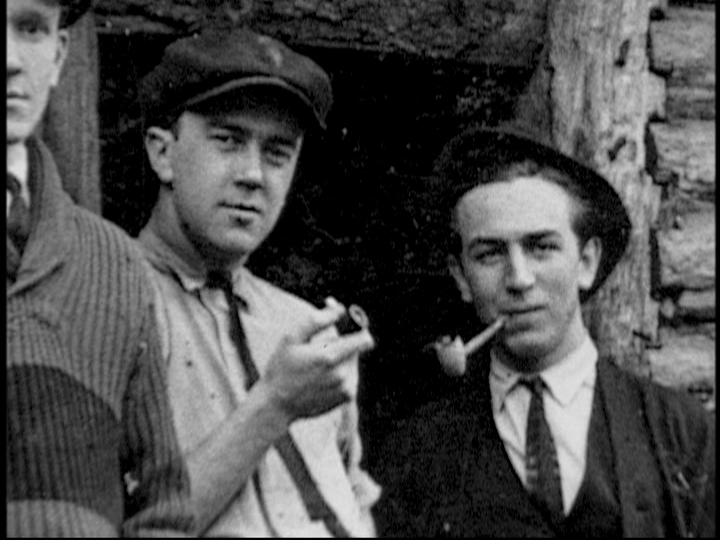
Ub and Walt after meeting at the Pesman-Ruben Commercial Art Studio

While working at the Pesman-Ruben Commercial Art Studio, where Ub’s unique skills as a draftsman were gaining attention, Ub met a young man named Walt Disney. Ub and Walt became fast friends, sharing a similar background and a passion for animation, and decided to set up shot for themselves. Unfortunately, they quickly found that they weren’t going to be successful on their own, and business closed down after a month. They then decided to work at the Kansas City Slide Company, where they were able to learn more about motion picture production, particularly animated images. Although an innovative idea at the time, animation wasn’t a profitable business. Walt and Ub decided to try their hand at an animated commercial. They were commissioned to create cartoons known as Laugh-O-Grams, which helped the pair create their own company again, this time known as Laugh-O-Grams, Incorporated. Ub’s draftsmanship proved to be one of the keys to the studio’s success, and they soon came up with the idea for the Alice comedies. But before they could develop the idea, their money ran out, and Ub got a job back at the Kansas City Film Ad Service, while Walt decided to go out to Hollywood.
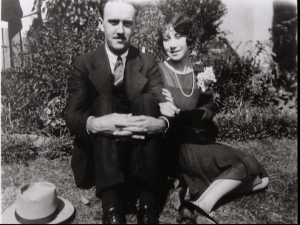
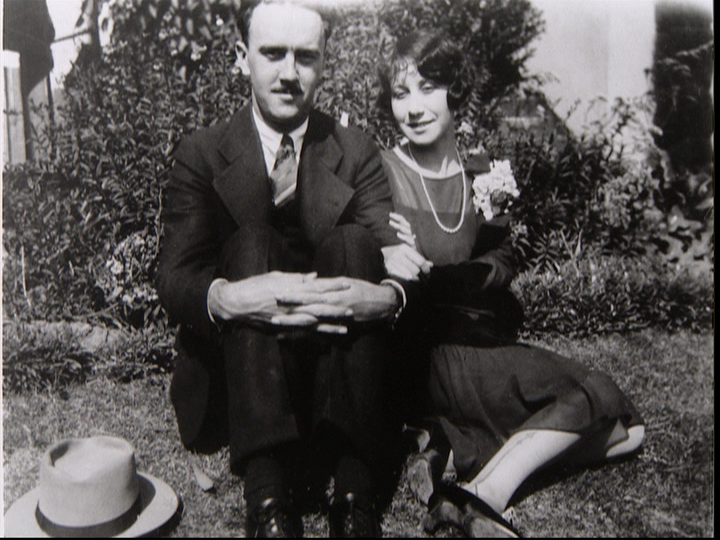
Ub and Mildred Henderson, who met on a blind date in 1926; they married in 1927

Ub had been promoted to the head of the art department at the Kansas City Film Ad Service when Walt invited him out to Hollywood, and he decided to take the trip out there with his mother. Once he arrived, he became the top animator of the Disney Brothers Studio, and the highest paid employee, even above Walt. The two began their production of the Alice Comedies, which became very popular. After the Alice Comedies had worn out their welcome, Ub and Walt were tasked by Charles Mintz to design a new character, which would become Oswald the Lucky Rabbit, Universal’s first cartoon series. The cartoon was a huge success, and Ub was finally able to have a social life after working so hard for so long. In 1926, he met Mildred Henderson on a blind date, and in January 1927, Ub and Mildred married.

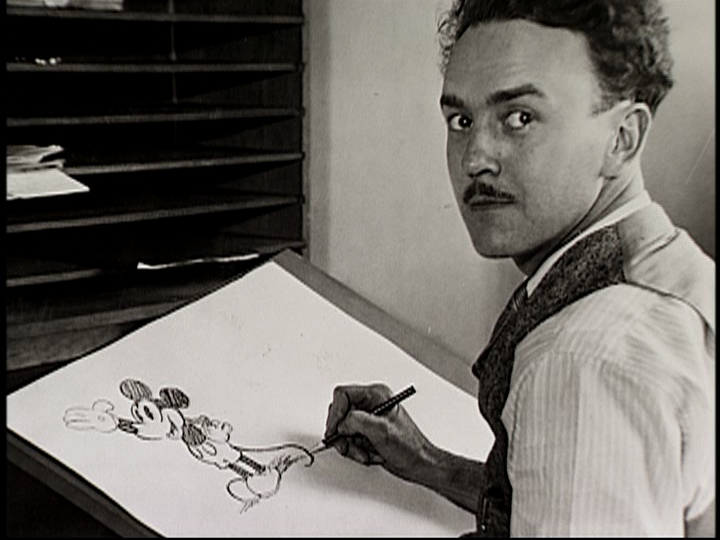
In 1928, Charles Mintz offered Ub a job, in hopes of stealing Oswald away from Walt. Though Ub turned the offer down, he learned that the other artists in the studio had agreed to join with Mintz. He warned Walt, but Walt couldn’t believe it. When Walt came back from the loss of Oswald in New York, the two decided secretly that they needed a new character. Although the story of how Mickey Mouse came to be is still shrouded in mystery, it was very clear that Ub was the one who first drew Mickey, and in two weeks, Ub completed the first Mickey Mouse cartoon, Plane Crazy. Ub’s work led to a growth of personality animation, rather than just straight character animation, as had been seen before. Ub said in an interview that Mickey was based on Douglas Fairbanks Sr., making him heroic and dashing, never a sissy. After the creation of Steamboat Willie, the first synchronized sound cartoon, Mickey’s popularity soared.

Ub included a lot of barnyard humor when he created many of the Mickey Mouse shorts. Due to the udder jokes he liked to use, the censorship board asked that the cows be given modest skirts to wear. And while Mickey’s popularity grew, another animated series began to take shape, known as the Silly Symphony. The first short film, The Skeleton Dance, was drawn by Ub, who seemed to be thoroughly inspired by the music for the short. The entire film, minus one or two scenes, was animated by Ub, who experimented with many elements of perspective and shape. Ub’s animation skills were praised by the animation community, and Ub continued to experiment with each new short he animated.
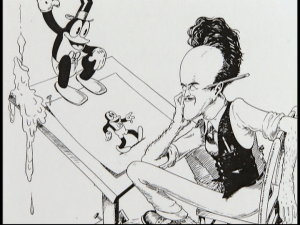
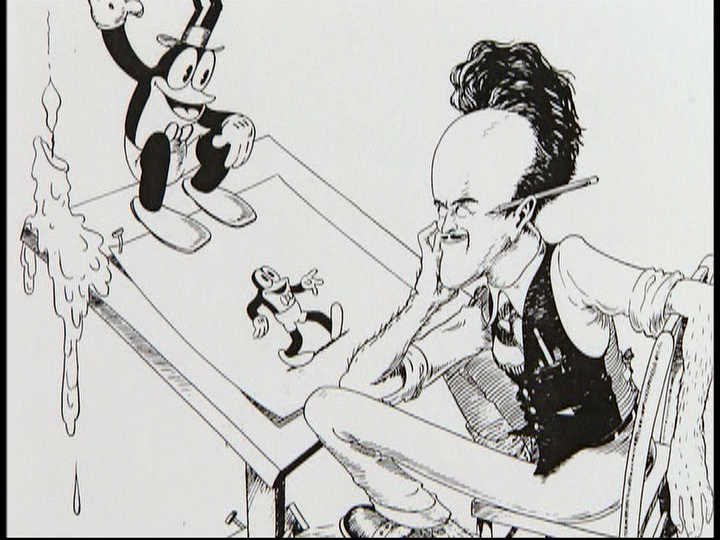
A caricature of Ub Iwerks and his creation, Flip the Frog

In 1929, tensions grew between Ub and Walt, as Walt began to take control of the artistic direction of the company, which caused Ub some concern. When Walt, who was getting all the attention for Mickey Mouse, began to interfere with Ub’s artistic ideas, Ub was tempted to leave Walt to set up his own studio. Ub finally decided that it was time for him to leave Walt and explore his own opportunities. He created his own new character, known as Flip the Frog. The animation style was very different than what he had done at the Disney Studio, with new kinds of gags and a distorted realism. Another character created by Ub was Willie Whopper, a chubby boy who had surrealistic adventures. His studio was a success, and Ub continued to push the envelope artistically, to the delight of audiences.

Ub created his own cartoon series known as the ComiColor series, in which he was able to use his technical and inventive skills to create new areas of techniques in animation. His created his own version of the three-dimensional camera, with $300 and parts from a 1920s Chevrolet, around the same time the Disney Studios were inventing their multi-plane camera. Unfortunately, while Ub was starting to make great strides with his animation technique, the Hays code was passed, and many of the adult jokes that were contained in his cartoons had to be cut. Also, Ub’s characters imitated life a little too much for Depression audiences, who wanted an escape from their troubles, not a reminder of them. MGM, Ub’s cartoons distributor, was a little disturbed with the cartoons that were being sent to them. The distribution contract with MGM was dissolved in 1934, and Ub was forced to close the studio in 1938, and retired from animation, deciding to venture into the challenge of technical innovations in the arena of animation.
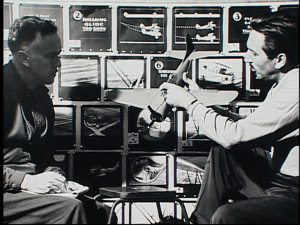
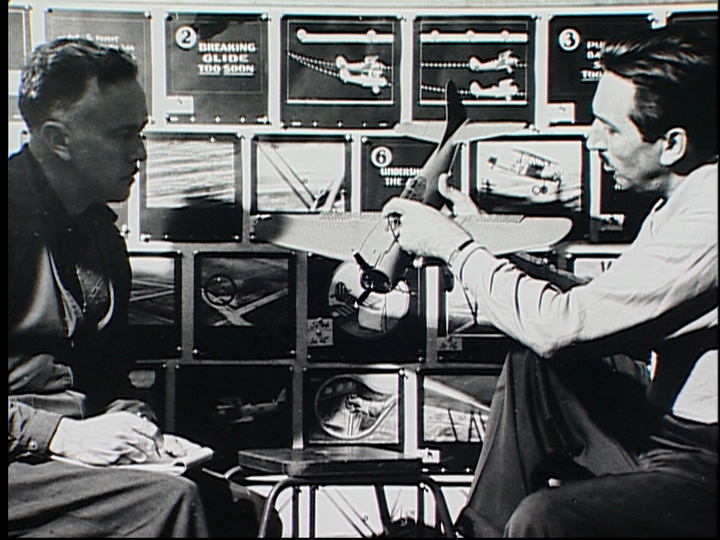
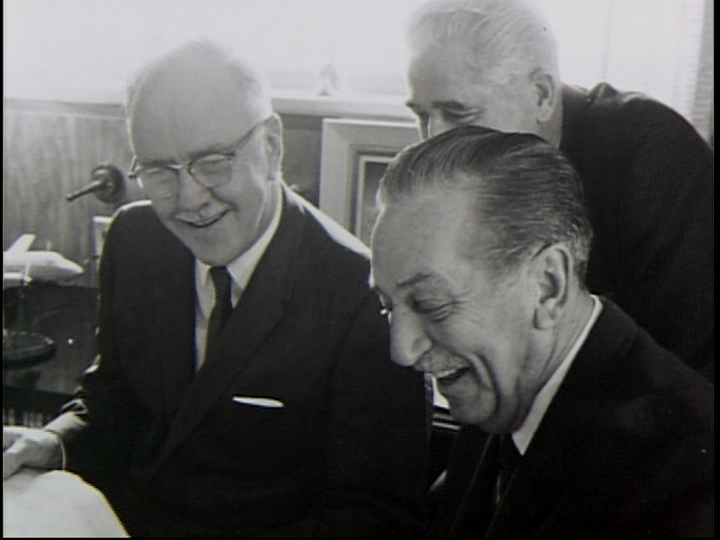
Ub (R) and Walt after Ub rejoined the studio, studying methods for the World War II projects

Finding that Ub was now available, Walt asked Ub to come back to the studio. Ub agreed, returning to the studio in 1940, and welcoming the chance to collaborate with Walt in an entirely new way. At this point, the studio was helping the war effort, which put a tight strain on the budget. Disney needed to come up with new technological advances to make the production of animated films more cost effective. Named as the head of the Photographic Effects lab, Ub received one of his first assignments, to expand upon the idea from more than twenty years ago in the Alice Comedies – combining live action and cartoon – for the movie The Three Caballeros.

Ub’s most recognized technical achievement was for the film One Hundred and One Dalmatians, where he changed not only the style of Disney animation, but also the speed at which things were animated, thanks to the Xerox Process (see January 25th article for more information). The process adapted the Xerox method to animated cells, displacing the inking process altogether and allowing the animator’s intended lines to appear directly on the screen. This process helped the Disney films’ success all the way into the 1980s.
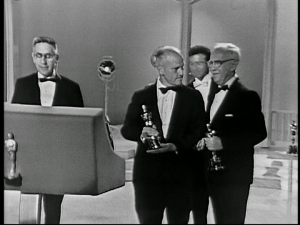
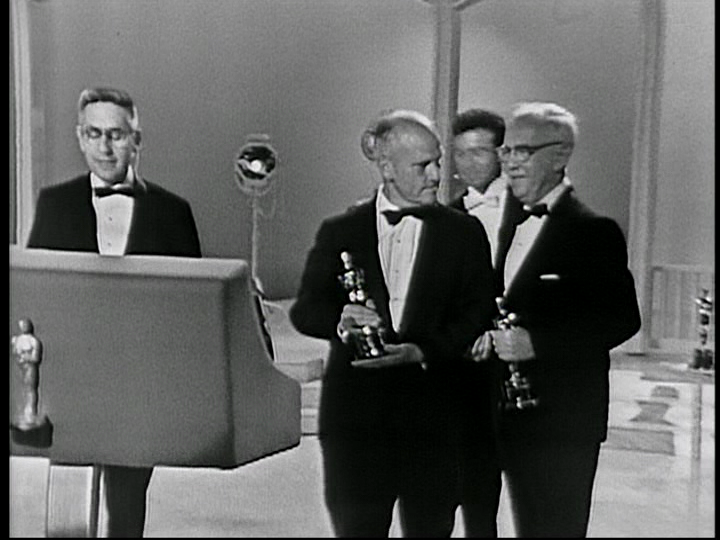
Ub (L) winning a special Academy Award for the sodium matte traveling process used successfully in Mary Poppins

In 1956, Ub invented a sodium traveling matte process, which helped pave the way for creating live action animation combinations, and was first successfully used in Mary Poppins. Ub went on to win a special Class One Scientific Academy Award for the sodium matte traveling process. Not only was Ub recognized for his work at Disney, but Alfred Hitchcock also asked him to create the effects in the movie The Birds with the sodium matte process. John Lasseter once remarked on Ub’s technical advancements, “A lot of the work that Ub did was to take people’s suspension of belief to another level, to where they never thought they were looking at drawings anymore.”

Ub’s advances were numerous, ranging from technical achievements in films (like the split screen technique in The Parent Trap), to creating a quicker editing system for television. Much of his work in the Disney parks, including bringing to life the audio animatronics found throughout the parks, is still used today.
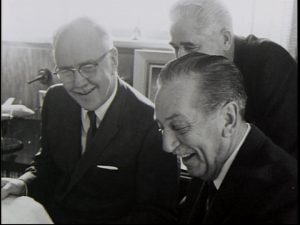
Ub and Walt, two parts of the whole that made up the success of the Disney Studios

Walt’s death greatly affected Ub, as the two were lifelong friends and collaborators, although their relationship was not an easy one at times. Don Iwerks, Ub’s son, remarked that, upon hearing of Walt’s death, Ub remarked, “That’s the end of an era.” The following five years after Walt’s death, Ub continued to push the boundaries of the field. In July on 1971, Ub passed away of a heart attack at age 70. He was honored as a Disney Legend in 1989 for all of his achievements.
March 4

March 4, 1914 – Birth of Disney Legend Ward Kimball, One of the Nine Old Men

“I checked out a scene of Ward Kimball’s animation on Cinderella, and it had some of his rough notes on the scene. He had done the mice in the scene, and Cinderella was also in the scene, but the note to his assistants was, ‘The stooge enters here,’ and the stooge was Cinderella. I think [Kimball] had a certain attitude toward the straighter characters…he lived for the comedy and the counterpoint to the [straight character.]” – Animation Director John Musker.

Ward Walrath Kimball, known as one of Disney’s famed Nine Old Men, was born on March 4, 1914, in Minneapolis, Minnesota. He attended the Santa Barbara School of Art in California, with an ambition of becoming a magazine illustrator. But after catching a screening of Walt Disney’s Three Little Pigs, Kimball quickly put together a portfolio and headed straight to Disney Studios, which he joined in 1934.

Kimball’s animation style, with his focus on comedy, and the emotion he was able to infuse in his drawings was quickly noticed in the studio, One of the most well-known characters he developed was Jiminy Cricket in Pinocchio, which was a bit of a gift from Walt after one of Kimball’s scenes was cut from Snow White and the Seven Dwarfs. Kimball remarked on this: “I spent eight months on it. It was all cleaned up and ready to be inked and painted. Walt sensed it stalled the plot at that point. So he called me to his office and said, ‘Ward, I hate to say this, but I’m going to have to take out this soup sequence.’ Of course, I was crestfallen, but right away he came in and said, ‘But I’ve got a little character in our next picture and we’re going to call him Jiminy Cricket. I’d like to have you be the animation supervisor on this.’ My first impression of him was, ‘This ugly insect.’ I said, ‘How can that guy carry the picture?’ My only answer to this is I’ve got to make him look funny. Walt didn’t really want a clown-looking cricket. As he put it, ‘Make him cute, Kimball.’”

Kimball (R) in a scene from The Reluctant Dragon, showing Robert Benchley how animated characters move

Along with many of the Nine Old Men that created the rules of modern animation, he continued to learn throughout his entire career. “An artist always goes back to the source,” he said wisely. “If he’s drawing animals, he looks at the giraffes and the lions; he caricatures them, but he starts out drawing realistically. Like on Bambi, the guys used to go down at the zoo and see how the animals acted.”

Kimball also animated Tweedledee and Tweedledum in Alice in Wonderland, and Lucifer in Cinderella, as well as the Academy Award-winning shorts Tootle, Whistle, Plunk and Boom – the first Cinemascope cartoon – and It’s Tough to Be a Bird. Kimball branched out of animation for the Disneyland show, producing and directing three episodes about space: Man in Space (which discusses the history of rockets), Man and the Moon (about man’s fascination with the moon), and Mars and Beyond (narrated by Paul Frees and discusses the possibility of life on other planets). Kimball also expanded into the story division, and helped write the script for the live-action film, Babes in Toyland.

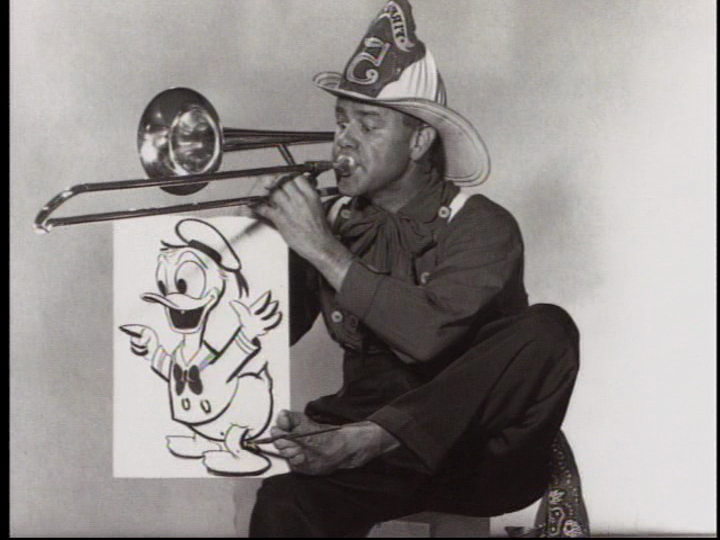
Kimball brought his unique sense of humor to every aspect of his life, including performing with the famous Firehouse Five Plus Two

Kimball had many interests beyond animation. A railroad buff, his enthusiasm for his hobby spurred Walt to set up a backyard railroad of his own. Kimball was also a fantastic trombone player, and played in the famous group, “Firehouse Five Plus Two,” most notably with Frank Thomas, another member of the Nine Old Men. He was awarded as a Disney Legend at the ceremony in 1989, and his plaque honors his sense of humor by adding an extra finger to the hand holding the wand. Ward Kimball passed away on July 8, 2002, in Los Angeles, California.


February 18

February 18, 1967 – Birth of Disney Legend, Animator, and Current Voice of Donald Duck, Tony Anselmo

“The legacy is in my heart and soul that, I feel that it’s an honor to be the guy who gets to be the keeper of the keys or the carrier, or what have you, of this legacy. I love that so much, that’s so important to me. That’s the best part [about being Donald] for me. It’s fun. It can actually be a lot of work, you know, and you have to do long sessions, especially if there’s a lot of tantrums.”

Born February 18, 1967, in Salt Lake City, Utah, Tony Anselmo loved animation from an early age. “I would write the animators, you know, Frank Thomas, and Ollie Johnston, and Jack [Hannah] about what it took to be a Disney animator,” Anselmo explained, “and they would write back, very generously with advice.” While in high school, he took night classes in figure drawing and acting, and submitted his portfolio to the studio. After Ollie Johnston and Jack Hannah saw it, they sent him to the California Institute of the Arts, where he spent three years studying animation under Hannah’s direction. “At that time, I remember telling people I wanted to be an animator, and they didn’t know what that was,” Anselmo recalled. “Since The Little Mermaid, I think there’s been a popularity of what animation is, and everybody wants to be a part of it, but before that it was a very, sort of a cultish thing, where there were very few of us who knew what Disney animation was, and who those people were, the Nine Old Men and California Institute of the Arts.”

After graduating from CalArts, Anselmo was placed into a training program with famed animator Eric Larson for eight months, studying Disney style animation and being given animation tests. After that, Anselmo became and inbetweener at the studio. Anselmo credits Jack Hannah for his entering the studio; coincidentally, Hannah became the director of the Donald Duck unit under Walt Disney, so the old director of Donald hired the new voice of the duck.

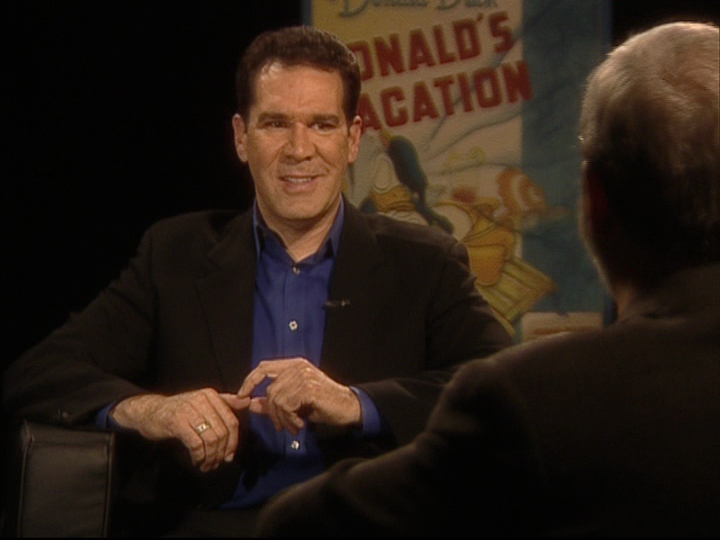
Anselmo being interviewed by Leonard Maltin in 2005

When asked how he became the voice of Donald, Anselmo responded that “It wasn’t anything I actually intended to do, but…it really was a small family, everybody knew everybody. And the first day I was on the lot, I was walking up Dopey Drive, and a man came down the steps of the animation building, five-foot-two and white hair [Clarence Nash, longtime voice of Donald Duck], and he passed me and he goes, ‘Good morning’ [in Donald’s voice], and I, in a split second, I had never met him before, and I had never seen who did Donald’s voice, so to hear that distinctive voice coming out of a man who I hadn’t met before was shocking, but at the same moment it was like, that’s Donald Duck! It would have been like being at MGM and seeing Clark Gable.

“Clarence was a good friend. And, doing voices and being the class clown, Donald was a voice that I couldn’t do. And I asked [Nash], for fun, ‘How do you do that?’ And he showed me, and I couldn’t do it. But I would practice from time to time – any voice person will tell you that the best place to practice is in the car, or in the shower – and one day it kind of clicked in, and I thought, ‘Okay, I think that I did it.’ The next time I saw Clarence I said, ‘Is this it?’ and goes, ‘That’s it!’ But it was just the sound, and there’s much more to it. You know, how to enunciate as much as possible. There’s certain words you use, certain words you try not to use, or you use something that means the same thing.

“It wasn’t until…he was supposed to the Rose Parade. In his fiftieth year, I think Ducky got the attention and the acclaim that he had, I think, always deserved. To celebrate Donald’s fiftieth birthday, he put his hand and footprints at the Chinese Theater, he was on the Tonight Show, the Academy Awards, and he was supposed to do the Rose Parade, and I didn’t know that he was sick; he had gotten leukemia. And I went to the Rose Parade and he wasn’t in the car, and Margie Nash called and said he was in the hospital. So I went to the hospital to visit…and he said, ‘You’re gonna do this.’ It all came at the same time and I thought, ‘You’re dying, and you want me to do that? No, I don’t want you to die, and no, I want you to do this.’

“The odd thing about it was, for a period of about six months before that, I thought it was just because we were friends and he thought it was fun, he would come in my room in the animation building when I was drawing, and he would say, ‘Try this,’ or ‘What would you do if Donald had to be in this situation, what would you say?’ or ‘Say this,’ and I would go, ‘Okay,’ and I thought it was fun. I really didn’t think he was spending the time, you know…I felt like he had taken me under his wing, to use a corny phrase, but I didn’t know why he was spending so much time with me. And it wasn’t until he was ill in the hospital and he told me, that it was like, ‘Oh.’ So, I’m very protective of it. It’s a legacy of not only Clarence and Jack, who were dear friends of mine, who I respected, and miss, but Walt Disney, and a legacy that I wanted to be a part of. It’s something that I watch over and I’m very protective of it, because I want to keep the integrity of not only the sound of it, but the integrity of the personality of Donald, what he does, what he doesn’t do. It’s not just the way Donald sounds, it’s how he reacts to any given situation. He would react differently to the same situation as Mickey or Goofy would act differently.”

In 1990, Anselmo put both of his skills to good use by animating and voicing Donald in Disney’s version of Mark Twain’s The Prince and the Pauper. He continues voicing Donald in various Disney projects, most recently the Kinect Disneyland Adventures game, and has said, “Pending natural disaster, I expect to be doing Donald the rest of my life.” He was named a Disney Legend in 2009 at the D23 Expo in Anaheim.

February 13

February 13, 1957 – The Disneyland Episode Tricks of Our Trade Premieres on ABC

“Before our eyes, we have seen an entire industry grow literally from the ground up. And this growth was no accident. It was painstakingly built, step by step, by men with pioneering spirit, who loved this puzzling new art form, and believed in its future.”- Walt Disney.

On February 13, 1957, audiences were treated to a different kind of episode of Disneyland: one that focused on how animated films were able to capture things as realistically as they did. With our host, Walt Disney, we are taken through the “tricks of the trade,” where he explains some of the then-commonplace animation principles, as well as some of technical advances made in the studio, and why they needed to be created. The examples given are obviously staged, but they give the audience a great example of the process used to come to a solution. Animation examples are from Snow White and the Seven Dwarfs, Bambi, and Fantasia. The episode was written by animation veteran Dick Huemer and directed by Wilfred Jackson. It also includes cameos of four of the famed Nine Old Men: Frank Thomas, Ollie Johnston, Marc Davis, and Milt Kahl. The episode refers to the book, The Art of Animation, which was the book that inspired John Lasseter to want to be an animator (please see the January 12th entry for more information).

“Because the animated cartoon comes to life on the screen, it belongs in the field of the motion picture,” Walt explains, as he opens up the episode. “But because it is drawn and painted, it is also one of the graphic arts, like painting. As a matter of fact, it is often referred to as the last of the graphic arts.” Disney then goes to his desk and shows the audience the book The Art of Animation, which was written by Bob Thomas about the Disney Studios. Disney turns to chapter eight, entitled Tricks of Our Trade, and explains that the pupils were their own teachers when it came to the principles of animation. “They had to be, because no one in the world could give them the answer to what they wanted to know,” Disney says, adding that their overall question was: How could animation be improved?

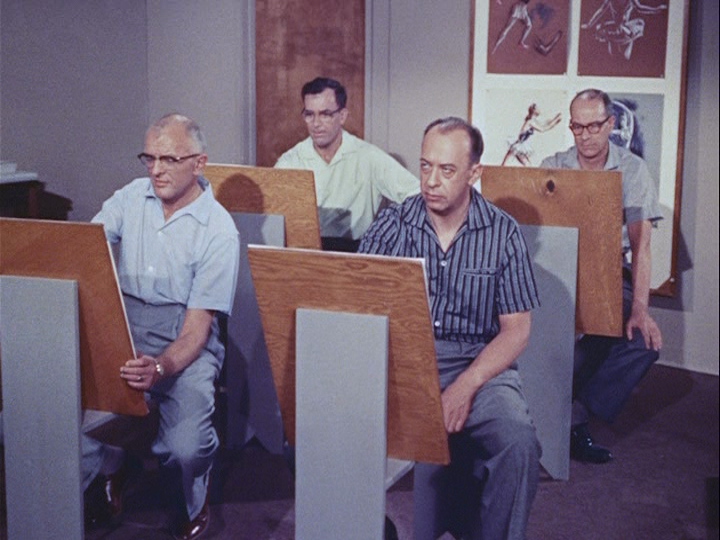
The animators in a classroom after hours, learning more about their own medium by one of their own

The first segment shown is of a group of animators watching a film of overweight comedian Billy House performing a two-step. The animators note that an overweight man moves differently, and that the human body does not move all in one piece. When the film is slowed down, there are many details they recognize that cannot be seen at normal speed. We then see the animators use what they saw to create an animation of the dwarf Happy doing the two-step dance, with the animation principles of weight, contact, follow-through, squash and stretch, and overlapping actions being used effectively. Disney points out while it’s true that thoughts and emotions can be expressed through pantomime, who a character is and what they think can best be revealed by dialogue. The trick of using dialogue is shown through a clip from Show White and the Seven Dwarfs, where Snow White identifies which dwarf is which.

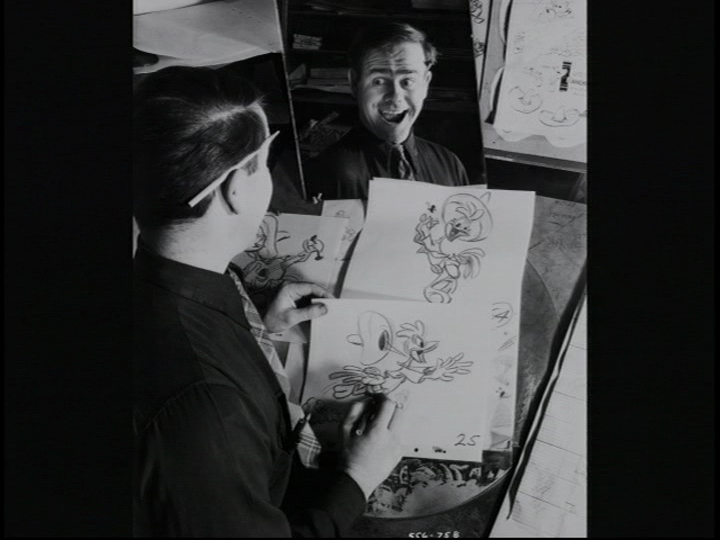
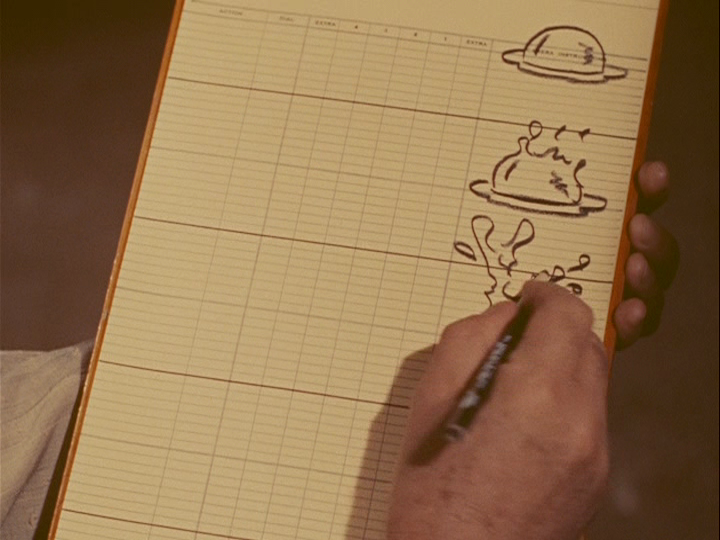
Dan MacManus sketching on an exposure sheet, trying to see how many frames it wll take to draw before the animator can draw the bubble bursting

The next animation technique we look at is effects animation: the trick of making the cartoon characters more believable by using extremely realistic animation of incidental action. There are many clips of animators watching various actions—including a baseball thrown through a window, or a bubble being blown from a pipe—and Disney explains that animating breakage required tremendous attention to detail. This leads into a clip of the earthquake from The Rite of Spring sequence in Fantasia. Continuing with that sequence, we see three effects animators looking at a tub of orange-colored mud, trying to solve three different problems for the creation of earth sequence in The Rite of Spring. Joshua Meador, head of the experiment, uses color chalks and pastels to render the sketch that would give an overall impression of the sequence. Jack Boyd’s assignment is to establish the individual action of a pair of bubbles, verifying his findings with the 2-drawing flipping action. Dan MacManus’s job is to see exactly how many drawings it would take to animate the bursting of a bubble, using an exposure sheet and a stopwatch. The audience then sees the clip from The Rite of Spring in its entirety.

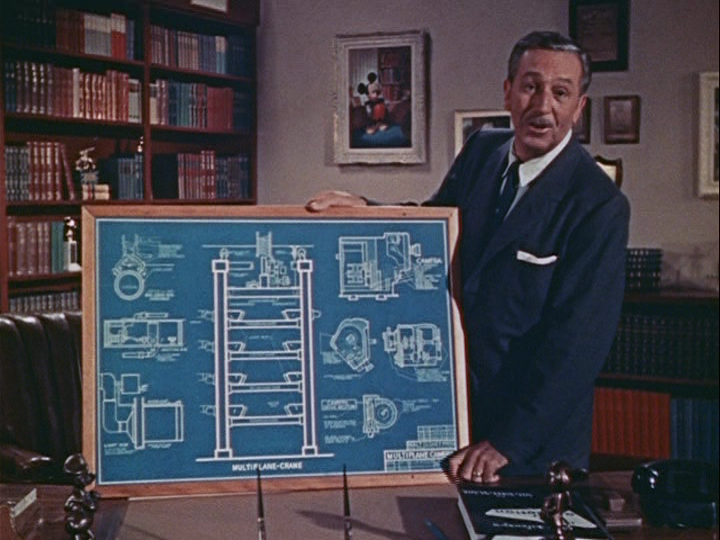
Walt with a blueprint of the Multi-Plane Camera, a Walt Disney Studios invention. Coincidentally, Ub Iwerks had created his own version at his own studio, only it was a horizontal camera

Walt pulls out a picture, calling it a different kind of drawing, which “also came out of our school of self-improvement here at the studio.” The blueprint is of the multi-plane camera, which was first used to great success in the Silly Symphony The Old Mill. Disney explains that the old process for animated films was fairly simple in construction and operation, but the biggest problem was that any dimension the character brought with him or her into the scene disappeared when the character left the frame. Another example used was a painting of a house on a moonlit night, and when the camera zoomed in on the scene, everything got larger, including the moon, which does not happen in reality. The use of the multi-plane camera shows the audience the big difference it makes in that scene. The audience next sees the opening scene of Bambi, and how the multi-plane camera works to give realism to the forest.

Four of the famous Nine Old Men, studying ballet moves. From Far Left: Milt Kahl, Frank Thomas, Marc Davis, and Ollie Johnston

“Perhaps the thing that distinguishes animated cartoons more than anything else is the trick of caricature,” Disney says. He tells the audience the story of the animation of Dance of the Hours from Fantasia, which involved the use of a live-action model to help the animators see the ballet movement of the dance. The ballet dancer they used was Helene Stanley, who was also the live-action model for Cinderella and Aurora in Sleeping Beauty. In this segment, we see the four of the famous Nine Old Men as they study Stanley’s movements. Kahl discovers that he may not be getting the kick right. Davis asks Stanley to perform it again, and as she does, Kahl makes a comment that the kick should be higher “in order to get all that weight off the ground. She’s no cream puff, you know.” Davis agrees, adding, “Yeah, that is a lot of beef.” These comments grab Stanley’s attention, but she keeps dancing. Thomas steps forward with his drawing and asks if he’s made the trunk too long: at this point, the audience sees that the drawings are those of the animals in the Fantasia sequence, although Stanley still thinks they are talking about her. Kahl responds to Thomas, “Oh, no, that’s what gives it that goofy look. Trunk’s way out of proportion to the rest of her body…it wouldn’t hurt to make [her legs] good and hairy.” These comments finally get the best of Stanley, who grabs her hat and cape and runs to the door, before turning around and seeing the animals they’ve been animating, and laughs before returning to the stage. The episode ends with the ballet segment from Fantasia, with all elephants, ostriches, and hippos.

The episode is wonderful for those who are fans of animation, and wish to see a dramatic look at how the animators were able to teach themselves and develop the new techniques to create better animation. Similar to “lessons learned” when creating computer animation in this generation, this highly recommended episode shows how the animators really had to, and did, step up to blaze a new trail.