RSS Feed

Tag Archives: 1940s

August 30

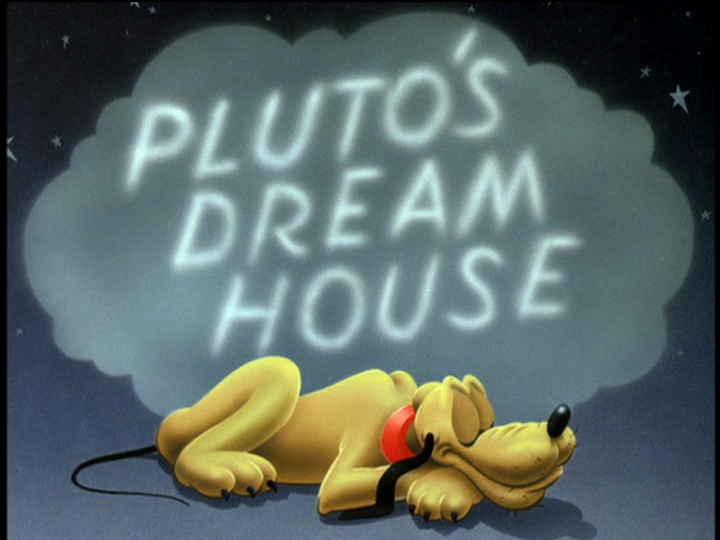
August 30, 1940 – The Mickey Mouse Short Film Pluto’s Dream House is Released to Theaters
vlcsnap-2013-08-30-19h38m18s190

“Man, if you don’t want nothin’, don’t rub us magic lamps!”

On August 30, 1940, the Mickey Mouse short film Pluto’s Dream House was released to theaters. This short is an example of dialect humor, which was a popular staple of entertainment in this time period, especially with radio programs. If one looks closely, you can see that Mickey and Pluto have been together a long time, as Pluto’s first doghouse was built in 1926 – two years before Steamboat Willie. The short was directed by Clyde Geronimi.

In Mickey’s backyard, Mickey and Pluto are studying the blueprints for Pluto’s new streamlined doghouse. Pluto looks over at his old house, which is falling apart rapidly. Mickey and Pluto then excitedly begin building. As Pluto digs, several things are pulled from the ground, including a magic lamp, which starts talking after Mickey rubs in. The lamp, after scaring Pluto, lets Mickey know that he will grant any wish Mickey asks. Mickey then asks for a doghouse for Pluto. The lamp sputters and spins, and a burst of magic comes out of his spout, causing all the tools to start work on the doghouse by their own accord.
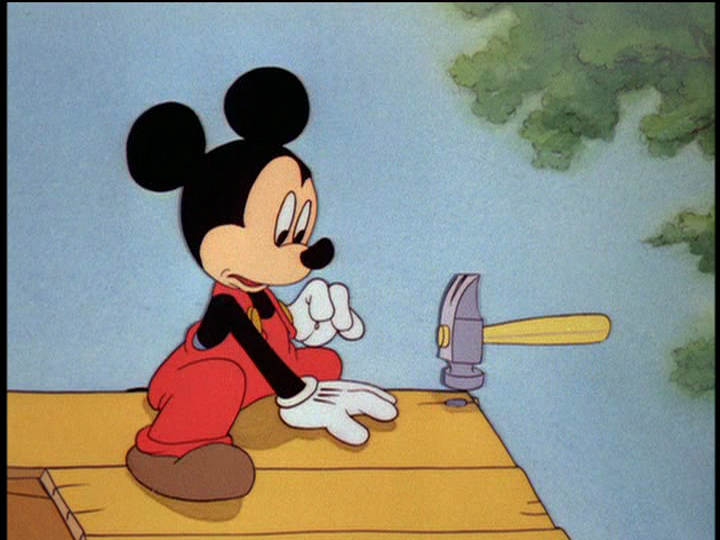
Mickey watches as the hammer starts working by itself to build the doghouse

Mickey watches as the hammer starts working by itself to build the doghouse

Mickey watches in astonishment as the house is made, and Pluto is attacked by the tools when he gets a little too close to their activities. Finally, the hosue is created, all tricked out with neon lishgts and a diamond encrusted fire hydrant. The lamp then gives Mickey the idea to wish that Pluto had a bath, and Pluto is sent flying into a tub of water. After a while, Pluto begins to enjoy the bath. Mickey then sits and relaxes in the living room, but has trouble finding something to listen to on the radio. As the lamp scrubs behind Pluto’s ears, Pluto ends up slammed against the wall, hitting it hard enough to knock the radio over and break it. The lamp interprets the sounds from the broken radio as commands from Mickey, and starts beating Pluto up. As Pluto is being tortured, the audience then realizes that this has all been Pluto’s dream. When Mickey tries to wake the whimpering Pluto, the dog howls with fright and leaps into Mickey’s bed. Mickey laughs at his pet’s behavior as Pluto clutches his master tightly.
August 27

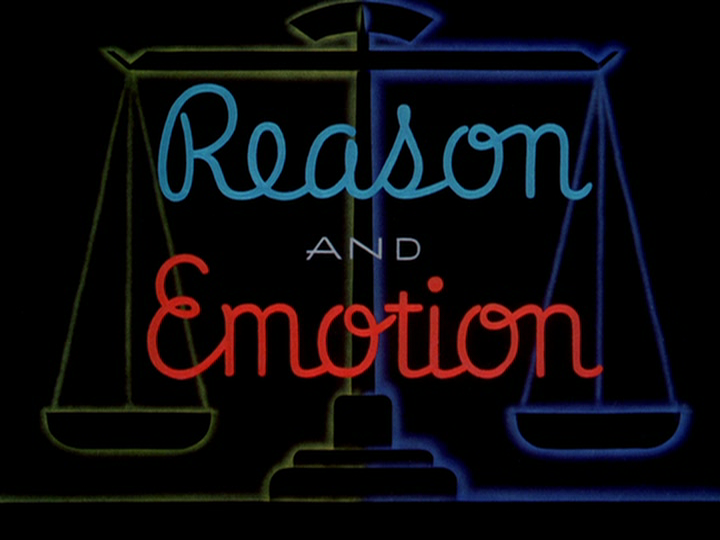
August 27, 1943 – The Wartime Short Film Reason and Emotion is Released to Theaters

vlcsnap-2013-08-26-20h59m19s50

“Each one of us is equipped with the ability to think, known as Reason, and the ability to feel, known as Emotion. Within the mind of each of us, these two wage a ceaseless battle for mastery.”

On August 27, 1943, the wartime short film Reason and Emotion was released to theaters. It was nominated for an Academy Award, but lost to The Yankee Doodle Mouse from Metro-Goldwyn-Mayer. The short was directed by Bill Roberts.

The short begins with an explanation of how each person has two abilities: Reason and Emotion. From birth, Emotion is the more powerful of the two, as Reason isn’t born yet. A baby is seen acting on pure Emotion, until Reason arrives to stop Emotion. The baby grows up, and Reason is in the driver’s seat of the man’s mind. When the man passes by and attractive woman, Emotion knocks out Reason and acts crudely toward the woman, earning a slap in the face. The attention then turns to the woman who, when Emotion takes over her mind, decides to eat as much as she can at the nearby café, with her figure ballooning quickly.

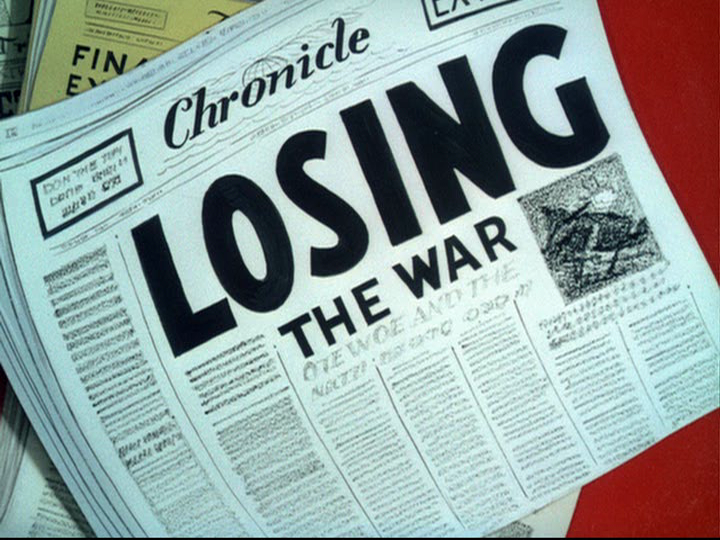
The narrator explains that, during this time of war, it is easy to let Emotion take control over Reason, thanks to headlines like this

The narrator explains that, during this time of war, it is easy to let Emotion take control over Reason, thanks to headlines like this

The attention then turns to the War, and how easily people can let their emotions get the best of them in such a stressful time. In the case of Mr. John Doakes, although he tries to keep himself informed of the current events, he is easily ruled by Emotion with all the rumors running around. The narrator then points out to Emotion that this is exactly what Hitler plays upon, using tactics of fear, sympathy, pride, and hate. The audience is then taken inside the mind of a Nazi, with Emotion completely manipulated by Hitler’s speeches. Although Reason knows better, Emotion enslaves Reason and leaves nothing but ruin in his wake. The narrator tells Reason and Emotion that they must work together to fight against all odds to defeat Hitler.

August 5

August 5, 1959 – The Donald Duck Short Film Honey Harvester is Released to Theaters

vlcsnap-2013-08-05-05h02m28s146

“Oh boy – honey!”

On August 5, 1949, the Donald Duck short film Honey Harvester was released to theaters. This short features the Goofy holler; commonly attributed to Goofy, this is one of the rare examples it has been used by Donald. It was directed by Jack Hannah, with story by Nick George and Bill Berg.

Spike the Bee is hard a work in Donald’s greenhouse, gathering honey from flowers and taking it back to his hive in a broken down old car’s radiator. As he works, Donald enters the greenhouse and sees Spike, but thinks nothing of it until he realizes that Spike will lead him to a large amount of honey. He starts looking for Spike, although the bee is reluctant to let Donald follow him to his hive. Donald sets up an ink pad for Spike to step in, and follows the footsteps, although Spike is able to outwit him. Donald tries again, attaching some string to some flypaper and following it to the old car. However, the string leads past the car and up a tree, where Spike cuts down a branch, sending Donald plummeting to the ground.

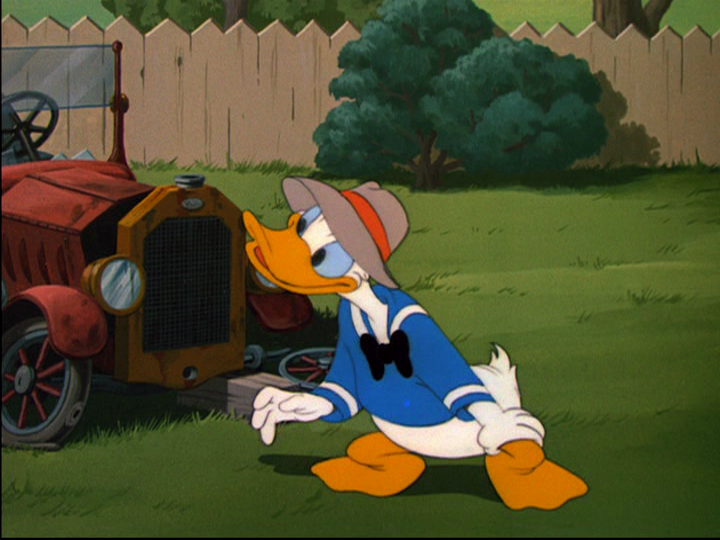
After several failed attempts to follow Spike, Donald accidentally finds the honey's location

After several failed attempts to follow Spike, Donald accidentally finds the honey’s location

After this mishap, Donald leans on the radiator of the old car, irritated, when he realizes that he has honey all over his hand. Donald then starts filling jars with honey just when Spike returns with more honey. He sees Donald getting away with his stash and attempts to sting him, but Donald protects himself with a pot and a cork. Spike manages to free himself from the cork, but grabs a cactus spike and attempts to attack Donald again with much more force. Donald finally surrenders after being chased around his yard and returns the honey – save for one jar he has hidden in his shirt. Spike sees this and stings Donald again, and Donald flees in panic.

July 27

July 27, 1945 – The Pluto Short Film Canine Casanova is Released to Theaters

vlcsnap-2013-07-27-10h59m17s198

“Hey you…!”

On July 27, 1945, the Pluto short film Canine Casanova was released to theaters. It was directed by Charles Nichols, with story by Harry Reeves, Jesse Marsh, and Rex Cox.

Pluto is skipping through the park, when he passes by a beautiful dachshund. Immediately smitten, he turns around and follows her, making a fool of himself as he does so. She rebuffs his attention every time, leaving him more determined than ever. He finds a large bone buried in the ground, and uses it to steal a kiss from her, which only makes her angry. She stops to admire her reflection in a window, and finds Pluto has followed her once again, nearly getting the two in trouble when he breaks the window. Pluto slinks away sadly as she tells him off, and as she walks away, she is snatched up by the dog catcher. She calls out for Pluto’s help as she is driven away.

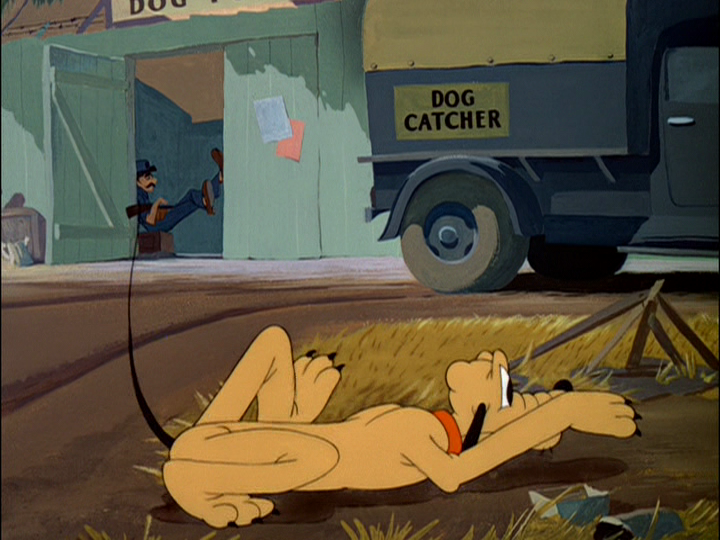
Pluto sneaks into the dog pound to rescue the cute dachshund

Pluto sneaks into the dog pound to rescue the cute dachshund

Pluto tracks her scent to the dog pound, and quietly peers in, seeing the poor dachshund being courted by scoundrels. He rushes to her rescue, narrowly missing the sleeping guard and his shotgun. He crawls around the back to open her pen, and she is surprised to see Pluto as her rescuer. As the two look for a way out, they realize the only opening is past the sleeping guard and his shotgun. Pluto quickly formulates a plan, and the two almost make it out, except that the guard’s foot drops right as the dachshund is about to crawl underneath his legs. Pluto manages to keep his leg propped up long enough for her to escape, but accidentally hits the butt of the shotgun, slamming it to the ground and setting it off. The two race away as the guard quickly pursues them in his truck. Pluto accidentally sends three barrels of nails flying down the path, which stops the truck in its tracks. The dachshund returns home, giving Pluto a kiss before she does. Pluto follows her, only to find that she has a litter of puppies waiting for her return.

July 13

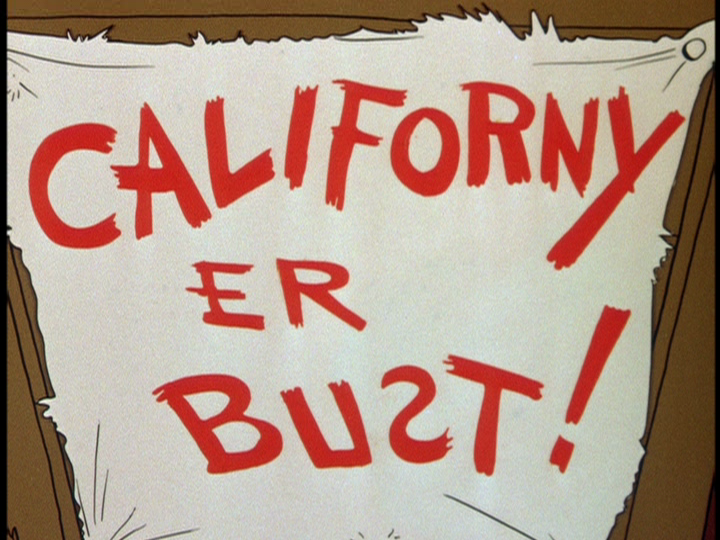
July 13, 1945 – The Goofy Short Film Californy ’er Bust is Released to Theaters

vlcsnap-2013-07-13-10h55m30s72

“Howdy, strangers. Now, I ain’t aimin’ pick no argument or nothin’, understand? Cause anybody knows them old ‘civered’ wagons look powerful slow creakin’ and a-groanin’ cross them plains.”

On July 13, 1945, the Goofy short film Californy ’er Bust was released the theaters. This short is a parody of the popular Western films of the 1940s, as the Native Americans in this short are caricatures of the caricatures in the films. A clip from this film was also reused in the 1953 short How to Dance; another clip was reused in the 1956 short A Cowboy Needs a Horse. This short was directed by Jack Kinney, with story by Bill Peed.

The short begins with the narrator setting off with a wagon train with a rather beat up wagon. The wagon train he is a part of sought a speed record when it came to traveling to California, which the narrator says hasn’t been busted yet. The narrator is then revealed to be Goofy, who leads the wagon train on a slow, beaten-down horse named Hamlet. As they pass through Buffalo, New York, a herd of Indians spots them and sends out their troops for an attack. The wagon train, asleep when the Indians arrive, wake up quickly and attempt to attack back, and a comical fight ensues. Unfortunately, the wagon train runs out of ammunition, and the Indians attack with gusto, until a tornado arrives, sucking up the wagon train and taking them out West, right where they wanted to be.

July 3

Posted on

July 3, 1942 – The Pluto Short Film The Sleepwalker is Released to Theaters

vlcsnap-2013-07-03-04h49m18s39

On July 3, 1942, the Pluto short film The Sleepwalker was released to theaters. It was directed by Clyde Geronimi.

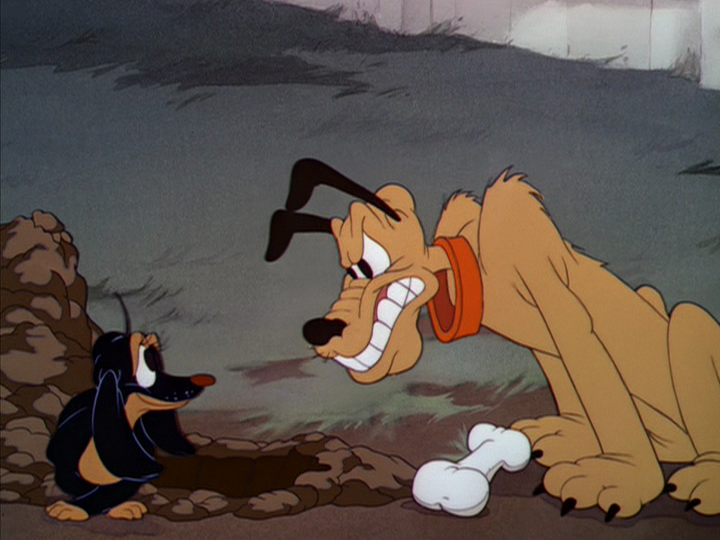
Pluto is sleeping in his doghouse, with a large bone sitting in his food bowl. From a hole in the fence nearby, a female dachshund observes the bone, drooling. She wanders in and tries to take it from the sleeping Pluto, and as he wakes, he growls and chases after the hungry female. He returns home after chasing her away, and she begins to cry. Once again, Pluto falls asleep, but begins to sleepwalk, taking the bone over to the dachshund. She is surprised to see him, but happy to receive the bone. Later, when Pluto wakes up (with no recollection of giving away his bone), he finds it missing, and angrily goes to retrieve it, breaking her food bowl in the process.

Pluto has several angry confrontations with the dachshund, unaware that he is the one giving her the bone

Pluto has several angry confrontations with the dachshund, unaware that he is the one giving her the bone

As he walks away, he falls asleep and sleepwalks back to her, dropping off the bone again. She happily begins to dig a hole for the bone, but when Pluto wakes up again, she quickly digs it back out and hands it back. In a fit of rage, Pluto destroys her doghouse, and in the destruction, finds that the hungry dachshund has a litter. The puppies play with Pluto, and he realizes with guilt what he has done, particularly when it starts to rain. He offers them his doghouse and his collection of bones, which they accept happily. The dachshund gives Pluto a large kiss for his kindness, and he curls up under some newspapers to keep dry, happy about his good deed.

June 29

June 29, 1945 – The Donald Duck Short Film Donald’s Crime is Released to Theaters

vlcsnap-2013-06-29-18h13m08s255

“Gotta date with Daisy, Daisy, Daisy…she’s my sweetie gal!”

On June 29, 1945, the Donald Duck short film Donald’s Crime was released to theaters. The film was nominated for an Academy Award, but lost to the Tom and Jerry short film Quiet Please! It was directed by Jack King, with story by Ralph Wright.

Donald is excitedly preparing for his date with Daisy, when he realizes at the last minute that he’s broke. He spies his nephews’ piggy bank sitting on the table, and hears a voice telling him that it’s the answer to his problem. He tries to resist, knowing it would be wrong, but the voice keeps telling him that no one will know, and he should take it. He gives in to temptation, just as his nephews start playing around his feet. They ask him what he’s doing, and he demands that they go to bed as he tries to hide the piggy bank. They quickly run upstairs, saying their prayers for Daisy and Uncle Donald before they fall asleep.

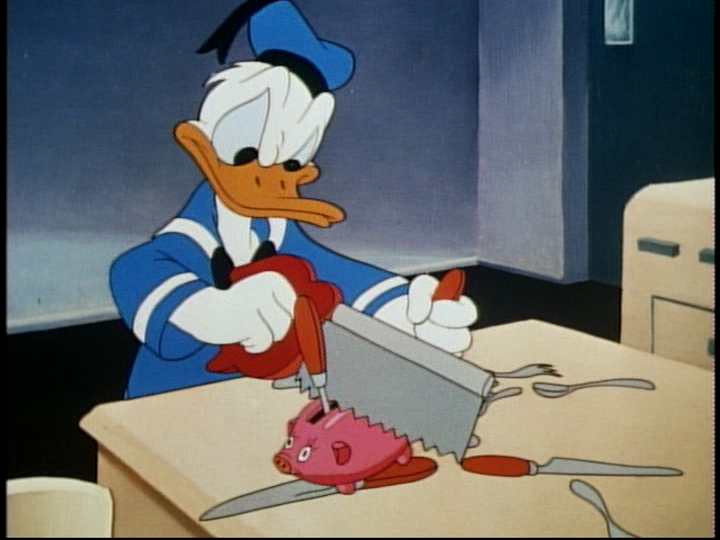
Donald breaks out his tools to try and get the money while leaving the bank in one piece

Donald breaks out his tools to try and get the money while leaving the bank in one piece

Donald uses every tool he can to get the money out of the bank, but the bank breaks, leaving him with all of the money. He suddenly hears the nephews calling for him, and he runs upstairs, sweating with guilt. He thinks they are on to him, until he hears them ask for a kiss goodnight. He feels like a skunk for stealing their money, but soon forgets it as he takes Daisy out for a night on the town. After he brings Daisy home, he floats away on a cloud after she give him a kiss goodnight and calls him a big shot. The voice he heard before boosts his ego, before bringing back all of the guilt from before. The guilt gets the best of him as he starts to act like he’s a gangster, with the police after him wherever he goes.

He runs around town before spotting his own face on a wanted poster, with a reward of $100, dead or alive. As he pulls the poster from the post, another one is posted behind it, with the reward increasing to $500. The more he pulls the posters, the higher the reward, until the zeros start to circle around. He flees again and ends up in a blind alley, and thinks he’s in jail, pulling on the bars of the door in front of him, when a sign falls on his head. He looks up to see that he’s at the service entrance of a café, and there is help wanted inside. He decides to take up the job and pay back the money for the nephews. However, when he finds he’s paid them one nickel too many, the nephews spot him trying to get the money out, and they throw a tantrum while he fidgets nervously.

June 23

June 23, 1944 – The Pluto Short Film Springtime for Pluto is Released to Theaters

vlcsnap-2013-06-23-08h08m17s38

“Spring! Spring! Sweet, scented spring! Loveliest time of year!”

On June 23, 1944, the Pluto short film Springtime for Pluto was released to theaters. This was the first short directed by Charles Nichols, who would go on to have a long history of directing at the Disney Studios, including many of the Pluto shorts. Pluto’s allergy to goldenrod is seen here, which was used as a major plot point in the 1948 short film Bone Bandit (see April 30th entry for more details). The story for this short was written by Nick George and Eric Gurney.

The Spirit of Spring, appearing in the guise of a faun, skips through the winter surroundings, changing them into spring as he plays his panflute. He tries to wake Pluto, who follows the spirit in a dreamlike state, before realizing that spring is indeed there, and decides to explore the area. He watches as all signs of spring appear, including bluebirds and lambs, and hears the caterpillar sing a song about spring. The caterpillar then uses Pluto’s tail as a perch for his cocoon, and when she emerges as a beautiful butterfly, Pluto blushes at how beautiful she is. Unfortunately, as he tries to imitate her dancing, he disturbs a bee hive, and the entire swarm of bees chase after him, only stopping after Pluto dives into a patch of poison ivy to escape them.

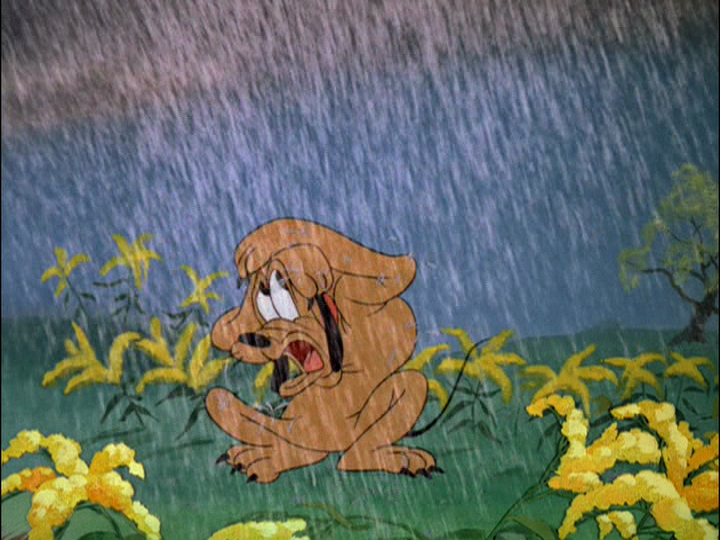
Just as things couldn't get worse for Pluto, it begins to rain heavily

Just as things couldn’t get worse for Pluto, it begins to rain heavily

When Pluto realizes what he’s jumped into, he starts writhing around as he starts to itch, sneezing when he ends up in a patch of goldenrod. It then begins to rain, and as Pluto tries to find shelter, he continues to sneeze so violently that he is thrown back several paces. It then begins to hail just as Pluto makes his way back to his doghouse. Pluto and his house have been ravaged by the time the storm ends, and as the Spirit skips by, Pluto stalks out of the broken shack, chasing after the fleeing Spirit.

June 12

June 12, 1942 – The Donald Duck Short Film Donald’s Garden Premieres in Theaters

vlcsnap-2013-06-12-04h30m20s99

“Exasperating, isn’t it?”

On June 12, 1942, the Donald Duck short film Donald’s Garden premiered in theaters. It was directed by Dick Lundy.

Donald is seen singing while taking care of his prize-winning watermelons. As he goes to get more water from the pump, he seems to misplace the watering can while the water barely comes out from the pipe. When he moves the can closer, the water then pours out, missing the can once again. He moves the can again, and begins to pump out water with vigor, which pushes the can to the edge of the platform. Donald tries to stop the can from falling, but is too late. Angered, he tries again, but the water refuses to come out from the pump. He declares that he’ll show the pump this time, but the water refuses to fill his can, which ends with Donald getting his bill stuck in the pipe, water coming out of his nostrils. He threatens to tear the pump into pieces, and sticks the can right on the pump’s pipe. The pump explodes with water, but does fill the can. Unfortunately, the can breaks, leaving Donald holding nothing but the handle.

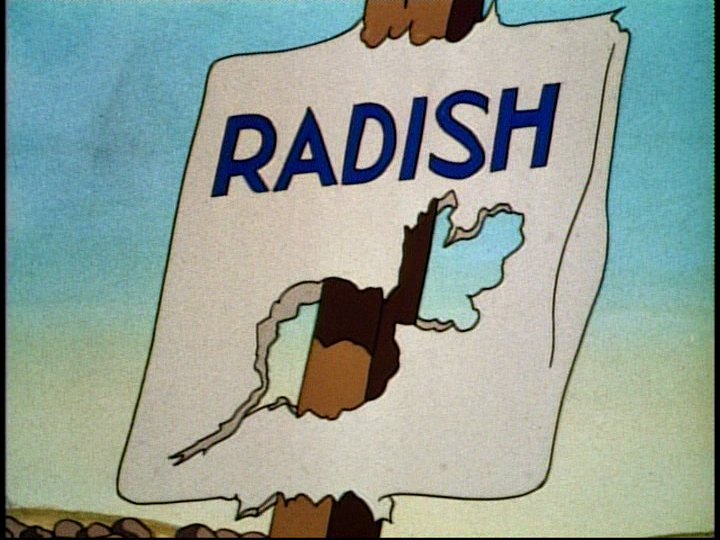
The gopher devours Donald's radishes, including the picture of the crop

The gopher devours Donald’s radishes, including the picture of the crop

The water falls into a hole in the ground, and a nearby gopher pops out of his hole, choking. He dries himself off and angrily walks around until he bumps into a sign for radishes in Donald’s garden. Suddenly hungry, he crawls underground and begins to pull down the radish crop to eat. The gopher then moves to the onions, but dislikes the taste of them. He spies the watermelon and starts to pull a good one away, but is unable to pull it through his hole. Quickly enlarging the hole, he is able to pull away the watermelon crop. Unfortunately, Donald is also harvesting the crop at the other end, and soon finds that his crop is being stolen. He attempts to pull back the crop, and finds the gopher, catching him in his hat. The gopher manages to escape, and Donald is pulled into the hole when trying to retrieve his crop. The gopher traps Donald with the watermelon vine, and decides to take the rest of Donald’s crops. He smiles with satisfaction as he polishes every single last vegetable.

June 2

Posted on

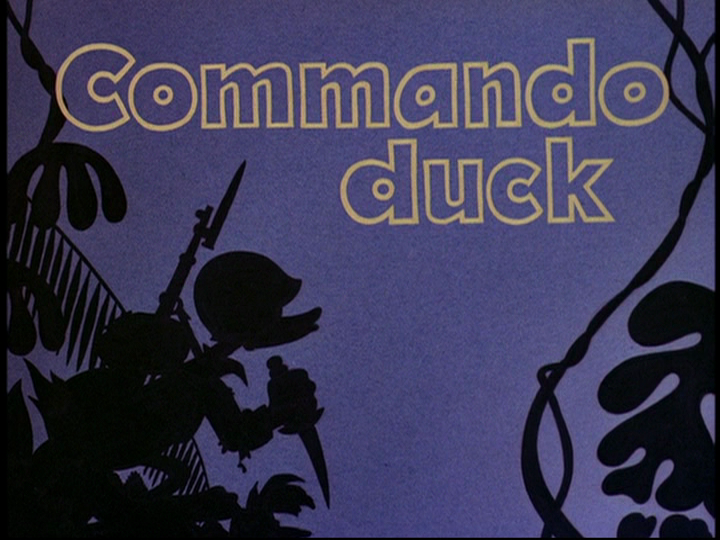
June 2, 1944 – The Donald Duck Short Commando Duck is Released to Theaters

vlcsnap-2013-05-29-23h12m14s177

“Contacted enemy, washed out same. Donald Duck.”

On June 2, 1944, the Donald Duck short film Commando Duck was released to theaters. The short contains several stereotypes of Japanese soldiers, as was common in this time period while the United States was embroiled in war. The short was directed by Jack King.

The short begins with Donald receiving his orders to parachute out of a plane into a forest, where he has to watch out for snipers and alligators to reach his objective and wipe out the enemy. He is then warned that he must complete this mission at all costs, and with trembling knees, parachutes out of plane. His chute gets caught on two tree branches and, thinking he’s safe, unhooks his belt only to find that he is falling several hundred feet into an alligator infested river. Luckily, he is able to save himself and end up on dry land, but with an emergency raft as his only supply.

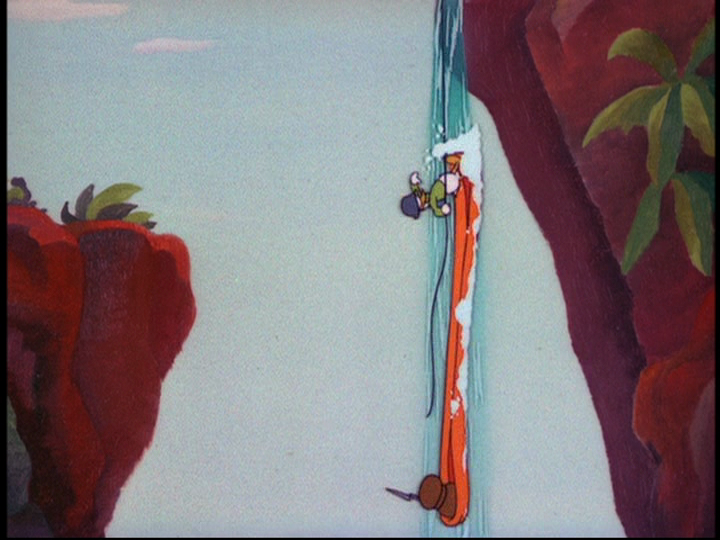
Donald falls down a waterfall after being shot at by Japanese snipers

Donald falls down a waterfall after being shot at by Japanese snipers

Several Japanese snipers are lying in wait on the side of the river, and point their guns at Donald as he passes by in the raft. They fire, but Donald mistakenly believes them to be mosquitoes, until he catches bullets in his helmet. He quickly flees, only to find that a waterfall is nearby, and nearly falls down the falls before roping a rock; the rope is shot by a sniper, and Donald is sent sailing down the falls. Fortunately, the raft saves his life, but fills with so much water that it nearly crushes him. The raft continues to expand with the water, and Donald continues to try and outrun it, as well as remove anything sharp from its path. It gets punctured by a log, and Donald had to outrun water and massive boulders. The boulders, however, send Donald flying into the air and, along with the water, crash into the enemy base, destroying it.