RSS Feed

Tag Archives: 1930s

July 7

Posted on

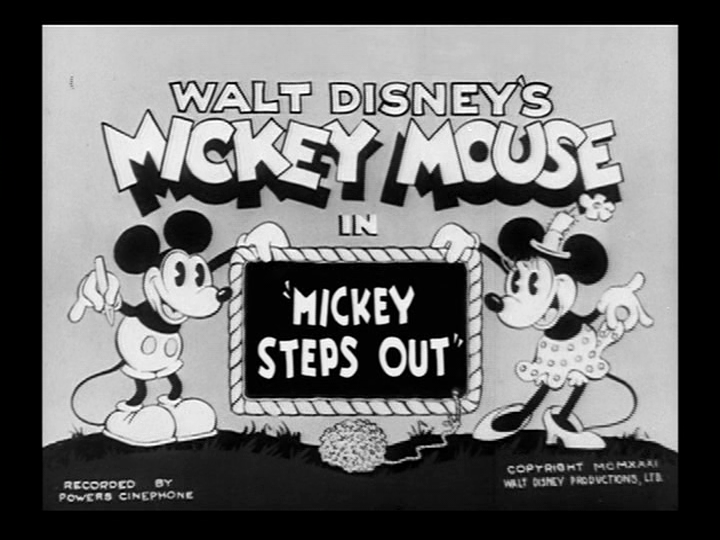
July 7, 1931 – The Mickey Mouse Short Film Mickey Steps Out is Released to Theaters
vlcsnap-2013-07-07-05h57m32s76

“Go on home, Pluto! Go on back!”

On July 7, 1931, the Mickey Mouse short film Mickey Steps Out is released to theaters. The short contains some dated humor in the form of “blackface,” which was common at the time, particularly as an imitation of popular vaudeville performer Al Jolson, who wore blackface and sang his popular song “Mammy.” This short was directed by Burt Gillett.

Mickey is gleefully preparing for his date with Minnie Mouse, putting on his hat and grabbing his cane before stepping out of his house. Unfortunately, Pluto rushes up behind him and accidentally pushes the mouse into a puddle of mud. Angry, Mickey sends Pluto back to his doghouse and ties up leash before he heads out again. Pluto, however, finds Mickey, dragging his doghouse behind him, and pushes Mickey into a puddle of mud again. Just as Mickey is about to yell at Pluto, he hears Minnie playing piano and singing inside her house. He peers through the window and begins to accompany her with her bird by whistling. Mickey is standing on Pluto’s backside to reach the window, but when a cat appears at the corner of Minnie’s fence, Pluto takes off like a shot, leaving Mickey stuck in the window as it shuts on his neck.
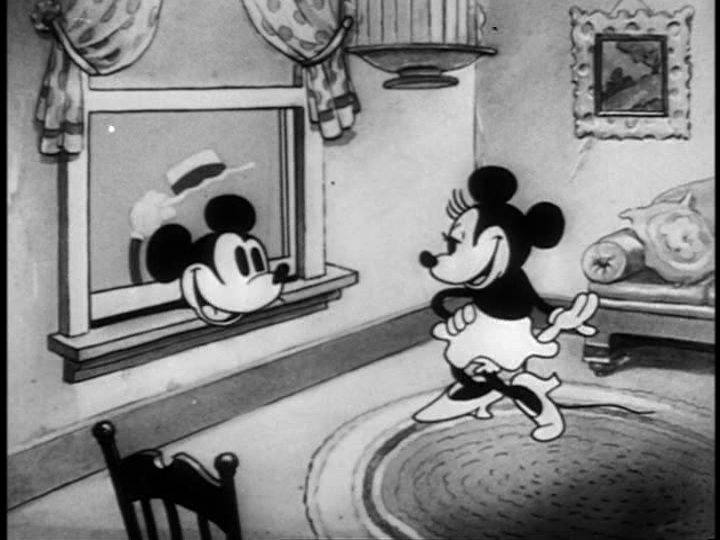
Minnie greets Mickey as he is trapped in her window

Minnie greets Mickey as he is trapped in her window

Minnie and Mickey trade greetings when she sees him in the window. When she opens the window to free him, he falls to the ground, but as Minnie begins to worry, he appears at the door, greeting her again. She plays a lively song on the piano, and Mickey begins to dance. Outside, Pluto chases the cat around Minnie’s laundry line, when the cat dives into the house, with Pluto in pursuit. The two run into the piano and begin to fight, with Pluto taking the player piano sheet with him as they resume the chase in the house. Mickey tries and fails to stop them, and are soon taken along on the chase. The cat dives into the stove, and Pluto runs into it, breaking it and spreading soot all over the house. The short ends with the cat using the lid of the stove to hit Pluto over the head.
June 30

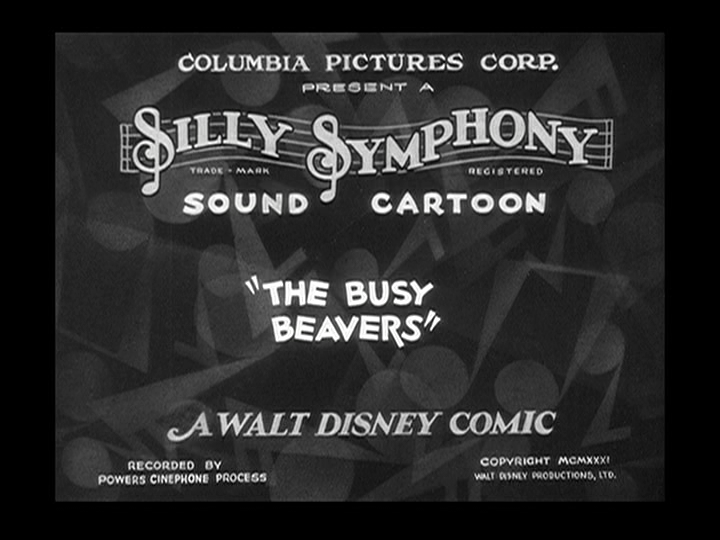
June 30, 1931 – The Silly Symphony The Busy Beavers is Released to Theaters

vlcsnap-2013-06-30-11h29m38s196

On June 30, 1931, the Silly Symphony The Busy Beavers was released to theaters. It was directed by Wilfred Jackson.

A group of beavers are diligently working together to build their dam, dancing while they work. As one gathers twigs, he accidentally disturbs a moose, thinking the antlers are twigs to use. Others mix up mud for use, while others use whatever they have on hand to create this dam. Two beavers go around chopping down trees marked for use, and when a pair of caterpillars find that their home has been marked, they quickly remove the “X,” leaving their home unscathed.

A storm quickly approaches, and the beavers scramble for cover in their dam. One little beaver, on his way home, finds a leak in the dam. He goes to plug the leak, when another one appears, followed by more. He is unable to cover them all with his own hands, and starts crying out for more help. A raincloud appears over the dam and dumps its contents into the mountains, with the water taking out everything in its path, including the recent work done by the beavers. As the animals try to scramble to safety, the young beaver quickly cuts down a large tree to stop the flow of the water. He achieves the feat, but is seemingly killed in the process. However, he appears from the top of the tree, unscathed, and is regarded as a hero for saving the day.

June 25

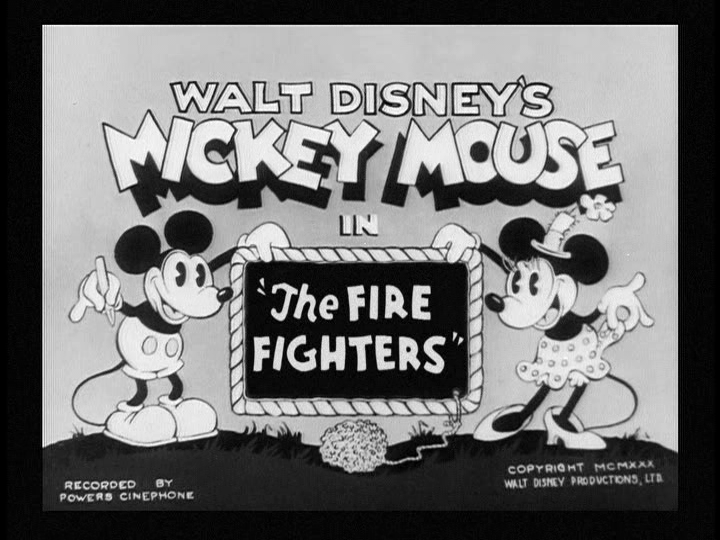
June 25, 1930 – The Mickey Mouse Short Film The Fire Fighters is Released to Theaters

vlcsnap-2013-06-25-06h09m04s92

“Fire! Fire! Fire!”

On June 25, 1930, the Mickey Mouse short film The Fire Fighters was released to theaters. The short was directed by Burt Gillett.

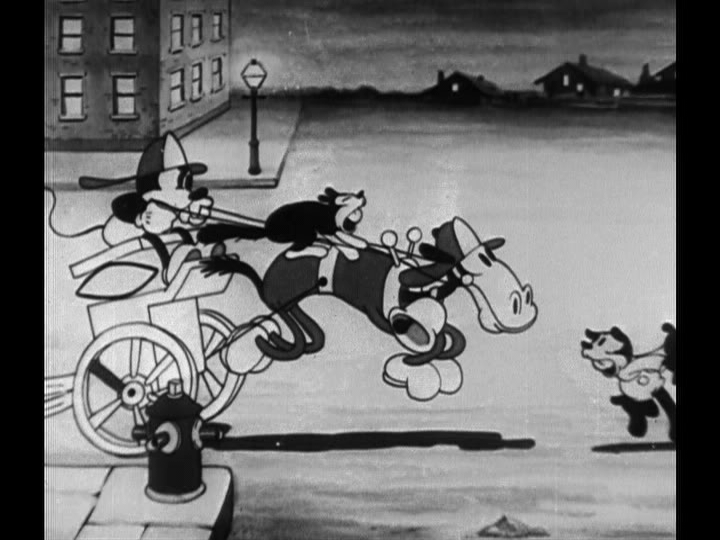
It’s a quiet night at the firehouse, with all the fireman asleep in their beds, including Fire Chief Mickey. Suddenly, someone comes running down the road, shouting out that there’s a fire, with a building seen burning in the distance. The bell sounds the alarm, and the firemen quickly rouse themselves and head out, except for Horace Horsecollar, who finally wakes up and rushes to follow the rest of the team. Using a cat to sound the fire engine alarm, the firemen speed out into the night, with Mickey leading the charge. Unfortunately, most of the fire engine and team get left behind as they travel over some rocky terrain.

Mickey arrives triumphantly on the scene to put out the fire

Mickey arrives triumphantly on the scene to put out the fire

The burning building begins to sway side to side, with people jumping out in all directions before scrambling to safety. The citizens of the city cheer as they see the firemen approaching, although when Mickey turns around, he is rather annoyed at finding he is the only one there. He grabs his fire hose and attaches it to the closest hydrant, and sets off to take out fire. The hydrant doesn’t seem to work, so Mickey milks all the water out that he can into a bucket and runs to the building, not realizing that he’s spilled all of the water most of the way there. He tries again, a bit more carefully, although he spills the water before it can hit the flames. Meanwhile, Horace has been taking water from a nearby pond and using it to put out the flames on the first floor.

Up at the top of the building, Minnie Mouse, who seems to have been asleep, opens her eyes and screams for help before she is consumed by smoke. Mickey, alarmed, bravely runs into the building, but is soon chased out by flames. He uses the ladder of the apartment building next door to jump into a pair of pants left on the clothing line, then pulls himself close to the burning building to catch Minnie as she falls out of the window from exhaustion. The flames break the clothing line apart, but the pants act as a parachute to send them safely to the ground. The two kiss and embrace.

June 20

June 20, 1936 – The Mickey Mouse Short Film Moving Day is Released to Theaters

vlcsnap-2013-06-20-07h25m39s62

“Too late! I’m selling your furniture, see?”

On June 20, 1936, the Mickey Mouse short film Moving Day was released to theaters. This short is one of the many that showcased all three leading Disney stars, although was credited only to Mickey. Goofy sings a snippet of his theme song, “The World Owes Me a Living.” The short was directed by Ben Sharpsteen, and stars Walt Disney as Mickey, Clarence Nash as Donald, Pinto Colvig as Goofy, and Billy Bletcher as Pete.

Mickey and Donald are pacing the floor nervously, staring at their calendar as it announces that their rent is six months overdue. As they pace, a loud knocking and ringing of their doorbell alerts the duo, and they run to hide. Finally, Mickey screws up the courage to open the door, and Sheriff Pete bursts in, holding a notice to dispossess. Mickey and Donald stutter that they’ll get the money to pay it, but Pete tells them that it’s too late, then uses Donald’s bill to light his match for his cigar. After Pete leaves, Donald throws a tantrum, but leaps to hide in an umbrella when someone knocks on the door. Outside, the knocking is just Pete nailing a sign to the house with his bare hands, announcing that there will be a sheriff’s sale of everything inside that day.

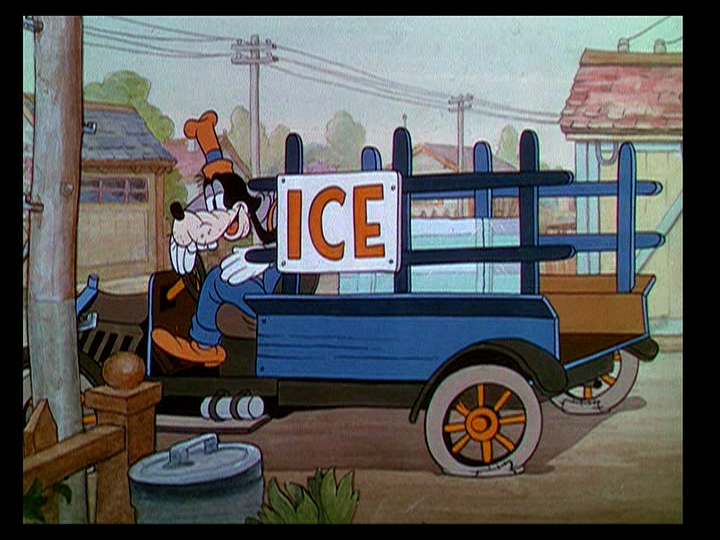
Goofy arrives as the ice delivery man

Goofy arrives as the ice delivery man

On the other side of the house, the ice delivery man Goofy pulls up in his truck and attempts to bring in a block of ice. When he calls out that he’s here, Mickey and Donald immediately shush him, and then decide they need to pack everything in a hurry and move. Mickey has trouble with over-packing a suitcase, and Goofy battles a piano that refuses to stay on his truck. Goofy and the piano chase each other around the house, with the piano purposefully trying to escape. Meanwhile, Mickey and Donald frantically pack, and when Donald shoves a plunger into a pipe to stop the air from escaping, the air builds up and sends the plunger flying onto Donald’s tail. Donald hears the plunger handle knocking against the floor and is confused by the sound, but once he sees the stuck plunger, he tries in vain to remove it. After finding himself attached to a cord on the ceiling, he finally gets unstuck from the plunger, but lands in a fishbowl. The plunger then lands itself on Donald’s head.

Goofy continues to tease the piano, which finally flies in and sends him flying into the refrigerator. He is undettered by this, however, and sits in the fridge door, enjoying a large piece of watermelon. Donald, at the same time, has managed to remove the plunger from his head, but is still stuck fast to the fishbowl. He uses a pair of suspenders to try and free himself, and when he does, he is sent flying into the pipe he tried to stop up with the plunger. After being filled with air, Donald flies around the house, crashing into Mickey’s packed suitcase, along with many other fragile items. Pete hears the commotion from outside the house and hurriedly enters, angrily demanding the trio to sit down. The three are blown into the wall from the force of Pete’s voice, causing the gas from the pipe to grow in intensity. When Pete tries to light his match for his cigar, the house explodes, leaving Pete stuck in the bathtub. Although Donald laughs at the sheriff’s predicament, he throws a tantrum when he finds that, once again, the plunger is stuck to his tail.

June 9

Posted on

June 9, 1939 – The Donald Duck Short Film Beach Picnic is Released to Theaters

vlcsnap-2013-05-29-23h47m13s183

“Boy! Time for my swim! Come on, Seabiscuit! Let’s go!”

On June 9, 1939, the Donald Duck short film Beach Picnic was released to theaters. This was the first short to be directed by Clyde Geronimi, who would go on to win an award for his work on the 1941 short film Lend a Paw. Although this is a Donald Duck short, more attention is given to Pluto, his co-star. The flypaper gag used in this short is reminiscent of the 1934 short film Playful Pluto.

Donald is enjoying a beautiful day at the beach, setting up a picnic. He then decides to go for a swim, taking his inflatable horse into the water with him. He struggles to stay on the inflatable animal, continuously sliding off into the water. He soon is distracted by a strange noise, and sees Pluto taking a nap, with the tide coming in and covering the dog. Getting an idea, Donald sends the inflatable horse sailing to shore to scare Pluto, mimicking a horse noise for greater effect. The inflatable creature ends up behind a rock, and Pluto walks out to investigate, only to be frightened by the sounds it makes, much to Donald’s glee. Pluto battles with the creature, only to find that it will literally bounce back from his punches. Finally, Pluto chomps down on the inflatable’s nose, but finds himself being filled with air and sent flying around the beach, landing in a shipwreck and having a bell land on his head.

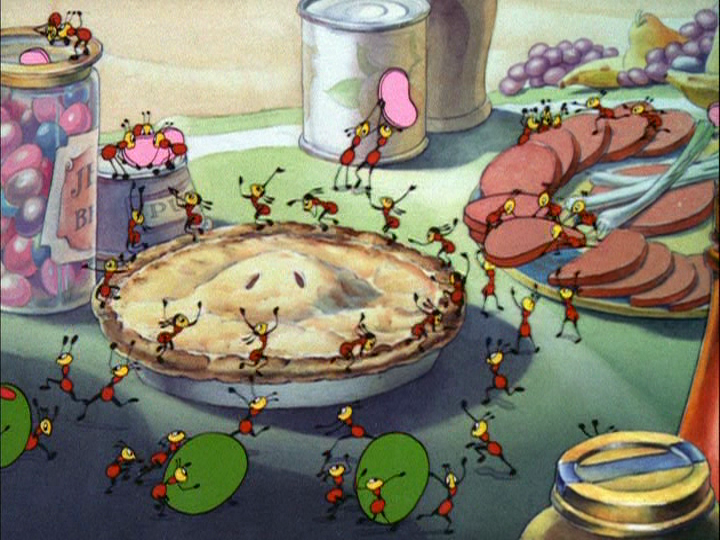
The ants quickly gather the food left out by Donald as he went for a swim

The ants quickly gather the food left out by Donald as he went for a swim

Meanwhile, an ant is surveying the scene of the beach and, seeing Donald’s unattended picnic, alerts all the other ants to “come and get it.” The food is soon carted away, but Donald spots the ants and chases them away. As he devises a plan to catch the ants with flypaper, one lone ant tries to run away with a piece of cake, but is spotted by Pluto, who is still stick in the shipwreck. He frees himself and begins to follow the ant, and the ant finds himself stuck between the flypaper and Pluto, but manages to get Pluto stuck to the flypaper instead. Pluto continues to try and free himself, but manages to remain completely stuck to the flypaper, with Donald laughing hysterically. While Donald’s back is turned, Pluto ends up sending himself flying in the duck’s direction, with the two of them getting stuck to the flypaper. Pluto tries to free Donald, and when he does, Donald ends up rolling all over the flypaper, completely covered. Pluto then licks the duck’s face as Donald throws a tantrum.

May 29

Posted on

May 29, 1937 – The Donald Duck Short Film Modern Inventions is Released to Theaters

vlcsnap-2013-05-29-05h06m18s156

“A fine way to act. Why don’t you pick on somebody your own size? You big goon!”

On May 29, 1937, the Donald Duck short film Modern Inventions was released to theaters. This was the first short directed by Jack King, who would go on to direct many of the early Donald shorts. This short was also originally released as a Mickey Mouse cartoon, although Mickey does not make an appearance.

Donald visits the Museum of Modern Marvels, where he is soon face to face with a robot butler, who takes his hat. However, Donald pulls a top hat out of thin air and continues to explore the museum. However, the butler appears again, taking his hat, but Donald pulls another hat from his sleeve. He comes across an automatic bundle wrapper with a sign that says “do not touch,” but Donald responds to this with his trademark “Aw, phooey!” and starts up the machine. The machine then grabs Donald and wraps him up, complete with a bow. When Donald breaks out of the packaging with his trademark anger, the butler appears, grabbing his hat. Donald pulls out yet another hat, and yells at the butler, who turns to retrieve the hat.

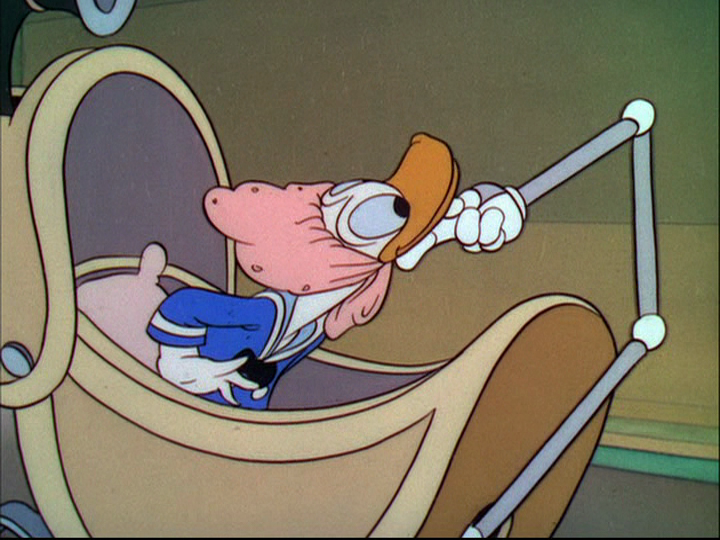
Donald enjoys the attention from the robotic nursemaid

Donald enjoys the attention from the robotic nursemaid

Donald flees, hiding in the robotic nursemaid invention. He at first has a good time while the invention rocks him to sleep and tickles him, but is soon irritated by the invention, and, after the overuse of talcum powder, Donald sneezes himself away from the invention, only to be met by the robot butler to take away yet another hat. Donald pulls out a bowler and continues exploring, ending up at a robotic barber chair. He asks the chair for the works, and it throws him in the air, where he lands with his tail upwards. Unfortunately, this is where the chair harnesses him, and his tail is the side that gets the haircut, rather than his head. Meanwhile, his head is polished as if it were a shoe. As he is finally able to leave, he is greeted by the robot butler, and finally loses his temper as the screen fades out.

May 27

Posted on

May 27, 1933 – The Silly Symphony The Three Little Pigs is Released to Theaters

vlcsnap-2013-05-27-06h01m34s96

“You can play and laugh and fiddle, don’t think you can make me sore, I’ll be safe and you’ll be sorry when the wolf comes to your door!”

On May 27, 1933, the Silly Symphony The Three Little Pigs was released to theaters. The short was based on the fable of the same name, and became a breakout hit of 1933, with Depression-weary audiences embracing the song “Who’s Afraid of the Big Bad Wolf?” as the anthem of the time, with the wolf representing the Depression and their troubles. The short was also a milestone in animation at the studio in the areas of characterization, score, and song. In most theaters, the short would be placed in top billing, lasting long after the accompanying feature had come and gone; one New York theater manager put beards on the pigs faces in their display, and had the beards “grow” the longer the run was extended. The original version of the short had the Wolf disguised as a Jewish peddler, but has since been removed. It is important to note that ethnic and racial stereotype humor were incredibly common in this time period, and many Jewish producers would incorporate these stereotypes themselves. Three Little Pigs went on to win the Academy Award for Best Cartoon. The short was directed by Burt Gillett.

Fiddler, Fifer, and Practical Pig are making their houses, with Fiddler and Fifer not taking their task too seriously. Practical Pig, however, is mostly concerned with keeping the wolf away, and builds his house of bricks. When his brothers come by to taunt him for working all day, he warns them that he will be safe when the wolf comes, but the two laugh it off, teasing Practical for being afraid of the Wolf. As the pigs dance and sing, the Wolf comes by, scaring the two back into their homes. He goes Fifer’s straw home first, and blows it clear away. Fifer runs to Fiddler’s stick home, and the two hide inside. The wolf then pretends to walk away, and the two begin to sing their song again.

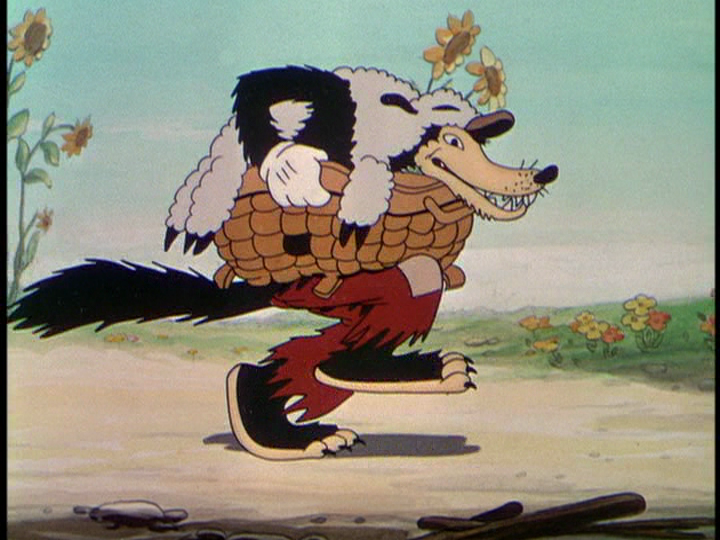
The Wolf tries to use a disguise to trick the pigs into letting him in

The Wolf tries to use a disguise to trick the pigs into letting him in

The wolf appears at the door, pretending to be a lost little sheep that needs help, but the two see right through his disguise. Angered, he blows the house down, and the two flee as fast as they can to Practical’s house. He lectures the two of their folly, but tells them he’s glad they’re safe. The Wolf then arrives as a brush salesman, but Practical Pig doesn’t fall for it. The Wolf then attempts to blow the house down, but is unable to do so. He finally decides to come down the chimney and seize the pigs, unaware that Practical Pig has a large boiling cauldron waiting below filled with turpentine. The wolf falls in and is sent shooting up again from the pain, and scurries down the road, howling. All three pigs end the short singing merrily.

May 25

Posted on

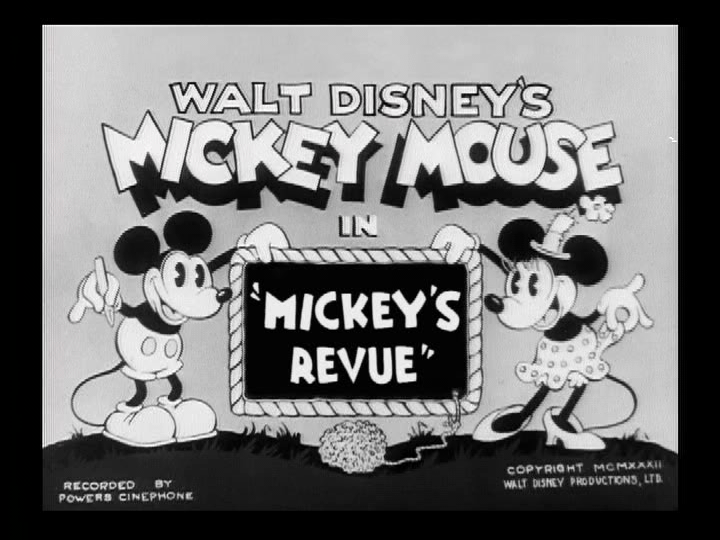
May 25, 1932 – The Mickey Mouse Short Film Mickey’s Revue is Released to Theaters

vlcsnap-2013-05-25-07h34m48s48

On May 25, 1932, the Mickey Mouse short film Mickey’s Revue was released to theaters. This short is notable for being Goofy’s first appearance, where he is a member of the audience, with his well-known laugh being the first sound he makes. The short was directed by Wilfred Jackson.

The band plays in the theater, with Mickey as the conductor. Meanwhile, an audience member is loudly cracking open peanuts and chomping them, much to the annoyance of the rest of the audience. The curtain then opens on the show, with Minnie playing a fairy (hoisted by Horace Horsecollar) and waving her magic wand on the flower dancers. Pluto appears on the side of the stage, barking at the dancers, until he is whisked away by a hook. The noisy audience member begins to laugh loudly, creating irritation around the audience again.

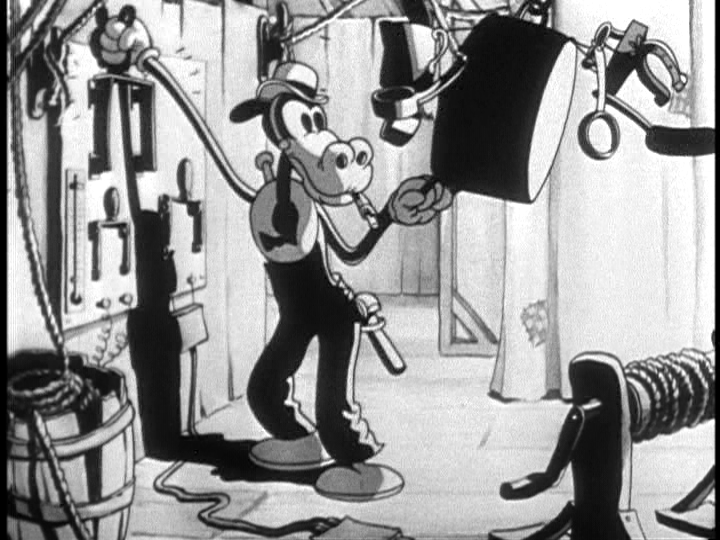
Horace Horsecollar creates a stormy scene for the dance performance

Horace Horsecollar creates a stormy scene for the dance performance

The scene changes in the show, and the dancers begin to skate around in the “snow,” which is just Horace chewing up some soda crackers. The curtain falls, and the audience cheers loudly. The next act begins with two dachshunds performing a tap show. Underneath the stage, a cat and her kittens are awakened by the tapping and peer through holes in the stage to see what is going on. Pluto still continues to wander onto the stage, getting pulled off by various means each time. The audience member’s laugh is now growing on two of the crowd members’ nerves, and they hit him on the head with a mallet, knocking him out before they surprising break out into the same kind of laughter they found so annoying.

The third act begins, with Minnie at the piano and Mickey playing various instruments in a one-man-band kind of performance. The kittens from under the stage have wandered amongst the instruments, and begin to play around, creating lively music alongside Mickey and Minnie. Pluto whines backstage, as he wants to chase the kittens, but Horace has him tied to a chair. Finally, Pluto breaks free from Horace, rushing onto the stage and breaking the piano and all of the instruments in the process. This does not prevent a successful end to the show, however, and the audience wildly applauds.

May 13

Posted on

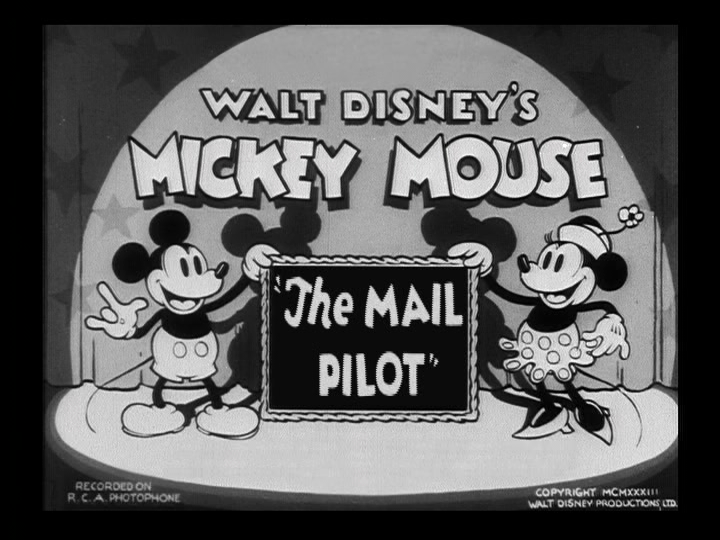
May 13, 1933 – The Mickey Mouse Short Film The Mail Pilot is Released to Theaters

vlcsnap-2013-05-13-04h17m43s211

“Through clouds and sleet, through rain and winds, a pilot never bends. We carry on, we carry on, for the mail must go through!”

On May 13, 1933, the Mickey Mouse short film The Mail Pilot was released to theaters. The short was directed by Dave Hand.

It’s a busy day at the airport, with all of the mail planes being loaded with sacks of mail. Mickey is seen oiling his plane for his journey, and an important package is delivered by armored truck for him to send. Mickey turns to the wall to see a wanted poster of mail bandit Pete, and vows to put Pete behind bars. He then starts his plane, and after some sputtering, he takes off to the sky. As he takes off, it begins to rain, but Mickey is undeterred, even more so when he is attacked by lighting, and when he comes across snow.

After being forced to the ground by Pete, Mickey uses some ingenuity to get back in the air

After being forced to the ground by Pete, Mickey uses some ingenuity to get back in the air

Unfortunately, Pete sees Mickey, and begins his attack. Mickey tries to jet away, but Pete uses a machine gun to cut up Mickey’s wings. Falling to the ground, Mickey uses some quick ingenuity to stay airborne, although he is followed closesly by Pete, who uses a harpoon to grab Mickey’s plane. Mickey refuses to be caught, and takes off, dragging Pete behind him. He lands back at the airport, Pete in tow, and Pete is soon arrested. Minnie appears at his side, and gives her brave pilot a kiss.

April 21

April 21, 1930 – The Mickey Mouse Short Film Fiddling Around is Released to Theaters

vlcsnap-2013-04-20-21h39m20s13

“As an encore, I will play the finale from the overture ‘William Tell.’”

On April 21, 1930, the Mickey Mouse short film Fiddling Around was released to theaters. This short is also known as Just Mickey, which was the short’s original working title. This is also one of the rare instances that Mickey is seen with hair. The pieces performed in the short are Schumann’s “Traumerei” and one of Listz’s “Hungarian Rhapsodies,” as well as the called out finale of the “William Tell Overture.”

Several pairs of curtains part on a large stage, revealing Mickey walking ceremoniously with a fiddle, but he trips at the front of the stage. As the audience laughs, Mickey blushes, but gets on with his performance, except that one of his violin strings breaks. He then musses his hair in an artistic manner before playing highly regarded pieces of classical music. He then breaks into a rather tragic piece, wailing and crying the entire length. He finishes that tune by crying and carrying his violin behind him as he walks offstage. He then comes back to wild applause from the audience. He then comes back on stage to announce his encore from the “William Tell Overture.” His spirited playing has him crawling across the stage, throwing his violin in the air, and breaking it in half. The concert is a rousing success.