RSS Feed

Tag Archives: 1930s

December 17

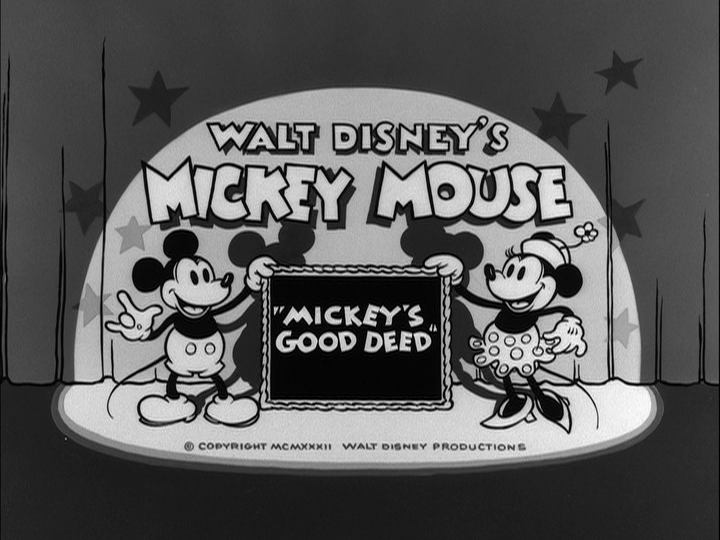
December 17, 1932 – The Mickey Mouse Short Film Mickey’s Good Deed is Released to Theaters
vlcsnap-2013-12-17-18h54m38s247

“Thank you! Merry Christmas!”

On December 17, 1932, the Mickey Mouse short film Mickey’s Good Deed was released to theaters. It was directed by Burt Gillett.

It’s a cold Christmas night, and Mickey is playing “O Come All Ye Faithful” on the cello while passersby throw him coins in his tin cup. Pluto howls along with Mickey’s playing, and the two are pleased that they have enough money to get something to eat. However, they find that people have been throwing them nuts and bolts instead of money, and are unable to buy any food. Mickey is discouraged, but cheers up quickly when he gets the idea to play outside of a rich person’s house. Inside the house, a spoiled piglet is loudly whining while his father and the butler try to entertain him. Suddenly, the piglet is distracted by Pluto’s howling outside, and demands that his father buy him the dog. The butler pursues Mickey and Pluto, but Mickey refuses to sell Pluto, as Pluto is his pal. Unfortunately, in the chase, Mickey’s cello is destroyed by a passing horse-drawn sled.
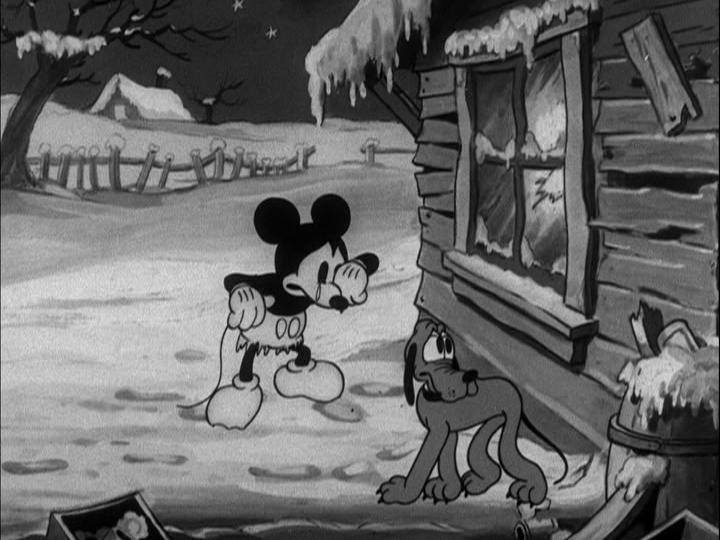
After seeing the poverty-stricken single mother and her several children, Mickey and Pluto are driven to tears

After seeing the poverty-stricken single mother and her several children, Mickey and Pluto are driven to tears

Mickey soon spies a woman crying in a dilapidated shack, and realizes that the money could help her and her several children for Christmas, and sells Pluto to the butler, provided that they give him a good home. Inside the home, the piglet starts abusing Pluto, hitting him with a hammer and chasing after him with a toy train. Meanwhile, Mickey uses the money to buy gifts for the children, and pretends to be Santa while packing their stockings. He wakes up the children as he leaves, and the children are delighted to find that Santa found them. Back at the hose, the piglet is causing even more havoc, with his father and the butler unable to stop him. The father is at his wits end, and decides to throw Pluto out. As the piglet whines, the father finally gives the piglet a long-overdue spanking. Pluto leaves the house and reunites with Mickey, and the two are pleased to find that the will have Christmas dinner, as the piglet tied a turkey to Pluto’s tail.
December 10

December 10, 1932 – The Silly Symphony Santa’s Workshop is Released to Theaters

vlcsnap-2013-12-10-18h24m25s57

“We’re the merry, merry men of the midnight sun, we work for Santa and have a lot of fun.”

On December 10, 1932, the Silly Symphony Santa’s Workshop was released to theaters. A sequel to this short, The Night Before Christmas, was released in 1933. There are several allusions to popular characters and often used stereotypes of the era, including a Charlie Chaplin wind-up doll. The short was directed by Wilfred Jackson.

At Santa’s Work Shop, all the elves are busy doing the final preparations for December 25th, including bringing mail and cleaning up his sled. Santa is seen reading his letters, and checking to see if the children that send the letters are on the naughty or nice list. An elf takes the letters to the factory, where dozens of elves are making the Christmas presents. An assembly line is seen working on rocking horses, while painters are seen working on blocks, dolls, and chess boards. Each toy goes to Santa for inspection, and he stamps them either with “OK” or “NG.” A marching band of tin soldiers marches through the factory, leading a parade of toys into Santa’s sack. As the sack is filled, Santa has his elves bring it out to his sled, and he bids his elves goodbye as he sets off to deliver the toys.

December 5

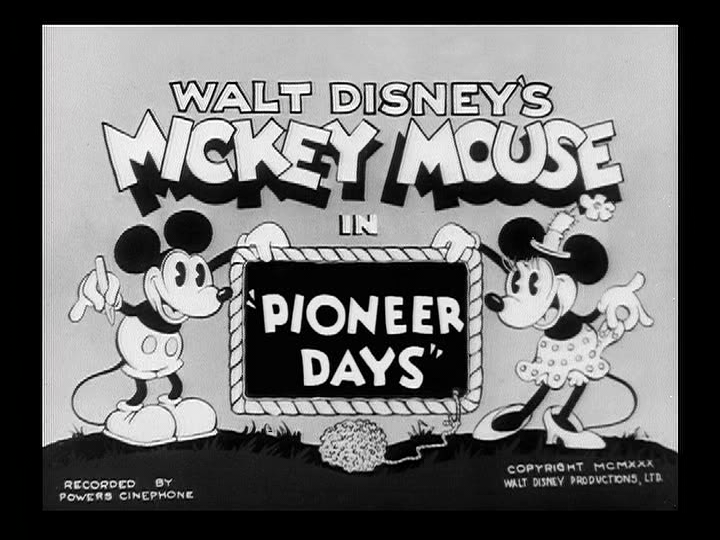
December 5, 1930 – The Mickey Mouse Short Film Pioneer Days is Released to Theaters

vlcsnap-2013-12-05-18h20m40s76

“Oh my poor Nellie Gray, they have taken you away.”

On December 5, 1930, the Mickey Mouse short film Pioneer Days was released to theaters. The short features cameos of Mickey and Minnie’s friends Clarabelle Cow and Horace Horsecollar. It was directed by Burt Gillett.

Mickey and Minnie are seen traveling with a wagon train, singing and playing the banjo. Mickey sings that he’s not afraid of Indians, but once he does, an Indian scout is seen making his way back to his camp after spying the wagon train. He alerts his tribe members, and they dance around the fire, whooping and hollering. Meanwhile, the wagon train has stopped for the evening and is sitting around a campfire, singing songs. A square dance begins, and everyone in the train joins in.

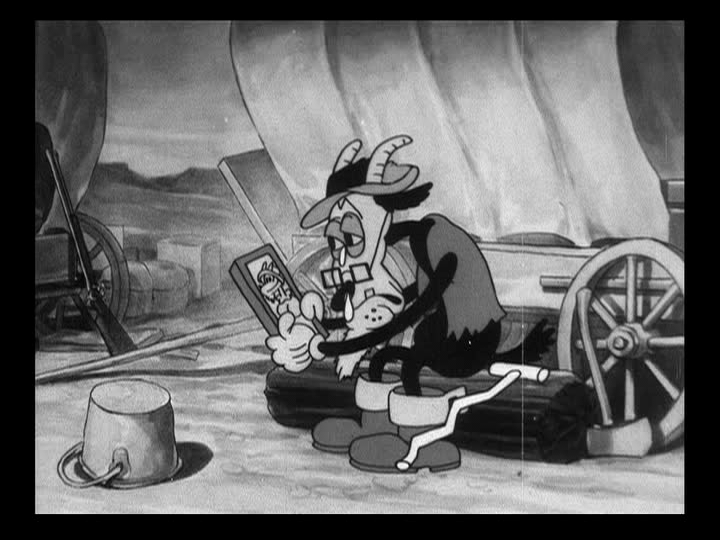
The old goat cries over a photo of his lost love, and sings a mournful song for her

The old goat cries over a photo of his lost love, and sings a mournful song for her

An old goat is morning over the loss of his love, and as he sings, everyone begins to cry, with Mickey comforting Minnie as they both sob. As they cry, an arrow is shot into the camp, landing right above Minnie’s head. The camp prepares itself for an Indian attack, and it soon becomes an all-out war. Mickey fights with gusto, hiding in a stove at one point. As his gun is blown up, he decides to use a porcupine to stop three Indians from setting fire to the wagons. After this victory, he hears Minnie screaming out for help, and sees her being ripped from a wagon and stolen away. Mickey chases after the Indian, and arrives at his camp to find he has tied Minnie to a tree. The two fight in the woods, but Minnie manages to free herself and place a hot coal down the Indian’s pants. Back at the camp, it appears that the Indians are winning, when Mickey and Minnie fool the Indians into thinking that the Calvary has arrived. The Indians flee, and the pioneers cheer.

November 30

November 30, 1935 – The Silly Symphony Cock o’ the Walk is Released to Theaters

vlcsnap-2013-11-30-18h38m38s55

On November 30, 1935, the Silly Symphony Cock o’ the Walk was released to theaters. The music used in the film, “Carioca,” was taken from the RKO film Flying Down to Rio, which was fitting, as 1935 was the last year that United Artists would distribute Disney films, as it would move to RKO the following year after a long courtship. It was directed by Ben Sharpsteen, and marks the debut of composer Albert Hay Malotte.

The short begins with a parade, welcoming home the world’s champion boxer, Cock o’ the Walk, who struts his stuff on a float, followed by all of the hens in the town. One hick rooster is professing his love to a skinny hen, but her attention is lost when she catches the eye of Cock o’ the Walk, who asks her to dance with him. The two begin to dance, and all of the hens in town begin to gossip and join in the dancing. The entire barnyard begins to dance, including chicks, caterpillars, and peacocks.

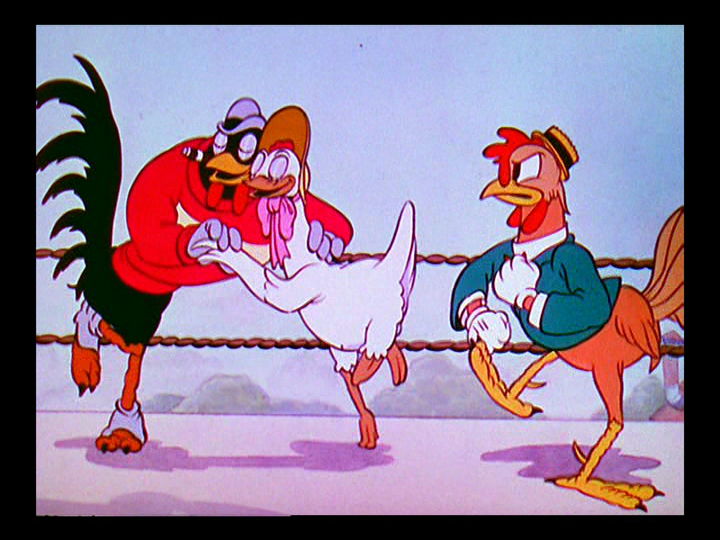
Angered by the champion taking his girl, the hick rooster tries to break them up

Angered by the champion taking his girl, the hick rooster tries to break them up

As Cock o’ the Walk continues to dance with the hick’s girl, the hick decides to put an end to it, and the hens laugh as Cock o’ the Walk mocks him. The hick challenges the champion to a fight, with the hick working more to dodge the advances before getting pummeled. Cock o’ the Walk’s bag is knocked into the skinny hen’s lap as she cheers for the champion, and discovers that Cock o’ the Walk is not only married, but he has 14 baby chicks. Angered at this realization, she slaps him, and tried to revive the hick rooster with a kiss. His strength is renewed, and he beats Cock o’ the Walk, winning the fight and sending the champion flying into his trophies. The short ends with the hick rooster and his skinny hen dancing together happily before he lays a large kiss on her and lets out a loud rooster call.

November 25

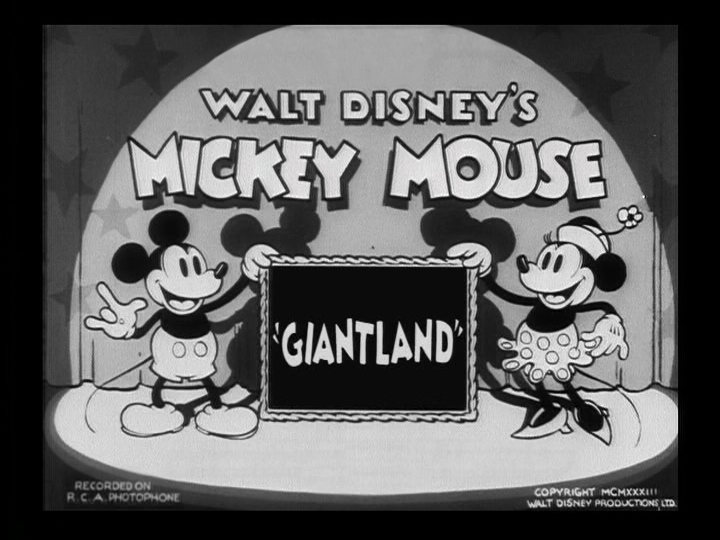
November 25, 1933 – The Mickey Mouse Short Film Giantland is Released to Theaters

vlcsnap-2013-11-24-18h34m28s80

“Tell us a story, Uncle Mickey! Yes, tell us a story, Uncle Mickey!”

On November 25, 1933, the Mickey Mouse short film Giantland was released to theaters. This short is known as the precursor to the “Mickey and the Beanstalk” segment of the 1947 package film Fun and Fancy Free; there are also many similarities to this short and the 1938 short The Brave Little Tailor. The short film was directed by Burt Gillett.

The short begins with Mickey reading Jack and the Beanstalk to his nephews. They are rapt with attention as he begins the story, and soon, Mickey inserts himself into the story, and the group begins to imagine Mickey climbing up the beanstalk, entering Giantland. He arrives at the castle door and hears the singing of the King of Giantland. He hides in the keyhole to avoid being spotted, and enters inside, trying to hide in the sugar bowl. Mickey is accidentally scooped up with a sugar cube and place in the giant’s cup of coffee, but manages to escape. After hiding in a block of Swiss cheese, Mickey is then accidentally eaten by the giant, and works to keep himself from being swallowed. When the giant develops hiccups, he swallows a jug full of water, but Mickey is able to once again avoid being swallowed.

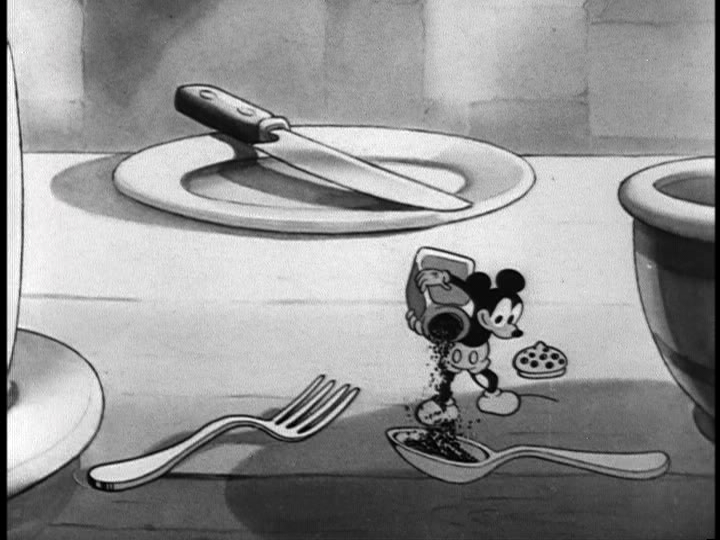
Mickey arms himself with pepper against the angry giant king

Mickey arms himself with pepper against the angry giant king

Mickey starts choking on the smoke from the giant’s pipe, and when the giant removes his pipe, he discovers the mouse. A chase ensues across the kitchen table, and Mickey ends up trapped in an empty bottle. The giant proclaims that he now has Mickey, but Mickey bites the giant’s finger and escapes, heading straight for the pepper shaker. He uses the pepper, and a spoon as a catapult, to cause the giant to sneeze. His sneezes are powerful enough to destroy the castle, and Mickey is sent flying to the ends of Giantland, where he slides down the beanstalk and burns it as the giant comes climbing down. The giant is sent tumbling to the ground, creating a massive hole where he falls. The scene then goes back to Mickey telling the story, saying that the giant went “down and down and down and down and down and down and down and down. And he came out in China.”

November 18

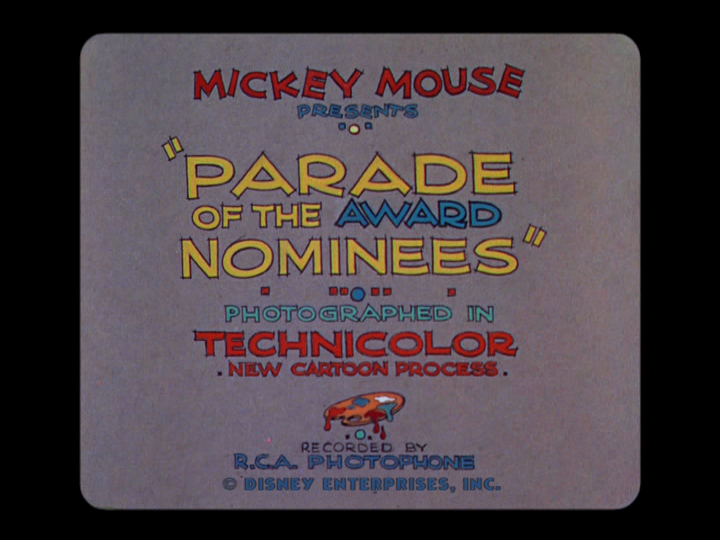
November 18, 1932 – The Short Film Parade of the Award Nominees Premieres at the Academy Awards

vlcsnap-2013-11-18-20h34m39s52

On November 18, 1932, the special short film Parade of the Award Nominees premiered at the 5th Academy Awards, held at the Ambassador Hotel in Los Angeles, California. This ceremony also introduced short films within the Oscar categories, with Disney’s Flowers and Trees winning the first Academy Award for Best Animated Short Film and being the first color winner. Parade of the Award Nominees was created specifically for the banquet, and the first short that showed Mickey Mouse in color. Pluto is also shown in color, but is a grey-ish brown rather than his standard yellow. Disney Legend Joe Grant was hired by the studio to create the caricatures of the actors for the short, and would remain at Disney for over 70 years.

Mickey is seen in a bandleader’s uniform, leading a parade which begins with Minnie holding a sing that says “Parade of the Award Nominees.” After three trumpeting pigs and a percussion set march by, a carpet is rolled out, with Clarabelle Cow throwing flowers on the ground for the actors to walk on. The first actor is Wallace Beery, for his role in The Champ, with costar Jackie Cooper. Following the two is Lynn Fontanne and Alfred Lunt for their roles in The Guardsman, and Helen Hayes for The Sin of Madelon Claudet. Next is Fredric March, who transforms to a hideous monster, as he represents his role as the titular Dr. Jekyll and Mr. Hyde. Last but not least is Marie Dressler for her role in Emma, who is followed by Pluto, who has “The End” on a flag tied to his tail.

October 28

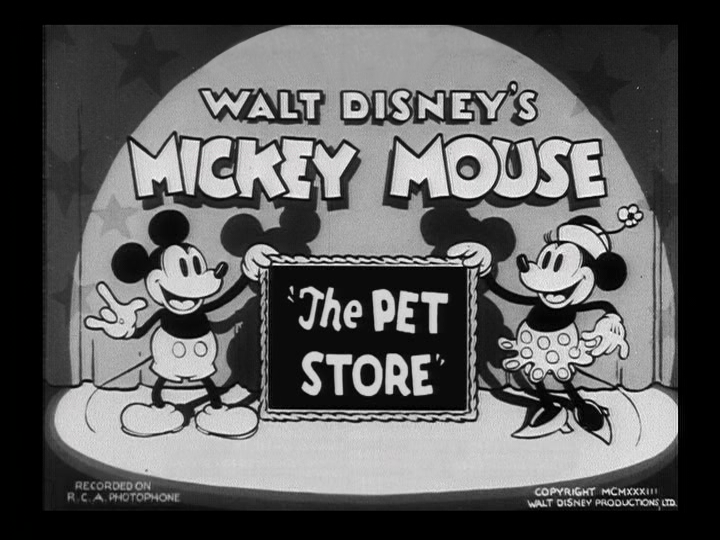
October 28, 1933 – The Mickey Mouse Short Film The Pet Store is Released to Theaters

vlcsnap-2013-10-28-21h02m10s245

“Oh, hello Minnie! How do you like my zoo?”

On October 28, 1933, the Mickey Mouse short film The Pet Store was released to theaters. It was directed by Wilfred Jackson.

A sign hangs in the window of Tony’s Pet Store for a boy wanted to work in the shop. Mickey happens to come across it, and enters the store to apply for work, and Tony gladly offers him the job to sweep the shop while he goes out for lunch. Mickey takes to his job quickly, when Minnie strolls in. She is impressed with the pet shop, and begins to sing for the birds, who start chirping with her. An ostrich nearby starts eating the birdseed on the shelf, and develops a bad case of the hiccups. As Mickey takes Minnie to dance, she sets down her umbrella, which is soon eaten by the ostrich. Thanks to his hiccups, the umbrella opens in his throat with every hiccup.

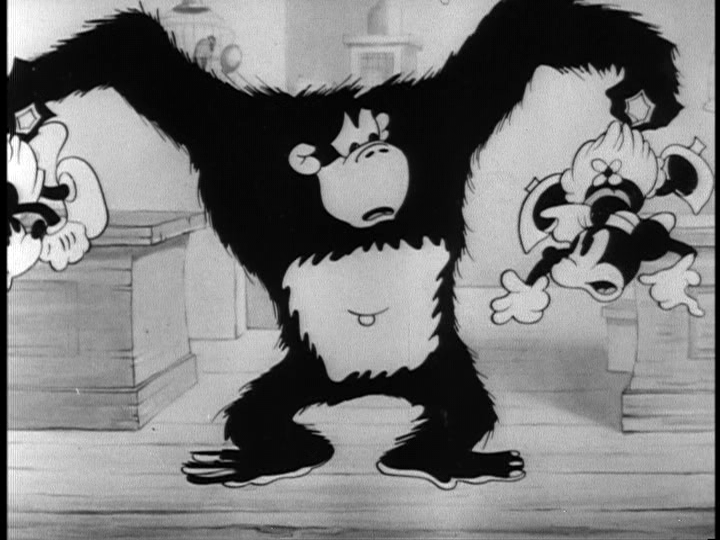
Beppo pries Minnie away from Mickey, acting as though he were King Kong

Beppo pries Minnie away from Mickey, acting as though he were King Kong

A gorilla named Beppo, who does imitations of movie actors (including one of Stan Laurel), decides to imitate King Kong and break out of his cage. After leaving his cage, he grabs Minnie from Mickey and throws Mickey aside, sending the mouse crashing into the birdcages, freeing all the birds. Beppo then climbs a tower of birdseed, in true King Kong fashion, and starts growling from his perch. All of the freed animals start throwing things around creating a huge mess in the pet shop as they try to stop Beppo. Finally, Beppo is captured in a cage, and Mickey takes Minnie to flee from the shop before Tony returns from lunch to find his shop in disarray.

October 20

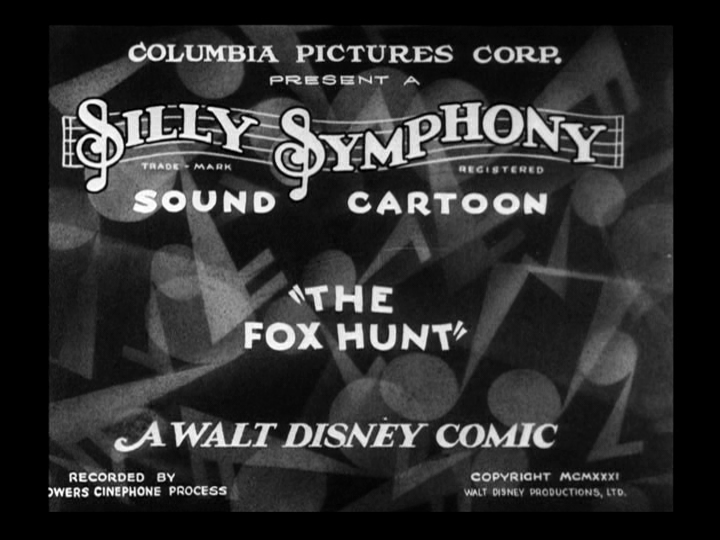
October 20, 1931 – The Silly Symphony The Fox Hunt is Released to Theaters

vlcsnap-2013-10-20-17h41m22s148

“Hooray!”

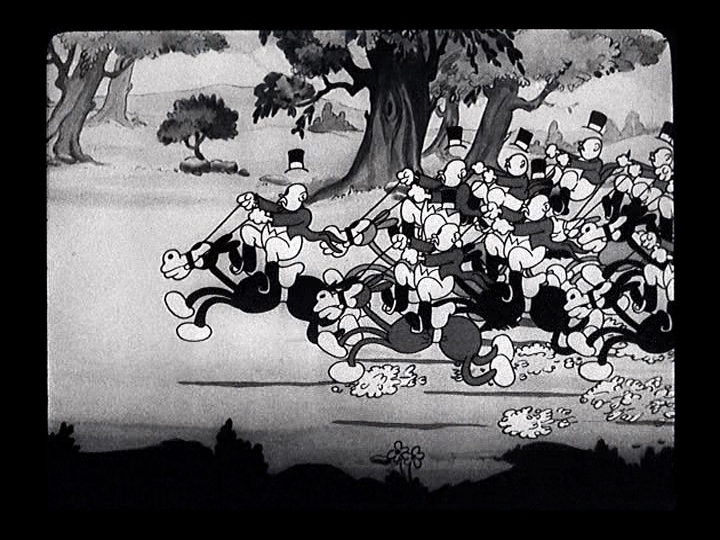
On October 20, 1931, the Silly Symphony The Fox Hunt was released to theaters. The short was remade in 1938 as a Donald Duck and Goofy short. The Silly Symphony was directed by Wilfred Jackson.

Sunlight streams through the trees of the forest, and several birds chirp with the coming of the dawn while a bell rings in the steeple nearby. Two riders sound their horns, and are followed by a long line of riders, finished with two pages holding a fox in a cage, and one page holding on to several leashes of dogs who are ready to begin the chase. The riders stop in front of a blacksmith, who is working hard at his trade. He sends out a horseshoe to his assistant, who begins to shoe the horses while the riders have tea. The horns sound again, and the riders head out for the hunt.

The riders eagerly chase the fox once the hunt begins

The riders eagerly chase the fox once the hunt begins

The gun sounds, and the fox is set free, followed by the herds of dogs and riders. The riders travel at different rhythmic paces, but are soon stopped when the fox jumps over a wall, with each rider accidentally headbutting the next. One rider flips off of his horse and ends up riding a cow instead, and when he falls off the cow, he ends up riding a pig, a porcupine, and a log that is filled with stuck dogs. The rider finally catches the fox by the tail, and traps him in another log. Unfortunately, when he thinks he can pull it out from the log, he pulls out a skunk instead. The appearance of the skunk causes all the riders and dogs to flee; once the crowd is gone, the fox leaves the log and shakes hands with the skunk.

October 14

October 14, 1938 – The Silly Symphony Farmyard Symphony is Released to Theaters

vlcsnap-2013-10-14-20h15m41s85

“How are ya, toots?”

On October 14, 1938, the Silly Symphony Farmyard Symphony was released to theaters. It was based on the story of Chanticleer the rooster, a staple in Middle Ages folklore. Interstingly enough, stories of Chanticleer are usually told with Reynard the Fox, a character that the Disney Studios were looking to make a movie about, which eventually led the way to the 1973 film Robin Hood. The songs featured in this film is “La Donna E’mobile” from the opera Rigoletto by Giuseppe Verdi, “The William Tell Overture” by Gioachino Rossini, and Franz Liszt’s Hungarian Rhapsody. The film was directed by Jack Cutting.

The morning breaks over a pleasant farm, and a rooster is heard crowing with the dawn. Doves exit their nest, a bull scratches his back on a fencepost, and other animals wake up to greet the day. As a calf drinks from his mother’s udder, a baby pig, unable to get milk from his own mother, runs to hopefully get some milk. The claf scares the poor pig away, sending him running into the horse pen. The calf and the foal start running around together, until they spy some geese marching to the barn. The rooster crows again, although he has some trouble crowing to begin with. He marches around his domain as the literal cock of the walk, until he hears the hens snoring. He sneaks into the hen house and lets out a loud crow, waking them with a startle.

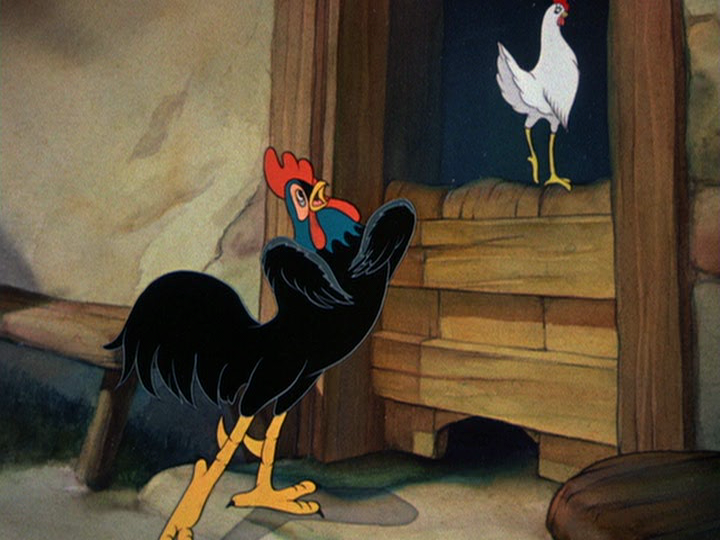
The rooster woos the hen with some serenading

The rooster woos the hen with some serenading

The rooster is attracted to one of the hens, who flirts with him not-so-subtly, but she also flees from his rather pushy nature of running after her. He then serenades her, and the two end up serenading the farm with a duet, with the whole farm eventually joining in. The opera is interrupted by the farmer and his wife calling the animals for feeding time. The baby pig from the beginning is once again unable to get food, and runs around the farm, trying to find a way to get something to eat, but is chased off by all the animals he encounters. He runs into a building, and knocks out all the corn inside, which is soon eaten the baby pig and all of the chicks.

September 28

September 28, 1935 – The Mickey Mouse Short Film On Ice is Released to Theaters

vlcsnap-2013-09-28-20h40m49s41

“It’s a cinch! Watch me!”

On September 28, 1935, the Mickey Mouse short film On Ice was released to theaters. Clarabelle Cow and Horace Horsecollar make a brief appearance at the beginning of this short; Goofy also sings a snippet of his theme song, “The World Owes Me a Living.” It was directed by Ben Sharpsteen.

Everyone is skating at the nearby frozen river, and as Minnie and Mickey skate together, Mickey keeps a pillow ready for Minnie, as she keeps falling. Mickey then shows off for Minnie, although she warns him to be careful as he trips on a barrel and falls through the ice, but he is able to laugh off the incident. Goofy finds a spot on the river to go ice fishing, using chewing tobacco as bait. The fish chew the tobacco, and as they jump to spit in the spittoon, he attempts to club them. Unfortuantely, one of the fish takes his club and clubs Goofy.

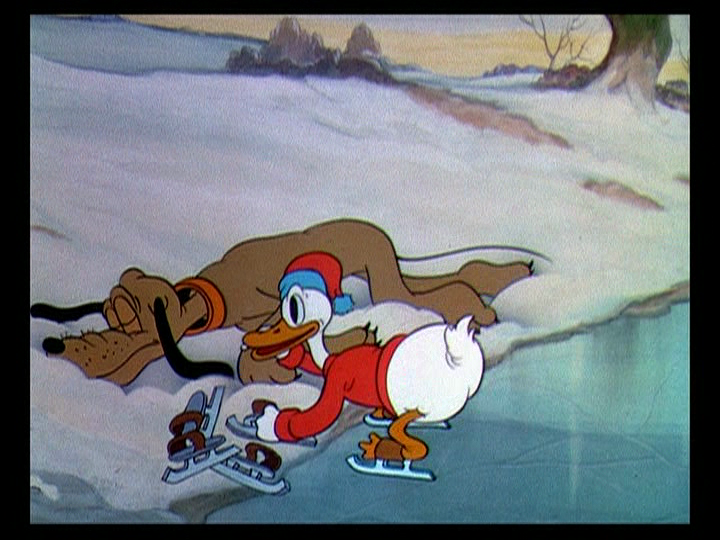
Donald takes skates and ties them to the sleeping Pluto's feet

Donald takes skates and ties them to the sleeping Pluto’s feet

Donald, meanwhile is skating along, when he spies Pluto sleeping on the bank. He decides to play a prank on the dog by placing ice skates on his feet. He then hides and makes cat noises, waking Pluto and sending him flying out on the ice, only to slip and fall thanks to the skates. Donald laughs at Pluto’s misfortune, but Pluto endeavors to master the skates. At one point, Pluto sneezes hard enough to send himself flying into the campfire on the bank, and puts his end into a hole in the ice to cool down. When he removes his tail, he finds that it is completely frozen, and starts chasing it.

Donald attaches himself to a kite and skates around Pluto, mocking him, when a strong wind picks up and sends Donald flying down the pond, and he cries out for help. Mickey spots Donald heading towards a waterfall, and races to save the duck. Mickey is pulled off the ice and scrambles to return to shore, but loses Donald, who sails back into the river and straight into the hole where Goofy is waiting to club fish. Goofy apologizes, stating that he thought Donald was a fish, and Donald angrily yells at Goofy and Pluto, who barks at the duck’s misfortune.