RSS Feed

Tag Archives: Short film

March 14

March 14, 1929 – The Mickey Mouse Short, The Barn Dance, is Released to Theaters
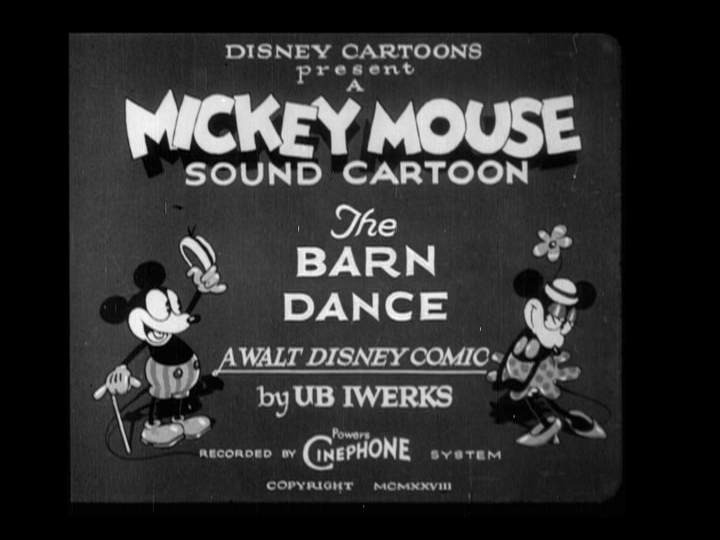
On March 14, 1929, the fourth Mickey Mouse short, The Barn Dance, was released to theaters. Directed by and using the vocal talents of Walt Disney (although this short continues to feature more “squawking” than actual dialogue), this short is one of the disastrous dates of Mickey and Minnie. Although not the first short where Minnie rebuffs Mickey’s advances, it is one of the more tragic ones, due to Mickey’s emotional outburst in the end.

Mickey is seen in the opening shot in a horse-drawn buggy, holding flowers for his sweetheart, Minnie Mouse. As he uses the whip to make the horse gallop faster, his buggy also begins to gallop, and Mickey has to hold onto his seat for dear life. They stop in front of Minnie’s house, where she is seen in the window, powdering her nose. Mickey’s heart pounds loudly before he whistles for her attention. Minnie appears in the window and waves before quickly pulling her bloomers on the laundry line inside. Mickey and his horse both look excitedly at the window, but Mickey pulled down a shade attached to the blinders on the horse, and the animal turns away to pout.
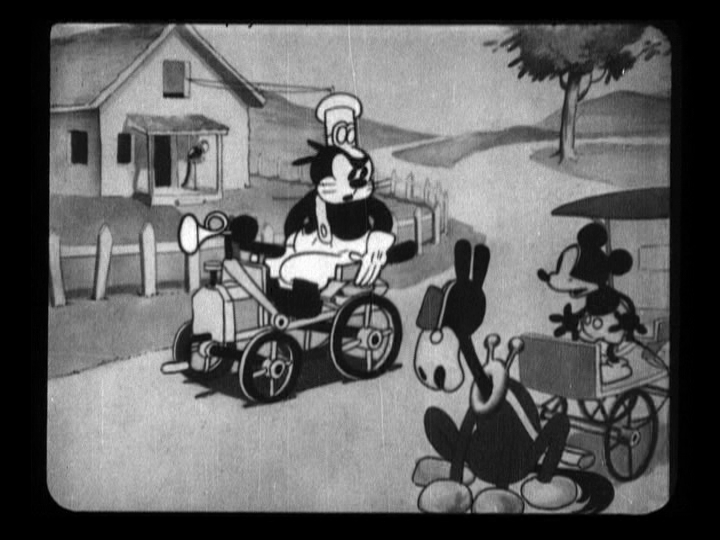
Pete arrives as a rival to Mickey for Minnie's affections

Meanwhile, Pete is driving up the road in his car, also on his way to see Minnie. He looks over at Mickey in his buggy and doesn’t think much of the mouse before he honks his horn for Minnie’s attention. Mickey is initially angered by Pete, but when he spies a duck on the road next to him, he picks up the bird and begins honking it like a horn to match Pete’s incessant honking.

Suddenly, Minnie appears, all dolled up for a night on the town. She stops at the gate while both of her admirers bow, and as she steps out to greet them, she spies Pete’s car and runs to it excitedly. As Pete starts up the car, it sputters and shakes, and Pete sends a stream of black smoke from the tailpipe in Mickey’s direction. Unfortunately, the car takes off and leaves Minnie and Pete behind before crashing into a tree and breaking into several car parts. Minnie rejects Pete and decides to go to the dance with Mickey, and the two flirt and kiss on the way there.
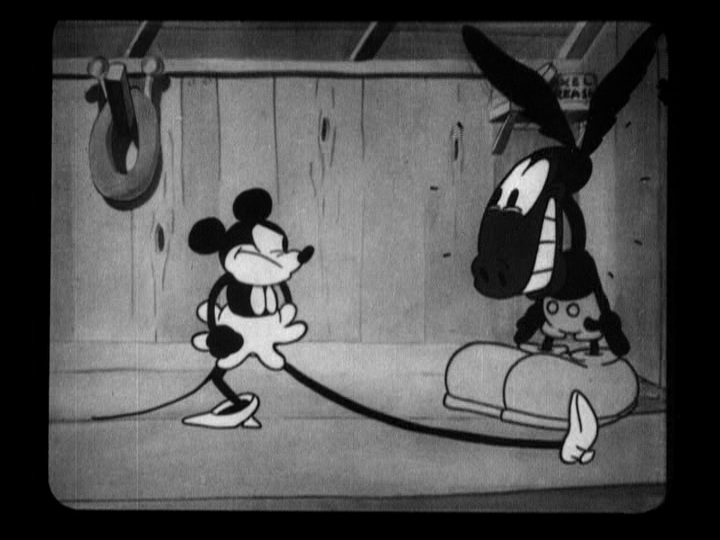
Mickey literally feels like a jackass for continually stepping on Minnie's feet and legs

The dance is already in full swing when the couple arrives. Unfortunately Mickey is so overzealous in his dancing that he keeps stepping on Minnie’s feet, with his feet growing in size for comic effect. At the end of the dance, Mickey is standing with both feet on Minnie’s leg, and she struggles to pull it out. Mickey finally notices that he’s on Minnie’s leg and gingerly steps off, with Minnie holding the limp limb sadly. As Minnie is furious and Mickey literally feels like a jackass, Minnie knots up her stretched leg just as a new dance begins. Although Mickey tries to dance with Minnie again, Minnie decides to dance with Pete, who is a much better dancer, instead.

Mickey stands in the corner, but gets the bright idea to be “light on his feet” by tucking a helium balloon into his shorts. He leaps gracefully over Pete, surprising the two, and Minnie begrudgingly agrees to dance with Mickey. Things go well for a while, until Pete realizes Mickey’s scheme and shoots a nail at the balloon in Mickey’s shorts, making Mickey fall on Minnie. Having had enough, Minnie decides to dance with Pete for the rest of the dance, leaving Mickey to cry in a corner.
March 12

March 12, 1943 – The Donald Duck Short, The Flying Jalopy, is Released to Theaters

“Ah, yes, a little matter of insurance…”

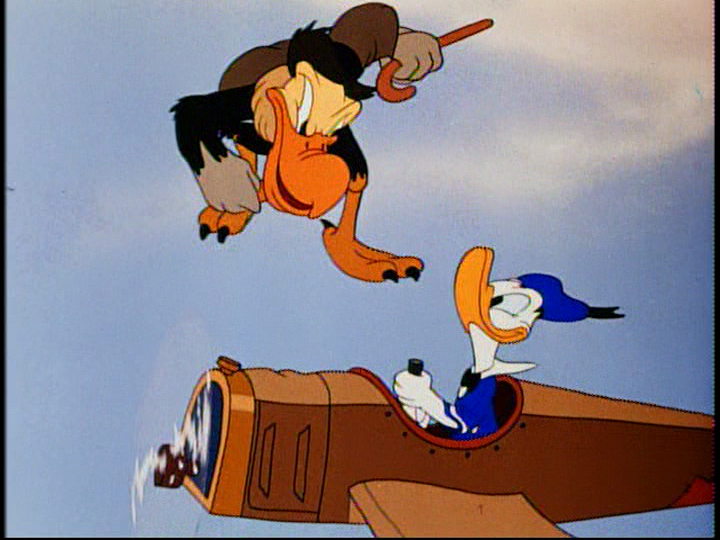
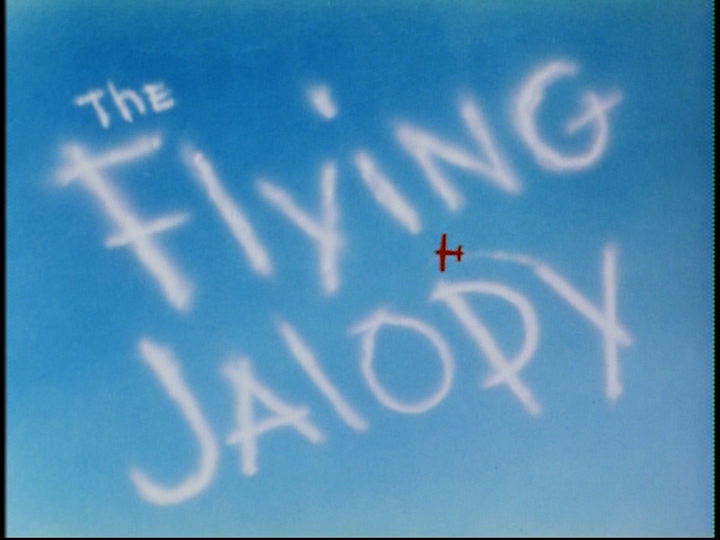
On March 12, 1943, The Flying Jalopy, a Donald Duck short, was released to theaters. Directed by Dick Lundy, the short is about Donald dealing with a shady used plane dealer, who tries to get Donald to have an accident so he can collect on a $10,000 insurance policy. Although Donald is known for being accident-prone, this short is one of the few that shows Donald avoiding a major accident, for the most part.

The short opens with a billboard sign for Ben Buzzard and his used planes (which used to be called “wrecked planes,” but the word “wrecked” is crossed out in bold back strokes). The camera zooms out and shows the airfield where the “used” planes sit as scrap sculptures, except for one last plane that is very Wright Brothers-esque. Donald is seen examining the plane, which has been marked down to a down payment of $59.98. Donald feverishly checks to see if he has enough money, but unfortunately is a bit short of the asking price.

Ben Buzzard, the proprietor, lurks in the office doorway, observing the cash in Donald’s hands. Thinking quickly, he starts the salesman act, pulling Donald back with his cane and asking Donald if he is interested in an airplane. Donald nods excitedly, and Ben launches into his sales pitch. The first one he calls attention to has its wheel burst while they are observing it, but Ben offers Donald the chance to buy it with an offer of no down payment. He hits the tail of the plane with his cane, making the tail fall off. He quickly puts it back on and rushes to get Donald to take a test flight.

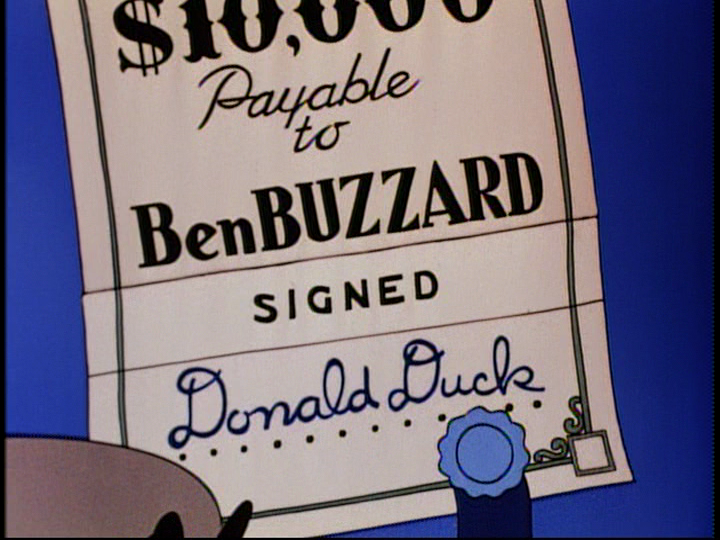
The shady insurance document Ben was able to have Donald sign

As Donald is sitting in the cockpit, ready for his test flight, Ben tells him there is one more thing: an insurance policy he unrolls from his coat pocket. Donald eagerly signs it, as it seems to say that in the event of an accident, he will be paid $10,000. As Ben takes the paper, he unfolds it, revealing that in the event of an accident, $10,000 will be paid to Ben, signed by Donald. To get this money, Ben decides that Donald will have to die.

Ben begins the test flight, breaking the front propeller, and continuing his plan of making Donald have an accident. Unfortunately for him, Donald is able to avoid hitting the side of a cliff, and manages to keep the plane in the air, with Ben watching angrily from the ground as his plans are foiled. Ben swears that he will get Donald, and takes off to the sky.

Donald feels pretty good about his flying skills as he keeps the jalopy in the air

Ben greets Donald in the air, telling the beaming duck that he is rather good at flying, and suggesting a game of Follow the Leader. Donald agrees, and Ben offers to lead. He gracefully dives around the clouds, and Donald tries to follow him, but both of the plane’s wings rip from the body of the plane. Quickly, as Donald begins to plummet to the ground, he grabs the wings floating in the air and reattaches them, and is able once again to keep himself in the air.

Ben sits on a cloud and furiously tries to come up with a plan, only to be blown away by Donald, who is quickly flying by. As Ben dangles in the air from his cane that has caught a part of a cloud, he spies a small opening between two cliffs, which he knows the plane won’t possibly make it through. He then surrounds the cliff tops with cloud cover, and calls Donald over to continue the game. As he slips to the other side, Ben gives an evil grin and brags to the audience with death in his eyes, “He’ll never make it!” Unfortunately for Ben, once again, Donald is able to save himself from danger at the last minute, turning the plane sideways and slipping through quite easily.

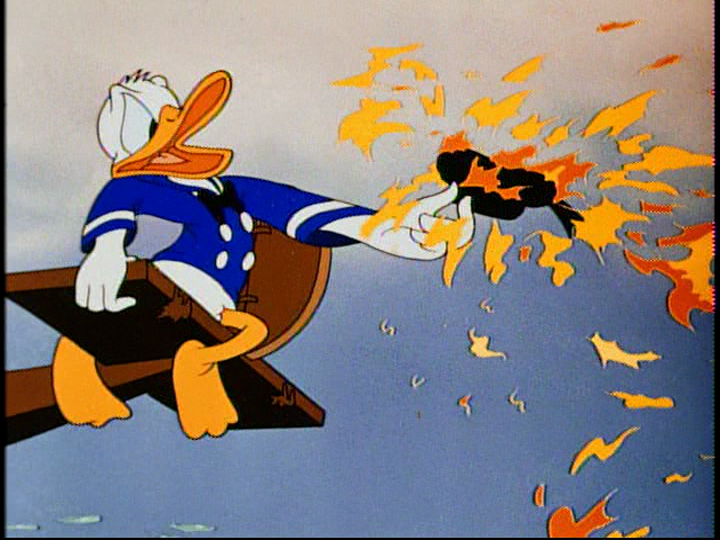
As Donald tries to put out the flames with his hat, he looks in alarm as it catches on fire

Having had enough, Ben cries out that Donald is a dirty cheat, and begins to destroy the plane outright, being done with underhanded plans. It becomes an outright war between the two, especially after Ben opens Donald’s gas tank and sets the stream of gasoline on fire. Donald tries to blow the flames out, but to no avail. Ben, meanwhile, perches on a cloud and laughs, thinking the policy will soon be his. He doesn’t count on Donald flying in his direction, and while Ben tries to make a break for it, he continues to be in the plane’s path. The plane finally meets its demise when the flames reach the gas tank, but all is not lost: Donald safely flies his new plane – Ben, who is trapped inside the last piece of the body of the plane – through the air, laughing all the way.

March 11

March 11, 1933 – The Silly Symphony Short Film, Birds in the Spring, is Released to Theaters

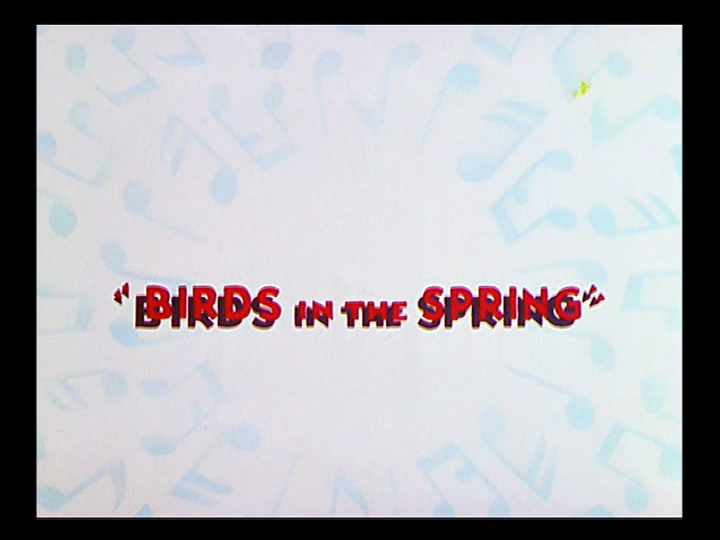
The Silly Symphony short, Birds in the Spring, was released in theaters on March 11, 1933 by United Artists. Directed by Dave Hand, with music by Bert Lewis, the short tells the story of a baby bird whose thirst for curiosity brings him a day full of adventures. The title card of the Silly Symphony attests to the popularity of Mickey Mouse in the early 1930s, as it states: “Mickey Mouse Presents Walt Disney’s Silly Symphonies.” It had been believed that, as far as animation, people would only want to see Mickey Mouse cartoons, and Mickey’s name on the title card would ensure an audience. Luckily, the Silly Symphonies were popular in their own right.

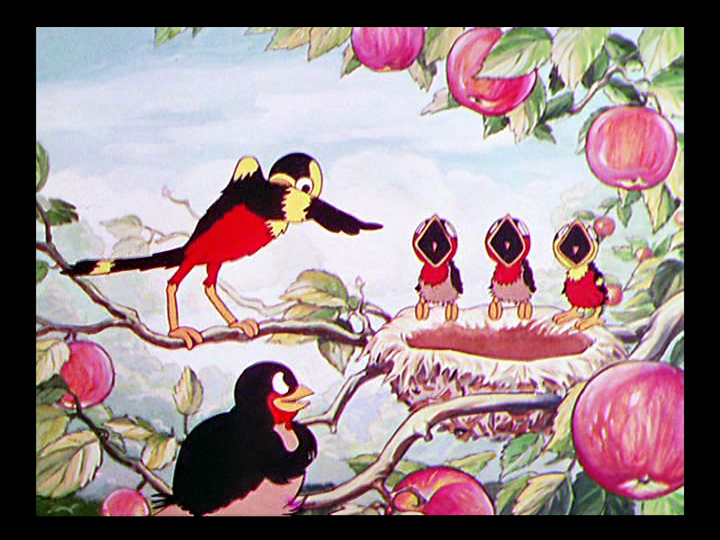
The scene opens on a beautiful spring day, in a field full of apple trees in bloom. Birds are flying about, chirping their songs as they flit around the branches, with some being romantic, while others are working on building nests. A nervous mother is seen in her nest, wondering when her eggs are going to hatch. She flips the eggs and sits on them again, hoping they will hatch soon. The father paces back and forth on a branch, looking equally anxious. Without warning, the first egg hatches underneath the mother, and the proud parents cheer when all three eggs hatch to reveal healthy chicks. The father gathers all the birds in the field to come see his newborns.

The babies have singing lessons with their father

The newborns begin to cry for food, and as they do, we suddenly see the time elapse, with the newborns becoming healthy young birds, who are learning to sing instead of crying for food. A bee buzzes around the nest, attracting the attention of the only male baby bird (named Otto, according to the Disney Archives), and causing him to depart from the music lesson to catch a quick snack. Otto hurries back to sing the final note in the song, only to let out a buzzing sound instead. Otto’s father’s disposition turns sour at this development, and while Otto tries to sing, he is still only able to let out the buzzing noise from the bee inside him.

After the bee escapes from Otto’s insides, the father decides it’s time for a flying lesson. He tries to impress his children with his grace, only to end up flying into a tree, making them laugh. Nevertheless, they follow him in their flying lesson, making a chain by grabbing each other’s tails as they fly through the air. When they let go, the birds surprise themselves by being able to fly, but unfortunately they also quickly fall. Otto then finds himself separated from the others, but decides it’s a better time to explore than to go home.

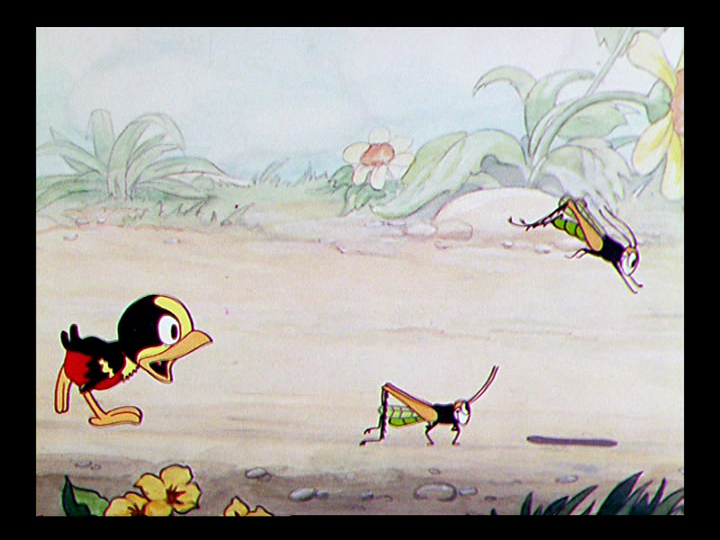
Otto excitedly watches grasshoppers at play

Otto’s first part of the adventure involves two grasshoppers playing leapfrog, and he follows them with great interest. He tries to eat one, but the grasshopper continues to jump, taking the poor baby bird with him until he jumps out of Otto’s mouth and spits in his face. Otto, not really fazed by the reaction, then follows a hummingbird, and tries to eat the way the hummingbird does, only to get poked by another hummingbird when he is inside the blossom.

Otto’s next adventure begins with a simple rattle in the bushes. He sees what is making the noise and shakes the rattle, only to find that the rattle belongs to a rattlesnake, one that is very hungry. The snake hypnotizes the baby bird, but Otto falls into nearby pond, breaking the spell. He begins to flee, with the snake following with great vigor. Otto tries to fly over the water, but his flying still needs a lot of work, and the snake is rather faster – even faster on land. Otto manages to get the snake to tie himself in knots to escape.

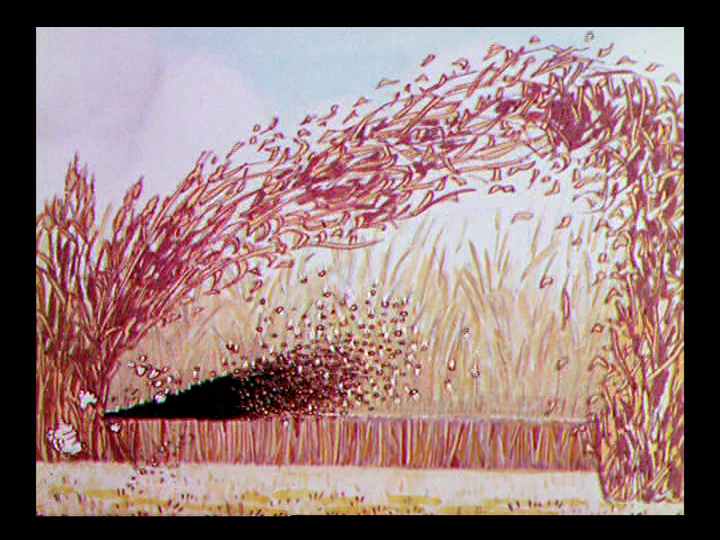
The bees harvesting wheat while trying to attack Otto

Otto attempts to dive for cover in a beehive, only to have the swarm inside chase him out and pursue him angrily, destroying everything in their path. Otto lets out frantic chirps, which alerts his family nearby, and the father races to his rescue. The birds manage to hide under their nest while the bees race past. Otto’s curiosity comes at a price, as his father takes the baby over his knee and spanks him for running away.

March 8

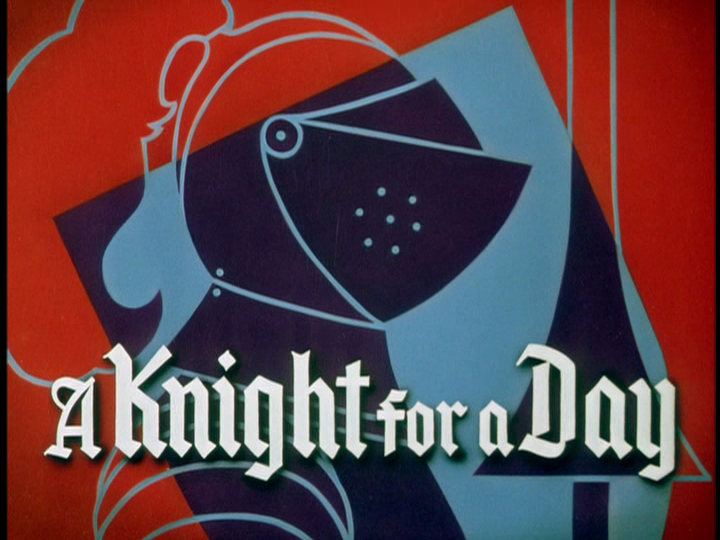
March 8, 1946 – The Goofy Short, A Knight for a Day, is Released to Theaters

“Stand by, everybody, as we turn the calendar back 500 years and bring you the 123rd running of the Canterbury tournament at Blunderstone Castle.”

Directed by Jack Hannah, A Knight for a Day was released on March 8, 1946. This short continues the trend of having Goofy play a part in the story, rather than being the regular Goofy audiences were used to from earlier Mickey Mouse shorts. Also, all the characters in Knight for a Day are designed to look like Goofy. The story was written by Bill Peet, with music by in-house composer Oliver Wallace.

Knight for a Day relies on clever puns woven throughout the story, such as the names of the knights: Sir Loinsteak and Sir Cumference. Modern day sports-casting and a medieval setting mix as the audience is taken back in time to attend, the announcer says, the 123rd annual Canterbury jousting tournament. Everyone in town flocks to the castle for this event, and it sells out fast. The winner is to receive honor, glory, and the hand of the beautiful Princess Esmeralda, who is seen watching from her tower.

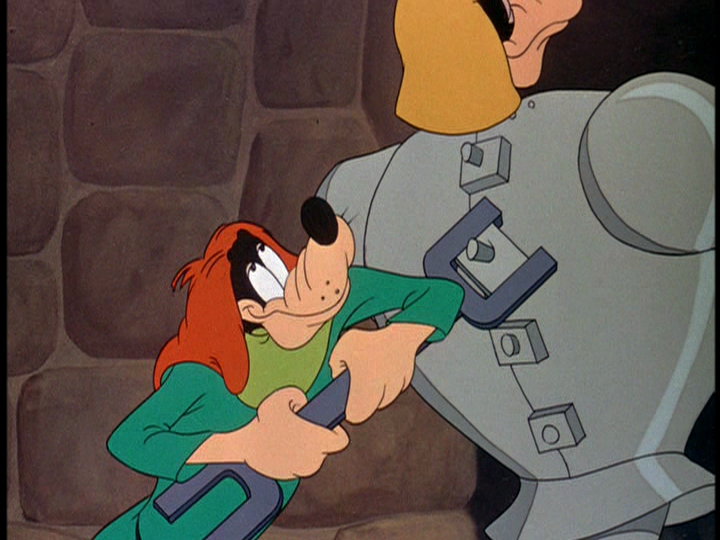
The squire Cedric, dreaming of the day he can win the favor of the princess through jousting as a knight

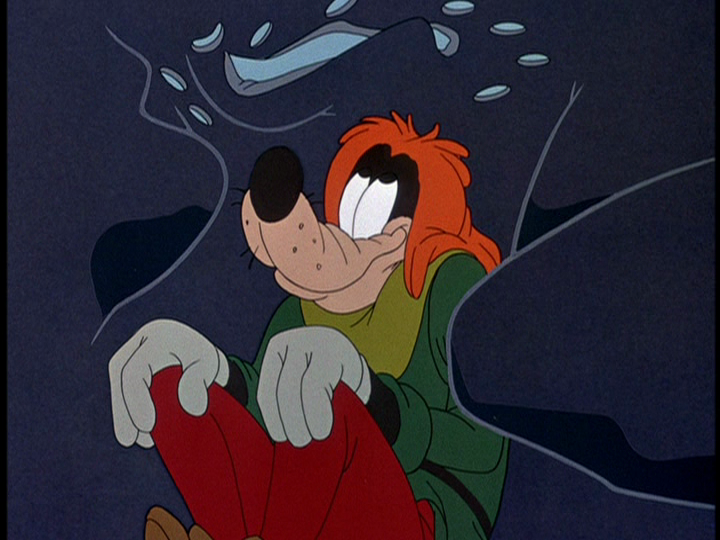
We then head to the dressing room of Sir Loinsteak, whose squire, Cedric, is busy polishing the knight’s suit of armor and preparing him for the fight. Cedric dreams that one day he shall be a knight “and face death for the smile of a lovely princess.” He takes a moment to daydream, but quickly sets back to work preparing the knight.

As the trumpet sounds, Cedric races to help Sir Loinsteak mount his horse, breaking the knight’s sword in his haste. He hides the pieces and continues to prep, but as he tries to shove the knight onto his horse, he pushes the Sir Loinsteak out of his armor (and Cedric into it) and the knight is knocked out cold when he lands on an anvil. Cedric can’t believe that Sir Loinsteak is unable to fight, and then realizes that he is wearing the armor. The narrator tells Cedric that this is his big chance—he can win the honor and glory, not to mention the hand of the fair princess.

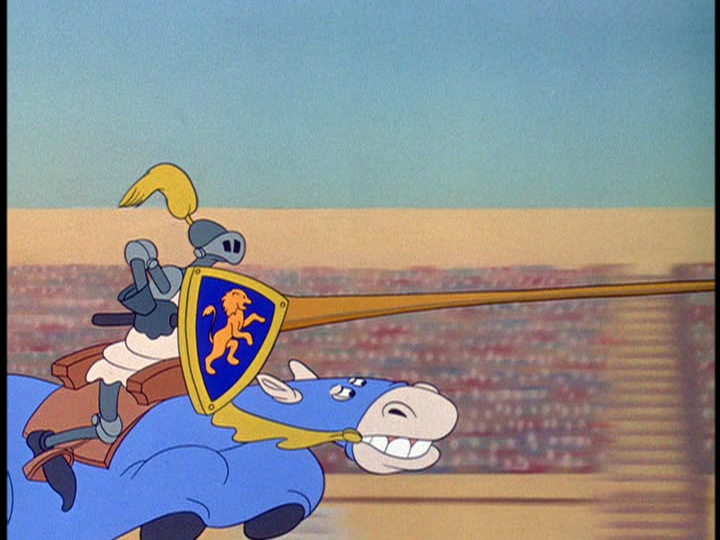
The tournament begins with the champion, Sir Cumference (“Old Iron Pants, they call him”), entering the arena. His horse has hash marks for all the gallant knights who have fallen in battle against him. Cedric enters from the other gate, and is blown a kiss by Princess Esmeralda; the narrator comments that it must be love at first sight. Cedric’s dreamy-eyed gaze is cut short when he notices that the knights are prepared to joust, with shields made of bricks and sharp points at the end of their lances. He quakes in his armor.

Although nervous, Cedric charges with all of his might

The umpire checks his wrist-sundial, and the crowd waits anxiously for his signal to begin. The umpire waves his flag, the trumpet sounds, and off they go into the joust! Cedric charges gallantly forward, but it’s no use again Sir Cumference – Cedric and his horse are pushed out through the castle wall into the moat. Sir Cumference is still the champion, but this does not please the princess, who lets out a loud shout of discontent at this outcome.

Suddenly, Cedric is seen climbing through the hole in the castle wall, still on his horse, ready to try again. The champion puts on his helmet again, charges, and sends Cedric flying into the air and landing in the bleachers. The crowd lifts him back to his horse, infuriating Sir Cumference, who pulls out his sword and charges. Cedric pulls out his sword, too—forgetting that he had destroyed it earlier. Thinking fast, he attaches the arm from his armor to the end of the broken sword and goes full speed ahead, using it to knock the champion out of his seat. He then uses the armor arm to push the challenger back as he tries in vain to hack away at Cedric.

Cedric is able to hide comfortably inside the armor as Sir Cumference beats it relentlessly with a mace

Cedric begins to throw pieces of his armor at Sir Cumfrence, and the fight becomes a no-holds-barred scuffle. Sir Cumference takes out a mace and begins to smash the Cedric’s armor, with Cedric hiding inside. Cedric, however, being a lot smaller than the armor would suggest he is, is able to hide away without being injured. The champion is exhausted from his angry work, and Cedric becomes the new champion when “Old Iron Pants” falls from his horse. The princess leaps from her balcony and begins to shower Cedric with kisses. “What a day for a knight,” the narrator ends, “and what a knight for a day.”


March 7

March 7, 1936 – The Mickey Mouse Short, Mickey’s Grand Opera, is Released to Theaters

“Pluto! Go home!”

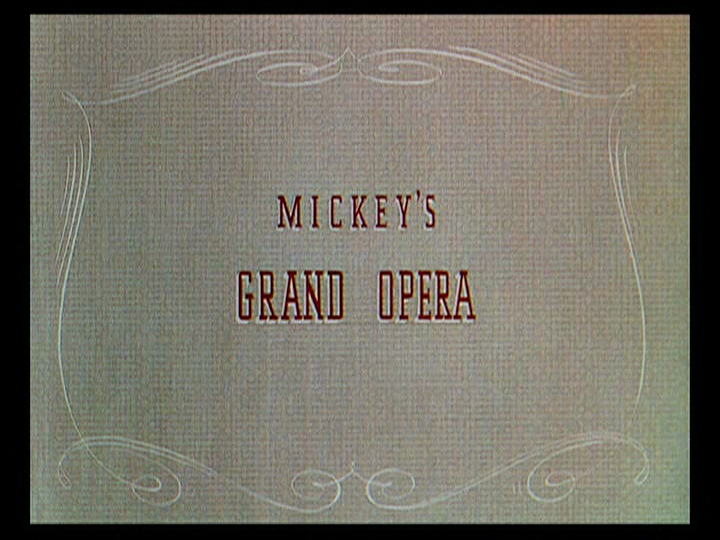
On March 7, 1936, the Mickey Mouse short, Mickey’s Grand Opera, was released to theaters. Directed by Wilfred Jackson, the short is about Mickey directing an opera, only to have his effort ruined by Pluto’s run-in with a magic hat. Although the short was released as a Mickey Mouse short, it deals more with Pluto, Donald Duck, and, to a lesser extent, Clara Cluck, more than Mickey. The short stars the vocal talents of Walt Disney as Mickey Mouse, Pinto Colvig as Pluto, Clarence Nash as Donald Duck, and Florence Gill as Clara Cluck. This was not the only time Donald and Clara had an operatic duet, as Clarence Nash and Florence Gill were seen as themselves in The Reluctant Dragon, recording a session of their characters singing together. Mickey’s Grand Opera was also the last short film to use the original design of Donald Duck before making him a rounder character.

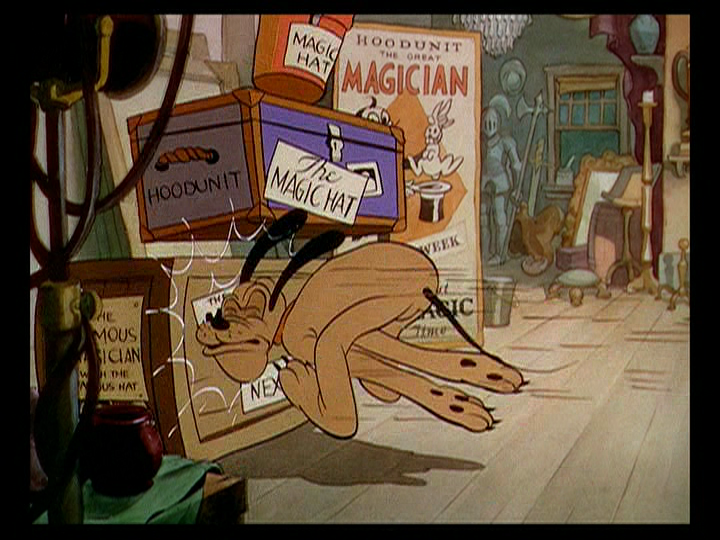
Pluto flies into the crates in the prop room after being told off by Mickey

The scene opens on a big sign proclaiming “Mickey Mouse presents GRAND OPERA featuring Mme. Clara Cluck and Donald Duck.” The viewers are taken backstage where Mickey is checking out the audience through a hole in the curtain. Suddenly his dog, Pluto, jumps on him. Mickey angrily asks him how he got into the theater, then tells him to go on home. Pluto sadly skulks away, but keeps turning back in hopes that Mickey will change his mind. When Mickey screams at him to go home, it startles Pluto to the point that he accidentally runs into the prop room and knocks into boxes for next week’s act, Hoodunit the Magician. The contents of the boxes spill everywhere, including the magician’s famous magic hat.

Pluto, still saddened by Mickey’s unfriendly manner, attempts to take a nap in the prop room, but keeps thinking he sees something pop out of the hat. As he tries to sniff the hat, a rabbit pops out and punches him on the nose. Angered, Pluto takes the hat with his teeth and shakes it, causing a flock of doves to fly out into the room. After they scare him and fly back into the hat, Pluto decides to jump on it, thinking this will stop the strange occurrences. As he tries to walk away, though, the hat pops back into shape as if nothing had happened, scaring Pluto silly. The two then play a game of cat and mouse as Pluto tries to chase the magic hat around a crate.

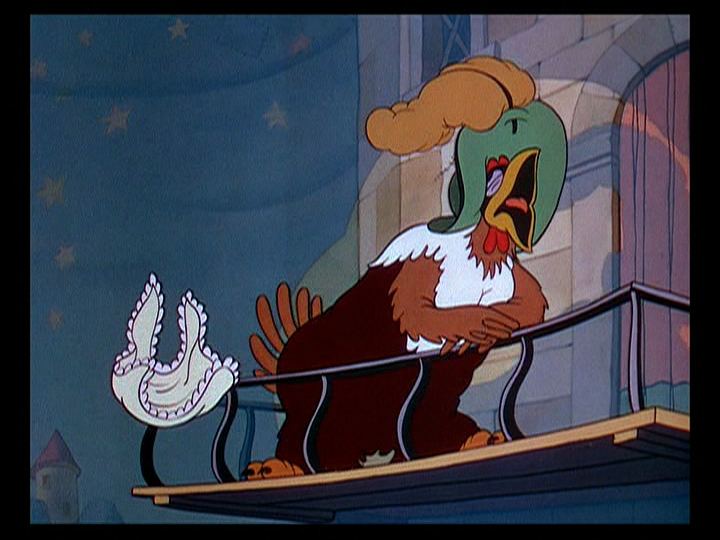
Clara Cluck, singing of her despair that her love has not come to see her

Applause marks the beginning of the opera, and Mickey takes his place at the podium. The curtains open on a balcony scene, where Clara Cluck appears in the spotlight. She begins to “sing,” looking and listening for her love. When he does not appear, she begins to cry in longing, but the gate suddenly opens, revealing none other than Donald Duck, playing her Romeo. He sneaks into the courtyard with a bouquet of flowers and trips over his own feet, making the audience laugh. This gets Clara’s attention, and she begins to sing to him. Donald then quacks his song back to her, and throws the bouquet to her.

As they continue their duet, Donald pulls out his sword dashingly, only to get it stuck in one of the trees from the set. He tries to pull it out, unsuccessfully, which leaves poor Mickey to try and conduct the orchestra to match Donald’s frustrated quacking. Donald finally does get the sword out, and the opera continues peacefully. Unbeknownst to them, Pluto is following the magic hat, which has appeared on the side of the stage. Noticing that Pluto has been following it, it hurriedly waddles onto the stage, with Pluto timidly following it.

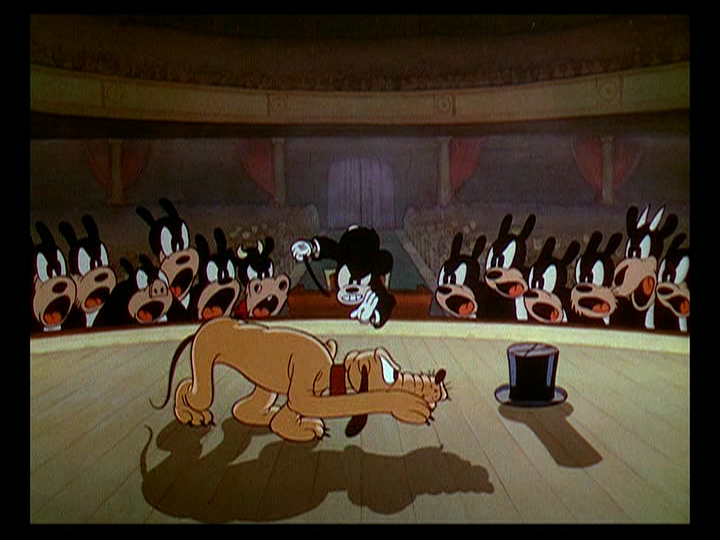
The orchestra follows Mickey's example, ordering Pluto to go home

The hat and Pluto cross the stage right in front of Mickey, with the audience breaking into peels of laughter. Mickey finally notices his dog and is furious that Pluto never went home. Mickey once again orders the dog home, but Pluto only looks at his master sadly before looking back at the suspicious hat. Once again, Mickey orders Pluto home, but Pluto won’t move away from the strange hat. Finally, the whole orchestra stands up and yells at Pluto to go home, which startles the dog and hat and they run off in different directions. As Pluto watches from the wings sadly, the hat suddenly crawls underneath him, surprising him.

Having had quite enough, Pluto begins to chase the hat, which falls into a tuba, letting loose a steady stream of doves, mice, and rabbits as the tuba player plays his instrument. Donald and Clara try to continue with the scene, although two doves attempt to take off with Donald’s cape, and the doves dart around Clara. The tuba player keeps playing, and a strange plant sprouts from inside, releasing a frog as the sunflower on top opens. Pluto follows the frog, until Donald accidentally swallows it. The frog continues to jump, taking Donald with him. With one large hop, Donald accidentally stabs Clara through the balcony, causing the hen to fly into the rafters from the surprising poke. When she comes back down, the set comes crashing to the floor. When Pluto, Clara, Donald, and the frog, break through the backdrop, they give their final high note of the night, at least bringing this strange opera to an end.

March 3

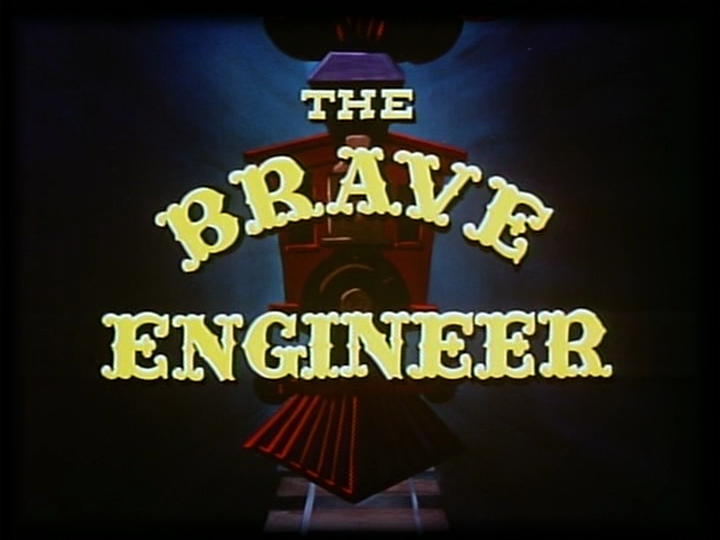
March 3, 1950 – The Special Cartoon, The Brave Engineer, is Released to Theaters

“Ah, ‘tis morning, and all the trains in the railroad yard are fast asleep. All except Casey’s. His engine is slow asleep.”

 On March 3, 1950, The Brave Engineer, a  special short subject cartoon, was released to theaters. Based on the “Ballad of Casey Jones,” by T. Lawrence Seibert and Eddie Newton, the short tells the story of engineer Casey Jones, who will stop at nothing to deliver the mail on time. The ballad was based on a real-life engineer, John Luther “Casey” Jones, who died stopping a train and saving many lives in the process. The story was adapted by Dick Kinney and Dick Shaw, with the musical score by Ken Darby, and stars the vocal talents of Jerry Colonna (also known for playing the March Hare in Disney’s Alice in Wonderland) and The King’s Men singers.

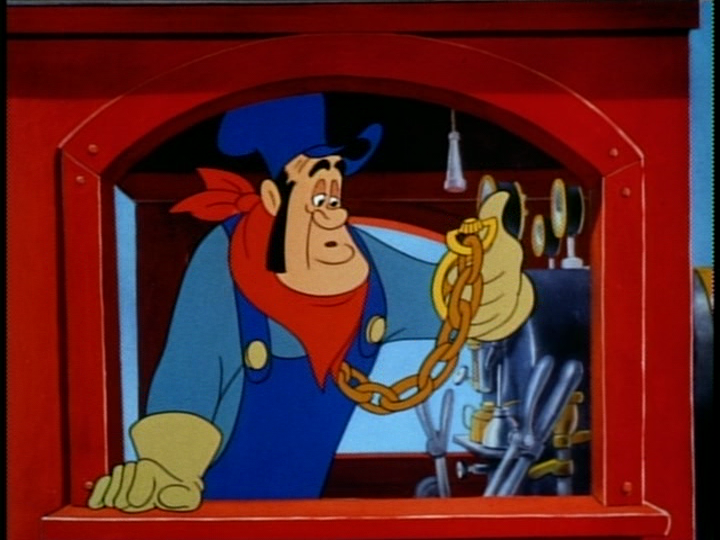
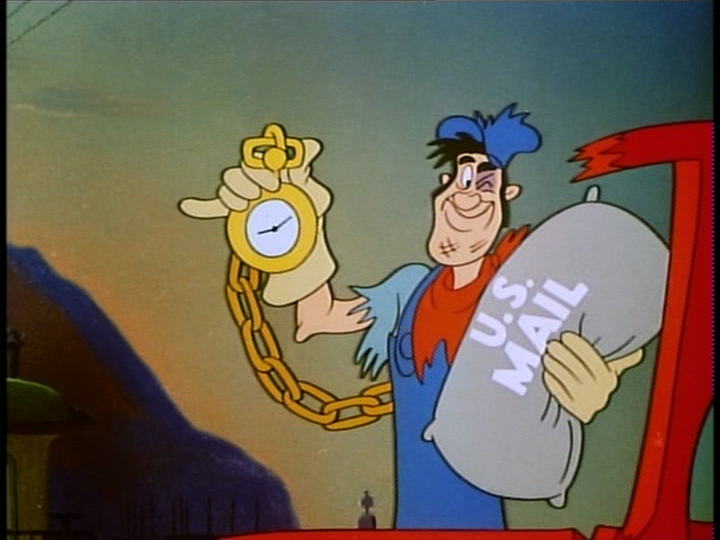
Casey checks his watch for the time, only to realize he's already late

The sun rises over the railroad yard, and the camera zooms in on Casey Jones’ engine, as Casey slowly wakes up, and is alarmed by the time shown on his stopwatch. Once signaling he’s ready, Casey takes off like a shot, with the track switches moving as rapidly as possible to match Casey’s speed. Casey’s many close calls cause his poor brakeman to collapse in exhaustion and nerves.

Casey first problem on his route to deliver the mail is a flood that has been building up for five or six weeks. Considerably slowed by the rain, Casey climbs on the roof of the train and paddles with a shovel, but despite his efforts, the western mail is “exactly eight hours late.” When the train emerges from the flood, it is covered by the roof of a house, with an attached laundry line, but it quickly rids itself of the burden and the excess water, and immediately speeds ahead to its next destination.

Close call for the cow

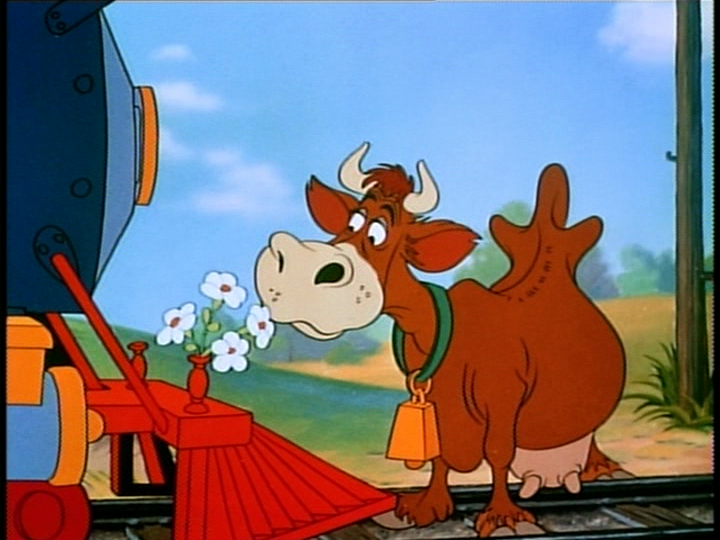
Unfortunately, it is not smooth sailing for Casey, as there is a cow standing in the middle of the tracks. Casey brakes hard, and the train stops just inches from the cow. Casey screams at the cow to move, pulling out his stopwatch and proclaiming that he’s late. Offended by Casey calling her “old cow” and “bossy,” the cow saunters off as slowly as she possibly can. Casey barely waits for her to clear the tracks before he speeds past her, leaving the cow clutching a telephone pole for dear life.

Casey is feverishly shoveling coal into the engine when his next problem arises: a bandit has just tied a helpless maiden onto the tracks. Casey climbs out to the front of the engine and scoops up the girl, with the bandit cursing him. Casey continues to up his speed, although he realizes, as he travels around a mountain track, he’s going too fast. As he travels through a tunnel, the audience sees another bandit getting ready to blow up the train tracks. The dynamite explodes just as Casey travels over the bridge, but Casey’s engine doesn’t give up, and just climbs up the steep sides of the mountain.

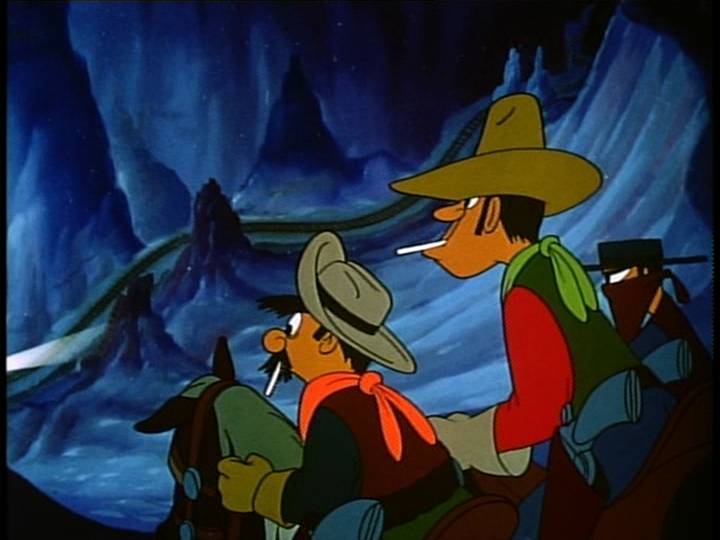
A gang of bandits, lurking in the shadows, watching Casey's train

As the train speeds through a tunnel, a gang of bandits lurk in the shadows, ready to jump the train and rob it. Still shoveling coal, Casey doesn’t notice that the robbers are now in the engine, guns drawn, until one is nearly shoveled into the furnace. Angered by this new interruption, Casey attacks the gang with his shovel. He continues to battle the bandits almost nonchalantly as he keeps on shoveling more coal into the engine. He successfully beats the gang, but he’s alarmed to see how late he is when he looks at his watch.

Desperate to make it on time, Casey shovels the coal into the furnace crazily, causing the engine to overheat. After running out of coal, Casey throws anything he can into the furnace, still overheating until gears and gauges explode. The train begins to fall apart, with Casey trying to hold it all together, and the tracks melt. While otherwise occupied, the brave engineer doesn’t notice another train coming toward him on the same track. Casey’s train is heading toward it like a bullet, and the conductor of Casey’s train runs to warn Casey, but Casey can’t hear him, and the trains collide in a cloud of black smoke.

Casey makes it through his sheer determination...and a lot of luck

The mailman waiting at the station thinks Casey is not going to make the stop today, when all of a sudden, the last remaining pieces of Casey’s train appear, with Casey holding the mail. According to Casey’s watch, Casey made it “On Time…Almost.”

March 2

March 2, 1951 – The Donald Duck Short Film, Dude Duck, is Released to Theaters

“D. Duck, Rover Boy, number six.”

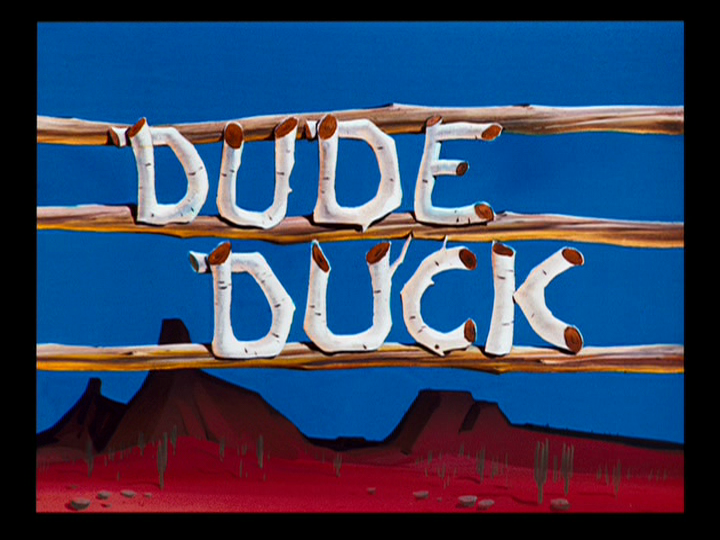
 On March 2nd, 1951, the new Donald Duck short, Dude Duck, was released to theaters. In this short, Donald takes his vacation at a dude ranch, but ends up assigned to a horse that does not want him as a rider. As with many of the shorts featuring Donald and an animal, there is a lot of humor in the mutual animosity between the duck and the horse. The short was directed by Jack Hannah, with story by Ralph Wright and Riley Thompson, and stars Clarence Nash as the voice of Donald.

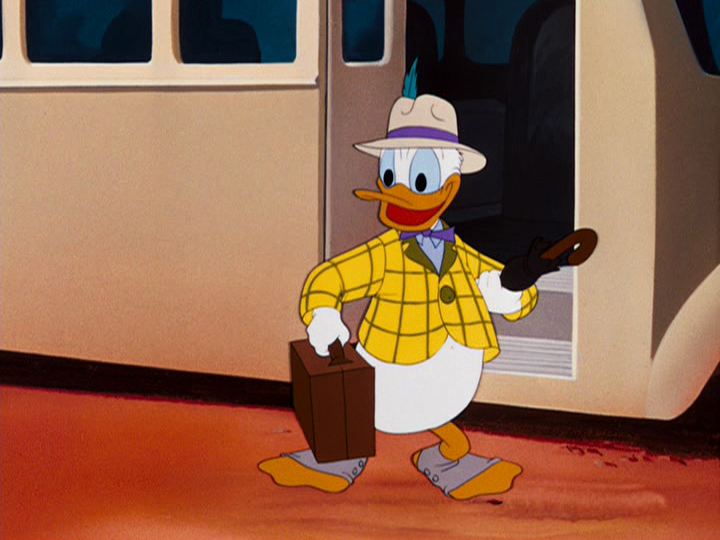
Donald steps off the bus, admiring his surroundings

The audience is taken to the Bar-None Dude Ranch, where the horses are seen relaxing in their stalls, except for one playing horseshoes with his own shoes, whose name is Rover Boy. A bus horn sounds, and a group of beautiful women step out excitedly, ready for their vacation, which causes Rover Boy to wolf whistle and quickly put his shoes back on. Donald is the last to step off the bus, and slowly begins to explore the ranch.

Meanwhile, Rover Boy is busily primping, hoping one of the girls will pick him as her steed. They take little notice of him, however; no matter how much he whistles and pounds his hooves on the fence for their attention. Soon, all the girls are off riding, while Rover Boy stands at the fence, visibly upset.

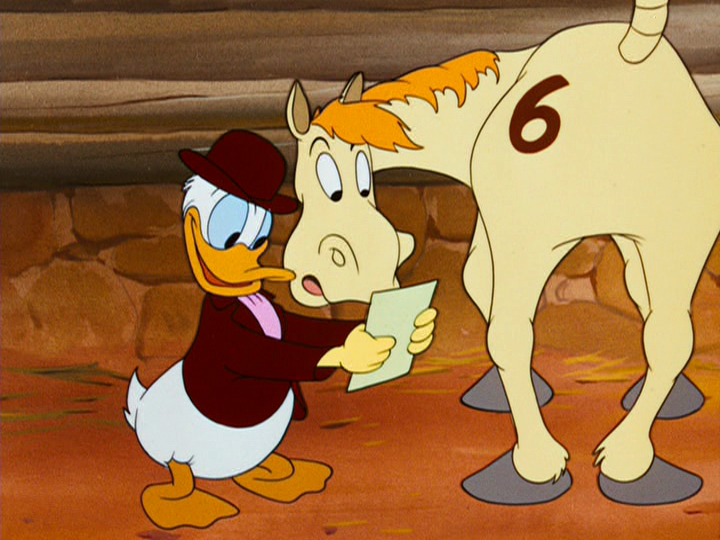
Donald has found his horse - Rover Boy can't believe Donald's his rider

He soon hears whistling, and looks up to see Donald, who is dressed in formal riding gear. Donald approaches Rover Boy, and he studies Donald’s outfit before bursting into peels of laughter. Donald doesn’t seem to notice, but instead walks in the gate and reads the sheet with his name and assigned horse. The horse stops laughing, alarmed that Donald is his assigned rider. He attempts to hide, unsuccessfully, but Donald insists that they get going.

Now desperate to be rid of Donald, Rover Boy fakes an injured leg and a broken back, as well as having no teeth, a horrible cough, heart palpitations, and ultimately, death. Donald rushes to grab some water to help revive the horse, only to have the horse quickly move out of the way as he throws the water. Donald senses something’s amiss, and pulls an apple from his pocket to tempt the horse. Rover Boy tries to fight the temptation of the treat, but ends up taking it from Donald’s hand, chewing it as he still feigns death. Donald then pulls a trumpet from his coat, and the horse quickly is revived, standing in race position. Donald pulls out a starter’s pistol and fires it, and Rover Boy takes off like a shot, before realizing that he gave up his ruse, causing Donald to begin to laugh.

Donald then throws down the saddle and points the gun at his steed, ordering him to put on the saddle. Rover Boy refuses, and Donald begins shooting at the creature’s feet, causing him to jump around the yard. Quickly, he puts on the saddle, and Donald twirls the gun, thinking he’s won, until the gun slips from his finger, leaving only a metal ring. The horse, seeing an opportunity, takes off the saddle. Donald tries to threaten him again, only to find his gun is gone.

"Moo."

Undeterred, Donald grabs a lasso and begins to chase Rover Boy behind some hay bales, but stops when he sees that Rover Boy has attached bull horns to his hair, and gives his pursuer a haughty “Moo.” He whispers in Donald’s ear, presumably telling him where his “horse” has gone, and Donald races on, until he realizes he’s been duped.

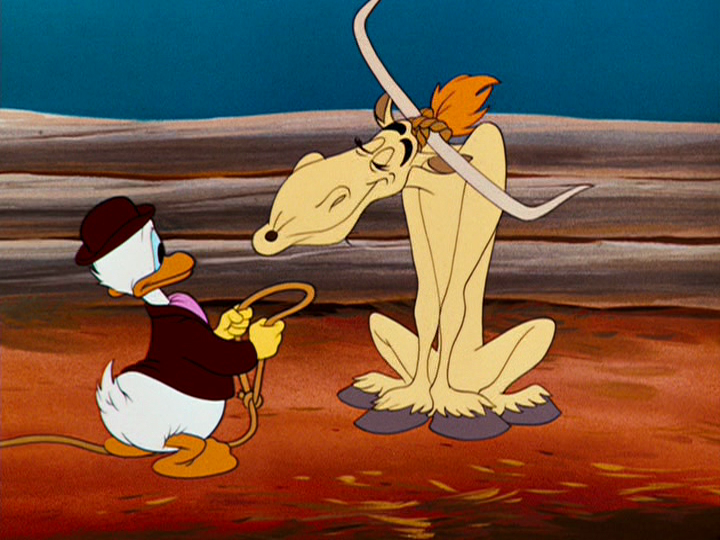
Thoroughly frustrated at this point as only Donald can be, he pursues the horse again, with Rover Boy hiding behind some other hay bales and pretending that he’s gone galloping off. Donald almost falls for it, until he looks down and sees the horse. Thinking fast, Donald stands behind the other side of the bales and laments that the horse got away from him, and he’d better go home, then pretends to walk away. The horse falls for this easily, and begins to laugh, thinking he’s gotten rid of the duck. He is then alarmed at the sound of galloping, and a woman’s voice (which the audience is able to see is Donald doing a spot-on imitation) asking for that “big beautiful number 6.” Excited, Rover Boy races out, only to be caught in Donald’s lasso. Calmly, Donald ties the other end of the rope to a post and waits, while the horse is still running wildly.

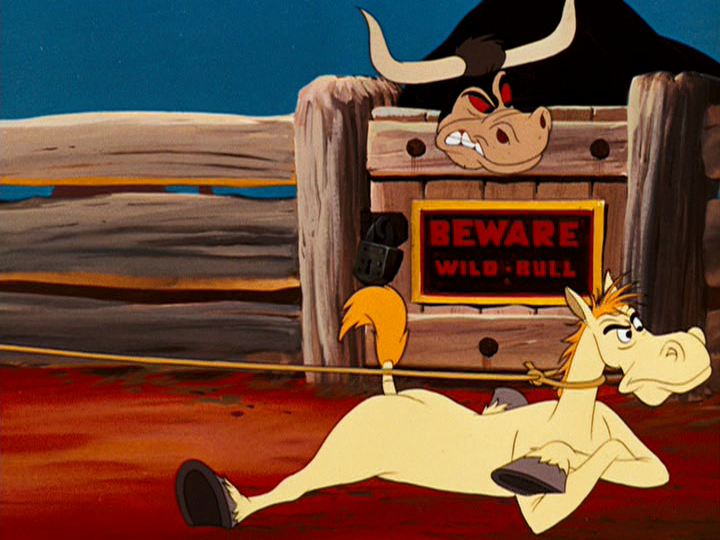
Rover Boy comes up with an evil scheme as he passes the bull pen

Rover Boy is suddenly pulled to a stop, falls to the ground, and can only say, “Oh, no.” Donald laughs at this situation and begins to pull the horse in; unfortunately, the horse passes by the wild bull pen, giving him a wicked idea. We see the horse run to the fence, quietly observing his little plan, while Donald still blissfully pulls on the rope. The horse tilts the bull’s horns in the direction of Donald’s tail, and with Donald giving the rope one final pull, the audience sees only Rover Boy’s reaction, but hears Donald give out a loud scream, and a whistle that indicates the duck shot straight up into the air. He lands on the now saddled bull and rides off into the old west, just as he wanted to in the first place.

March 1

March 1, 1924 – The First Alice Comedy, Alice’s Day at Sea, is Released to Theaters


“It would be a big opportunity for her and would introduce her to the profession in a manner that few children could receive.” – Walt Disney’s letter to Virginia Davis’ mother

On March 1, 1924, after a long process of putting all the pieces of the company in place, the Disney Brothers Studio had their first release of the first of the series of Alice Comedies, entitled Alice’s Day at Sea.

The first six Alice Comedies began with a long  live-action segment, then went into the cartoon. The seventh film had a change of format, when Disney scrapped the live-action introductions. In this first film, Alice goes to the seashore with her dog and falls asleep in a rowboat, and in her dreams, she battles marina wildlife and finds a shipwreck.

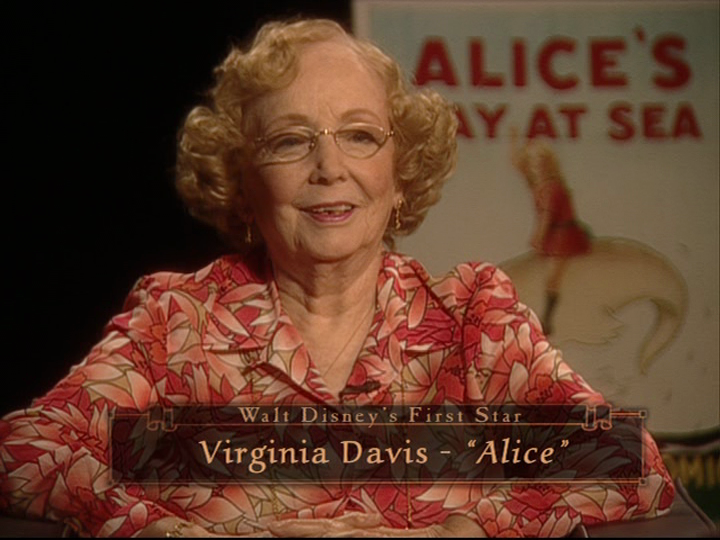
Disney's first star: Virginia Davis

Virginia Davis, the first actress to portray Alice in the Alice comedies, was still living in Kansas City, Missouri, when Walt made his way out to California to create his animation studio. Fortunately, Disney was able to convince her family to move out to California, with Virginia recalling, “Oh, what a salesman [Disney] was…my mother fell for it, but she liked him because she sensed a sincerity in his mind. She really liked him very much; she saw great things in Walt.” When they were ready to film Alice’s Day at Sea, Virginia recalled, “…that film, we came from Missouri, I had never seen the ocean, and all of a sudden there was that sand, and all the ocean…I loved it, I just loved it.”

Walt animated the films by himself, and was able to deliver the first film on December 26, 1923, ahead of schedule, and was able to collect on the offer from Margaret Winkler of $1500. However, Walt was not happy with how it had turned out, and Winkler agreed, telling him that it was only “satisfactory,” but she encouraged Walt by telling him to inject more humor into the shorts. Fortunately, Walt kept producing the shorts, and each one was better than the one preceding it.

February 29

February 29, 1940 – The Last Silly Symphony, The Ugly Duckling, Wins the Academy Award for Best Animated Short Subject

At the 12th Academy Awards, held at The Coconut Grove in Los Angeles on February 29, 1940, the Walt Disney Studios and RKO Radio were awarded an Academy Award for their final Silly Symphony, The Ugly Duckling. The short was up against Detouring America by Warner Brothers, Place on Earth by MGM, and The Pointer, also by the Walt Disney Studios and RKO Radio.

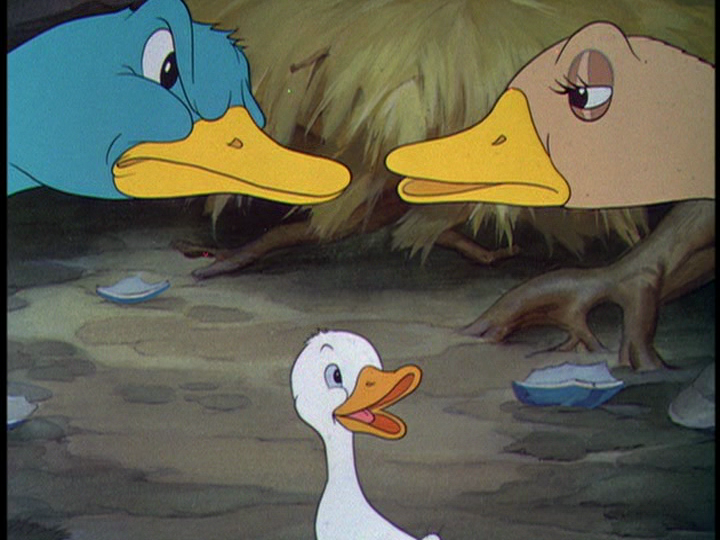
First released April 7, 1939, it was a remake of the 1931 Silly Symphony of the same name, and was the only Silly Symphony ever remade. The story and animation were significantly different from the 1931 short, which shows the tremendous strides in animation the Disney Studios had made in those nine years. Instead of the slapstick and gags they relied so heavily on in the early days of the studio, the 1939 version shows how they were able to make their character emote and become fully fleshed out.

The scene when the father and mother discover the odd looking duckling. Notice the characterization of the characters, which was rather nonexistant in the 1931 short

The plot of this short is based on the Hans Christian Andersen tale, and tells the story through music of a duckling shunned by his family, as he is considered by his parents to be ugly. The duckling, ashamed, tries to find a mother that will accept him the way he is. It’s easy to see, after watching this short, why it would win an Academy Award – it truly was a high note for the Silly Symphonies in which to go out.


February 28

February 28, 1942 – Pluto Short Film Pluto, Junior is Released to Theaters


Pluto, Junior, a Pluto short film, was released by the Disney Studios on February 28, 1942. Directed by Clyde Geronimi and with the voice talent of Pinto Colvig, the short shows a different side of Pluto as a father to a rambunctious puppy that is so much like him in curiosity and ending up in precarious situations.

The short opens on a sunny day, and snoring is heard as the audience sees a ball rolling back and forth across the lawn. As the camera zooms out, we see Pluto and Junior, fast asleep in their respective doghouses, with the ball rolling in between their snores. Pluto’s snore is a bit too strong, and pushes the ball straight into Junior’s nose, startling him awake. Eyeing the ball bouncing up and down, Junior decides that it’s playtime, only to end up being more bullied by the ball than actually playing with it. The ball slips and lands in Pluto’s mouth, who ends up choking on the toy. Seeing his father awake, Junior barks enthusiastically, hoping his father will want to play. Pluto, however, is too tired, and angrily growls at the puppy, scaring the poor thing.

Junior ends up stuck to a stray balloon in the yard

As the puppy rolls backward from trying to get away from Pluto, he ends up rolling onto a balloon, which sticks to him and causes his ears to stand up from the static electricity. Curious, he turns around to sniff the balloon, and ends up trying to attack it, only to pull away the string and let the balloon fly across the yard, landing in Pluto’s mouth. Pluto unwittingly fills the balloon with air as he snores, and Junior, now thinking the balloon is an enemy, tries to sneak up on it, only to be scared of his own growing reflection in the balloon. Junior finally gets the courage to bite it, and it explodes. The sound makes Pluto shoot through the roof of his doghouse.

Junior, meanwhile, ended up in a patch of dandelions from the force of the explosion, and when he sneezed away the dandelion fluff, a worm landed on his head, and is not happy about his new location. Junior tries to pull the worm from his face, only to have it stuck in more humorous positions, such as around his eye like a monocle. Junior finally flings the worm away, and goes after it like a shot, determined to fight it. The chase goes all over the backyard and up a tree, where a hungry bird is waiting to devour the worm.

The hungry bird comically welcomes the worm to walk straight into his mouth

As the bird tries to chase the worm, it accidentally grabs a hold of Junior’s tail, and Junior angrily chases the bird in revenge. The bird flies around with Junior on its tail, until the puppy falls and lands into a sock on the laundry line, with only a feather as his spoils of war. He looks down to see that the ground is so far away, and begins yelping helplessly. Pluto wakes to see Junior in his precarious position and rushes to try and save him.

As Pluto pulls on the laundry line, the line stops when a knot prevents it from moving. Pluto tries his best to get the line to move, and finds himself being carried out on the line and having to walk it like a tightrope. After one daring swing, he ends up flying through the air and landing in some socks, only to have the socks snap away from their pins. Pluto then uses his tail to stay on the rope, and Junior, impressed, begins to cheer his father on. Still trying to rescue the pup, Pluto tries to pull his way down the laundry line, until Junior is right on top of him. Unfortunately, Junior’s enthusiastic wagging hits Pluto’s nose, and he lets out a mighty sneeze, sending both of them into the laundry tub.