RSS Feed

Tag Archives: Short film

April 6

April 6, 1931 – The Mickey Mouse Short Film, The Castaway, is Released to Theaters
“Bananas! Am I hungry! Oh boy!”

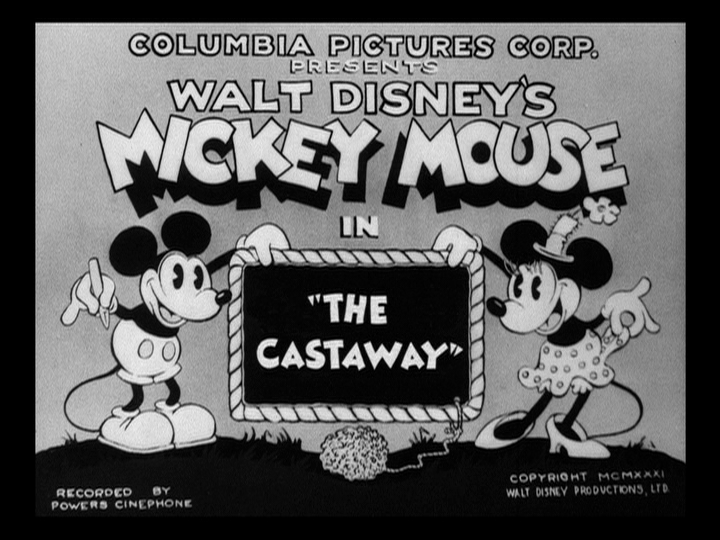
On April 6, 1931, the new Mickey Mouse short film, The Castaway, was released to theaters. It was directed by Wilfred Jackson, with Walt Disney as Mickey. It’s one of the few shorts that uses the Mickey Mouse Club theme song, “Minnie’s Yoo-Hoo,” as the title and end music.
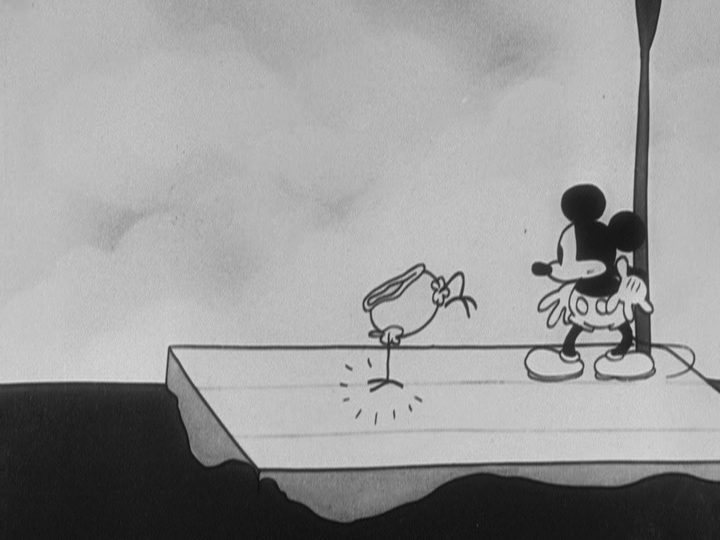
Mickey is stunned as his "sail" begins to perform a dance

The short opens with poor Mickey adrift at sea, the waves crashing wildly around him. Seagulls fly through the legs of his “sail” (a pair of bloomers), until one gets stuck and brings the sail to the boat, and Mickey watches the odd sight of dancing bloomers as the seagull tries to escape. As it flies away, Mickey spots land and tricks a swordfish into pushing his boat to shore.

Immediately after landing, Mickey spots food: he crashlanded into a banana tree. He shakes the tree, and then uses a stick to help him bring down the bananas, but the stick acts like a boomerang and sends Mickey flying into the tree, which, fortunately, brings the bananas to the ground. As Mickey tries to eat them, however, he accidentally knocks a spider from its web, and nearly into Mickey’s mouth. The mouse screams at the arachnid, and seemingly forgets about the bananas as he runs to the shoreline.
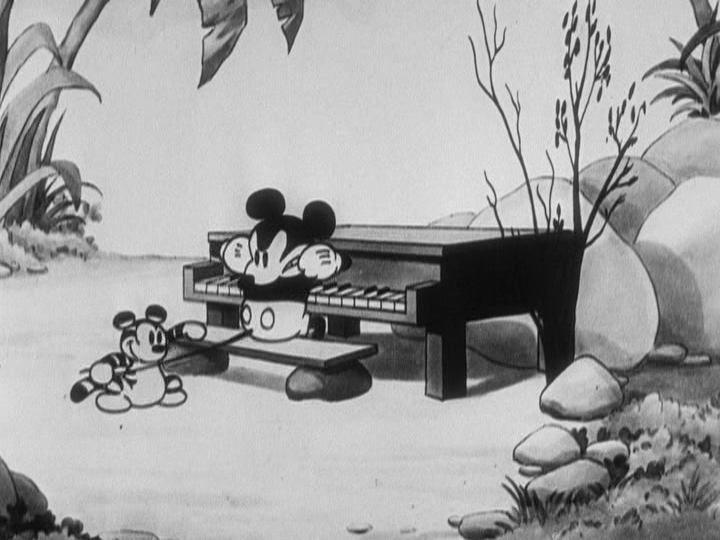
The cub continues to annoy Mickey as Mickey tries to keep playing the piano

Seeing a crate, Mickey tries to retrieve it before the tide comes in, but the tide ends up washing Mickey and the crate further inland. The crate breaks open on a rock, revealing a very soggy piano. Mickey empties the piano of the excess water, sits down, and begins to play, accompanied by three nearby seals. A tiger cub also hears the music and comes out to help Mickey play, but Mickey knocks the cub aside. The cub then tries to use Mickey’s tail as an instrument, but Mickey won’t have it and places the cub in a nearby tree.

The music also gets the attention of a gorilla nearby, and Mickey lets the gorilla play the piano with its feet. Unfortunately, the gorilla gets a little too rough with the piano, and Mickey tries to stop the animal from completely destroying it, with no success. As Mickey grabs a rock to throw at the gorilla, it turns around, and Mickey pretends to perform a few tricks with it before showing it a nervous smile.
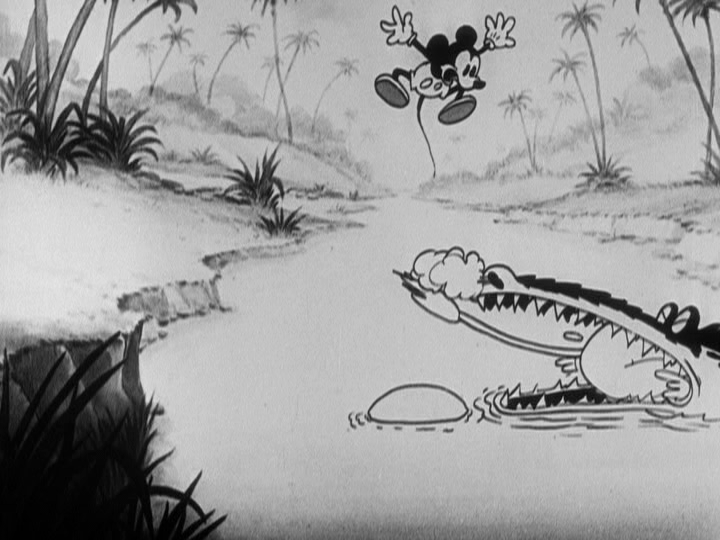
Mickey leaps into the air, as the lion leaps into the open mouth of the alligator

Mickey drops the rock onto the back of a sleeping lion, who begins to chase the frightened mouse. After jumping into a river and laughing at the roaring lion on the riverbank, Mickey thinks he’s home free, not spotting the alligator ready to eat him right behind his back. Stuck between the two dangers, Mickey leaps into the air as the lion leaps to attack. The lion ends up getting swallowed by the alligator, and Mickey cheers. The rock he’s standing on moves, however, and he finds himself riding downstream on the back of a tortoise. Mickey gives a friendly salute to the audience, and waves as he drifts away.
March 31

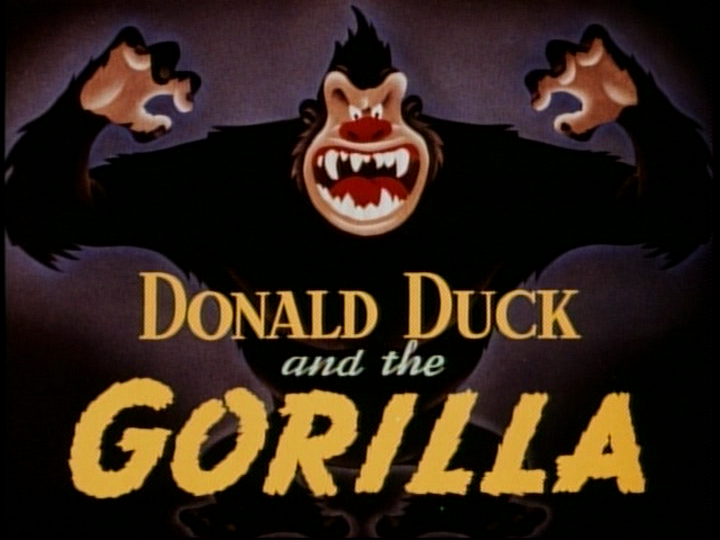
March 31, 1944 – The Donald Duck Short Film, Donald Duck and the Gorilla, is Released to Theaters.

“Where’s Uncle Donald?”

On March 31, 1944, the Donald Duck short film, Donald Duck and the Gorilla, was released to theaters. The short was directed by Jack King, with Clarence Nash voicing Donald Duck and the nephews Huey, Dewey, and Louie. As with many of the early Donald Duck shorts featuring the nephews, it was hard to tell which one was which, as the colors for their outfits were used interchangeably. This would be remedied with the show Ducktales, in which the nephews played lead roles and the stories were vastly more complicated.

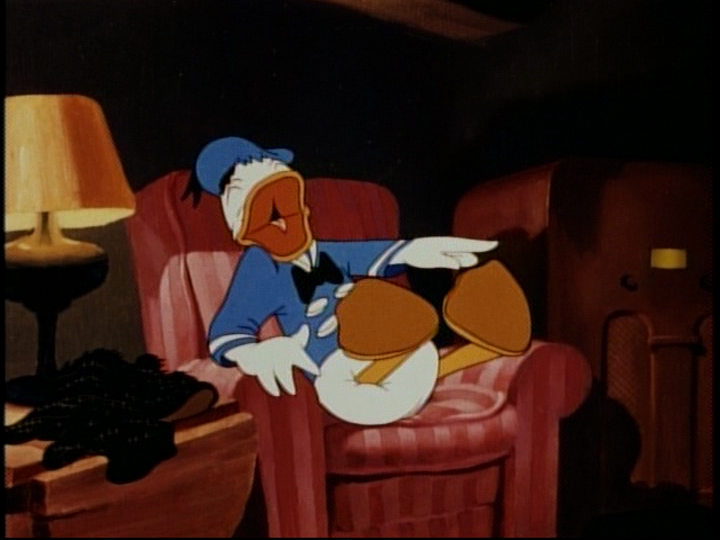
Donald laughs at the nephews' fear of the killer gorilla, Ajax

But back to Donald Duck and the Gorilla: It’s a stormy night, and Donald is sitting around the radio with his nephews Huey, Dewey, and Louie. The announcer informs the audience that the terrible gorilla, Ajax, has escaped from the city zoo. The nephews cling to each other in fear, while Donald laughs. He then notices a pair of gloves next to him that resemble gorilla hands, and gets the fiendish idea to scare the boys. He turns out the light, and the boys, frightened, call out for their uncle. When the boys turn on the light again, Donald is gone from the chair.

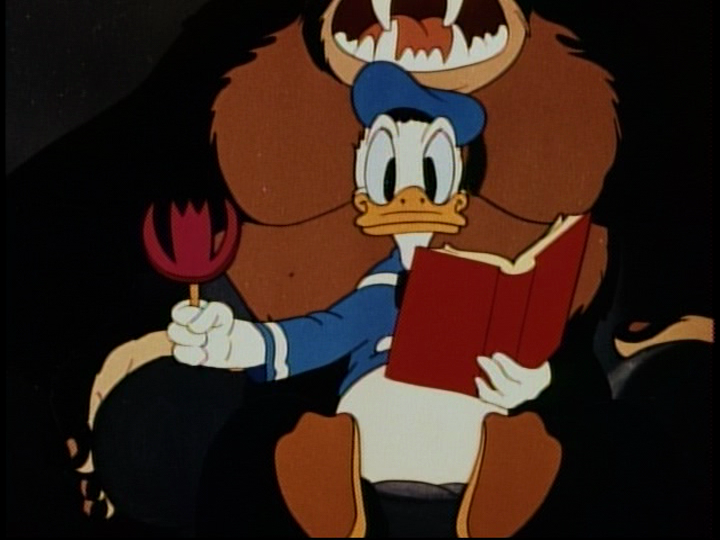
Still holding on each other, the boys are unaware of two large, hairy hands coming around the corners of the couch until the hands almost grab them. The boys scream and take off into the other room, slamming the door shut. Peering out through the keyhole, they see their Uncle Donald laughing hysterically at their flight. Angered by their uncle’s prank and bent on revenge, the three find a gorilla costume and begin to creep into the room where their uncle is getting ready to relax. Donald grabs a book and sits down in his chair to read, unaware that it is now occupied by a “gorilla.” Donald continues to be oblivious to the guest in his chair, even when the guest covers the duck’s mouth when he yawns.

Donald finally gets the hint that something may be off about the chair he's sitting in...

Donald finally gets the hint when he takes out a giant lollipop, and sets it aside for a moment while reading. The nephews take a big bite out of the lollipop with the costume’s teeth. When Donald picks up the lollipop again, he is  alarmed to see the teeth marks in the candy. He finally notices the “gorilla” in the room and bolts out of there as fast as he can, leaving the nephews to laugh at their success.

Unbeknown to both parties, the real Ajax is standing at the window, watching the scene unfold. With a menacing smile, he tears open the window and growls at the boys.  They run into their angry uncle hiding in an umbrella stand, and decide to run off in another direction, only to meet up with Ajax again. They run into separate rooms, with Donald following close behind. When Donald enters the hallway, he sees Ajax and, thinking it’s his nephews, starts pulling at the gorilla’s head, only to find that he was pulling on the head of the real gorilla.

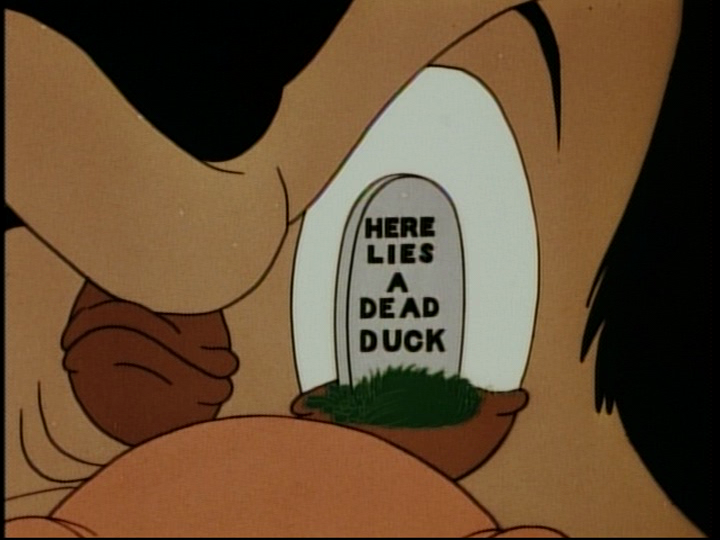
Donald sees a terrifying image when he tries to intimidate Ajax

Just as things are looking bleak for the duck, the radio announcer informs all listeners that one can tame all wild animals by looking them straight in the eye. Donald attempts to do so, only to see a tombstone in the gorilla’s eye staring back at him. Donald uses the umbrella to escape Ajax’s clutches, and rejoins his nephews to hunt down and rid themselves of their unwelcome guest. As they sneak around, there are many comical instances with the nephews’ clumsiness with the candle, including pouring wax all over Donald’s tail. Donald snatches the candle from the boys and shoves them into another room, not noticing that he has placed the flame right under the doorknob, which burns his hand.

Donald continues his search, and falls into the gorilla’s trap, but is able to escape – barely. The chase continues through the house, leaving destruction in its wake. Unfortunately, Donald is trapped by the hungry gorilla, and just as it seems that all hope is lost, the radio announcer gives another timely message: the gorilla can be subdued with tear gas. Hearing this, the nephews find some and throw the grenade in just in time. Seeing the gorilla begin to cry, Donald laughs at him, but ends up a victim of the tear gas as well. The two sit together, crying in each other’s arms.

March 28

March 28, 1936 – The Silly Symphony, Elmer Elephant, is Released to Theaters

“Elmer’s got a funny nose, looks just like a rubber hose!”

On March 28, 1936, the Silly Symphony, Elmer Elephant, was released to theaters. Directed by Wilfred Jackson, the short film tells the story of an elephant named Elmer, who is cruelly teased about his appearance, particularly his nose, but is able to use his nose to save the day from a runaway fire. Elmer would go on to be a popular merchandising character, and even had his own short-running Silly Symphony comic.

As the story opens, Elmer is seen skipping through the jungle, holding a bouquet of flowers, which he adds to as he passes by a flower bush. He knocks on the door to Tillie Tiger’s house, where the song “Happy Birthday” is heard being sung to Tillie. Elmer peeks in and sees the kids skipping in a circle around Tillie, and then they implore her to blow out the candles on her birthday cake. She agrees, but is unable to extinguish the birthday candles. Sweetly, she asks Joey the Hippo to do it for her, and he agrees.

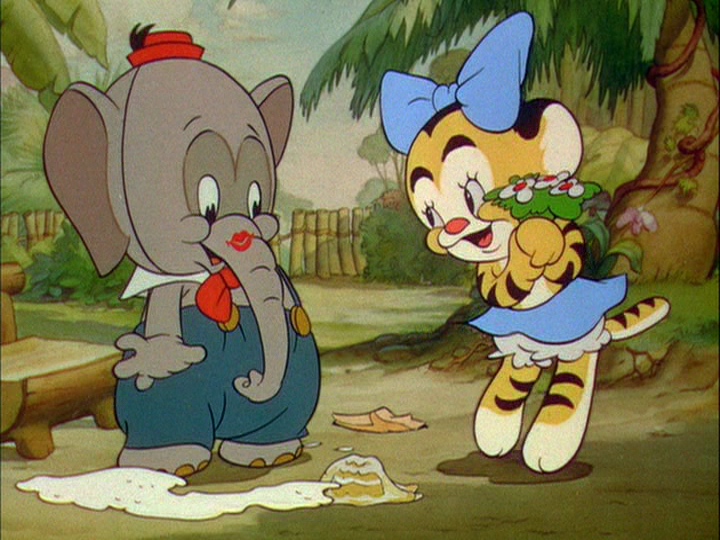
Elmer and Tillie, with Tillie fawning over the flowers he brought for her

Just as Joey is preparing to let out massive breath of air, Elmer appears on the other side of the table, and is rewarded with Tillie’s cake in his face, as Joey left the candles on the plate, still burning brightly. While the kids laugh, Tillie pulls out a napkin and cleans away the cake from Elmer’s face. Tillie spots the flowers in Elmer’s hand, and begins to coo over them, calling them “the nicest present of all.” She gives him a kiss on the nose, which causes him to react comically.

Some of the boys get together and begin to whisper as Tillie scuttles up to her tree house, telling everyone to have a good time and that she will be right back. As Elmer sits down to wait, the boys appear, holding various long objects as “noses” and pretending they have big, floppy ears. Poor Elmer is so embarrassed that he tries to tuck away his nose. The boys bully him, pulling on his nose and sending him flying down a hill and back into the jungle, when all the party guests appear and begin to sing their taunts to him.

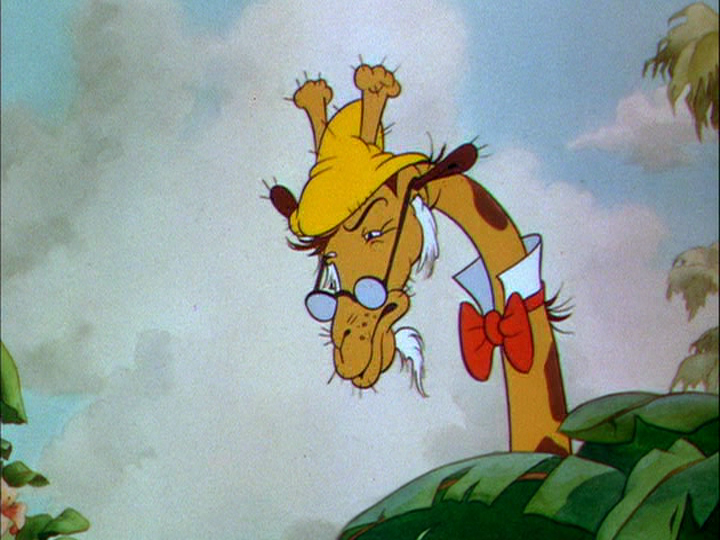
The kindly Old Giraffe, giving Elmer some well-needed advice

Elmer walks away from the party, very upset, when he runs into an elderly giraffe, who asks him what’s the matter. When Elmer explains, the giraffe tells him that “They used to make fun of me too, son, but I don’t care.” He then points out the pelicans nearby in an attempt to make Elmer feel better about his nose.

Just then, sirens are heard in the distance, with the crazy fire truck heading straight for Tillie’s. Tillie is seen trying to beat away the flames with a broom, yelling at her guests to help her get down from the tree house. The boys pull out a blanket for her to jump into, but the flames pull her back and they jump into the outstretched blanket, turning it to ashes. The fire team finally arrives at Tillie’s place, but can’t stop the flames from chasing them down the ladder. The flames trap Tillie up a pole, where she screams for help.

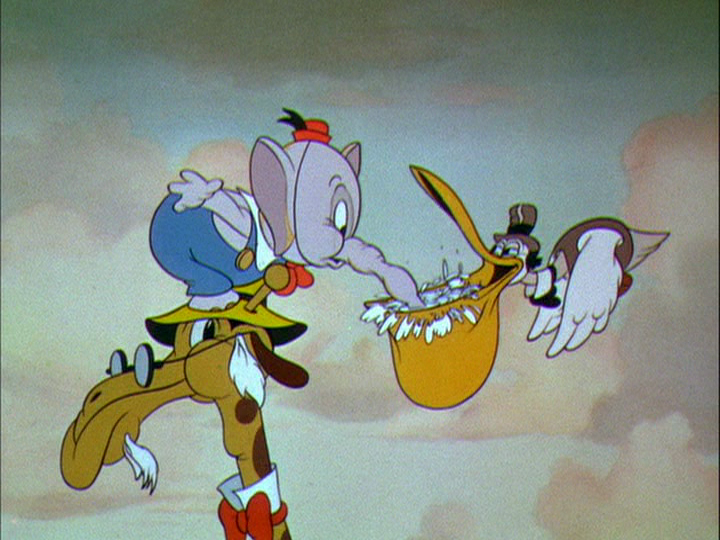
The Old Giraffe, Elmer, and the pelicans use their perceived flaws to work together and save the day

Having observed all of this from the Old Giraffe’s head, Elmer slides down his neck and begins to run at breakneck speed to save Tillie. The Old Giraffe follows, along with the pelicans, and they all work together to put out the flames: the Old Giraffe holds Elmer up to the top of the tree house, the pelicans provide the water, and Elmer uses his nose as a hose. Although the flames are stubborn, Elmer uses some fancy moves to extinguish the flames.

Stuck on her precarious perch, where four little flames are taking apart the pole one splinter at a time, Tillie calls out for Elmer. Elmer comes to her rescue, extinguishing the flames and grabbing the pole Tillie’s holding onto before it completely breaks apart. Tillie calls Elmer her hero, and the two share a kiss, with Elmer using his nose to pull her closer, and one of his ears to keep the moment a bit more private.

March 22

March 22, 1935 – The Silly Symphony, The Golden Touch, is Released to Theaters

“Is this the great man that bellowed, ‘Give me gold, not advice?’”

On March 22, 1935, the Silly Symphony, The Golden Touch, was released to theaters. Based on the tale of King Midas, it was directed by Walt Disney himself, who thought that this would be an easy task. Finding it was more work than he thought, Walt did not direct another short again. The music was written by Frank Churchill, and stars Billy Bletcher as the voice of King Midas.

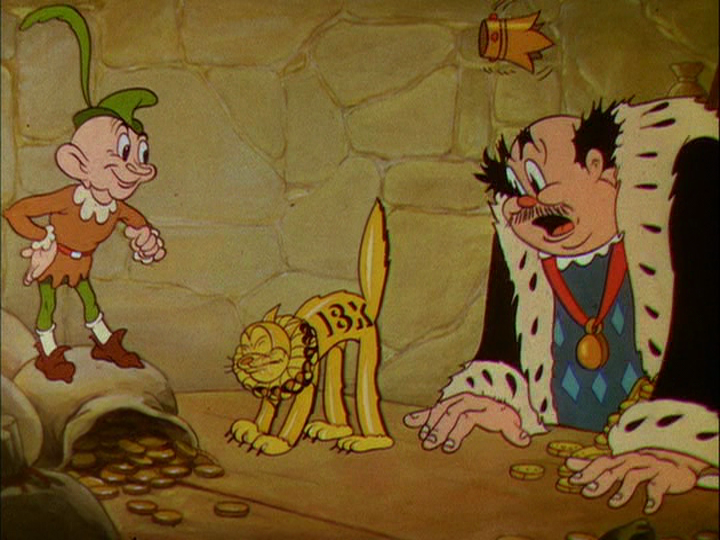
Midas is shocked when Goldie easily turns his cat into gold

The short opens in the vaults of the kingdom, where King Midas is happily counting his gold. He introduces himself to the audience, stating that he never cared for women or wine, but instead loves and worships gold. He then wishes that he could have everything he touched turn to gold. No sooner has he made this wish when a strange creature appears named Goldie. Midas is afraid that Goldie is there to steal his gold, but Goldie tells Midas that he, Goldie, doesn’t want it, and shows Midas that he can turn things to gold with a single touch. Midas offers everything he owns for the golden touch, but Goldie warns Midas that this would be a curse rather than a blessing. Midas doesn’t want Goldie’s advice, so Goldie finally gives the king what he wishes.

Now armed with the golden touch, Midas is determined to test it out. He chases his cat up the stairs of the castle, and as Midas runs into a tree, the tree suddenly turns to gold, dropping 18K apples, and the 18K cat as well. Midas skips around gleefully, incredibly happy that he has the golden touch, and begins touching everything he can, from flowers to fountains.

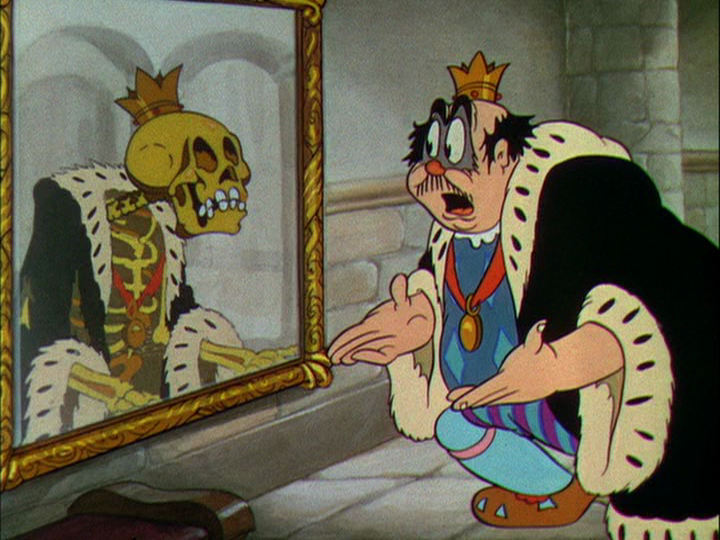
The king becomes delusional from hunger and fear, seeing himself as a golden corpse.

Some time later, a hungry King Midas sits down to eat a hearty meal, only to find that he is unable to eat anything, as it all turns to gold. Angered, he begins to turn all of the food to gold, and seems to go mad over the fact that Goldie had been right about it being a curse. He moans that the richest king in the world must now starve to death, and is chased by illusions of death. He locks himself in his counting room and calls out for Goldie, who appears, laughing.

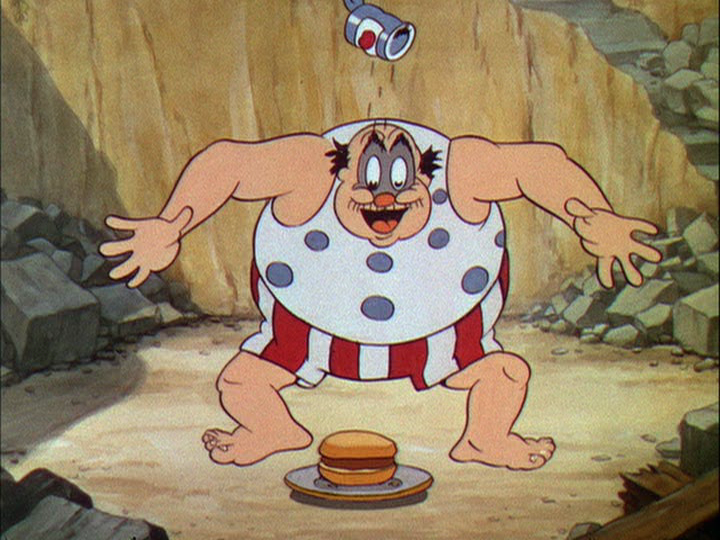
Midas, thrilled to see that Goldie has appeared, begs the creature to take away the curse, so he can eat once more. He offers everything he has, and even offers his kingdom for a hamburger. Goldie laughs and teases, “With or without onions?” The king begs for just a plain old hamburger, and Goldie finally agrees to take back the curse, in exchange for everything the king possesses.

"My kingdom for a hamburger!"

As Goldie disappears, Midas looks around wildly, before seeing his entire kingdom disappear before his eyes, as well as his clothes, save for his undershirt and boxers, with his crown now nothing more than a tin can. As promised, his hamburger appears in front of him, and as he sits down to eat it, he pauses, afraid that he still possesses the golden touch. He is relieved to find that it has indeed been taken away, and that Goldie also gave him onions.

March 21

March 21, 1947 – The Pluto Short Film, Rescue Dog, is Released to Theaters

On March 21, 1947, the Pluto short, Rescue Dog, was released to theaters. It was directed by Charles Nichols, with the story by Eric Gurney and Bill de la Torre, and music by Oliver Wallace. It features Pluto interacting with a creature smaller than himself, with comical results.

It’s a blustery winter day, and Pluto is seen peeking his head out from the Rescue Dog Doghouse, when he excitedly puts up the sign, “Dog on Duty.” He looks around for any signs of trouble, before he falls into a thick patch of snow on the side of a cliff. He falls through and skids on the ice-covered pond below, stopping just before an open patch in the ice, where his rescue barrel is floating.

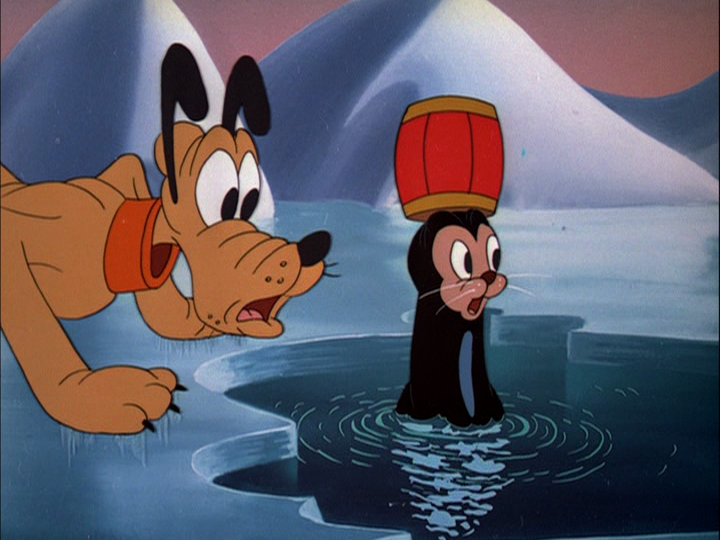
Pluto is shocked to see this strange creature rise out from under the ice

As Pluto reaches in to grab his barrel, it suddenly disappears into the water, before splashing back up and hitting him on the nose. It rises out of the water, being perched on the head of a seal. The seal turns and sees Pluto, who is suspicious of this new character. It barks at Pluto playfully, although Pluto runs away and ducks behind a rock. The seal returns the barrel to Pluto, but Pluto’s reaction is to bark angrily at the seal, causing it to duck into the water with fear. Pluto begins to march away, only to find that the seal is holding on to his tail.

The seal claps his fins, wishing to play with Pluto, but the dog just pushes the seal away, sending him flying back into the water. Pluto laughs, but just before he grabs his barrel to continue on his way, the seal sneaks in and steals it. Pluto chases after it, only to miss and get stuck in a snow bank. The seal returns the barrel to Pluto, but Pluto ends up walking way, wanting nothing to do with it. The seal, however, is not done playing with Pluto, and ends up walking underneath him, before stealing the barrel again.

The seal watches as Pluto falls through the ice

As Pluto chases the seal, the seal drops the barrel onto the ice, and Pluto chases it into a cave, which turns into a game of keep-away with the seal holding on to the barrel. The game takes a bad turn when Pluto falls off the side of a cliff and breaks the ice below, falling into the water. Pluto is seen stuck under the ice, and the seal dives down to rescue the poor pup. Using the barrel to break a patch of ice, the seal dives in and pulls out the frozen dog, and warms him up with the brandy in the barrel. Grateful for the seal’s help, Pluto makes the seal an honorary rescue dog, and they end with the seal giving Pluto a huge hug.

March 20

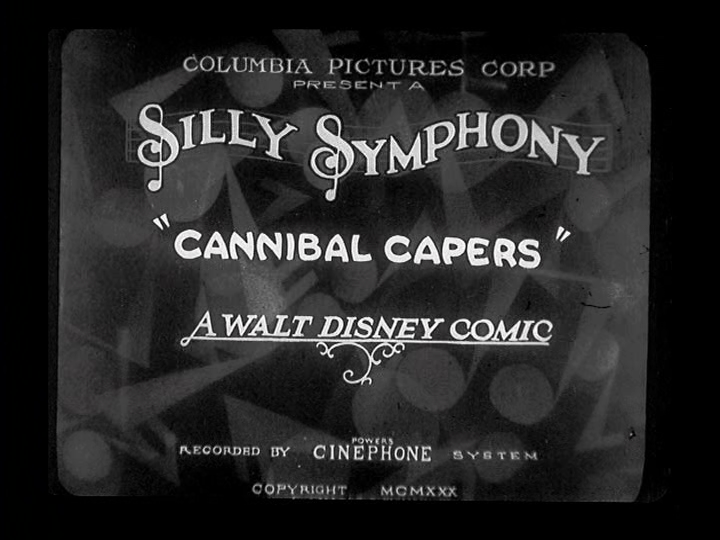
March 20, 1930 – The Silly Symphony, Cannibal Capers, is Released to Theaters

On March 20, 1930, the Silly Symphony, Cannibal Capers, was released to theaters. Directed by Burt Gillett, it was a good representation of the humor and style of movies back in the ’30s. It was normal for people to see stereotypes not just in cartoons, but also in live action films. This is the only Silly Symphony that, when shown on the Mickey Mouse Club show in the ’50s, had its ending edited out. The plot description below is of the original full short.

The Silly Symphony opens with what appears to be trees swaying in the breeze. As the camera pulls out, we see that it isn’t trees, but four cannibals, dancing and singing. They perform a dance for the audience of other cannibals, and another is seen drumming on a drum, a shield, a set of human skulls, and even his own teeth. As he grabs two of the skulls and uses them as castanets, “Habanera” from the opera Carmen begins to play.

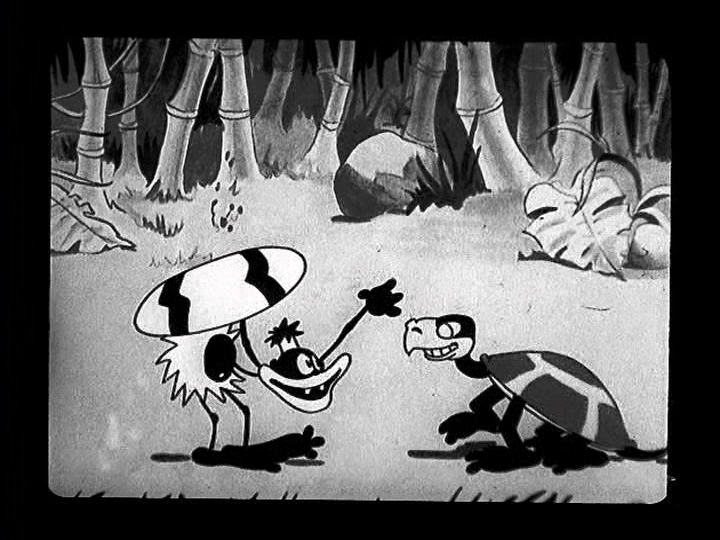
The cannibal and the turtle dancing together

The scene switches to another cannibal, who does a sort of hula, causing his grass skirt to fall to the ground. He pulls it up and begins to dance again, with the same result. Angered, he pushes his stomach to the ground, so that his skirt won’t fall anymore. He continues to dance merrily after that. The camera then moves to a turtle who is dancing to the music, and runs into a cannibal. The cannibal, using his shield like a shell, imitates the dancing of the turtle, which turns into a game of patty-cake.

In the main village, the chef is preparing the pot for a great feast, when he spots the cannibal dancing with the turtle. Although the turtle and cannibal retreat into their shells, the chef picks up the cannibal, intending to feed him to the village. The tribe cheers as the cannibal is thrown into the pot of boiling water, but are shocked when he calmly steps out and begins to cool himself down with the shield.

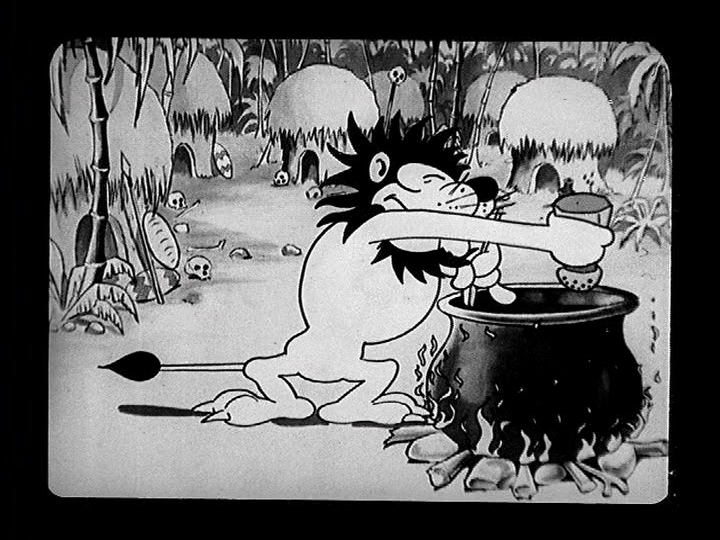
The lion preparing the cannibal for consumption

A lion roars at the edge of the village, and the cannibals flee into their homes. The cannibal that was in the pot continues to hide inside, thinking he’s safe. The lion, however, grabs a spoon, the salt, and the pepper, and begins to cook the cannibal to his liking. The lion tries to eat the cannibal, but the cannibal outsmarts him.

As the cannibal runs away, the lion pursues him. Once the lion bites down on the cannibal, however, he loses his teeth. Seeing this as an opportunity, the cannibal decides to wear the teeth and teach the defenseless lion a lesson. The cannibal chases the lion out of the village, and the cannibals are seen laughing.

March 19

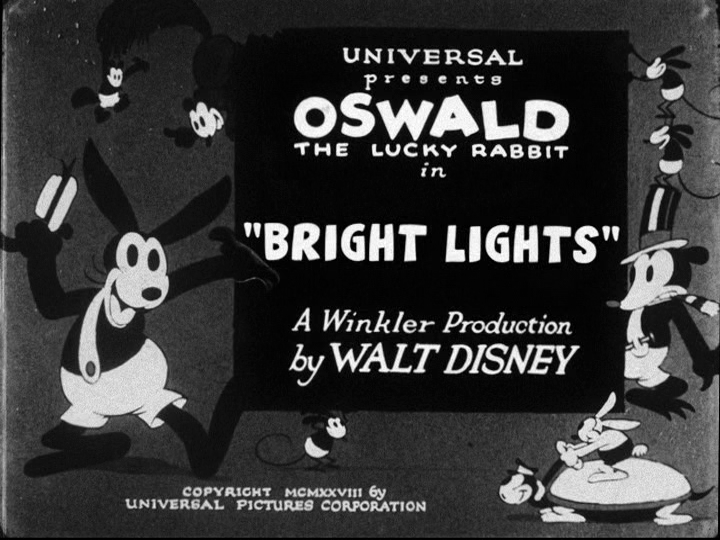
March 19, 1928 – The Oswald the Lucky Rabbit Short Film, Bright Lights, is Released to Theaters

On March 19, 1928, the 16th Oswald the Lucky Rabbit short film, Bright Lights, was released to theaters through Universal. The short itself is very different from the style of the Mickey Mouse shorts that were to follow: although Mickey Mouse cartoons contained the elements of stretching limbs and comical japes, the Oswald shorts were more brash in their day (as seen with Mlle. Zulu’s dancing), and the characters seem as if they were made out of clay with the way they can split themselves in two and wrap other characters’ limbs around solid objects.

The short opens with a bright light marquee parody of Vaudeville called “Vodvil,” advertising Mlle. Zulu, the Shimmy Queen, performing at a theater. The theater is packed with spectators, watching as a line of cats performs a variety of dances on stage. After a bit of the performance, most of the girls dance offstage, leaving Mlle. Zulu behind in the spotlight.

Oswald, dreamily staring at the picture of Mlle. Zulu

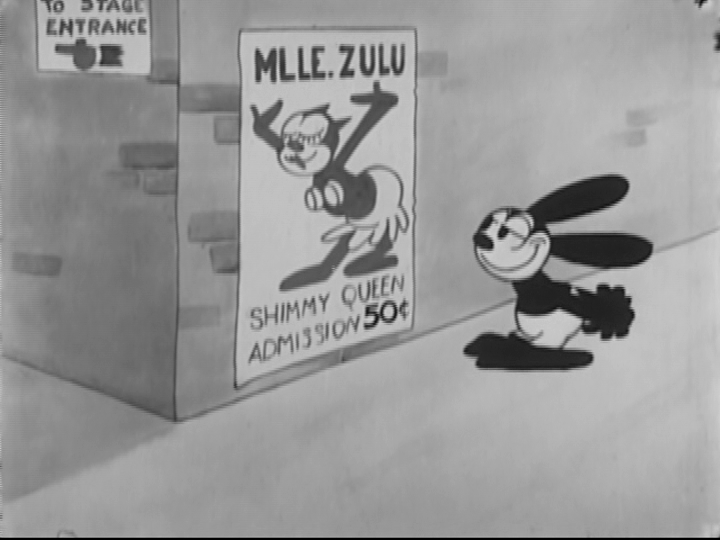
Outside, we see Oswald staring at a picture of Zulu, clearly smitten, with his heart beating right out of his chest. Oswald gets a shock, however, when he sees that the price of admission to the show is 50 cents, and he is saddened to realize he doesn’t have any money. He spots the stage entrance around the corner, and comes up with a plan to just walk right in. The guard stops Oswald at every turn, although Oswald is able to slip out of his grasp so he can try again. Comically, Oswald manages to tie the guard up to a lamppost with the guard’s own foot, and walks in confidently – only to be chased out a second later by other guards and thugs.

There’s a quick shot to Zulu still performing on stage, and then we go back to Oswald, who comes up with another plan to sneak inside: hiding under the shadow of a man in an oversized fur coat. The coat is taken away to reveal both the thin man inside it and Oswald. As the guard looms over the rabbit, Oswald scampers out on the stage in the middle of a performance, with the guard chasing him.

Oswald realizes that the box was not the best place to hide

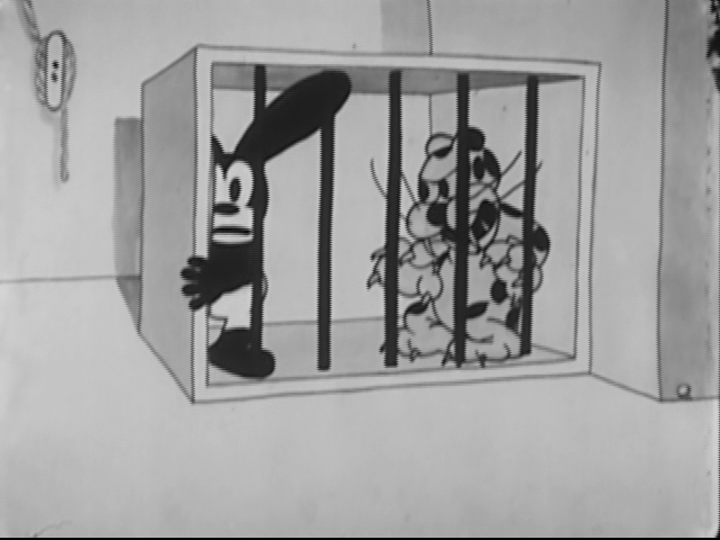
Backstage again, Oswald jumps inside a box to hide, missing the clear sign on the side that says “Danger – Keep Away.” When the guard can’t find Oswald, and and continues searching in another direction, Oswald, thinking he’s won, laughs—until he discovers the cheetah in the box with him. Oswald escapes from the box, with the cheetah in pursuit, determined to eat the rabbit. Oswald once again rushes out onto the stage in the middle of a pole-balancing act and scrambles up the pole, with the cheetah jumping up, mouth wide open to catch his snack.

The performer and Oswald climb all the way up to the rafters, holding onto a backdrop for dear life. The performer, who had been holding on to Oswald’s shorts, falls as the cheetah waits for his prey. The performer is able to fly his way back up to where Oswald is dangling and grabs his foot, pulling the limb out several feet. With the use of a nearby mallet, Oswald gets rid of the performer, but realizes a bit too late that he’s lost his hold of the backdrop and falls to the stage, landing on the head of the cheetah.

Everyone stampedes out of the theater, pursued by hungry lions

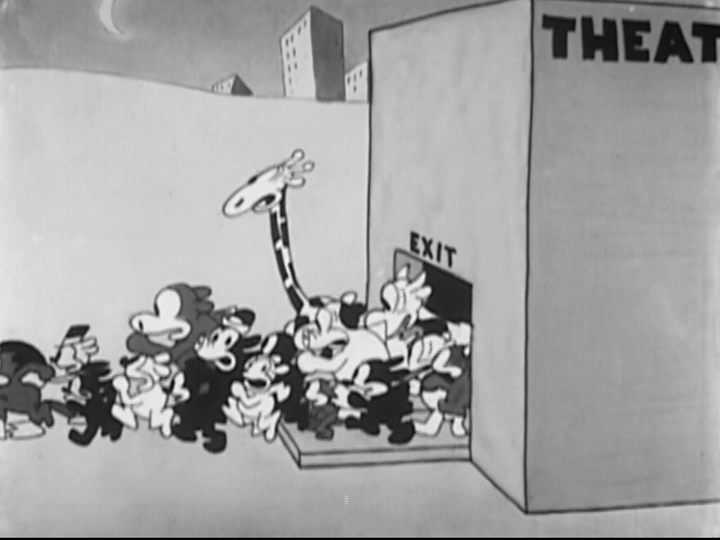
The audience and orchestra run for their lives as the cheetah goes on the rampage. Backstage, the lions break free from their cage and join the chase, scaring the performers out into the empty theater. The audience is seen breaking down the door and fleeing the theater, with the lions in close pursuit. Oswald finally appears in a nearby building, with the last lion spotting him and chasing him into town.

March 17

March 17, 1939 – The First Goofy Short, Goofy and Wilbur, is Released to Theaters

“That’s a little palsy-walsy!”

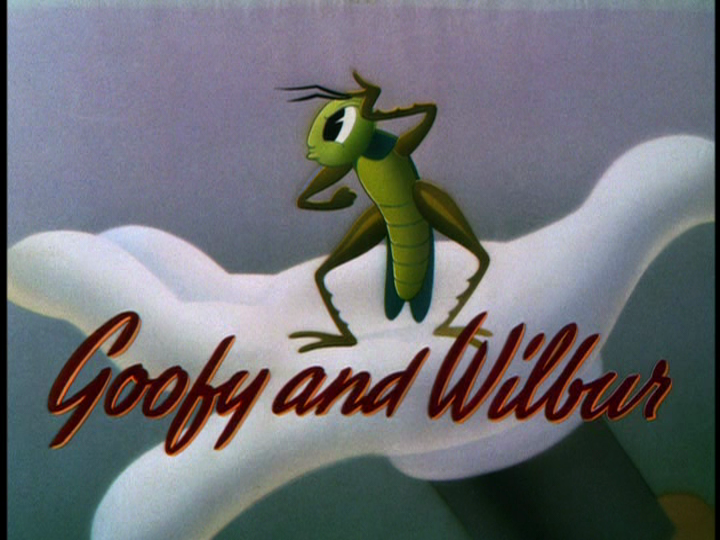
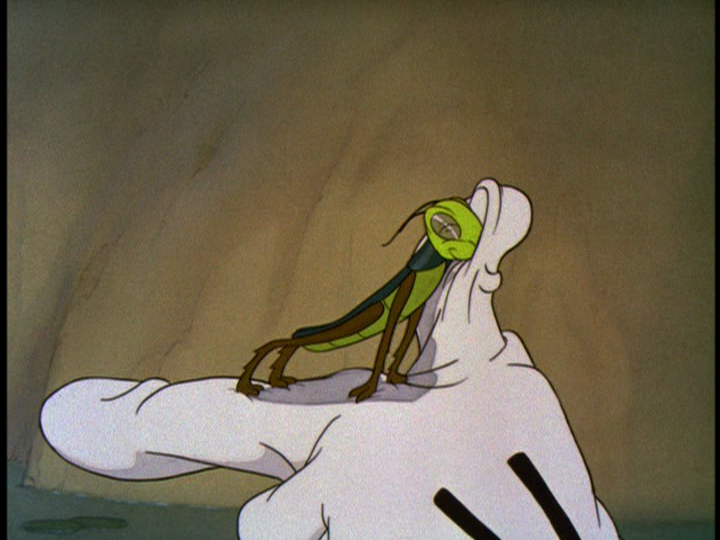
On March 17, 1939, the first short of the Goofy series, entitled Goofy and Wilbur, was released to theaters. Goofy goes fishing with his grasshopper friend Wilbur, who ends up getting into many scrapes as he tries to attract the fish for Goofy to catch. Goofy was voiced by George Johnson in this short, and it was directed by Dick Huemer. Interestingly, Goofy takes off his glove by accident, to reveal that his hands are flesh colored underneath.

Wilbur acts very pet-like, and is very loyal to his friend Goofy

Goofy is out fishing in a small beaten boat with a sputtering motor, and stops when he comes across a sign that says “No Fishing.” He opens up a box, and out leaps his grasshopper friend Wilbur, landing on his finger. Goofy strokes Wilbur like a pet, and asks if he’s all set, to which Wilbur sticks out his chest proudly. Giving Goofy a wave, Wilbur gently dives into the water, but is able to walk across the surface with his feet and look for fish to catch. Goofy sits in his boat and hollers out to the fish, hitting a horseshoe with a stick to get their attention.

A fish wakes up to see Wilbur, and begins to chase the grasshopper while Goofy stays hidden in the boat, sticking out his net cautiously. Wilbur is able to jump through the holes in the netting while the fish gets caught. Wilbur goes out again to get another victim, this time splashing water in the fish’s face. Angered by this, the fish swims at full force to catch the grasshopper, but Wilbur is too fast. Unfortunately, Wilbur is so busy taunting his victim that he doesn’t see another fish lurking near the boat who thinks Wilbur would make a tasty snack. Caught between two fish, Wilbur jumps straight into the air, with one fish almost devouring the other one. Goofy catches both in his net, and asks Wilbur to bring back a big fat fish next. Wilbur jumps excitedly as a big fat fish follows him back to the boat, although the poor fish is too big to fit into the net. However, Goofy is able to catch him all the same.

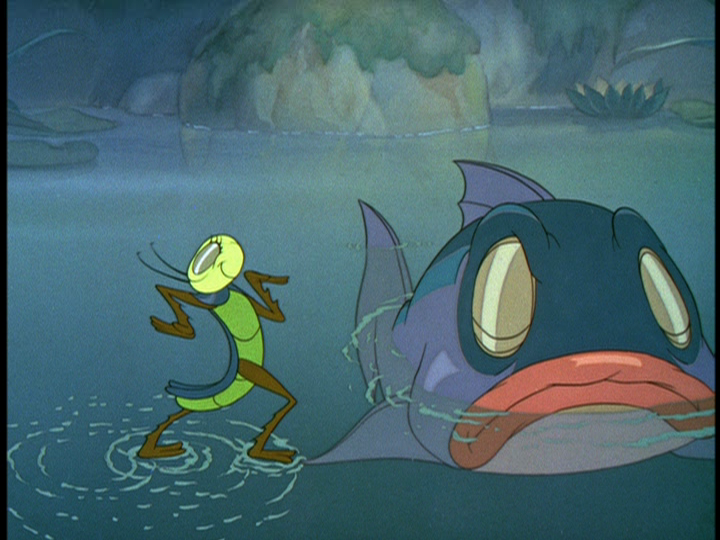
Wilbur performs a dance to get the fish's attention, but the fish still stays "asleep"

Wilbur skates around on the surface of the water, noticing a fish in front of him that, unbeknownst to him, is pretending to be asleep. Wilbur tries to get its attention, but the moment he stops watching to think about how to get the fish to wake up, the fish turns around and nearly eats him. Fortunately, Wilbur turns around at the last second, causing the fish to resume its fake sleep. Wilbur then begins to dance for the fish, hoping this will do the trick. Finally, annoyed, Wilbur spits in its eye, causing it to run after Wilbur at full speed. Goofy, meanwhile, is still trying to get the fat fish out of his net. He slams the fish in, but the fish take the netting with it, and when Goofy tries to save Wilbur with the net, the fish dives through the now netting-free net, with Wilbur scrambling to get to safety on the boat. The fish throws itself at the side of the boat, catching Wilbur as it stays suctioned fast.

Alarmed, Goofy pulls off the fish and starts calling out for Wilbur, who is still inside the fish. Goofy can hear Wilbur’s call, but it seems that he is unable to get out. Goofy finally slaps the fish, causing a very blue Wilbur to fall onto his knee, unable to move. Goofy is worried sick, wondering what can he do. Using Wilbur’s legs, Goofy pumps out all the water inside Wilbur, and revives him with smelling salts, although the poor creature is still woozy from his adventure. Goofy warns Wilbur that the fish are getting wise to him, to which Wilbur is suddenly fully revived and ready to attack.

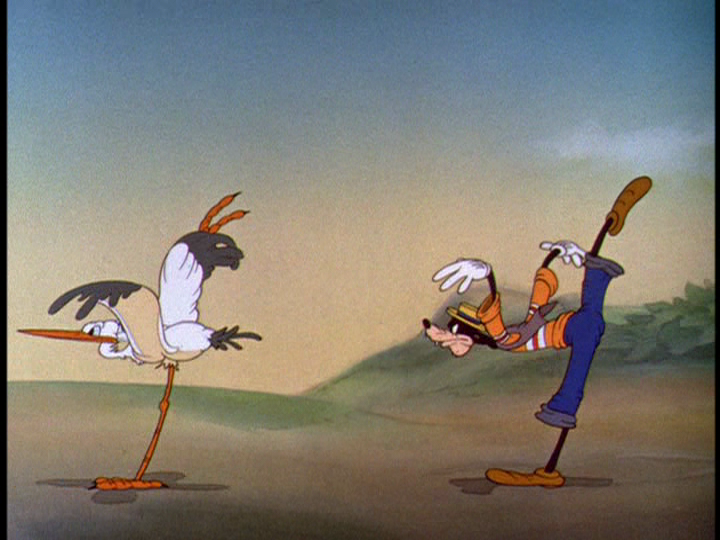
Goofy chases the stork, who has eaten the toad, who has eaten Wilbur

Leaping into the water, Wilbur sends out a massive call to all the fish in the area, and they respond, circling the poor insect. A great chase ensues, but Wilbur is able to keep one step ahead of the fish – until he finds himself to be the snack of a toad. Goofy, having seen everything, cries out Wilbur’s name, horrified, and runs out to save his friend. The toad manages to get away from Goofy – but finds itself to be the snack of a stork. The stork begins to run away as it sees Goofy in pursuit, and lands safely in its nest at the top of a hollow tree. Wasting no time, Goofy climbs up the insides of the tree and tries to battle the stork to get his friend back. The stork flies away angrily, leaving its egg behind, and Goofy begins to cry, mourning the loss of his friend. Fortunately, the egg hatches, revealing a not-dead Wilbur. The two celebrate, with Wilbur giving his friend a huge hug and a kiss.

March 16

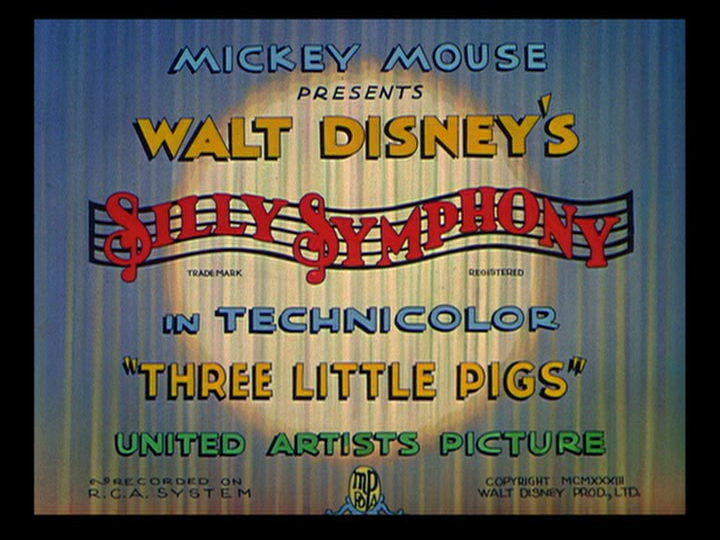
March 16, 1934 – The Silly Symphony The Three Little Pigs Wins the Academy Award


“…[The Three Little Pigs] sent a message of optimism to moviegoers who’d been battered by the Great Depression.” – Film Critic Leonard Maltin.

The 6th Academy Awards were held at The Ambassador Hotel on March 16, 1934, and the Disney Studios walked away with the Academy Award for Best Animated Short film for the wildly popular Silly Symphony The Three Little Pigs. It was in competition with the Universal Studios short The Merry Old Soul, as well as the Walt Disney and United Artists Mickey Mouse short Building a Building (see entry for January 7).

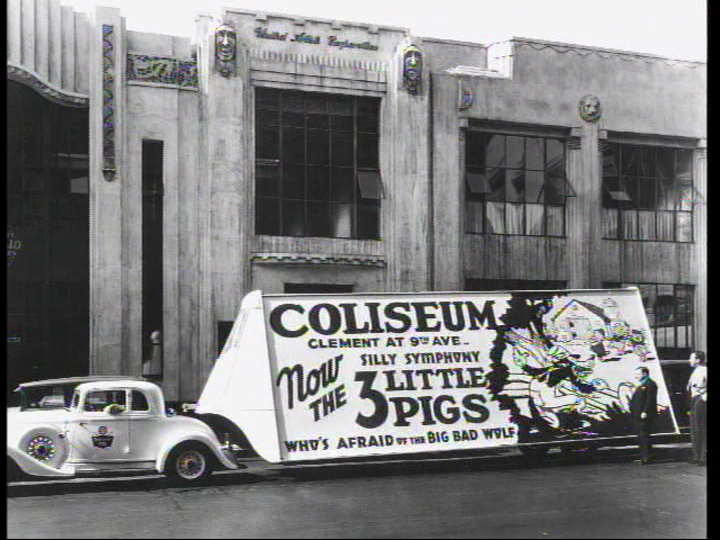
This is one of the billboards advertising the short at the Coliseum. The short was able to get top billing after a while due to its success

The short, although well done in its own right, was popular due to being released at the right time. It was considered groundbreaking in its characterization and musical score, but Depression-weary audiences adopted the song “Who’s Afraid of the Big Bad Wolf” as their fight song. The short’s immense success kept it in theaters for months with top billing, even after feature films had long left the theater. The success of the short, including the Academy Award, led to a major merchandising campaign, as well as three sequels: The Big Bad Wolf, Three Little Wolves, and The Practical Pig.

March 15

March 15, 1940 – The Donald Duck Short, The Riveter, is Released to Theaters

“Oh boy, oh boy! Am I a riveter!”

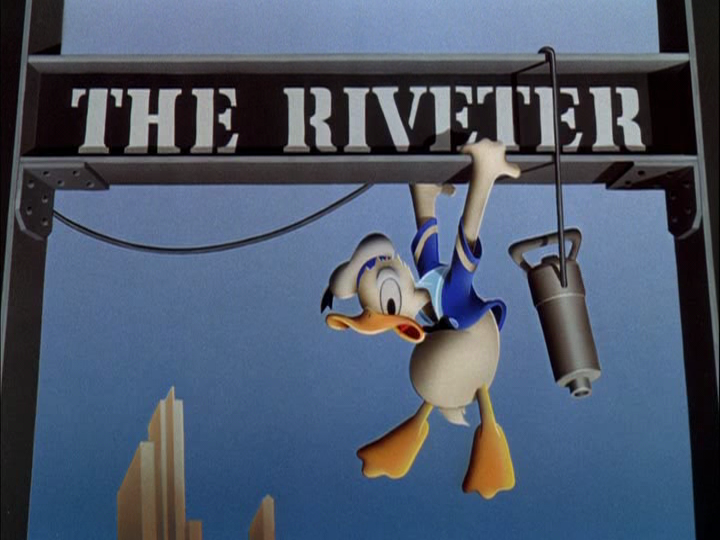
On March 15, 1940, the Donald Duck short, The Riveter, was released to theaters. Directed by Dick Lundy, and starring the voices of Clarence Nash as Donald and Billy Bletcher as Pete, the short tells the story of Donald eagerly taking a job as a riveter for Pete, even though Donald really has no clue what a riveter is.

It’s a busy day at a construction site, and a fence is seen bulging from some sort of racket. Suddenly, a worker bursts through the fence, with Pete yelling off screen, “Get out! You’re fired!” The worker dashes away, leaving his lunch behind. Pete steps through the hole the worker made through the fence and looks around menacingly before hammering in a sign with his fist: Riveter Wanted. Who should turn the corner at that moment than Donald Duck, who is happily signing “Heigh Ho” from Snow White and the Seven Dwarfs. He walks past the sign, but is suddenly drawn back to it.

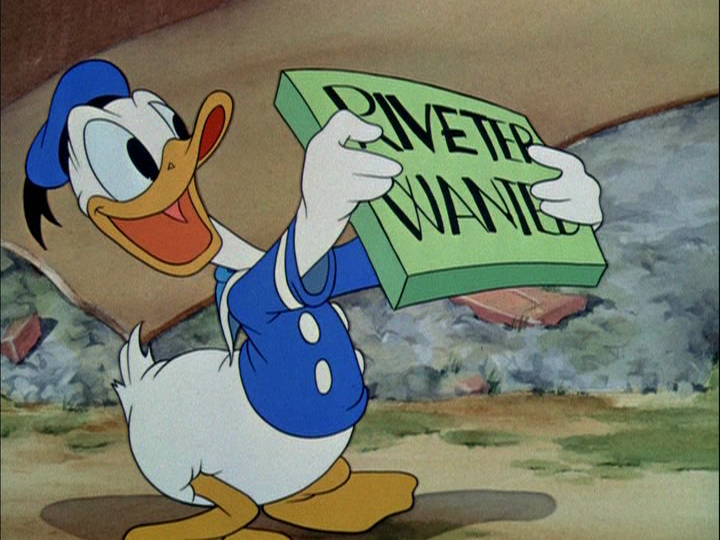
Donald shows Pete the sign, explaining that he's a riveter

Suddenly excited, Donald grabs the sign and decides to apply for the job. He looks up at the outline of the worker that was thrown through the fence and remarks on what a peculiar doorway it is, not realizing the danger he’s going to be in. When Donald applies for the job, Pete laughs at him, but gives him the job when Donald shows Pete he has some backbone. Elated, Donald asks where he starts, and Pete grabs him by the collar, showing him that he’ll stop on the top floor of the skyscraper, which appears to be a hundred stories high. Donald nearly passes out at seeing the great heights he has to go up.

Pete throws Donald into an elevator, and Donald tentatively asks how he gets up to the top. Pete then throws a lever, which zooms the elevator up to the top floor. Donald walks across steel beams, as if dazed, and nearly walks off the edge before getting his act together and crawling back to the safety of the elevator. Unfortunately, the elevator falls beneath him, and he grabs onto a steel beam for dear life. Suddenly he hears Pete yelling at him from the ground to get to work. Donald grumbles at him to shut up, voice very low, but Pete flies up to the top in the elevator and demands to know what he said. Donald mollifies his boss, embarrassed, and Pete goes back down again.

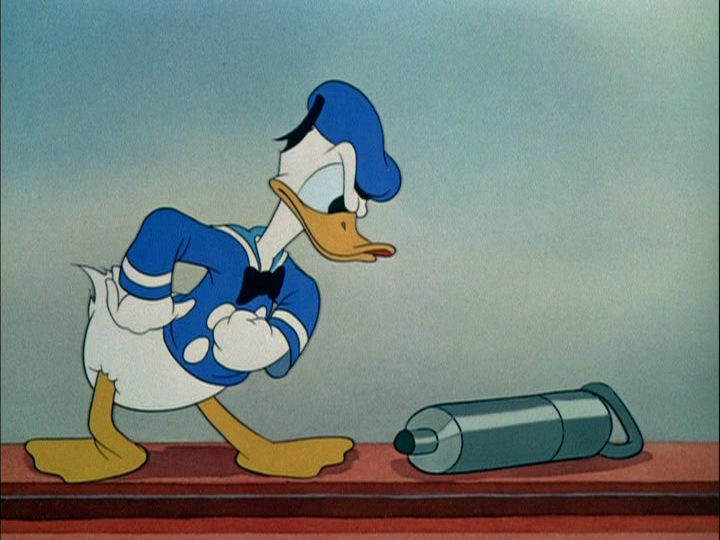
Donald versus the rivet gun

Although Donald had been excited to be a riveter, he looks at the rivet gun curiously, wondering how it works. He smashes the handle of it on the beam, demanding that it do something, which it does when it begins shooting rivets into Donald’s hat, nearly tearing his head off. As Donald tries to gain control of the strange tool, it begins to rivet with him barely hanging on to the handle. When he is able to let go, he decides to give it a good kick, but ends up catching his foot in the handle and having it start to rivet again.

Donald is carried all around the construction site at the rivet gun continues to run, and ends up accidentally riveting Pete’s blueprints to the steel beams. When Pete pulls them out, he is able to pull out only a set of paper dolls made by the rivet gun. Many strange mishaps continue to occur thanks to the rivet gun, and although Donald is able to stop its rampage, the sound of other rivet guns being used makes him nervous and he shakes uncontrollably.

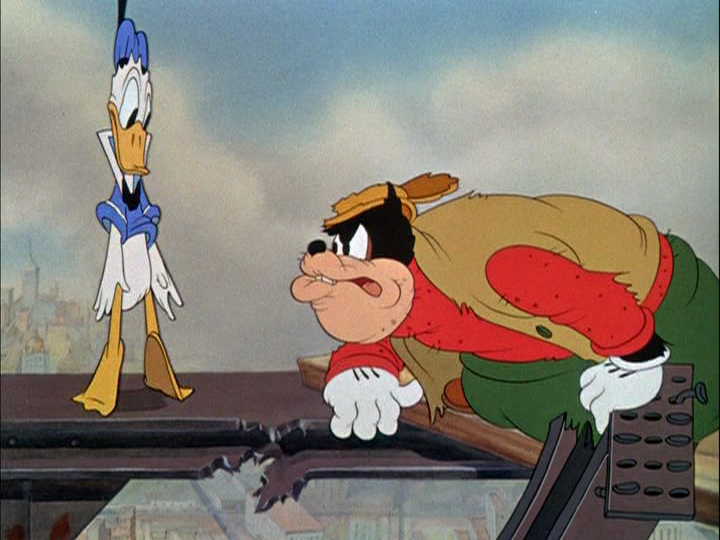
Donald's antics, however, have caused Pete's anger to grow

When Pete calls Donald over to serve him his lunch, Donald is ready to sprinkle some pepper when the rivet guns begin again, making Donald spill pepper all over the place. Pete lets out a loud, powerful sneeze, and loses his lunch in the process. Donald tries to make amends with coffee, but also loses control of it when the rivet guns start up once more. When the rivet gun sounds cause Donald to accidentally destroy Pete’s cigar, Pete has had enough, and begins to chase Donald around the construction site. The chase causes destruction of many parts of the site, but quick-thinking Donald causes Pete to fall into a vat of cement, turning Pete into a fountain as he poses with a water hose. Donald ends the short with laughter.