RSS Feed

Tag Archives: Goofy

June 27

June 27, 1952 – The Goofy Short Film Teachers are People is Released to Theaters
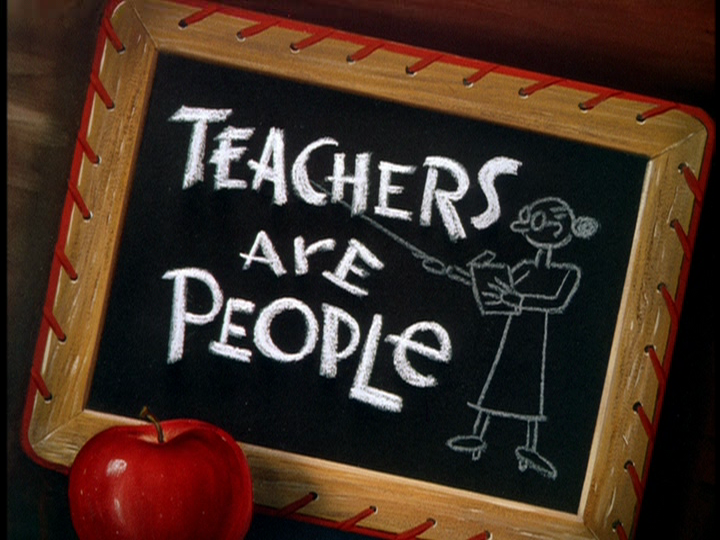
“The person upon whose capable shoulders rests the responsibility for their education is that unsung hero, the teacher.”

On June 27, 1952, the Goofy short film Teachers are People was released to theaters. It was directed by Jack Kinney, with story by Dick Kinney and Brice Mack. The short was narrated by Alan Reed, who would go on to fame as the voice of Fred Flintstone. When this short was released, the idea that a school would be bombed or that dangerous weapons would be brought in a school was an outlandish one; needless to say, attitudes have changed a great deal since then.

The short opens with the narrator explaining how school has become a vital part of every child’s life. We then see a mother dragging her reluctant son George to school, dressed in a smart suit and sailor cap, holding an apple for his teacher. When he reaches his clubhouse in the front yard, he quickly changes and emerges in somewhat “cooler” attire. We then see the other children walking to school, “whetting their appetites for knowledge” (splashing through rain puddles) and “forming friendships for the future” (a boy is seen carrying all of a pretty girl’s schoolbooks).
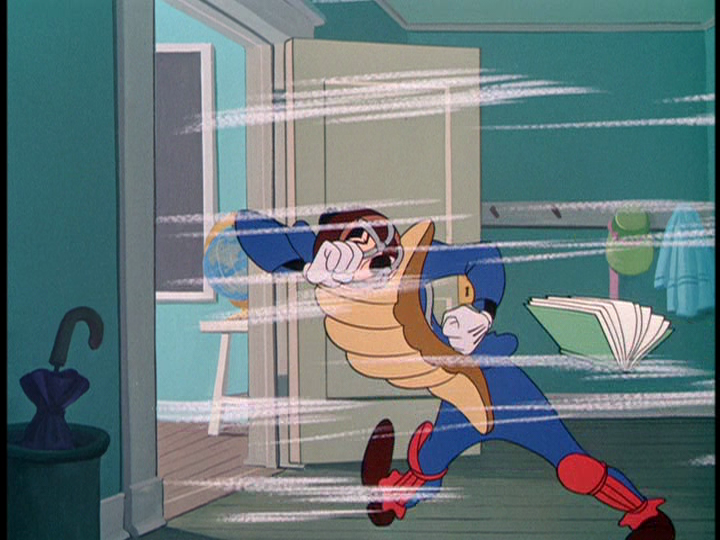
Goofy, as the brave educator, prepares himself as he enters a classroom full of chaos

As the audience’s attention turns to the school, the doors open to reveal the educator, played by Goofy. He steps forward as the crossing guard is letting the kids cross the road, but unfortunately Goofy gets stuck in the middle of the road as the cars speed past. The audience then sees his classroom: the children have gone wild, throwing books and ink, making a complete mess of the room. Before Goofy enters, he dons an umpire’s outfit, ready to tackle anything that comes his way. He calms everyone down, and the students begin to sing a good morning song.

As Goofy erases a demeaning doodle from the board, a little mirror pops out of his jacket, allowing him to see George attempting to hit the teacher with his slingshot. Goofy ducks just in time, and demands that George put all of his toys and pranks into the drawer in his desk. George reluctantly puts in his slingshot, and various weapons, including fireworks, a pocketknife, and a grenade. The grenade shocks Goofy, and he carefully places it in a nearby bucket of water. As Goofy calls roll, we see the students continuing to play pranks on each other. When he calls for George, he sees George sneaking out the window to go fishing, and quickly pulls him back inside.
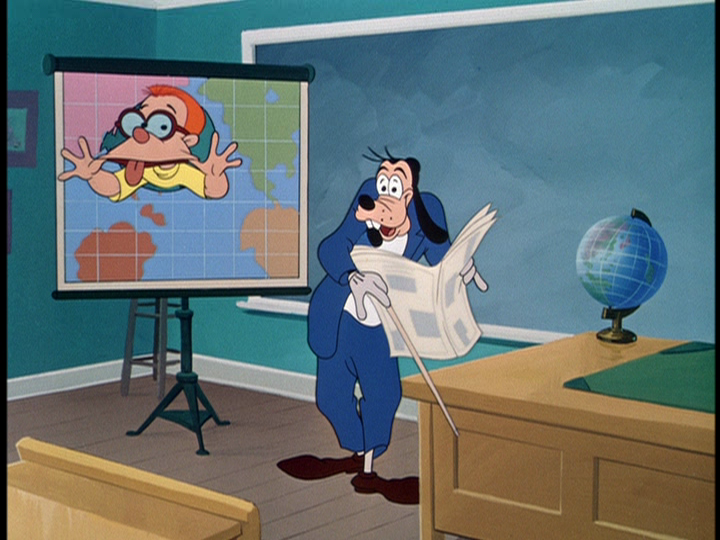
An oblivious Goofy is unaware that his student George is causing mischief behind his back

Goofy then calls for homework, and the students begin to place apples on the teacher’s desk. One apple seems to be missing, and when Goofy wonders who is absent, he looks over to see George at his place in the corner, eating his apple. George then begins to run the chalk down the chalkboard, making an annoying squeaking sound. Goofy cuts him off before the geography lesson, and pulls down the map. While he tries to give the geography lesson, the students have their books propped up, but are playing with various toys behind them. George then cuts a hole in the map, making faces at his fellow students.

When the bell sounds for lunch, the student stampede outside, making a mess of the playground. Goofy hears a group of his students whispering, and when he goes over to hear their conversation, he blushes at the obscene nature of the joke. The students return from lunch as if they were forcibly marched, and Goofy has to drag George inside. When the spelling lesson begins, Goofy asks George to spell the word “cat.” George attempts to cheat off his neighbor’s paper, but when the student pulls it away, George pulls a squirt gun on him. The student misspelled the word on purpose, so George ends up squirting the student in the face.
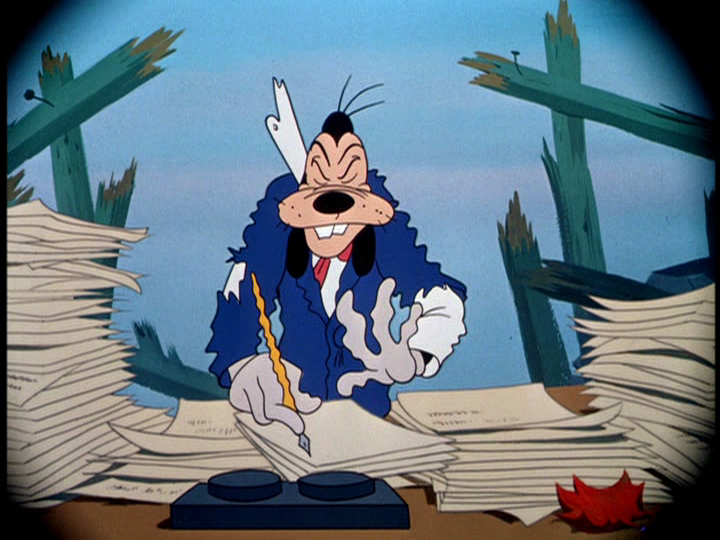
Poor Goofy is reaching the end of his rope as George squeaks the chalk during his punishment

George continues to cause mischief in the classroom, and finally sets the clock ahead an hour to 3 o’clock, when the bell rings and the students take off like a shot. Goofy is left to clean up the students’ mess, and have a parent-teacher conference. In this conference, the parent grabs Goofy by his collar and demands to know “What’s the matter with my kid’s grammar?” before punching Goofy on the head. As the short draws to a close, the school building suddenly explodes, and we see “I will not bomb the school again” written several times on the chalkboard by George, still using the squeaking chalk.
May 6

Posted on

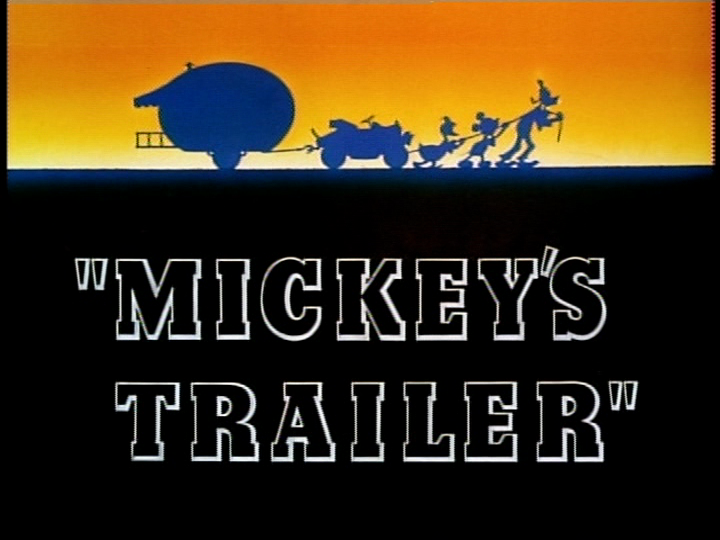
May 6, 1938 – The Mickey Mouse Short Film Mickey’s Trailer Premieres in Theaters

“The worst is over – it’s all downhill from here!”

On May 6, 1938, the Mickey Mouse short Mickey’s Trailer was released to theaters. The short was directed by Ben Sharpsteen, and stars Walt Disney as the voice of Mickey Mouse, Clarence Nash as the voice of Donald Duck, and Pinto Colvig as the voice of Goofy. The short features many mechanical gags that are reminiscent of the early Mickey Mouse shorts.

The audience first sees Mickey’s trailer, in front of a picturesque background of the mountains. The door opens, and Mickey steps out in his nightgown, excited at the prospect of a beautiful day. He pulls a lever next to him, and the whole trailer begins to rattle as he goes back inside. Suddenly every bit of the trailer, from the white picket fence to the “lush green lawn”, folds back into the trailer. A car rolls out of the side, with Goofy sleeping in it; He awakens and slips into the front seat and gets ready to drive. The “picturesque” scenery folds up behind them and slips into the trailer, leaving behind a view of the city dump, with some refineries for good measure in the distance.

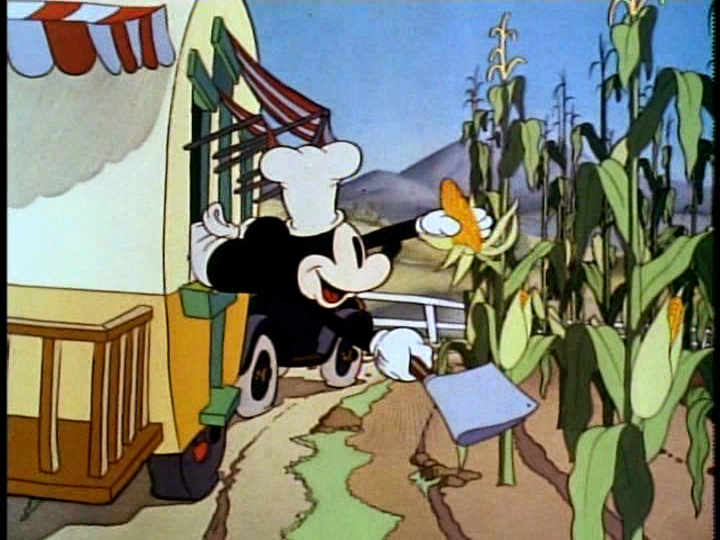
Mickey snatching some corn from a nearby field

As Goofy drives the trailer on a dirt road, he begins to sing “She’ll Be Comin’ Round the Mountain.” Inside the trailer, Mickey begins to fix breakfast, grabbing water from a nearby waterfall for the coffee, cutting some corn from nearby stalks, and, with Goofy tempting it with some hay, getting some milk from a wandering cow. Also inside the trailer is Donald, fast asleep on the top bunk. The alarm clock goes off, which is rigged to pull away his covers and force him to get up. Slowly he tries, but ends up falling back asleep. Mickey, from the kitchen, pushes a button, which turns the bedroom into a bathroom, and Donald excitedly enters the bathtub and begins to sing a nonsensical song as some robins watch at the window.

Mickey pushes another button, and the bathroom becomes a dining room, and Mickey sounds the alarm for breakfast. Goofy leaves his post as driver to get his food – with the car driving into an area marked with a “road closed” sign. As the car stumbles over several bumps in the road, each bump makes part of Goofy’s breakfast disappear. He watches Mickey and Donald enjoy their corn on the cob, and as he reaches for a cob, he accidentally sticks his fork in a light socket, which pops all the kernels from the cob. So he has popcorn for breakfast.

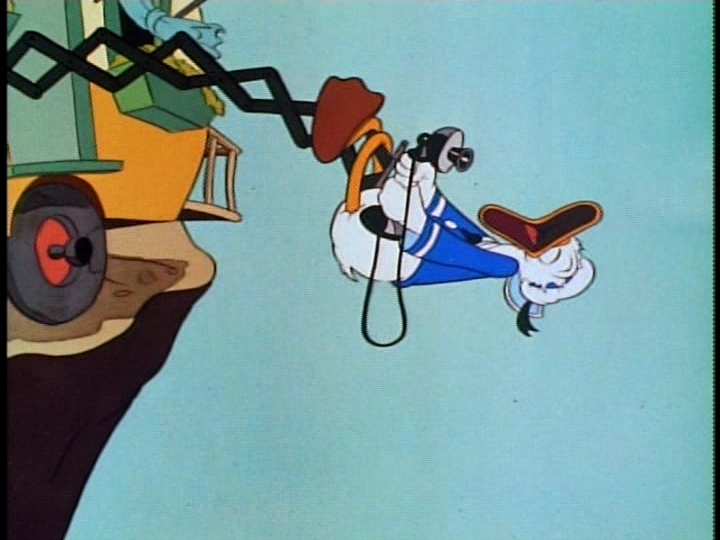
Donald clings to the phone for dear life as he is projected through the window

Mickey finally notices that there is nobody in the car, and turns to Donald, asking who is driving. Goofy responds that he is, and it suddenly dawns on him that he should be in the car driving. When he dives out the window to get back in the driver’s seat, he unwittingly knocks the connector loose from the trailer, sending Donald and Mickey flying the other way on the perilous path. Inside, the pair are knocked about as they continue sliding backwards on the one-way path. A truck slowly climbs its way up the mountain pass, but they fortunately miss it as the trailer uses the fence as a track. Donald tries to use the phone to call for help, only to have to cling to it for dear life as he is outside the window.

Just as the two think they’ve avoided trouble after a curve, they hear the sound of a train, and look out to see it fast approaching the bridge. Donald’s kneels to pray. They narrowly miss the train as they cross the bridge; both breathe a sigh of relief, only to see that they’ll be coming across it again, and again they narrowly miss it. As they fall off a curve and fly down the side of a mountain, they luckily get connected to the car again. Goofy informs them that he got them down safe and sound, unaware of the adventure they had without him.

April 27

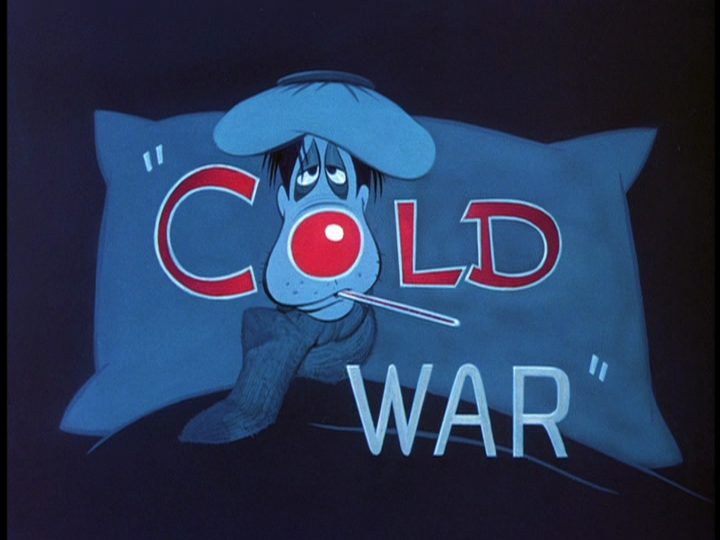
April 27, 1951 – The Goofy Short Film, Cold War, is Released to Theaters

“Now, look, Geef, a cold is nothing to be sneezed at. Beat it!”

On April 27, 1951, the Goofy short film, Cold War, was released to theaters. As Goofy is seen as an “everyman” sort in many of these shorts, he was given an “everyman” name: George Geef, which is used throughout by the other characters. The short was directed by Jack Kinney, with the story by Dick Kinney and Milt Schaffer, and Goofy being voiced by Pinto Colvig.

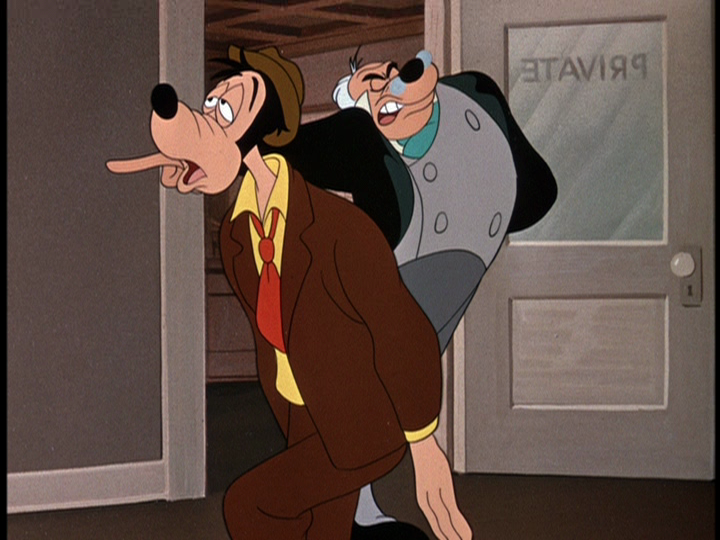
Dejected, Goofy is sent home from the office, thanks to his cold

The short opens with a narration on how to spot the carrier of the common cold: a virus easily identified by his red nose. We then see Goofy at his desk on a cold winter’s day, and he opens the window to get some air, inadvertently inviting in the cold carrier. Goofy then lets out a loud sneeze, which is heard by his boss. His boss demands that he take his cold out of there Goofy protests that he doesn’t have a cold, but he loses the argument by letting out another powerful sneeze. Defeated, Goofy leaves the office, while the boss sprays the room with sanitizer to kill the germs.

Goofy comes home, looking for a little sympathy, when he spies on a nearby table a note from his wife, informing him that she’s playing bridge at her friend Mabel’s, and dinner is in the ice box. He cries out, to no one in particular, that he has been deserted, and makes his way to the bed to lie down. The cold carrier is seen tormenting poor sick Goofy, using his nose for a punching bag, among other indignities. Goofy resolves to stay strong, but is reluctant when he has to take cold pills, and finds he is unable to swallow the pill. After fighting with it, it falls down the drain, and poor Goofy is without relief.

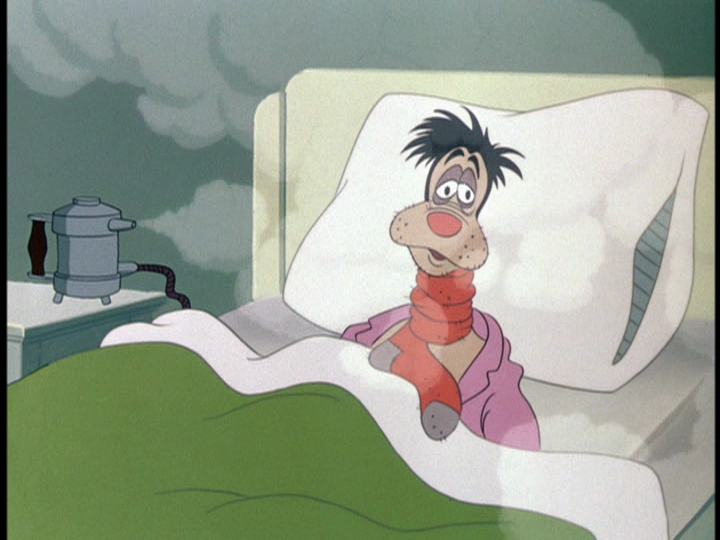
Goofy relaxing in bed as his wife continues her care of him

Goofy is in the kitchen, soaking his feet in a hot tub, when his wife returns, asking what he’s doing home. He tries to explain that he has a cold, but she isn’t listening, and continues to tell him about her day. She then accuses him of not listening – he’s tried, and his ears have gotten clogged from the cold – and realizes that he’s come down with a cold. She pushes him into bed and begins to take care of him with every remedy known to man, with comedic results. The cold is sent packing as Goofy sleeps peacefully, and the announcer lets us know that two weeks later, Goofy is well once more. Unfortunately, when he opens the window at work again to let in some cold air, the cold carrier comes racing back, causing him to sneeze loudly once again.

March 17

March 17, 1939 – The First Goofy Short, Goofy and Wilbur, is Released to Theaters

“That’s a little palsy-walsy!”

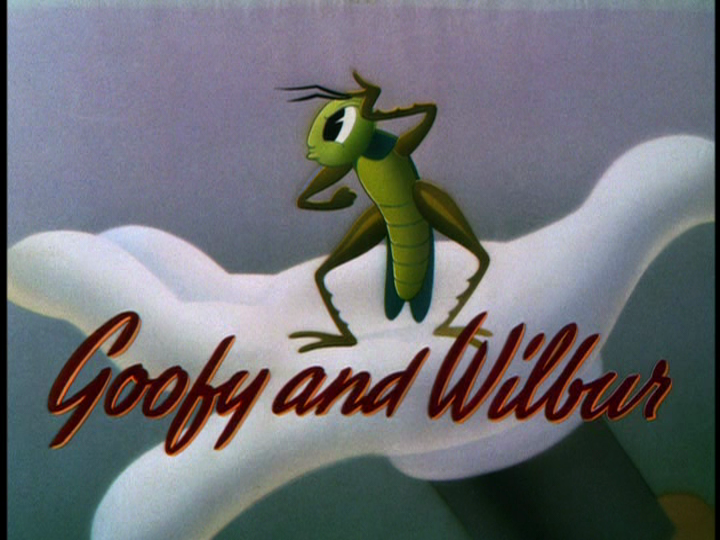
On March 17, 1939, the first short of the Goofy series, entitled Goofy and Wilbur, was released to theaters. Goofy goes fishing with his grasshopper friend Wilbur, who ends up getting into many scrapes as he tries to attract the fish for Goofy to catch. Goofy was voiced by George Johnson in this short, and it was directed by Dick Huemer. Interestingly, Goofy takes off his glove by accident, to reveal that his hands are flesh colored underneath.

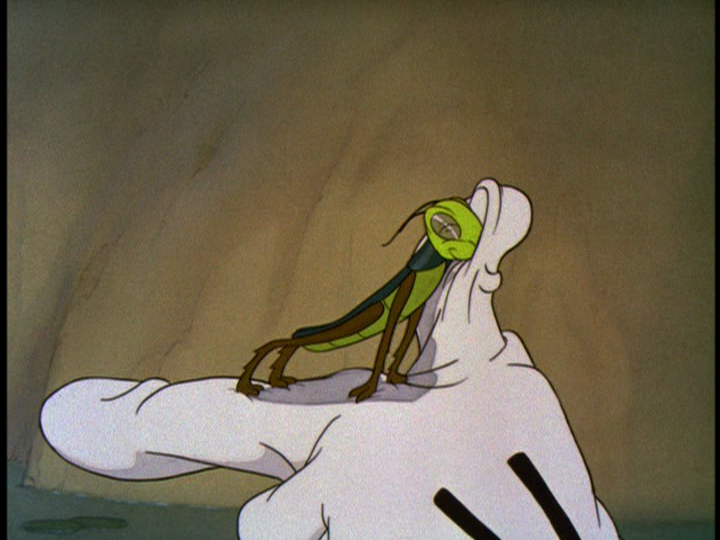
Wilbur acts very pet-like, and is very loyal to his friend Goofy

Goofy is out fishing in a small beaten boat with a sputtering motor, and stops when he comes across a sign that says “No Fishing.” He opens up a box, and out leaps his grasshopper friend Wilbur, landing on his finger. Goofy strokes Wilbur like a pet, and asks if he’s all set, to which Wilbur sticks out his chest proudly. Giving Goofy a wave, Wilbur gently dives into the water, but is able to walk across the surface with his feet and look for fish to catch. Goofy sits in his boat and hollers out to the fish, hitting a horseshoe with a stick to get their attention.

A fish wakes up to see Wilbur, and begins to chase the grasshopper while Goofy stays hidden in the boat, sticking out his net cautiously. Wilbur is able to jump through the holes in the netting while the fish gets caught. Wilbur goes out again to get another victim, this time splashing water in the fish’s face. Angered by this, the fish swims at full force to catch the grasshopper, but Wilbur is too fast. Unfortunately, Wilbur is so busy taunting his victim that he doesn’t see another fish lurking near the boat who thinks Wilbur would make a tasty snack. Caught between two fish, Wilbur jumps straight into the air, with one fish almost devouring the other one. Goofy catches both in his net, and asks Wilbur to bring back a big fat fish next. Wilbur jumps excitedly as a big fat fish follows him back to the boat, although the poor fish is too big to fit into the net. However, Goofy is able to catch him all the same.

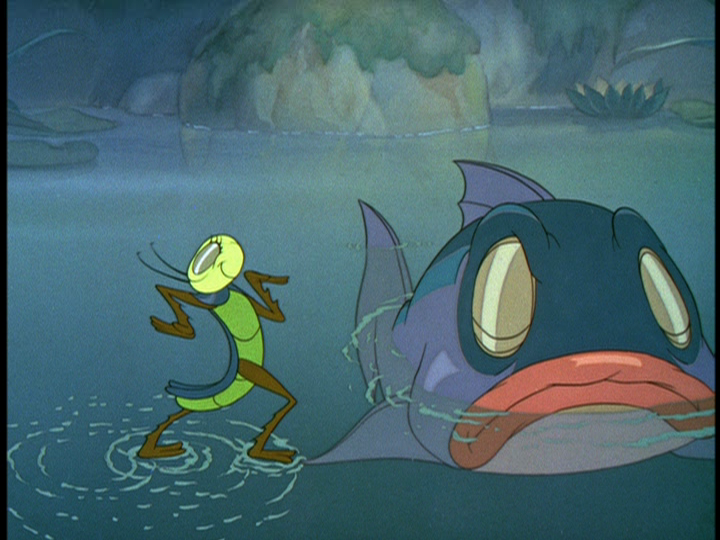
Wilbur performs a dance to get the fish's attention, but the fish still stays "asleep"

Wilbur skates around on the surface of the water, noticing a fish in front of him that, unbeknownst to him, is pretending to be asleep. Wilbur tries to get its attention, but the moment he stops watching to think about how to get the fish to wake up, the fish turns around and nearly eats him. Fortunately, Wilbur turns around at the last second, causing the fish to resume its fake sleep. Wilbur then begins to dance for the fish, hoping this will do the trick. Finally, annoyed, Wilbur spits in its eye, causing it to run after Wilbur at full speed. Goofy, meanwhile, is still trying to get the fat fish out of his net. He slams the fish in, but the fish take the netting with it, and when Goofy tries to save Wilbur with the net, the fish dives through the now netting-free net, with Wilbur scrambling to get to safety on the boat. The fish throws itself at the side of the boat, catching Wilbur as it stays suctioned fast.

Alarmed, Goofy pulls off the fish and starts calling out for Wilbur, who is still inside the fish. Goofy can hear Wilbur’s call, but it seems that he is unable to get out. Goofy finally slaps the fish, causing a very blue Wilbur to fall onto his knee, unable to move. Goofy is worried sick, wondering what can he do. Using Wilbur’s legs, Goofy pumps out all the water inside Wilbur, and revives him with smelling salts, although the poor creature is still woozy from his adventure. Goofy warns Wilbur that the fish are getting wise to him, to which Wilbur is suddenly fully revived and ready to attack.

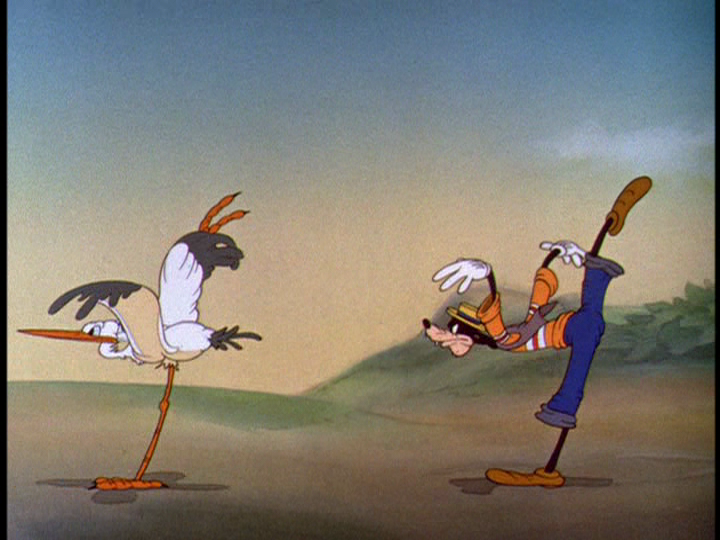
Goofy chases the stork, who has eaten the toad, who has eaten Wilbur

Leaping into the water, Wilbur sends out a massive call to all the fish in the area, and they respond, circling the poor insect. A great chase ensues, but Wilbur is able to keep one step ahead of the fish – until he finds himself to be the snack of a toad. Goofy, having seen everything, cries out Wilbur’s name, horrified, and runs out to save his friend. The toad manages to get away from Goofy – but finds itself to be the snack of a stork. The stork begins to run away as it sees Goofy in pursuit, and lands safely in its nest at the top of a hollow tree. Wasting no time, Goofy climbs up the insides of the tree and tries to battle the stork to get his friend back. The stork flies away angrily, leaving its egg behind, and Goofy begins to cry, mourning the loss of his friend. Fortunately, the egg hatches, revealing a not-dead Wilbur. The two celebrate, with Wilbur giving his friend a huge hug and a kiss.

March 8

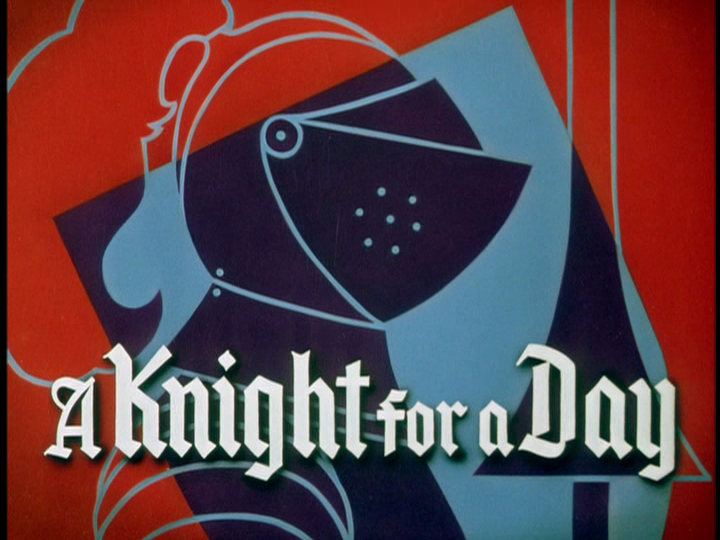
March 8, 1946 – The Goofy Short, A Knight for a Day, is Released to Theaters

“Stand by, everybody, as we turn the calendar back 500 years and bring you the 123rd running of the Canterbury tournament at Blunderstone Castle.”

Directed by Jack Hannah, A Knight for a Day was released on March 8, 1946. This short continues the trend of having Goofy play a part in the story, rather than being the regular Goofy audiences were used to from earlier Mickey Mouse shorts. Also, all the characters in Knight for a Day are designed to look like Goofy. The story was written by Bill Peet, with music by in-house composer Oliver Wallace.

Knight for a Day relies on clever puns woven throughout the story, such as the names of the knights: Sir Loinsteak and Sir Cumference. Modern day sports-casting and a medieval setting mix as the audience is taken back in time to attend, the announcer says, the 123rd annual Canterbury jousting tournament. Everyone in town flocks to the castle for this event, and it sells out fast. The winner is to receive honor, glory, and the hand of the beautiful Princess Esmeralda, who is seen watching from her tower.

The squire Cedric, dreaming of the day he can win the favor of the princess through jousting as a knight

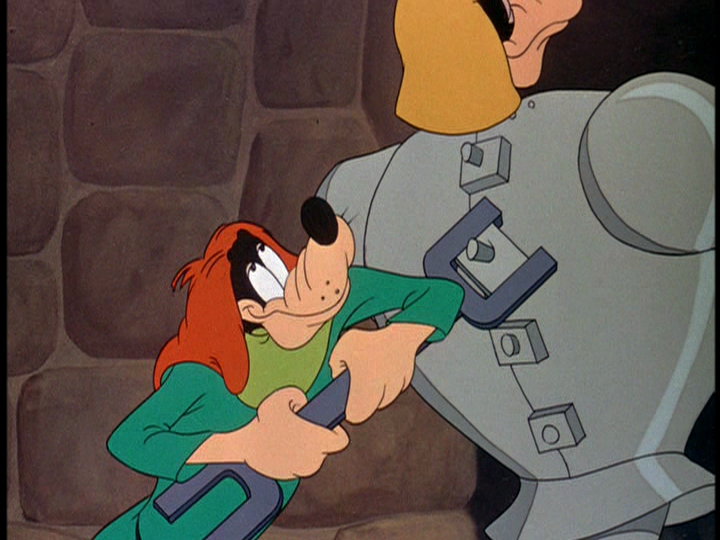
We then head to the dressing room of Sir Loinsteak, whose squire, Cedric, is busy polishing the knight’s suit of armor and preparing him for the fight. Cedric dreams that one day he shall be a knight “and face death for the smile of a lovely princess.” He takes a moment to daydream, but quickly sets back to work preparing the knight.

As the trumpet sounds, Cedric races to help Sir Loinsteak mount his horse, breaking the knight’s sword in his haste. He hides the pieces and continues to prep, but as he tries to shove the knight onto his horse, he pushes the Sir Loinsteak out of his armor (and Cedric into it) and the knight is knocked out cold when he lands on an anvil. Cedric can’t believe that Sir Loinsteak is unable to fight, and then realizes that he is wearing the armor. The narrator tells Cedric that this is his big chance—he can win the honor and glory, not to mention the hand of the fair princess.

The tournament begins with the champion, Sir Cumference (“Old Iron Pants, they call him”), entering the arena. His horse has hash marks for all the gallant knights who have fallen in battle against him. Cedric enters from the other gate, and is blown a kiss by Princess Esmeralda; the narrator comments that it must be love at first sight. Cedric’s dreamy-eyed gaze is cut short when he notices that the knights are prepared to joust, with shields made of bricks and sharp points at the end of their lances. He quakes in his armor.

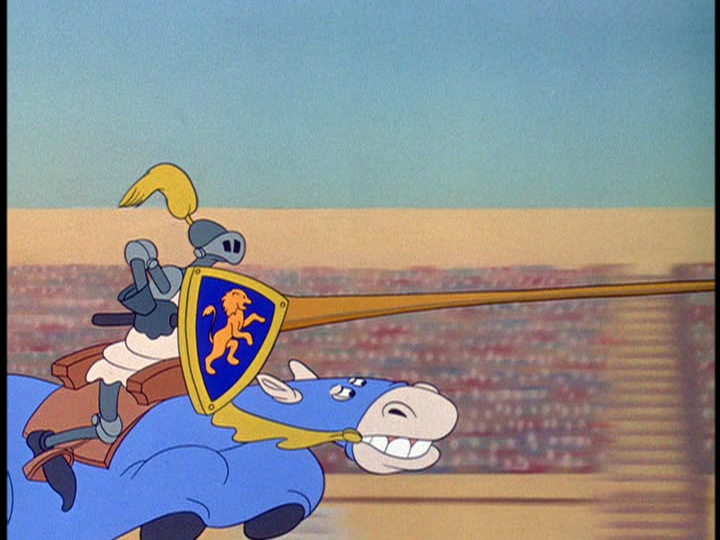
Although nervous, Cedric charges with all of his might

The umpire checks his wrist-sundial, and the crowd waits anxiously for his signal to begin. The umpire waves his flag, the trumpet sounds, and off they go into the joust! Cedric charges gallantly forward, but it’s no use again Sir Cumference – Cedric and his horse are pushed out through the castle wall into the moat. Sir Cumference is still the champion, but this does not please the princess, who lets out a loud shout of discontent at this outcome.

Suddenly, Cedric is seen climbing through the hole in the castle wall, still on his horse, ready to try again. The champion puts on his helmet again, charges, and sends Cedric flying into the air and landing in the bleachers. The crowd lifts him back to his horse, infuriating Sir Cumference, who pulls out his sword and charges. Cedric pulls out his sword, too—forgetting that he had destroyed it earlier. Thinking fast, he attaches the arm from his armor to the end of the broken sword and goes full speed ahead, using it to knock the champion out of his seat. He then uses the armor arm to push the challenger back as he tries in vain to hack away at Cedric.

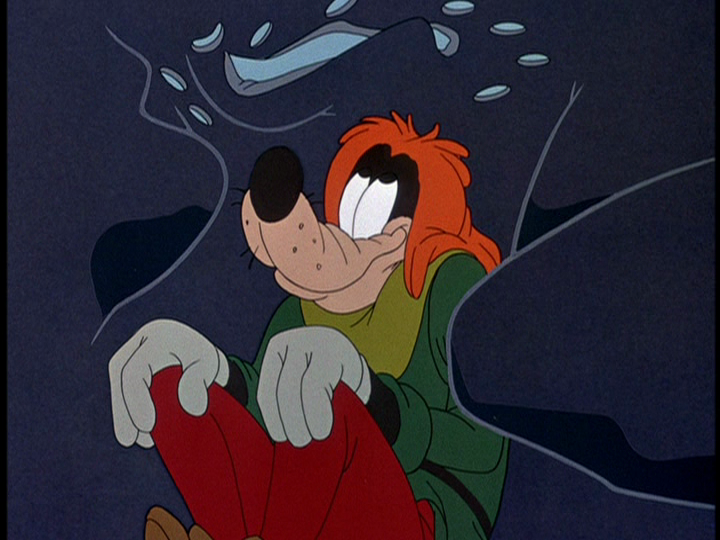
Cedric is able to hide comfortably inside the armor as Sir Cumference beats it relentlessly with a mace

Cedric begins to throw pieces of his armor at Sir Cumfrence, and the fight becomes a no-holds-barred scuffle. Sir Cumference takes out a mace and begins to smash the Cedric’s armor, with Cedric hiding inside. Cedric, however, being a lot smaller than the armor would suggest he is, is able to hide away without being injured. The champion is exhausted from his angry work, and Cedric becomes the new champion when “Old Iron Pants” falls from his horse. The princess leaps from her balcony and begins to shower Cedric with kisses. “What a day for a knight,” the narrator ends, “and what a knight for a day.”


January 28

January 28, 1944 – Goofy Short Subject How to Be a Sailor is Released.

“Star light, star bright – gosh, I wish I knew where I was tonight.”

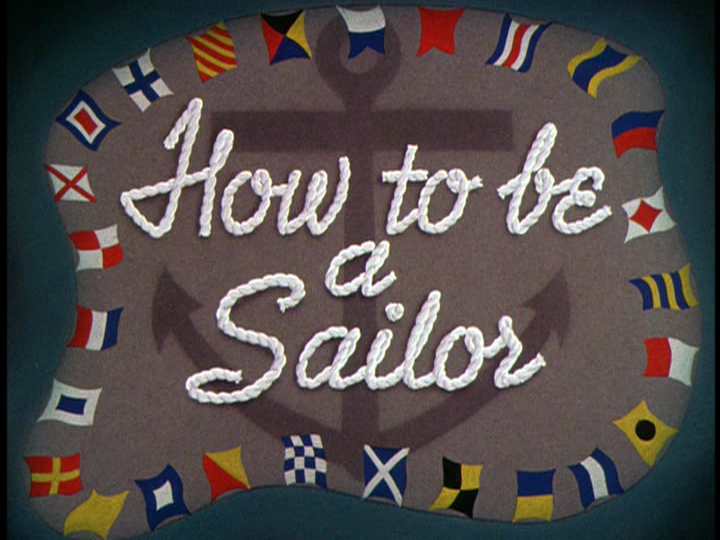
On January 28, 1944, the short How to Be a Sailor was released to theaters. Following in the tradition of the How-To series starring Goofy, the short is an entertaining quick run-through of sailing throughout the ages. The surprising thing about this short is that the ending does deal with World War II, where it is Goofy against the entire Japanese fleet. This section, coupled with the rest of the short, not only gives the audience a good laugh, but also helps establish the feeling of invincibility in the face of fear when it came to the Japanese soldiers and the war. It’s also notable for being the only short of the war shorts to deal with the Navy, as the rest were mostly dealt with Army settings. The short was directed by Jack Kinney, and stars Pinto Colvig as the voice of Goofy, with John McLeish as the narrator.

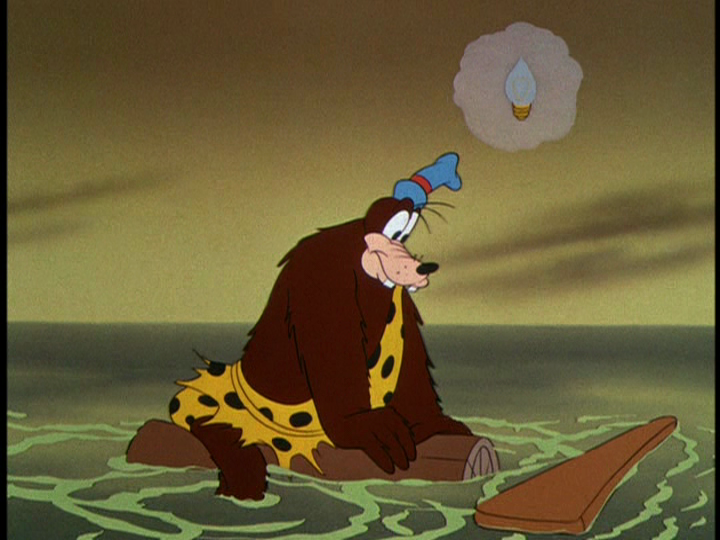
“In the beginning,” the narrator starts off, “the world was all wet. Today, it is still four-fifths wet.” We are introduced to early man – or, early Goofy, as the case would be – who tromps through the woods and through shallow water, before falling into a deep section. Struggling to swim, he comes across a log; he’s unsteady on it, but manages to gain some stability and float along, until he comes across a method of propulsion: a wooden board. Excited, Caveman Goofy takes the board and happily steers himself around in circles.

Caveman Goofy gets an idea of how to propel himself on his log

We fast-forward to Egypt, where we see a boat rowing down the Nile river, and find that Goofy is rowing it by his lonesome, with a contraption that allows him to row the at least twenty oars needed to propel the ship. Soon after, we are sent to visit Viking Goofy, who used the stars as his compass. As Goofy laments that he wish he knew where he was, a constellation of Goofy with a bow and arrow hears his plea and shoots the star arrow, sending Viking Goofy and his boat flying across the ocean to their destination.

The next sequence addresses how 13th Century people viewed the world, and wondered what shape it was in, and the audience sees various shaped globes, ranging from diamonds to cylinders. We then see one of their theories in action: sail West far enough, you would sail off the edge of the world. A Goofy version of King Neptune and two fish peek out from the edge of the world, watching the ship fall, and shake their heads.

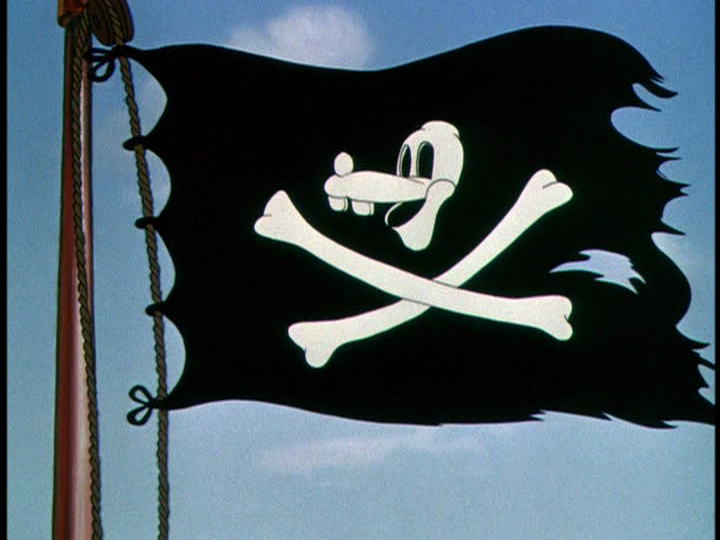
Scarier than Pirates of the Caribbean were the Goofy Pirates

“From the earliest days, sailors were preyed upon by…pirates!” the narrator yelps as the pirate flag is raised. Goofy, a perfect pirate captain with peg-leg and eye-patch, is the victim of a mutiny. His crew pushes out a board, and he is sent to walk the plank, or “feed the sharks.” But a storm hits the next boat the audience sees, and the waves play a game of passing the ship from wave to wave. “For safety’s sake,” the narrator explains, “sailors would lash themselves to the mast.” We then see Goofy tied tightly to the mast, which is unfortunately is struck by lightning and sent crashing through the ship.

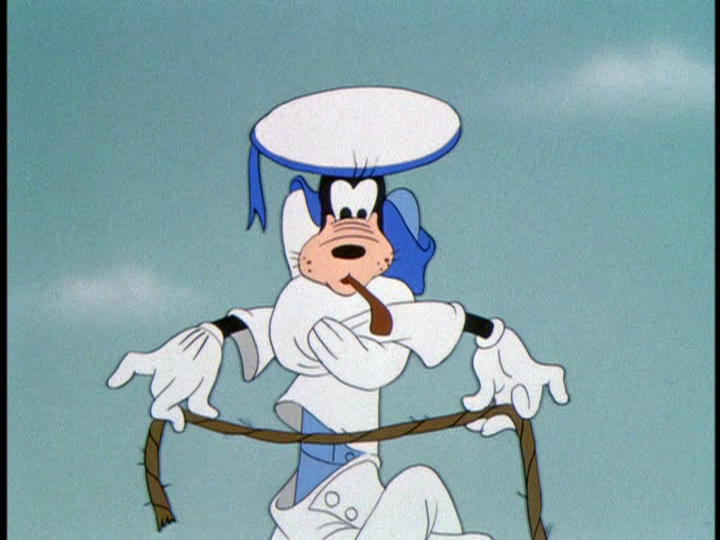
The most famous sequence of the short is the flag sequence, where we are taught the alphabet through semaphoring and wigwagging. Goofy tries to keep up with the fast pace of the narrator, but unfortunately wigs where he should have wagged, and his trousers fall around his feet. After hiding behind a sail to fix his situation, he comes out and begins to dance the traditional dances of the sea, including a dance of hoisting the sail, rowing, and being a look out, only he isn’t looking out where he is going. We also see Goofy tying knots, with some literal interpretations by the animators: Goofy ties a square knot (the knots make the shape of a square), then a sheepshank (which “baas” when he pulls on it), and as he slips on the next knot, he knocks himself in the jaw, to which the narrator explains is the “slipknot.”

Goofy finds that knots are a little more complicated than he thought

“And now, through trial and error, the sailor has at last, mastered the sea.” We see sailors on a Navy vessel, dreaming of pin-up girls, when the call to attack is sounded. Goofy picks up a missile to fire, only he slips and is sent out of the ship instead of the weapon, and is seen single-handedly destroying the Japanese fleet, as well as the symbol of the Rising Sun, saving the day.

The real gem of this short is the music, with the use of sea tunes to add humor to the situations. For instance, in the Egypt scene, when Goofy is struggling to row by himself, there is a teasing version of Row, Row, Row Your Boat playing in the background. Goofy, when dancing, also keeps in time with a xylophone version of The Sailor’s Hornpipe, which gives a whimsical addition to the already humorous dancing.

Although considered one of the war shorts, the short can stand up well on its own without the association. The pace is quick, but not overwhelmingly so, and gives the audience one laugh after another. This short is a highly enjoyable piece, and one of the best gems of Goofy’s career.

January 23

January 23, 1948 – Goofy Short Subject, They’re Off, Released to Theaters

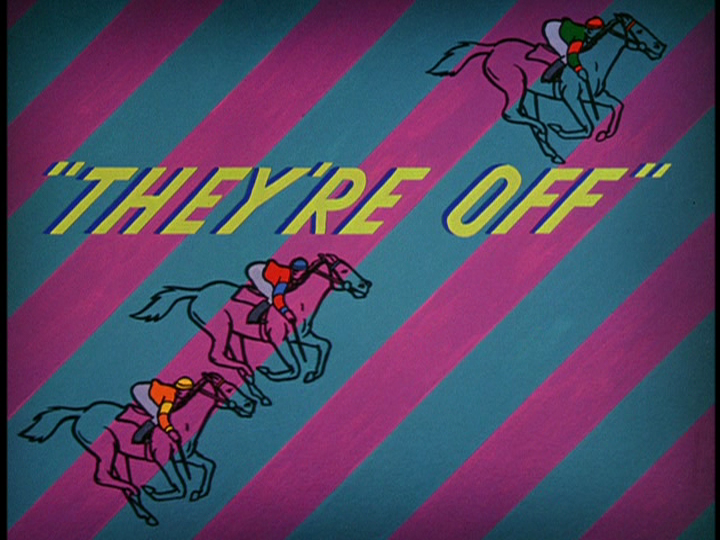
Title Card for the Short, They're Off

Since Tintype I, horses of this line have been noted for their burning speed. And they’re also noted as camera muggers, or lens louses.

On January 23, 1948, the Goofy short, They’re Off, was released to theaters. Following in the tradition of the “How To” films that began with The Art of Skiing in 1941, the short is a tongue-in-cheek how-to on horse racing and betting on the winning horse. The short was directed by Jack Hannah, with story by Reiley Thomson and Campbell Grant, and music by Oliver Wallace.

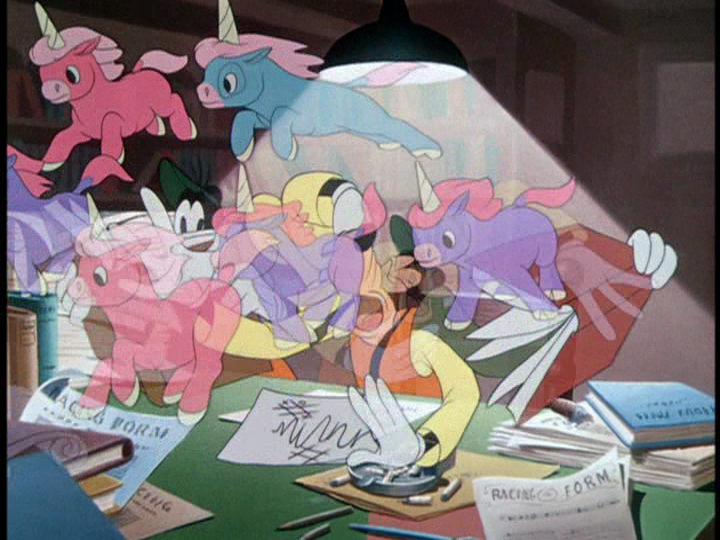
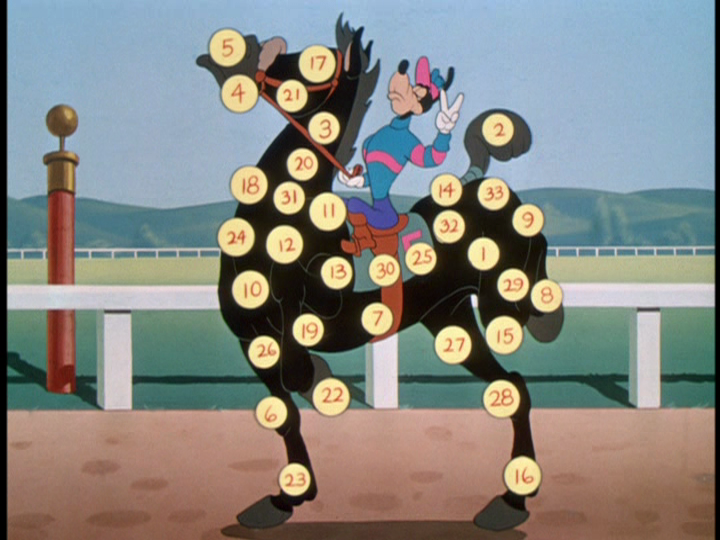
Our narrator begins the film by taking us through the research one must do to identify the winning horse. “Today horse racing has become a science,” he declares, “a science to test the skill of the professional and unprofessional handicapper.” We see Goofy surrounded by mountains of books, periodicals, and newspapers, trying to identify what makes a winning horse. He tries to consider all the elements, including wind velocity, humidity, and rotation of the earth, with comical effect. As the narrator gives a brief history of the thoroughbred, the animators seem to have taken the terms quite literally, such as the horses being referred to as “bang tails,” much to the delight of the audience. Finally Goofy picks his horse, Snapshot III, and now must determine whether this horse has the “fine points of a horse’s conformation,” as the narrator states. Throughout his explanation, the narrator’s voice gradually speeds up, and Goofy ends up overwhelmed and delusional, with animations from How To Ride a Horse and the baby unicorns from Fantasia making a cameo.

Goofy becoming delusional from all of the confusion.

We next see Snapshot III’s pedigree. This is another clever example of wordplay: Snapshot III out of Developer by Hypodeveloper, out of Bromide by Flashbulb and Hypo, out of Tintype by Negative. This wordplay reflects Snapshot’s well-known trait of being a camera mugger or a “lens louse,” a term that causes the horse to glare at the audience.

The day of the big race arrives, and our confident Goofy enters the racetrack, trying desperately not to be swayed by the whisperings of the other bettors and the touts who convince him which horse will win. The narrator explains the many systems people use to pick a winner – again, with the animators taking it quite literally for comic effect. We then see the horses coming out to line up, with Snapshot III taking a jaunty trot down the track.

A confident Snapshot III, shown portraying the perfect conditioning

At this point, we see another Goofy, who has decided to go by luck to pick his horse. With “Eeny, Meeny, Miney, Moe,” he decides that Moe means something, and picks his horse: Old Moe, the 100-1 shot. The score at this point is a comically dour version of The Old Gray Mare, blaring from a brass instrument. Both Goofys place their bets, with the confident researcher stuffing in all of his money, and the play-by-luck Goofy betting only $2.

“The atmosphere is electric,” the narrator observes, although the members of the press, the cameramen, and the jockeys contradict the atmosphere he describes. The race starts, with Snapshot still standing at the gate, calmly eating oats. With a yawn, Snapshot’s jockey tells him to go ahead and start, and he takes off at a fiery speed. The scene grows more tense and chaotic as reporters are typing like crazy, flashbulbs are constantly flashing, and the audience is fighting among themselves. Old Moe and Snapshot are “grappling it out neck and neck,” and the race becomes a photo finish between the two.

The writers and animators must have had a fun time doing this short, with little gags here and there: Jack Hannah, for instance, is seen as the owner of Snapshot III and Insomnia, and writers Reiley Thomson and Campbell Grant are the trainer and owner, respectively, of Crankcase. Even the names of the books are wonderfully tongue-in-cheek, like Know Your Nag and Mother Hubbard’s Selections. Overall, this short is a clever one; while it may not stand out as one of the best, it is definitely one to watch for the subtle gags.