RSS Feed

Tag Archives: 1940s

March 10

March 10, 1944 – The Goofy Short Film How To Play Golf is Released to Theaters

vlcsnap-2013-03-09-20h28m18s69

“Contrary to popular belief, golf is not a waste of time.”

On March 10, 1944, the Goofy short film How to Play Golf was released to theaters. It was directed by Jack Kinney, with Fred Shields as the voice of the narrator.

The narrator begins by trying to explain why golf is not a “waste of time.” Goofy steps on the course and tries to pull out his club, and ends up pulling out all of them at the same time, sending them flying over the green. Undeterred, he grabs his tee and his ball and sets up his shot. While the narrator tries to explain the grip, Goofy ends up knotting his fingers together. As he swings, he ends up hitting himself in the jaw, and tangles himself up even more trying to free his fingers. As he bounces all over the green, the ball ends up on his nose, and he creates what the narrator calls a divot, “caused by an indirect swing.” The ball slides down the divot, and into Goofy’s mouth, where he accidentally swallows it.

The figure and Goofy square off on the ball, not realizing they are about to hit each other

The figure and Goofy square off on the ball, not realizing they are about to hit each other

The narrator then begins to explain a proper swing, separating Goofy from a diagrammatical figure that Goofy tries to emulate. The figure is alarmed that Goofy’s swing has swung the poor guy around and around. The figure then takes on the task of untangling Goofy, sending him flying through the blueprint paper behind him. He finally fixes Goofy, but the two end up smacking each other with their clubs by accident, sending the ball straight into Goofy’s eye.  Back on the green, Goofy sends the ball flying near the hole, where he needs to putt. He checks all the variables before his shot, including wind velocity, humidity, rotation of the earth, time of day, temperature, drift indication, lay of the land, trajectory angle, longitude, and latitude. However, Goofy misses the putt, with rather dramatic results.

The next shot is an incorrect shot known as a hook, which has Goofy’s ball sailing around the hole and into the woods, burying itself in the dirt near some tree roots. When Goofy tries to move his ball to a better position, the figure slaps him on the hand, as moving the ball is strictly forbidden. Another example of playing the ball where it lies is when Goofy is stuck in a sand trap, and has dug himself a hole deep into the earth, with the ball just dancing around his feet. He finally sends it flying up the side, but it just slides back down into the pit, sending Goofy into a rage. The figure helps him get the ball out of the pit, but Goofy runs into another problem when the sprinkler system turns on. However he overcomes the problem and continues the play the ball where it lies – including on a bull’s nose. Goofy and the figure sprint across the green as the bull gives chase, with Goofy still playing the ball. Finally, Goofy makes it back to the bar in the lodge, where he, the bull, and the figure sit together for a drink, singing “Auld Lang Sine.”
March 7

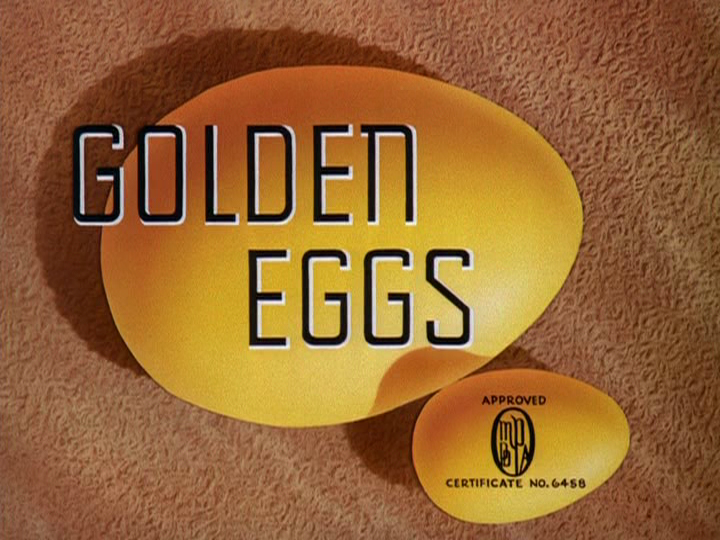
March 7, 1941 – The Donald Duck Short Film Golden Eggs is Released to Theaters

vlcsnap-2013-03-07-07h18m53s118

“This will never do with eggs 85 cents! Have to work faster than this!”

On March 7, 1941, the Donald Duck short film Golden Eggs was released to theaters. The film was directed by Wilfred Jackson, and stars Clarence Nash as Donald.

Donald is reading the Farmer’s Gazette, which declares that the price of eggs has skyrocketed, and labels them “liquid gold.” He leaps out of his chair and races to his chickens in the backyard, where they are lazily swaying around and laying eggs. Thinking that he needs to speed up production, he changes the record playing in the barn from “Lazy Daze” to “Hot Stuff.” With the music speeding up, the chickens lay eggs faster than before. Unfortunately, the rooster comes along and sees Donald collecting the eggs, and throws Donald out of the hen house.

Using a red rubber glove, a feather duster, and a burlap sack, Donald disguises himself as a chicken

Using a red rubber glove, a feather duster, and a burlap sack, Donald disguises himself as a chicken

Hiding in the shed, Donald watches as the rooster protects the eggs. Donald comes up with a plan to disguise himself as a chicken to retrieve the egg basket, although the glove he uses on his head keeps snapping off. The rooster is immediately smitten with Donald’s chicken, and Donald uses this to try to get close to the basket. Unfortunately, the glove snaps off his head again, and lands on top of a caterpillar. When Donald puts the glove back on, the caterpillar begins to wiggle about, which only causes the rooster’s love for Donald to grow. He is able to avoid the rooster’s advances for a moment, but when he tries to find the cause for the moving glove, the caterpillar moves away from Donald’s head and down his neck. The rooster returns and thinks Donald is dancing, and the two begin to samba together.

The rooster’s dancing begins to turn into spinning Donald about as fast as he can. Finally, all of the dancing tears off Donald’s disguise, leaving a very dizzy Donald crowing like a chicken. Having been found out, the rooster chases Donald across the farm, but Donald escapes and leaves him trapped in the pen. As Donald laughs, an egg drops out of the basket and breaks, and Donald slips on the yolk and falls into the basket, breaking every egg inside. The rooster crows with laughter at Donald’s misfortune.

February 18

February 18, 1944 – The Donald Duck Short Film Trombone Trouble is Released to Theaters

vlcsnap-2013-02-17-21h47m43s187

“Earthquake? Ha! That’s me!”

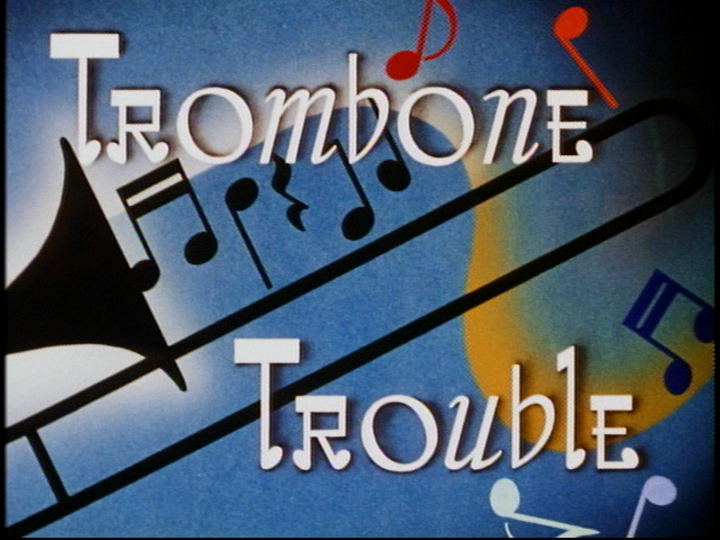
On February 18, 1944, the Donald Duck short film Trombone Trouble was released to theaters. This is the only Donald Duck short that features gods. It was directed by Jack King, with story by Jack Hannah and Carl Barks.

The gods Jupiter and Vulcan are woken up with loud noises from the earth, and wonder how long they must suffer. Zooming into earth, we see that Pete is(badly) playing the trombone, which has his neighbor Donald also unable to sleep. He storms over next door to tell Pete to stop, but is intimidated by Pete’s size. When Donald politely asks him to stop, Pete uses the trombone to send Donald flying back into his house.

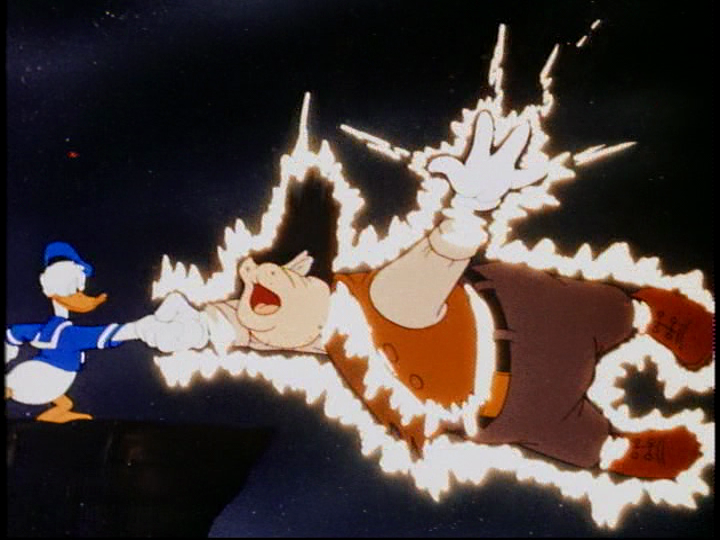
Donald, delighted by the fact he now has mysterious powers, uses them to his full advantage

Donald, delighted by the fact he now has mysterious powers, uses them to his full advantage

Jupiter turns to Vulcan and points out that Donald is also unable to stand the music. They decide to give Donald power to stop the sound. Donald is suddenly amazed that he is ablet o destroy a piano rather easily, and light up a bulb with his mouth. Becoming mad with power, Donald marches over next door while the gods watch excitedly. Donald grabs Pete’s house and begins to shake it violently. He then shoots Pete with lightning bolts and sends him barreling over a cliff, and he lands on a water wheel. The gods are satisfied with Donald’s results and attempt to go to sleep, when Donald stumbles on the trombone and begins to play a lively jazz tune.

February 7

February 7, 1942 – The Mickey Mouse Short Film Mickey’s Birthday Party Premieres in Theaters

vlcsnap-2013-02-06-19h52m51s41

“He’s coming! Shhh! Hide!”

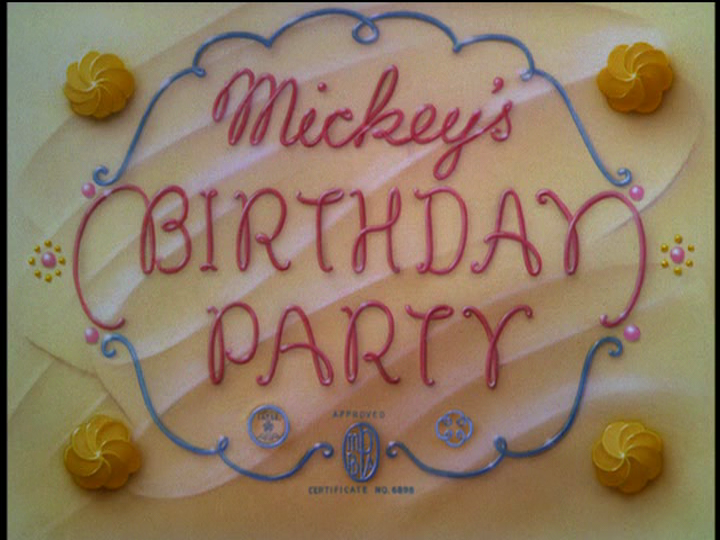
On February 7, 1942, the Mickey Mouse short film Mickey’s Birthday Party premiered in theaters. The short is considered a remake of the 1931 black and white short film The Birthday Party, although the earlier version did not include Donald Duck and Goofy. The 1942 short was directed by Riley Thompson.

Minnie is peering out her door’s peephole, then turns back to everyone inside and tells them to hide, as Mickey is approaching. Everyone scrambles around to find a place to hide while she reapplies her makeup. When she opens the door, Mickey steps in, asking for a little kiss. Minnie flirtatiously fends him off, and when Mickey tries to kiss her, everyone jumps out yelling “Surprise!” startling him. They wish him happy birthday, and Minnie then whispers to Goofy to go bake the cake.

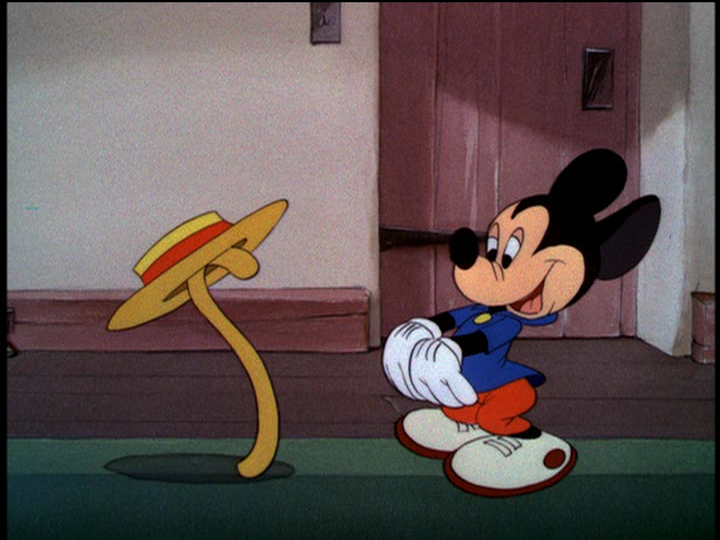
Mickey dances with his cane while Minnie plays the new electric organ

Mickey dances with his cane while Minnie plays the new electric organ

Mickey is asked to open his present, and inside is a brand new electric organ. Mickey sheepishly says that he doesn’t deserve it, and Donald says that they know that. Mickey sits down to play the organ, although he’s not sure how to play the newfangled instrument. Minnie decides to play the organ while Mickey entertains their friends with his dancing. In the kitchen, Goofy has been distracted by the music and dances with the mop before checking on the cake. Unfortunately, when he uses a straw to test if it’s fully baked, the cake deflates like a balloon. Minnie checks in on him, and Goofy pretends that everything is just fine.

The party continues, with Donald dressed in a sombrero and leading a conga line. Goofy tries to bake a new cake, but has another failure. Minnie checks in again, and tells Goofy to hurry up. Donald dances with Clara Cluck, while Horace Horsecollar and Clarabelle Cow partner up. Goofy quickly tries to create yet another cake, cooking it at a setting called “volcano heat,” and the cake erupts all over the kitchen. Goofy becomes distraught, until he comes up with an idea and speeds out of the house, returning with a store-bought cake. Everyone begins to sing to Mickey, when Goofy trips and spills the cake all over the birthday mouse.

January 29

January 29, 1943 – The Donald Duck Short Film Donald’s Tire Trouble Premieres in Theaters

vlcsnap-2013-01-28-19h38m55s74

“Doggone rubber shortage!”

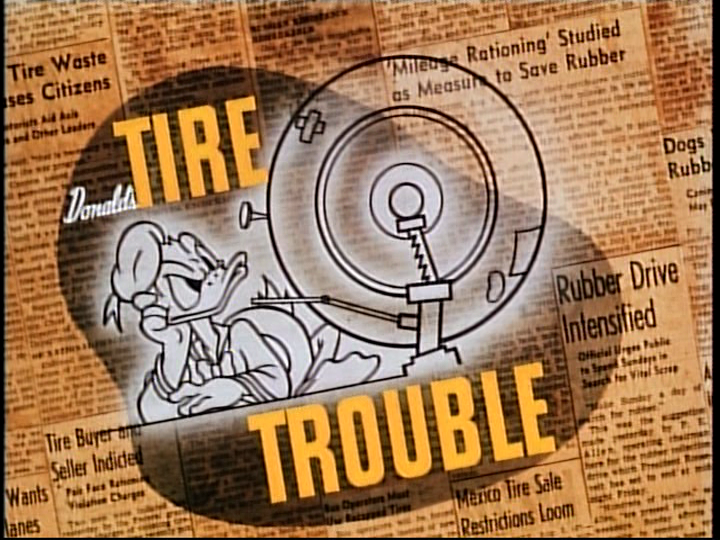
On January 29, 1943, the Donald Duck short film Donald’s Tire Trouble premiered in theaters. Although not considered a WWII propaganda short, the film does reference the rubber shortage that went on during the time. The short was directed by Dick Lundy.

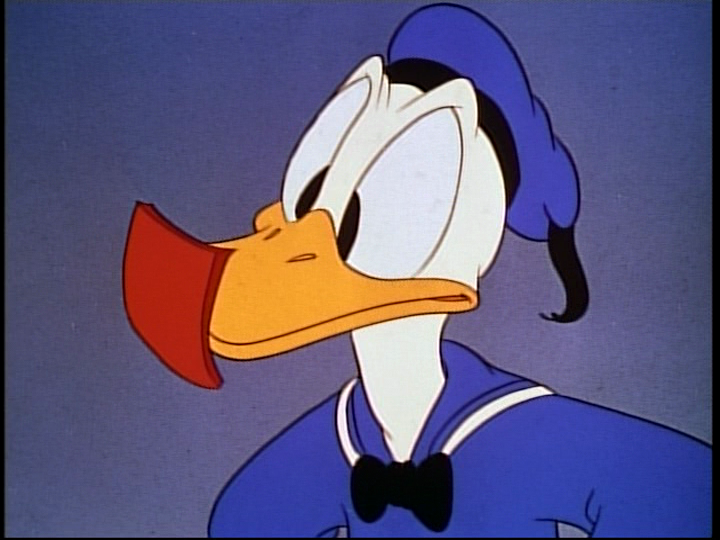
Donald is zooming down a mountain path in his little sports car, when one of the tires deflates, having been punctured by a nail. Irritated, Donald starts throwing supplies to fix it out of his car, and almost immediately has trouble with the jack, as it seems to disobey him as most objects tend to when around the duck. Finally, Donald is able to prop up his car, only to have it land on him before he can change the tire. He struggles to get the tire removed from the car, and when he does, he notices all the patches he’s used before on the tire, from rubber gloves to hot water bottles.

The one last rubber patch Donald has decides to stick all over the place other than the tire

The one last rubber patch Donald has decides to stick all over the place other than the tire

Donald has one last rubber patch, and attempts to use it, only to have it stuck on his fingers, his beak, and his tail. It finally attaches to the tire, but to his foot as well. Once be removes the patch from his foot, he finds that it attached itself to exactly the right spot. He then attempts to use an air pump to inflate the tire, only to have the air go right back into the pump, which makes it explode. He then tries to manually inflate it, but it deflates once more. Finally, he begins to reassemble his tire, only to get his feet, followed by his fingers, then his beak, stuck in the rim. He then attempts another method to get the rim on the tire, only to get the rim caught around his waist. After freeing himself, he once again tries to get the rim on the tire, only to be completely encased in the rubber. Trying once again to get things to work his way, he accidentally catapults himself into a tree, which sends all the parts of the tire flying into their proper places on the car. Donald shrugs, and is about to head off, when he finds that all of his tires have been punctured. Unable to handle this, he loses his temper in his fashion, but attempts to drive off anyway, bursted tires and all.

January 26

January 26, 1945 – The Donald Duck Short Film The Clock Watcher Premieres in Theaters

vlcsnap-2013-01-25-19h22m11s219

“Dear Royal, we’re loyal, we’ll always be joyful, we’ll work hard and long for to you we do belong.”

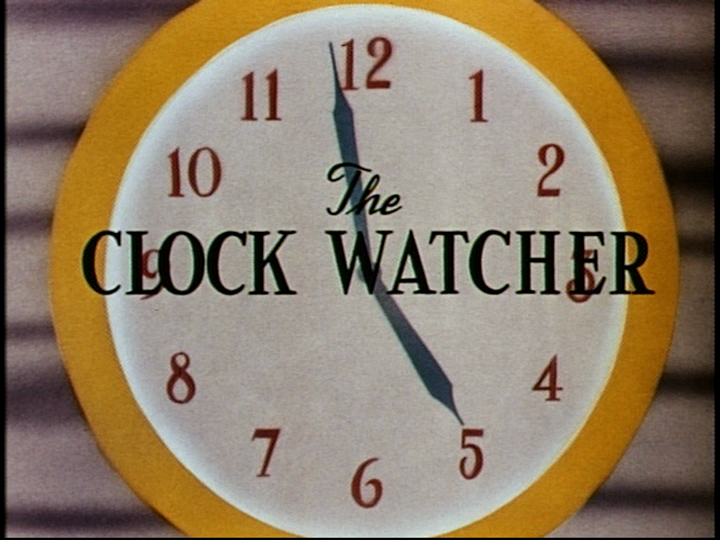
On January 26, 1945, the Donald Duck short film The Clock Watcher is released to theaters. The short was directed by Jack King, with the story written by Harry Reeves and Rex Cox.

The clock tower tolls 8 o’clock, and a figure is speeding through traffic. The figure stops to reveal that it’s Donald, who has to punch his time card, although he is a bit late. He fools the clock by turning the hand back with a magnet, and punches in to appear that he’s there early. He then goes to his job at the gift wrapping department at Royal Brothers Department Store, but is less than thrilled to hear the boss sing a song about “loyal workers.”  Just as the song ends, a barrage of merchandise slides down the shoot to meet Donald, and he quickly begins his work. But he doesn’t do a great job, as he breaks a fragile bowl, squashes a trombone into a tuba to make it fit in a box, and pops a football to fit in another box.

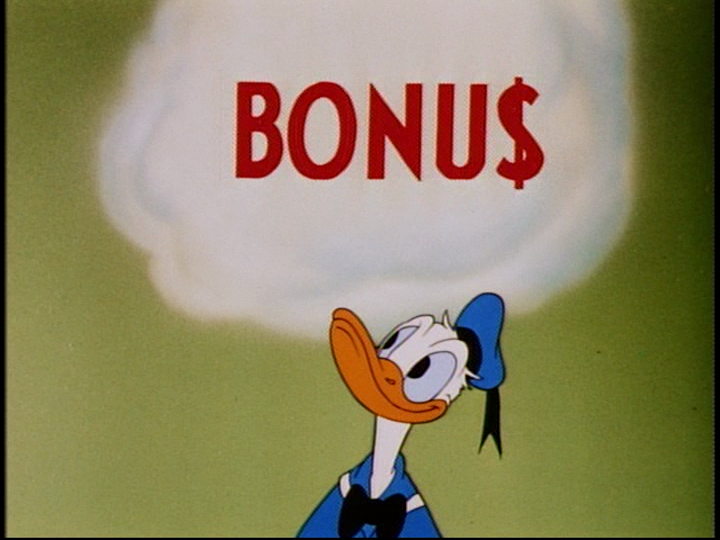
When the boss has an important announcement, Donald thinks that he'll be getting a nice bonus

When the boss has an important announcement, Donald thinks that he’ll be getting a nice bonus

Donald is distracted by a magazine and pretends to be working, then gives himself a rather long lunch hour. The loudspeaker announces big news, which has Donald excited, thinking he’s earned a raise. The boss announces that production has increased in every single department – except Donald’s. Donald continues his less than stellar work, wrapping himself in a rocking chair and getting flustered when trying to wrap a jack in the box. Donald imposes every method to keep the jack-in-the-box wrapped, but it gets loose every time. Finally, it’s five o’clock, and Donald is almost at the door, when the boss informs him that he has to stay and wrap a few more packages. Donald, having had enough, runs to the boss’s office, and the sounds of a fight between the two are heard over the loudspeaker.

January 10

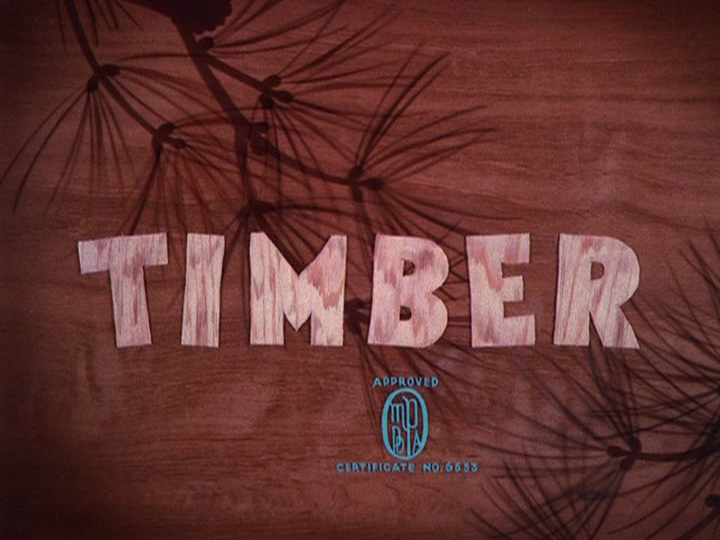
January 10, 1941 – The Donald Duck Short Film Timber is Released in Theaters

vlcsnap-2013-01-09-19h02m53s212

“Doggone it…I might just as well be in a concentration camp.”

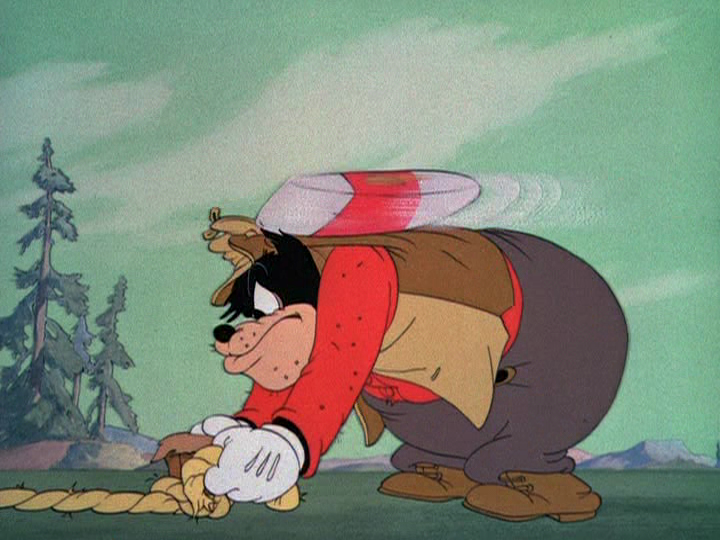
On January 10, 1941, the Donald Duck short film Timber premiered in theaters. The antagonist, Pete, is named Pierre in this short, playing the part of a French-Canadian lumberjack. The short was directed by Jack King, and stars Clarence Nash as Donald Duck, and Billy Bletcher as Pete/Pierre.

Donald is seen walking the train tracks with a hobo sack, when he smells something delicious. Spying food in a nearby window, he decides to steal some. Inside, Pete is beginning to enjoy his meal when he spots Donald’s wandering hand. Donald begins to load up his sack, with Pierre, the owner of the shack, just watching. Finally, Pierre decides to trick Donald by baiting him with a lighted stick of dynamite in place of a hot dog. Donald’s clothes are blown clean off, and he emerges from a deep hole in the ground where the blast blew him.

The head of the axe flies off the handle, sailing close enough to Pete to sear through a layer of his clothes

The head of the axe flies off the handle, sailing close enough to Pete to sear through a layer of his clothes

Pierre then tells Donald that he will work for food as a lumberjack; Donald, however, has other plans. He breaks his axe when Pierre isn’t looking, hoping that Pierre will just let him go since he has no tool. But Pierre won’t let him off so easily, and fixes the axe for him. When Donald begins his attempt at chopping down a tree, the axe head breaks off and flies into another tree, cutting off part of Pierre’s clothing in the process. Donald, hoping to avoid trouble, attempts to use a saw instead, only to find himself in more trouble. As he flees with the saw in hand, it begins to vibrate, sending Donald bouncing around the forest. When he finally is able to chop something down, he saws off a branch, which knocks Pierre deep into the ground

After Pierre sends Donald flying and bouncing with the saw, Donald is knocked into a tree and chops it down accidentally with his beak. The tree falls on Pierre, who has had it with the duck. Donald flees the camp, with Pierre close behind. As the chase continues on train tracks, Pierre tries anything he can to stop Donald, including breaking his cart piece by piece. Luckily, Donald is able to evade him, and uses quick thinking to send Pierre flying through a line of empty boxcars. Donald walks off into the sunset, traveling once again.

December 27

December 27, 1940 – The Pluto Short Film Pantry Pirate is Released to Theaters

vlcsnap-2012-12-27-09h13m35s121

“You let me catch you messin’ around in my kitchen again, and I’m gonna bust all the hide off’n you!”


On December 27, 1940, the Pluto short film Pantry Pirate was released to theaters. The short has been cut when released on television, due the depiction of the cook as a somewhat stereotypical black servant, which was a normal depiction in films of this time period. The short was directed by Clyde Geronimi, and stars Lillian Randolph as the cook.

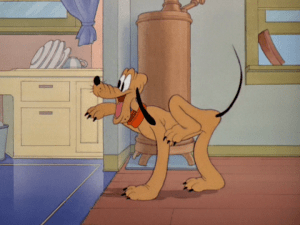
Pluto is thrown out of a kitchen by the scruff of his neck, with the cook tying him to his doghouse in the backyard. She warns him to stay, and Pluto lets one tear roll down his cheek. Inside, the cook pulls a roast from the oven, with the scent leaking through the screen door and wafting all the way to Pluto. He frees himself from the rope and sneaks into the kitchen once again, his mouth salivating at the thought of the roast.

Pluto traipses about happily in the house, thinking about how he can get the roast that the cook just made

Pluto traipses about happily in the house, thinking about how he can get the roast that the cook just made

Inside the house, Pluto slips on the polished floor, and is almost spotted by the cook. He has an idea to use the ironing board to get close to the roast, but immediately steps back to the wall when the board starts to buckle under his weight. He tentatively tries again, but he still isn’t close enough. Keeping his toes on the board, he is able to reach the handle of the oven, and is finally close enough to reach the roast, when he accidentally falls, pulling the oven door down and ending up in the oven himself. He flies out with a cry, and bumps into a box of soap, spilling its contents into a nearby bucket of water. The soap also fills the air, and Pluto sneezes from the irritation. Each sneeze sends out a stream of bubbles from his mouth. One bubble in particular sticks to his nose, and when he attempts to blow it away, the bubble only increases in size until it explodes.

Trying to return to his main mission of the roast, Pluto stalks his prey, until he sneezes and knocks into a table with china cups. None of the cups break, but the sound is enough to alert the cook, who has been upstairs. After she leaves, Pluto sneaks towards the roast again, this time bringing with him the tablecloth and cups without him noticing. When he does, he sneezes again, sending the cups flying into the air. Thinking he’s done for, he closes his eyes, but the cups neatly stack themselves on his backside, the handles slipping onto his tail. He breathes a sigh of relief, but not for long, as he keeps sneezing. All the cups finally break, with the cook racing downstairs to see what’s going on. As he races to the door, he keeps getting thrown back by his sneezes, but finally makes it outside and pretends he’s been asleep the entire time. The cook is fooled by his act, and Pluto smiles, bubbles still leaking from his mouth.

December 26

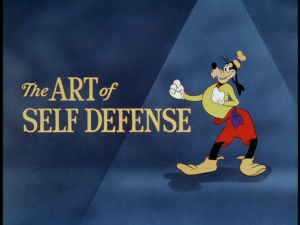
December 26, 1941 – The Goofy Short Film The Art of Self Defense is Released to Theaters

vlcsnap-2012-12-26-10h21m56s181

“From the earliest dawn of humanity, the cold, unrelenting law of nature has been, and still is, the survival of the fittest.”

On December 26, 1941, the Goofy short film The Art of Self Defense was released to theaters. This was one of the first shorts to show more than one Goofy-designed character in the same scene. The short was directed by Jack Kinney, and stars John McLeish as the narrator.

The short takes us through the history of man defending himself, beginning with the cavemen. Two cavemen are seen beating each other over the head with a hammer and a club. The scene then travels to ancient Egypt, where moving wall paintings show that man has learned to use his hands for combat, particularly poking the other person in the eye. Reaching the middle ages, two knights are seen clad in armor, hitting each other with maces much as the cavemen did with their clubs. Time rushes forward to the Romantic Age, with two men slapping each other with gloves rather daintily. One of the men gets the idea to put his snuff box in his glove, giving his slap a little more “oomph.” The scene then changes to when boxing came into vogue, but these men, as the narrator puts it, “could fight for only seventy-five or eighty rounds.”

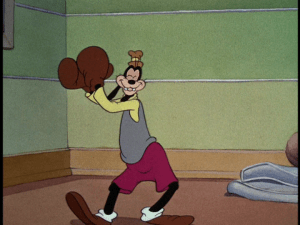
Goofy arrives at the boxing gym, ready to learn all the fundamentals of how to defend himself

Goofy arrives at the boxing gym, ready to learn all the fundamentals of how to defend himself

The audience is then brought to the modern era, with Goofy entering a boxing gym. He starts to punch enthusiastically, until the narrator stops him, informing him that they were learn to box properly, with scientific conditioning. They learn how to breathe properly, but as the narrator gets involved with his own commentary, Goofy breathes in (forgetting to breathe out) to the point of floating like a balloon. When he is finally told to exhale, Goofy sails around the gym as all the air is pushed out. Next, Goofy attempts to jump rope, but ends up tangled. He then tries to punch a double-ended bag, only to have the bag knock him out.

Goofy then shadow boxes – literally – ended up knocked out by his own shadow with every punch shown, from jabs, to crosses, to uppercuts. When the narrator points out there is a rule that no boxer shall ever be hit below the belt, Goofy manages to pull his pants and belt above his head, so there is nowhere for his shadow to strike, but the shadow, after kicking Goofy out of his clothes, manages to win just the same. After weeks of conditioning, the night of the fight arrives, and Goofy steps confidently into the ring. His opponent, however, knocks him out with one punch.

December 20

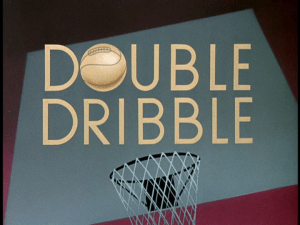
December 20, 1946 – The Goofy Short Film Double Dribble is Released to Theaters

vlcsnap-2012-12-19-20h11m15s239

“Good evening, ladies and gentlemen. We’re about to witness the basketball battle of the century.”

On December 20, 1946, the Goofy short film Double Dribble was released to theaters. The players’ names that are announced by the narrator are actually names of Disney animators, such as “Kinney” for animator and director Jack Kinney. The short was directed by Jack Hannah, with story by Bill Berg and Milt Banta.

The day of the big basketball game arrives, with half of the stadium filled to capacity for the home team, University U, while the visitor side (P.U.) has a solitary fan in the seats. The teams hit the court, practicing their free throws before the game. One tiny player on the P.U. team is excited to play, but the much taller players ignore him as the game gets underway. A replay of one of the plays shows that, in slow motion, the players are much more violent than meets the eye. The game continues, with each team scoring left and right, with the U.U. fans overstepping their bounds as they “assist.” The first half ends, with U.U. leading 16 – 12.

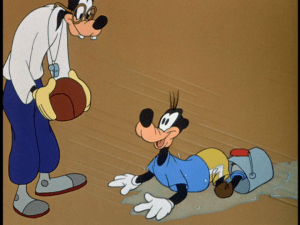
The smallest player, Marathu, is the most enthusiastic, although not the best player on either team

The smallest player, Marathu, is the most enthusiastic, although not the best player on either team

In the second half, the P.U. coach nervously watches as his team members are repeatedly called out by fouls. Finally, the last player he can send in is the shortest member of the team, Marathu. With one minute to go, the score is in U.U.’s favor, 35 – 34. Marathu tries to be involved in the game, but he lags behind his taller teammates. Suddenly, he has the ball – only to have it taken away. He retrieves the ball by untying the string to the opposing player’s shorts, revealing the player’s polka dot boxers. Ball in hand, Marathu makes his way to the basket, with the player in boxer shorts chasing after him. As the opposing player trips and falls, he lifts a floorboard, which sends Marathu flying into the air and in through the hoop – and P.U. wins, 36 – 35.