RSS Feed

Tag Archives: Silly Symphony

July 30

July 30, 1932 – The Academy Award Winning Silly Symphony Flowers and Trees is Released to Theaters
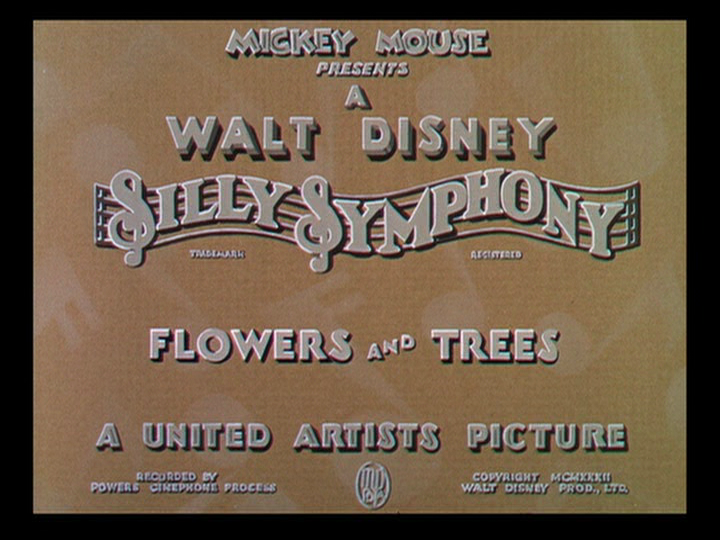
On July 30, 1932, the groundbreaking Silly Symphony Flowers and Trees was released to theaters. The short was directed by Burt Gillett, and became a landmark in Disney animation. Originally conceived in black and white, the short was scrapped at great cost to the studio to be redone in the new Technicolor process. Walt Disney signed an exclusive deal with Technicolor that gave him alone the rights of the process for two years, and after this short, all of the Disney shorts would be released in color. This process helped enhance the quality of Disney’s films, and Flowers and Trees would be awarded an Academy Award for Best Cartoon; at the same ceremony, Walt would be awarded a special Academy Award for the creation of Mickey Mouse.

One spring morning, the trees and flowers wake to the sound of a bird’s chirping, stretching in the morning light. One pair of trees in particular is enjoying the day, while an old stump scares the bird that tries to wake him. One tree begins to play a harp for his love, a beautiful young tree, who dances gracefully to the music while flowers dance around her. The flowers then bring her closer to her love and dance around them before making a heart shaped wreath on the ground. The male tree places it around the female’s head.
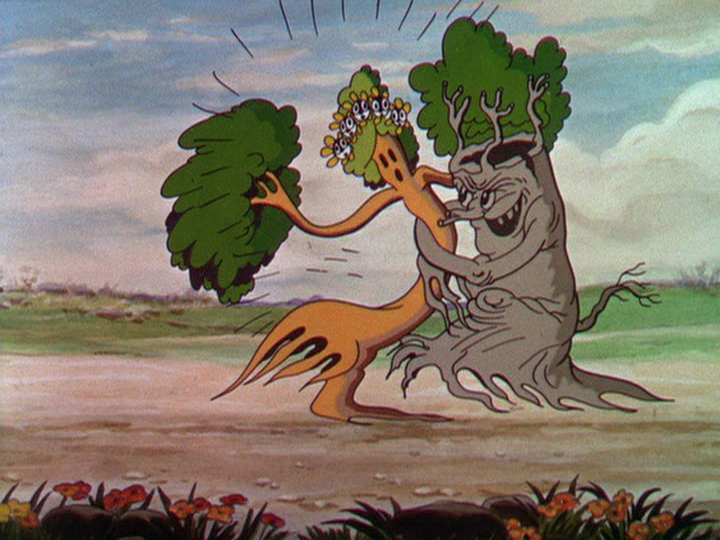
The female tree is captured by the stump, and she struggles in vain to escape

She continues to dance, unaware she is being pursued by the jealous, cranky old stump. He grabs her for his own, and the young male tree saves her before beginning a sword fight with the stump. The old stump is defeated, and decides to set the young male tree on fire. The male tries to stomp out the blaze, but to no avail. The plants that can run begin to flee, while others try to help put out the flames. The stump watches will glee as he sees the young couple being engulfed in flames, but soon finds himself victim of the blaze as well.

The flames being to grow in intensity, and the birds flock together to create a hole in the clouds that causes rain to fall and put out the fire. What’s left of the stump is found on the road, a victim of his own plan to destroy the couple, with his vultures swarming around the remains. After the storm clears, the male tree, proposes to the female, and the flowers sound the wedding bells.
July 28

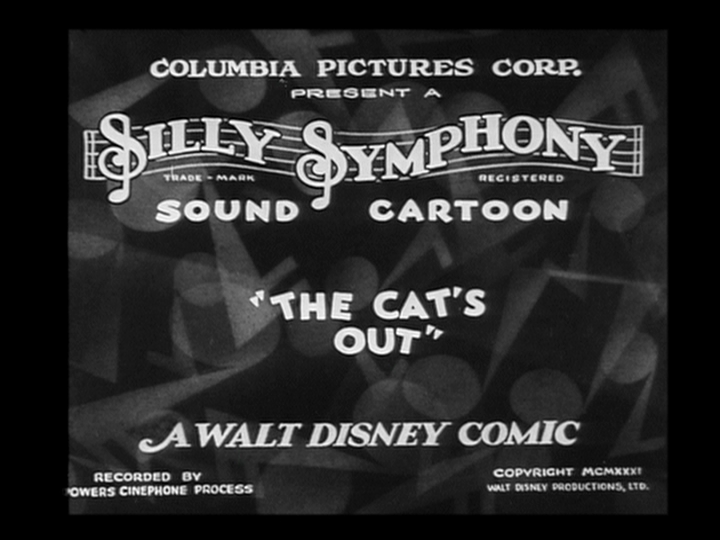
July 28, 1931 – The Silly Symphony The Cat’s Out is Released to Theaters

On July 28, 1931, the Silly Symphony The Cat’s Out was released to theaters. It has been copyrighted as The Cat’s Nightmare, but the studio now refers to it by its original name. The short was directed by Wilfred Jackson.

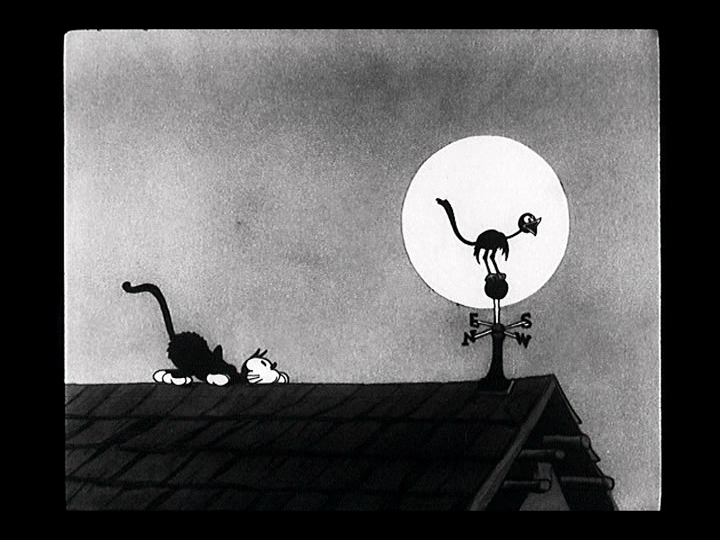
A cat is put out for the night outside a country home, and howls at the door before going off to explore.­­ As he perches on a fence, still howling, neighbors begin to throw shoes, and one lands on the cat’s head. He runs away in a flurry, falls off the fence, and lands in a washtub. After drying himself, the cat hears a bird chirping from its perch on a weathervane.

The cat carefully stalks his prey, which is perched on the weathervane

The cat, now suddenly hungry, stalks the bird, waiting for his chance to attack. He catches the bird by the tail just as it takes off, and tries to remain on the roof by wrapping his tail around the weathervane. Unfortunately, he loses his balance and falls, ripping the vane from the roof. As he lands on the ground, the vane falls soon after, landing on his head. The cat’s lives begin fleeing to heaven, but he is able to grab his last one and save it. The bird he chased shows up, and as he is about to grab it again, it triples in size and begins to taunt the cat.

The cat, annoyed by the taunting, punches the bird. As his feathers fly off, the feathers become more birds, which circle the cat and taunt him mercilessly, trying to peck him with their beaks. Suddenly, the birds disappear, and a herd of owls in the trees scares the cat. He runs to hide behind a bucket, but the water pump, now alive, dumps water on him. The startled cat runs into a pole and knocks down a scarecrow. As the cat hides behind a pumpkin, the scarecrow comes to life and begins to dance. The multiple dancing scarecrows appear and dance together before they merge back into one scarecrow again, who climbs back on his pole.

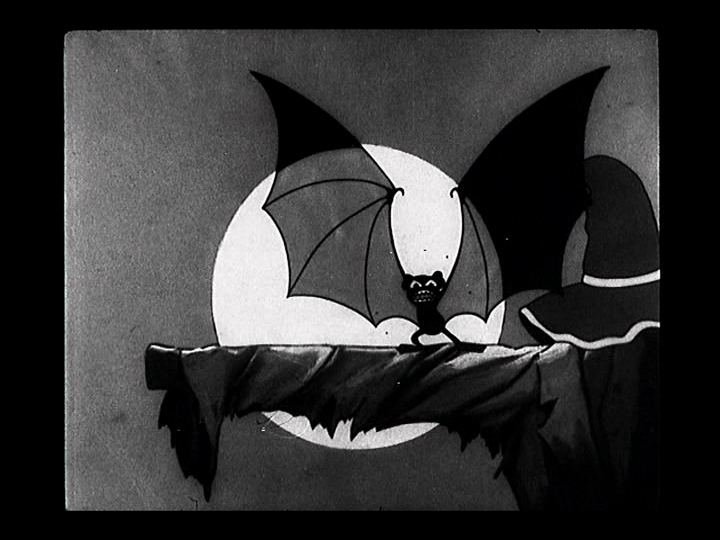
A bat appears from under the scarecrow’s hat and begins to dance in the moonlight, which frightens the already scared cat

From under the scarecrow’s hat, a bat appears and begins to dance in the moonlight. The terrified cat throws the pumpkin at the bat, which turns into a flock of bats that swarm the cat. The cat flees, only to find himself trapped at the mercy of giant spiders. As they attack, he is able to escape them, but everywhere he goes, he finds more trouble: trees come to life and beat him, and the bird laughs at the cat’s misfortune.

The cat wakes to find that it has all been a dream, and it’s now morning. He goes to the door of his house and howls, hoping the owner will let him in. The owner opens the door and the cat steps inside while the owner grabs the bottle of milk, then shoves the cat back outside. Angrily, the cat paws at the welcome mat, then blows his master a raspberry before haughtily walking away.

July 14

July 14, 1934 – The Silly Symphony The Flying Mouse is Released to Theaters

“Please, I wanna fly like the birds!”

On July 14, 1934, the Silly Symphony The Flying Mouse was released to theaters. It featured a popular song called “You’re Nothin’ But a Nothin’,” composed by Larry Morey and Frank Churchill, which would later be released on sheet music. The short was directed by Dave Hand.

The short opens on a warm spring day at a quaint pumpkin house, with a mother mouse giving her youngest child a bath while her children play see-saw on a mushroom. One of her children is sitting away from everyone, admiring the birds he sees fly high in the sky. His greatest desire is to fly, and he imagines himself soaring through the sky with a beautiful pair of wings. He comes up with the idea to attach leaves to his arms, then calls over for his brothers’ attention. He runs off a branch, attempting to fly, and falls like a rock face-first into a pit of mud. His siblings laugh, but he decides that all he needs is a higher jumping point, and climbs up a flower. As he lifts into the sky, a gust of wind comes his way, and he falls into the tub of water from his sister’s bath, splashing the water everywhere, which causes his sister’s clothes to shrink.

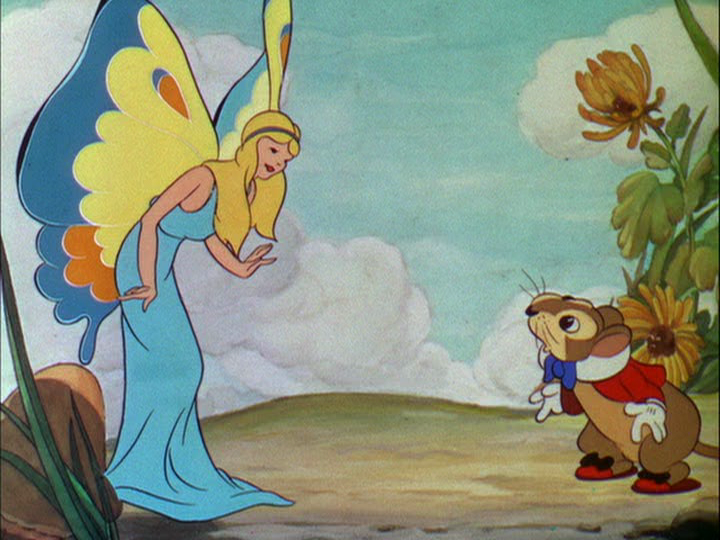
The astonished mouse meets the fairy, who wishes to reward him for his brave deed

After a good spanking from his mother, he runs away to cry as his other siblings laugh at his folly. Suddenly, the mouse hears a cry for help from a beautiful butterfly caught in a spider web, with the spider licking his chops. He saves the butterfly, who turns out to be a beautiful fairy, and offers to grant him one wish for his kindness. Without hesitation, he tells her that he wants to fly. She warns him that mice were never meant to have wings, but after he pleads again, she grants him his wish. He kisses her hand in gratitude, and goes to join the birds in their flying dances. However, although he can fly, he is not welcome at the birds’ party, and is soon all alone. He decides to go surprise his family.

As he flies down, the family members are startled by his shadow, thinking he’s a predator, and they hide inside and throw items at him until he flees. Alone, the mouse ends up in a cave full of bats, who welcome him as one of their own, calling him brother. When the mouse cries that he’s not their brother, they tell him that since he’s not a mouse, and if he’s not a bat, then he’s a nothing. He runs as fast as he can away from the cave, and cries, realizing the wings have only brought him unhappiness. From one of his tears, the fairy reappears, asking why he’s so sad. He tells her he wishes he could die. The fairy tells him to cheer up and be happy that he’s himself, and if he does so, life will smile on him. She then removes his wings, and he’s so happy he kisses her hand once again in gratitude before running home to greet his family.

July 9

Posted on

July 9, 1932 – The Silly Symphony The Bears and the Bees is Released to Theaters

On July 9, 1932, the Silly Symphony short film The Bears and the Bees was released to theaters. The short was directed by Wilfred Jackson.

The short opens in the woods, where a bear and her two cubs are seen sleeping next to a river. The cubs wake up and begin to tussle, in turn waking up their mother, who roars at them before returning to her sleep. The cubs run off to play in the woods, and one of the cubs falls head first onto a rock and gets a rather large bump on his forehead. The other cub runs over and soothes the sibling’s injury before finding a berry bush and pulling off berries for a snack.

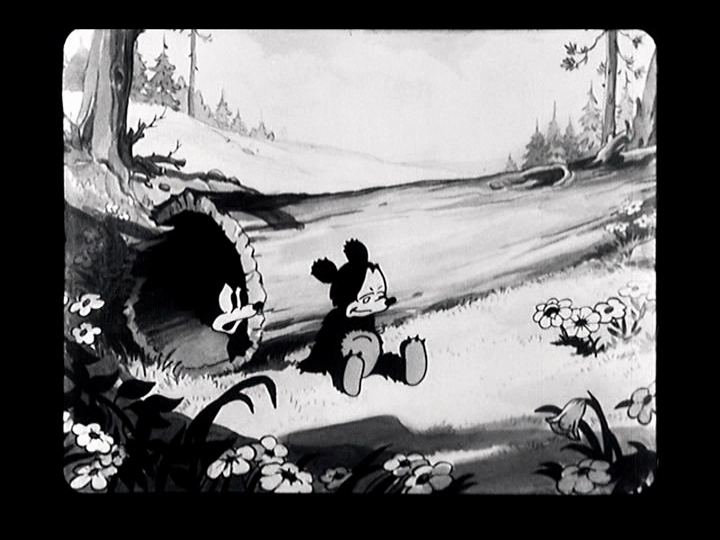
The cubs are bullied by a big black bear and take to hiding in a hollow log nearby

A nearby roaring alerts them, and a large black bear emerges from his cave, growling angrily. He runs to attack the two cubs before eating from what appears to be his berry bush. When the cubs approach to grab just one berry to eat, the black bear startles them and sends them hurrying to a nearby log, where one of them begins to cry at the meanness of the other bear. The other cub tries to cheer the sibling by giving it flowers to eat. When a bee emerges from one of the flowers and begins to buzz around, the cubs follow it curiously.

The cubs spot a flower garden, with bees buzzing all around collecting nectar and taking it back to their hive in a hollowed-out tree. After the bees leave the hive, the cubs poke around inside it, delighted to know that the hive contains honey. They begin to eat the honey in the hive eagerly, until a bee comes back and sees them and sounds the alert to the other bees. Angrily, the swarm grows and immediately heads back to protect the hive.

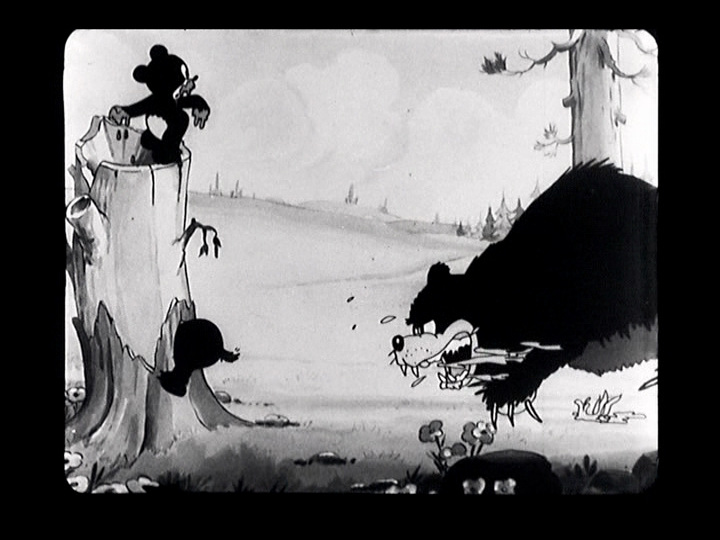
Meanwhile, the angry black bear has spotted the cubs and their honey, and decides he wants it for himself. He charges at the tree and throws the cubs aside, where they can only watch as the swarm heads for the hive and the black bear. The bees attack the bear, covering him with stings while his head is stuck in the hole in the tree. The bees continue their attack, stinging him with points from a plant and a tree branch, before delivering the final blow, sending the bear running for his life. The cubs take advantage of the bees’ disappearance and continue to eat from the now destroyed hive, enjoying all the leftover honey.

June 29

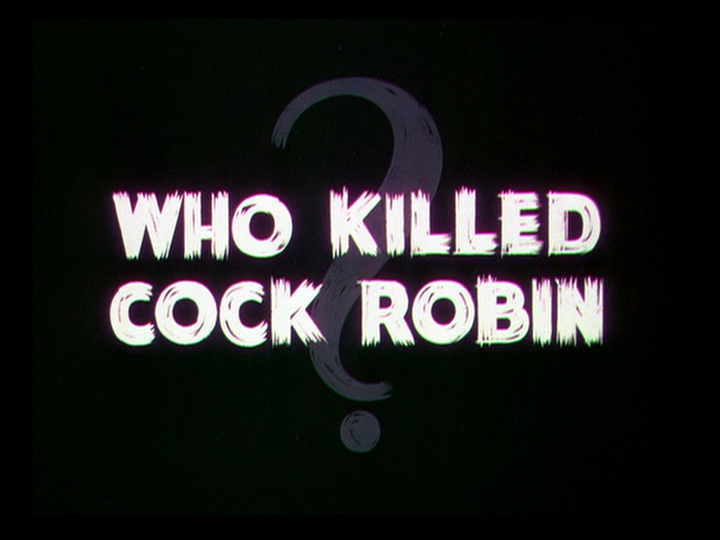
June 29, 1935 – The Silly Symphony Who Killed Cock Robin? is Released to Theaters

“Who killed Cock Robin? Who got him with a shot and put him on the spot? Who killed Cock Robin and vanished like a phantom in the night?”

On June 29, 1935, the Silly Symphony short film Who Killed Cock Robin? was released to theaters. The short was a modern take on the popular nursery rhyme, which was believed to be a satirical comment on the fall of Sir Robert Walpole, who was falsely accused of corruption and imprisoned in the Tower of London. He was eventually released and became the first Prime Minister of Great Britain, but was met once again with opposition and was forced to resign. The short was directed by David Hand, and stars Billy Bletcher as the voice of the judge, and Martha Wentworth as the voice of Jenny Wren. The short is also notable for the many celebrity caricatures; Jenny Wren is a caricature of popular actress Mae West.

The short opens with Cock Robin whistling and playing a guitar outside the home of Miss Jenny Wren. Jenny steps out onto her balcony to listen to the music, and Cock Robin begins to croon. A shadow of a bird with a bow and arrow is seen against the trees, firing an arrow straight into Cock Robin’s chest. He swoons a bit, then plummets to the ground, with everyone looking. Everyone comes out, alarmed at what just happened, and the police are called in to investigate. The medics take Cock Robin away on a stretcher.

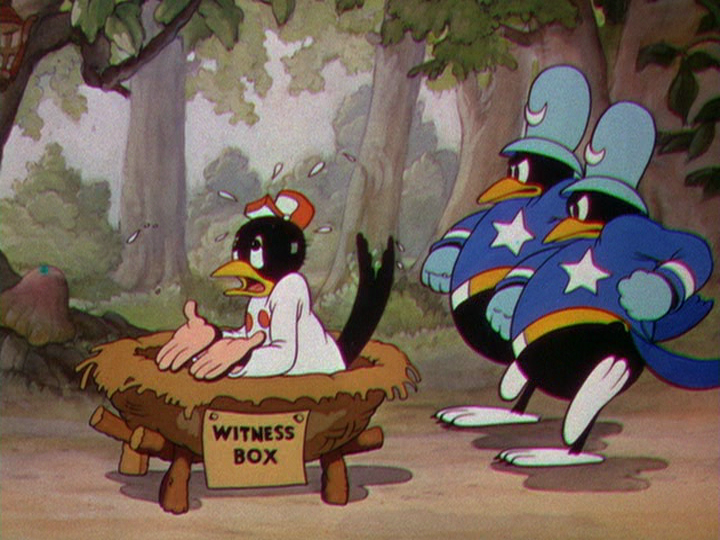
The Crow appears as the first witness, but keeps insisting that he doesn’t know anything

The court case begins, with the judge asking who killed Cock Robin. A scared crow is sitting in the witness box, and when asked, answers that he doesn’t know who killed him. When shown Cock Robin’s body, the crow turns deathly white and tries to flee. He reiterates that he knows nothing about the case, and is hauled off to jail as they pull out the next witness, Legs Sparrow. Legs won’t answer the questions, so the next witness, the Cuckoo Bird, is called. The Cuckoo Bird isn’t a reliable witness, however, so they decide to move on, with everyone rather frustrated that nobody knows.

Jenny Wren steps forward as the next witness, entrancing the entire court. She tells the judge that she wants to see justice done, as somebody took out her Robin. When she suggests that somebody ought to be hanged for the crime, the judge, very taken with Miss Wren, demands that all three suspects be hanged for the crime. Out of nowhere, another arrow flies in, taking the judge’s hat and nailing it against a tree. The judge looks up to see the real culprit, Cupid. Cupid informs them all that he shot Cock Robin, but Robin isn’t dead, he’s just fallen for Jenny and landed on his head. Jenny asks Robin to kiss her, and he wakes up, giving her a smooch.

June 9

Posted on

June 9, 1934 – The Silly Symphony The Wise Little Hen Premieres in Theaters

“Who, me? Oh, no! I’ve got a bellyache!”

On June 9, 1934, the Silly Symphony The Wise Little Hen premiered in theaters. It was based on the folk tale The Little Red Hen, and was directed by Wilfred Jackson. It is notable for the debut of Donald Duck, voiced by Clarence “Ducky” Nash; it also stars Florence Gill as the Wise Little Hen, and Pinto Colvig as Peter Pig.

“There once was a wise little hen, who worried now and then, for fear that she’d be found in need when winter came again,” begins the narration in song for the short. The hen is seen stepping out her front door while all of her chicks play in the yard. With a basket of corn under her arm, she sets out to plant the kernels, and decides to ask her neighbors to help her plant her corn. She first stops at Peter Pig’s house, where Peter is playing an accordion and dancing a jig. But when she asks him for help, Peter feigns a stomachache and starts moaning. When she’s not looking, Peter sneaks a smile to the audience.

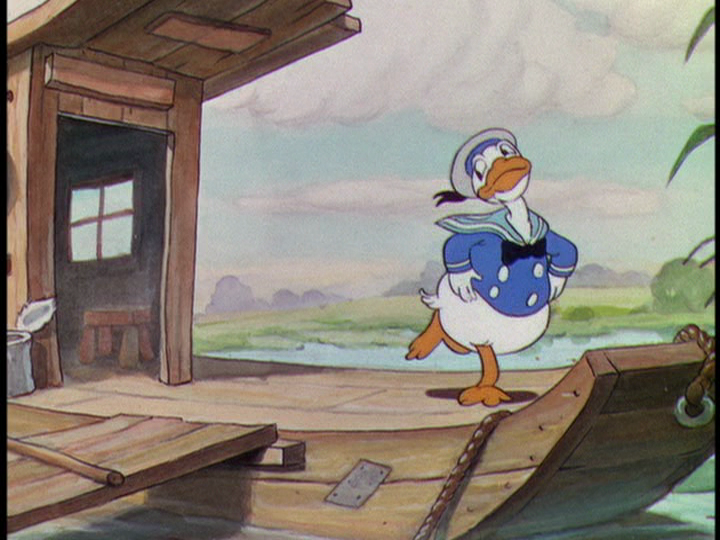
The first appearance of Donald Duck

Upset, but not discouraged, the hen moves on to Donald Duck’s houseboat, where he is also seen jovially dancing. When she asks for help, Donald also feigns a stomachache and begins to moan, also giving the audience a smile when she isn’t looking. Again, she is saddened by this, but decides she’ll just have to do it alone. With the help of her chicks, they dig the rows and plant the corn kernels.

The corn soon sprouts, and the hen and her chicks are excited to see how their crop has grown. She decides to visit Peter Pig and Donald Duck, to ask if they will help her harvest her crop. She finds the two at the “Idle Hour Club,” dancing and singing. When she asks for their help, once again, the two fake stomachaches, and go into their clubhouse, moaning. Part of their clubhouse wall falls down, revealing the two shaking hands and laughing at their supposed deception.

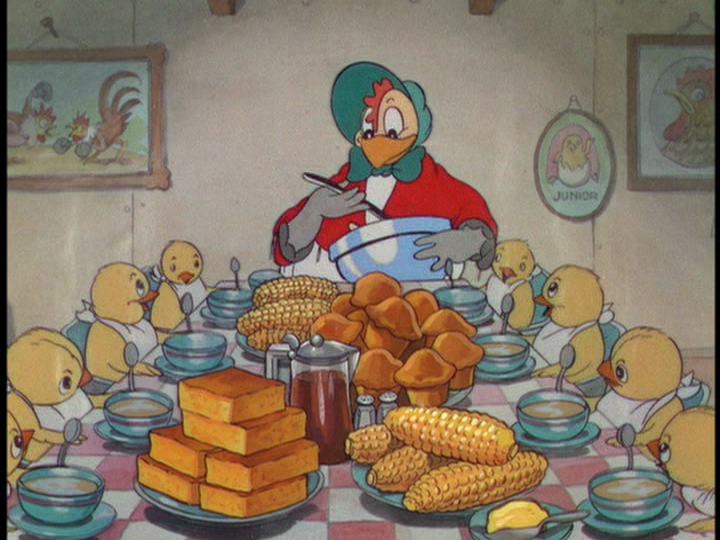
The hen and her chicks enjoying their corn feast that they alone planted and harvested

The hen winks at her chicks, getting an idea. She goes out and harvests her corn, and is soon seen at her oven, cooking and preparing many corn dishes. The entire family is shown around the dinner table, with the table piled high with delicious food, and everyone eating heartily. The Wise Little Hen looks out to see the pig and the duck dancing once again, and they feign stomachaches the moment they spot her, with more symptoms, like seeing spots. The hen asks them if they’ll help her eat her corn, and when they readily agree, she hands them a bottle of castor oil – for tummy aches. The singing narrators let us know that “she’ll eat the corn herself,” with Donald and Peter seen kicking each other for their foolishness.

May 25

Posted on

May 25, 1935 – The Silly Symphony The Cookie Carnival is Released to Theaters

“Here they come, freshly baked, covered with spice and candy flake, marching along in this parade at the Cookie Carnival.”

On May 25, 1935, the Silly Symphony The Cookie Carnival was released to theaters. The idea for the short came from the parades and bathing beauty contests held in Atlantic City during this time. The short was directed by Ben Sharpsteen, and starred the vocal talents of Pinto Colvig (best known as the voice of Goofy) as the wandering gingerbread man.

The short opens on the grand day of the Cookie Carnival, with a gingerbread marching band playing down the street, and one member holding a sign: “Beauties on Parade.” The procession of potential Cookie Queens begins with Miss Peppermint, who is followed by others the likes of Miss Cocoanut and Miss Banana Cake. All sorts of sweet treats have shown up for the festivities.

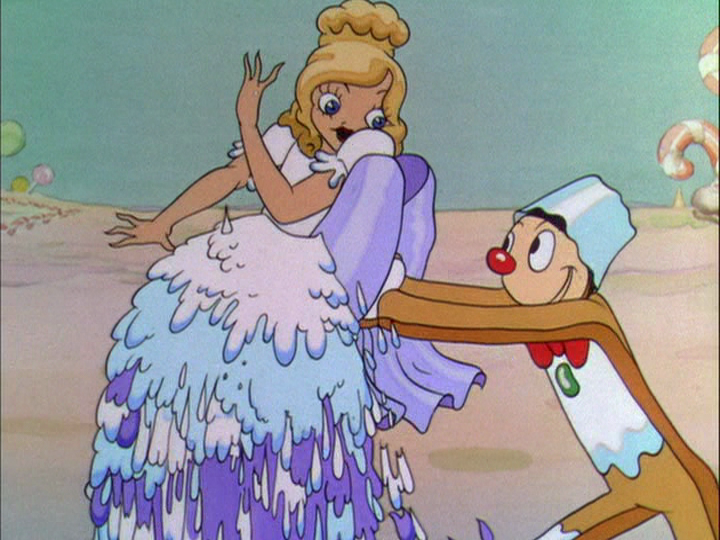
The gingerbread man decorating the girl, helping her to be the next Cookie Queen

On the peppermint railroad tracks, a wandering gingerbread man carrying a hobo sack enters the town, whistling the carnival tune. He hears crying and turns to see a young girl in rags sitting on a stump. He asks her what’s wrong, and she tells him that she’d love to be in the parade, but she doesn’t have anything pretty to wear. He tells her not to be so down, and begins to fix her up in true Cinderella fashion, telling her that she’s going to be the Cookie Queen.

Back at the parade, the judges look at each contestant, but still haven’t selected a queen. As the carnival comes to a close, the gingerbread man places the girl at the end, and upon seeing her, the judges declare her the queen. They knock the gingerbread man down to get to their queen, and the crowd carries her through the street to her throne. The judges then declare that the queen must have a king, and they pull out a collection of potential bachelors, known as the Candy Dates.

The gingerbread man is spotted by the soldiers and has to make a break for it while the Candy Dates are performing

The dates include from the Dandy Candy Kids, the Old-Fashioned Cookies, the Angel Food Cakes, the Devil’s Food Cakes, the Upside-Down Cakes, and the Jolly Rum Cookies. While the Queen is presented with the dates, the gingerbread man, who has been trying to watch the show and see the Queen, has been caught by the soldiers and is chased around the pavilion. Meanwhile the Queen rejects all the dates, and the judges conclude that she should marry one of them, or all three.

The gingerbread man steps out of his hiding place, thinking he’s safe, only to find himself pursued once more. He slips under the red carpet leading to the Queen’s throne, and has his hat broken into pieces as he steps onto the stage, bringing some of the red carpet with him. The Queen tells them to stop, that they shouldn’t crown the King that way, and everyone begins to celebrate the arrival of the new King. The Queen and King are spotted kissing, and they shyly hide behind a lollipop, which melts when they kiss again.

May 23

Posted on

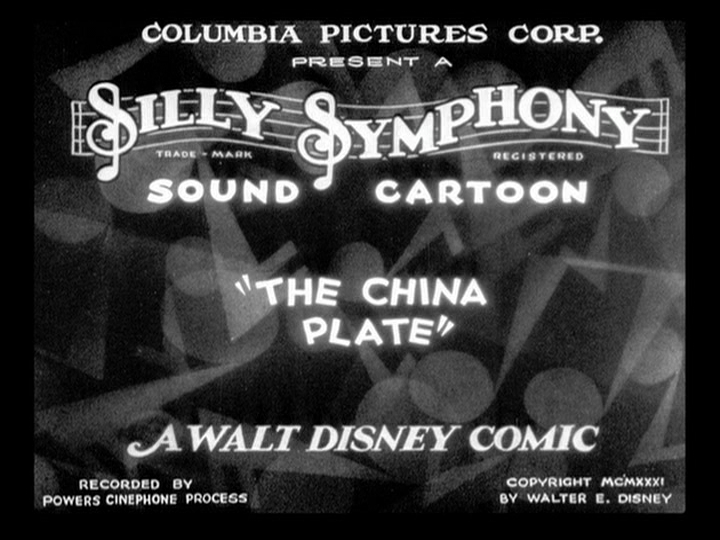
May 23, 1931 – The Silly Symphony The China Plate is Released to Theaters

On May 23, 1931, the Silly Symphony The China Plate was released to theaters. The short was directed by Wilfred Jackson, and while entertaining, this is another example of the stereotypical view Hollywood had of other cultures during this time period.

The short opens on a collection of exquisitely decorated pieces of china: two cups with saucers, a teapot, and a plate. The audience zooms in on the plate, and the figures begin to move. Three Chinese servants prepare to serve food for the Emperor, and as he eats, the bowl slips away from him and knocks into the instruments of the sleeping band, who wake and begin to play. Three maidens appear and begin to dance to the music, and a poor cat that is walking along ends up getting stepped on and accidentally used as an instrument by the band.

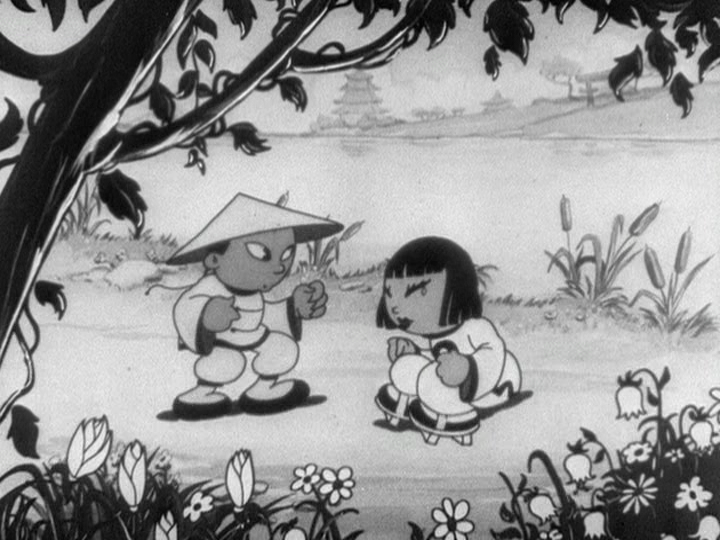
The boy tries to cheer up the crying girl after her fall in the river

As the cat runs away in fright, he knocks into a screen, revealing a frightening face on an umbrella, which is held by another maiden. She gets distracted by the view of a butterfly and seeing the Emperor asleep, chases after it into the garden. As she chases it, the view moves to a young fisherman nearby, who uses a bird to help him catch the fish in the river. The girl accidentally falls into the river as she chases the butterfly, and the boy quickly rescues her and puts her on dry land. He tries to comfort her as she cries, and makes her laugh as he wipes away her tears. She points to the butterfly she was chasing, who is now perched happily on a sundial, and the boy lets her know that she can count on him to catch the elusive insect.

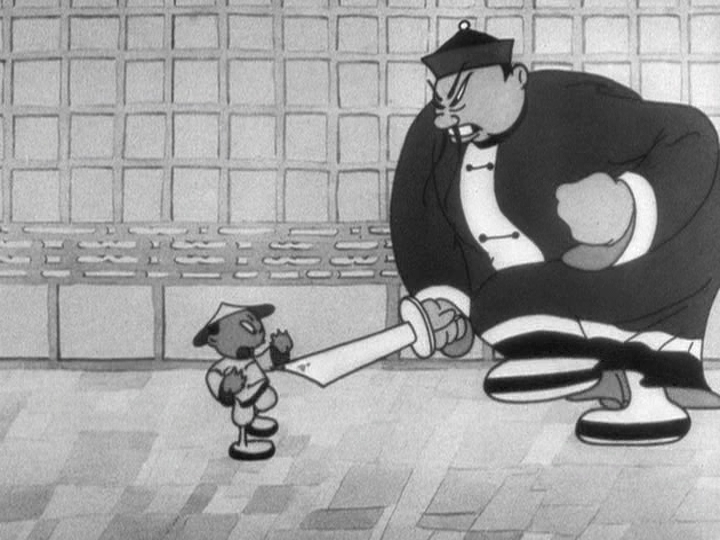
The two begin to chase the butterfly, and it flies into the Emperor’s palace where it tries to perch on the sleeping Emperor’s nose. The boy sees it flying by the chair and leaps up to catch it, inadvertently waking the Emperor. The Emperor, furious at the boy’s actions, grabs a sword, ready to execute him. The boy backs up against a wall where another sword falls down, and the two begin to battle, with the Emperor easily breaking the boy’s sword. The girl tries to plead for mercy, but the Emperor swats her away.

The boy bravely soldiers on, although the Emperor has a huge advantage

The boy continues bravely to fight, even though he has no advantage whatsoever. When it looks like the end with the boy cornered against a pillar, the boy accidentally knocks the vase at the top of the pillar down onto the Emperor’s head, knocking him out cold. The boy grabs the girl’s hand and they flee from the palace, stealing a cart as the Emperor follows close behind in a wheelbarrow. The cart breaks on a rock, but the two continue to run hiding behind a rock. The Emperor doesn’t see them, but thinks they have run into a cave nearby.

The cave, however, turns out to be a dragon, who gobbles up the Emperor and catches the girl in his claw. The boy tries to fight to protect her, but the dragon is too powerful. At one moment, the girl is able to escape, and the two race away once again, with the dragon following close behind. The pair manages to make their way up a hill where a boulder stands precariously on the edge. They push it off, where the dragon accidentally swallows it and is stuck at the bottom. The pair makes it back to the boat, where they embrace.

May 15

Posted on

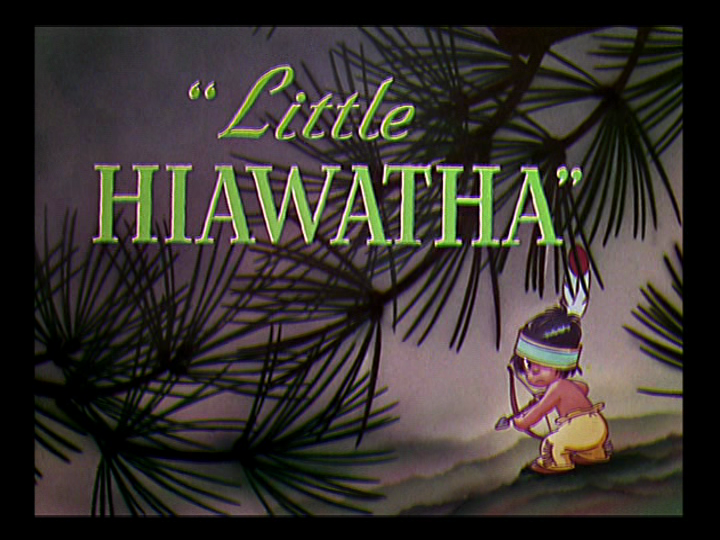
May 15, 1937 – The Silly Symphony, Little Hiawatha, is Released to Theaters

“Mighty hunter Hiawatha. Mighty warrior Hiawatha. Mighty chieftain Hiawatha. Mighty Little Hiawatha.”

On May 15, 1937, the Silly Symphony, Little Hiawatha, was released to theaters. The short was directed by Dave Hand, and distributed by United Artists. Walt once had the idea of turning the story into a full-length feature film, but the idea was shelved, as it never developed the way Walt wanted, story-wise.

The short opens with a small Indian boy paddling his canoe down the river as the narrator begins to tell the story of Little Hiawatha, as if reciting a poem. As birds begin to sing around him, Little Hiawatha grabs his bow and arrow, with the intent to shoot, but loses his balance when the canoe passes through a small bit of rapids, and the birds fly away. He pulls his canoe up to a patch of rocks on the shore and gets out of the canoe, searching for his prey, and ends up falling in the river.

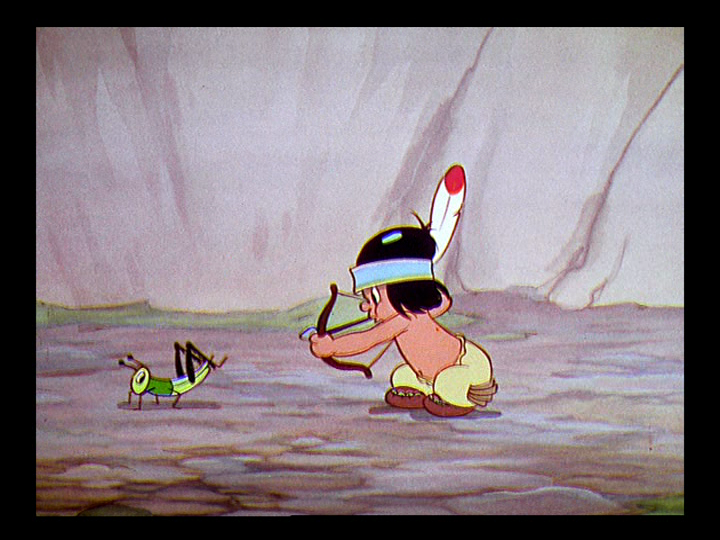
Little Hiawatha begins to track a grasshopper

The animals in the forest spot Little Hiawatha’s fall and begin to laugh. Angered, he pulls out his bow and begins to chase the forest creatures, although the end up taunting him and eluding his capture. He then spots some strange tracks on the ground and, with all the animals watching him curiously, he decides to track the creature, although the tracks were made by a grasshopper instead of anything vicious. Little Hiawatha loses the fight with the grasshopper, causing all the animals to laugh once again.

As Little Hiawatha chases the animals once again, he corners a baby bunny, who stands on a stump, frightened, as the boy begins to cheer. As he draws back his bow, the animals of the forest watch with trepidation, unsure if the boy would actually kill the innocent rabbit. Lucky for the rabbit, Little Hiawatha is touched by the bunny’s sadness, and decides to then duel the rabbit, only the rabbit is too afraid to comply. Annoyed, the boy lets the rabbit get away, much to the joy of the animals in the forest. Angry at his failure, Little Hiawatha breaks his bow and arrow and tosses it aside, but then hears all the animals in the forest cheering. As the boy tries to hide with his shame, he spots bear tracks nearby, and decides to track down the bear.

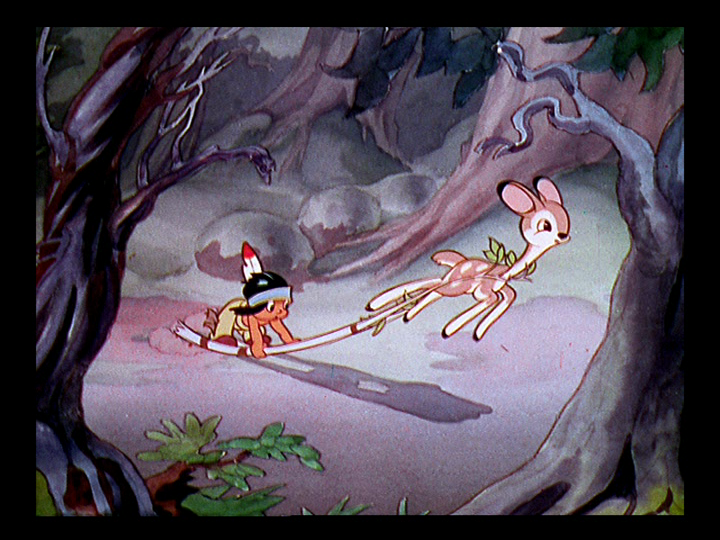
A fawn volunteers his efforts to help Little Hiawatha escape from the bear

As Little Hiawatha is tracking down the bear, a cub crawls out from another side of a boulder, tracking the same tracks. The two run into each other, and flee in fear, but Little Hiawatha turns around to chase the cub, only to run across the mother. He tries to hide from the angry bear, but is almost paralyzed in fear. Three beavers notice that the boy is in trouble and sound out an alarm, causing all the animals in the woods to come to attention. As Little Hiawatha does his best to flee, the animals step in to help as best they can. In the end, Little Hiawatha stopped wishing to hunt the animals, but became their friend instead.


May 11

Posted on

May 11, 1935 – The Silly Symphony, Water Babies, is Released to Theaters

“…it was inspired by the story Water-Babies, written in 1863 by Charles Kingsley, the great English writer and naturalist.” – Walt Disney

On May 11, 1935, the Silly Symphony Water Babies was released to theaters. It was loosely based on the children’s novel The Water-Babies, A Fairy Tale for a Land Baby by Reverend Charles Kingsley, which was published in 1863. The short was directed by Wilfred Jackson. Merbabies, released in 1938, is considered to be its sequel.

The short opens just as the sun is beginning to rise over a quiet pond. Two birds wake and begin to chirp, flying over the lilypads and trying to rouse the water babies sleeping inside. Once the water babies wake, the jump into the pond and begin to swim away. One baby has decided to remain sleeping, until the flower he’s sleeping in gives him a harsh slap to wake him. With a yawn, and trepidation over the temperature of the water, the baby joins the others as they splash and play around in the pond.

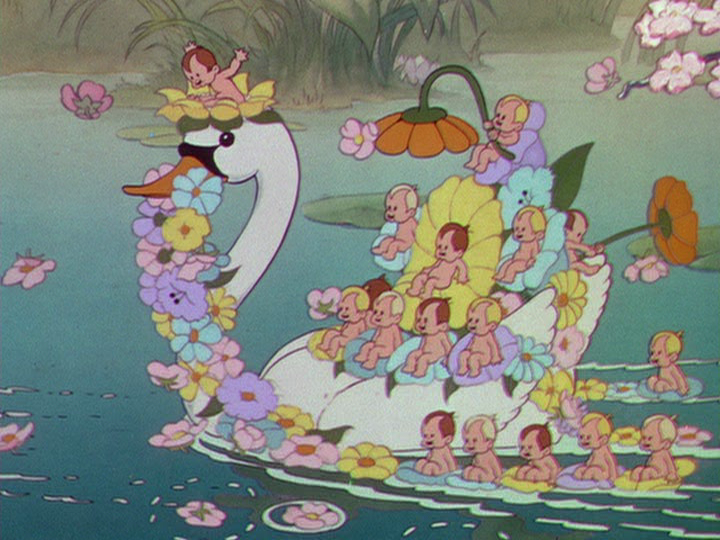
The Water-Babies riding of the back of a swan during a mini parade

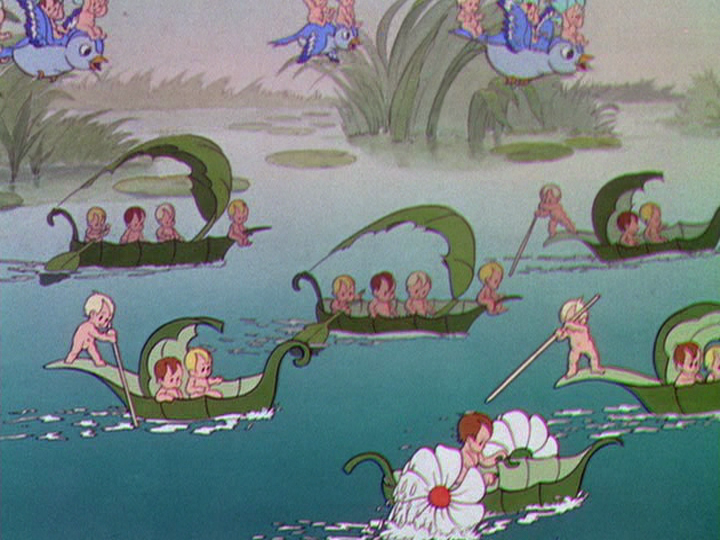
As they play, they all hear the trumpets sound and excitedly swim in that direction. A parade has begun, with babies playing flower trumpets and ride on the backs of turtles and swans. Some travel on leaves, and a trio is seen riding on fish. The festival leads the babies to a patch of land where they begin to play in the weeds and with the frogs that live there. Three babies are seen using a spiderweb as a trampoline, and another trio are seen riding bullfrogs as if they were at a rodeo.

Another baby is seen preparing for a bull(frog) fight, pulling down a red petal to use as the red flag. The bullfrog gets his head caught in a flower, and uses the stem as a horn to try and attack the baby. Luckily, the baby sneaks back into the bullfrog’s cage before it can attack him.

All the Water-Babies heading home after the day’s festivities

The trumpets sound again soon after the fight finishes, and the babies all head back to the pond to travel home at the end of a long eventful day. As the sun begins to set, the babies crawl into their lilypad beds after saying their prayers, and quickly fall asleep as the flower petals close up protectively, leaving the audience with a beautiful moonlit night on the pond.