RSS Feed

Tag Archives: Short film

February 25

February 25, 1938 – The Mickey Mouse Short Boat Builders is Released to Theaters

“All you do is put it together.”

On February 25, 1938, the new Mickey Mouse short, Boat Builders, was released to theaters. This is another one of those shorts where the comedy is actually found through the actions of Goofy and Donald, rather than through Mickey’s actions. Directed by Ben Sharpsteen, Boat Builders featured the vocal talents of Walt Disney as Mickey, Pinto Colvig as Goofy, Clarence Nash as Donald Duck, and Marcellite Garner as Minnie Mouse.
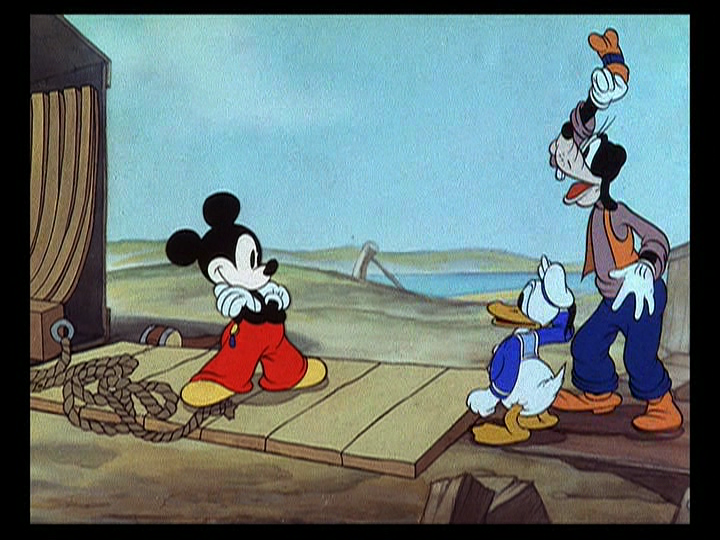
"Lend a hand, me hearties!" Mickey tells the gang, and they happily agree

The short begins with Mickey, Donald, and Goofy excited about building a boat from a kit they have ordered, especially after turning the page and seeing a picture of what the finished project should look like. It’s easy, too: The included instruction manual taunts that “Even a child can do it.” Mickey declares that once she’s built, they will call her The Queen Minnie.

The boys set to work opening crate number one, labeled the keel and ribs, merrily whistling (and quacking, in Donald’s case), sea shanties. Grabbing the rope, they pull out the collapsed innards of the boat, only to have the boat chase them down the shore and capture them on the beams. Mickey laughs when he recites the simple instructions once again, and Donald laughs with him when he reminds them of the boast that even a child can do it.
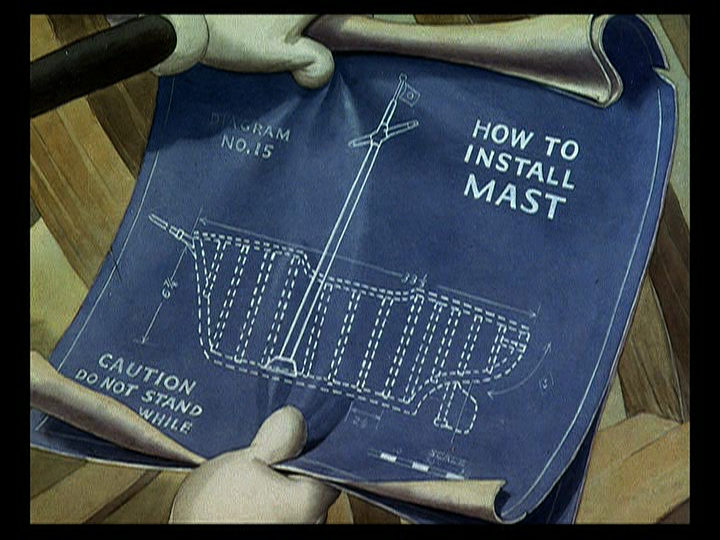
The blueprints for how to assemble the mast. Note the warning in the lower left corner

The scene then moves to Mickey picking up the box with the mast enclosed and pulling out the blueprints on how to install the mast. When Mickey stands on top of the mast, trying to pull it out, it shoots out of the box, sending Mickey all the way up to the sky. The mast is then assembled with Mickey, still hung up at the top of the mast by his clothing, saluting the audience.

Assembling the boat is quick work for the three, and Goofy is seen hammering nails into the sideboards, although, as is usually the case with Goofy, the board does not want to stay nailed down, and hits Goofy square in the head. Slightly angry, Goofy grabs another set of nails and hammers it down again, only to have it swing back at him. Goofy ducks, but it hits him on its swing back. He then feverishly hammers the board down and turns to another task, but continues to be taunted by the board. It finally hits him, spinning him until he falls onto his barrel of nails.
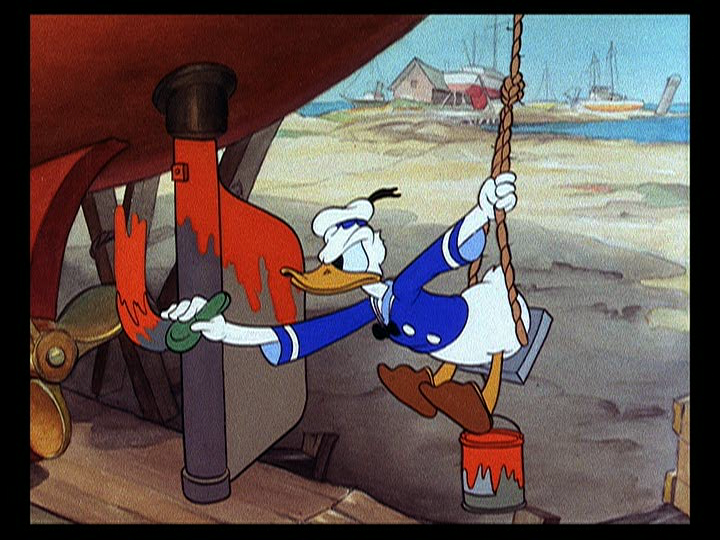
Donald has a difficult time painting the rudder of the boat

Mickey and Donald continue putting the boat together, with Donald painting the rudder, not noticing that Mickey has just placed the helm into its socket and is testing it, causing Donald to completely miss the rudder while trying to paint. Donald holds it still, causing Mickey to think that the wheel is now stuck, and as he tries to free it, Donald gets wrapped around the rudder like a tetherball, and then is hit like a ping-pong ball as Mickey continues to pull on the helm.

Goofy sets about to add the figurehead to the boat, but when he opens to see that it’s in the shape of a beautiful mermaid, he closes the box, flustered, thinking that there’s an actual lady enclosed. He tries to straighten himself up a bit more, and knocks on the lid, apologizing to the figurehead. When it falls out of the box, Goofy catches it, alarmed, and calls out to the others that she’s fainted. He puts her in a beach chair and asks if she’s feeling better, but of course, she doesn’t say a word. “Gee, but you’re purty,” he tells her, twisting his hat in embarrassment. As he admits he could fall for a girl like her, he accidently steps on her tail, pushing the figure up and meeting him in a “kiss,” which causes him to spin around giddily. While Goofy hides his head, giggling, Mickey takes the figurehead and places it in the front of the boat. Poor Goofy is alarmed to find that she has disappeared, and begins to search for her, but ends up falling off the boat and pulling down the anchor.
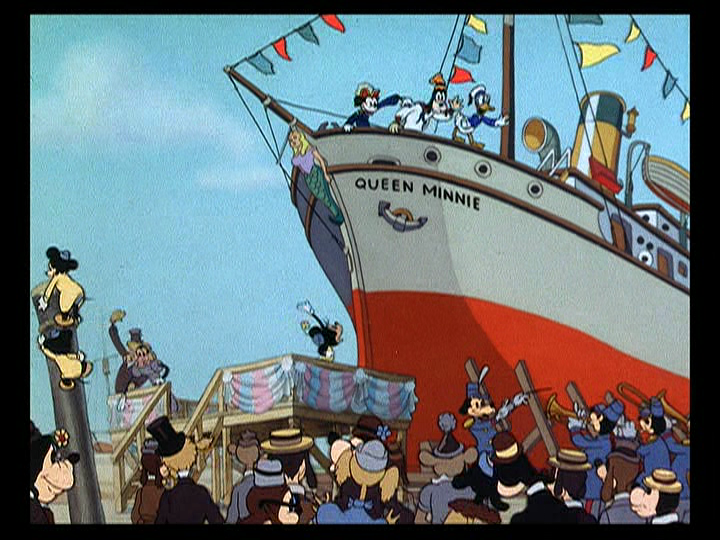
The christening of the Queen Minnie

At last, the boat is built, and a huge crowd appears at its christening and maiden voyage. Mickey, dressed as the captain, tells Minnie to christen the boat, and she gladly grabs the champagne bottle. She’s shocked, however, to find that the bottle will not break, so she gives it a mighty swing. The swing was too great, and the boat begins to fall apart from the impact, with it collapsing in on itself. The boys find themselves in the water, and while Mickey laughs at their predicament, Donald just gives out his trademark, “Aw, phooey!”
February 23

February 23, 1935 – The Mickey Mouse Short The Band Concert is Released to Theaters

“Yet, in a funny way, The Band Concert spelled the beginning of the end for Mickey as a solo cartoon star. As good as he is in this film, and his range of expressions as the frustrated conductor is marvelous, his thunder is easily stolen by a newcomer on the scene, Donald Duck.” – Film Critic Leonard Maltin.

On February 23, 1935, audiences flocked to see a new Mickey Mouse short, only this time, it was in Technicolor. The Band Concert, Mickey’s first color short film, would not go on to win an Academy Award, but has been hailed as one of, if not the, best Mickey Mouse short of them all. From this point on, with the exceptions of Mickey’s Service Station and Mickey’s Kangaroo, all of the Disney shorts would be in Technicolor. The short also boosted the popularity of Donald Duck, who was considered to be a funny character, as opposed to Mickey’s charming personality. The film was directed by Wilfred Jackson, and has Clarence “Ducky” Nash with the only speaking role in the film as Donald. ­­­It has been noted that orchestra conductor Arturo Toscanini considered this film his favorite; it has also been said that the short film Symphony Hour (1942) may have been a more outlandish remake of this film.

With great enthusiasm, Mickey leads the orchestra in The William Tell Overture

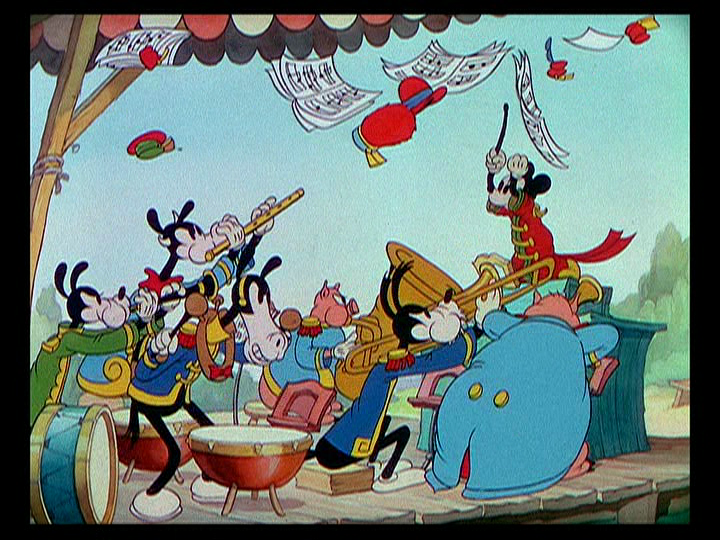
The short opens with a concert in a park, with Mickey and his orchestra taking a bow after finishing Selections from Zampa, and the audience applauding enthusiastically. When Mickey shows the card displaying the title of their next piece – The William Tell Overture – the audience is overjoyed. With great fanfare, Mickey leads his orchestra into the piece, only to get distracted by a voice calling out “Popcorn! Lemonade!”

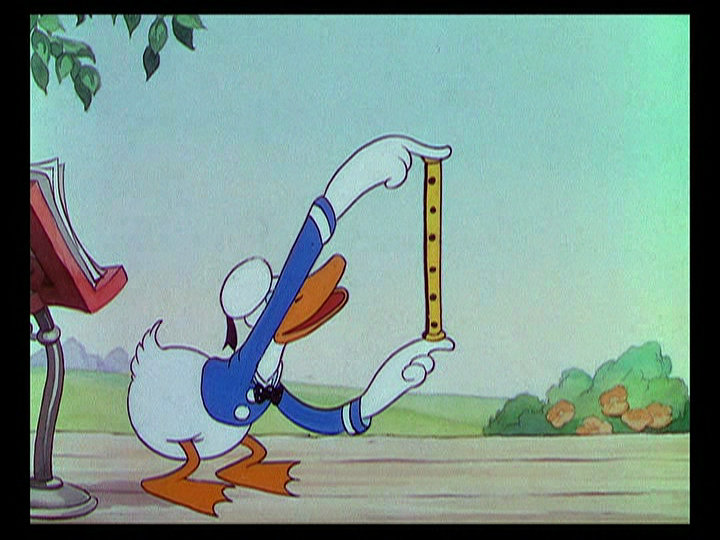
The camera moves to the distraction, and we see Donald Duck pushing an ice cream cart, with lemonade and bags of popcorn for sale as well. He stops to admire the music, then pulls a flute from the front of his uniform, wanting to join in with the orchestra. In the middle of the William Tell Overture, Donald begins to play Turkey in the Straw, which gets the orchestra to switch to the similar sounding tune. When Mickey notices the switch, he grabs Donald’s flute and breaks it in half, but Donald has another trick – or flute, rather – up his sleeve, and resumes his tune while Mickey tries to bring the concert to a halt.

Just like magic, Donald makes a flute appear out of thin air

With a wink, Donald presents another flute as the orchestra tries to get back on track, and when an aggravated Mickey tries to break the third flute, Donald decides to do it for him, sending the audience into peels of laughter. Mickey, at wits’ end, lunges at Donald, only to land on his face as the duck speeds off the stage. With renewed vigor, Mickey pulls the orchestra back to the assigned piece. As they begin to play, Donald, hiding behind a music stand, pulls out another flute, only to have the trombone player encircle the duck’s neck with the trombone slide and shake him down, revealing all the flutes Donald had hidden away, before throwing him right onto his cart, spilling food everywhere. Donald throws a tantrum, but the trombonist just laughs.

Donald grabs one of the flutes from the shake down and begins his takeover attempt again, not noticing a bee buzzing around him curiously. The bee flies into the flute, and ends up in Donald’s mouth, causing the duck to have another fit. When the bee flies away and lands on Mickey’s hat, Donald grabs an ice cream cone and throws it in the insect’s direction. The ice cream lands in a trumpet, and the trumpeter blows it out, which hits Mickey on the back of the head. As Mickey tries to shake the ice cream out, directing the orchestra along the way, the classical piece gets a somewhat interesting interpretation, and Mickey’s temper flares again.

As Mickey finally gets the orchestra back on track, the bee returns and buzzes around Mickey, and each move the mouse makes to swat it away is interpreted by the orchestra as his direction with comical results. The bee buzzes around Horace Horsecollar, playing percussion, who tries to swat him with the cymbals, only to crash around Goofy’s head.

Mickey hadn't realized how complicated this part of the piece was going to be

Mickey turns the page in his music book to the part in the overture called The Storm. He looks rather surprised at how complicated the piece is, but is determined to play it and play it well. When the orchestra starts to play, the clouds get noticeably darker, and the wind begins to blow ominously. Without warning, a tornado sweeps through the town, heading directly for the concert in the park. The audience and the benches flee the concert in a panic as the tornado devours everything in its path. Donald stands around, confused as to why everyone is running away, until he sees the tornado bearing down and tries to hide by climbing up a tree, only to have the tornado braid him within three tree trunks.

The orchestra continues to play with Mickey conducting,as they are dramatically pulled up into the storm, seemingly oblivious to their peril. As they reach the climax of the piece, they stop in midair and are once again set down to the ground for a triumphant finish. The only audience member remaining, however, is Donald, who once again tries to take over with Turkey in the Straw, only to have a tuba land on his head.


February 21

February 21, 1947 – The Pluto Short Pluto’s Housewarming is Released to Theaters

On February 21, 1947, audiences were shown a new Pluto short, Pluto’s Housewarming. Charles Nichols directed the film, from a story by Eric Gurney and Bill de la Torre, and with music by Oliver Wallace. This is one of the few shorts where Pluto does battle with his nemesis Butch the Bulldog, who was introduced in the 1940 short Bone Trouble. As with many of the Pluto stories that dealt with Pluto and another critter, the short relies on charm to carry it through, with much success and usually a new friend for Pluto.

Pluto’s doghouse on the beach has been completed, and shines in the summer sun. Excited about the prospect of moving, Pluto takes all of the bones he’s collected from his dilapidated old shanty, and gives his old house a haughty snort after he and his possessions are out the door. He moves into his new house, giving his bones a quick clean before pushing them inside, and begins to organize them by type into little cubbies built beneath his bed. Realizing that he’s forgotten something, he dashes back to the old place to grab his “Home Sweet Home” sign, kicking dust at the old shack before trotting to his new home.

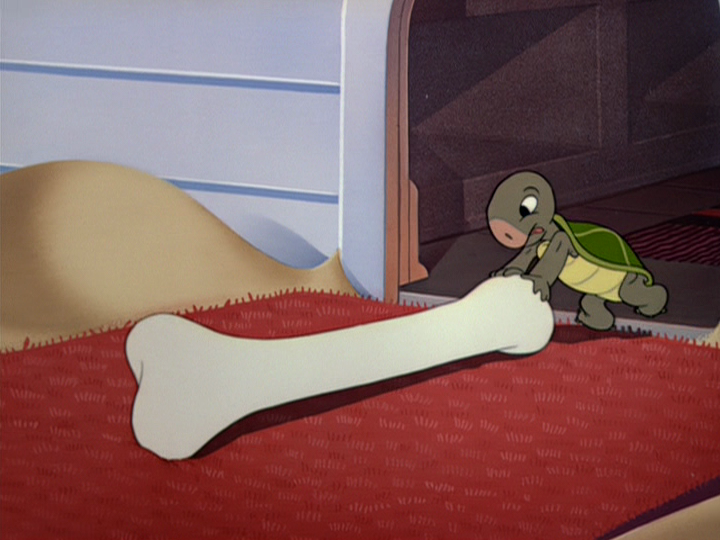
Pluto's enticing new doghouse attracts wildlife, including this tiny turtle

As Pluto heads back, however, he notices that his bones have been tossed out, and is astonished to see a tiny turtle having taken up residence in his new home. The turtle gives Pluto a wave, and continues to set up house. When the turtle tries to push out Pluto’s bowl, Pluto takes a stand against this. Pluto ends up winning this non-aggressive fight by pushing the tiny turtle out onto the beach, only to have the turtle turn around and walk right back in. Pluto ends up carrying the turtle with his teeth in order to dispose of him, throwing him under a crate and leaving him trapped there.

A bit later, Pluto is seen gnawing on a rib bone, when the turtle knocks on the window. As Pluto angrily goes out to dispose of the unwanted squatter, the turtle sneaks in and decides to curl up on the bed, only to find Pluto carrying him away once again. When Pluto comes back, he finds another unwelcome visitor: Butch, the bulldog, who has been chewing on Pluto’s bones in the few moments Pluto was disposing of the other pest. Although Pluto is ready to deal with Butch, Butch seems unconcerned that Pluto is angered by his presence. When Pluto bites Butch, however, Butch goes on the attack.

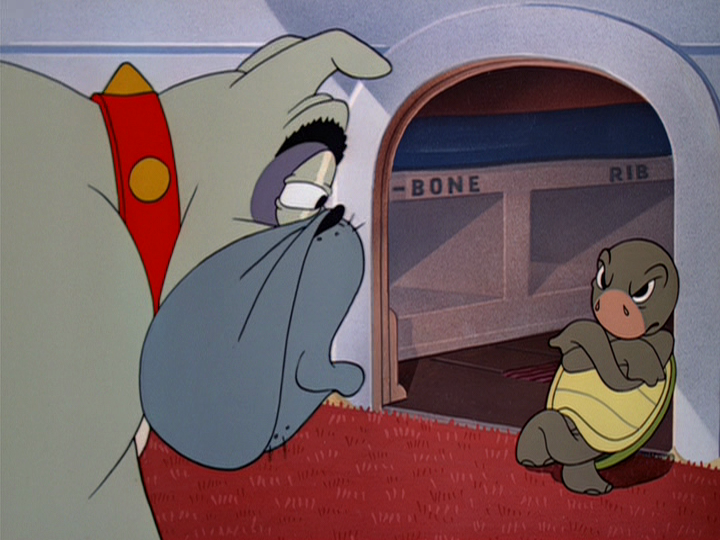
Butch is surprised to see such a creature challenging him for squatter's rights


Pluto manages to hide in his old shack while Butch gets stuck in the doorway. Convinced that Pluto will stay there, Butch returns to the new house and spies the turtle in the doorway, with crossed arms and a glare on his face. The turtle shows Bruce he’s ready to fight, and ends up biting the bulldog on the nose. When Butch tries to retaliate, the only thing Butch can get his teeth around is the turtle’s shell. Butch tires himself out trying to bite the turtle, and the turtle slips out of his shell when Butch isn’t noticing, giving him a nice bite on the foot. The turtle retrieves his shell and uses it to trip up the bulldog.

Meanwhile, Pluto watches nervously from the old shack, and is amazed to see that the tiny turtle has bested Butch. The turtle gives Butch one last present – a bite on the tail – that sends Butch flying down the beach whimpering. The turtle lands in front of Pluto, limp, which causes Pluto to think the poor creature has died in the line of duty. As he begins to cry, one teardrop falls from Pluto’s snout and revives the turtle. The two hug and decide that they both can live in the new doghouse amicably.

February 20

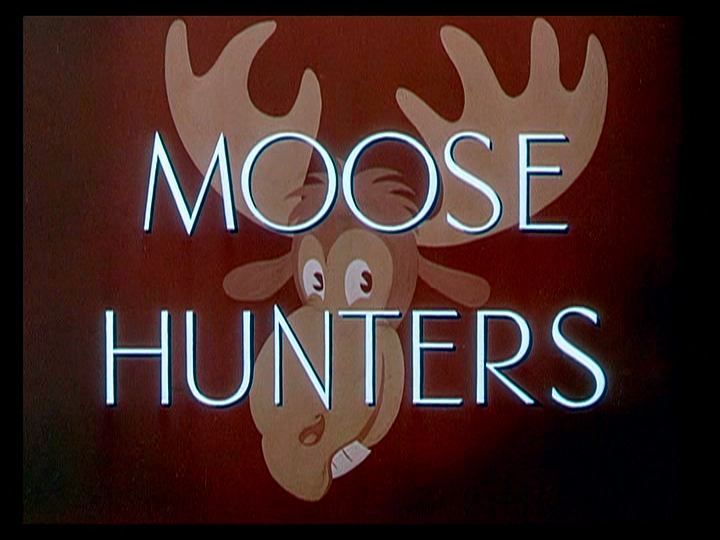
February 20, 1937 – The Mickey Mouse short Moose Hunters is Released to Theaters

“Hi, Mr. Moose. Have a bite?”

 On February 20, 1937, the Mickey Mouse short Moose Hunters was released to theaters. This was one of the few shorts that used Donald and Goofy along with Mickey, as the writers were finding it difficult to give Mickey solo material. The short was directed by Ben Sharpsteen, with music by Paul J. Smith, and starred Walt Disney as Mickey Mouse, Pinto Colvig as Goofy, and Clarence Nash as Donald Duck.

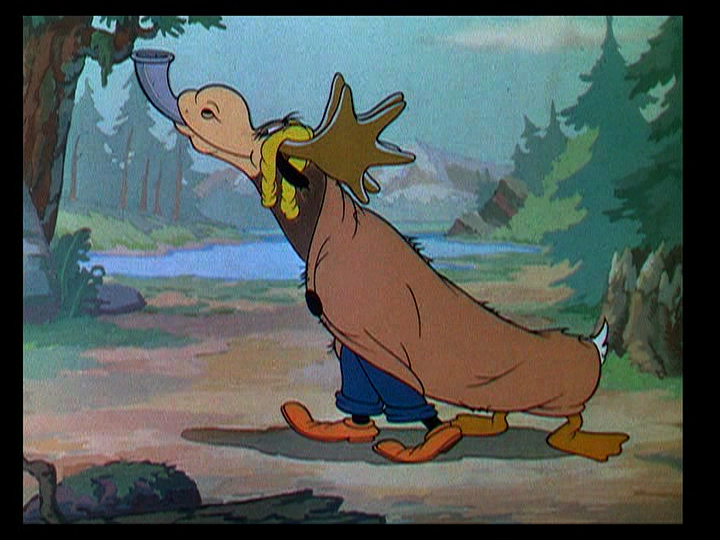
The "female moose" making her mating call

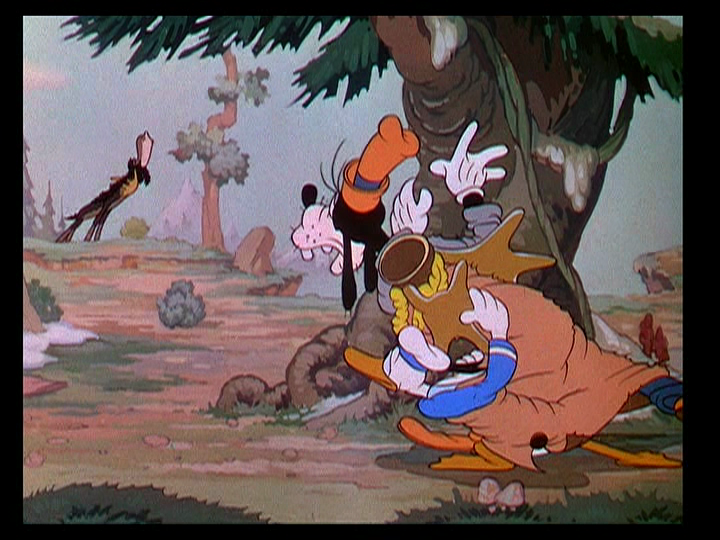
The short opens with a female moose swimming across a river. When she emerges, however, we see that she has two familiar, yet mismatched, pairs of feet, and sounds her call by using a horn. Following behind this strange moose is a swimming bush, which also sounds out a call by using a horn. As the moose continues to walk and call, it hears something respond, and the front half of the moose stops, causing the back half to run into the front. Goofy emerges from his disguise, excitedly informing the others that there is a moose nearby, and Donald emerges as well, repeating the sentiment. Mickey, now revealed to be the walking bush, answers joyfully, holding a shotgun. “Now do your stuff,” he tells them. “I’ll take care of the rest,” he adds with a wink, patting the shotgun.

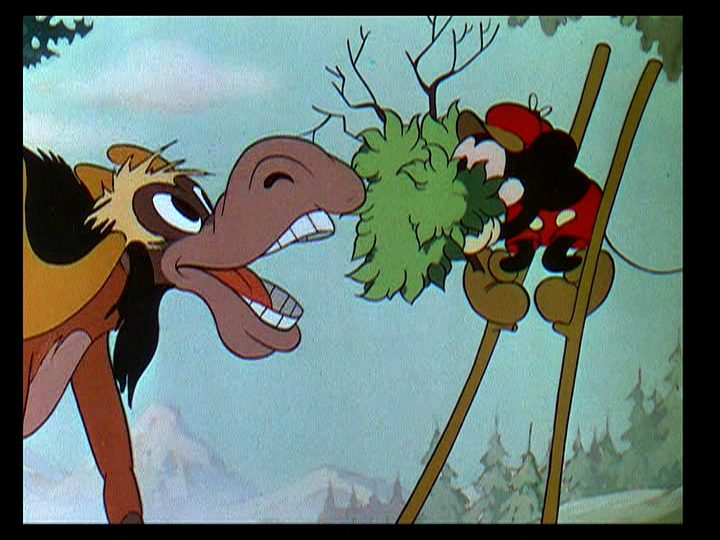
Goofy and Donald continue walking in the female moose costume, trying to lure out the real moose. Mickey, meanwhile, travels a bit behind, carefully using his horn to call out the moose, trying to keep hidden within the leaves of his disguise. He stands on top of a bush and uses the horn again; unfortunately, the moose appears beneath him, startling the mouse and causing him to drop his shotgun, which lets out a shot, scaring the moose. Mickey is starting to sweat, as his gun is now in pieces, and he is even more alarmed when the moose spots his disguise, thinking it would be a tasty snack. Mickey tries to keep himself covered and backs away slowly, only to be pursued by the hungry moose, who nearly eats Mickey’s trademark shorts.

Goofy and Donald spy the moose they've been tracking

Goofy and Donald are still trying to track down the moose they’d heard earlier, and when they spy him, they decide to make their disguise prettier, adding lipstick and powder, with Goofy spraying copious amounts of perfume (named Deer Kiss: Parfum Paris) to entice the moose. The perfume wafts its way toward the unsuspecting creature, who willingly follows the teasing scent. The moose takes one look at the “female” and is instantly smitten, especially when Goofy and Donald perform a teasing walk for him.

When Goofy gives the moose a “yoo-hoo,” the moose responds in kind, but with a force so strong that it blows the costume away. Goofy quickly comes up with a plan, grabbing leaves and performing a ballet/fan dance until they can retrieve their disguise, which only causes the moose to become even more smitten with their character. Once clothed again, the two continue their seductive walk, succeeding in getting the moose to follow them; unfortunately, the Donald half of the moose ends up falling off a cliff, and lands on a bee when he jumps back on the land. The bee, very unhappy with Donald’s appearance, flies inside the costume, sending the pair into a dance to the tune of La Cucaracha. The moose, angling for a kiss, ends up kissing Goofy on the face, as Donald tries to hit the bee, only to cause the moose mask to fly off Goofy’s head, but luckily land back just in time so their cover isn’t blown. Again, Goofy and Donald have the moose follow them, bringing him back to Mickey so Mickey can “do the rest.”

The moose has been eating Mickey's disguise, leaving him rather nervous about the inevitability of being caught

Unfortunately for the mouse, the moose that thought his disguise was a tasty snack has been eating the disguise, leaving almost nothing for Mickey to hide behind. When the moose takes the last mouthful and sees Mickey holding onto a branch for dear life, he glares at Mickey and gets ready to charge, until he hears a “yoo-hoo” nearby. Turning around, he sees the disguise of Goofy and Donald, becomes instantly smitten, and begins trotting over to “her.” Donald doesn’t see the moose, and keeps trying to pull them away, although Goofy is stuck as the moose cozies up to the front half. Donald emerges, only to see that the moose they’d gotten the attention of, and the moose that just got there, have spotted each other, and are ready to duel for the lady’s hand.

Donald and Goofy try to sneak away and hide up a tree as the two males growl and size each other up before pacing and getting ready to duel with their antlers. The force of their fighting is strong enough to tear the trees from the ground, which causes Goofy and Donald to fall from their perch and land between the two, their disguise blown. “April fool!” Goofy offers weakly, with Donald chiming in with the same sentiment; this does not appease the two males, who decide to take out their aggression on Goofy and Donald. The trio speeds away crazily while being pursued by the two males.

February 19

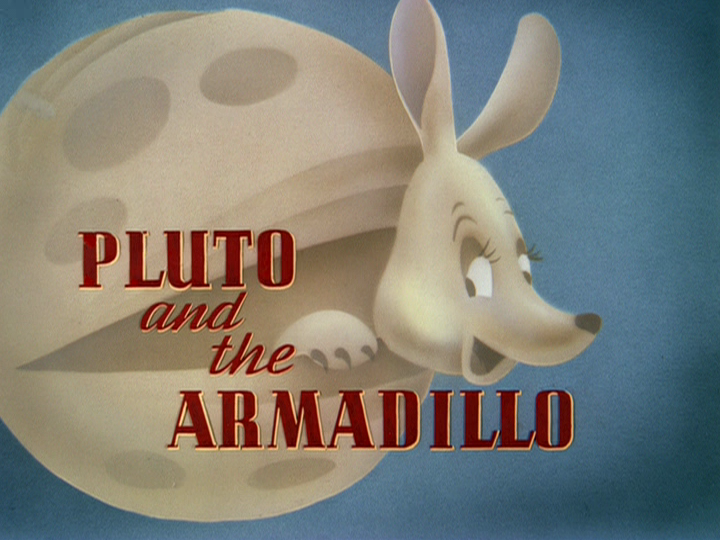
February 19, 1943 – The Mickey Mouse Short Film Pluto and the Armadillo is Released to Theaters

“Down where the mighty Amazon winds its way through the heart of Brazil, we find many strange and exotic species of flora and fauna.”

On February 19, 1943, audiences were presented with a new Mickey Mouse short entitled Pluto and the Armadillo. Directed by Clyde Geronimi, the short starred Walt Disney as Mickey Mouse, Pinto Colvig as Pluto, and Fred Shields as the Narrator. Interestingly enough, although listed as a Mickey Mouse short, its main actor is Pluto, and Mickey appears only in two small sections.

Our narrator opens the story by explaining that there are “many strange and exotic species of flora and fauna” near Brazil, and then introduces a hanging armadillo, affectionately nicknamed Tatou. Tatou, the narrator informs the audience, “is a very timid creature, and at the slightest noise, even at the drop of a pin, he snaps into a solid ball, becoming, so to speak, a hard nut to crack.”

Turista Americana and his canine play a game

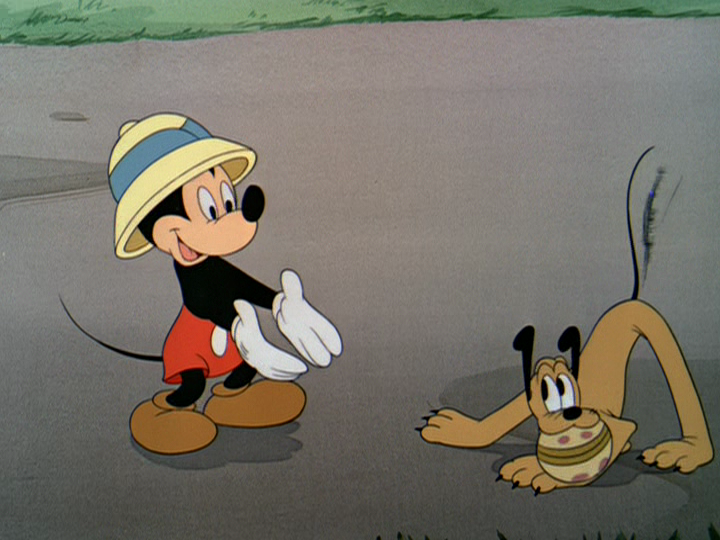
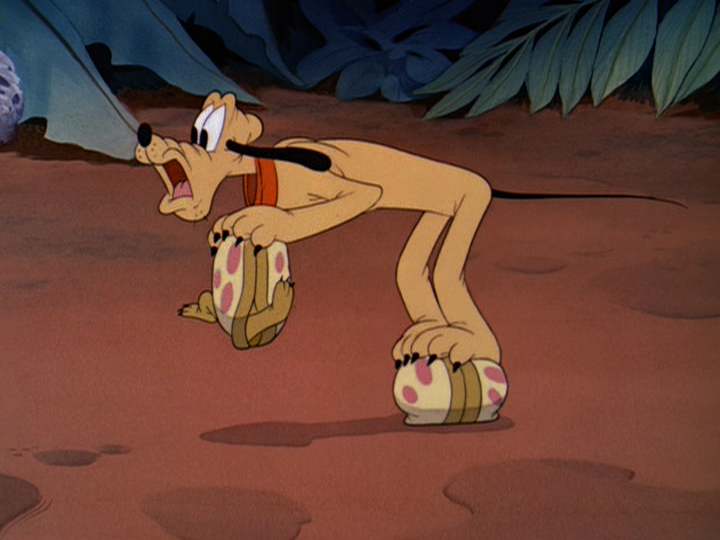
The narrator then moves to the next unusual creature: the turista Americana, or the American Tourist. Mickey and Pluto hop off the Pam Am plane for a fifteen-minute stopover, and Pluto begins to play with a ball that has a strikingly similar design to Tatou’s shell. Mickey throws the ball into some nearby woods, and hits Tatou, who curls up inside his shell. Pluto, thinking Tatou is the ball, goes to retrieve it, but Tatou begins to jump away from Pluto’s mouth. When Pluto gingerly puts out a paw to touch it, Tatou buries himself under ground, then digs a trail away from Pluto, before coming up again and bouncing away from the curious dog and pushing the real ball out from some ferns.

Pluto is confused at the fact that there are now two balls in front of him, and he doesn’t know which one is the one that has been tricking him. Tatou, with a smile on his face, opens his shell slightly to see if Pluto’s still there, and when he gives Pluto a playful wink, Pluto tries to hide while Tatou shuts himself inside again. Although Tatou is being friendly, Pluto’s anger only grows. He tries to capture both of the balls, but the real one is squeezed out of his grasp. Pluto grabs it with his back legs, and both the ball and Tatou begin bouncing as Pluto tries to hold on.

Pluto trying to have a grasp on the situation

Tatou begins to walk away once he slips from Pluto’s grasp, but Pluto rushes around to stop him, determined to find out what exactly this strange creature is. After the two sniff each other out, Pluto determines that he likes Tatou, and the two begin to play a game of underground tag with each other. Tatou hides within a hole, and Pluto, a bit peeved that he ran into some plants and ended up looking like Carmen Miranda, grabs the nearby ball, thinking it’s Tatou, and plays with it rather roughly, causing it to pop. Thinking he’s killed the poor thing, Pluto begins to panic and cry. Tatou, observing from his hiding spot, sees Pluto and starts feeling guilty for making the dog cry. He appears in front of the weeping dog, gives him a lick across the nose, and Pluto instantly cheers at seeing his friend is alive.

The bell is ringing for everyone to get back on the plane, and Mickey is frantically looking for Pluto, who appears to have vanished. He finally spies Pluto and what he thinks is the ball, gathers them up, and drags them onto the plane in the nick of time. As Mickey holds the “ball,” Tatou sticks his head out, startling Mickey, who is very, very confused by the situation as the plane flies away.

February 17

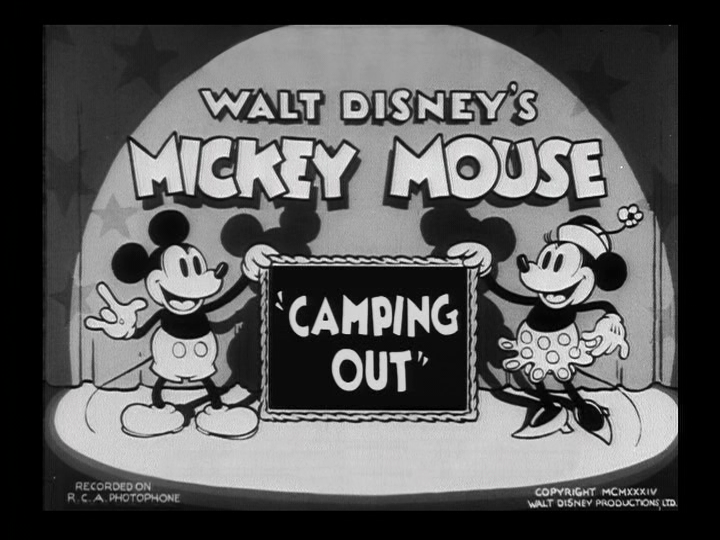
February 17, 1934 – Mickey Mouse Short Film Camping Out is Released to Theaters

“Hey, Pop! I was having fun, and a big guy hit me!”

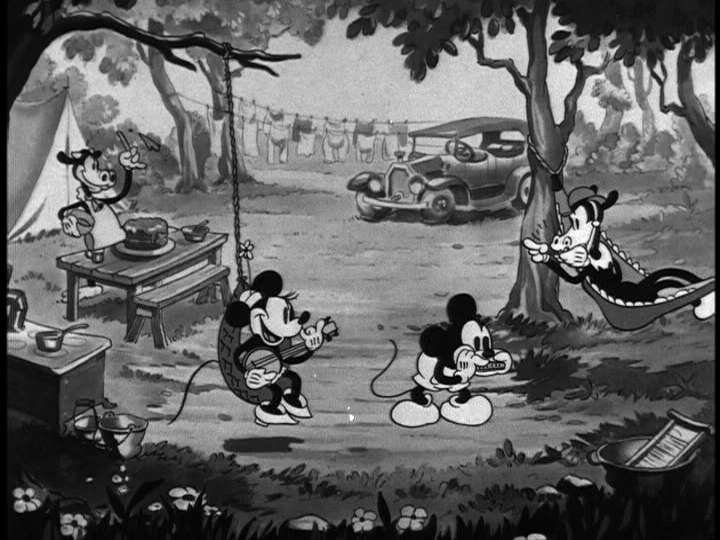
On February 17, 1934, the Disney Studios released the Mickey Mouse Short Camping Out, starring Mickey, Minnie, Horace Horsecollar, and Clarabelle Cow. Before the studio created and realized the individual star power of Mickey, Donald Duck, and Goofy, Mickey and Minnie were usually paired with Horace and Clarabelle, who were the major bit players in the short films of the ’30s. The short was directed by David Hand, with music by Bert Lewis.

Mickey and the gang relaxing at their summer camp out

The scene opens on a lazy summer day, with the gang playing a joyful tune. Mickey is playing the harmonica, accompanied by Minnie on banjo and Horace on the mouth harp, and Clarabelle is in the background icing a couple of cakes. As they dance and play merrily, a lone mosquito flies into the picture, wanting to join in on the fun and landing on Mickey’s nose. Mickey tries to blow him away, only to end up getting stung on the nose. Angered, Mickey takes a frying pan, planning to squash the mosquito when he gets the chance. It lands on Clarabelle’s cake, and Mickey ends up flattening the cake and sending icing flying all over Clarabelle, while the mosquito flies away unscathed. Upset by Mickey’s ruining her hard work, Clarabelle takes the other cake and shoves it in Mickey’s face.

As Horace laughs at Mickey and Clarabelle, the mosquito sees an opportunity to give Horace a good sting. It winds up and flies like a fighter plane, sending Horace flying into the air from the impact. Horace swings wildly at it, and thinks he finally hit it, until he hears buzzing from inside his hat. When he removes it, he discovers a giant bump on his head from where the mosquito stung him. Completely angry at this point, Horace swats the mosquito, sending it flying to the ground with a bent nose. Shaking his fist in revenge and sobbing, he calls over his father and says that he was just having fun when a big guy hit him. Heroic music plays as the entire swarm of mosquitoes flies to seek vengeance for the poor little mosquito.

Seeing the swarm coming, the gang mans their battle stations

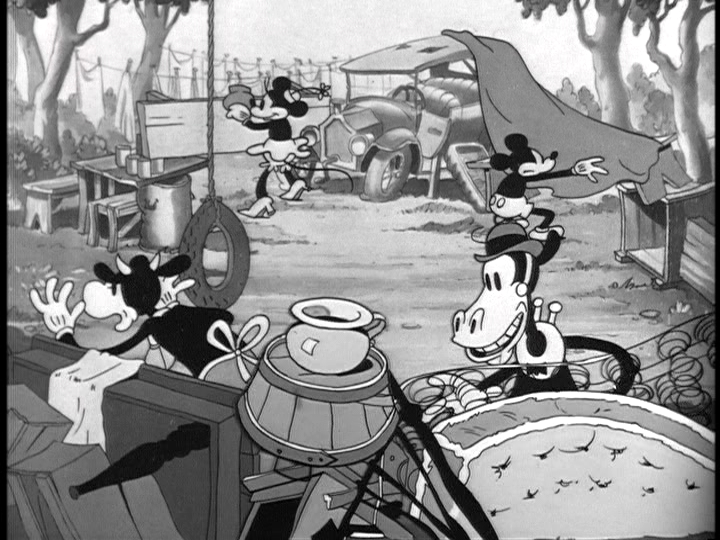
Minnie spies the swarm, cries out in alarm, and the gang sets up their battle stations. Horace decides to spray them with molasses, which effectively stops them and sticks them to a nearby tree. The second batch of molasses-drenched mosquitoes, however, is sent flying back to Horace, hitting him square in the face. Clarabelle takes the old fashioned method with a flyswatter, only to have the mosquitoes grab the netting and tear it apart. Minnie and Mickey team up, with Minnie opening cans of peas, and Mickey filling a bicycle pump with them, then using the pump as a sort of machine-gun with pea pellets. The mosquitoes catch the peas on their noses, causing them to fall to the ground with the weight. The swarm finds a hammer and uses it to remove the peas from their noses, then take to the air again. Horace uses corn to make his own shooter in order to break up the swarm. Believing him to be successful at driving the swarm away, everyone cheers, but the victory is short-lived as the bugs dive bomb the quartet. Horace, however, grabs an umbrella and pulls the gang to safety, with the swarm hitting the umbrella and sticking. Poor Horace is still holding on to the umbrella, and as the swarm flies away, he joins them. Mickey grabs on to try and pull him down, but is also taken away. The umbrella breaks from the weight, and Horace and Mickey crash to the ground.

The mosquitoes free themselves, pull together to form a giant mosquito, and angrily chase after the gang as they run to take refuge in their tent, with the only casualty being Horace’s hat. The swarm continues its attack, with the gang using all of their supplies as best they can to stop the menace. Mickey’s solution is to trap the mosquitoes in the only thing he can find: Clarabelle’s bloomers. As the mosquitoes buzz away, surrendering, the gang cheers at their victory.

February 10

February 10, 1934 – The Silly Symphony The Grasshopper and the Ants is Released to Theaters

“Oh, the world owes me a living…”

In 1934, the Disney Studios released what was to become another wildly popular Silly Symphony, The Grasshopper and the Ants. Based on the fable by Aesop, it was adapted by William Cottrell, directed by Wilfred Jackson, and starred Pinto Colvig as the Grasshopper. Colvig is better known as the original voice of Goofy, and the song in this short, “The World Owes Me a Living,” would become a theme song for Goofy in later shorts. The song was composed by Larry Morey and Leigh Harline, and was so popular that sheet music for the piece was published. The short is also notable for being the first instance of a character turning blue from the cold. Although this is a common idea these days to show how cold the weather is, the Technicolor process was still new in 1934, therefore any color change to show emotion would have been relatively fresh.

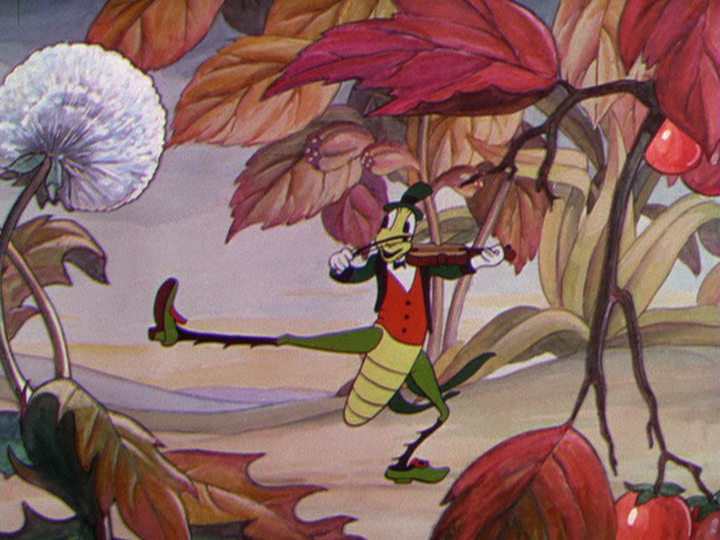
The first shot we see is of the Grasshopper skipping down a flower-filled path, playing his fiddle merrily. As he stops for something to eat and drink, we see that the Grasshopper is actually quite wasteful, taking one bite of a leaf before throwing it away to grab another. He becomes distracted, however, when he sees a hive of ants busily working to store food for the winter, doing such chores as picking off the individual kernels from an ear of corn to chopping up slices of carrots, making it easier to bring the food inside their hollow tree.

The Grasshopper gets a young ant to shirk his work to sing and dance

The Grasshopper begins to laugh at their efforts, and calls over an ant to join him. “Listen,” he tells the ant, “the Good Book says the Lord provides. There’s food on every tree. I see no reason to worry and work, no sir, not me.” With that, he goes into the theme song for this short, “The World Owes Me a Living,” enticing the ant to “play and sing and dance,” to which the impressionable ant agrees, imitating the Grasshopper’s dancing. Unfortunately for the ant, the Queen arrives, shocked to see an ant shirking its duty. The ant, embarrassed at being caught, rushes back to his work at breakneck speed.

The Grasshopper greets the Queen and tries to entice her the way he did the ant, but the Queen is firm. “You’ll change that tune when winter comes and the ground is covered with snow,” she warns him. But the Grasshopper assures her that winter’s a long way off, and begins to sing again. The Queen leaves him to his foolishness, and the Grasshopper continues to sing and dance, and not “spoil his Sunday pants like the other foolish ants.”

The Grasshopper begins to dance his way through the seasons, caring little for the upcoming winter

As he continues to fiddle and dance, the seasons quickly change from summer to autumn, with the leaves beginning to fall. The scene begins to grow more desolate, but the Grasshopper continues to blithely fiddle and dance, unaware that all he considers food is quickly disappearing with the changing of the seasons.

As heavy winds begin to blow, we see the ants finishing up their food gathering, and rushing inside their hollow tree for shelter before it begins to snow. The Grasshopper is seen wandering the snowy fields, searching for any morsel of food, but sadly, the trees are all bare. Finally, he spots one lone leaf on a branch, and just as he is about to grab and devour it, a strong gust of wind swoops in and blows it out of reach. He begins to turn blue from the cold as he keeps walking in the heavy snows, looking for food and shelter. At last, he spies the ants’ tree, and makes his way to the door, spying through the window.

The last piece of food the Grasshopper can find

Inside, every ant is well fed and merry, clinking glasses and enjoying the fruits of their labor. The Grasshopper knocks on the door, but is so weak from hunger and the cold that he faints just before they open the door. The ants carry him inside and warm him while feeding him soup. The Queen makes her way over to the Grasshopper, looking angry at his presence. He tries to make amends for his previous lackadaisical attitude, begging her to not throw him out. “With ants,” she tells him, “just those who work may stay. So take your fiddle.” The Grasshopper, visibly upset, takes his fiddle from her and begins to leave. But the Queen has other ideas: “And play,” she says, giving him the opportunity to earn his keep by entertaining the ants during the long winter. The Grasshopper is more than willing to meet her terms, adding a new verse to his song about his whole change of attitude.

February 9

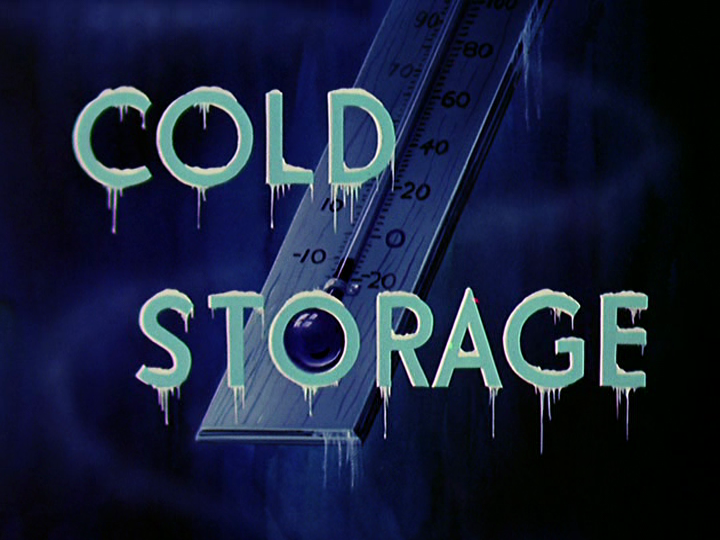
February 9, 1951 – Pluto Short Film Cold Storage is Released to Theaters

On February 9, 1951, the Pluto short film, Cold Storage, was released. The short was directed by Jack Kinney, with the story by Dick Kinney and Milt Schaffer. It was the 46th Pluto short released, the first in 1951, which was the last year of the Pluto short films.

The scene opens on a pond in winter, where a stork is shivering in the cold as his feet are frozen in the pond. He manages to extract himself, and is on the search for somewhere warm to stay, when he spies a doghouse. He quickly takes over, preparing to hibernate. Unfortunately, just as he has found a place to stay, a shivering Pluto makes his way into the yard, hoping to get warm inside his doghouse. He tries to fall asleep in the house, only to find that the stork has pushed him back out into the cold.

Pluto wakes up, alarmed to find himself in the elements again, and attempts to walk back inside. The cunning stork, however, lifts the doghouse so the sleepy Pluto walks right through it without noticing. Pluto, alarmed again at being outside, runs around to the entrance to once again get warm and as he settles down, the house gets up (thanks to the stork) and walks away. Pluto’s anger grows as he finds he cannot enter his own doghouse, no matter how hard he tries. He sees that the house seems to be moving on its own, and fears he’s become ill or crazy.

Pluto, checking to see if he's sick, ends up seeing his house walk across the yard

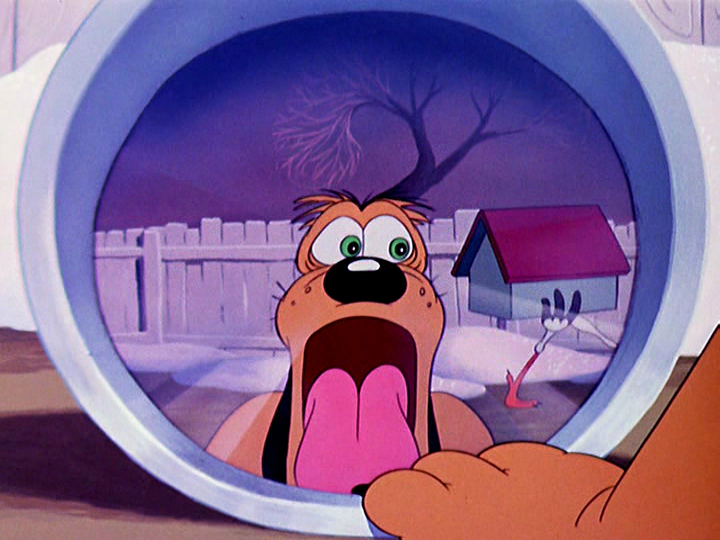
As Pluto checks his vitals, he notices in the reflection of his bowl that the house seems to have sprouted legs and is moving across the yard. He goes into attack mode, but is stopped when the stork’s beak appears in the doorway. As he watches the stork take a drink from the water bowl, Pluto can’t take it any more and begins to bark profusely at the intruder. The stork replies by stepping on Pluto’s snout, silencing the poor pup. As Pluto looks around for his house, he is alarmed to see that the stork has decided to fly away, house and all. When the stork perches on the fence, Pluto knocks him into the yard, only to discover that the stork is now using the house as a cradle, and lulls himself to sleep singing “Rock-a-Bye-Baby.”

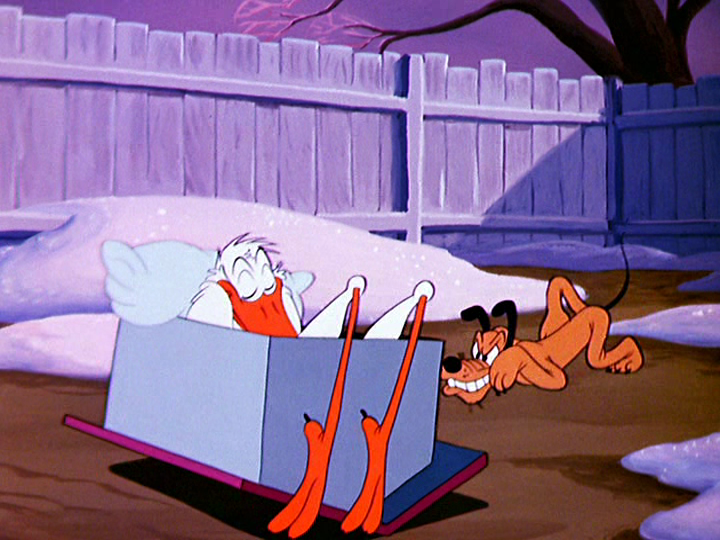
As the stork lulls himself to sleep, Pluto decides to implement a sneak attack

Pluto begins to sneak up on the stork, but the stork is unfazed by the dog, until Pluto attacks him. After Pluto thinks he’s won the fight, he goes inside the doghouse and settles on the pillow, hoping to finally get to sleep. The “pillow,” however, has other plans, walking outside the house and dropping Pluto into the frozen pond. Another fight ensues between the stork and the dog, with each fighting for dominance. Suddenly, the sun bursts out from behind the clouds, quickly signaling the beginning of spring. Just as the two were fighting to get in the doghouse, now the two are fighting to get out, as the temperature rises to an uncomfortable level. Fortunately for Pluto, he is able to come up with a compromise that allows both of them to find relief from the heat..

February 6

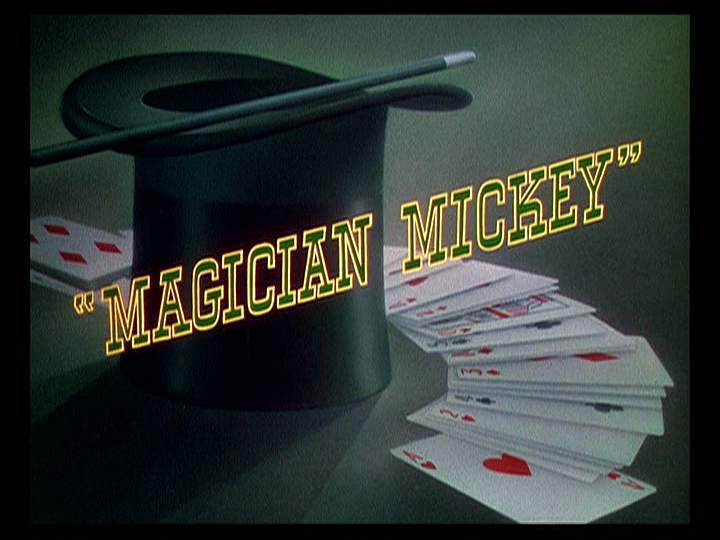
February 6, 1937 – Release of the Mickey Mouse Short Film Magician Mickey

“Aw, why don’t you go home? Phooey!”

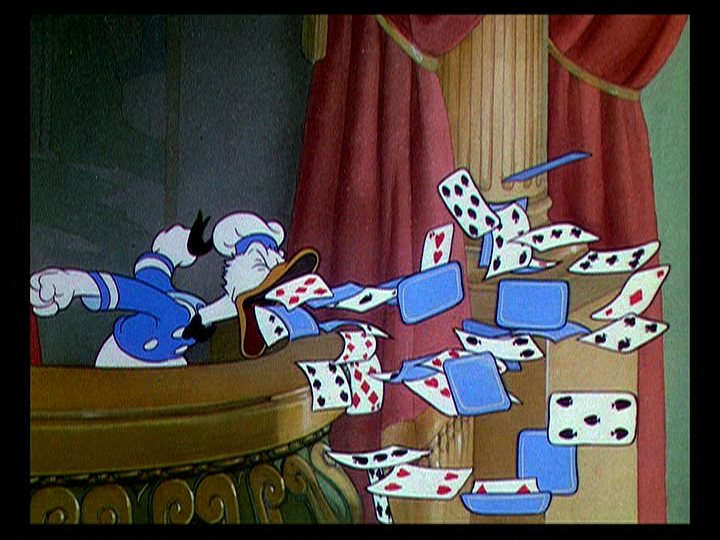
On February 6, 1937, audiences were treated to a cartoon magic show called Magician Mickey, starring Mickey Mouse. Unfortunately for Mickey, Donald Duck decides to attend the show, heckling Mickey from beginning to end with a growing degree of cartoon violence, but Donald learns that Mickey will always get the best of him in the end. The short was directed by David Hand, and stars Walt Disney as Mickey Mouse, Clarence Nash as Donald Duck, and Pinto Colvig as Goofy. As with many of the shorts of this period, this one relies on the use of pantomime, as Mickey and Goofy only have one line each. The short has the added bonus of Donald throwing ten fits, including the ones where he is a kangaroo, a seal, and a monkey—it is a magic show—and with every fit, he spits out cards ending with the ace of hearts sticking out of his mouth.

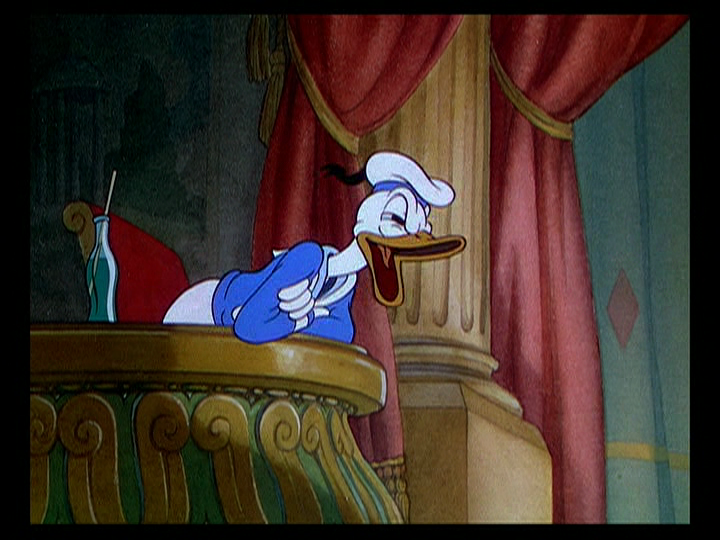
The short opens in a theater, and we see Goofy up in the rafters, setting up the ropes and lights for the show. We then hear applause as Mickey struts onto the stage. His first trick is making his table appear from his hat. He then turns his cloak into a crow, and as the crow flies away, Mickey is startled by hearing loud laughter. As he turns, he sees Donald Duck in a balcony seat, beginning his heckling as Mickey’s personal skeptic, crying, “Aw, phooey.”

Donald Duck, Mickey Mouse's personal heckler

Mickey’s next trick is to release a balloon from his hand, after showing that there was nothing up his sleeve. He releases another one, which suddenly pops over Mickey’s head, drenching him. He glares over at Donald, who spies the other balloon floating over and shoots it with a slingshot. Unfortunately, the balloon turns into a lobster, and begins to fight with Donald. As Donald throws it back at Mickey, Mickey catches it and turns it back into a balloon, which he pops with his magic wand.

Mickey then begins a card trick, but Donald, ever up to mischief, pulls out a bellows and shoots the air in Mickey’s direction, causing the cards to fly all over the place. Mickey amazes the audience by turning the cards into flock of birds, which he then sends into a cage he makes appear out of thin air. He then makes the cage disappear, replacing it with a new deck of cards. Donald proclaims that anyone can do that trick, and as Mickey makes the cards disappear, they reappear shooting out of Donald’s mouth as he throws a fit. Humiliated, he throws his empty soda bottle at Mickey. Unfazed, Mickey makes the bottle float in midair and fill with water, which shoots back at Donald, causing another card-spitting fit.

Mickey makes the cards reappear through Donald's fits, a humiliation not even Donald expected

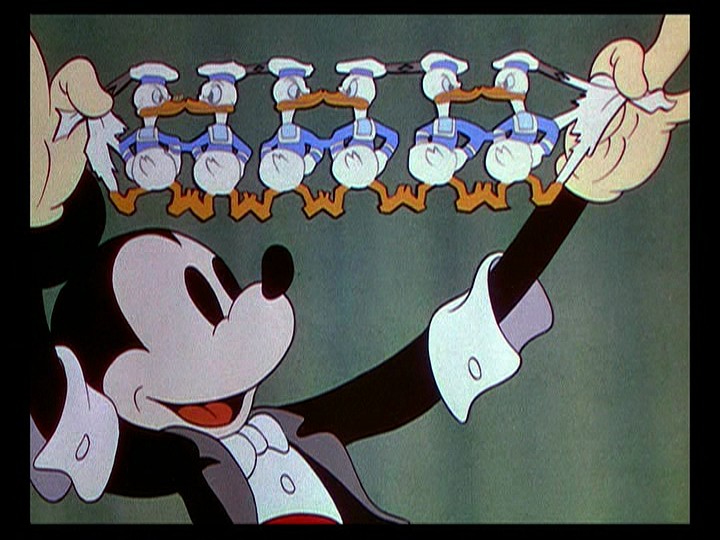
As Mickey bows to the audience, Donald jumps onto the stage and steals the magic wand, trying to use it on Mickey. The wand does give Donald a giant ice cream cone, which spits raspberry ice cream into the duck’s face, causing a third card-spitting fit. As he leaps at Mickey, Mickey catches him and makes him disappear in his hands, turning him into a set of Donald Duck paper dolls, and then into a twisted bullet, which Mickey places into a starter’s pistol. Mickey shoots Donald at an egg on the side table, and by the light of a candle, the audience sees Donald inside the egg, throwing another fit. Mickey grabs the egg and throws it into his hat, and makes Donald reappear by emptying the yolk from the hat.

Magician Mickey and his amazing Donald Duck paper dolls

Angered again, Donald steals the wand again, breaks it in half and throws it on the ground before having another tantrum; this tantrum, however, distracts him from seeing the wand pieces turning into a cactus equipped with boxing gloves. The cactus then begins to punch Donald, with one knockout punch sending him flying offstage. Having enough of the humiliation, but not knowing when to give up, Donald lunges onto the stage, sailing through a hoop Mickey holds up, turning into an assortment of animals as he goes through the hoop over and over. After getting himself back to normal, and seeing Mickey take another bow before the enthralled audience, he spies the pistol in Mickey’s back pocket rips it away and points it at Mickey, who becomes alarmed. “Look out! It’s loaded!” Mickey cries. Donald doesn’t care, but at least he provides the show with an explosive ending.


February 3

February 3, 1931 – Silly Symphony Birds of a Feather is Released to Theaters

Directed by Burt Gillett, the Silly Symphony Birds of a Feather was released to theaters on February 3, 1931. A black and white short, the story is of several types of birds and how they react around each other, especially when a hawk steals a chick, and a brave group of crows decides to fight back to rescue it.

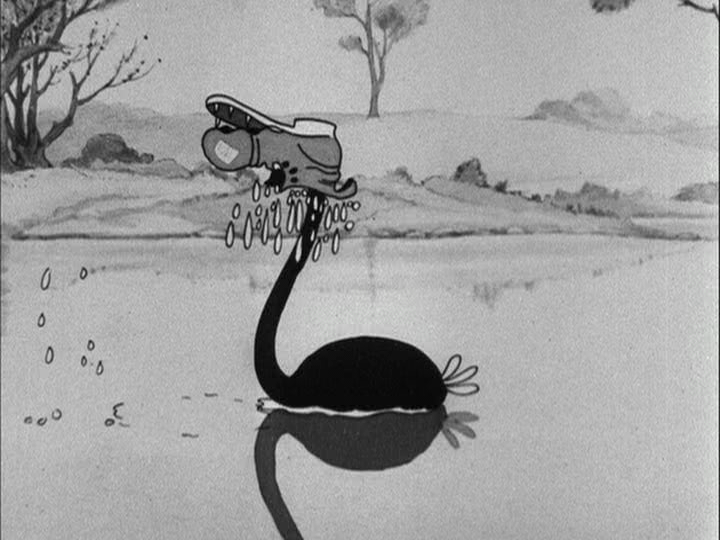
The short opens on a rather idyllic river scene, where three white swans are gliding down a river. They are followed by a black swan, which has two babies as passengers on its back. After the babies decide to swim away, the black swan dives into the water for something to eat, and devours a worm. When it dives again, instead of a worm, it has found a shoelace still attached to a boot, which then lands on its head. The next bird we see is a peacock, preening alongside the water’s edge. After spreading its tail feathers and admiring itself, a duck enters the picture. After observing the narcissistic peacock for a second, the duck sticks its tongue out at the bird, thoroughly distracting it before sailing away.

The swan that accidentally eats a shoelace

The scene then moves to two birds who appear to have harps for tails, beginning the symphony part of this Silly Symphony. The audience travels up a tree, stopping at certain moments to observe the musical habits of the occupants. First, there are several birds chirping the cheerful melody begun by the harp-tailed birds, and above them is a mother bird watching her three eggs hatching. Four hummingbirds buzz around the flowers above them, gathering nectar. The scene travels up a little more, where two birds are trying to continue the melody, but are interrupted by a cuckoo bird, who pops out of several different openings in the tree.

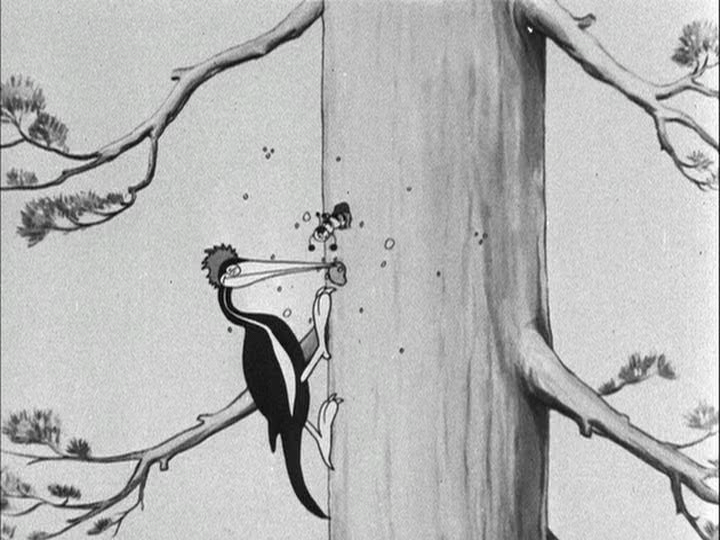
In another tree, a woodpecker tries to peck for food, disturbing a caterpillar that lives in the tree. Annoyed, the caterpillar knocks on the woodpecker’s head, which begins the woodpecker’s pursuit of its possible snack. The woodpecker wins the chase, eating the caterpillar segment by segment.

The woodpecker trying to find food. Little does he know that food is annoyed with his pecking.

A crow flies into the picture, observing another bird giving food to her babies. After the mother bird flies away, the crow climbs into the nest and steals the baby birds’ food, a worm, and flies back to her own nest in the backside of a scarecrow. Her baby crows fight over the worm, which escapes down the leg of the scarecrow and scampers away, only to be pursued by a chicken and her chicks. There are many great gags here, including the worm trying to throw the chickens off by crawling under boots, a pipe, and a can, only to have the hen lift them up with her head and have them land on her chicks. Eventually, the worm crawls into a hole, and the chickens pace and wait, but eventually give up and walk away, except for one chick, who grabs the worm by the end, only to have it crawl up through another hole and bite it on the tail.

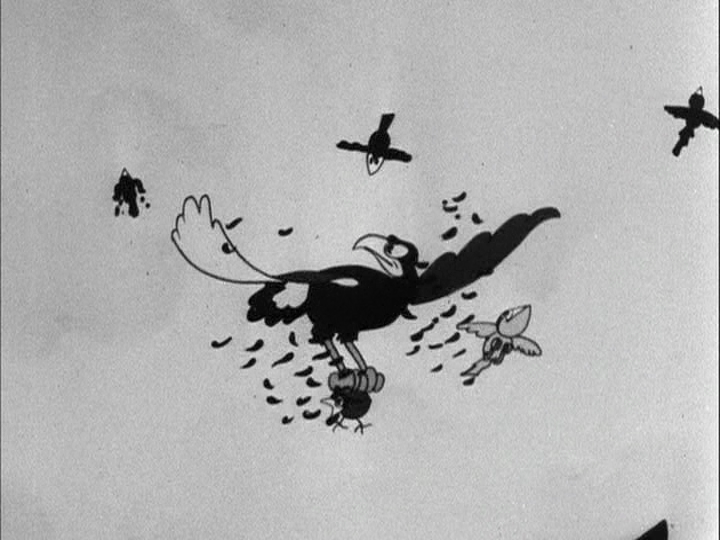
While the chickens look for food, the hen notices the shadow of a hawk circling around them. She desperately gathers her chicks together for safety, but misses the one chick who was still after the worm, who is caught by the hawk. After a crow notices what happens, he calls together his friends, who go after the hawk in formation, dive bombing and attacking it to save the chick.

The formation of crows dive bombing the hawk

Overall, the short isn’t that memorable of all the Silly Symphonies, but there are a few good gags that make it a good short to watch. If you watch them in chronological order, you’re able to see how the animation was improving, but this short still has the more cartoony style that was present in the earlier shorts.