RSS Feed

Tag Archives: Short film

May 23

Posted on

May 23, 1931 – The Silly Symphony The China Plate is Released to Theaters
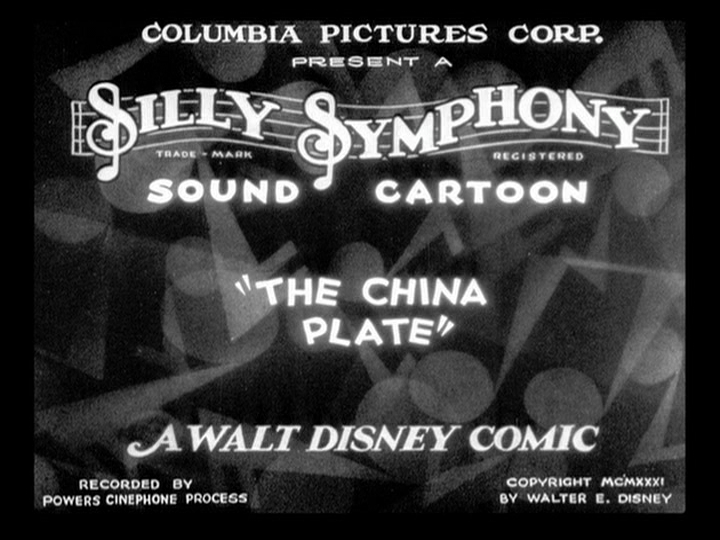
On May 23, 1931, the Silly Symphony The China Plate was released to theaters. The short was directed by Wilfred Jackson, and while entertaining, this is another example of the stereotypical view Hollywood had of other cultures during this time period.

The short opens on a collection of exquisitely decorated pieces of china: two cups with saucers, a teapot, and a plate. The audience zooms in on the plate, and the figures begin to move. Three Chinese servants prepare to serve food for the Emperor, and as he eats, the bowl slips away from him and knocks into the instruments of the sleeping band, who wake and begin to play. Three maidens appear and begin to dance to the music, and a poor cat that is walking along ends up getting stepped on and accidentally used as an instrument by the band.
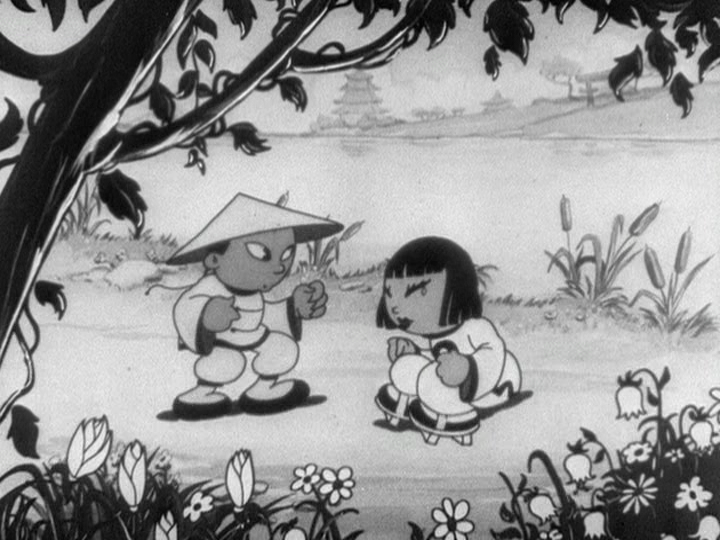
The boy tries to cheer up the crying girl after her fall in the river

As the cat runs away in fright, he knocks into a screen, revealing a frightening face on an umbrella, which is held by another maiden. She gets distracted by the view of a butterfly and seeing the Emperor asleep, chases after it into the garden. As she chases it, the view moves to a young fisherman nearby, who uses a bird to help him catch the fish in the river. The girl accidentally falls into the river as she chases the butterfly, and the boy quickly rescues her and puts her on dry land. He tries to comfort her as she cries, and makes her laugh as he wipes away her tears. She points to the butterfly she was chasing, who is now perched happily on a sundial, and the boy lets her know that she can count on him to catch the elusive insect.

The two begin to chase the butterfly, and it flies into the Emperor’s palace where it tries to perch on the sleeping Emperor’s nose. The boy sees it flying by the chair and leaps up to catch it, inadvertently waking the Emperor. The Emperor, furious at the boy’s actions, grabs a sword, ready to execute him. The boy backs up against a wall where another sword falls down, and the two begin to battle, with the Emperor easily breaking the boy’s sword. The girl tries to plead for mercy, but the Emperor swats her away.
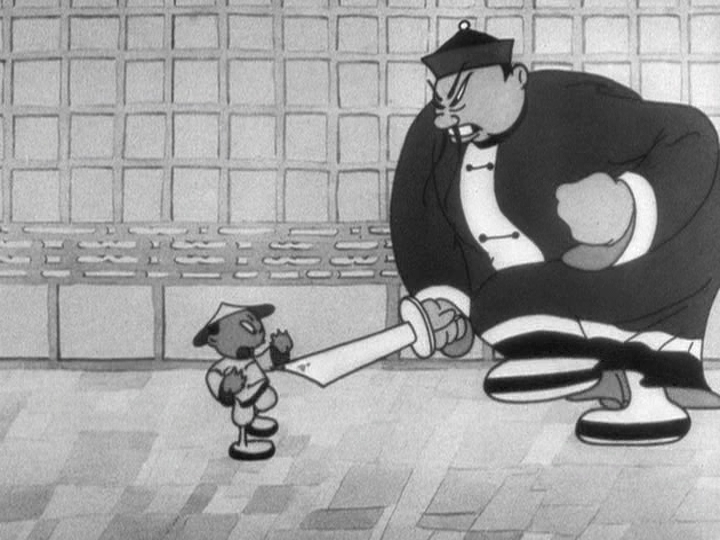
The boy bravely soldiers on, although the Emperor has a huge advantage

The boy continues bravely to fight, even though he has no advantage whatsoever. When it looks like the end with the boy cornered against a pillar, the boy accidentally knocks the vase at the top of the pillar down onto the Emperor’s head, knocking him out cold. The boy grabs the girl’s hand and they flee from the palace, stealing a cart as the Emperor follows close behind in a wheelbarrow. The cart breaks on a rock, but the two continue to run hiding behind a rock. The Emperor doesn’t see them, but thinks they have run into a cave nearby.

The cave, however, turns out to be a dragon, who gobbles up the Emperor and catches the girl in his claw. The boy tries to fight to protect her, but the dragon is too powerful. At one moment, the girl is able to escape, and the two race away once again, with the dragon following close behind. The pair manages to make their way up a hill where a boulder stands precariously on the edge. They push it off, where the dragon accidentally swallows it and is stuck at the bottom. The pair makes it back to the boat, where they embrace.
May 22

Posted on

May 22, 1942 – The Pluto Short Film The Army Mascot Premieres in Theaters

“He’s better than Gunther!”

On May 22, 1942, the Pluto short The Army Mascot was released to theaters. This was released as one of the wartime shorts meant to boost morale and make audiences laugh. The short was directed by Clyde Geronimi, and written by Carl Barks and Jack Hannah.

The short opens at the U.S. Army base Camp Drafty, where Pluto is seen sniffing around the gate. He looks up when he hears trumpets sound, and sees the mascots of all the divisions stepping out of their doghouses. A truck from the Army field kitchen stops by, dropping off plates of roast beef and steak. A very hungry Pluto’s mouth waters; he then spies another mascot – a goat named Gunther – sound asleep in his pen.

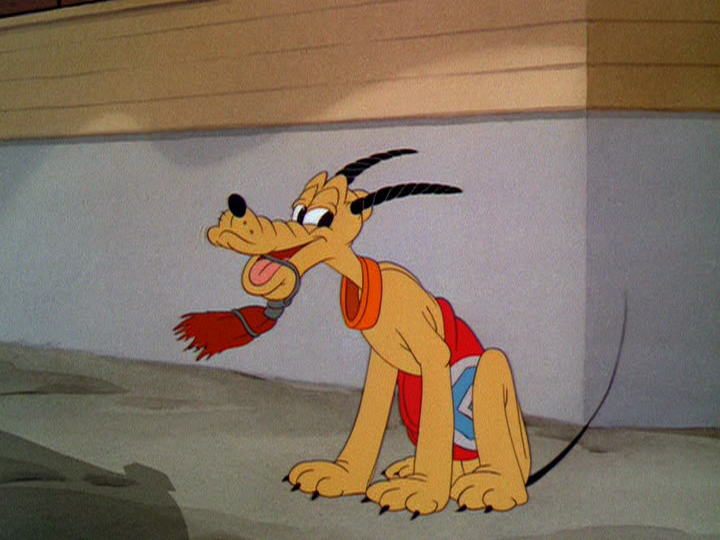
Pluto disguises himself as Gunther the Goat

Thinking this is his chance to grab a juicy steak, Pluto sneaks into the base and peers around Gunther’s pen. Ever so quietly, Pluto closes Gunther’s door, and disguises himself as the mascot right before the truck stops by. Pluto opens his mouth in anticipation of a morsel of meat, only to be thrown an avalanche of tin cans.

Hearing the noise, Gunther pokes two holes in his door with his horns and peeks out at his surroundings. He sees Pluto angrily kicking the cans, and steps out to confront the dog. As he bears down on Pluto, the dog flees, trying desperately to keep away from the goat’s horns. The goat marks his target and gives Pluto a mighty headbutt into the fence; after knocking him there like a paddleball, he then sends Pluto flying out of the camp.

Pluto, to impress the soldiers, grabs the plug of tobacco left on the bench

Pluto is then seen limping around the camp, when a soldier calls out for Gunther to have some chewing tobacco. Pluto’s eyes literally turn green from jealousy, but he’s soon excited when he sees the leftover tobacco sitting on a bench after Gunther has walked away. He prances out in front of the soldiers, grabs the entire plug of tobacco, and chews, much to the amazement of the troops. When one cries out that Pluto is better than Gunther, the goat is startled awake and looks out angrily to see Pluto chewing calmly. Furious, the goat headbutts Pluto, who swallows the plug.

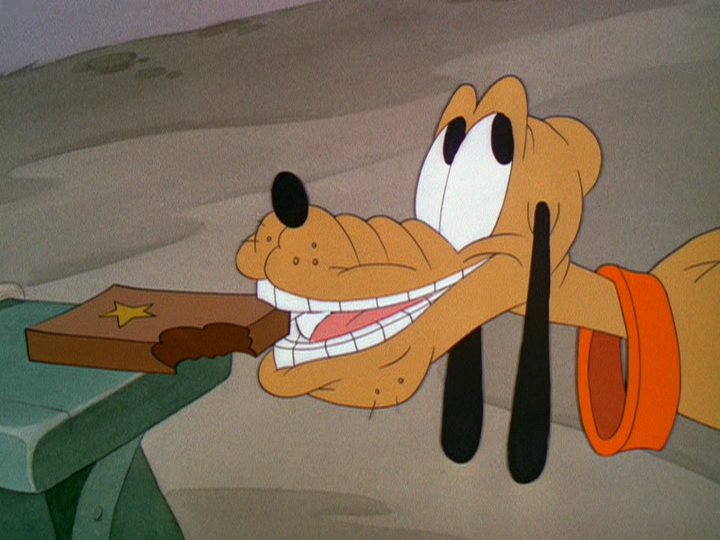
Poor Pluto begins to feel ill and stumbles around the camp, turning colors and patterns as he hiccups. The goat, not satisfied yet, props up Pluto, and gets ready to propel the pup into a tent full of explosives. Pluto drops at the last possible second with Gunther flying full speed ahead into the explosives tent. The blast sends Gunther sky high, where he holds tight to the front of a plane as it flies off into the distance. With Gunther heading overseas, this leaves an opening for a mascot, one that Pluto is happy to fill. Pluto steps out of his doghouse, saluting the officers, before receiving what he’d been craving: a nice, juicy ham. He tears into it eagerly, giving the audience a smile.

May 21

Posted on

May 21, 1948 – The Donald Duck Short Film Donald’s Dream Voice Premieres in Theaters

“I can talk…I can talk! I can talk! Oh, boy! I can talk!”

On May 21, 1948, the Donald Duck short Donald’s Dream Voice was released to theaters. It was directed by Jack King, with a story by Roy Williams, and features Clarence Nash as the voice of Donald Duck, Leslie Denison as the suave voice of Donald Duck, and Ruth Clifford as Daisy Duck. The suave voice of Donald is a case of topical humor; he sounds like screen actor Ronald Coleman, who was very popular with audiences of the ’40s.

The short begins with Donald going door to door, peddling brushes. At the first door, the owner of the house tells Donald that he can’t understand him, and demands that he leave, which makes Donald angry, but he lets it dissipate before he knocks on the door of the next house. Unfortunately, the lady of the house hears Donald and slaps him for “using such language in [her] presence.”

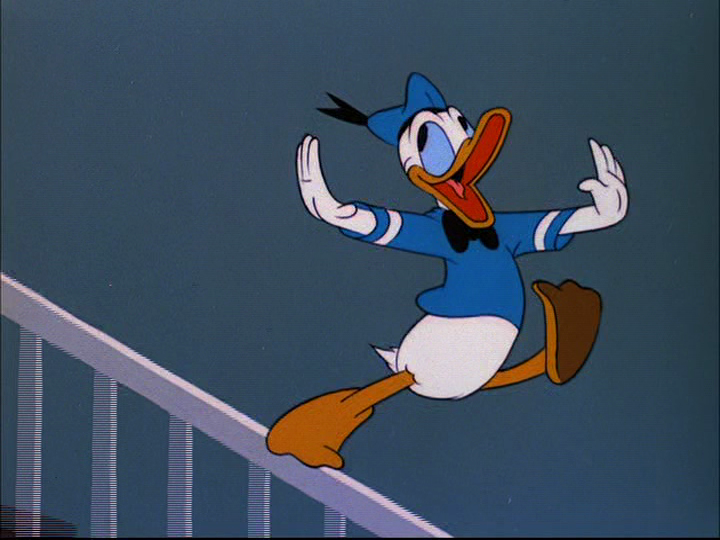
Donald is elated at the support that he receives from Daisy

Donald is next seen looking rather defeated at Daisy’s house, but she insists that he not give up, as she has faith in him. She kisses him and encourages him to try again, and Donald excitedly cartwheels out of the house, determined once more to try. Again, much to Donald’s dismay, he is misunderstood and sent packing by the owner of the house. Humiliated and angry, Donald continues to walk the city streets, until he passes a peddler selling “voice pills” for only 10 cents. Donald doesn’t believe it, but is willing to try anything once, so he buys a box.

Donald tries a pill, and instantly, his voice changes to sound like Ronald Coleman. Shocked, he tests it out a bit before bursting into rapturous praise. He begins to rush home to tell Daisy, when he decides to instead go sell his brushes, come home to her as a success, and ask her to marry him – although the pill wears off before he can actually state the last part of his plan. Popping in another pill, he completes the statement.

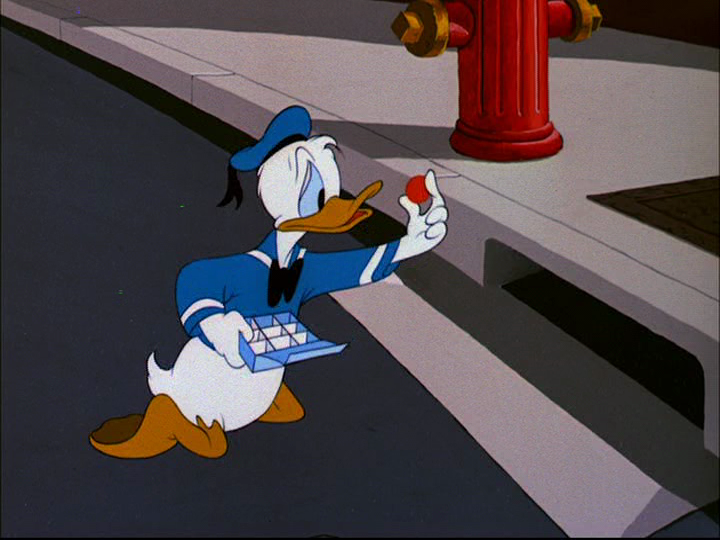
Donald holding the only pill he managed to save

With his new voice, Donald approaches a house, where the woman who lives there remarks on his fine, forceful voice and she can’t help but buy several brushes. Suddenly, several hands appear waving money, wishing to buy brushes from the duck with the amazing voice. Donald then runs home, popping in another pill as the other one wore off. As he runs, he trips on the sidewalk, and the pills pop out of his pocket and fly into the sewer, save for one that Donald manages to retrieve. With only one left, he decides he has to save it for the moment he proposes to Daisy.

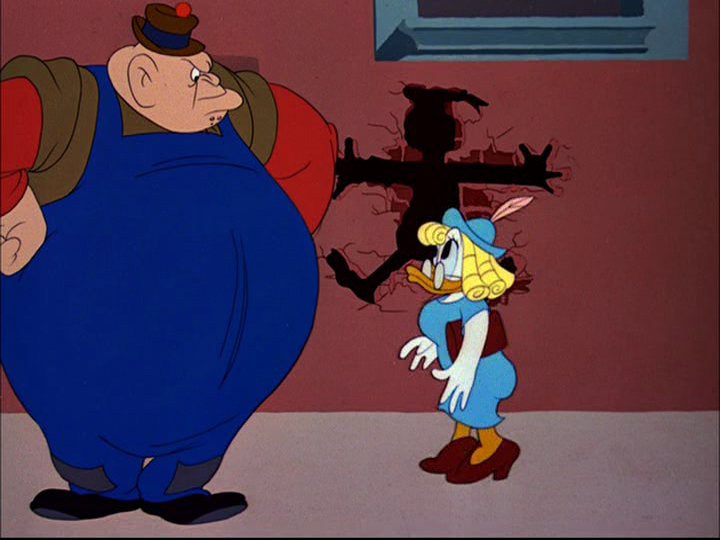
Arriving at Daisy’s house, Donald is ready to ask the question when the pill wears off. Grabbing the last remaining pill, it slips from his hand and bounces down the sidewalk, falling into a sewer hole. A large, thug-like man emerges from the hole, with the pill safely in the top of his hat. Donald follows the man, trying to get the pill, but the man yells at Donald, informing him that he hates people. Donald then tries the approach of grabbing the pill from the man’s hat through a nearby window, but accidentally grabs the man’s nose.

Donald’s last resort when it comes to retrieving his pill

As a last ditch effort, Donald walks by, dressed as a woman, hoping the man will lift his hat in a polite greeting. He does so, and as the pill bounces away, Donald quickly slips down the street and races after the pill as he turns the corner. The pill bounces into a farmyard labeled “no trespassing,” and Donald watches in horror as it slips into a cow’s open mouth. The duck bursts into the fenced in yard and starts screaming at the cow, when the cow, now with the voice of Ronald Coleman, tells him to shut up and that the sign says “no trespassing.” As Donald tries to get the pill back, the cow informs him that he can’t understand a word the duck says, causing Donald to fly into a rage.

May 18

Posted on

May 18, 2004 – The Third Wave of the Walt Disney Treasures is Released

Image Credit: Wikipedia

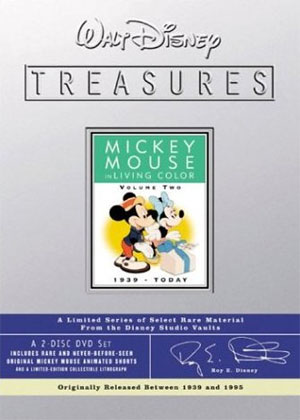
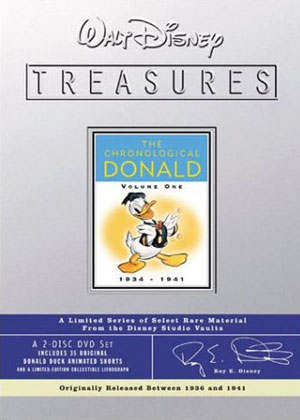
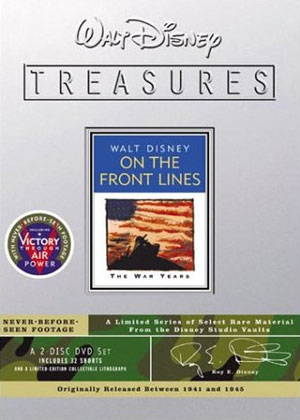
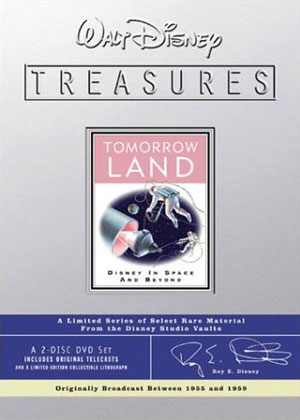
On May 18, 2004, Disney’s video distribution company, Buena Vista Home Entertainment, released the third wave of the popular Walt Disney Treasures. This set included Mickey Mouse in Living Color, Volume Two; The Chronological Donald; On The Front Lines; and Tomorrow Land. Although this wave was supposed to be released in December, as the other two were, the release had to be delayed to meet the demand of the popularity of the sets. As with the other two waves, the third set was introduced by film critic Leonard Maltin, who also provides commentary for the more politically incorrect works, known as the works “In the Vault.”

Mickey Mouse in Living Color. Image Credit: wikipedia

Mickey Mouse in Living Color, Volume Two is the second of the Mickey Mouse color short collections, and the fourth Mickey Mouse collection in all. The first disc gives the shorts from 1939 to the last Mickey Mouse short film in 1953, with bonus features including The Sorcerer’s Apprentice from Fantasia, Mickey and the Beanstalk from Fun and Fancy Free, as well as an Easter egg of Walt Disney performing the voice of Mickey for the short Mr. Mouse Takes a Trip. Disc two shows the modern revival of Mickey Mouse, which includes Mickey’s Christmas Carol, The Prince and the Pauper, and Runaway Brain. The bonus features are numerous on this disc, and include an interview with the voices of Mickey and Minnie (Wayne Allwine and Russi Taylor), an interview with Disney animators Mark Henn and Andreas Deja, and clips from the Walt Disney anthology series that use Mickey as an example of animation techniques.

The Chronological Donald. Image credit: wikipedia

The Chronological Donald is the first set of Donald Duck short films, which begins with the Silly Symphony The Wise Little Hen in 1934 on disc one, and ends with the 1941 short Chef Donald on disc two. The disc one bonus features include a clip from the film The Reluctant Dragon, where the voice of Donald, Clarence Nash, is heard performing with Florence Gill, the voice of Clara Cluck. Disc two includes a mini-biography about Clarence Nash, and how his unusual voice inspired the creation of Donald Duck, as well as another clip from The Reluctant Dragon, where Donald is explaining to Robert Benchley how animation comes to life.

On the Front Lines. Image credit: wikipedia

On the Front Lines is a collection of all the propaganda, educational shorts, and films released when the Disney Studios were taken over during World War II. Disc one includes mostly the short films, including the shorts where Donald is drafted into the army. In the vault, there are four films: Der Fuehrer’s Face (a propaganda film where Donald believes he lives in a land occupied by Nazis), Education for Death (a chilling film based on the book by Gregor Ziemer), Reason and Emotion (a humorous look about how people needed to keep their emotions in check during wartime), and Chicken Little (a horrifying update to the children’s story). Disc two is of the film Victory Through Air Power, which Walt Disney created to send a message to the American people that the war could be won through the use of aviation and long-range bombing. This DVD set is the first release of the film since its rerelease in 1944. This disc also includes some training shorts, behind the scenes documentaries of the film Victory Through Air Power, galleries of insignias and posters created during wartime, and an interesting interview with long-time Disney employee John Hench, who recounts his time at the studio after the attack at Pearl Harbor.

Tomorrow Land. Image credit: wikipedia

The last set in this wave is Tomorrow Land, which pulls together episodes from the anthology series about space and the future, with many of these episodes directed by Nine Old Men member Ward Kimball. The first disc has three episodes: Man in Space, Man and the Moon, and Mars and Beyond. The second disc includes Eyes in Outer Space, Our Friend the Atom, and EPCOT, a look at the Florida Project Walt Disney planned, which was to be a Tomorrowland type theme park. Bonus features include interviews with author Ray Bradbury and long-time employee Marty Sklar, as well as an Easter egg of the Sherman Brothers singing “There’s a Great Big Beautiful Tomorrow” with Walt, as the song was featured at the General Electric Pavilion at the 1964 World’s Fair.

May 15

Posted on

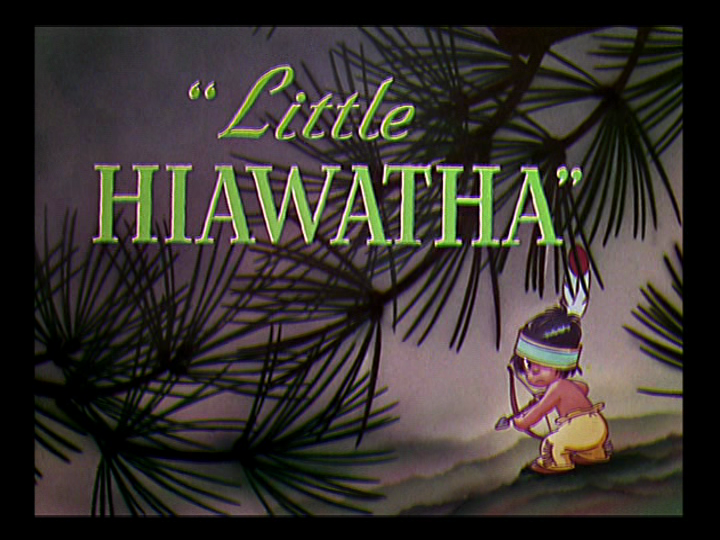
May 15, 1937 – The Silly Symphony, Little Hiawatha, is Released to Theaters

“Mighty hunter Hiawatha. Mighty warrior Hiawatha. Mighty chieftain Hiawatha. Mighty Little Hiawatha.”

On May 15, 1937, the Silly Symphony, Little Hiawatha, was released to theaters. The short was directed by Dave Hand, and distributed by United Artists. Walt once had the idea of turning the story into a full-length feature film, but the idea was shelved, as it never developed the way Walt wanted, story-wise.

The short opens with a small Indian boy paddling his canoe down the river as the narrator begins to tell the story of Little Hiawatha, as if reciting a poem. As birds begin to sing around him, Little Hiawatha grabs his bow and arrow, with the intent to shoot, but loses his balance when the canoe passes through a small bit of rapids, and the birds fly away. He pulls his canoe up to a patch of rocks on the shore and gets out of the canoe, searching for his prey, and ends up falling in the river.

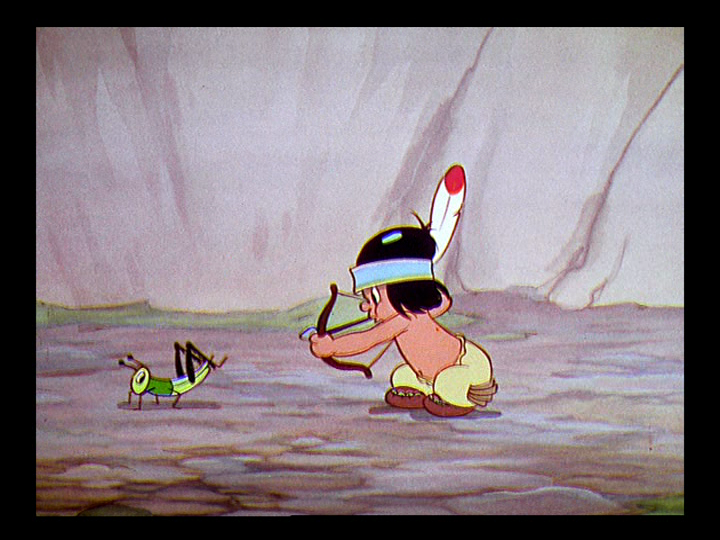
Little Hiawatha begins to track a grasshopper

The animals in the forest spot Little Hiawatha’s fall and begin to laugh. Angered, he pulls out his bow and begins to chase the forest creatures, although the end up taunting him and eluding his capture. He then spots some strange tracks on the ground and, with all the animals watching him curiously, he decides to track the creature, although the tracks were made by a grasshopper instead of anything vicious. Little Hiawatha loses the fight with the grasshopper, causing all the animals to laugh once again.

As Little Hiawatha chases the animals once again, he corners a baby bunny, who stands on a stump, frightened, as the boy begins to cheer. As he draws back his bow, the animals of the forest watch with trepidation, unsure if the boy would actually kill the innocent rabbit. Lucky for the rabbit, Little Hiawatha is touched by the bunny’s sadness, and decides to then duel the rabbit, only the rabbit is too afraid to comply. Annoyed, the boy lets the rabbit get away, much to the joy of the animals in the forest. Angry at his failure, Little Hiawatha breaks his bow and arrow and tosses it aside, but then hears all the animals in the forest cheering. As the boy tries to hide with his shame, he spots bear tracks nearby, and decides to track down the bear.

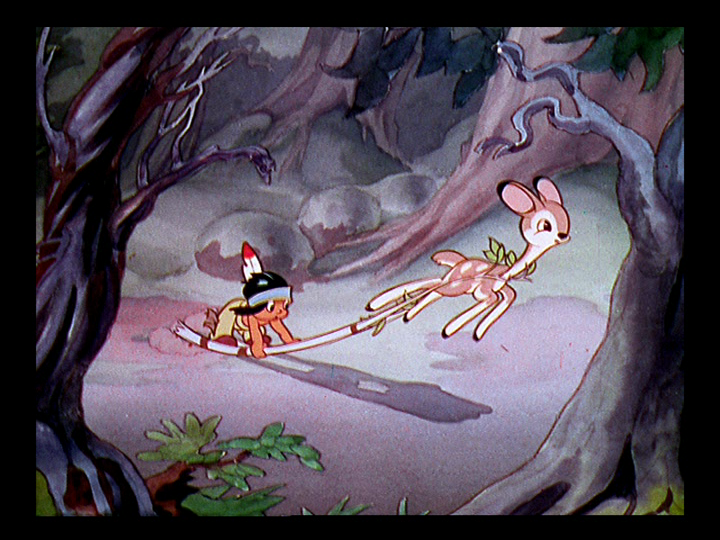
A fawn volunteers his efforts to help Little Hiawatha escape from the bear

As Little Hiawatha is tracking down the bear, a cub crawls out from another side of a boulder, tracking the same tracks. The two run into each other, and flee in fear, but Little Hiawatha turns around to chase the cub, only to run across the mother. He tries to hide from the angry bear, but is almost paralyzed in fear. Three beavers notice that the boy is in trouble and sound out an alarm, causing all the animals in the woods to come to attention. As Little Hiawatha does his best to flee, the animals step in to help as best they can. In the end, Little Hiawatha stopped wishing to hunt the animals, but became their friend instead.


May 12

Posted on

May 12, 1932 – The Mickey Mouse Short Film Mickey’s Revue is Released to Theaters

On May 12, 1932, the Mickey Mouse short Mickey’s Revue was released to theaters. It was directed by Wilfred Jackson. This short is best known as the first appearance of the character of Dippy Dawg, who would evolve into Goofy; he is recognizable in this short by his peculiar laugh, which was provided by Pinto Colvig.

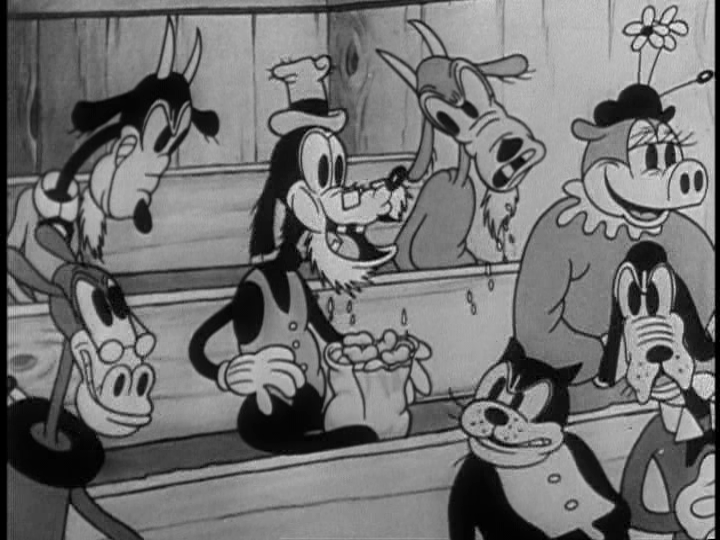
The first appearance of Dippy Dawg, later known as Goofy, annoying the audience members around him

The short opens in a theater, where the orchestra is in the middle of a song, with Mickey at the helm as the conductor. As the piece reaches a dramatic part, an audience member (Dippy Dawg) loudly cracks open peanuts and eats with his mouth open, to the annoyance of the other members of the audience surrounding him.

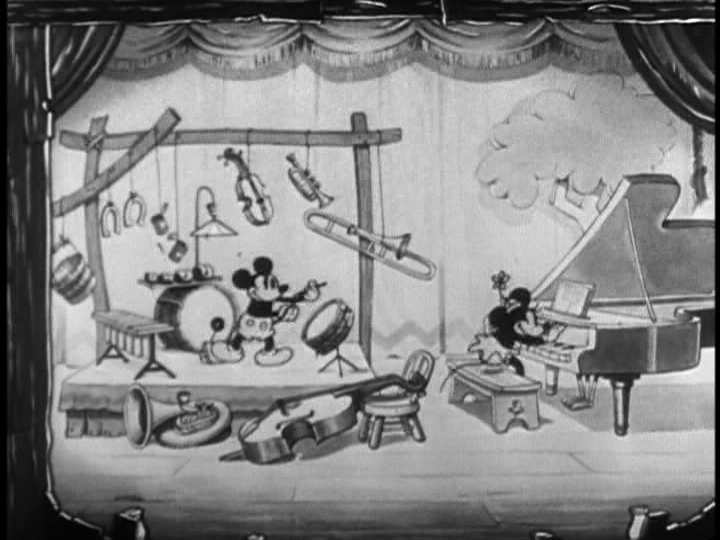
The curtain opens, revealing three actors dressed as flowers, and Minnie tied to a rope, floating as she plays the part of a fairy, while Horace Horsecollar holds her from a fishing rod in the rafters. Minnie taps an actor, who stands up, revealing herself to be Clarabelle Cow. On the other side of the stage, Pluto sneaks on, sniffing the dancer. When the dancer pushes him away, he begins to bark until a hook yanks him off the stage. Dippy Dawg begins to laugh loudly from the audience, again annoying all those around him.

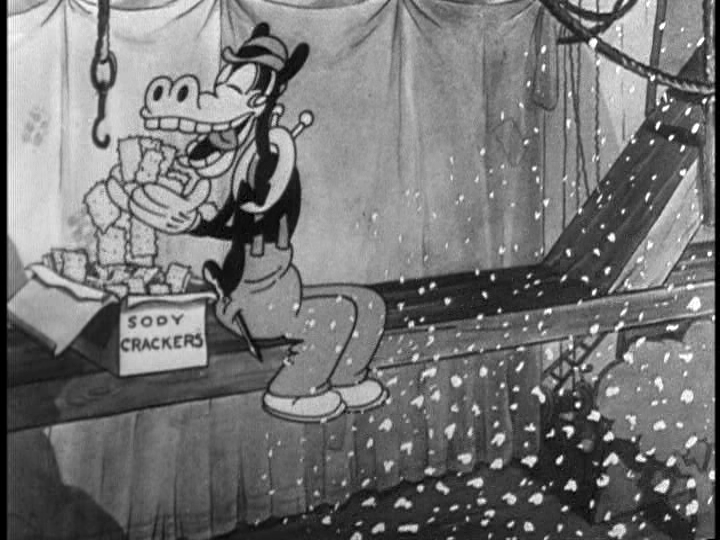
Horace demonstrating how he makes his stage snow

Mickey continues to conduct as the cow dancers begin their ballet. A loud crashing noise sounds, as the band members and stage hand Horace create a storm for the piece. The cow ballerinas look around at the “snow,” then begin to ice skate around the stage (although it is revealed to the audience that the “snow” is just soda crackers Horace chews up and spits out across the stage). As the dancers skate offstage, Pluto is seen crawling on stage, hot on their trail, but is quickly retrieved and pulled off stage.

The curtain falls and the audience applauds wildly before the next act begins. Two dogs begin a rather comical tap dance. As it ends, Pluto is once again seen trailing something, only this time he’s on the trail of a bug, until a lasso appears and pulls him away. Dippy Dawg begins to laugh his peculiar laugh again, but this time, the fed-up audience members hit him over the head with a hammer, knocking him out cold. The two main conspirators begin to laugh in the same manner that Dippy Dawg did, much to the surprise of the rest of the peanut gallery.

Mickey and Minnie in their grand performance

The curtain opens again to reveal Mickey in a “one-man-band” kind of show, with Minnie accompanying him on the piano. As they play, a family of kittens that has been living under the stage pops out through holes in the floor and begins to play with the instruments, making it livelier than before. Horace has Pluto tied up in the back while he reads a magazine, and Pluto begins to whine, wishing to explore the stage. Seeing the kittens, he leaps forward, throwing Horace from his chair, and dives onto the stage. Pluto’s chase destroys the set and instruments, but the audience still applauds loudly thinking it was a great show.

May 11

Posted on

May 11, 1935 – The Silly Symphony, Water Babies, is Released to Theaters

“…it was inspired by the story Water-Babies, written in 1863 by Charles Kingsley, the great English writer and naturalist.” – Walt Disney

On May 11, 1935, the Silly Symphony Water Babies was released to theaters. It was loosely based on the children’s novel The Water-Babies, A Fairy Tale for a Land Baby by Reverend Charles Kingsley, which was published in 1863. The short was directed by Wilfred Jackson. Merbabies, released in 1938, is considered to be its sequel.

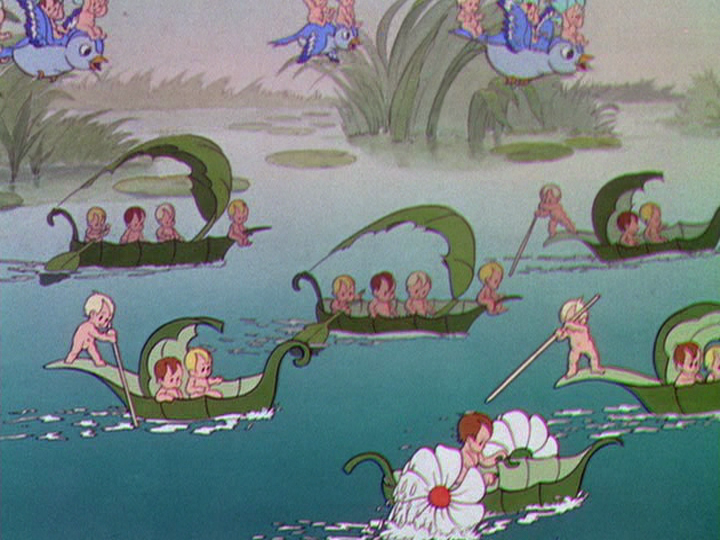
The short opens just as the sun is beginning to rise over a quiet pond. Two birds wake and begin to chirp, flying over the lilypads and trying to rouse the water babies sleeping inside. Once the water babies wake, the jump into the pond and begin to swim away. One baby has decided to remain sleeping, until the flower he’s sleeping in gives him a harsh slap to wake him. With a yawn, and trepidation over the temperature of the water, the baby joins the others as they splash and play around in the pond.

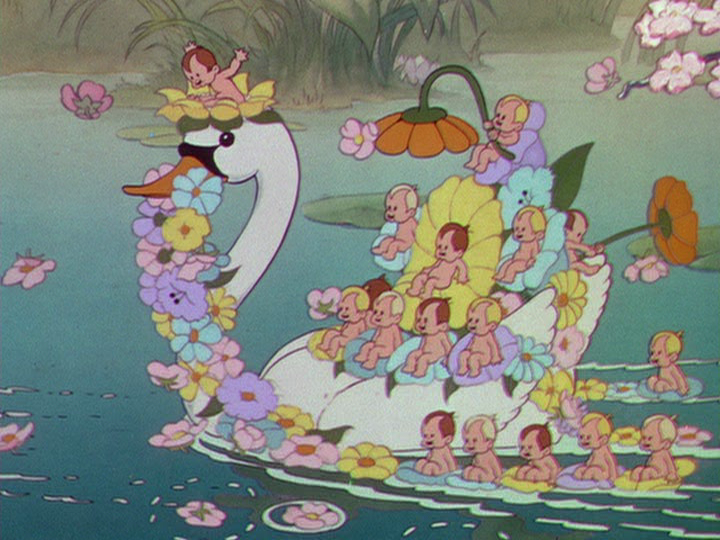
The Water-Babies riding of the back of a swan during a mini parade

As they play, they all hear the trumpets sound and excitedly swim in that direction. A parade has begun, with babies playing flower trumpets and ride on the backs of turtles and swans. Some travel on leaves, and a trio is seen riding on fish. The festival leads the babies to a patch of land where they begin to play in the weeds and with the frogs that live there. Three babies are seen using a spiderweb as a trampoline, and another trio are seen riding bullfrogs as if they were at a rodeo.

Another baby is seen preparing for a bull(frog) fight, pulling down a red petal to use as the red flag. The bullfrog gets his head caught in a flower, and uses the stem as a horn to try and attack the baby. Luckily, the baby sneaks back into the bullfrog’s cage before it can attack him.

All the Water-Babies heading home after the day’s festivities

The trumpets sound again soon after the fight finishes, and the babies all head back to the pond to travel home at the end of a long eventful day. As the sun begins to set, the babies crawl into their lilypad beds after saying their prayers, and quickly fall asleep as the flower petals close up protectively, leaving the audience with a beautiful moonlit night on the pond.

May 9

Posted on

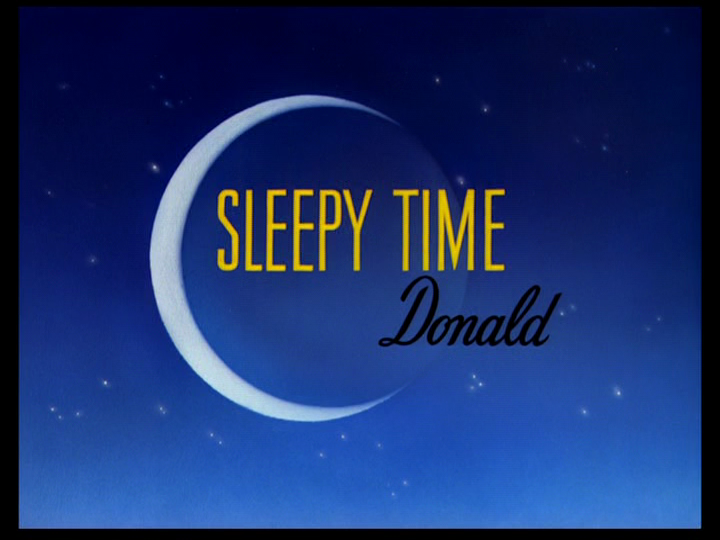
May 9, 1947 – The Donald Duck Short Film, Sleepy Time Donald, is Released to Theaters

“I must humor him. I mustn’t wake him, or it would be fatal.”

On May 9, 1947, the Donald Duck short film, Sleepy Time Donald, was released to theaters. The short was directed by Jack King, with story by Roy Williams, and starred Clarence Nash as the voice of Donald Duck, and Gloria Blondell as the voice of Daisy Duck. This is one of those rare shorts that, while Donald’s name is in the title, Daisy gets more of the starring role, with great results.

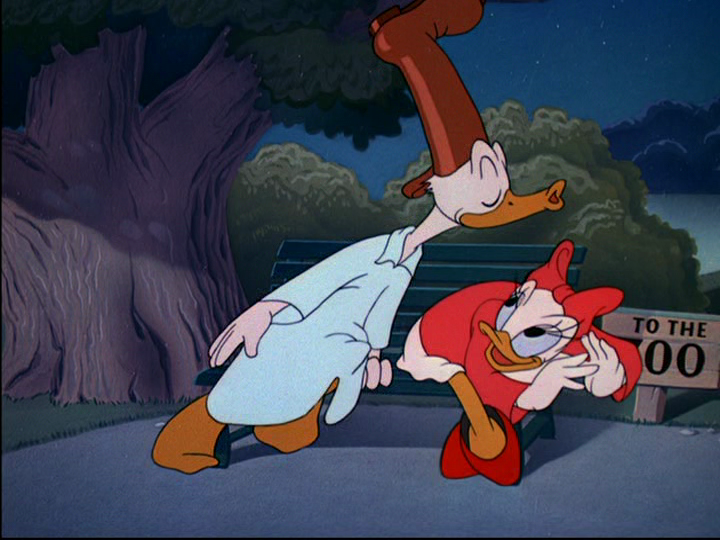
The scene opens with Donald fast asleep in his suburban home, when suddenly he rises from his bed, places a boot on his head, and sleepwalks to Daisy Duck’s house. Daisy wakes up, alarmed, but becomes puzzled when Donald walks right past her and out the other door, only to turn around and ring the doorbell. Daisy leaps out of bed and throws on a date-night outfit before answering the door for her “date.”

As Donald tries to kiss Daisy, she begins to play hard-to-get

Deciding that she needs to “humor” Donald, she opens the door and greets him, and Donald asks if he’s on time for their date. Daisy giggles as she reassures him he is, and then she is seen being escorted to the zoo. There’s a moment where she wonders if he’s going to kiss her, and she ducks when he tries to, and begins to play hard to get with him. She tricks him into kissing a tree branch, with Donald thinking it’s her arm. He then slips an engagement ring on the branch, with Daisy swooning at his romantic gestures. As he lets the branch go, the ring catapults into the monkey’s pen, with the female monkey giving the male a big kiss. Unfortunately for her, Daisy slips the ring away from the pair, causing the female monkey to deck the male.

Daisy admires the ring on her hand, noticing just a bit too late that Donald has sleepwalked into the lion’s cage, narrowly missing being eaten. After the zoo, Donald walks up the side of a building, with Daisy watching in horror on the ground. She calls out his name, and he only motions for her to join him. She tells him that her way is the shorter way; he shrugs and decides she’s right, although he continues to walk on the side of the building as they continue down the street, with Daisy trying to prevent him from getting into trouble as best she can.

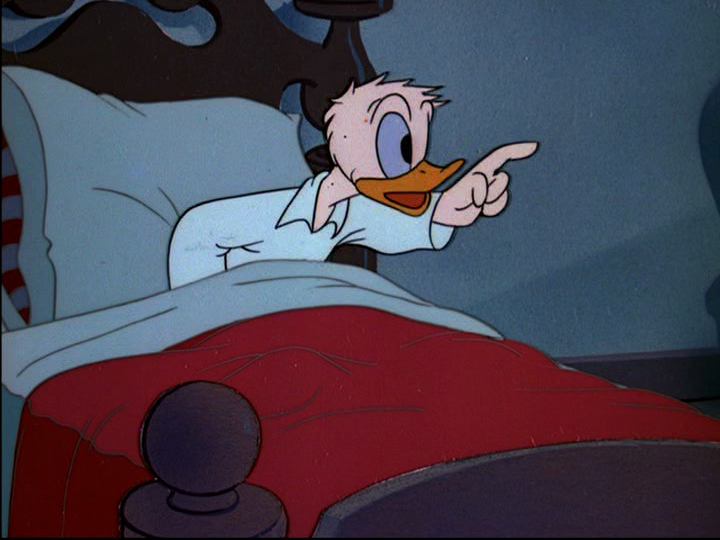
Donald wakes and accuses Daisy of sleepwalking

Donald continues his sleepwalking by walking straight into traffic. Daisy flips the traffic sign to a stop so Donald won’t get hit by a car, causing a massive pile-up. Finally, she decides to make him think that they’re boarding a boat as she leads him back to his house and gets him back into bed. As she tries to slip out, Donald wakes up and accuses her of walking in her sleep. She argues with him that she has not been walking in her sleep, but Donald laughs, until Daisy hits him over the head with his boot, causing him to sleepwalk back into bed and fall fast asleep.

May 6

Posted on

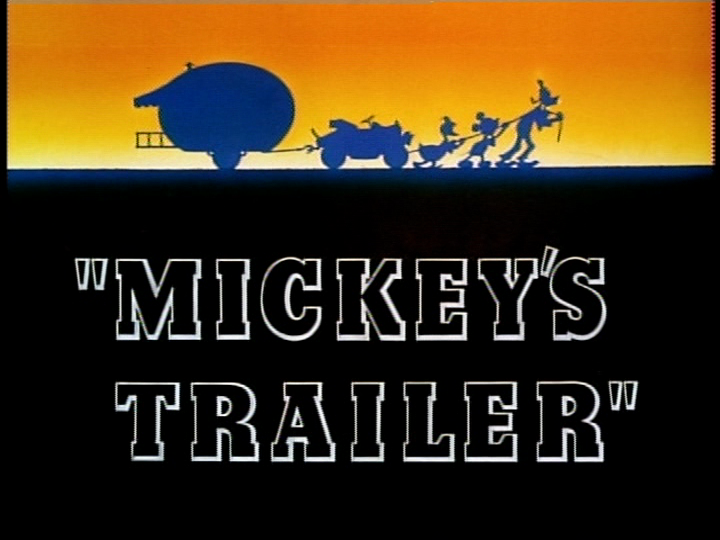
May 6, 1938 – The Mickey Mouse Short Film Mickey’s Trailer Premieres in Theaters

“The worst is over – it’s all downhill from here!”

On May 6, 1938, the Mickey Mouse short Mickey’s Trailer was released to theaters. The short was directed by Ben Sharpsteen, and stars Walt Disney as the voice of Mickey Mouse, Clarence Nash as the voice of Donald Duck, and Pinto Colvig as the voice of Goofy. The short features many mechanical gags that are reminiscent of the early Mickey Mouse shorts.

The audience first sees Mickey’s trailer, in front of a picturesque background of the mountains. The door opens, and Mickey steps out in his nightgown, excited at the prospect of a beautiful day. He pulls a lever next to him, and the whole trailer begins to rattle as he goes back inside. Suddenly every bit of the trailer, from the white picket fence to the “lush green lawn”, folds back into the trailer. A car rolls out of the side, with Goofy sleeping in it; He awakens and slips into the front seat and gets ready to drive. The “picturesque” scenery folds up behind them and slips into the trailer, leaving behind a view of the city dump, with some refineries for good measure in the distance.

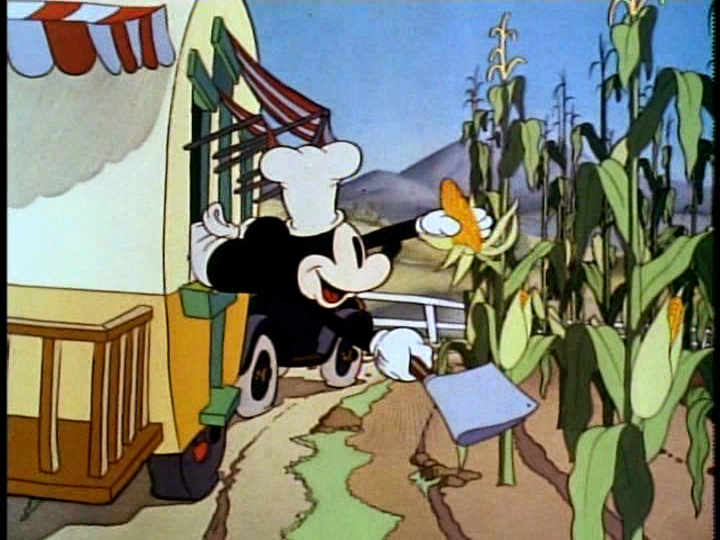
Mickey snatching some corn from a nearby field

As Goofy drives the trailer on a dirt road, he begins to sing “She’ll Be Comin’ Round the Mountain.” Inside the trailer, Mickey begins to fix breakfast, grabbing water from a nearby waterfall for the coffee, cutting some corn from nearby stalks, and, with Goofy tempting it with some hay, getting some milk from a wandering cow. Also inside the trailer is Donald, fast asleep on the top bunk. The alarm clock goes off, which is rigged to pull away his covers and force him to get up. Slowly he tries, but ends up falling back asleep. Mickey, from the kitchen, pushes a button, which turns the bedroom into a bathroom, and Donald excitedly enters the bathtub and begins to sing a nonsensical song as some robins watch at the window.

Mickey pushes another button, and the bathroom becomes a dining room, and Mickey sounds the alarm for breakfast. Goofy leaves his post as driver to get his food – with the car driving into an area marked with a “road closed” sign. As the car stumbles over several bumps in the road, each bump makes part of Goofy’s breakfast disappear. He watches Mickey and Donald enjoy their corn on the cob, and as he reaches for a cob, he accidentally sticks his fork in a light socket, which pops all the kernels from the cob. So he has popcorn for breakfast.

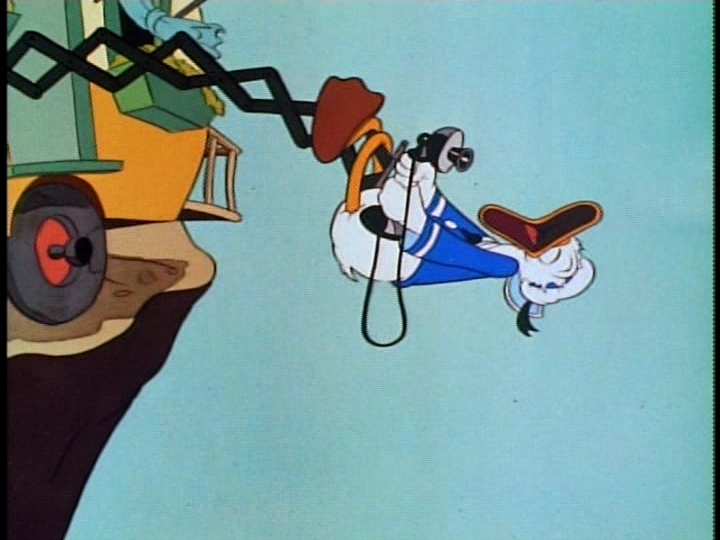
Donald clings to the phone for dear life as he is projected through the window

Mickey finally notices that there is nobody in the car, and turns to Donald, asking who is driving. Goofy responds that he is, and it suddenly dawns on him that he should be in the car driving. When he dives out the window to get back in the driver’s seat, he unwittingly knocks the connector loose from the trailer, sending Donald and Mickey flying the other way on the perilous path. Inside, the pair are knocked about as they continue sliding backwards on the one-way path. A truck slowly climbs its way up the mountain pass, but they fortunately miss it as the trailer uses the fence as a track. Donald tries to use the phone to call for help, only to have to cling to it for dear life as he is outside the window.

Just as the two think they’ve avoided trouble after a curve, they hear the sound of a train, and look out to see it fast approaching the bridge. Donald’s kneels to pray. They narrowly miss the train as they cross the bridge; both breathe a sigh of relief, only to see that they’ll be coming across it again, and again they narrowly miss it. As they fall off a curve and fly down the side of a mountain, they luckily get connected to the car again. Goofy informs them that he got them down safe and sound, unaware of the adventure they had without him.

May 3

Posted on

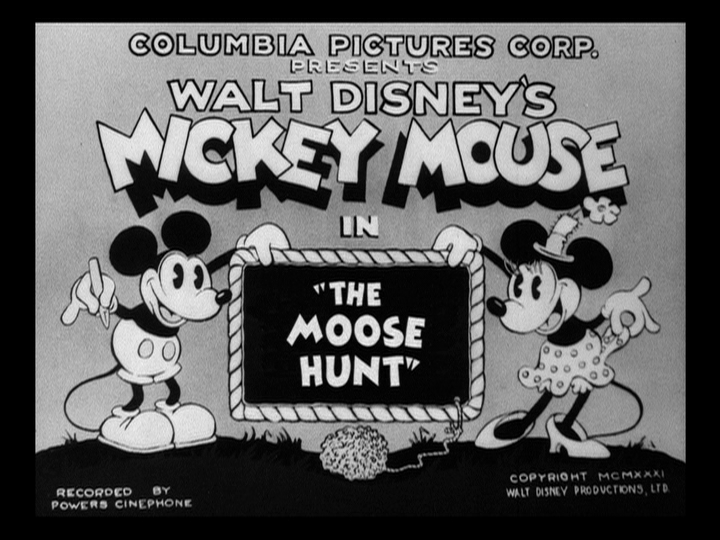
May 3, 1931 – The Mickey Mouse Short The Moose Hunt is Released to Theaters

“Old pal, old pal! What have I done? Oh, what have I done?”

On May 3, 1931, the Mickey Mouse short film The Moose Hunt was released to theaters. It was directed by Burt Gillett, and starred Walt Disney as the voice of Mickey, and Pinto Colvig as the voice of Pluto. This is the first film where Pluto is known by his name.

The short opens with Mickey and Pluto walking in the woods, with Mickey toting a shotgun and whistling “She’ll Be Comin’ ’Round the Mountain.” He trips over a rock, making the shotgun go off, but it doesn’t stop him from dancing down the path. He ends up falling into some tall grass, startling some birds that fly to safety in a tree. When he shoots at the tree, the only thing he’s able to hit are all the leaves. The birds sit safely, singing his song back to him.

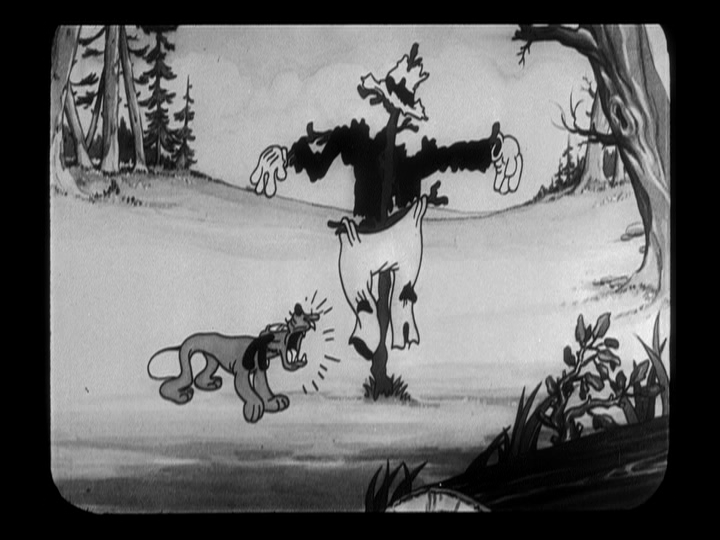
Pluto versus the scarecrow

Pluto, meanwhile, wanders away from Mickey, following a flea that he scratched off. When he comes across a scarecrow, the dog is frightened, and begins to bark at it. When he’s hit by one of the pant legs, Pluto takes off in fear, but ends up sneaking back to sniff and study the scarecrow again. One of the scarecrow’s gloves falls off and lands on Pluto’s tail, startling him and sending him scurrying off in a frenzy.

As Mickey is walking along, Pluto runs up behind him and pushes past, causing the shotgun to go off again as Mickey flies into the air. Pluto ends up flying into a river, with all the fleas he had abandoning ship, only to return once Pluto climbed up onto dry land. He ends up groveling back to an angry Mickey, who glares at him, tapping his foot. The mood quickly changes when Mickey asks Pluto to perform tricks. Mickey grabs a stick and begins to play fetch with Pluto, but unfortunately throws the stick into a pile of branches, and Pluto has to guess which one is the right one. The one he picks, however, makes him look like he has antlers.

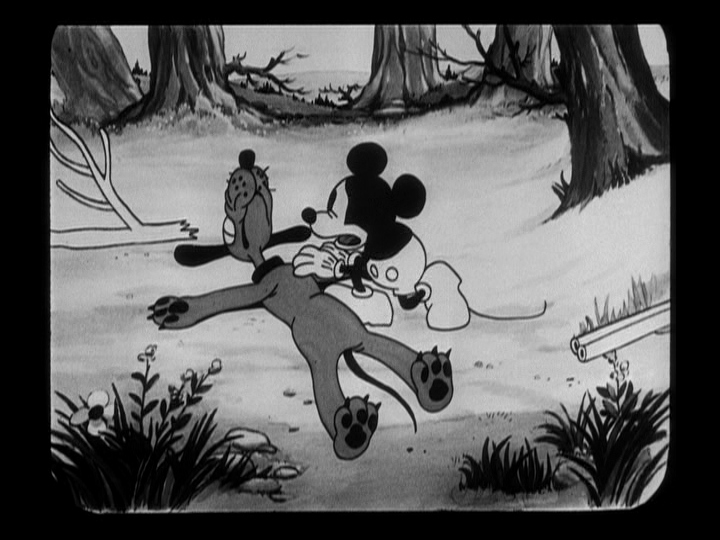
Mickey mourns over the body of his pal, thinking he’s killed him

As Pluto races back to his master, Mickey sees his shadow through the trees, and gets excited. He aims and fires twice, and a loud whimper is heard. As Mickey runs to see his kill, he stops, shocked, observing that the “moose” he shot was in fact his dog. Mickey cries over the body, but the audience sees that Pluto is just pretending to be dead, and he winks at the audience. As Mickey pleads for his dog to be alive and say something, Pluto “revives” and says, “Kiss me.” He then barks, and Mickey happily hugs his friend.

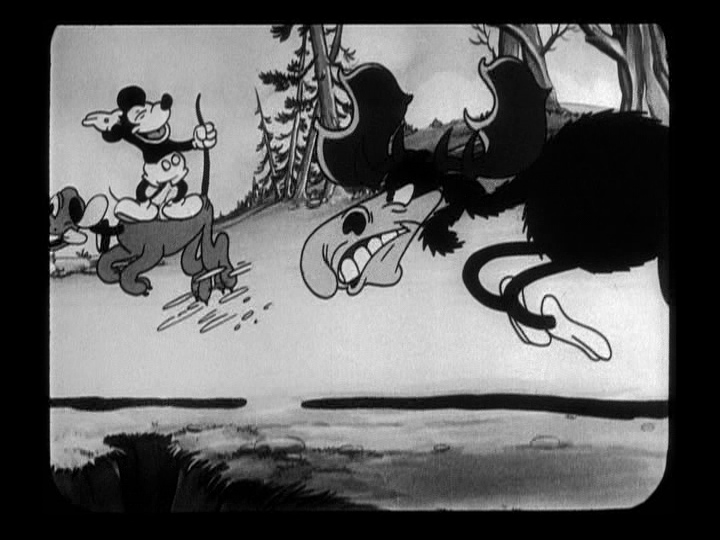
The mood is broken, however, when Mickey hears the call of a moose, and tells Pluto to be quiet. The two carefully sneak along, and Pluto tries to sniff the moose out. Circling around what he thinks are trees, the camera zooms out to show the audience that Pluto has, indeed, found the moose. Continuing to find the scent, Pluto keeps walking, unaware that the moose is copying him and following closely behind. The strange trio is then seen together, with Pluto following Mickey, and the moose following Pluto.

Mickey and Pluto fly away to safety from the clutches of the angry moose

Pluto finally gets the feeling that something strange is going on, and turns to see the moose, causing him to jump in fear. He taps Mickey to get his attention, but Mickey just rebuffs him. Finally, he turns and tries to shoot, only to have his shotgun break into pieces. Mickey and Pluto begin to run for their lives as the moose pursues them, and the day is saved when Pluto uses his ears to help the duo fly away to safety.