RSS Feed

Tag Archives: Pixar

July 15

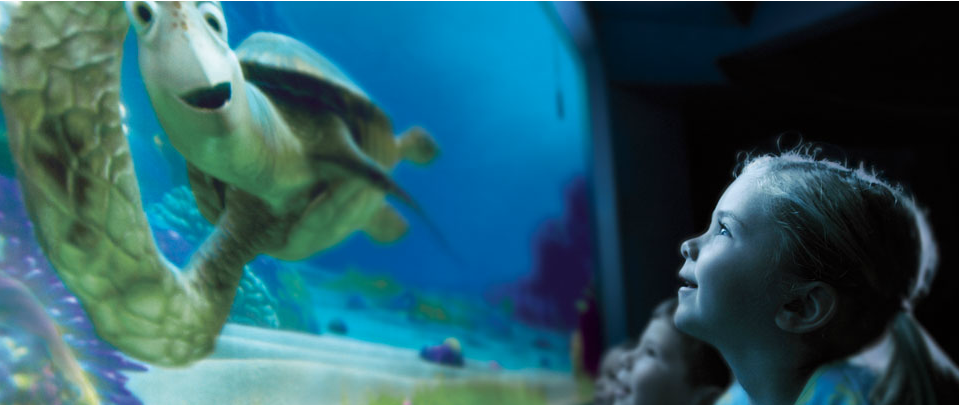
July 15, 2005 – The Turtle Talk with Crush Attraction Opens at Disneyland

Image Credit: Official Disneyland Website

“Have an in-depth chat with Crush, the totally awesome sea turtle from the Disney-Pixar film, Finding Nemo.”

On July 15, 2005, the interactive attraction Turtle Talk with Crush opened in Disney’s California Adventure’s Hollywood Land. The Disneyland version was based on the Walt Disney World attraction that opened on November 16, 2004. The attraction allows guests to have an improvisational conversation with Crush, the sea turtle featured in the Disney-Pixar film Finding Nemo. Guests enter a movie-theater styled room, with children being allowed to sit on the carpet up front for a better view. A moderator gives a brief introduction, and helps Crush to select audience members to chat with. Brief cameos of other Finding Nemo characters may appear during the attraction.

The attraction is a blend of computer animation, image projection, and improvisation, with real-time animation used for the live conversations. Each show is unique, as Crush communicates directly with the audience members; Crush is even able to pick out children to converse with by calling them out by what they wear. The attraction has become popular enough to warrant a copy in Tokyo DisneySea, and the Disney Dream’s Animator’s Palate restaurant.

June 17

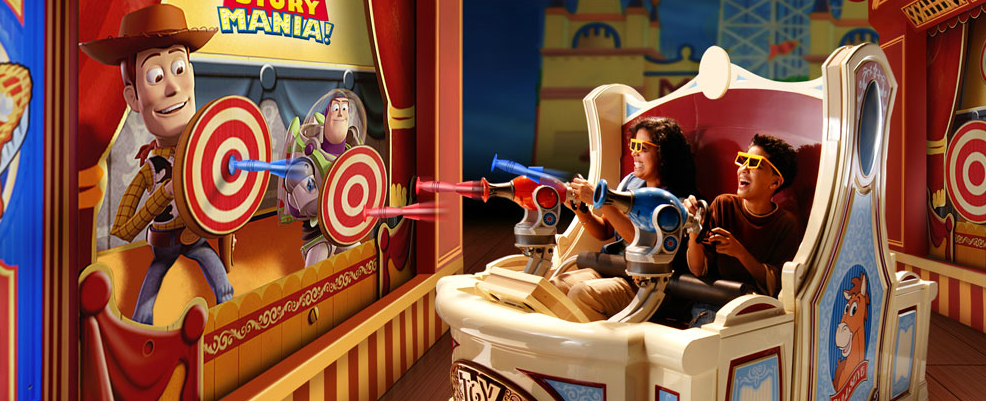
June 17, 2008 – Toy Story Midway Mania Opens at Disney’s California Adventure

Image credit: Official Disneyland Website

 “Andy’s got some new games and the toys are taking over!”

 On June 17, 2008, the Toy Story Midway Mania attraction opened in Disneyland’s California Adventure Park in the Paradise Pier area. This was the first time that an attraction was designed and built at both American parks simultaneously. It is one of the most technologically sophisticated attractions built by Disney Imagineers: guests never have the same ride twice due to the nature of the attraction.

Guests wear 3-D glasses and travel through environments based on carnival midway games. There are five games in total in this attraction. After a practice game, where guests practice how to shoot with Woody and Rex, guests participate in “Hamm & Eggs” hosted by Hamm, followed by “Rex and Trixie’s Dino Darts,” “Green Army Men Shooting Camp,” “Buzz Lightyear’s Flying Tossers,” and “Woody’s Rootin’ Tootin’ Shootin’ Gallery.” There are also chances for guests to unlock “Easter eggs,” which reveal new targets for more points. The attraction is also notable for the Audio-Animatronic Mr. Potato Head, voiced by Don Rickles; the character is one of the most sophisticated in terms of technology, as it is able to identify people in the audience, sing, and tell jokes.

June 11

June 11, 2007 – The Finding Nemo Submarine Voyage Attraction Opens

Image Credit: Official Disneyland Website

“Immerse yourself in the world of Disney-Pixar’s Finding Nemo on this fascinating submarine voyage!”

On June 11, 2007, the Finding Nemo Submarine Voyage attraction opened at Tomorrowland in Disneyland. It is a redesign of the Submarine Voyage attraction, which closed in 1998. Guests board the Nautical Exploration and Marine Observation Institute’s research submarine (known as N.E.M.O.), and are able to look out portholes to see a newly erupting volcano and a stunning underwater environment. One of the first views that will delight fans of the movie Finding Nemo is the dentist’s niece Darla swimming around in the coral, holding a baggie containing a fish.

In 1998, after the original Submarine Voyage was closed, it was reported by Paul Pressler, Disneyland’s president at the time, that the ride would be redone with a new theme by 2003. After the box-office failure of Atlantis: The Lost Empire, plans to use that film as the theme were shelved. The success of the Pixar film allowed the attraction to be rebuilt with the Finding Nemo theme.

There’s something for guests above and below the water. Under, guests can put on “sonar headphones,” giving them the ability to hear the fish chatter among themselves, especially as the guests follow Marlin on his search to find Nemo. Onshore, the seagulls from the movie perch on a nearby buoy, shouting their familiar call of “Mine! Mine! Mine!” Guests can also watch the voyage on the “SubCam,” manned by a member of the N.E.M.O. Institute.

May 29

Posted on

May 29, 2009 – The Pixar Film Up is Released to Theaters

“My name is Dug. I have just met you and I love you.”

 On May 29, 2009, the Disney Pixar film Up was released to theaters. The film was Pixar’s 10th film, and the first released in 3D format. The film holds the distinction of being the first animated film shown at the Cannes Film Festival, as well as the second animated film ever nominated for the Best Picture Academy Award. The film won the Academy Award for Best Animated Feature, and Best Score. Up was directed by Pete Docter, with story by Docter, Bob Peterson, and Thomas McCarthy, and stars the vocal talents of Ed Asner (Carl Fredericksen), Christopher Plummer (Charles Muntz), Jordan Nagai (Russell), and Bob Peterson (Dug). As usual, Pixar’s lucky charm, John Ratzenberger, has a small voice role in this film.

The film tells the story of Carl Fredericksen, which begins with him as a shy boy whose hero is legendary explorer Charles Muntz. He watches a newsreel of Muntz, and is inspired to pretend he is having his own adventure when he hears a voice saying Muntz’s famous phrase: “Adventure is out there!” He enters the dilapidated house to see a girl pretending to be Charles Muntz on an adventure. Although a mishap causes Carl to break his arm, the girl, Ellie, comes to visit him, and tells him she likes him, as they bond over a love of adventure and an admiration of Muntz. This leads to a segment showing their lives together after their wedding day until Ellie’s death. Ellie’s death is hard on Carl, especially since he was never able to take her to explore Paradise Falls as they promised.

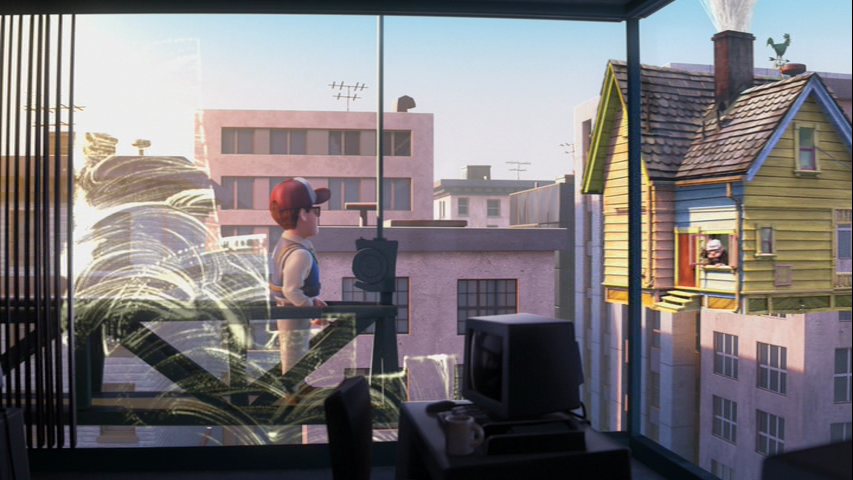
Carl greets a window-washer as his house floats through the city

A while later, all the houses around Carl’s have been torn down for urban development, but Carl refuses to sell. He also runs across a young boy named Russell, who is part of a group called the Wilderness Explorers, and wishes to get his “Assisting the Elderly Badge” by offering to help Carl “cross something,” and Carl tricks him into looking for a snipe. A mishap sends Carl to court, where is ordered to leave his house and live in a retirement home. Unable to bear with parting with his and Ellie’s home, Carl uses his skills as a balloon salesman to keep the promise of the house landing at Paradise Falls: he attaches thousands of balloons to the house, turning it into a makeshift airplane, and Carl sets sail for Paradise Falls. Unbeknownst to him, Russell was hiding under the house at the time of lift-off, and becomes Carl’s accidental co-pilot.

After surviving a severe thunderstorm, the two find themselves in Venezuela, a bit of a ways from the falls. They attach themselves to the still-buoyant house, intending to walk it over to the falls before the balloons deflate. On their way, they encounter a large bird that Russell believes to be a snipe and names it Kevin (although Kevin is a girl), and a dog named Dug, who is able to talk through the use of a device on his collar. Dug has been on a special mission to “capture the bird,” which causes no shortage of trouble between Dug, Kevin and Russell that annoys Carl to no end. There are other dogs in the jungle searching for the bird, and when they run across Carl and his gang, they take him to their master: the one and only, Charles Muntz.

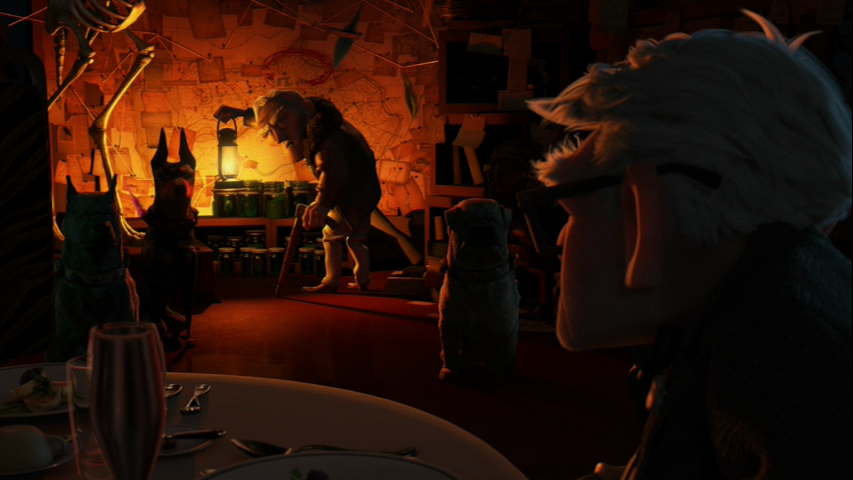
Muntz is determined to get the bird at all costs; his demeanor changes fiercely when he finds that Carl and Russell have seen the bird

Although initially elated that his hero is alive, Carl finds out that Muntz has been driven to almost madness in his search for the bird that will clear his name. Muntz shows Carl helmets of explorers he’s met and killed, convinced they were there at the falls to steal his bird. Upon finding out that Carl has the bird, he decides he will kill Carl and Russell and steal the bird. At one point, Carl has to decide to either save Kevin or save his house, and when he picks to save his house, this allows Kevin to be captured.

Carl finally gets his house to the falls, although Russell is angry that Carl broke his promise to protect the bird. As Carl sits inside the house, he discovers Ellie’s adventure book from when she was a little girl, and finds that she has filled it with memories of their life together, and message thanking him for their adventure, and now he should find a new one. Inspired by her words, Carl resolves to rescue the bird. Russell, still angry, has decided to go on his own to rescue Kevin, and Carl has to rescue him with Dug’s help. There is a fight to the finish between Carl and his childhood hero, with Muntz falling to his death, and Carl’s house falling to the ground, which Carl accepts as for the best, as “it’s just a house.”

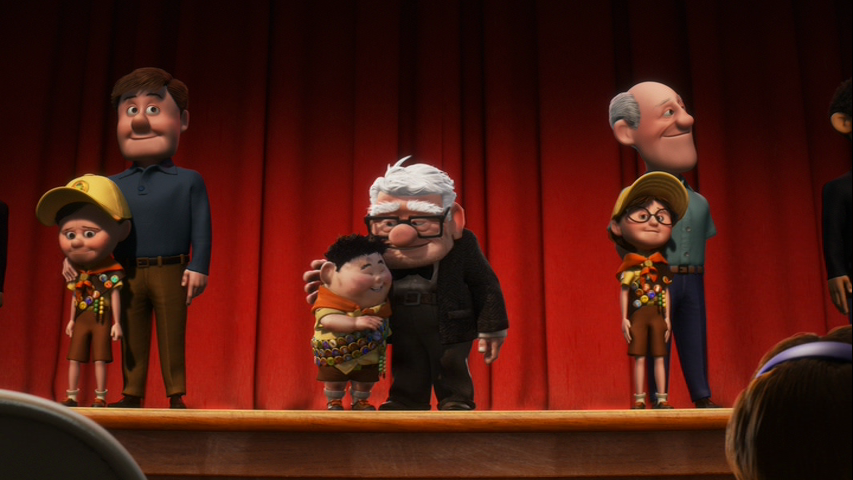
Carl stands with Russell at the boy’s Wilderness Explorers meeting, with Carl becoming Russell’s surrogate grandfather

Kevin is reunited with her chicks, and Russell and Carl head home in Muntz’s airship. At the Wilderness Explorers meeting, Carl is there to give Russell the “Assisting the Elderly Badge,” as well as a very special badge – the grape soda badge Ellie gave to Carl as a child, known as “The Ellie Badge.” After the ceremony, Carl, Russell and Dug sit on the curb at the ice cream parlor, counting cars. The house is seen again as well – landing perfectly next to the falls.

March 30

March 30, 1992 – The Walt Disney Feature Animation Department Wins the Academy Award for the Development of CAPS

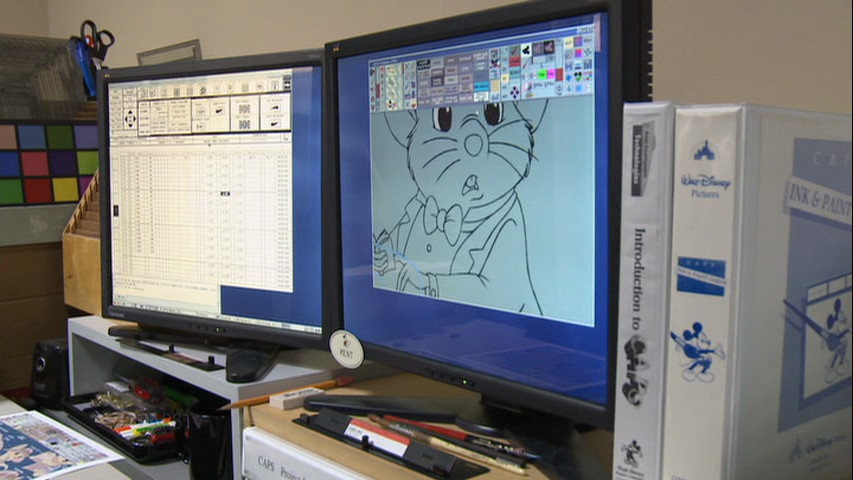
The CAPS System at work

“[CAPS] gives us not only the opportunity to do some really good art, but it also gives us the opportunity to really begin to explore what these computers and graphics things can do for us in kind of shorter pieces where we can get really a little crazy. And I’m looking forward to all of us getting a little crazy.”- Roy Disney

During the 64th Academy Awards ceremony in Los Angeles on March 30, 1992, nine men—Randy Cartwright, David B. Coons, Lem Davis, Thomas Hahn, James Houston, Mark Kimball, Peter Nye, Michael Shantzis, and David F. Wolf—shared an Oscar for a technical innovation developed jointly by the Walt Disney Feature Animation Department and Pixar Studios. Known as CAPS, or Computer Animation Production System, this innovation computerized the ink and paint process of animated films. CAPS allowed the artists to assemble the separate pieces of animation, from the background to the special effects, onto the final film directly. CAPS was first used in an animated feature in the final scene of The Little Mermaid, and was fully used in The Rescuers Down Under.

“One of the technology guys, Lem Davis, thought we could use computers to paint the characters in our films and digitally assemble all the artwork,” Don Hahn said about the CAPS project.

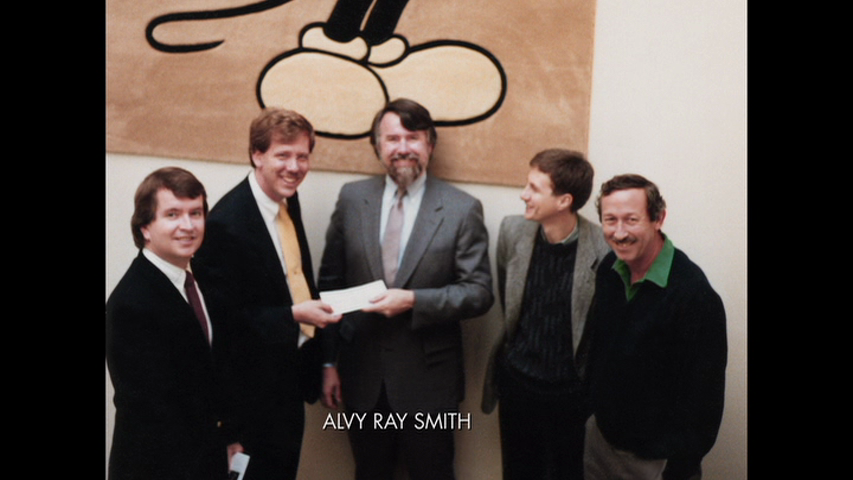
The main negotiators in the CAPS Project

Roy Disney, excited about the opportunity CAPS could give the company, asked Frank Wells, President of the Walt Disney Company, for $10 million to spend on the CAPS program, even though the risk was great, and there was no guarantee of return on the investment. The Disney check went to Alvy Ray Smith, the co-founder of Pixar, the best company to work with when bridging the gap between hand-drawn animation and computer technology. Pixar and Disney employees on the project worked around the clock on the program, with mounting deadlines and quotas. Although The Rescuers Down Under was not a huge success, CAPS received widespread critical acclaim on Beauty and the Beast.

“It was just the basis of what was to come in terms of the 3-D animation process. It was the engine that drove everything else forward,” former chairman Peter Schneider has said about the use of CAPS.

February 24

February 24, 1997 – Pixar and Disney Jointly Agree on the Production of Five Feature Films

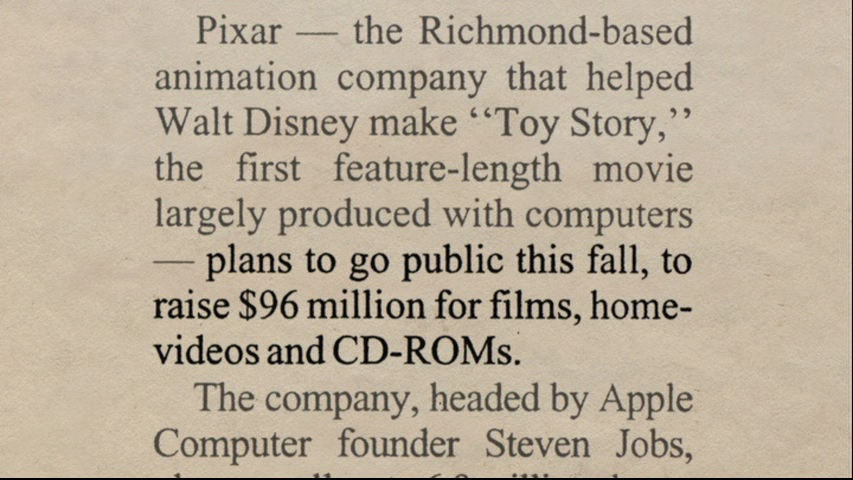
This newspaper article around the time Pixar went public described the reason for the need to become a studio, one that would be addressed in the extended contract

“We got the money in the bank, and then shortly after, Disney came to us and said, ‘We want to extend the contract.’ And Steve [Jobs] said, ‘Okay, we will extend it if we can be fifty-fifty partners.’ And they said, ‘Okay, we’ll do that.’” – Ed Catmull

After the success of Toy Story, which provided more income to the once-struggling Pixar Studios, a new agreement was signed on February 24, 1997, for a new five-film deal. This deal gave Pixar more of an equal share of the assets from their films. This extended deal only served to further prove that Pixar had something amazing to offer Disney and the film industry in general.

When Pixar signed the first three-film contract with Disney in 1991, the studio was cash-strapped and needed the deal, so they had agreed to a 10 to 15 percent share of their films’ profits so that Disney would fully finance the films. This left most of the profits and merchandising with Disney. “Financially, if one film did not do well,” Steve Jobs explained about the first contract, “we would be wiped off the face of the planet.” Jobs began to push Michael Eisner for a new contract a few months after the release of Toy Story, when he was confident in the film’s success both commercially and as a groundbreaking achievement for Pixar. Jobs realized at that point that Pixar needed to become a studio, instead of a production company, and to accomplish this, they would need capital. Their best option was to go public, and Pixar became the highest initial public offering (IPO) of 1995.

The success of Toy Story helped to make Pixar's IPO the highest of the year

Toy Story had given Pixar a massive success, and with the added bonus of their IPO, Pixar was able to co-finance their films, work on getting a higher percentage of the films’ profits, and get the proper credit for their work. Jobs offered Eisner the one bargaining chip he had: more films. Eisner could not say no, and in 1997, Pixar’s Chief Financial Officer, Lawrence Levy, and the similar representative for Disney, Robert Moore, signed a 42-page contract for five feature films (the first one being A Bug’s Life, which was beginning production and still known as Bugs), in which the production costs would be split 50-50, and Pixar would receive 50 percent of the profits, along with home video and tie-in product receipts, and equal advertising with Disney for the films. When Jobs and Eisner announced the extension of the contract, the Pixar stock jumped 50 percent.

February 22

February 22, 2009 – Pixar’s Wall-E Wins the Academy Award for Best Animated Feature

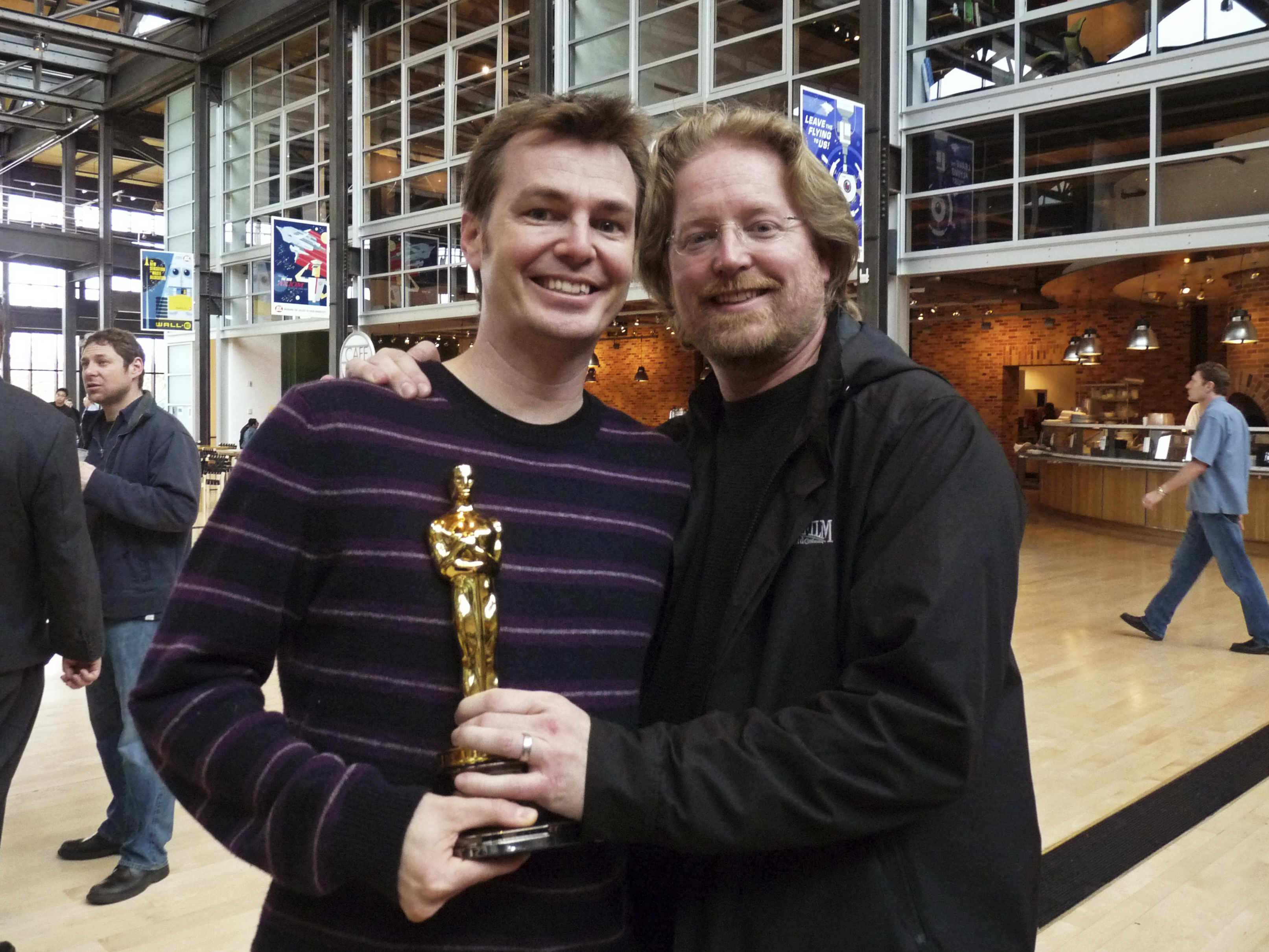
Andrew Stanton (R) with the Wall-E Academy Award. Image Credit: Wikipedia

“[We’ve] been trying for four years to make the best film possible and have it recognized in that regard in something like this – it’s huge.” – Andrew Stanton at the Academy Awards

At the 81st Academy Awards, broadcast February 22, 2009, the Pixar film Wall-E won the Academy Award for Best Animated Feature. The film was also nominated for Best Original Screenplay (written by Andrew Stanton, Jim Reardon, and Pete Docter), Best Original Score (by Thomas Newman), Best Original Song (Down to Earth by Peter Gabriel and Thomas Newman), Best Sound Editing (by Ben Burtt and Matthew Wood), and Best Sound Mixing (by Tom Meyer, Michael Semanick, and Ben Burtt). This award would be the fourth win for Pixar in this category since the creation of the Best Animated Feature category in 2001. Many critics voiced their surprise that Wall-E was not nominated for Best Picture, as it was one of the highest rated films of 2008, with a 96 percent approval rating on the online rating site, Rotten Tomatoes. Only three animated films were nominated in the Best Animated Feature category that year: Wall-E, Disney’s Bolt, and Dreamworks’ Kung Fu Panda.

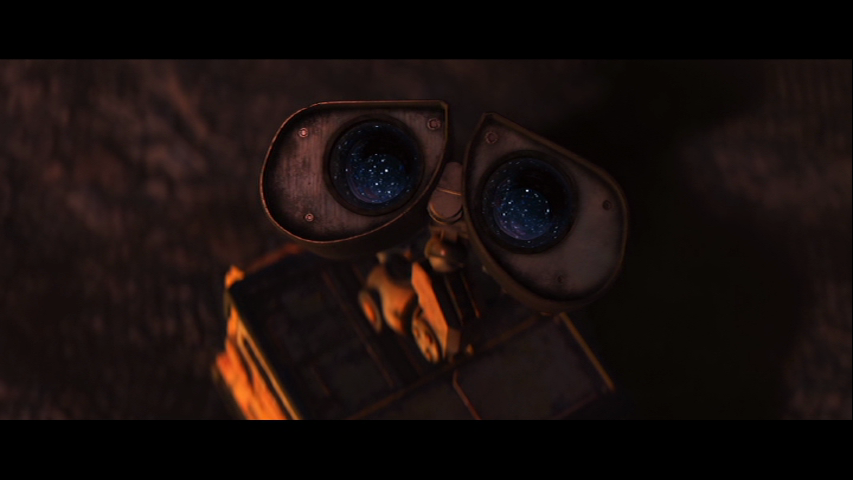
Image from one of the first advertisements for Wall-E

In an advertisement for the film, shortly after the release of Ratatouille, Andrew Stanton described a lunch with three of the other main players at Pixar: John Lasseter, Pete Docter, and Joe Ranft. “In the summer of 1994,” he begins, “there was a lunch…Toy Story was almost complete, and we thought, ‘Well, jeez, if we’re going to make another movie, we gotta get started now.’ So at that lunch, we knocked around a bunch of ideas that eventually became A Bug’s Life, Monsters, Inc., Finding Nemo…the last one we talked about that day was the story of a robot, named Wall-E.”

Released on June 27, 2008, the film posed the question: What if mankind had to leave Earth 700 years in the future, and somebody forgot to turn off the last robot? The film includes the voices of Ben Burtt as Wall-E and Elissa Knight as EVE, with Jeff Garlin as the Captain, John Ratzenberger as John, and Kathy Najimy as Mary. The film went on to become the ninth highest grossing film of 2008, with a total domestic gross of $223,808,164.

January 24

January 24, 2006 – Disney Announces an Agreement to Purchase Pixar for $7.4 Billion

The major players: John Lasseter (L), Steve Jobs, Bob Iger, and Ed Catmull

“…We had to return to the glory days of animation. So I began focusing on how to do that, and it really begins with finding the right people. The more I thought about it, the more I realized that Pixar had more of the right people than probably any other place in the world, from an animation perspective.” – Bob Iger, CEO, the Walt Disney Company.

On January 24, 2006, new CEO Bob Iger announced that Disney had agreed to acquire Pixar for 287.5 million shares of Disney stock, which equaled about $7.4 billion. Because Steve Jobs owned 49.8 percent of Disney shares, his vote was the only one that mattered, and it became a done deal. “We’re convinced that Bob really understands Pixar,” Jobs said in an interview on On The Money, “and we think that we have some appreciation of Disney and love the unique Disney assets, like being able to get the characters in the theme parks and really express them through all of Disney’s incredible assets. And we think we understand how to keep Pixar being Pixar, and how to spread some of that culture around…a few other parts of Disney as well, ’cause we think we’ve got something pretty good going here.”

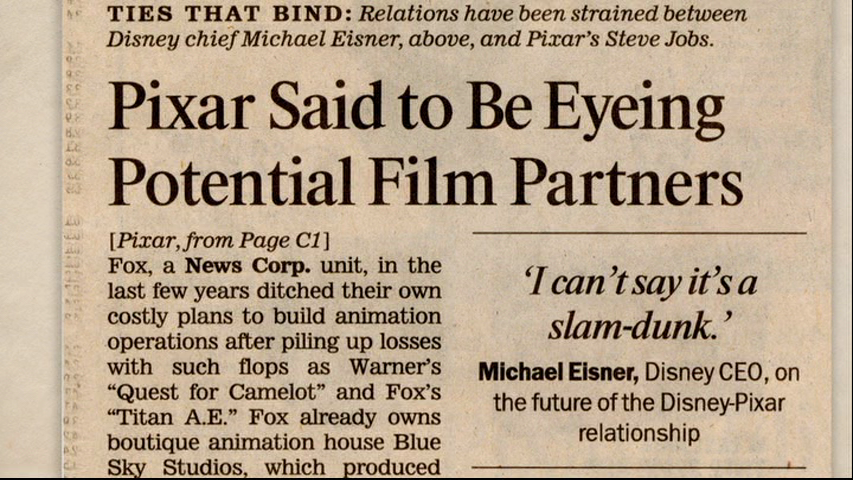
The road to this acquisition was not a smooth one by any means. Although Pixar had been the studio with hit after hit, Jobs was involved in a feud with the Walt Disney Company over the negotiations of their contract. It was public knowledge that Michael Eisner and Steve Jobs were not getting along. Jobs had reached out to Roy Disney for a conversation to share his grievances. Unfortunately for Disney, Jobs had come up with his own solution: After Pixar had completed the terms of the 1997 contract, Pixar would provide no more films for Disney, as long as Eisner was in charge.

Newspaper article declaring Pixar's search for a new distribution partner

As Pixar and Disney approached the end of their deal with no clear solution in sight, the anxious Pixar employees tried to figure out what to do. If they merged with a larger company, they could lose the independent spirit that had made them what they were. The employees “wanted to be an independent company,” Ed Catmull explained, “whereas if we were to become independent, we’d have to take on marketing and distribution, and get another partner, and it would change the culture in ways that we didn’t necessarily want…it was actually unfortunate at that time, because we’d had this phenomenal relationship with Disney all these years, where we were an independent company and they did the distribution and the marketing.” Another source of contention was the fact that Disney could make sequels without Pixar’s involvement. Pixar was heartbroken by this, as they regarded the characters they created like their children – this plan through Disney would make them more like dollar signs than anything else.

Things changed in 2005, when a corporate shakeup within Disney resulted in Eisner’s resignation, and the appointment of Bob Iger as the new CEO of the company. Iger was well known for his accomplishments in the development of Hong Kong Disneyland. Although he could deal well with overseas affairs, it was the domestic affair with Steve Jobs that was more difficult. But Iger was convinced that he would be able to repair the fractured relationship, since Jobs had said that the problem had been between him and Eisner, not the Walt Disney Company as a whole.

Iger’s focus on the rift took a serious turn when he attended the opening of Hong Kong Disneyland in September 2005, a month before he officially became CEO. Iger said that as he watched the opening parade, “[i]t hit me that the characters that were in the parade all came from films that had been made prior to the mid-90s, except for some of the Pixar characters. I felt that I needed to think even more out of the box than I had been thinking, and I had a much greater sense of urgency. I became CEO October 1st. I called Steve around that time and I said I thought we ought to talk, I had some bigger ideas, and that began a long period of discussion, because it was very serious for both sides. He really needed to feel comfortable that Pixar was in the right hands, and, more importantly, respect the talent and the culture.”

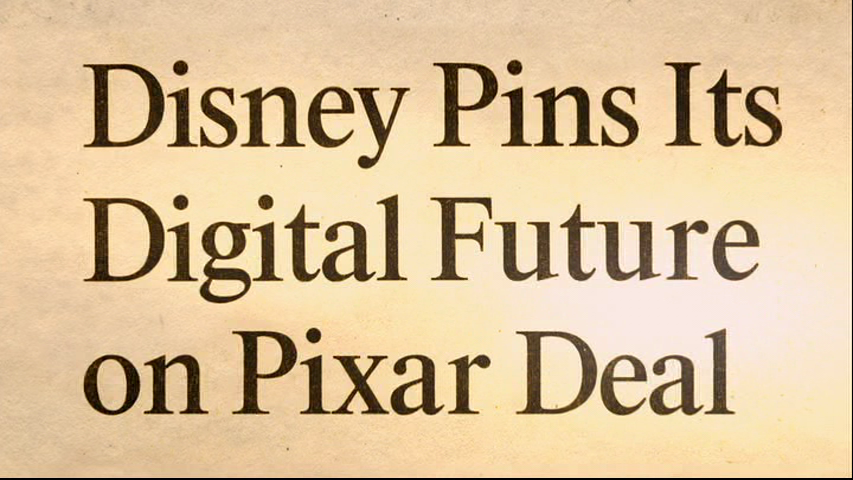
Another newspaper headline, this time with the good news that Pixar and Disney would continue their partnership

Expectations had been high that Iger could repair the fractured relationship, and with the announcement on January 24, Iger had proven that Disney was the best partner there could be for Pixar. The acquisition deal gave Steve Jobs a seat on the board as the largest shareholder, made John Lasseter Chief Creative Officer and principal creative advisor at Walt Disney Imagineering, and elevated Ed Catmull to President of Disney and Pixar Animation Studios. “It feels like this is the true culmination of the building of Pixar and this amazing company into something which will continue on and continue to make waves in the future,” Catmull said about the deal.

January 12

January 12, 1957 – John Lasseter is Born

“There’s something about John that you kind of get the feeling that [the fact that something’s never been done before] doesn’t matter. I mean, [just because it hasn’t] been done before, doesn’t mean it can’t be done.” – Glen Keane, animator (The Little Mermaid, Tangled)

John Lasseter was born on January 12, 1957, in Hollywood, California, and was raised in Whittier. When he was growing up, cartoons were seen as “kidstuff,” and part of growing up was to leave the childish things behind, but Lasseter refused to shed his love of animation. “I even watched them when it wasn’t cool in high school,” Lasseter reminisced. During his freshman year, Lasseter found a book in the library that would set him on the path of his passion: The Art of Animation, by Bob Thomas. “When I was growing up, I loved cartoons more than anything else. And when I was in high school, I found this book, this old, ratty book, called The Art of Animation. And it was about the Disney Studios and how they made animated films,” Lasseter said. “And it was one of those things that just dawned on me: people make cartoons for a living. They actually get paid to make cartoons. And I thought, ‘That’s what I wanna do.’ Right then, right there, it was like I knew that’s what I wanted to do.”

Soon after reading the book, Lasseter went to the movies to see a re-release of Disney’s The Sword in the Stone, and after seeing it, he proclaimed to his mother, an art teacher, that he wanted to be an animator for Disney. She encouraged his dream, and Lasseter began to send letters and drawings to the studio, receiving letters of support back. In 1975, Lasseter applied to the California Institute of the Arts (CalArts), was accepted into the first program that taught Disney-style character animation, taught by Disney’s great collaborators of the 1930s, the Nine Old Men. Lasseter found himself in an atmosphere where he didn’t have to hide his love of animation anymore, and was surrounded by those who had the same passion. His classmates included Brad Bird (director of The Incredibles), John Musker (co-director of The Little Mermaid), and Tim Burton.

Lasseter's class at CalArts, dated March 1976

There was no denying Lasseter’s talent at CalArts. Two of his student films won back-to-back Student Academy Awards: Lady and the Lamp in 1979, and Nitemare in 1980. His success brought him his dream job: he became a junior animator at the Disney Studios. Animator Glen Keane remarked that it was “. . . so great to meet John. There was this immediate sharing of information of your passion and excitement for animation, and he knew a lot about the history and the past.” To outsiders, Lasseter was touted as a new rising star. But inside the studio, animation had grown dormant. Budget cuts were taking their toll on animated films, leaving Lasseter brokenhearted. “This was not what I always dreamed Disney was,” he remembered.

The turning point came when employees of the studio were shown a screening of the 1982 film Tron. Lasseter and Keane became excited about the potential they saw in the use of computers for animation. They were able to get approval to experiment with a combination of computer background and 2D animated characters, first working on a 30-second test clip based on Maurice Sendak’s Where the Wild Things Are. Soon after, Lasseter got approval to work with his story team on a feature film based on the short story The Brave Little Toaster, which would mark his feature directorial debut. After eight months of development, Lasseter had a pitch meeting with the then-head of the studio, Ron Miller. Miller didn’t react favorably to the story, telling Lasseter that “[t]he only reason to do computer animation is if [they] could do it faster or cheaper.” A few mintues later, Lasseter was called down to a manager’s office with this simple but staggering message: “Well, John, your project is now complete, so your employment with the Disney Studios is now terminated.”

Don Hahn (producer for Beauty and the Beast) remarked, “He got fired, because, honestly, the studio didn’t know what to do with him. Even at that early day, this Disney Studio that he dreamed about working at, turned out to be a really dysfunctional place, in reality. And he was a born director, he was a born leader, and his expectation and passion excelled what the studio was doing then.” In 1983, while attending a computer conference in Long Beach, Lasseter ran into Ed Catmull, a speaker at the conference, and a comrade in the passion for 3D computer animation. Lasseter didn’t have the heart to tell Catmull he’d been fired from Disney, but did admit that Brave Little Toaster had been shelved. This was a great opportunity for them both, as Catmull, then working at Lucasfilm, needed to bring on someone who was a real animator. John was hired on the spot under the title of “interface designer,” so as not to alarm George Lucas, as they weren’t sure he would approve of hiring an animator for the technical team.

The Lucasfilm group.

Lasseter inspired the team to create software that would imitate the squash and stretch technique that had been taught in traditional animation courses. Inspired by the design of Mickey Mouse, as well as the limitations of what the computer could do, Lasseter created a character named Andre, made entirely of geometric shapes. The group at Lucasfilm’s first short film, The Adventures of Andre and Wally B, was premiered at the 1984 SIGGRAPH computer convention, and the crowd went wild over it. Lasseter made his way into the spotlight in 1989, when he and Bill Reeves won Oscars for Best Animated Short Subject for Tin Toy, the first ever awarded to a computer-animated film. “With each subsequent short film,” Steve Jobs explained, “John got more ambitious, and the team got more experience, and the software got better.”

To save Pixar, Lasseter pitched to Disney an idea for a half-hour Christmas special based on the award-winning short. Disney, on the other hand, was trying to lure Lasseter back to direct a feature film. But Lasseter was determined to stay with the struggling company. Eventually, Pixar and Disney reached a deal for a full-length animated feature: a story from a toy’s point of view, done in a 3D plastic world. The Pixar staff was elated, and Lasseter later recalled, “Ignorance is bliss. We did not know what we didn’t know.” After many trials and tribulations, including an entire scrapping of the “jumped-through-Disney’s-hoops” version of the film, Toy Story was released in theaters on Thanksgiving Weekend, 1995. Lasseter was awarded a special achievement Oscar for creating the first computer-animated feature film. The animation community was blown away, and audiences fell in love with the story.

Lasseter being presented with a special achievement Oscar.

Lasseter continued to push his animators with the next film, A Bug’s Life. Determined to beat the “second-product syndrome,” the animators pulled out all of the stops, and A Bug’s Life became the highest grossing animated film of 1998. After the international promotional tour of the film, Lasseter came home for a well-deserved break, while a secondary team began work on a direct-to-video sequel to Toy Story, which would be the first project not supervised by Lasseter. However, the film was not very good, although Disney had said it was good enough to release theatrically, and Lasster was asked to come in and help fix it. Nine months before its release, Lasseter scrapped the entire film over the course of a weekend and rewrote it. Jim Murphy, an animator at Pixar, had this to say about the rewrite: “John came back and pitched the story to the animation department. Just in that pitch, he totally fired everyone up and inspired everyone to really do the impossible.” In the end, Toy Story 2 was another success for Lasseter and Pixar, becoming one of those rare sequels considered as good as, or better, than the first film.

With Disney’s acquisition of Pixar in 2006, Disney finally got Lasseter back, only this time Lasseter was named the Chief Creative Officer of both studios, as well as the Principal Creative Advisor at Walt Disney Imagineering. He has acted in many roles since then, including executive producer for films including WALL-E and Tangled, director for Ponyo and Cars 2, and creative consultant on The Muppets. In 2007, Lasseter was inducted into the American Academy of Arts and Sciences, in honor of all of his achievements in the field of computer animation.

"So it’s become this way of working that the art challenges technology, technology inspires the art."

John Lasseter is one of my heroes, and a true example of why you should never let go of your dreams. There is so much to say on Lasseter’s influence, and it was hard to not start to write the entire history of Pixar, as the two go hand in hand. It’s interesting to see the development of a kid who tried to not be seen going to see a Disney film as a teenager, to one of the most influential people in the field of animation. The amount of dedication he and the other members of Pixar have put in their films, including their focus on story as much as their focus on the medium, is truly inspirational.
January 5

January 5, 1941 – Prominent Film Director and Animator Hayao Miyazaki is born.

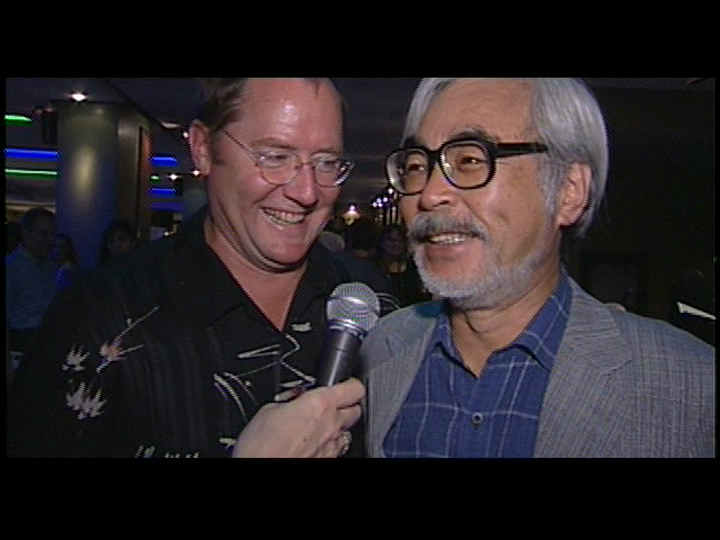
John Lasseter (L) and Hayao Miyazaki

“When you see a movie of his, you see something in film you’ve never seen before.” – John Lasseter, Chief Creative Officer of Walt Disney and Pixar Animation Studios.

If Japanese animation legend Tezuka Osamu is known as the Japanese Walt Disney, Hayao Miyazaki could be seen as the Japanese John Lasseter: both men’s works have changed the landscape of animation for future generations.

Miyazaki was born to a well-to-do family on the outskirts of Tokyo in 1941. He and his family were forced to evacuate their home during World War Two (although they were able to move back in 1950), and in 1947, Miyazaki began school as an evacuee. Wartime events would have an impact in his work, one example being his 2004 film Howl’s Moving Castle. Like many children in post-war Japan, Miyazaki was inspired by the works of Tezuka Osamu (best known for his work Astro Boy), who had just made a big impact with his comic New Treasure Island. In fact, most of Miyazaki’s early work was, as he acknowledged, heavily inspired by Osamu, even as Miyazaki struggled to develop his own artistic direction, and it was only when he became an animator at Toei Animation that he felt he had finally shaken off the influence.

Miyazaki had several other influences: He studied political science and economics at Gakushuin University, and was part of a children’s literature research society, where members read many stories, including European texts, exposing him to a wide range of fantasy and legends. After leaving university in 1963, he joined Toei Animation Studios, working as an inbetweener after three months’ training. He first gained recognition for his work on the film Gulliver’s Travels Beyond the Moon in 1965. He was able to pitch his own ending to the film when he found the original one unsatisfactory, and his ending was used in the final product. Miyazaki married fellow animator Akemi Ota in 1965.

Miyazaki continued to play important roles including animator, concept artist, and storywriter for various films, including Hols: Prince of the Sun (1968), Puss in Boots (1969), and Animal Treasure Island (1971). In 1971, Miyazaki left Toei and joined A Pro to work with Isao Takahata, and also worked for Nippon Animation, which he left in 1979 in order to direct his first feature animated film, The Castle of Cagliostro.

In 1984, Miyazaki had his big breakthrough in animated film with Nausicaä of the Valley of the Wind, based on the comic he had written (first published in 1982, and serialized until its completion in 1994). This film introduced many themes that occur frequently in his later films: environmental issues, feminism, pacifism, and an interest in flight and aircraft. The success of the film, and the need to establish a new production center, led Miyazaki and Isao Takahata, along with producer Toshio Suzuki, to form Studio Ghibli, a subsidiary of Tokuma Publishing.

In 1996, Disney made a deal with Tokuma to distribute the Studio Ghibli works, excluding Grave of the Fireflies, and Ocean Waves. Since then, Disney has released the films on DVD, with the likes of John Lasseter and Pete Docter from Pixar helping to create the English-dubbed version. Spirited Away, the only traditionally animated and foreign animated film to win the Academy Award for Best Animated Feature, brought Miyazaki and Studio Ghibli to the world stage. John Lasseter noted that “since Spirited Away was released in the United States, it has created a large following for Miyazaki-san’s work. Since then they’ve released on DVD most of Miyazaki-san’s films, so there’s a lot of people – a lot more Miyazaki fans in the United States now than there was when Spirited Away was released.” Studio Ghibli and Walt Disney Studios have also seen success with release of Howl’s Moving Castle and Ponyo.

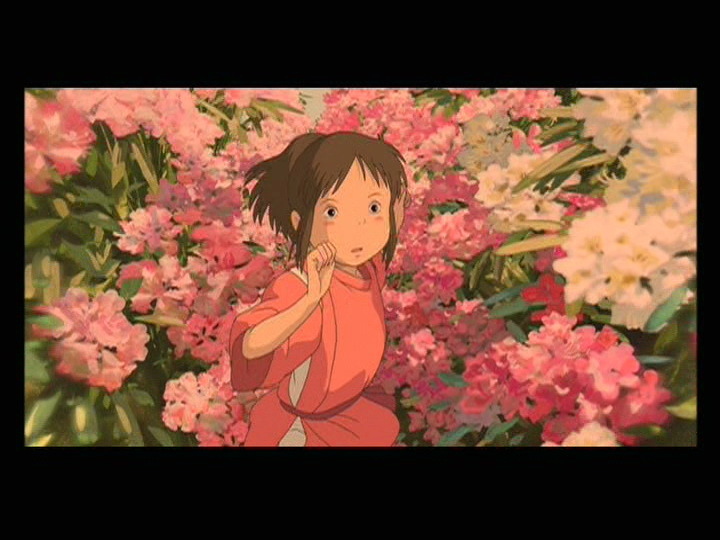
The main character of Spirited Away, Chihiro.

Miyazaki has been a great inspiration to many animators, from the staff at Pixar to the animators at Walt Disney Studios. John Lasseter is a close friend of Miyazaki’s, and has mentioned on numerous occasions how Miyazaki’s films inspire the animators at Pixar. “He is one of the great filmmakers living today,” says Lasseter. “When you see a movie of his, you see something in film you’ve never seen before. . . His films have always been inspirational for me and for everyone at Pixar…It’s interesting to talk to people and they have different interpretations of it. And that’s what’s so special about [Miyazaki’s] films…they make you think. Miyazaki’s films always make you think. And that’s what’s so special about them. And that’s why they get better. Just like a fine wine, they get better with age, because you keep watching them and you understand them more and more, and that’s what I just love about them. …[T]hey’ll live on forever.”

Animator Glen Keane (Beauty and the Beast, Aladdin, Tangled) has also been inspired by the animation style of Miyazaki and Studio Ghibli. “Well, it’s hard to ever separate the huge influence that Japanese animation has had on me,” he says. “I was just in awe of Miyazaki’s work, and have emulated his sensitivity, his approach to staging. That had a gigantic impact on our films, starting with Rescuers Down Under, where you saw the huge Japanese influence on our work. That’s part of our heritage now, which we don’t back away from.”

I included Miyazaki for several reasons: 1) Disney does have distribution rights to the Studio Ghibli films; 2) many animators in Pixar have worked on the English translation of the films; and 3) the influence the Studio Ghibli and Miyazaki has had on Disney and Pixar is unmistakable. Many people find the films inspirational both for the stories being told and the animation style. There is no denying the impact Miyazaki has had on the animation world.