RSS Feed

Tag Archives: 1930s

March 22

March 22, 1935 – The Silly Symphony, The Golden Touch, is Released to Theaters
“Is this the great man that bellowed, ‘Give me gold, not advice?’”

On March 22, 1935, the Silly Symphony, The Golden Touch, was released to theaters. Based on the tale of King Midas, it was directed by Walt Disney himself, who thought that this would be an easy task. Finding it was more work than he thought, Walt did not direct another short again. The music was written by Frank Churchill, and stars Billy Bletcher as the voice of King Midas.
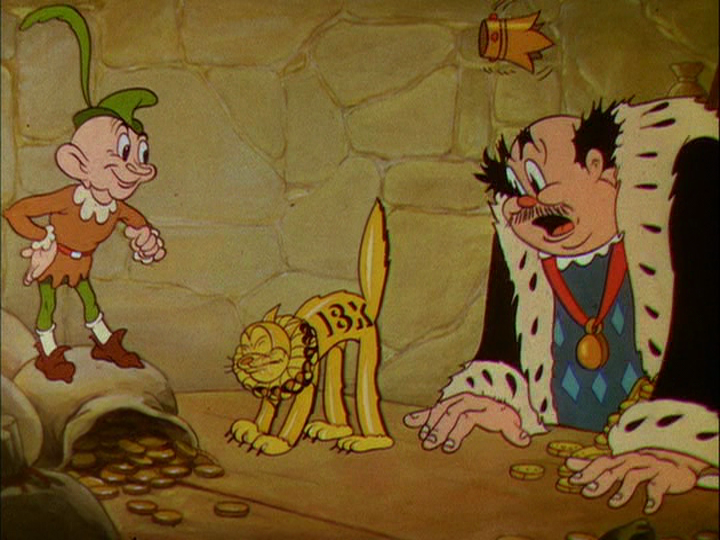
Midas is shocked when Goldie easily turns his cat into gold

The short opens in the vaults of the kingdom, where King Midas is happily counting his gold. He introduces himself to the audience, stating that he never cared for women or wine, but instead loves and worships gold. He then wishes that he could have everything he touched turn to gold. No sooner has he made this wish when a strange creature appears named Goldie. Midas is afraid that Goldie is there to steal his gold, but Goldie tells Midas that he, Goldie, doesn’t want it, and shows Midas that he can turn things to gold with a single touch. Midas offers everything he owns for the golden touch, but Goldie warns Midas that this would be a curse rather than a blessing. Midas doesn’t want Goldie’s advice, so Goldie finally gives the king what he wishes.

Now armed with the golden touch, Midas is determined to test it out. He chases his cat up the stairs of the castle, and as Midas runs into a tree, the tree suddenly turns to gold, dropping 18K apples, and the 18K cat as well. Midas skips around gleefully, incredibly happy that he has the golden touch, and begins touching everything he can, from flowers to fountains.
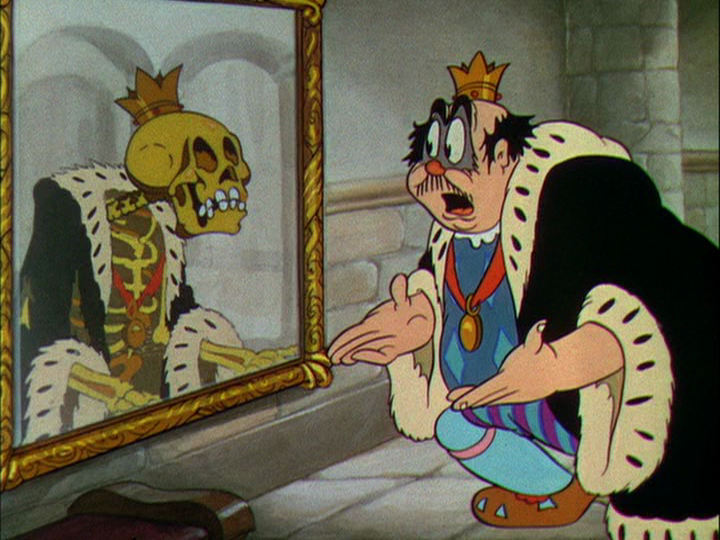
The king becomes delusional from hunger and fear, seeing himself as a golden corpse.

Some time later, a hungry King Midas sits down to eat a hearty meal, only to find that he is unable to eat anything, as it all turns to gold. Angered, he begins to turn all of the food to gold, and seems to go mad over the fact that Goldie had been right about it being a curse. He moans that the richest king in the world must now starve to death, and is chased by illusions of death. He locks himself in his counting room and calls out for Goldie, who appears, laughing.

Midas, thrilled to see that Goldie has appeared, begs the creature to take away the curse, so he can eat once more. He offers everything he has, and even offers his kingdom for a hamburger. Goldie laughs and teases, “With or without onions?” The king begs for just a plain old hamburger, and Goldie finally agrees to take back the curse, in exchange for everything the king possesses.
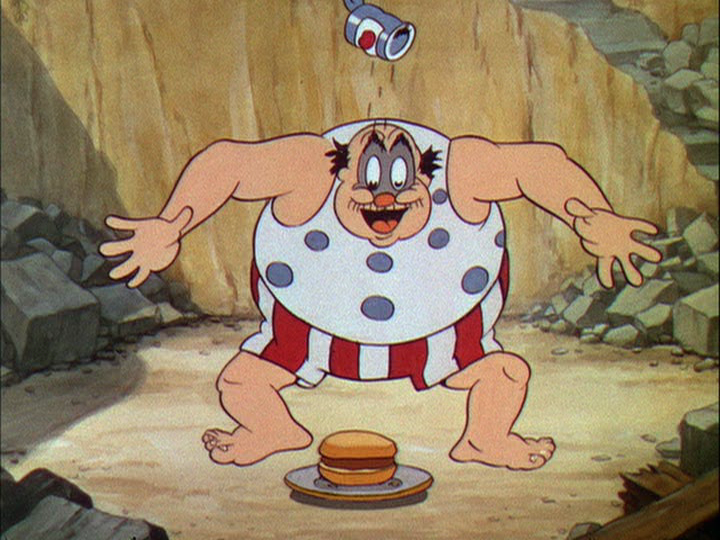
"My kingdom for a hamburger!"

As Goldie disappears, Midas looks around wildly, before seeing his entire kingdom disappear before his eyes, as well as his clothes, save for his undershirt and boxers, with his crown now nothing more than a tin can. As promised, his hamburger appears in front of him, and as he sits down to eat it, he pauses, afraid that he still possesses the golden touch. He is relieved to find that it has indeed been taken away, and that Goldie also gave him onions.
March 20

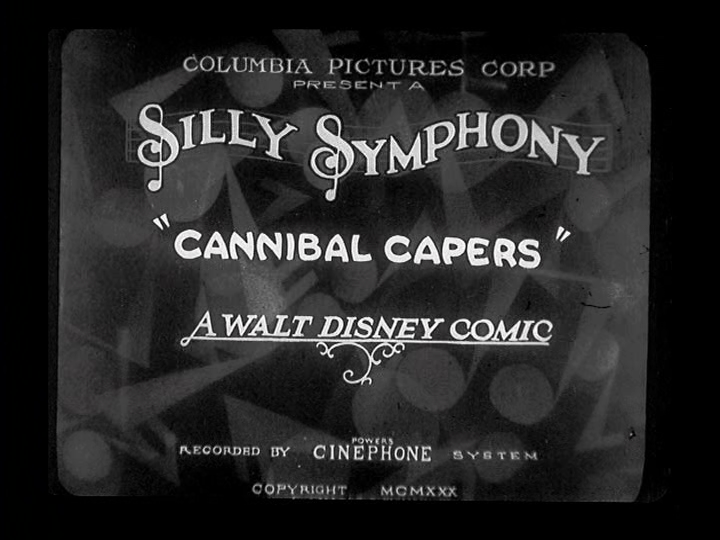
March 20, 1930 – The Silly Symphony, Cannibal Capers, is Released to Theaters

On March 20, 1930, the Silly Symphony, Cannibal Capers, was released to theaters. Directed by Burt Gillett, it was a good representation of the humor and style of movies back in the ’30s. It was normal for people to see stereotypes not just in cartoons, but also in live action films. This is the only Silly Symphony that, when shown on the Mickey Mouse Club show in the ’50s, had its ending edited out. The plot description below is of the original full short.

The Silly Symphony opens with what appears to be trees swaying in the breeze. As the camera pulls out, we see that it isn’t trees, but four cannibals, dancing and singing. They perform a dance for the audience of other cannibals, and another is seen drumming on a drum, a shield, a set of human skulls, and even his own teeth. As he grabs two of the skulls and uses them as castanets, “Habanera” from the opera Carmen begins to play.

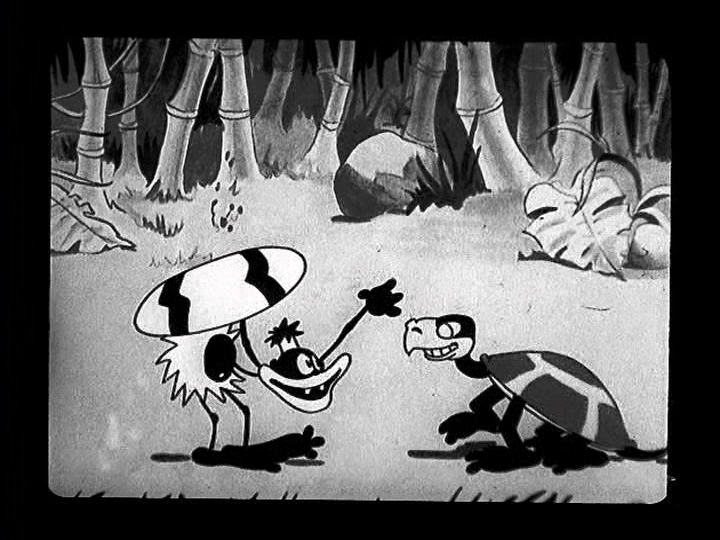
The cannibal and the turtle dancing together

The scene switches to another cannibal, who does a sort of hula, causing his grass skirt to fall to the ground. He pulls it up and begins to dance again, with the same result. Angered, he pushes his stomach to the ground, so that his skirt won’t fall anymore. He continues to dance merrily after that. The camera then moves to a turtle who is dancing to the music, and runs into a cannibal. The cannibal, using his shield like a shell, imitates the dancing of the turtle, which turns into a game of patty-cake.

In the main village, the chef is preparing the pot for a great feast, when he spots the cannibal dancing with the turtle. Although the turtle and cannibal retreat into their shells, the chef picks up the cannibal, intending to feed him to the village. The tribe cheers as the cannibal is thrown into the pot of boiling water, but are shocked when he calmly steps out and begins to cool himself down with the shield.

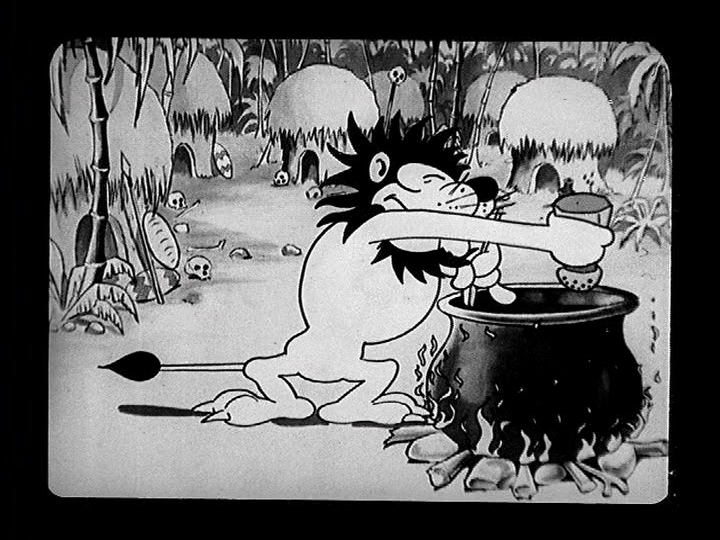
The lion preparing the cannibal for consumption

A lion roars at the edge of the village, and the cannibals flee into their homes. The cannibal that was in the pot continues to hide inside, thinking he’s safe. The lion, however, grabs a spoon, the salt, and the pepper, and begins to cook the cannibal to his liking. The lion tries to eat the cannibal, but the cannibal outsmarts him.

As the cannibal runs away, the lion pursues him. Once the lion bites down on the cannibal, however, he loses his teeth. Seeing this as an opportunity, the cannibal decides to wear the teeth and teach the defenseless lion a lesson. The cannibal chases the lion out of the village, and the cannibals are seen laughing.

March 17

March 17, 1939 – The First Goofy Short, Goofy and Wilbur, is Released to Theaters

“That’s a little palsy-walsy!”

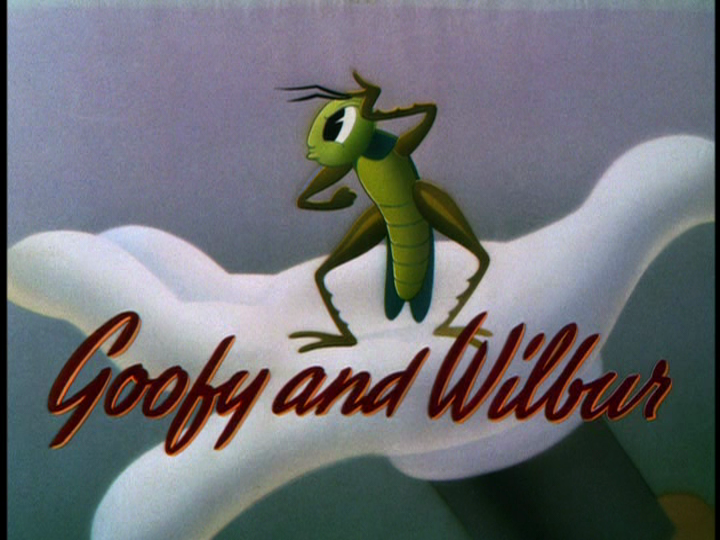
On March 17, 1939, the first short of the Goofy series, entitled Goofy and Wilbur, was released to theaters. Goofy goes fishing with his grasshopper friend Wilbur, who ends up getting into many scrapes as he tries to attract the fish for Goofy to catch. Goofy was voiced by George Johnson in this short, and it was directed by Dick Huemer. Interestingly, Goofy takes off his glove by accident, to reveal that his hands are flesh colored underneath.

Wilbur acts very pet-like, and is very loyal to his friend Goofy

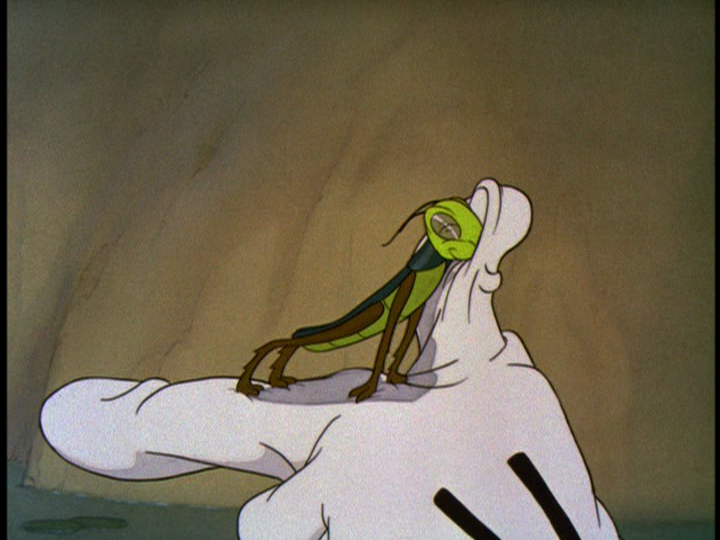
Goofy is out fishing in a small beaten boat with a sputtering motor, and stops when he comes across a sign that says “No Fishing.” He opens up a box, and out leaps his grasshopper friend Wilbur, landing on his finger. Goofy strokes Wilbur like a pet, and asks if he’s all set, to which Wilbur sticks out his chest proudly. Giving Goofy a wave, Wilbur gently dives into the water, but is able to walk across the surface with his feet and look for fish to catch. Goofy sits in his boat and hollers out to the fish, hitting a horseshoe with a stick to get their attention.

A fish wakes up to see Wilbur, and begins to chase the grasshopper while Goofy stays hidden in the boat, sticking out his net cautiously. Wilbur is able to jump through the holes in the netting while the fish gets caught. Wilbur goes out again to get another victim, this time splashing water in the fish’s face. Angered by this, the fish swims at full force to catch the grasshopper, but Wilbur is too fast. Unfortunately, Wilbur is so busy taunting his victim that he doesn’t see another fish lurking near the boat who thinks Wilbur would make a tasty snack. Caught between two fish, Wilbur jumps straight into the air, with one fish almost devouring the other one. Goofy catches both in his net, and asks Wilbur to bring back a big fat fish next. Wilbur jumps excitedly as a big fat fish follows him back to the boat, although the poor fish is too big to fit into the net. However, Goofy is able to catch him all the same.

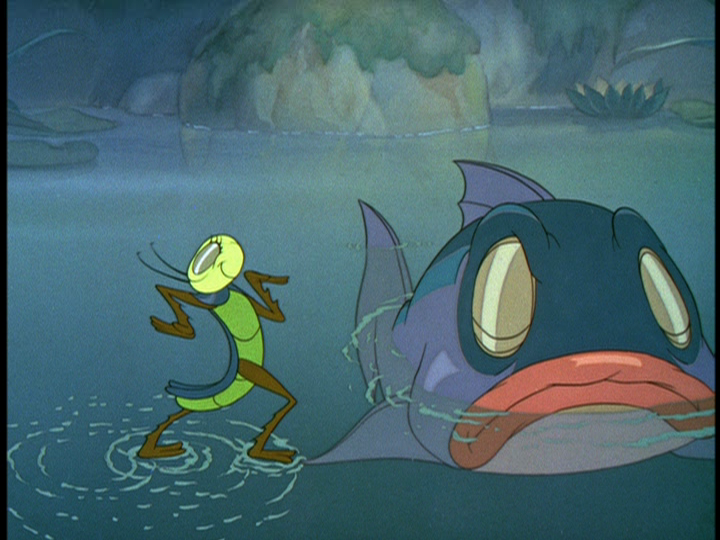
Wilbur performs a dance to get the fish's attention, but the fish still stays "asleep"

Wilbur skates around on the surface of the water, noticing a fish in front of him that, unbeknownst to him, is pretending to be asleep. Wilbur tries to get its attention, but the moment he stops watching to think about how to get the fish to wake up, the fish turns around and nearly eats him. Fortunately, Wilbur turns around at the last second, causing the fish to resume its fake sleep. Wilbur then begins to dance for the fish, hoping this will do the trick. Finally, annoyed, Wilbur spits in its eye, causing it to run after Wilbur at full speed. Goofy, meanwhile, is still trying to get the fat fish out of his net. He slams the fish in, but the fish take the netting with it, and when Goofy tries to save Wilbur with the net, the fish dives through the now netting-free net, with Wilbur scrambling to get to safety on the boat. The fish throws itself at the side of the boat, catching Wilbur as it stays suctioned fast.

Alarmed, Goofy pulls off the fish and starts calling out for Wilbur, who is still inside the fish. Goofy can hear Wilbur’s call, but it seems that he is unable to get out. Goofy finally slaps the fish, causing a very blue Wilbur to fall onto his knee, unable to move. Goofy is worried sick, wondering what can he do. Using Wilbur’s legs, Goofy pumps out all the water inside Wilbur, and revives him with smelling salts, although the poor creature is still woozy from his adventure. Goofy warns Wilbur that the fish are getting wise to him, to which Wilbur is suddenly fully revived and ready to attack.

Goofy chases the stork, who has eaten the toad, who has eaten Wilbur

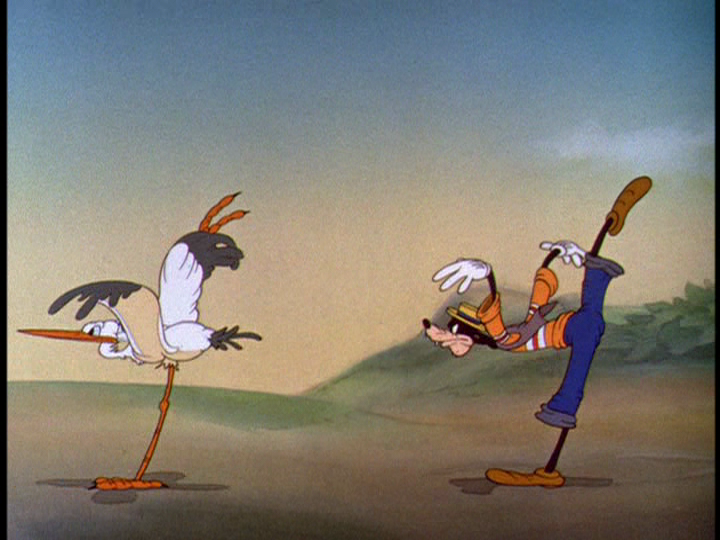
Leaping into the water, Wilbur sends out a massive call to all the fish in the area, and they respond, circling the poor insect. A great chase ensues, but Wilbur is able to keep one step ahead of the fish – until he finds himself to be the snack of a toad. Goofy, having seen everything, cries out Wilbur’s name, horrified, and runs out to save his friend. The toad manages to get away from Goofy – but finds itself to be the snack of a stork. The stork begins to run away as it sees Goofy in pursuit, and lands safely in its nest at the top of a hollow tree. Wasting no time, Goofy climbs up the insides of the tree and tries to battle the stork to get his friend back. The stork flies away angrily, leaving its egg behind, and Goofy begins to cry, mourning the loss of his friend. Fortunately, the egg hatches, revealing a not-dead Wilbur. The two celebrate, with Wilbur giving his friend a huge hug and a kiss.

March 16

March 16, 1934 – The Silly Symphony The Three Little Pigs Wins the Academy Award


“…[The Three Little Pigs] sent a message of optimism to moviegoers who’d been battered by the Great Depression.” – Film Critic Leonard Maltin.

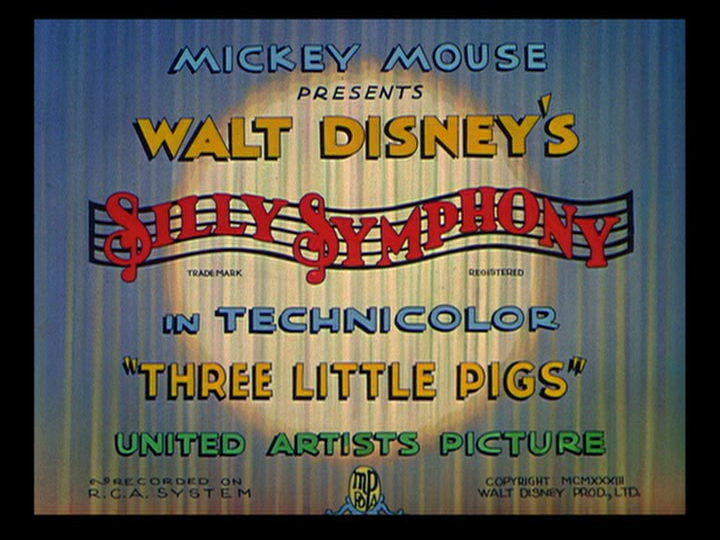
The 6th Academy Awards were held at The Ambassador Hotel on March 16, 1934, and the Disney Studios walked away with the Academy Award for Best Animated Short film for the wildly popular Silly Symphony The Three Little Pigs. It was in competition with the Universal Studios short The Merry Old Soul, as well as the Walt Disney and United Artists Mickey Mouse short Building a Building (see entry for January 7).

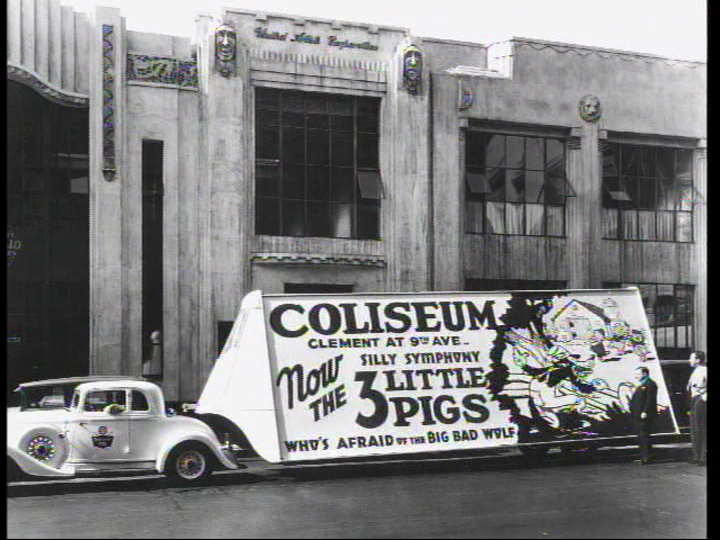
This is one of the billboards advertising the short at the Coliseum. The short was able to get top billing after a while due to its success

The short, although well done in its own right, was popular due to being released at the right time. It was considered groundbreaking in its characterization and musical score, but Depression-weary audiences adopted the song “Who’s Afraid of the Big Bad Wolf” as their fight song. The short’s immense success kept it in theaters for months with top billing, even after feature films had long left the theater. The success of the short, including the Academy Award, led to a major merchandising campaign, as well as three sequels: The Big Bad Wolf, Three Little Wolves, and The Practical Pig.

March 11

March 11, 1933 – The Silly Symphony Short Film, Birds in the Spring, is Released to Theaters

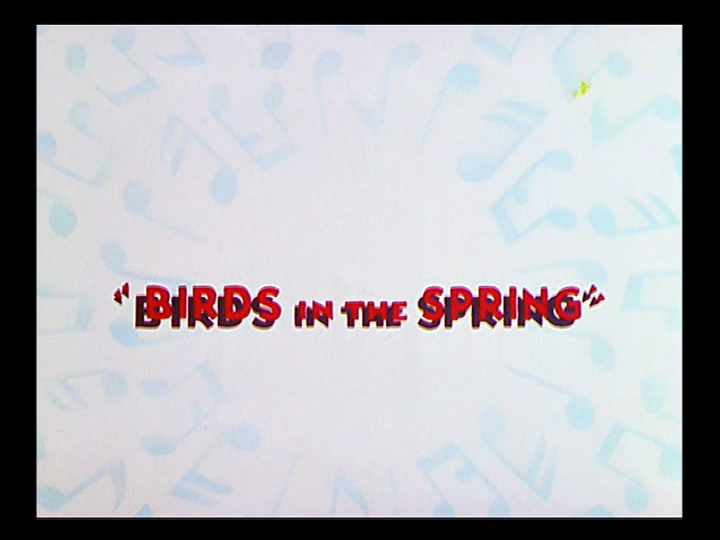
The Silly Symphony short, Birds in the Spring, was released in theaters on March 11, 1933 by United Artists. Directed by Dave Hand, with music by Bert Lewis, the short tells the story of a baby bird whose thirst for curiosity brings him a day full of adventures. The title card of the Silly Symphony attests to the popularity of Mickey Mouse in the early 1930s, as it states: “Mickey Mouse Presents Walt Disney’s Silly Symphonies.” It had been believed that, as far as animation, people would only want to see Mickey Mouse cartoons, and Mickey’s name on the title card would ensure an audience. Luckily, the Silly Symphonies were popular in their own right.

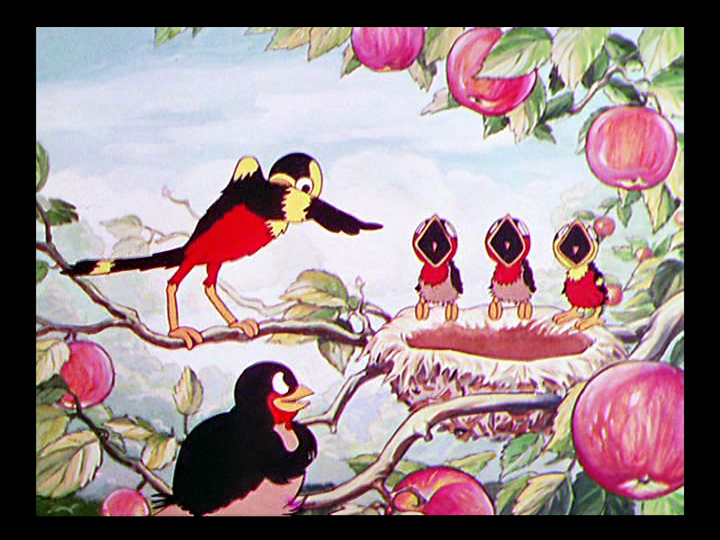
The scene opens on a beautiful spring day, in a field full of apple trees in bloom. Birds are flying about, chirping their songs as they flit around the branches, with some being romantic, while others are working on building nests. A nervous mother is seen in her nest, wondering when her eggs are going to hatch. She flips the eggs and sits on them again, hoping they will hatch soon. The father paces back and forth on a branch, looking equally anxious. Without warning, the first egg hatches underneath the mother, and the proud parents cheer when all three eggs hatch to reveal healthy chicks. The father gathers all the birds in the field to come see his newborns.

The babies have singing lessons with their father

The newborns begin to cry for food, and as they do, we suddenly see the time elapse, with the newborns becoming healthy young birds, who are learning to sing instead of crying for food. A bee buzzes around the nest, attracting the attention of the only male baby bird (named Otto, according to the Disney Archives), and causing him to depart from the music lesson to catch a quick snack. Otto hurries back to sing the final note in the song, only to let out a buzzing sound instead. Otto’s father’s disposition turns sour at this development, and while Otto tries to sing, he is still only able to let out the buzzing noise from the bee inside him.

After the bee escapes from Otto’s insides, the father decides it’s time for a flying lesson. He tries to impress his children with his grace, only to end up flying into a tree, making them laugh. Nevertheless, they follow him in their flying lesson, making a chain by grabbing each other’s tails as they fly through the air. When they let go, the birds surprise themselves by being able to fly, but unfortunately they also quickly fall. Otto then finds himself separated from the others, but decides it’s a better time to explore than to go home.

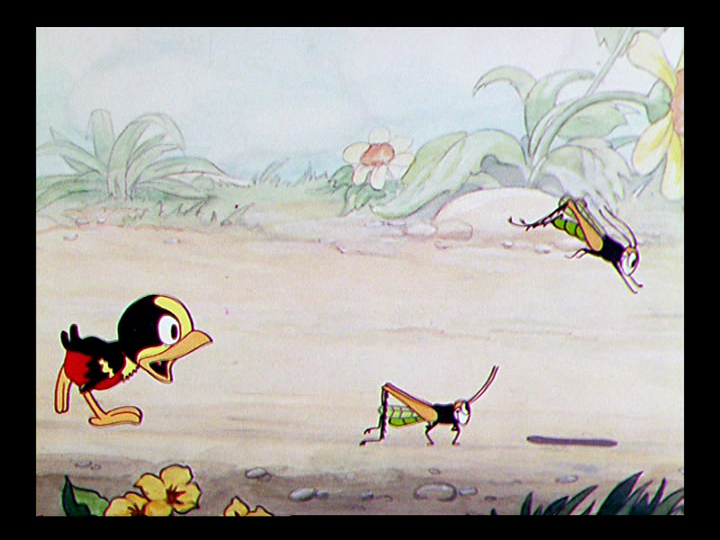
Otto excitedly watches grasshoppers at play

Otto’s first part of the adventure involves two grasshoppers playing leapfrog, and he follows them with great interest. He tries to eat one, but the grasshopper continues to jump, taking the poor baby bird with him until he jumps out of Otto’s mouth and spits in his face. Otto, not really fazed by the reaction, then follows a hummingbird, and tries to eat the way the hummingbird does, only to get poked by another hummingbird when he is inside the blossom.

Otto’s next adventure begins with a simple rattle in the bushes. He sees what is making the noise and shakes the rattle, only to find that the rattle belongs to a rattlesnake, one that is very hungry. The snake hypnotizes the baby bird, but Otto falls into nearby pond, breaking the spell. He begins to flee, with the snake following with great vigor. Otto tries to fly over the water, but his flying still needs a lot of work, and the snake is rather faster – even faster on land. Otto manages to get the snake to tie himself in knots to escape.

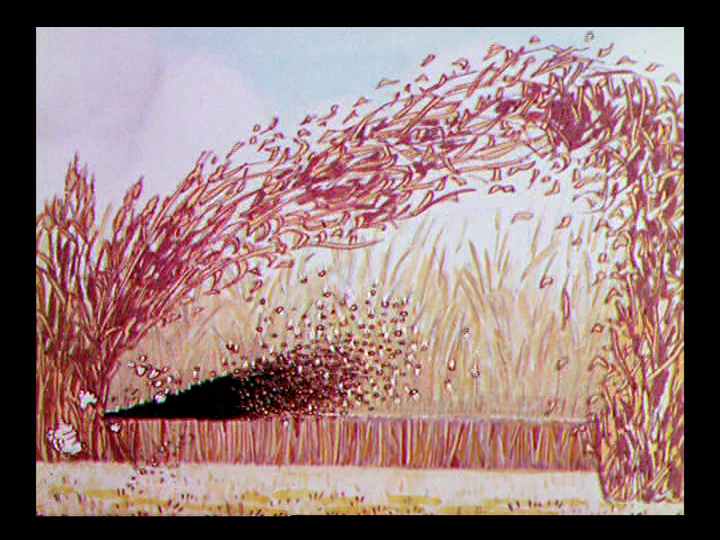
The bees harvesting wheat while trying to attack Otto

Otto attempts to dive for cover in a beehive, only to have the swarm inside chase him out and pursue him angrily, destroying everything in their path. Otto lets out frantic chirps, which alerts his family nearby, and the father races to his rescue. The birds manage to hide under their nest while the bees race past. Otto’s curiosity comes at a price, as his father takes the baby over his knee and spanks him for running away.

March 7

March 7, 1936 – The Mickey Mouse Short, Mickey’s Grand Opera, is Released to Theaters

“Pluto! Go home!”

On March 7, 1936, the Mickey Mouse short, Mickey’s Grand Opera, was released to theaters. Directed by Wilfred Jackson, the short is about Mickey directing an opera, only to have his effort ruined by Pluto’s run-in with a magic hat. Although the short was released as a Mickey Mouse short, it deals more with Pluto, Donald Duck, and, to a lesser extent, Clara Cluck, more than Mickey. The short stars the vocal talents of Walt Disney as Mickey Mouse, Pinto Colvig as Pluto, Clarence Nash as Donald Duck, and Florence Gill as Clara Cluck. This was not the only time Donald and Clara had an operatic duet, as Clarence Nash and Florence Gill were seen as themselves in The Reluctant Dragon, recording a session of their characters singing together. Mickey’s Grand Opera was also the last short film to use the original design of Donald Duck before making him a rounder character.

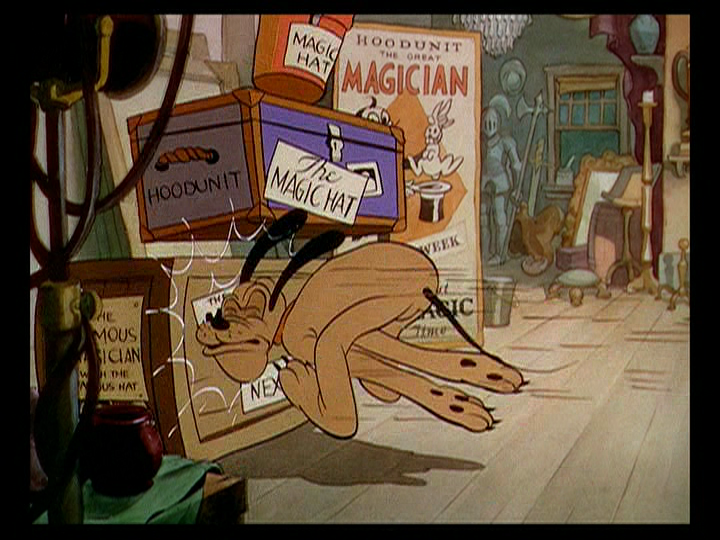
Pluto flies into the crates in the prop room after being told off by Mickey

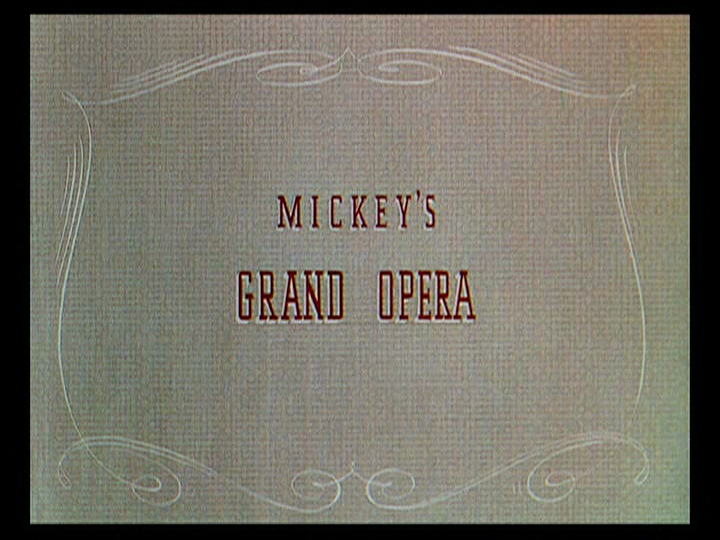
The scene opens on a big sign proclaiming “Mickey Mouse presents GRAND OPERA featuring Mme. Clara Cluck and Donald Duck.” The viewers are taken backstage where Mickey is checking out the audience through a hole in the curtain. Suddenly his dog, Pluto, jumps on him. Mickey angrily asks him how he got into the theater, then tells him to go on home. Pluto sadly skulks away, but keeps turning back in hopes that Mickey will change his mind. When Mickey screams at him to go home, it startles Pluto to the point that he accidentally runs into the prop room and knocks into boxes for next week’s act, Hoodunit the Magician. The contents of the boxes spill everywhere, including the magician’s famous magic hat.

Pluto, still saddened by Mickey’s unfriendly manner, attempts to take a nap in the prop room, but keeps thinking he sees something pop out of the hat. As he tries to sniff the hat, a rabbit pops out and punches him on the nose. Angered, Pluto takes the hat with his teeth and shakes it, causing a flock of doves to fly out into the room. After they scare him and fly back into the hat, Pluto decides to jump on it, thinking this will stop the strange occurrences. As he tries to walk away, though, the hat pops back into shape as if nothing had happened, scaring Pluto silly. The two then play a game of cat and mouse as Pluto tries to chase the magic hat around a crate.

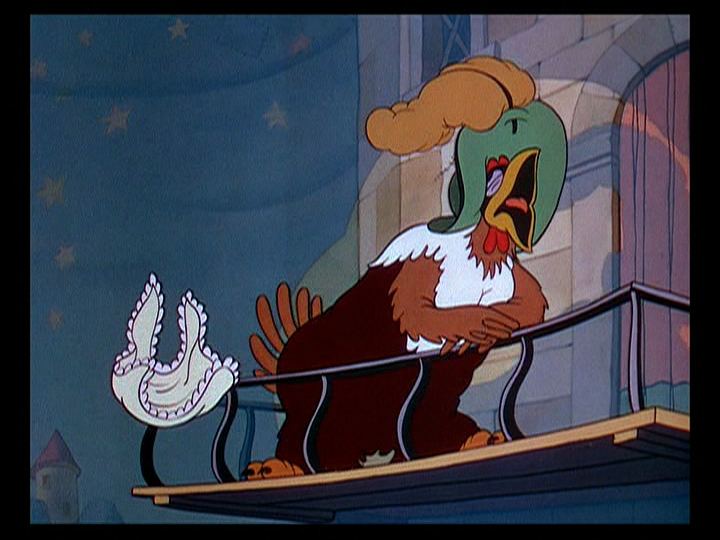
Clara Cluck, singing of her despair that her love has not come to see her

Applause marks the beginning of the opera, and Mickey takes his place at the podium. The curtains open on a balcony scene, where Clara Cluck appears in the spotlight. She begins to “sing,” looking and listening for her love. When he does not appear, she begins to cry in longing, but the gate suddenly opens, revealing none other than Donald Duck, playing her Romeo. He sneaks into the courtyard with a bouquet of flowers and trips over his own feet, making the audience laugh. This gets Clara’s attention, and she begins to sing to him. Donald then quacks his song back to her, and throws the bouquet to her.

As they continue their duet, Donald pulls out his sword dashingly, only to get it stuck in one of the trees from the set. He tries to pull it out, unsuccessfully, which leaves poor Mickey to try and conduct the orchestra to match Donald’s frustrated quacking. Donald finally does get the sword out, and the opera continues peacefully. Unbeknownst to them, Pluto is following the magic hat, which has appeared on the side of the stage. Noticing that Pluto has been following it, it hurriedly waddles onto the stage, with Pluto timidly following it.

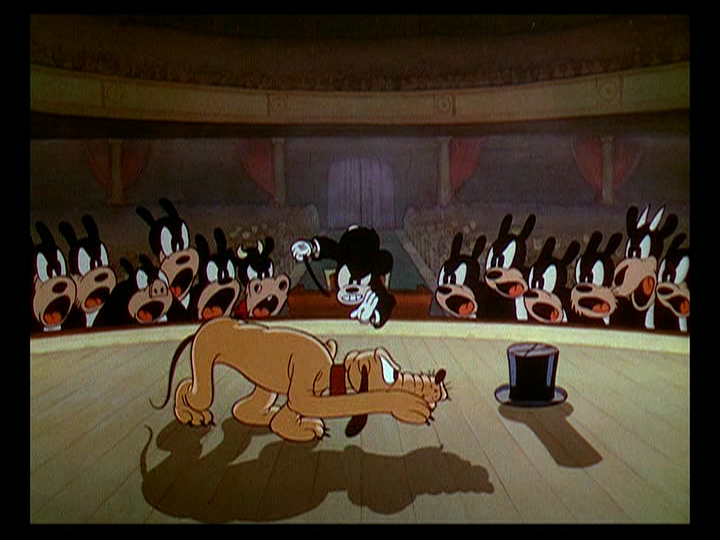
The orchestra follows Mickey's example, ordering Pluto to go home

The hat and Pluto cross the stage right in front of Mickey, with the audience breaking into peels of laughter. Mickey finally notices his dog and is furious that Pluto never went home. Mickey once again orders the dog home, but Pluto only looks at his master sadly before looking back at the suspicious hat. Once again, Mickey orders Pluto home, but Pluto won’t move away from the strange hat. Finally, the whole orchestra stands up and yells at Pluto to go home, which startles the dog and hat and they run off in different directions. As Pluto watches from the wings sadly, the hat suddenly crawls underneath him, surprising him.

Having had quite enough, Pluto begins to chase the hat, which falls into a tuba, letting loose a steady stream of doves, mice, and rabbits as the tuba player plays his instrument. Donald and Clara try to continue with the scene, although two doves attempt to take off with Donald’s cape, and the doves dart around Clara. The tuba player keeps playing, and a strange plant sprouts from inside, releasing a frog as the sunflower on top opens. Pluto follows the frog, until Donald accidentally swallows it. The frog continues to jump, taking Donald with him. With one large hop, Donald accidentally stabs Clara through the balcony, causing the hen to fly into the rafters from the surprising poke. When she comes back down, the set comes crashing to the floor. When Pluto, Clara, Donald, and the frog, break through the backdrop, they give their final high note of the night, at least bringing this strange opera to an end.

February 29

February 29, 1940 – The Last Silly Symphony, The Ugly Duckling, Wins the Academy Award for Best Animated Short Subject

At the 12th Academy Awards, held at The Coconut Grove in Los Angeles on February 29, 1940, the Walt Disney Studios and RKO Radio were awarded an Academy Award for their final Silly Symphony, The Ugly Duckling. The short was up against Detouring America by Warner Brothers, Place on Earth by MGM, and The Pointer, also by the Walt Disney Studios and RKO Radio.

First released April 7, 1939, it was a remake of the 1931 Silly Symphony of the same name, and was the only Silly Symphony ever remade. The story and animation were significantly different from the 1931 short, which shows the tremendous strides in animation the Disney Studios had made in those nine years. Instead of the slapstick and gags they relied so heavily on in the early days of the studio, the 1939 version shows how they were able to make their character emote and become fully fleshed out.

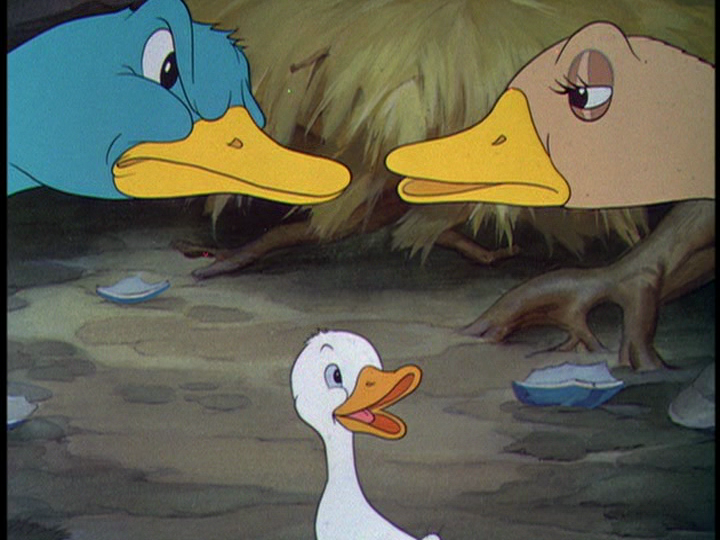
The scene when the father and mother discover the odd looking duckling. Notice the characterization of the characters, which was rather nonexistant in the 1931 short

The plot of this short is based on the Hans Christian Andersen tale, and tells the story through music of a duckling shunned by his family, as he is considered by his parents to be ugly. The duckling, ashamed, tries to find a mother that will accept him the way he is. It’s easy to see, after watching this short, why it would win an Academy Award – it truly was a high note for the Silly Symphonies in which to go out.


February 25

February 25, 1938 – The Mickey Mouse Short Boat Builders is Released to Theaters

“All you do is put it together.”

On February 25, 1938, the new Mickey Mouse short, Boat Builders, was released to theaters. This is another one of those shorts where the comedy is actually found through the actions of Goofy and Donald, rather than through Mickey’s actions. Directed by Ben Sharpsteen, Boat Builders featured the vocal talents of Walt Disney as Mickey, Pinto Colvig as Goofy, Clarence Nash as Donald Duck, and Marcellite Garner as Minnie Mouse.

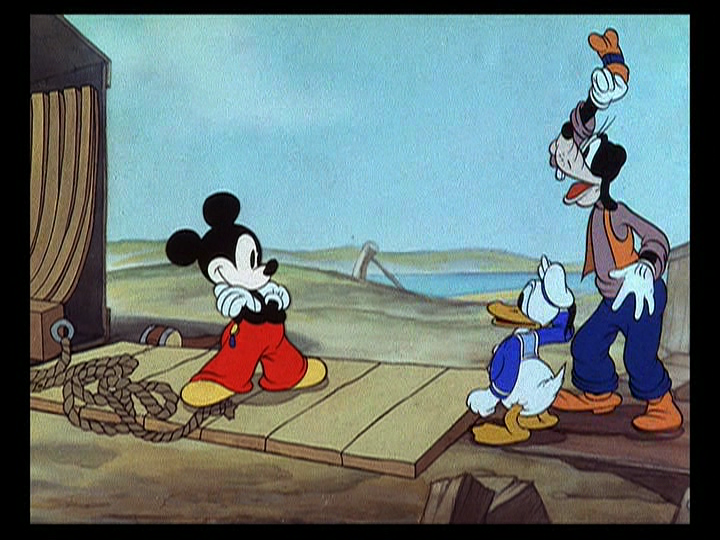
"Lend a hand, me hearties!" Mickey tells the gang, and they happily agree

The short begins with Mickey, Donald, and Goofy excited about building a boat from a kit they have ordered, especially after turning the page and seeing a picture of what the finished project should look like. It’s easy, too: The included instruction manual taunts that “Even a child can do it.” Mickey declares that once she’s built, they will call her The Queen Minnie.

The boys set to work opening crate number one, labeled the keel and ribs, merrily whistling (and quacking, in Donald’s case), sea shanties. Grabbing the rope, they pull out the collapsed innards of the boat, only to have the boat chase them down the shore and capture them on the beams. Mickey laughs when he recites the simple instructions once again, and Donald laughs with him when he reminds them of the boast that even a child can do it.

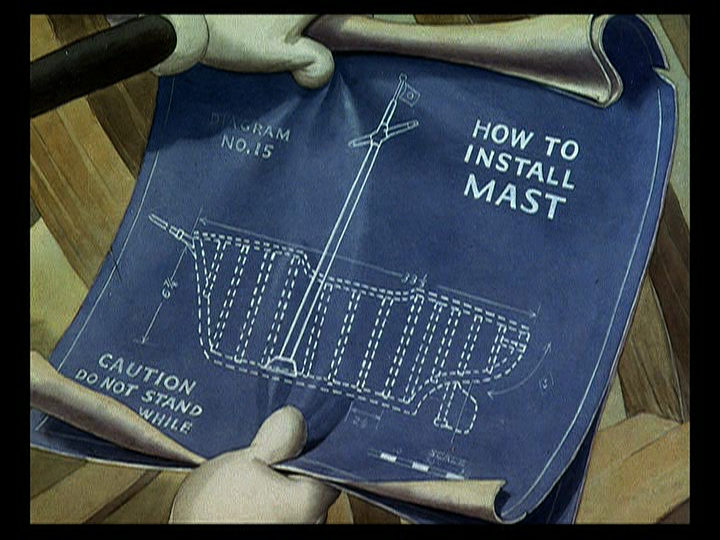
The blueprints for how to assemble the mast. Note the warning in the lower left corner

The scene then moves to Mickey picking up the box with the mast enclosed and pulling out the blueprints on how to install the mast. When Mickey stands on top of the mast, trying to pull it out, it shoots out of the box, sending Mickey all the way up to the sky. The mast is then assembled with Mickey, still hung up at the top of the mast by his clothing, saluting the audience.

Assembling the boat is quick work for the three, and Goofy is seen hammering nails into the sideboards, although, as is usually the case with Goofy, the board does not want to stay nailed down, and hits Goofy square in the head. Slightly angry, Goofy grabs another set of nails and hammers it down again, only to have it swing back at him. Goofy ducks, but it hits him on its swing back. He then feverishly hammers the board down and turns to another task, but continues to be taunted by the board. It finally hits him, spinning him until he falls onto his barrel of nails.

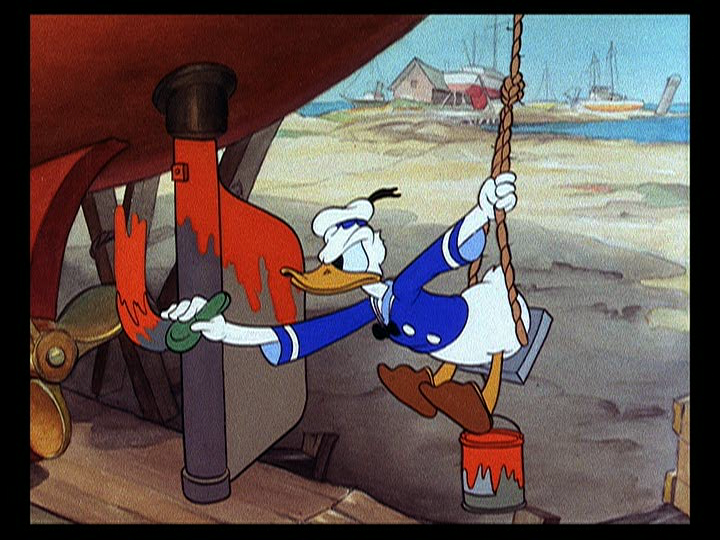
Donald has a difficult time painting the rudder of the boat

Mickey and Donald continue putting the boat together, with Donald painting the rudder, not noticing that Mickey has just placed the helm into its socket and is testing it, causing Donald to completely miss the rudder while trying to paint. Donald holds it still, causing Mickey to think that the wheel is now stuck, and as he tries to free it, Donald gets wrapped around the rudder like a tetherball, and then is hit like a ping-pong ball as Mickey continues to pull on the helm.

Goofy sets about to add the figurehead to the boat, but when he opens to see that it’s in the shape of a beautiful mermaid, he closes the box, flustered, thinking that there’s an actual lady enclosed. He tries to straighten himself up a bit more, and knocks on the lid, apologizing to the figurehead. When it falls out of the box, Goofy catches it, alarmed, and calls out to the others that she’s fainted. He puts her in a beach chair and asks if she’s feeling better, but of course, she doesn’t say a word. “Gee, but you’re purty,” he tells her, twisting his hat in embarrassment. As he admits he could fall for a girl like her, he accidently steps on her tail, pushing the figure up and meeting him in a “kiss,” which causes him to spin around giddily. While Goofy hides his head, giggling, Mickey takes the figurehead and places it in the front of the boat. Poor Goofy is alarmed to find that she has disappeared, and begins to search for her, but ends up falling off the boat and pulling down the anchor.

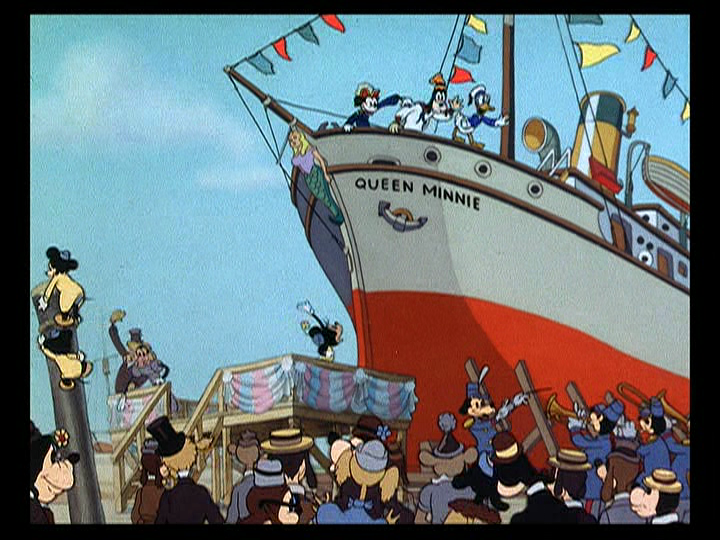
The christening of the Queen Minnie

At last, the boat is built, and a huge crowd appears at its christening and maiden voyage. Mickey, dressed as the captain, tells Minnie to christen the boat, and she gladly grabs the champagne bottle. She’s shocked, however, to find that the bottle will not break, so she gives it a mighty swing. The swing was too great, and the boat begins to fall apart from the impact, with it collapsing in on itself. The boys find themselves in the water, and while Mickey laughs at their predicament, Donald just gives out his trademark, “Aw, phooey!”

February 23

February 23, 1935 – The Mickey Mouse Short The Band Concert is Released to Theaters

“Yet, in a funny way, The Band Concert spelled the beginning of the end for Mickey as a solo cartoon star. As good as he is in this film, and his range of expressions as the frustrated conductor is marvelous, his thunder is easily stolen by a newcomer on the scene, Donald Duck.” – Film Critic Leonard Maltin.

On February 23, 1935, audiences flocked to see a new Mickey Mouse short, only this time, it was in Technicolor. The Band Concert, Mickey’s first color short film, would not go on to win an Academy Award, but has been hailed as one of, if not the, best Mickey Mouse short of them all. From this point on, with the exceptions of Mickey’s Service Station and Mickey’s Kangaroo, all of the Disney shorts would be in Technicolor. The short also boosted the popularity of Donald Duck, who was considered to be a funny character, as opposed to Mickey’s charming personality. The film was directed by Wilfred Jackson, and has Clarence “Ducky” Nash with the only speaking role in the film as Donald. ­­­It has been noted that orchestra conductor Arturo Toscanini considered this film his favorite; it has also been said that the short film Symphony Hour (1942) may have been a more outlandish remake of this film.

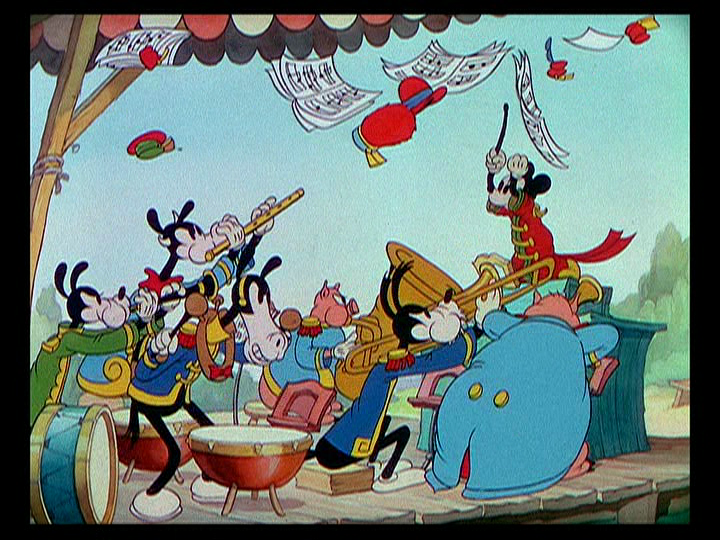
With great enthusiasm, Mickey leads the orchestra in The William Tell Overture

The short opens with a concert in a park, with Mickey and his orchestra taking a bow after finishing Selections from Zampa, and the audience applauding enthusiastically. When Mickey shows the card displaying the title of their next piece – The William Tell Overture – the audience is overjoyed. With great fanfare, Mickey leads his orchestra into the piece, only to get distracted by a voice calling out “Popcorn! Lemonade!”

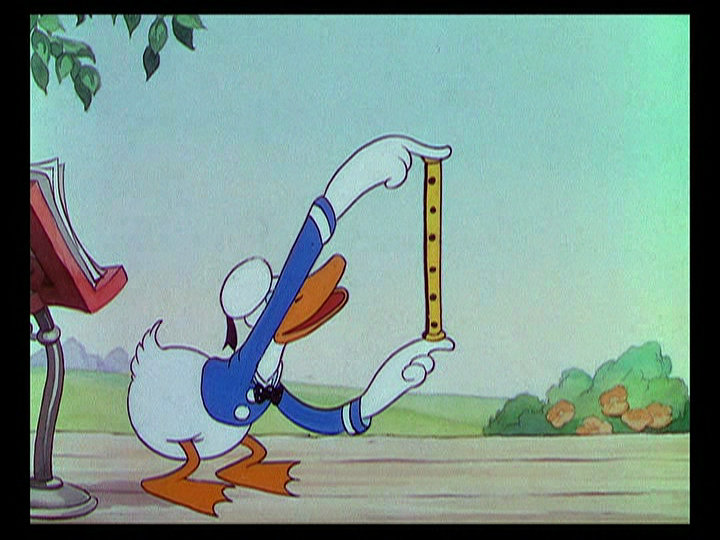
The camera moves to the distraction, and we see Donald Duck pushing an ice cream cart, with lemonade and bags of popcorn for sale as well. He stops to admire the music, then pulls a flute from the front of his uniform, wanting to join in with the orchestra. In the middle of the William Tell Overture, Donald begins to play Turkey in the Straw, which gets the orchestra to switch to the similar sounding tune. When Mickey notices the switch, he grabs Donald’s flute and breaks it in half, but Donald has another trick – or flute, rather – up his sleeve, and resumes his tune while Mickey tries to bring the concert to a halt.

Just like magic, Donald makes a flute appear out of thin air

With a wink, Donald presents another flute as the orchestra tries to get back on track, and when an aggravated Mickey tries to break the third flute, Donald decides to do it for him, sending the audience into peels of laughter. Mickey, at wits’ end, lunges at Donald, only to land on his face as the duck speeds off the stage. With renewed vigor, Mickey pulls the orchestra back to the assigned piece. As they begin to play, Donald, hiding behind a music stand, pulls out another flute, only to have the trombone player encircle the duck’s neck with the trombone slide and shake him down, revealing all the flutes Donald had hidden away, before throwing him right onto his cart, spilling food everywhere. Donald throws a tantrum, but the trombonist just laughs.

Donald grabs one of the flutes from the shake down and begins his takeover attempt again, not noticing a bee buzzing around him curiously. The bee flies into the flute, and ends up in Donald’s mouth, causing the duck to have another fit. When the bee flies away and lands on Mickey’s hat, Donald grabs an ice cream cone and throws it in the insect’s direction. The ice cream lands in a trumpet, and the trumpeter blows it out, which hits Mickey on the back of the head. As Mickey tries to shake the ice cream out, directing the orchestra along the way, the classical piece gets a somewhat interesting interpretation, and Mickey’s temper flares again.

As Mickey finally gets the orchestra back on track, the bee returns and buzzes around Mickey, and each move the mouse makes to swat it away is interpreted by the orchestra as his direction with comical results. The bee buzzes around Horace Horsecollar, playing percussion, who tries to swat him with the cymbals, only to crash around Goofy’s head.

Mickey hadn't realized how complicated this part of the piece was going to be

Mickey turns the page in his music book to the part in the overture called The Storm. He looks rather surprised at how complicated the piece is, but is determined to play it and play it well. When the orchestra starts to play, the clouds get noticeably darker, and the wind begins to blow ominously. Without warning, a tornado sweeps through the town, heading directly for the concert in the park. The audience and the benches flee the concert in a panic as the tornado devours everything in its path. Donald stands around, confused as to why everyone is running away, until he sees the tornado bearing down and tries to hide by climbing up a tree, only to have the tornado braid him within three tree trunks.

The orchestra continues to play with Mickey conducting,as they are dramatically pulled up into the storm, seemingly oblivious to their peril. As they reach the climax of the piece, they stop in midair and are once again set down to the ground for a triumphant finish. The only audience member remaining, however, is Donald, who once again tries to take over with Turkey in the Straw, only to have a tuba land on his head.


February 20

February 20, 1937 – The Mickey Mouse short Moose Hunters is Released to Theaters

“Hi, Mr. Moose. Have a bite?”

 On February 20, 1937, the Mickey Mouse short Moose Hunters was released to theaters. This was one of the few shorts that used Donald and Goofy along with Mickey, as the writers were finding it difficult to give Mickey solo material. The short was directed by Ben Sharpsteen, with music by Paul J. Smith, and starred Walt Disney as Mickey Mouse, Pinto Colvig as Goofy, and Clarence Nash as Donald Duck.

The "female moose" making her mating call

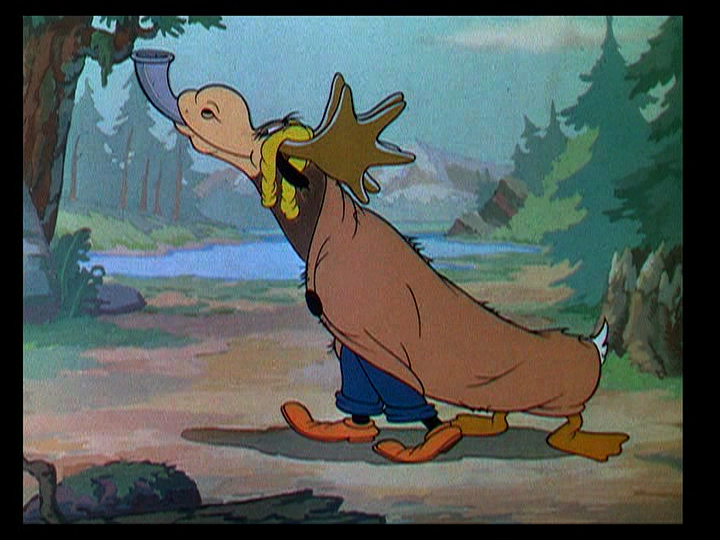
The short opens with a female moose swimming across a river. When she emerges, however, we see that she has two familiar, yet mismatched, pairs of feet, and sounds her call by using a horn. Following behind this strange moose is a swimming bush, which also sounds out a call by using a horn. As the moose continues to walk and call, it hears something respond, and the front half of the moose stops, causing the back half to run into the front. Goofy emerges from his disguise, excitedly informing the others that there is a moose nearby, and Donald emerges as well, repeating the sentiment. Mickey, now revealed to be the walking bush, answers joyfully, holding a shotgun. “Now do your stuff,” he tells them. “I’ll take care of the rest,” he adds with a wink, patting the shotgun.

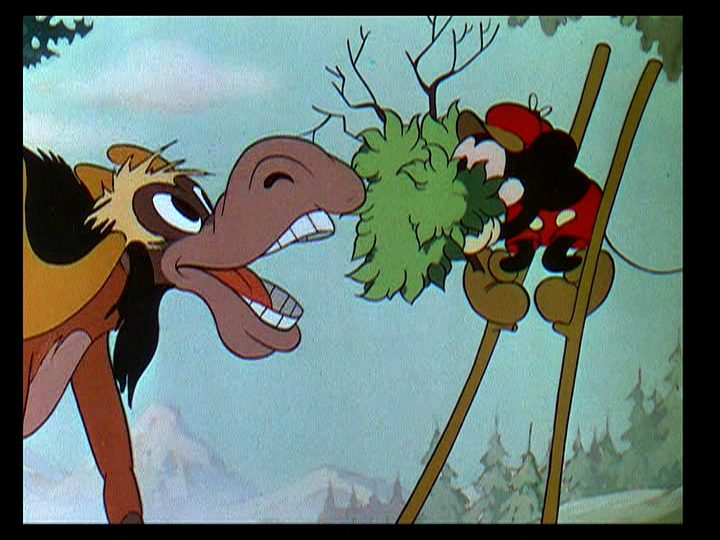
Goofy and Donald continue walking in the female moose costume, trying to lure out the real moose. Mickey, meanwhile, travels a bit behind, carefully using his horn to call out the moose, trying to keep hidden within the leaves of his disguise. He stands on top of a bush and uses the horn again; unfortunately, the moose appears beneath him, startling the mouse and causing him to drop his shotgun, which lets out a shot, scaring the moose. Mickey is starting to sweat, as his gun is now in pieces, and he is even more alarmed when the moose spots his disguise, thinking it would be a tasty snack. Mickey tries to keep himself covered and backs away slowly, only to be pursued by the hungry moose, who nearly eats Mickey’s trademark shorts.

Goofy and Donald spy the moose they've been tracking

Goofy and Donald are still trying to track down the moose they’d heard earlier, and when they spy him, they decide to make their disguise prettier, adding lipstick and powder, with Goofy spraying copious amounts of perfume (named Deer Kiss: Parfum Paris) to entice the moose. The perfume wafts its way toward the unsuspecting creature, who willingly follows the teasing scent. The moose takes one look at the “female” and is instantly smitten, especially when Goofy and Donald perform a teasing walk for him.

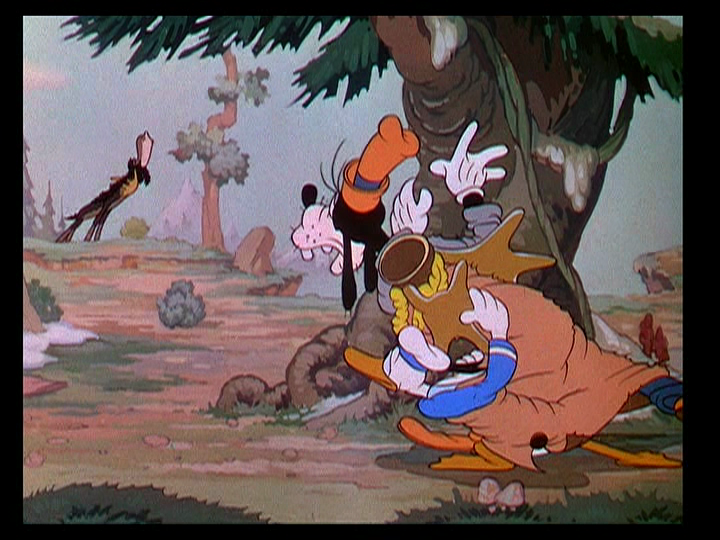
When Goofy gives the moose a “yoo-hoo,” the moose responds in kind, but with a force so strong that it blows the costume away. Goofy quickly comes up with a plan, grabbing leaves and performing a ballet/fan dance until they can retrieve their disguise, which only causes the moose to become even more smitten with their character. Once clothed again, the two continue their seductive walk, succeeding in getting the moose to follow them; unfortunately, the Donald half of the moose ends up falling off a cliff, and lands on a bee when he jumps back on the land. The bee, very unhappy with Donald’s appearance, flies inside the costume, sending the pair into a dance to the tune of La Cucaracha. The moose, angling for a kiss, ends up kissing Goofy on the face, as Donald tries to hit the bee, only to cause the moose mask to fly off Goofy’s head, but luckily land back just in time so their cover isn’t blown. Again, Goofy and Donald have the moose follow them, bringing him back to Mickey so Mickey can “do the rest.”

The moose has been eating Mickey's disguise, leaving him rather nervous about the inevitability of being caught

Unfortunately for the mouse, the moose that thought his disguise was a tasty snack has been eating the disguise, leaving almost nothing for Mickey to hide behind. When the moose takes the last mouthful and sees Mickey holding onto a branch for dear life, he glares at Mickey and gets ready to charge, until he hears a “yoo-hoo” nearby. Turning around, he sees the disguise of Goofy and Donald, becomes instantly smitten, and begins trotting over to “her.” Donald doesn’t see the moose, and keeps trying to pull them away, although Goofy is stuck as the moose cozies up to the front half. Donald emerges, only to see that the moose they’d gotten the attention of, and the moose that just got there, have spotted each other, and are ready to duel for the lady’s hand.

Donald and Goofy try to sneak away and hide up a tree as the two males growl and size each other up before pacing and getting ready to duel with their antlers. The force of their fighting is strong enough to tear the trees from the ground, which causes Goofy and Donald to fall from their perch and land between the two, their disguise blown. “April fool!” Goofy offers weakly, with Donald chiming in with the same sentiment; this does not appease the two males, who decide to take out their aggression on Goofy and Donald. The trio speeds away crazily while being pursued by the two males.