August 28, 1957 – The Special Short Film The Truth About Mother Goose is Released to Theaters
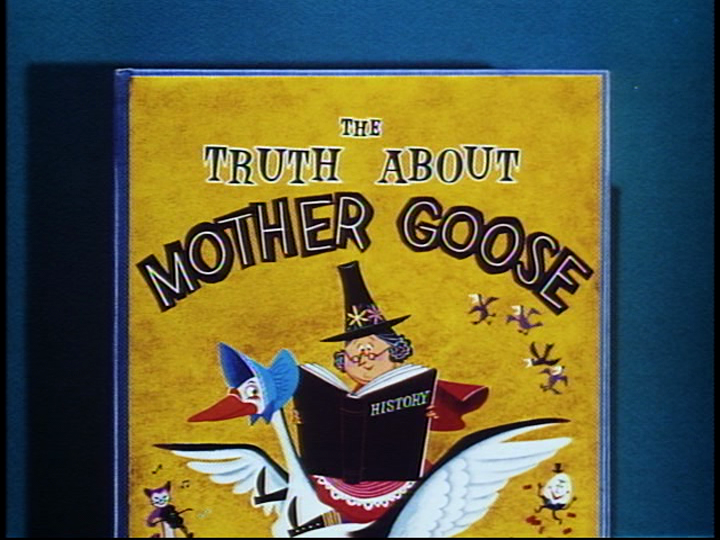
“What’s the truth about Mother Goose? Let’s clear up all the mystery. Her nursery rhymes from olden times are really part of history.”
On August 28, 1957, the special short film The Truth About Mother Goose was released to theaters. It was nominated for an Academy Award, but lost to Warner Brothers’ Birds Anonymous. It was directed by Woolie Reitherman and Bill Justice, with story by Bill Peet.
The short is narrated by three jesters and a voice-over narrator, with the jester singing their intention to give the history behind three popular nursery rhymes. They first begin with Little Jack Horner, which actually goes back to 16th century London. The real Jack Horner was the assistant to a city official, who was to deliver a Christmas present to Henry VIII. In this time period, in was a common practice to bake presents of great value into a pie. Knowing this, Jack pulled out from the pie a “plum,” which was a deed to a valuable estate. When Henry VIII found there was no gift, the city official was punished, and Jack ended up living in his stolen estate, although he may have been haunted by a popular rhyme that was gaining ground in London.
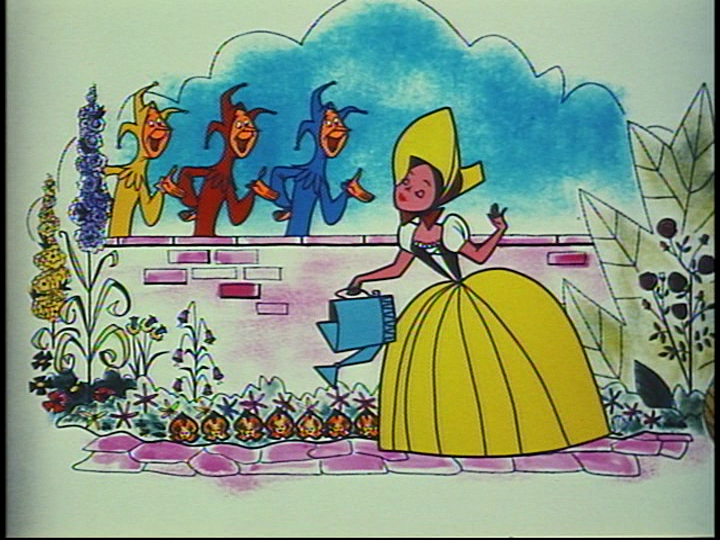
The jesters recite “Mary Mary Quite Contrary” before getting into the history of the rhyme
The next rhyme, Mary Mary Quite Contrary, is actually about the life of Mary Stuart, also known as Mary, Queen of Scots. She came from France to take over the Scottish throne, which was frowned upon by the Scottish court. The “silver bells” refer to Mary’s elaborately decorated attire, the “cockle shells” were a reference to her love of exotic foods, and the “pretty maids all in a row” were Mary’s ladies in waiting. The narrator then tells the tragic tale of Mary, who married Lord Darnley four years after her arrival in Scotland. Her marriage was unhappy, and when Mary found other lovers in a French poet and a court musician, these men were dispatched. She fell in love with the Earl of Bothwell, and after Darnley’s murder, she and the Earl were married. The Scottish people, outraged at Mary’s behavior, forced her to abdicate the throne, and imprisoned her in Lochleven. After a few months, the jailer’s son helped Mary to escape, and she organized an army to gain back the throne in Scotland, but was defeated. She then fled to England to seek refuge with her cousin, Queen Elizabeth I. Elizabeth soon became jealous of Mary, and was accused of being a traitor to the government. She was then executed, “quite contrary” until the end.
The last nursery rhyme discussed is London Bridge is Falling Down. Old London Bridge was built in 1176 to unite the two parts of London. It was finished in 1209, and a chapel was built over the central pier to sanctify it. Several beautiful buildings were also built on the bridge, and it was named a wonder of the world. Merchants would sell their wares on the lower floors of buildings on the bridge, with the upper stories of the buildings being sold as apartments. Celebrations of great moments in British history were also done on the bridge. Living on the bridge could also be hazardous, with the greatest hazard being fire; the worst fire was the Great Fire of London in 1666, when it broke out from the King’s bakery in Pudding Lane. The bridge would soon be rebuilt, but it never would return to its former glory. Its foundations were breaking from water and fire damage, and it was soon declared a public nuisance, ridiculed in rhyme. The bridge was given the declaration to be demolished on July 4, 1823. A new London Bridge would be built, which still stands today.
 disneydetail