RSS Feed

Tag Archives: Goofy

December 26

December 26, 1941 – The Goofy Short Film The Art of Self Defense is Released to Theaters

vlcsnap-2012-12-26-10h21m56s181

“From the earliest dawn of humanity, the cold, unrelenting law of nature has been, and still is, the survival of the fittest.”

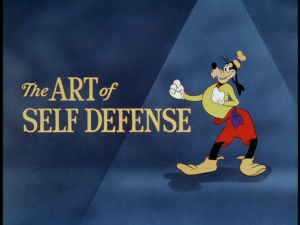
On December 26, 1941, the Goofy short film The Art of Self Defense was released to theaters. This was one of the first shorts to show more than one Goofy-designed character in the same scene. The short was directed by Jack Kinney, and stars John McLeish as the narrator.

The short takes us through the history of man defending himself, beginning with the cavemen. Two cavemen are seen beating each other over the head with a hammer and a club. The scene then travels to ancient Egypt, where moving wall paintings show that man has learned to use his hands for combat, particularly poking the other person in the eye. Reaching the middle ages, two knights are seen clad in armor, hitting each other with maces much as the cavemen did with their clubs. Time rushes forward to the Romantic Age, with two men slapping each other with gloves rather daintily. One of the men gets the idea to put his snuff box in his glove, giving his slap a little more “oomph.” The scene then changes to when boxing came into vogue, but these men, as the narrator puts it, “could fight for only seventy-five or eighty rounds.”

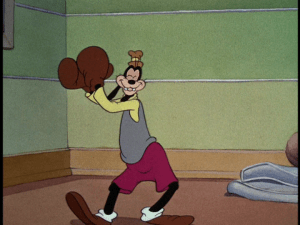
Goofy arrives at the boxing gym, ready to learn all the fundamentals of how to defend himself

Goofy arrives at the boxing gym, ready to learn all the fundamentals of how to defend himself

The audience is then brought to the modern era, with Goofy entering a boxing gym. He starts to punch enthusiastically, until the narrator stops him, informing him that they were learn to box properly, with scientific conditioning. They learn how to breathe properly, but as the narrator gets involved with his own commentary, Goofy breathes in (forgetting to breathe out) to the point of floating like a balloon. When he is finally told to exhale, Goofy sails around the gym as all the air is pushed out. Next, Goofy attempts to jump rope, but ends up tangled. He then tries to punch a double-ended bag, only to have the bag knock him out.

Goofy then shadow boxes – literally – ended up knocked out by his own shadow with every punch shown, from jabs, to crosses, to uppercuts. When the narrator points out there is a rule that no boxer shall ever be hit below the belt, Goofy manages to pull his pants and belt above his head, so there is nowhere for his shadow to strike, but the shadow, after kicking Goofy out of his clothes, manages to win just the same. After weeks of conditioning, the night of the fight arrives, and Goofy steps confidently into the ring. His opponent, however, knocks him out with one punch.

December 24

December 24, 1937 – The Mickey Mouse Short Lonesome Ghosts is Released to Theaters

vlcsnap-2012-12-23-19h32m40s223

“Notice! We exterminate all kinds of ghosts! Day and night service.”

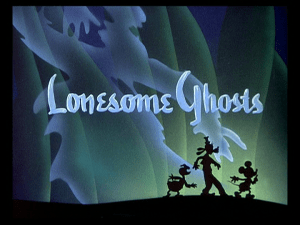
On December 24, 1937, the Mickey Mouse short film Lonesome Ghosts was released to theaters. The short made great use of a new invention of the animation department: transparent paint, which helped give the ghosts a more realistic ghastly appearance. The film was directed by Burt Gillett, and stars Walt Disney as Mickey Mouse, Pinto Colvig as Goofy, and Clarence Nash as Donald Duck.

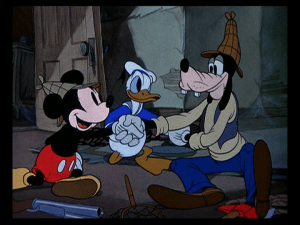
A group of four ghosts in a haunted mansion one winter’s night are bored, until one spots an ad in the paper for a ghost extermination service. Hoping to have new people to scare, they decide to call the service. Meanwhile, at Ajax Ghost Exterminators Headquarters, Mickey, Goofy, and Donald are sitting around the table sleeping when the phone rings. They wake up and scramble to answer it, and readily take the job the ghosts “scare up” for them. The ghosts wait anxiously, and watch with delight as the trio arrives. Mickey and the gang enter the house with trepidation, and hear the ghosts making noises inside.

The trio agrees to split up, hoping that they can divide and conquer the ghosts

The trio agrees to split up, hoping that they can divide and conquer the ghosts

Mickey suggests that the three separate and surround the ghosts, and the three go their separate ways. As Mickey goes one way, he meets a ghost that he tries to shoot it with his shotgun, but the ghost sticks his fingers in the barrel, causing the gun to implode. Mickey then chases the ghost around the house, only to be surprised by all four of the ghost residents. The ghosts had meanwhile taken great delight in scaring Donald with loud noises, although he punches one in the kisser.

Goofy is also startled by the ghosts and their noises, and although he tries to convince himself that he is not scared, he runs and hides when he spots them. He spies a ghost in the mirror who imitates every move Goofy makes. Goofy knows something is wrong with his reflection, but he can’t quite put his finger on it. He finally figures it out, but is unable to fight the ghost. While stuck fighting himself in a dresser, the ghosts push him down the stairs, where he crashes into Mickey and Donald, sending them flying into the pantry. The trio and the dresser fly into barrels of molasses and bags of flour, covering the three entirely. As the ghosts come to admire their handiwork, they mistake the flour-covered three as ghosts and flee the mansion in a panic.

December 20

December 20, 1946 – The Goofy Short Film Double Dribble is Released to Theaters

vlcsnap-2012-12-19-20h11m15s239

“Good evening, ladies and gentlemen. We’re about to witness the basketball battle of the century.”

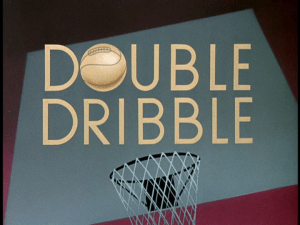
On December 20, 1946, the Goofy short film Double Dribble was released to theaters. The players’ names that are announced by the narrator are actually names of Disney animators, such as “Kinney” for animator and director Jack Kinney. The short was directed by Jack Hannah, with story by Bill Berg and Milt Banta.

The day of the big basketball game arrives, with half of the stadium filled to capacity for the home team, University U, while the visitor side (P.U.) has a solitary fan in the seats. The teams hit the court, practicing their free throws before the game. One tiny player on the P.U. team is excited to play, but the much taller players ignore him as the game gets underway. A replay of one of the plays shows that, in slow motion, the players are much more violent than meets the eye. The game continues, with each team scoring left and right, with the U.U. fans overstepping their bounds as they “assist.” The first half ends, with U.U. leading 16 – 12.

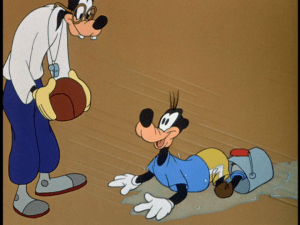
The smallest player, Marathu, is the most enthusiastic, although not the best player on either team

The smallest player, Marathu, is the most enthusiastic, although not the best player on either team

In the second half, the P.U. coach nervously watches as his team members are repeatedly called out by fouls. Finally, the last player he can send in is the shortest member of the team, Marathu. With one minute to go, the score is in U.U.’s favor, 35 – 34. Marathu tries to be involved in the game, but he lags behind his taller teammates. Suddenly, he has the ball – only to have it taken away. He retrieves the ball by untying the string to the opposing player’s shorts, revealing the player’s polka dot boxers. Ball in hand, Marathu makes his way to the basket, with the player in boxer shorts chasing after him. As the opposing player trips and falls, he lifts a floorboard, which sends Marathu flying into the air and in through the hoop – and P.U. wins, 36 – 35.

December 4

December 4, 1942 – The Goofy Short Film How to Fish is Released to Theaters

vlcsnap-2012-12-03-17h25m44s44

“This desire becomes acute only through bodily contact with the cosmic undulations of Pisces, or fishes. This creates a mental malady known as ‘Fishus Febris,’ or ‘fishing fever.’”

On December 4, 1942, the Goody short film How to Fish was released to theaters. It is technically the third in Goofy’s “How To” series. The short was directed by Jack Kinney, and narrated by John McLeish.

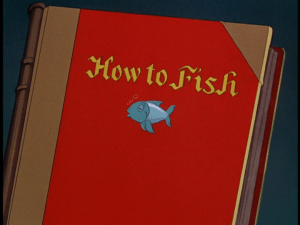
The short, presented as a book, opens as an instructional text all about fishing, including when to fish, which is determined by the zodiac. We then move to Goofy in his study, when he suddenly he has the overwhelming urge to go fishing. On the next page, Goofy is at a lake, having spent an uncomfortable night on the beach, ready to get on the water. The narrator then introduces a trout, who is afraid of his own shadow.

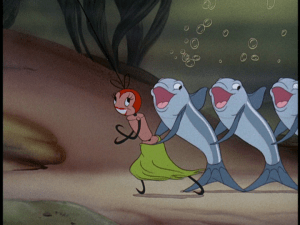
Goofy uses one of his lures to bring the fish to him in a conga line

Goofy uses one of his lures to bring the fish to him in a conga line

Goofy tries to sneak up on the fish, only to fall from a tree and land in the water, with the fish jumping up and attacking his hat, leaving it a tattered mess. The next lesson in the book is about fly-fishing and its many lures, including one that looks like a hula girl and leads the fish in a conga line. Goofy tries to let his line fly, but it hooks around a tree; as he tries to reel his catch in, he ends up in a tangled mess. He then tries to go out with a motorboat, and accidentally hooks his motor. The motor takes off, slicing the boat into pieces, and dragging Goofy all across the lake. However, Goofy is still impressed that he caught something, much to the exhaustion of the narrator.

October 15

October 15, 1937 – The Mickey Mouse Short Film Clock Cleaners is Released to Theaters

“Hickory dickory dock, the mouse ran up the clock…”

On October 15, 1937, the Mickey Mouse short film Clock Cleaners was released to theaters. The short was directed by Ben Sharpsteen, and stars Walt Disney as Mickey Mouse, Clarence Nash as Donald Duck, and Pinto Colvig as Goofy. The short is also notable for being edited; at one point, Donald yells “Says who?” to the spring mocking him, which was misconstrued in the 90s as Donald cursing. However, the Hays Code, adopted in 1930, would not have allowed such language in the first place.

At the top of a high clock tower, the bell rings three o’clock. Mickey is seen on the clock face, standing on the second hand and cleaning the numbers. Inside, Goofy is seen brushing the gears, and Donald grabs a mop to clean the main spring, even though there are several signs telling him to keep off the mainspring. As he cleans the spring, his mop gets caught, and as he pulls it loose, the spring uncoils, trapping Donald inside.

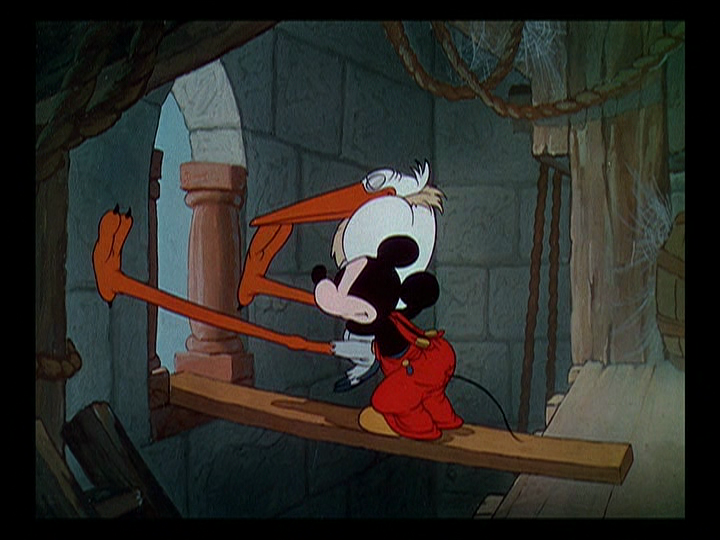
Even while sleeping, the stork is able to outwit Mickey as the mouse tries to throw the stork out of the clock tower

Mickey begins sweeping inside, and hears snoring from nearby gears. He spies a stork asleep in a nest above some gears, and tries to wake it. The stork ignores Mickey, continuing to sleep, and eluding the mouse with every move. The stork then throws Mickey out the window. As this happens, Donald attempts to put the spring back together, only to have it taunt him and knock him into the cogs nearby. Donald is knocked back and forth, and is unable to stop moving his body back and forth after being thrown from the cogs.

Goofy is seen cleaning the bell of the tower, when it strikes four o’clock. He is hit in the head by the mechanical statues that ring the bell, and begins to walk around in a daze. Mickey notices just in time that Goofy is about to fall off the building, and begins to run around after him, preventing him from falling to his doom. Unfortunately, Goofy falls through a missing ring in a ladder, only to be shot back up by a flag pole, sending him and Mickey flying into the clock tower. They land on the main spring, just after Donald finally got it back together, and all three are sent flying into the cogs the Donald was knocked into before, unable to stop their bodies from dancing back and forth from the cog’s motion.

October 9

October 9, 1942 – The Goofy Short Film The Olympic Champ is Released to Theaters

“The ritual of the Olympiads demands that this heroic flame shall not become extinguished, but shall be kept burning at all costs, serving as a beacon whose unfailing light shall guide all athletes in fair play and clean sportsmanship…”

On October 9, 1942, the Goofy short film The Olympic Champ was released to theaters. It was directed by Jack Kinney, and stars John McLeish as the narrator.

Our narrator takes us back in time to Mt. Olympus, the birthplace of the Olympic Games. The first person we see is the torchbearer, who takes it all across the world, from Rome to China. The torch is then brought to a present day Olympic coliseum, where the narrator goes into a speech about how the Olympic flame must never be extinguished. During this, the flame burns down to Goofy’s hand, and extinguishes.

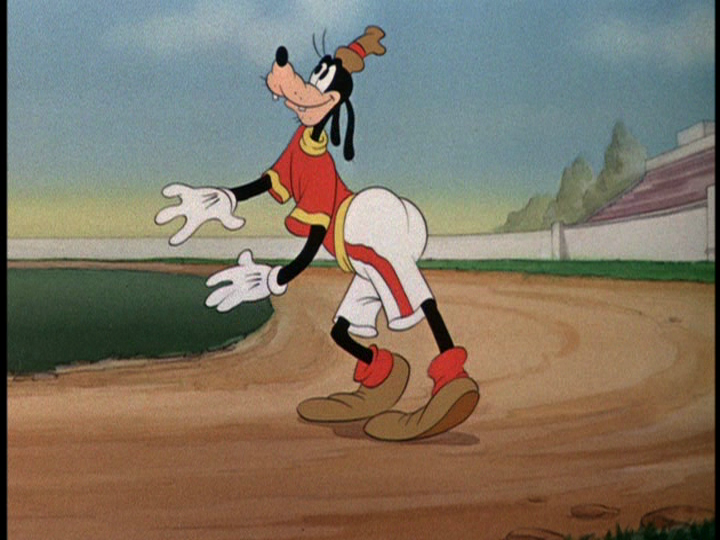
Goofy, in an attempt to show running form, ends up dancing all over the track

The first Olympic event we see is the racer, with Goofy first acting as a sprinter, then a long distance runner, a marathon runner, then a walker. Goofy then ends up dancing all over the field. After the runner is the hurdler. Goofy begins to jump the hurdles, but after catching one on his foot, he ends up carrying all the hurdles with him to the finish line. Pole vaulting follows this, with Goofy holding to the top, trying to cross the bar as he sits at the top of the pole. He is accidentally catapulted into the sky, but is able to land safely. Goofy then attempts the hammer-throw, but ends up destroying everything in the field and drilling himself into the ground, striking oil as he does so.

The last event is the decathlon, culminates in Goofy not only destroying more Olympic equipment, but landing headfirst into the scoreboard, knocking down all of the trophies. Goofy is unharmed, however, standing up with a smile and revealing a shiny trophy under his hat.

September 27

September 27, 1947 – The Ninth Animated Feature Film, Fun and Fancy Free, is Released to Theaters
“So if you’d really like to be happy-go-lucky just like me, drown your frowns my friend and you will see, you’ll see, that you’ll be full of fun and fancy-free.”

On September 27, 1947, the ninth animated feature film, Fun and Fancy Free, was released to theaters. It was the second package film released by Disney, comprised of two stories: Bongo (written originally by Sinclair Lewis), and Mickey and the Beanstalk, a retelling of the classic tale Jack and the Beanstalk. The two were originally meant to be full-length features of their own. Although Mickey was in the feature film Fantasia, this was the first time Goofy and Donald were also used to carry a feature film. As the story was tightened, many scenes were dropped, including the scene where Mickey receives the magic beans for his cow from none other than Minnie Mouse, playing the queen. The two stories were stopped in development when the country entered World War II. The live action segments were directed by William Morgan, with the animation sequences directed by Jack Kinney, Bill Roberts, and Hamilton Luske. The film included the talents of Anita Gordon, Cliff Edwards, Billy Gilbert, The Kings Men, the Dinning Sisters, and the Starlighters, as well as Edgar Bergen (ventriloquist for Charlie McCarthy and Mortimer Snerd) and Luana Patten. This film also marks the last time Walt Disney voiced the character of Mickey Mouse, as he would have sound effects man Jimmy MacDonald take over the role.

The movie begins with the voice of Jiminy Cricket ringing out, singing about being happy-go-lucky, and begins to sing and dance around a library, expressing his sadness about the whole world worrying about so many things. “But why get so excited,” he asks. “What’s going to be is going to be.” Unfortunately, he runs into a cat that chases him out of the library. He finds himself in a girl’s room, coming across what he calls a “deadpan doll and a droopy bear.” To cheer them up, he puts on a record about the story of Bongo, a musical story sung by Dinah Shore.
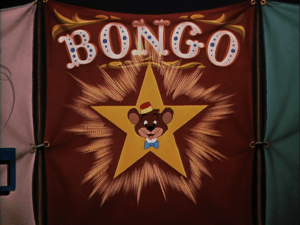
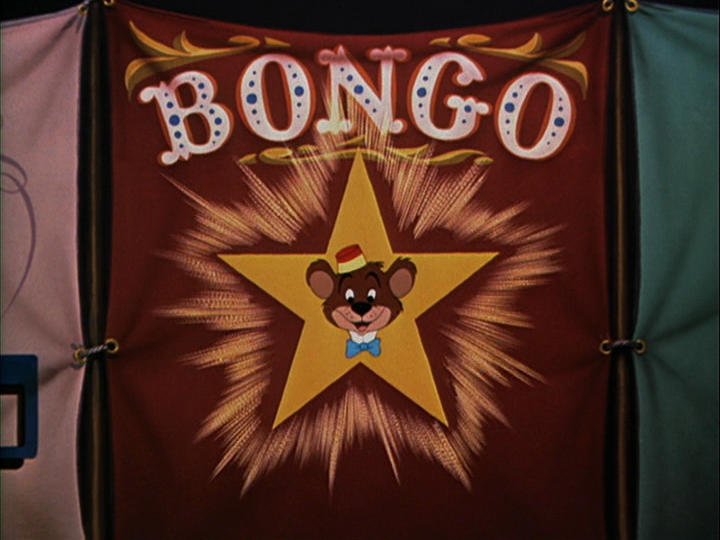
The story of Bongo begins with his days in the circus, where he was the star

Bongo is a circus bear: “he was born in the circus, grew up in the circus; in fact, Bongo was the star of the circus.” Bongo was seen as being able to do it all, with the circus tent packed with fans that wanted to see him perform the greatest of stunts. But although Bongo appeared thrilled with what he was doing, he was a prisoner of the circus, kept in a cage. He spent his nights dreaming of a place where he was free from the circus life. One fateful day, he decides to answer the call of the wild, and escapes from the circus train. Finally free, he explores the woods where he landed, smelling the flowers and leaping over tree roots. Unfortunately, Bongo doesn’t know how to survive in the woods, but he’s still elated to be out in nature. He soon makes friends with the animals of the forest, and they walk around, exploring their surroundings.

Unfortunately, life in the woods is not as pleasant as Bongo thought, as at first he is unable to get to sleep, then finds himself caught in a storm. He becomes discouraged that his dream life wasn’t the way he thought it would be, and even more discouraged that he can’t even catch food like a real bear would. As he tries to catch a fish, he hears the giggle of a young female bear named Lulubelle, and begins to follow her as she flirts with him. The two quickly fall in love, but there is one problem: Lumpjaw, the roughest, toughest, meanest bear in the woods, who wants Lulubelle all to himself. After some mixup, Lulubelle ends up in Lumpjaw’s arms, with Bongo being left heartbroken, as he didn’t understand the way of bears (bears express their love by slapping). Lulubelle sneaks away from the bears to find Bongo, and a fight ensues between Bongo and Lumpjaw, with Bongo using his circus skills to win. Lulubelle and Bongo live happily ever after in love.
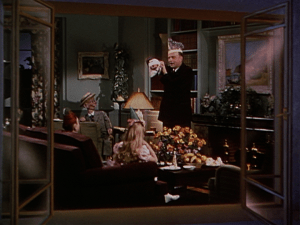
Jiminy decides to attend a party hosted by Edgar Bergen (C), with his puppets Charlie McCarthy and Mortimer Snerd, with Luana Patten as the guest

After the story ends, Jiminy comes across a party invitation for Luana Patten at Edgar Bergen’s house across the way, and decides to attend himself. Bergen is entertaining Luana, Mortimer Snerd, and Charlie McCarthy, and decides to tell the group a story: Mickey and the Beanstalk. He has Luana create a picture in his mind of Happy Valley, where Mickey, Goofy, and Donald live. Happy Valley was a prosperous place, with a magic singing harp residing in its castle, casting a spell of joy over the entire valley. One day, a mysterious shadow appears in Happy Valley, and steals the harp from the castle. Once the harp is stolen, the valley loses its joy and prosperity. The audience is taken inside the cottage of Mickey, Goofy, and Donald, sharing a pitiful meal. Unable to take it anymore, Donald loses his cool, going mad with hunger and desperation. He takes the axe from the wall and decides to kill their beloved cow.

The next day, Mickey decides to take their cow to market, with Goofy and Donald hopeful that they will be able to afford food. When Mickey comes home, however, he informs them that he sold the cow for magic beans. Donald loses his cool again, throwing the beans away. Once the moon hits the spot where the beans fell, however, a giant beanstalk begins to grow, destroying their house in the process and sending the trio sky high. When morning comes, the three are amazed to see a castle in the sky, and decide to explore. After surviving an attack a giant dragonfly, the three reach the castle steps and climb inside. They discover that the banquet table is covered in food, and don’t hesitate to eat the best meal they’ve had in ages. They also discover the harp being held hostage in a treasure box nearby, and she warns them about the giant, as he has the ability to turn himself into anything he wishes.
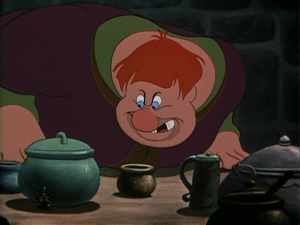
The giant suddenly appears, and looks around the table for the trio

Suddenly, the giant appears, singing a simple song about himself and adding the words, “Fe Fi Fo Fum.” He smells the scent of the trio and searches for them, but gets distracted by the food on the table and begins to eat. He catches Mickey, but with Mickey’s quick thinking, he’s able to escape, tricking the giant into changing into a fly. However, the giant would rather change into a pink bunny rabbit, and when he spies the trio with a flyswatter, he catches them and throws them into the treasure box, keeping the harp out for her to sing him to sleep. With the harp’s help, Mickey is able to free his friends and escape with the harp. The giant wakes up as they begin their escape and chases after the three. When the trio makes it to the bottom of the beanstalk, they grab a saw and begin to chop the beanstalk down, sending the giant tumbling down to earth. Happy Valley is returned to its peaceful and prosperous state.

As Bergen finishes telling the story, he notices that Mortimer begins to cry over the death of the giant. Bergen tries to explain that the giant never existed, and is succeeding until the roof of his house lifts, and the giant appears, asking the group if they’ve seen a mouse. Bergen faints, and the giant leaves, exploring Hollywood for signs of Mickey (and taking the Brown Derby restaurant with him as a new hat).
September 7

September 7, 1945 – The Donald Duck and Goofy Short Film No Sail is Released

“Oh, give me the flashing brine, the spray, and the tempest’s roar, a life on the ocean wave, a home on the rolling deep…”

On September 7, 1945, the Donald Duck and Goofy short film No Sail was released to theaters. The film is one of the few listed under only Donald Duck’s filmography, even though it’s a double-billed short film. It was directed by Jack Hannah, with story by Dick Kinney and Ralph Wright. Clarence Nash stars as Donald Duck, and Pinto Colvig stars as Goofy.

Donald and Goofy arrive at a dock with several sailboats, and Donald deposits five cents in their chosen boat. Once the money has been inserted, the mast shoots out from the deposit box, and the boat zips away into the ocean. Goofy and Donald continue to sing their sea chantey as they sail quickly; unfortunately, the five cents only covers a short amount of time, and the mast returns to the deposit box. Donald pays again, and they soon go off and running, until the time runs out again. The mast lands on his head after he pays, so he kicks it, sending it flying back into the box. As Donald searches for another nickel, he soon realizes that he is out of change, and he and Goofy are stranded.

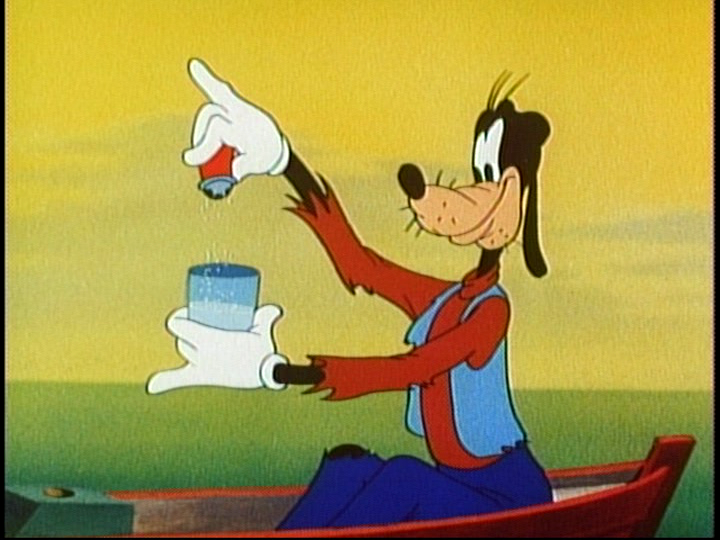
Goofy startles Donald when he declares that the ocean water he’s drinking needs more salt, then pulls a salt shaker from his pocket

Nighttime comes, and the two are still out in the open ocean. When the sun rises the next morning, Donald is nearly delirious with thirst. Goofy grabs a cup and attempts to drink the salt water, although Donald tells him not to. Goofy takes a sip and, to Donald’s surprise, proclaims it needs more salt. In the distance, Donald hears the sound of a boat approaching them, and they call out it. As Goofy waves his shirt, a nickel falls out of his shirt pocket. Donald chases after it, but it falls into the ocean, leaving them again stranded. Donald then looks up to see Goofy waving at the passengers as the ship sails by.

As the sun bears down on them, Donald is going mad. A fish lands on their boat, and the two argue over it, until a passing seagull eats it from their hands. Goofy attempts to kill the seagull for food, but the gull flies away unscathed. Out of nowhere, a shark appears, circling their boat. As Donald looks, several sharks have decided to circle their boat, until Goofy grabs one of their fins, realizing that the sharks aren’t real. Donald attempts to pick up a fin, and ends up staring a shark straight in the teeth. Goofy then decides that they can go fishing, and accidentally hooks Donald by the shirt and sends him flying into the water among the sharks. Donald tries to avoid getting eaten while Goofy attempts to untangle his line. At this point, Donald has had enough. He demands that Goofy let him down, so he does – beak first into the coin slot. This lets loose the mast, and the two sail home, although Donald isn’t too happy with how they accomplished such a feat.

August 26

August 26, 1949 – The Goofy Short Film Tennis Racquet is Released to Theaters

“Well, good afternoon, ladies and gentlemen. This is your sportscaster bringing today’s match to you [through] the courtesy of the BBB and BB Ball Company, which we will see in use today on this magnificently kept court, whose grassy lawn lies outspread before my very eyes.”

On August 26, 1949, the Goofy short film Tennis Racquet was released to theaters. It was directed by Jack Kinney, with the story by Dick Kinney.

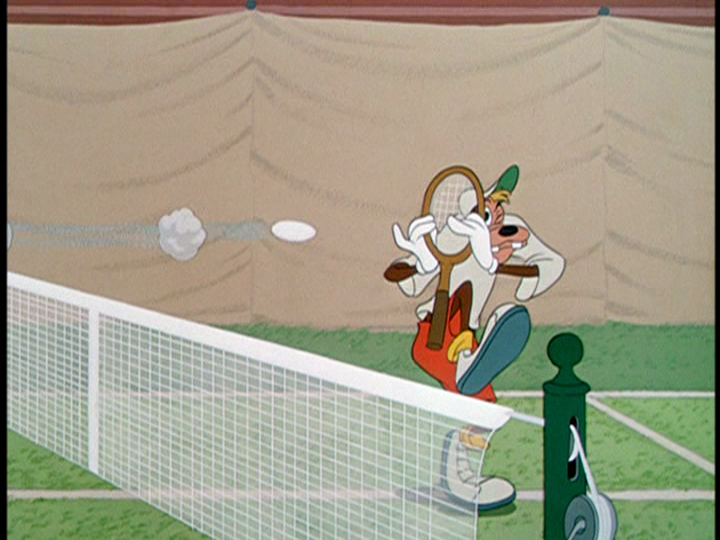
The sportscaster begins his broadcast before the tennis match starts, as the court is being prepared for the match. As he comments on how many people are waiting to watch the match, the camera pans to the road leading to the tennis club, which is completely packed with cars. Unfortunately for the tennis club, however, everyone seems to want to go to the nearby flower show instead. We see audience members crowding into their seats, but only in one small section of the bleachers in front of the sportscaster’s booth.

One of the competitors, Little Joe, uses his tactic of protecting himself to play the game

The contestants Little Joe and Big Ben come out to the field, and when the match starts, the sportscaster goes crazy with the descriptions, while the crowd’s heads follow the ball. The two have different styles of playing the game, the sportscaster notes, with Big Ben delivering hard and fast serves, while Little Joe tries to avoid getting hit by the ball. Little Joe wins the first game, and Big Ben wins the second. After a bit, the crowd cheers, blocking the sportscaster’s view of the game, and he has to ask a spectator for the score. While the two competitors play, a gardener continues to take care of the court, planting trees and spreading out grass seed.

The game’s pace quickens, so the sportscaster decides it’s time to view it in slow motion, with many comical side effects. Moving it back to real time, the game really heats up between the two, until the crowd cheers. The sportscaster is all ready to crown the champ, when he realizes he doesn’t know who the champ is, and has to ask the spectator again. Big Ben is the winner of the match, and Little Joe does not take this news well; however, the short ends with the two shaking hands, while the gardener hauls off the trophy and the contestants in his wheelbarrow.

August 17

August 17, 2004 – The Direct-to-Video Film Mickey, Donald, Goofy: The Three Musketeers is Released

“You see, before their dream can come true, our three heroes must learn the real meaning of the musketeer creed. All for one, and one for all!”

On August 17, 2004, the direct-to-video film Mickey, Donald, Goofy: The Three Musketeers was released on VHS and DVD. It was produced by DisneyToon Studios and directed by Donovan Cook. The story is based on The Three Musketeers by Alexandre Dumas, and was adapted by David M. Evans and Evan Spiliotopoulos. Vocal talents include Wayne Allwine as Mickey Mouse, Tony Anselmo as Donald Duck, Bill Farmer as Goofy, Russi Taylor as Minnie Mouse, Tress MacNeille as Daisy Duck, Jim Cummings as Pete, and Rob Paulsen as the Troubadour (narrator). The songs of the film are interpretations of well-known classical pieces; the opera in the film is Gilbert and Sullivan’s Pirates of Penzance.

The story begins with a crew preparing for Masterpiece Theater kind of program, and a turtle is seen sitting in a chair, reading a comic book of the story and singing loudly. He helps to bring the narrator of the show to the set, but when the narrator falls down a trap door, the turtle begins to tell the story from his comic book, of Mickey, Goofy, and Donald, and their goal to become musketeers. Their childhood is in the gutter, and one day as they are attacked, the musketeers save them. Inspired by their bravery, the trio swears they will become musketeers.

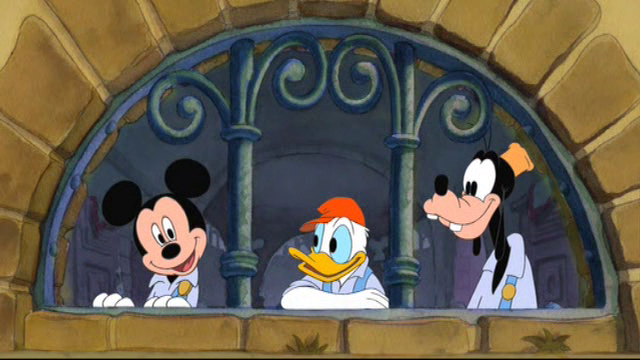
Mickey, Donald, and Goofy watch the musketeers as they go through their training drills, dreaming of the day they will join

Years later, the three still dream of the day they will be musketeers, but instead are janitors, constantly getting themselves into trouble, although they always have the best of intentions. Pete, the Captain of the Musketeers, is constantly annoyed with the trio and their accidents, and refuses to ever let them become musketeers. Meanwhile, at the palace, Princess Minnie is sitting and daydreaming about her one true love, while Daisy, her lady-in-waiting, sounds off as the voice of reason. Minnie strolls through the garden, daydreaming about the day she’ll meet him, when she narrowly misses getting hit by a safe. The Beagle Boys, the villains that attempted to crush the princess, report to their boss of their failure – with their boss just happening to be Pete. His plan is to kidnap the princess, then become king in her absence. Fortunately, they weren’t supposed to kill her anyway, but Pete replaces them with Clarabelle Cow.

The Princess calls Pete for a meeting, demanding that he provide musketeer bodyguards. Pete stalls for time, but tells Minnie that she will have bodyguards very soon. He surprises Mickey and his friends with the opportunity they’ve been dying for: to be musketeers. Pete believes that their incompetency will help his plan in becoming king. The trio arrives at the palace, and immediately gets into trouble when Goofy attacks a suit of armor, thinking it’s a bad guy. The door opens to reveal the three trying to put the armor back together again, and the moment Minnie and Mickey see each other, it’s love at first sight. The mood is broken when Daisy enters the room with a snack and, upon seeing the knife she carries, the trio attacks her, thinking she’s a bad guy. Although Minnie is furious at the infraction, she forgives them after hearing Mickey’s apology.

After Mickey rescues the princess, they take a romantic journey back to the palace, with romance blooming between the two

When the trio escorts Minnie and Daisy on a trip through the country, they are ambushed by the Beagle Boys. Mickey fights bravely, but the Princess and Daisy are captured. Goofy cries, thinking they’ve failed, but Mickey rallies their spirits and they track down the girls at a decrepit tower, and launch a brave, if purely accidental, rescue. Romance begins to bloom between Mickey and Minnie as they travel back to the palace, culminating in Minnie giving Mickey a kiss. When Pete sees that his kidnap plan has failed, he switches gears: he needs to get rid of Mickey, Donald, and Goofy, picking them off one by one. Goofy is tricked by Clarabelle and taken to drown in the Seine. Donald is scared off by the Beagle Boys, but hides in a suit of armor. When he sees Mickey, he tries to convince his friend that they need to run away. He tries to explain that Pete is the bad guy, but Mickey can’t understand Donald. Finally, he understands, but Mickey refuses to leave his post. Donald, unfortunately, decides to run, too afraid to stay.

While Mickey remains at the palace, Pete captures him and chains him in the basement of a decrepit castle that will fill with water when the tide comes in. Pete then heads to the opera, where he will trick the people of France into believing that Minnie has abdicated and declared him king. Clarabelle, on the other hand, is trying to drown Goofy, when Goofy falls for Clarabelle at first sight. She tries to resist his charms, but she can’t. Quickly, she tells him of how he needs to save Mickey. The bridge they’re standing on breaks, and as luck would have it, Donald is in a rowboat right underneath them.

The trio fights with Pete for the trunk, which contains Minnie and Daisy

The tide has begun to rise in the dungeon, and the Goofy and Donald race to save Mickey. Donald, still afraid, still tries to run away, but Goofy and the Troubadour are able to convince the duck to get over his fears and save their friend. They reach Mickey just in time, and they all race off to save the princess. When Minnie and Daisy arrive at the opera, they are quickly kidnapped by Pete and his henchmen, who lock the girls away in a trunk. One of the Beagle Boys, dressed as Minnie, declares Pete to be the new king. The show begins, and the trio arrives just in time, beginning an epic swordfight onstage during the opera. The swordfight ends with Pete battling Mickey one-on-one. While it looks like Mickey has been beaten, Goofy and Donald reappear and help Mickey defeat Pete and his evil scheme.

It’s a happy ending for all, and Mickey and Minnie have fallen in love, as well as Goofy and Clarabelle. Donald, meanwhile, gives an embarrassed smile to Daisy, who surprises him by taking him in her arms and kissing him. Mickey, Donald, and Goofy are made official musketeers, as thanks for saving France. The movie ends with a heroic song and dance with all the musketeers.