Welcome to 2012, the first post of the year as well as the first post of the blog! Of the many areas I could have spoken about today, I could not decide between these two. Read and enjoy!
January 1, 1904 – Birth of Disney Legend Grace Bailey
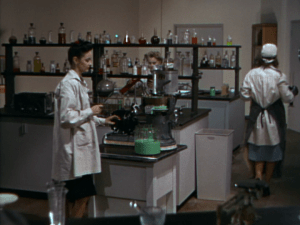
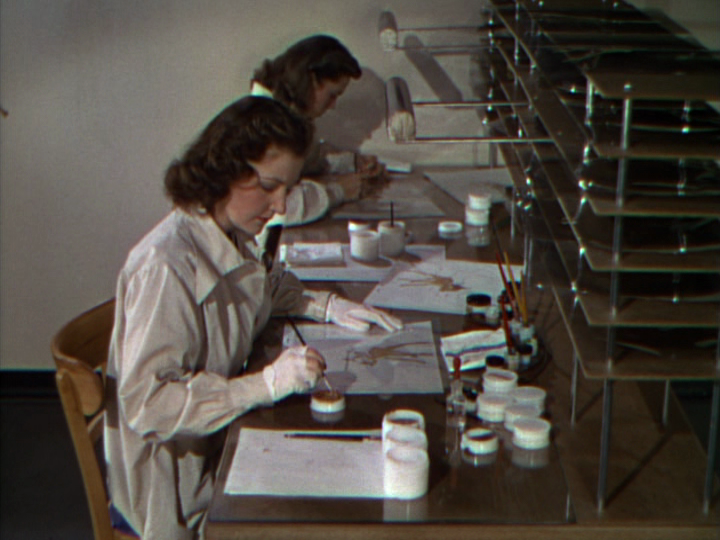
Disney Legend Grace Bailey Turner, born Elizabeth Grace Randall, is known for her work in the Ink and Paint department. She began working at Walt Disney Studios in 1932, rising through the ranks of the department to painting supervisor, then inking supervisor, and finally head of the department in 1954. She held this position until she retired in 1972, after 40 years of work with the company. She died on August 23, 1983, and was inducted posthumously into the Disney Legends on October 12, 2000.
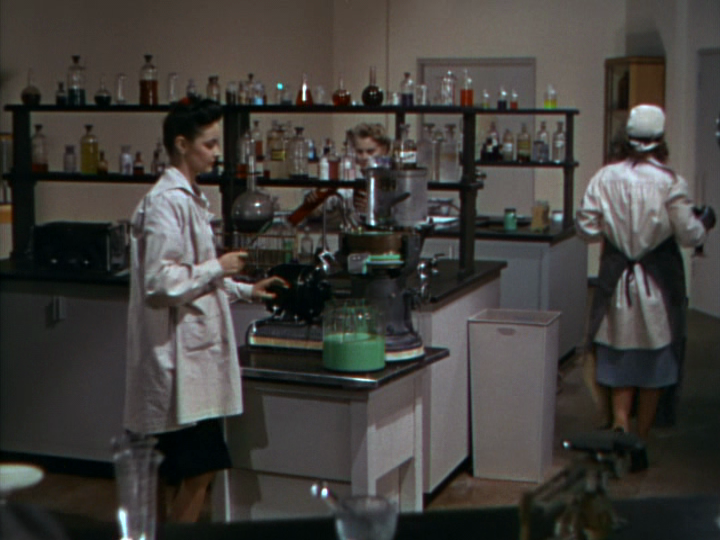
After the success of Flowers and Trees, Disney’s first Technicolor animated short, Bailey was tasked with the important duty of expanding the studio’s catalog of colors. Walt had made a deal with Technicolor to have exclusivity of the three-color process in animation for two years, and one can only imagine the challenges Bailey faced when dreaming up new colors. Betty Kimball, former Studio painter, said in an interview that “[e]verything was so unscientific back then. We were just creating, and it was fun.”
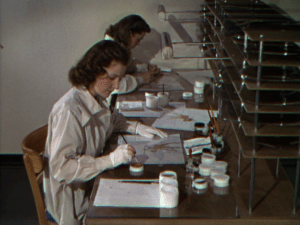
I was rather excited that my first post could be on Grace Bailey, for several reasons. Firstly, many people voiced complain that there are no important women in Disney’s history – my answer is that they’re not looking hard enough. Although the Ink and Paint Department was mostly, if not all, women, this does not mean their work was thought of as any less important. After watching scenes from The Reluctant Dragon, it’s easy to see that there was a lot of work that went into mixing and creating the new hues to bring animation to a higher level. The Ink and Paint department was highly important when it came to an animated film: inking could take about 12 months to learn properly, and one had to be very precise to preserve not only the animator’s original drawing, but also the emotion the animator wished to invoke. To say that women did not have an important role, or that there were hardly any important women, seems to ignore all of the work these women did. Bailey was an important part of Disney history, and I’m proud to put her in the spotlight today.
January 1, 1943 – Release of Der Fuhrer’s Face to Theaters
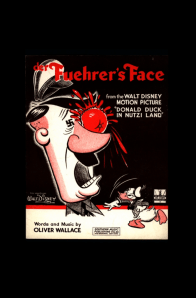
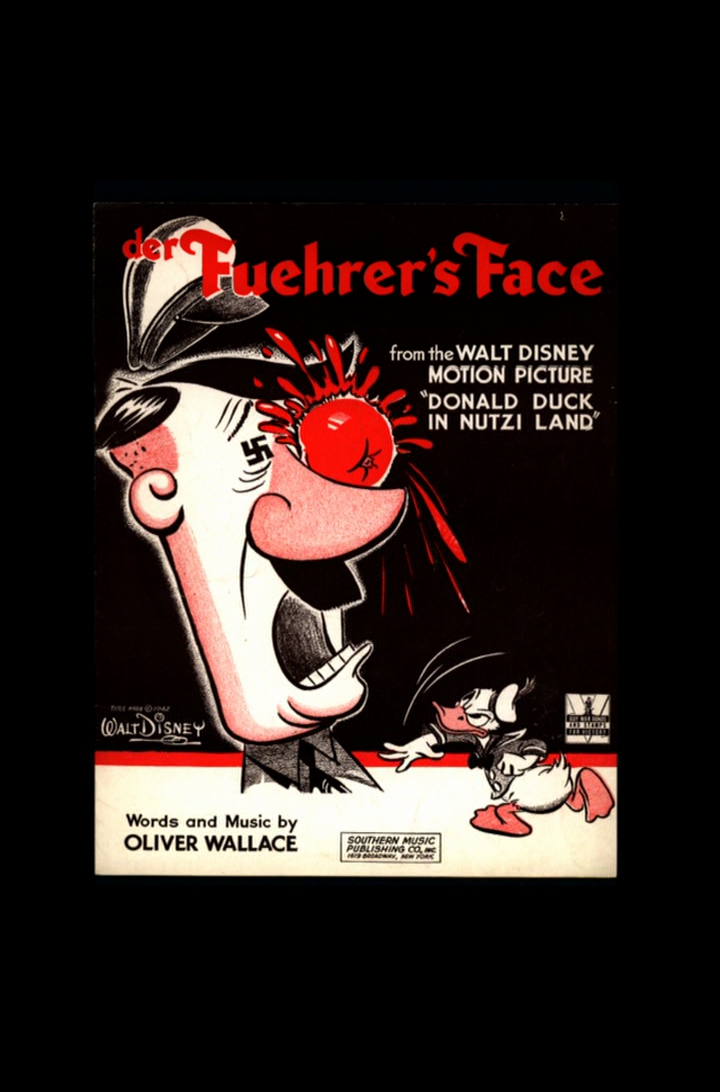
A prime example of homefront propaganda from World War II, Der Fueher’s Face was released to movie theaters on January 1st and was not only immensely popular, but it also won the Academy Award for Best Animated Short Film at the 15th Academy Awards. Directed by Jack Kinney, the short, in which Donald Duck has a nightmare that he resides in a country controlled by the Nazis, was originally called Donald Duck in Nutzi Land. The name was changed, however, when the title song for the short, written by Oliver Wallace, became a runaway hit after a record by Spike Jones was released (although the film preceded the record). According to Disney Legend Joe Grant, the short was inspired by the Charlie Chaplin film, Modern Times, especially the scene with Donald working on the belt line.
In this excerpt from the introduction to the short, film critic Leonard Maltin explains:
“It’s easy to see why the film was so popular. It’s very, very funny, reducing the serious tenets of Hitler’s Nazism to slapstick absurdities. And it gave audiences a chance to think, as Donald does, about the freedoms they might have taken for granted.”
As was common of propaganda films of the time, there are caricatures of Hirohito, Mussolini, and Nazi soldiers. This was a common tactic that is still seen today: the enemy is mocked to reduce the public fear and make the enemy less fear-inspiring. It was a good way to allow panicked Americans at that point a chance to laugh in the face of their fears.
One rumor that persisted about the film is that it was banned from being released to the public after the war. While the short was kept out of general circulation for many years because of its propagandistic content, it was released on the DVD set On the Front Lines in the third wave of Walt Disney Treasures, and was released again on the DVD set The Chronological Donald, Volume Two.
I find the work of the Disney Studios during WWII fascinating, from the propaganda shorts to the training films. All of these films helped Americans through their fear with laughter, and encouraged them to buy war bonds and support the troops through other methods. This short in particular conveys the message that Americans needed to be thankful for the freedoms they had and understand why they were fighting. America had been trying to stay out of the war until Pearl Harbor; these films helped rally the American Spirit.
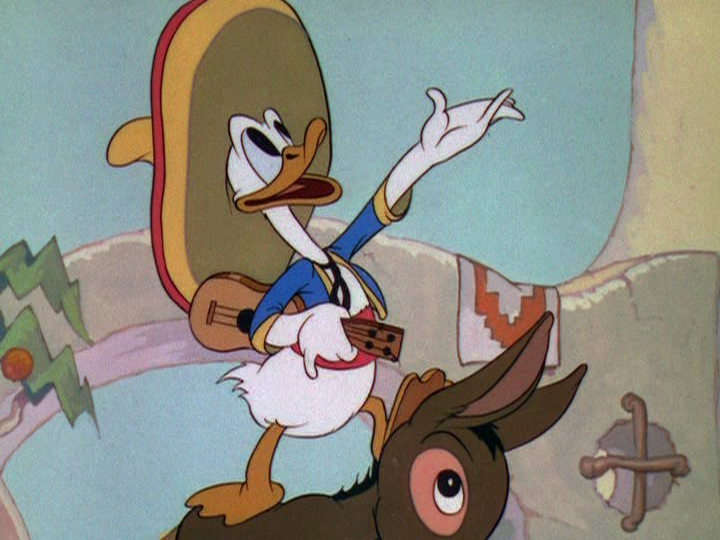
One thing that also interests me about this short is the use of Donald Duck. Donald was an international star at this point, received well all over the world. Donald’s character works well for this kind of satire. His inability to keep from muttering under his breath as he deals with the insanity of Nutzi Land suits the story and creates a more humorous impact than if the usually cheerful, uncomplaining Mickey Mouse had been the main character. Audiences would have been sad to see our favorite mouse in Hitler’s clutches.
With grumpy, grousing Donald as the main character, Der Fueher’s Face allowed audiences to find humor in the face of fear.
 disneydetail