RSS Feed

Tag Archives: 1940s

June 3

Posted on

June 3, 1949 – The Donald Duck Short Winter Storage is Released to Theaters
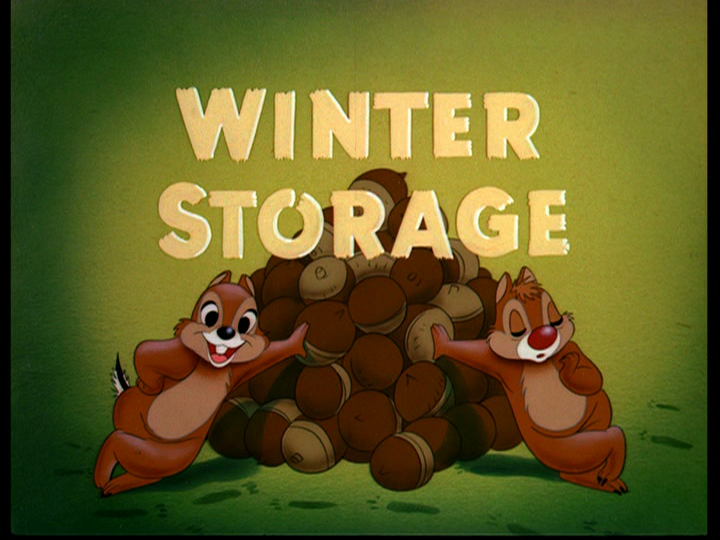
“Oh boy, oh boy! I finally got them!”

On June 3, 1949, the Donald Duck short film Winter Storage was released to theaters. It features Chip and Dale as Donald’s adversaries, their third short with Donald. It was directed by Jack Hannah, with the story by Bill Berg and Nick George, and music by Oliver Wallace. It featured Clarence Nash as the voice of Donald, and James MacDonald as the voices of Chip and Dale.

It’s autumn in the woods, and Chip is busy, storing nuts in a giant oak tree for the approaching winter. According to his calendar, it’s October 7th, and he hasn’t gotten very far with his collection. He passes by a matchbox in the tree that seems to be snoring, and opens it to find Dale fast asleep. Chip kicks the matchbox out onto the main branch, and Dale quickly sets to work picking the acorns from the tree. As Chip collects, he is suddenly thrown off stride by an acorn cap hitting his head.
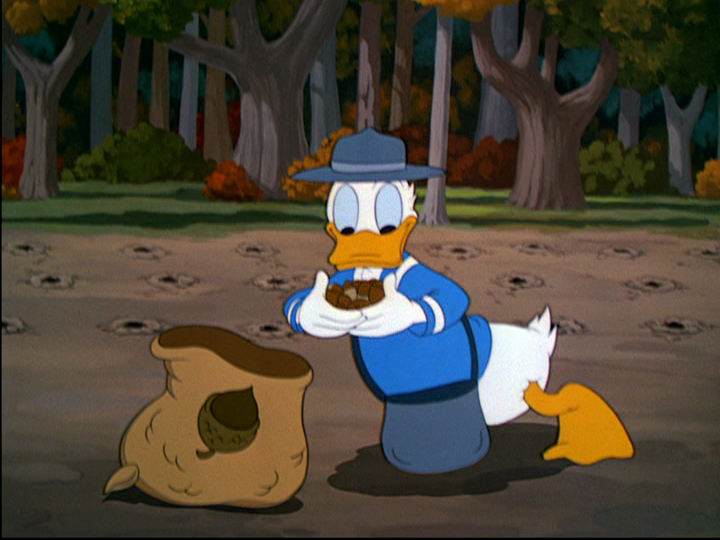
Donald with his bag of acorns to plant in the area

Chip storms out to ask Dale where the acorn went, and Dale points to the tree – every acorn is gone, save for their caps. Chip grabs Dale and pulls him to the calendar, explaining that they have to collect enough food before December 1st, otherwise it will be an awful winter. He then begins to pace, wondering what they’re going to do about their food problem. The pair hears a strange sound outside, and rush out to see Donald standing near their tree, holding a map marking an area that needs to be seeded. With him is a giant bag of acorns used for planting.

The pair becomes excited, and they rush down the tree, digging up the acorns Donald has planted, intending to them back to their food pile. Dale, being a bit slow-witted, decides to replant the acorns, following Donald’s example. When Chip finds out what Dale has done, he gives him a good hard kick before coming up with the next plan: following the acorn bag and collecting the nuts. Dale, however, pulls a loose string from the bottom of the acorn bag and lets all the nuts spill out over Chip, who is not the least bit amused.
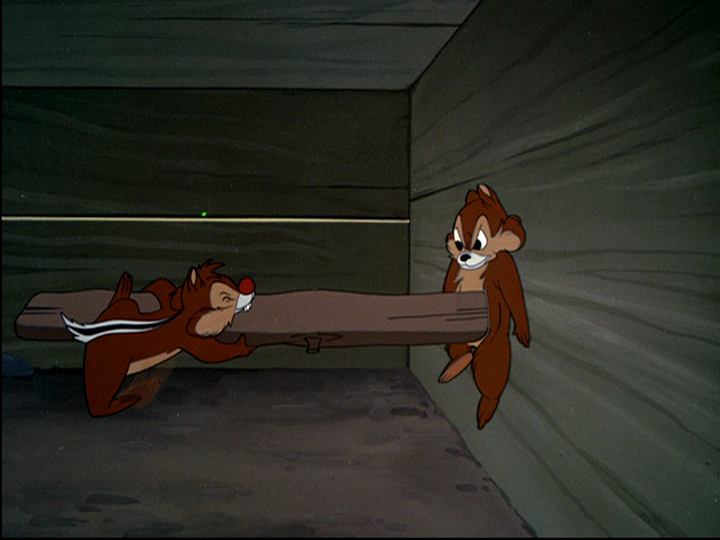
Although he has the best intentions, Dale accidentally traps both of them in the box again

Donald looks to see that his bag is entirely empty, and spots the two chipmunks creeping away with all the acorns in their own bag. He carefully follows them and sets out a trap to catch them, after taking the bag back, but Chip is able to spot the trick. However, Dale unwittingly gets Chip caught in the box, and when Chip makes a successful attempt to free himself, it’s Dale that gets both of them trapped inside.

As Donald rushes over to see his capture, the two dig into the dirt and tunnel out of the box, only to find themselves under it again when Donald has moved it. The two begin to argue, and Donald looks under the box to see his capture. He moves the box away, just observing their little quarrel, wondering if they’ll notice that they are, this time, free. The two face away from each other, silent, and Donald provokes the fight again by pulling Chip’s tail. This causes their argument to become physical, but Dale accidentally ends up punching Donald in the eye.
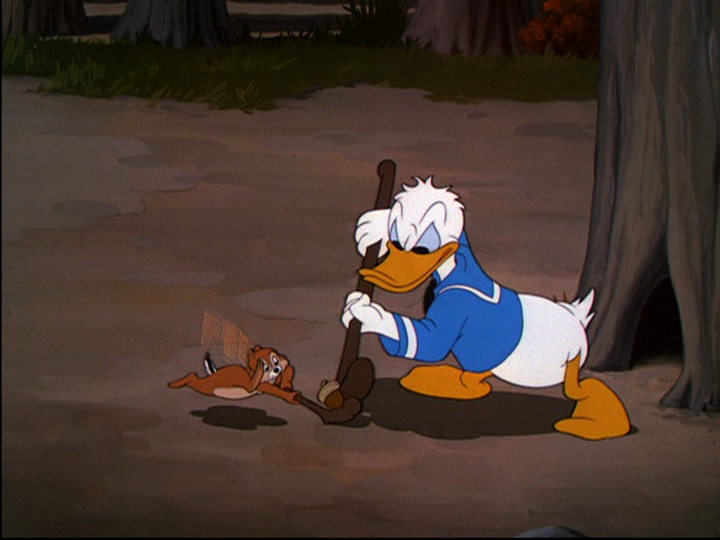
Donald begins to play a game of hockey with the pair with the stolen acorns

The two critters escape and make their way back to the tree with more acorns, and Donald hot on their tails. They begin to play a game of hockey with Donald, trying to shoot the nuts into the hole at the base of the tree. A sudden avalanche of nuts, directed by the chipmunks, approaches, and Donald has no time to prepare. The poor duck is knocked out, and seemingly driven mad, and the two chipmunks are happy they have enough food for the winter.
May 27

Posted on

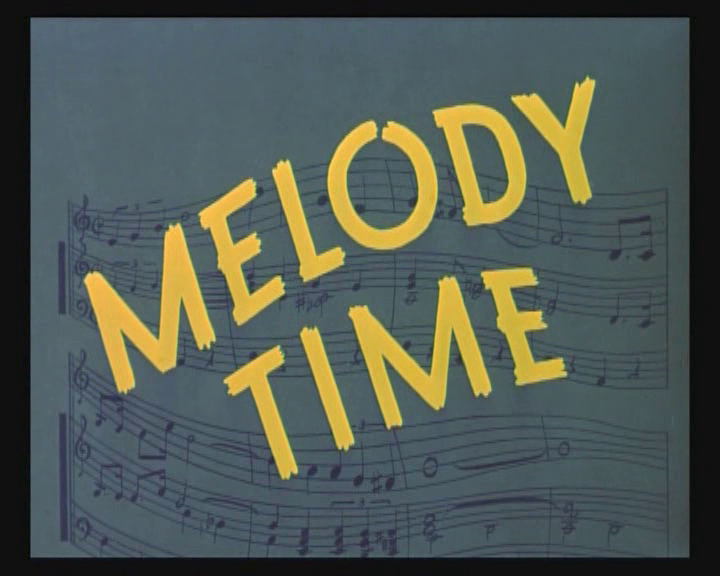
May 27, 1948 – The 10th Animated Feature, Melody Time, is Released to Theaters

“Yes, it’s Melody Time, time to hitch your wagon to a song. Cause a song’s the one and only thing that will take you over the rainbow to the land where music is king.”

On May 27, 1948, the tenth animated feature and sixth package film, Melody Time, was released to theaters. It was directed by Clyde Geronimi, Hamilton Luske, Jack Kinney, and Wilfred Jackson. The stories were written by Winston Hibler, Erdman Penner, Harry Reeves, Homer Brightman, Ken Anderson, Ted Sears, Joe Rinaldi, Bill Cottrell, Art Scott, Jesse Marsh, Bob Moore, and John Walbridge, with “Little Toot” by Hardie Gramatky, and Carl Carmer as the Folklore Consultant. Many famous performers contributed to the film, including Roy Rogers and Trigger, Dennis Day, the Andrews Sisters, Fred Waring and his Pennsylvanians, Freddy Martin, Ethel Smith, Frances Langford, and Buddy Clark as the Master of Ceremonies.

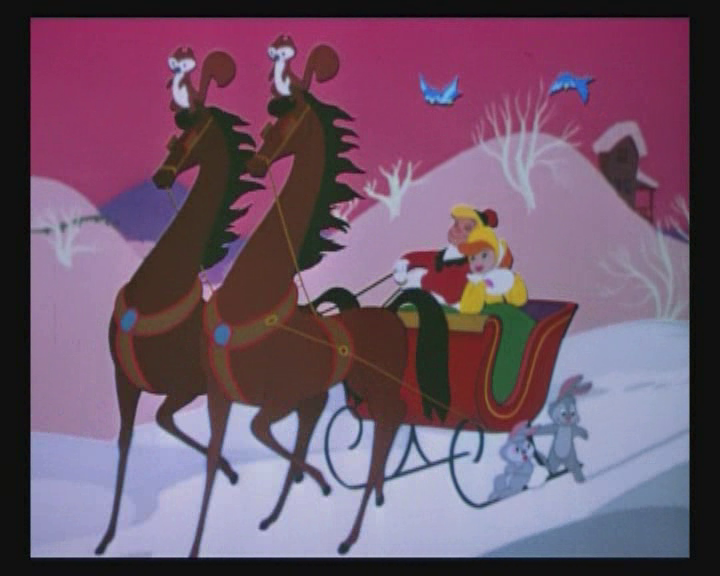
The two couples happily riding in a horse-drawn sleigh

The first segment is Once Upon a Wintertime, sung by Frances Langford. Two couples – one human, one rabbits – share an adventure on a beautiful winter day. The human couple takes a sleigh ride, and the rabbits hitch on to the cart for a ride. The couples stop near the pond to go ice skating, and both males end up upsetting their mates more than once throughout their trip. When both females end up on a dangerous patch of thin ice near a waterfall, they are saved with the help of the horses from the sleigh and a pair of squirrels, and all is well once again for the couples.

The next segment is a new take on the piece “The Flight of the Bumblebee,” known as Bumble Boogie, by Freddie Martin and his Orchestra. A frightened bumblebee is in a nightmare that involves all sorts of musical instruments, and he tries to escape as best he can while being pursued by harmonies and all sorts of strange musical creations.

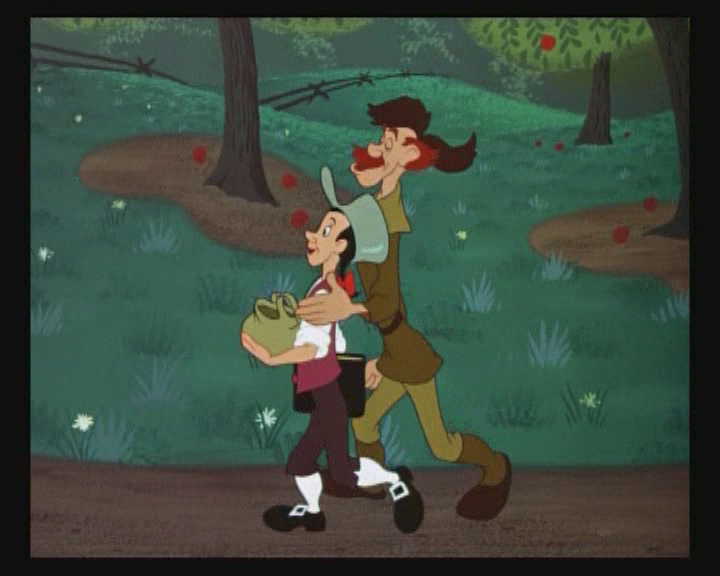
Johnny Appleseed (L) and his Angel walk down the path, with the Angel finally convincing him to go west and plant his apples.

This is followed by Dennis Day performing the tale of Johnny Appleseed, a story from “the pages of American Folklore.” Day was the narrator, Johnny, and Johnny’s Angel. This segment opens with Johnny picking apples from his apple trees, when he suddenly sees a wagon trail. Johnny feels the urge to head west, but believes himself to not be enough of a pioneer. His Angel appears, and convinces him to head west if that’s what he wants to do. Johnny decides to go west and plant his apple trees. No matter what dangers he faced, he was able to persevere, and was able to begin planting his trees wherever he found fertile soil. The settlers would honor him well for his gift of apple trees, which provided them with much needed food. Johnny continued planting for forty years, until one day, his Angel appeared to take him to Heaven, needing him to plant apple trees there.

Following that segment is Little Toot, as performed by The Andrews Sisters. Little Toot is a small tugboat who is very enthusiastic about joining the family business – unfortunately, Little Toot always finds himself in trouble, unable to behave, though he tries to be good. After nearly getting caught by a police officer, Little Toot decides to be helpful, but ends up accidentally causing trouble by turning the rudder on the boat his father is tugging and the boat crashes into the city. The police take Little Toot way out to sea as punishment, and his father is now only allowed to tow garbage. Fortunately, Little Toot is able to redeem himself by saving a ship that is in distress in a storm. Proclaimed a hero, Little Toot is able to return home.

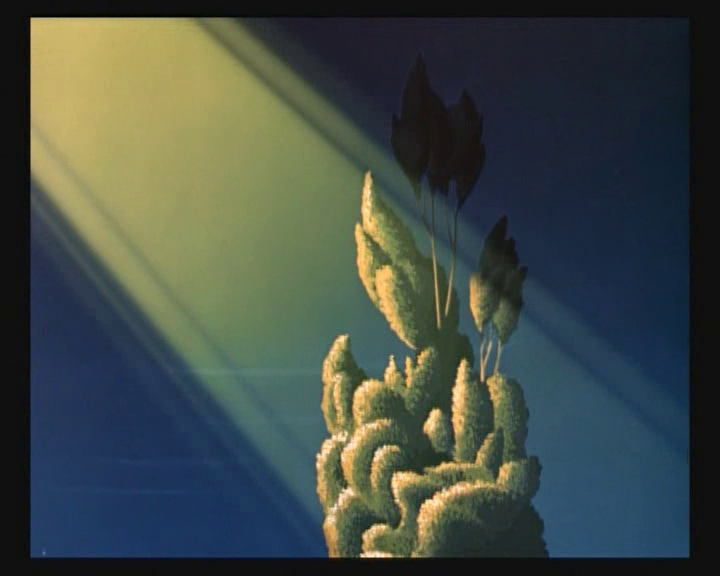
One of the beautiful illustrations used for the segment Trees.

Next is Trees, performed by Fred Waring and his Pennsylvanians, and based on the poem by Joyce Kilmer. The short is a simple homage to a tree, with a different style of animation than the rest of the film, looking like a more realistic Bambi than a regular-style Disney cartoon.

Trees is followed by the more upbeat Blame it on the Samba, performed by Ethel Smith and the Dinning Sisters, and stars Donald Duck, Jose Carioca, and the Arucuan Bird. Donald and Jose are walking in a depressing blue scene, when they stop by the Arucan Bird’s restaurant “Café de Samba.” Once the samba begins to play, the two are able to snap out of their funk and begin to dance. The short also combines live action again, where Donald and Jose dance while Ethel Smith plays the organ, and then plays the congas before breaking into her own dance to the samba. She returns to the organ by the end of the short, with everyone dancing happily.

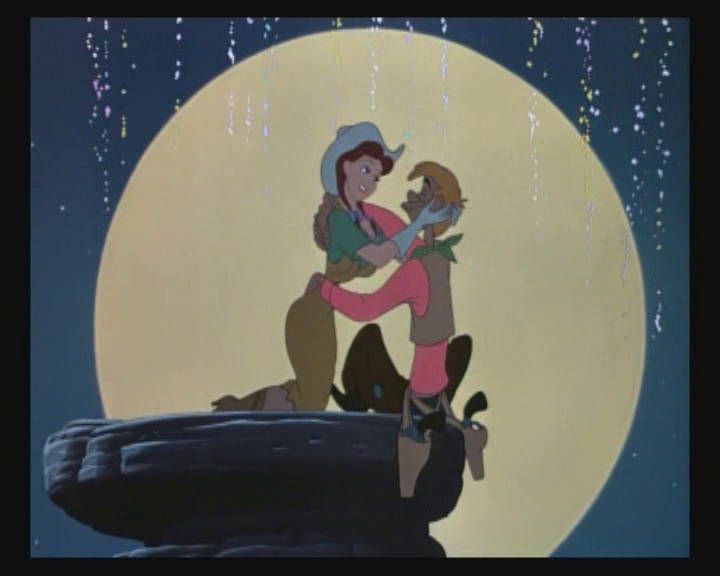
Pecos Bill and Slue-Foot Sue, proclaiming their love under a full moon

The last segment is hosted by Roy Rogers and Trigger, and also features child stars Bobby Driscoll and Luana Patten, telling one of the stories of Pecos Bill. After Bobby asks who Pecos Bill is, Roy begins to tell the story about how the bravest man of the west came to be and why the coyotes howl the way they do. Once, a wagon containing sixteen children and their parents was coming across a mean river in Texas, when a toddler popped out of the back and landed in the river. A coyote was traveling at night, and discovered the child in her den, and took to him, so Pecos Bill grew up with coyotes. One day, a pony was wandering through the desert and was saved by Bill, and this would become Bill’s best friend – Widow-Maker. Bill became the roughest, toughest cowboy in the west, with Widow-Maker by his side. Their partnership is threatened by a woman named Slue-Foot Sue, and the rest of the short tells how Widow-Maker ends their relationship, and why coyotes howl.

May 22

Posted on

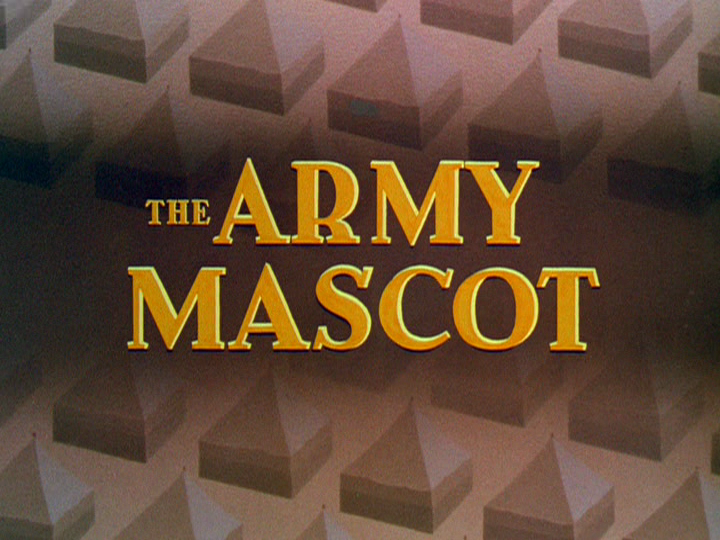
May 22, 1942 – The Pluto Short Film The Army Mascot Premieres in Theaters

“He’s better than Gunther!”

On May 22, 1942, the Pluto short The Army Mascot was released to theaters. This was released as one of the wartime shorts meant to boost morale and make audiences laugh. The short was directed by Clyde Geronimi, and written by Carl Barks and Jack Hannah.

The short opens at the U.S. Army base Camp Drafty, where Pluto is seen sniffing around the gate. He looks up when he hears trumpets sound, and sees the mascots of all the divisions stepping out of their doghouses. A truck from the Army field kitchen stops by, dropping off plates of roast beef and steak. A very hungry Pluto’s mouth waters; he then spies another mascot – a goat named Gunther – sound asleep in his pen.

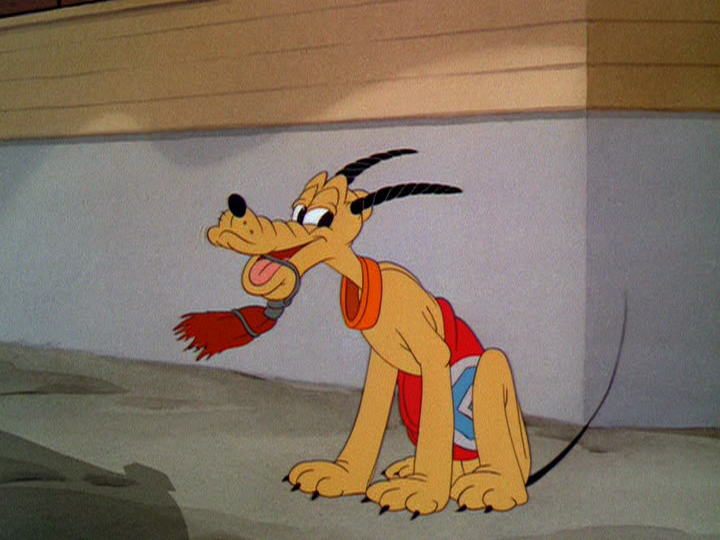
Pluto disguises himself as Gunther the Goat

Thinking this is his chance to grab a juicy steak, Pluto sneaks into the base and peers around Gunther’s pen. Ever so quietly, Pluto closes Gunther’s door, and disguises himself as the mascot right before the truck stops by. Pluto opens his mouth in anticipation of a morsel of meat, only to be thrown an avalanche of tin cans.

Hearing the noise, Gunther pokes two holes in his door with his horns and peeks out at his surroundings. He sees Pluto angrily kicking the cans, and steps out to confront the dog. As he bears down on Pluto, the dog flees, trying desperately to keep away from the goat’s horns. The goat marks his target and gives Pluto a mighty headbutt into the fence; after knocking him there like a paddleball, he then sends Pluto flying out of the camp.

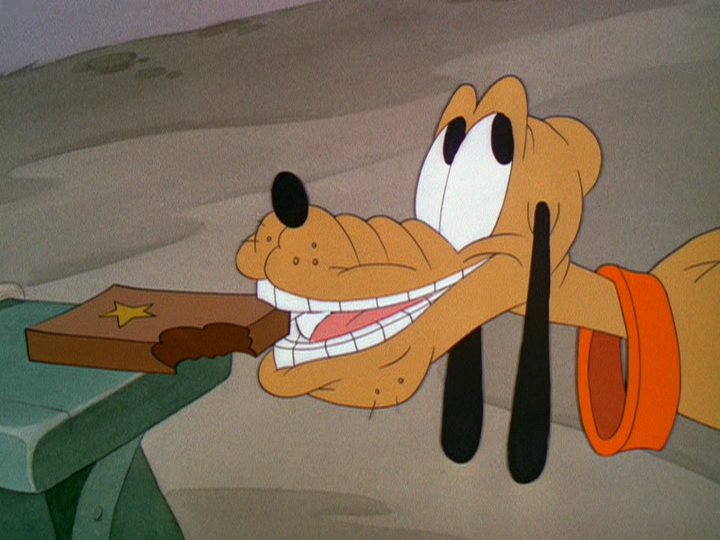
Pluto, to impress the soldiers, grabs the plug of tobacco left on the bench

Pluto is then seen limping around the camp, when a soldier calls out for Gunther to have some chewing tobacco. Pluto’s eyes literally turn green from jealousy, but he’s soon excited when he sees the leftover tobacco sitting on a bench after Gunther has walked away. He prances out in front of the soldiers, grabs the entire plug of tobacco, and chews, much to the amazement of the troops. When one cries out that Pluto is better than Gunther, the goat is startled awake and looks out angrily to see Pluto chewing calmly. Furious, the goat headbutts Pluto, who swallows the plug.

Poor Pluto begins to feel ill and stumbles around the camp, turning colors and patterns as he hiccups. The goat, not satisfied yet, props up Pluto, and gets ready to propel the pup into a tent full of explosives. Pluto drops at the last possible second with Gunther flying full speed ahead into the explosives tent. The blast sends Gunther sky high, where he holds tight to the front of a plane as it flies off into the distance. With Gunther heading overseas, this leaves an opening for a mascot, one that Pluto is happy to fill. Pluto steps out of his doghouse, saluting the officers, before receiving what he’d been craving: a nice, juicy ham. He tears into it eagerly, giving the audience a smile.

May 21

Posted on

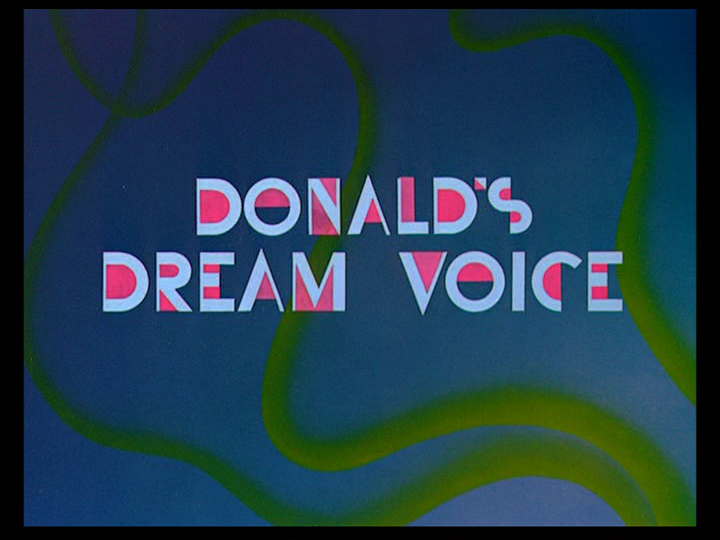
May 21, 1948 – The Donald Duck Short Film Donald’s Dream Voice Premieres in Theaters

“I can talk…I can talk! I can talk! Oh, boy! I can talk!”

On May 21, 1948, the Donald Duck short Donald’s Dream Voice was released to theaters. It was directed by Jack King, with a story by Roy Williams, and features Clarence Nash as the voice of Donald Duck, Leslie Denison as the suave voice of Donald Duck, and Ruth Clifford as Daisy Duck. The suave voice of Donald is a case of topical humor; he sounds like screen actor Ronald Coleman, who was very popular with audiences of the ’40s.

The short begins with Donald going door to door, peddling brushes. At the first door, the owner of the house tells Donald that he can’t understand him, and demands that he leave, which makes Donald angry, but he lets it dissipate before he knocks on the door of the next house. Unfortunately, the lady of the house hears Donald and slaps him for “using such language in [her] presence.”

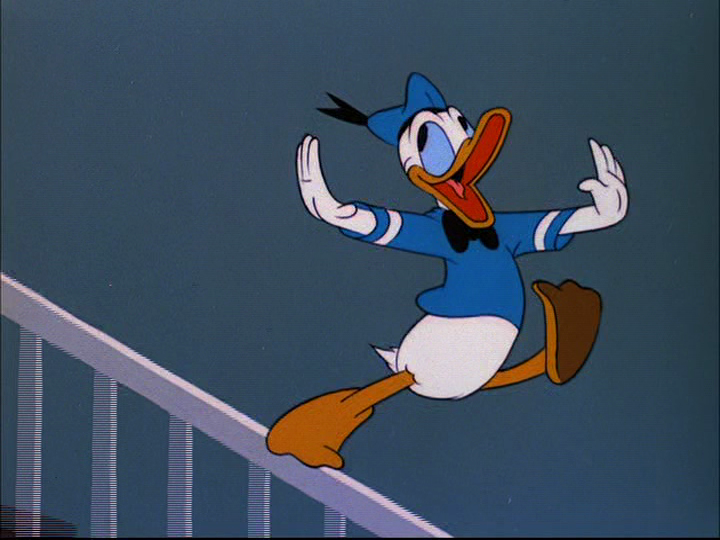
Donald is elated at the support that he receives from Daisy

Donald is next seen looking rather defeated at Daisy’s house, but she insists that he not give up, as she has faith in him. She kisses him and encourages him to try again, and Donald excitedly cartwheels out of the house, determined once more to try. Again, much to Donald’s dismay, he is misunderstood and sent packing by the owner of the house. Humiliated and angry, Donald continues to walk the city streets, until he passes a peddler selling “voice pills” for only 10 cents. Donald doesn’t believe it, but is willing to try anything once, so he buys a box.

Donald tries a pill, and instantly, his voice changes to sound like Ronald Coleman. Shocked, he tests it out a bit before bursting into rapturous praise. He begins to rush home to tell Daisy, when he decides to instead go sell his brushes, come home to her as a success, and ask her to marry him – although the pill wears off before he can actually state the last part of his plan. Popping in another pill, he completes the statement.

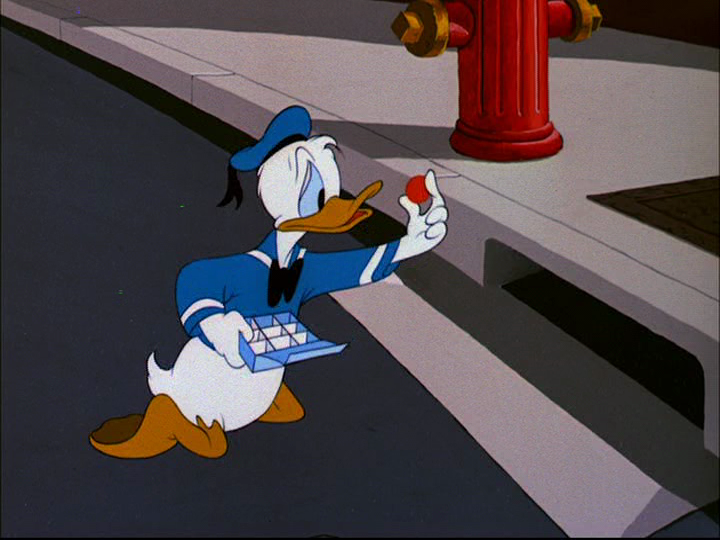
Donald holding the only pill he managed to save

With his new voice, Donald approaches a house, where the woman who lives there remarks on his fine, forceful voice and she can’t help but buy several brushes. Suddenly, several hands appear waving money, wishing to buy brushes from the duck with the amazing voice. Donald then runs home, popping in another pill as the other one wore off. As he runs, he trips on the sidewalk, and the pills pop out of his pocket and fly into the sewer, save for one that Donald manages to retrieve. With only one left, he decides he has to save it for the moment he proposes to Daisy.

Arriving at Daisy’s house, Donald is ready to ask the question when the pill wears off. Grabbing the last remaining pill, it slips from his hand and bounces down the sidewalk, falling into a sewer hole. A large, thug-like man emerges from the hole, with the pill safely in the top of his hat. Donald follows the man, trying to get the pill, but the man yells at Donald, informing him that he hates people. Donald then tries the approach of grabbing the pill from the man’s hat through a nearby window, but accidentally grabs the man’s nose.

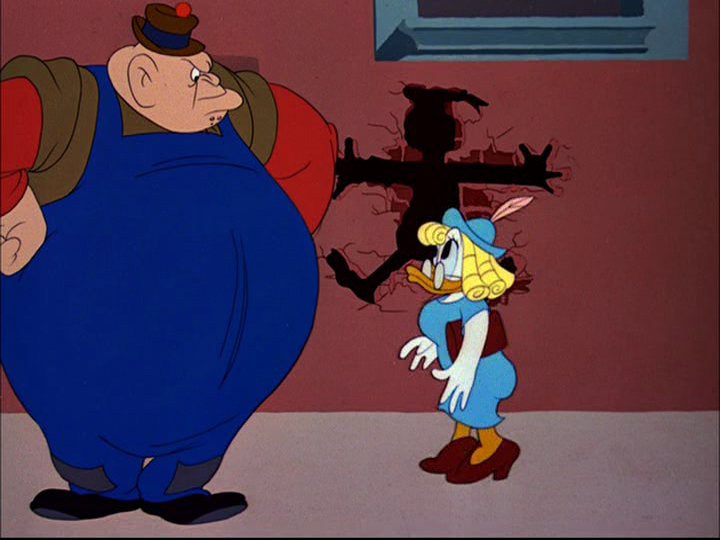
Donald’s last resort when it comes to retrieving his pill

As a last ditch effort, Donald walks by, dressed as a woman, hoping the man will lift his hat in a polite greeting. He does so, and as the pill bounces away, Donald quickly slips down the street and races after the pill as he turns the corner. The pill bounces into a farmyard labeled “no trespassing,” and Donald watches in horror as it slips into a cow’s open mouth. The duck bursts into the fenced in yard and starts screaming at the cow, when the cow, now with the voice of Ronald Coleman, tells him to shut up and that the sign says “no trespassing.” As Donald tries to get the pill back, the cow informs him that he can’t understand a word the duck says, causing Donald to fly into a rage.

May 9

Posted on

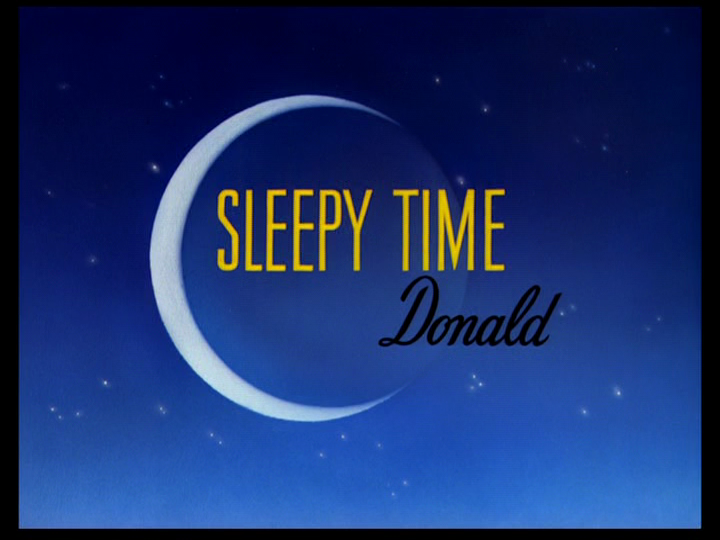
May 9, 1947 – The Donald Duck Short Film, Sleepy Time Donald, is Released to Theaters

“I must humor him. I mustn’t wake him, or it would be fatal.”

On May 9, 1947, the Donald Duck short film, Sleepy Time Donald, was released to theaters. The short was directed by Jack King, with story by Roy Williams, and starred Clarence Nash as the voice of Donald Duck, and Gloria Blondell as the voice of Daisy Duck. This is one of those rare shorts that, while Donald’s name is in the title, Daisy gets more of the starring role, with great results.

The scene opens with Donald fast asleep in his suburban home, when suddenly he rises from his bed, places a boot on his head, and sleepwalks to Daisy Duck’s house. Daisy wakes up, alarmed, but becomes puzzled when Donald walks right past her and out the other door, only to turn around and ring the doorbell. Daisy leaps out of bed and throws on a date-night outfit before answering the door for her “date.”

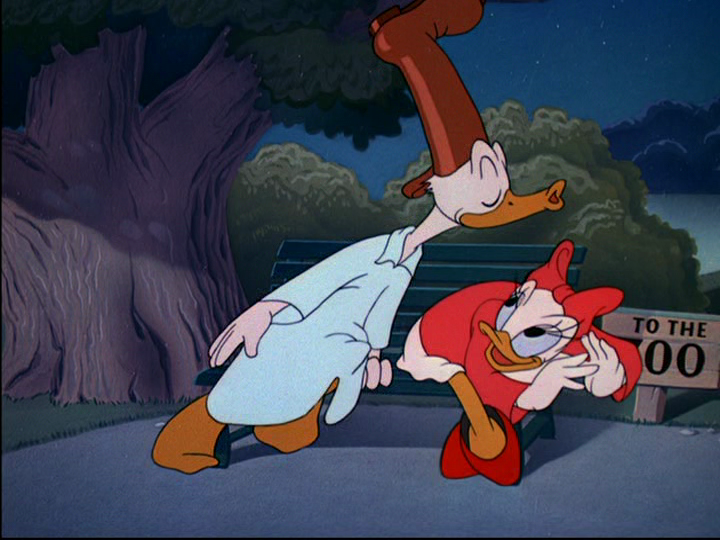
As Donald tries to kiss Daisy, she begins to play hard-to-get

Deciding that she needs to “humor” Donald, she opens the door and greets him, and Donald asks if he’s on time for their date. Daisy giggles as she reassures him he is, and then she is seen being escorted to the zoo. There’s a moment where she wonders if he’s going to kiss her, and she ducks when he tries to, and begins to play hard to get with him. She tricks him into kissing a tree branch, with Donald thinking it’s her arm. He then slips an engagement ring on the branch, with Daisy swooning at his romantic gestures. As he lets the branch go, the ring catapults into the monkey’s pen, with the female monkey giving the male a big kiss. Unfortunately for her, Daisy slips the ring away from the pair, causing the female monkey to deck the male.

Daisy admires the ring on her hand, noticing just a bit too late that Donald has sleepwalked into the lion’s cage, narrowly missing being eaten. After the zoo, Donald walks up the side of a building, with Daisy watching in horror on the ground. She calls out his name, and he only motions for her to join him. She tells him that her way is the shorter way; he shrugs and decides she’s right, although he continues to walk on the side of the building as they continue down the street, with Daisy trying to prevent him from getting into trouble as best she can.

Donald wakes and accuses Daisy of sleepwalking

Donald continues his sleepwalking by walking straight into traffic. Daisy flips the traffic sign to a stop so Donald won’t get hit by a car, causing a massive pile-up. Finally, she decides to make him think that they’re boarding a boat as she leads him back to his house and gets him back into bed. As she tries to slip out, Donald wakes up and accuses her of walking in her sleep. She argues with him that she has not been walking in her sleep, but Donald laughs, until Daisy hits him over the head with his boot, causing him to sleepwalk back into bed and fall fast asleep.

May 4

Posted on

May 4, 1944 – Disney Legend and Current Voice of Minnie Mouse, Russi Taylor, is Born.

“When I was a little girl, I was with my mom and my brother and it was late at night at Disneyland. We had just come off the Mark Twain Riverboat and were getting some popcorn. I looked over and saw Walt sitting on a bench, so we introduced ourselves and shared our popcorn with him. At one point during our chat, he asked me what I wanted to do when I grew up, and I said, ‘I want to work for you!’ So he said, ‘Okay!’ – and now I do!” – Russi Taylor

Russi Taylor was born on May 4, 1944, in Cambridge, Massachusetts, and grew up wanting to work as a movie actress. However, she found the work tedious, and decided to try voice acting, as she had had a good ear for languages and accents ever since she was a child. She auditioned for the role of Minnie Mouse in 1986, and has held the role ever since – longer than any voice actress in the role.

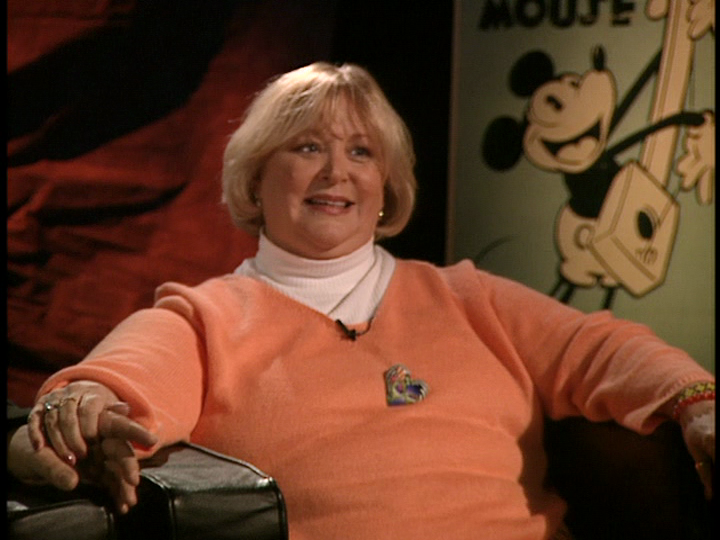
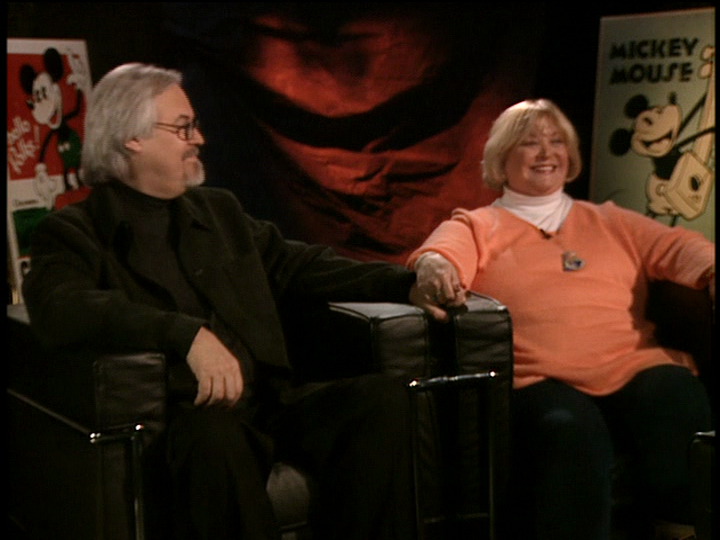
When Taylor was asked in an interview by Leonard Maltin how she got the role of Minnie, Taylor explained that Minnie hadn’t spoken in a long time, and when she was in Mickey’s Christmas Carol, the writers didn’t know that Minnie could speak, which was why she didn’t say anything. In 1986, they decided to give Minnie a comeback, and Taylor auditioned against almost 160 others for the role. She had prepared for the role by listening to Minnie from the cartoons in the ’30s and ’40s, and when asked to improvise as Minnie, Taylor performed the balcony scene from Shakespeare’s Romeo and Juliet.

Taylor (L) with husband, Wayne Allwine, the voice of Mickey Mouse

A prime example of life imitating art, Taylor married Wayne Allwine, the voice for Mickey Mouse, in 1991. They were working on a project for Radio Disney, and one night had dinner together, and soon became inseparable. “It was just a total friendship,” Taylor explained. “The next thing you knew, we were just sort of always together.” She remained married to Allwine until his death in 2009.

Taylor has a broad resume as a voice actress; for Disney, she voiced Huey, Dewey, Louie, and Webby in Ducktales, as well as Drizella and the Fairy Godmother in the Cinderella sequels. Taylor is also the voice of Martin Prince, twins Sherri and Terri, and Üter in The Simpsons, and was the voice of Baby Gonzo in the Muppet Babies series. Taylor was named as a Disney Legend, along with Allwine, in 2008, and continues to voice Minnie in many Disney projects.


April 23

April 23, 1943 – The Donald Duck Short, Fall Out – Fall In, is Released to Theaters

“After supper…? Please?”

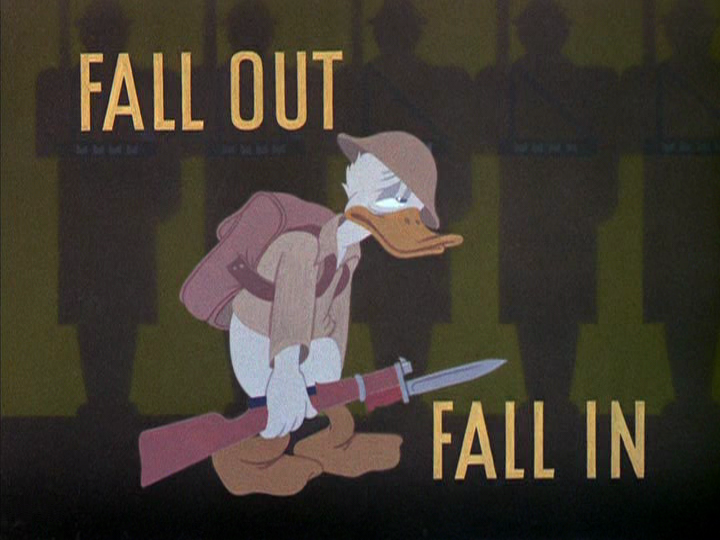
On April 23, 1943, the Donald Duck wartime short, Fall Out – Fall In, was released to theaters. As with the other Donald Duck wartime shorts, it was based on the experiences many of the animators had when they were in the army during World War II. It is also one of the few times that Donald’s headshot in the opening shows him without his usual sailor hat—he’s wearing an Army hat instead. The short was directed by Jack King, with Clarence Nash as the voice of Donald Duck.

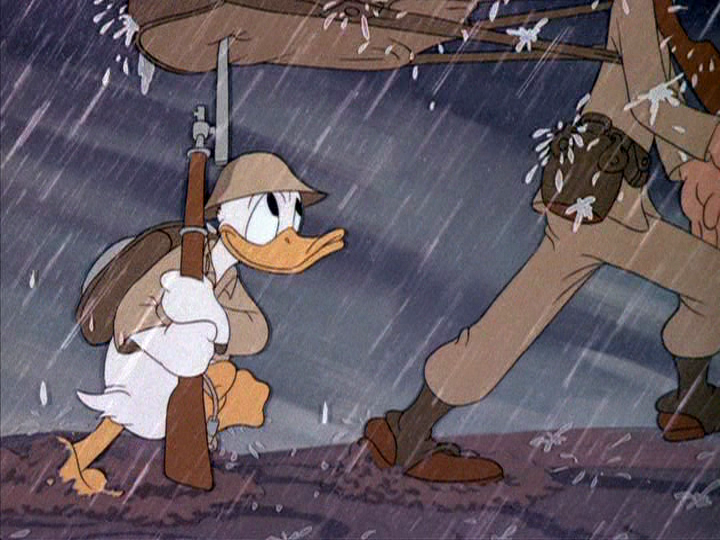
The short opens just as the sun is rising, with a rooster letting out his call. Soldiers are marching on the horizon, with Donald Duck the last one in line. When he passes a sign saying that the group has traveled five miles, Donald marks it down on the bag of the soldier in front of him, and continues marching with a smile. At the 10-mile mark, Donald’s cheer has waned slightly, and his rifle seems to be pulling his shoulder down, but he adjusts it and continues to march, though definitely not as enthusiastically as before.

Donald using ingenuity to keep himself dry

A harsh storm hits the troops by mile 20. Donald is annoyed with the raindrops hitting his helmet, but he comes up with an idea to shield himself from the rain by using the bag of the soldier ahead of him. As they continue to march, the rain turns into snow, and icicles hang from the duck’s tail. Donald is still wearily keeping track of the miles on his fellow soldier’s bag, with the count at 35 miles traveled.

As suddenly as the snowstorm arrived, the snow disappears and is replaced by scorching hot weather, 40 miles into their march. Donald isn’t so much as marching any more as he is limping, and sweating buckets. As the sun sets on the troops, their commanding officer calls them to a halt, and we see that Donald has marked the soldier in front of him up and down with hash marks for each mile they’ve crossed. When Donald is told to fall out, he collapses.

Donald rushes madly to grab his meal after the excruciating hike

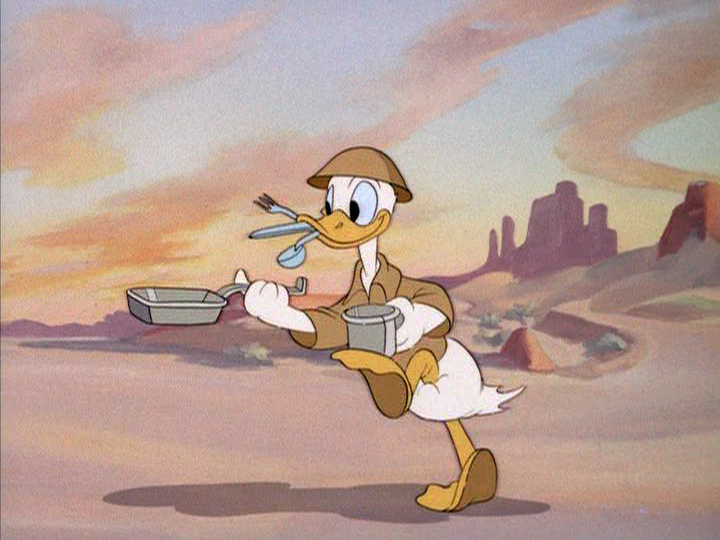
When a trumpet sounds, Donald revives, knowing that the sound means that it’s dinnertime. Excited, he opens his overstuffed bag, grabs his utensils, and runs to get his food – but his commanding officer won’t let him eat until he’s made up his tent. Donald leaps to the task, driven by the promise of food; unfortunately he has the worst luck when it comes to building his tent, and we see him still trying to build it long after the other soldiers have gone to sleep. Exhausted, Donald collapses and refuses to take care of his tent, but he can’t sleep because all of the other soldiers’ snoring keeps him awake.

Donald has only closed his eyes for a second, when the trumpet again sounds, telling the soldiers that it’s time to wake up. Too exhausted to even notice that he’s tied his belongings around a tree, Donald falls in line, carrying the tree and his belongings with him for the long trek back to camp.

April 10

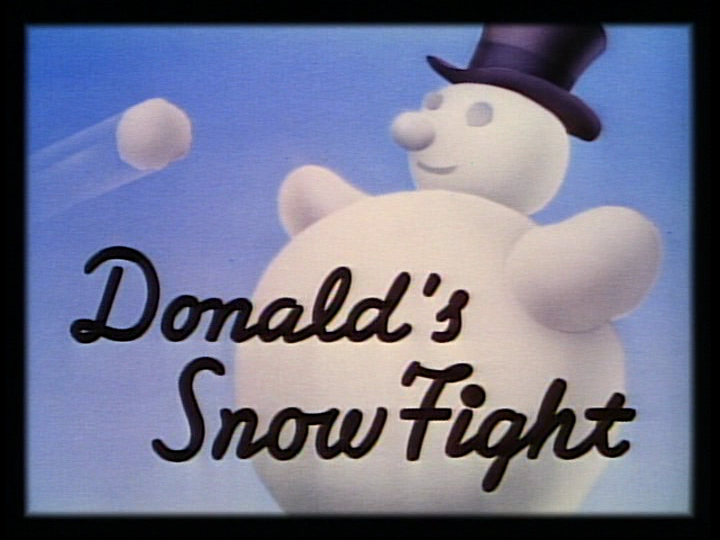
April 10, 1942 – The Donald Duck Short Film, Donald’s Snow Fight, is Released to Theaters

“Snow, oh boy! I’m crazy about snow!”

On April 10, 1942, the Donald Duck short film, Donald’s Snow Fight, was released to theaters. Directed by Jack King, it stars Clarence Nash as the voice of Donald and the nephews. There are many clever gags in this short, including a couple that is seen kissing underneath a mound of snow, which is swept away when Donald rushes by.

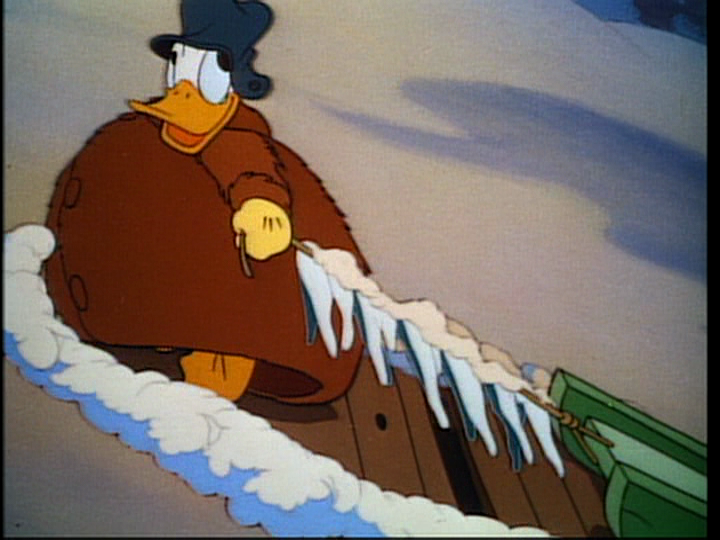
It’s a wintery day in suburbia, and Donald Duck is excited that there’s snow on the ground. He peeks outside to see how much there is, his beak turning blue in the process. Seeing the ice build up on the tip of his beak does not deter him from running to grab his overcoat.

Donald merrily on his way to go sledding

Bundled up and ready for a snow day, Donald treks up a hill with his sled, singing “Jingle Bells” while jingling the icicles on his sled rope. When he reaches the top of the hill, he notices his nephews building a snowman right in the sled path. Donald decides this is the perfect moment to “have some fun,” and dive bombs into the nephews’ creation, sending snow flying everywhere. Donald cracks up with laughter and rolls around in the snow, and the nephews quickly come up with a plan for revenge.

Their first idea is to disguise a rock with another snowman, one that looks like Donald. They cry for Donald’s attention, and the duck takes the bait, flying full speed toward the “snowman.” Donald hits the rock so hard that all of the fur is shaken off his fur coat. Not to be beaten by his nephews, he chases them across the snow, only to be cut off by the nephews escaping into their elaborate snow fort, with the springs of the door bouncing Donald back into a tree where the built-up snow and icicles trap him.

Captain Donald plays a bowling game while his nephews play the part of the pins

Inside, the nephews think they’ve won, but Donald swears revenge. The next scene shows that Donald has built his own fort that looks like a boat on the ice-covered pond, and he declares war on the nephews. He shoots snowballs at the three with elaborate trick shots, covering them with snow and making them appear to be bowling pins. Donald then grabs a large ball of snow and, throwing it like a bowling ball, throws a strike. Not satisfied, Donald grabs another large mound of snow shaped like a bullet and starts dunking it into a bucket of water, turning it into a deadly ice bullet. He fires it over to the nephews’ fort, splitting their flagpole into three sections, which ends up knocking into the nephews.

“Do you surrender?” Donald asks, but the nephews refuse. They gather all the materials they have, including mousetraps and rope, and plant the mousetraps into snow sculptures shaped like rockets. They place all the rockets into a basket and let it fly from a catapult, and Donald is trapped by the mousetraps. They continue their attack with more snow cannons, even though Donald calls it “unconstitutional.”

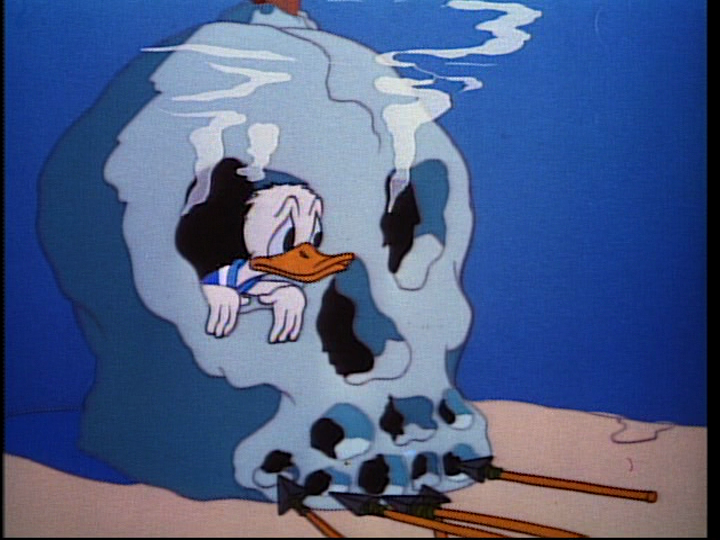
The first set of coals and arrows spell the end for Donald Duck

Not done with their uncle yet, the nephews gather hot coals and fire them attached to arrows, melting part of Donald’s boat. The largest arrow causes the whole boat to melt, with poor Donald stuck on the top. He falls through a hole in the ice and is seen frozen at the top of the splash of water, and the nephews are seen performing a victory war dance around the ice.

March 31

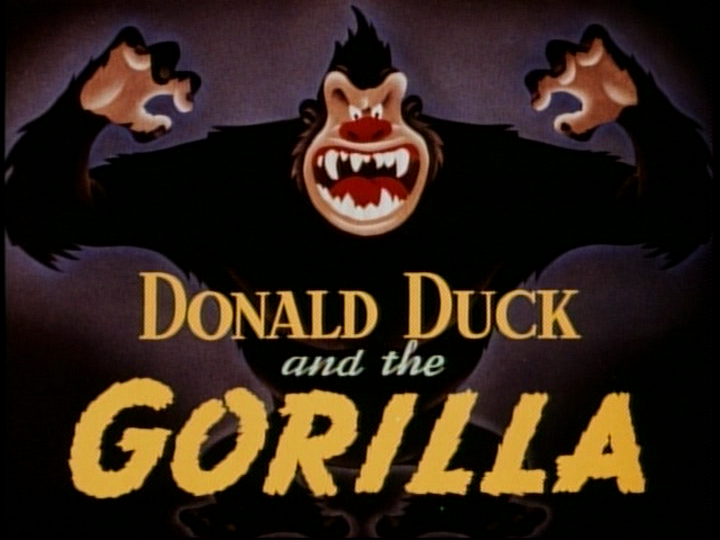
March 31, 1944 – The Donald Duck Short Film, Donald Duck and the Gorilla, is Released to Theaters.

“Where’s Uncle Donald?”

On March 31, 1944, the Donald Duck short film, Donald Duck and the Gorilla, was released to theaters. The short was directed by Jack King, with Clarence Nash voicing Donald Duck and the nephews Huey, Dewey, and Louie. As with many of the early Donald Duck shorts featuring the nephews, it was hard to tell which one was which, as the colors for their outfits were used interchangeably. This would be remedied with the show Ducktales, in which the nephews played lead roles and the stories were vastly more complicated.

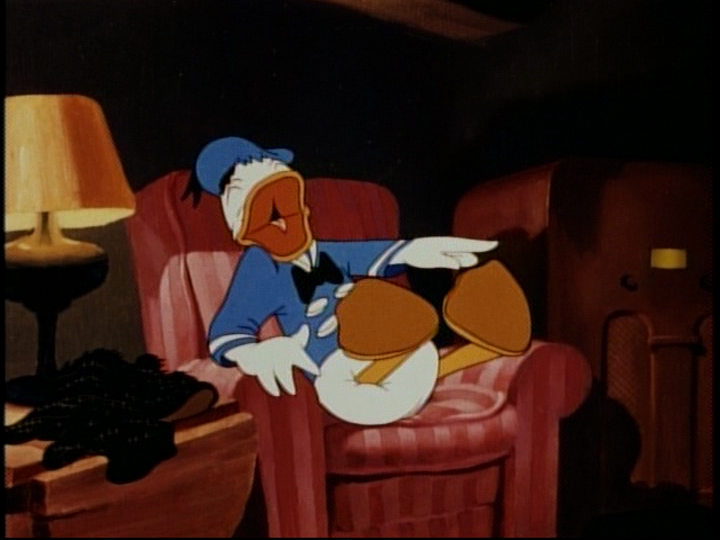
Donald laughs at the nephews' fear of the killer gorilla, Ajax

But back to Donald Duck and the Gorilla: It’s a stormy night, and Donald is sitting around the radio with his nephews Huey, Dewey, and Louie. The announcer informs the audience that the terrible gorilla, Ajax, has escaped from the city zoo. The nephews cling to each other in fear, while Donald laughs. He then notices a pair of gloves next to him that resemble gorilla hands, and gets the fiendish idea to scare the boys. He turns out the light, and the boys, frightened, call out for their uncle. When the boys turn on the light again, Donald is gone from the chair.

Still holding on each other, the boys are unaware of two large, hairy hands coming around the corners of the couch until the hands almost grab them. The boys scream and take off into the other room, slamming the door shut. Peering out through the keyhole, they see their Uncle Donald laughing hysterically at their flight. Angered by their uncle’s prank and bent on revenge, the three find a gorilla costume and begin to creep into the room where their uncle is getting ready to relax. Donald grabs a book and sits down in his chair to read, unaware that it is now occupied by a “gorilla.” Donald continues to be oblivious to the guest in his chair, even when the guest covers the duck’s mouth when he yawns.

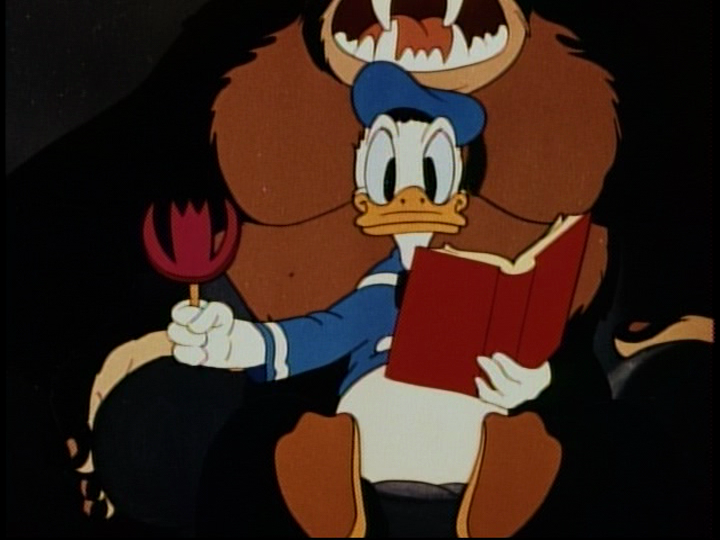
Donald finally gets the hint that something may be off about the chair he's sitting in...

Donald finally gets the hint when he takes out a giant lollipop, and sets it aside for a moment while reading. The nephews take a big bite out of the lollipop with the costume’s teeth. When Donald picks up the lollipop again, he is  alarmed to see the teeth marks in the candy. He finally notices the “gorilla” in the room and bolts out of there as fast as he can, leaving the nephews to laugh at their success.

Unbeknown to both parties, the real Ajax is standing at the window, watching the scene unfold. With a menacing smile, he tears open the window and growls at the boys.  They run into their angry uncle hiding in an umbrella stand, and decide to run off in another direction, only to meet up with Ajax again. They run into separate rooms, with Donald following close behind. When Donald enters the hallway, he sees Ajax and, thinking it’s his nephews, starts pulling at the gorilla’s head, only to find that he was pulling on the head of the real gorilla.

Donald sees a terrifying image when he tries to intimidate Ajax

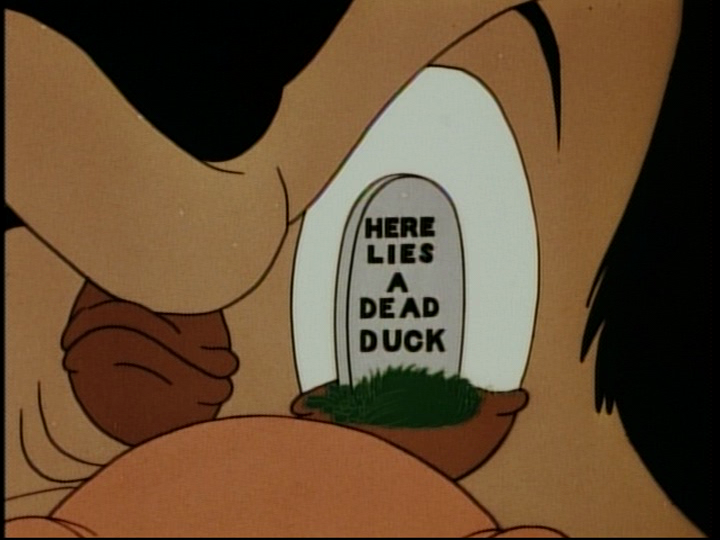
Just as things are looking bleak for the duck, the radio announcer informs all listeners that one can tame all wild animals by looking them straight in the eye. Donald attempts to do so, only to see a tombstone in the gorilla’s eye staring back at him. Donald uses the umbrella to escape Ajax’s clutches, and rejoins his nephews to hunt down and rid themselves of their unwelcome guest. As they sneak around, there are many comical instances with the nephews’ clumsiness with the candle, including pouring wax all over Donald’s tail. Donald snatches the candle from the boys and shoves them into another room, not noticing that he has placed the flame right under the doorknob, which burns his hand.

Donald continues his search, and falls into the gorilla’s trap, but is able to escape – barely. The chase continues through the house, leaving destruction in its wake. Unfortunately, Donald is trapped by the hungry gorilla, and just as it seems that all hope is lost, the radio announcer gives another timely message: the gorilla can be subdued with tear gas. Hearing this, the nephews find some and throw the grenade in just in time. Seeing the gorilla begin to cry, Donald laughs at him, but ends up a victim of the tear gas as well. The two sit together, crying in each other’s arms.

March 21

March 21, 1947 – The Pluto Short Film, Rescue Dog, is Released to Theaters

On March 21, 1947, the Pluto short, Rescue Dog, was released to theaters. It was directed by Charles Nichols, with the story by Eric Gurney and Bill de la Torre, and music by Oliver Wallace. It features Pluto interacting with a creature smaller than himself, with comical results.

It’s a blustery winter day, and Pluto is seen peeking his head out from the Rescue Dog Doghouse, when he excitedly puts up the sign, “Dog on Duty.” He looks around for any signs of trouble, before he falls into a thick patch of snow on the side of a cliff. He falls through and skids on the ice-covered pond below, stopping just before an open patch in the ice, where his rescue barrel is floating.

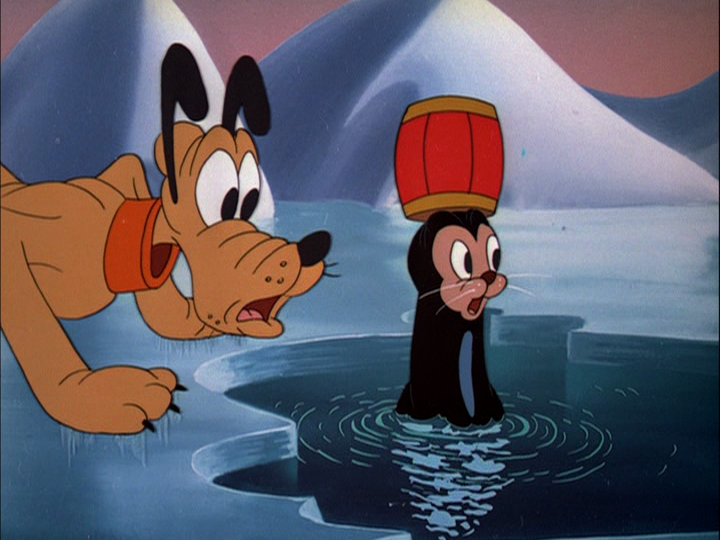
Pluto is shocked to see this strange creature rise out from under the ice

As Pluto reaches in to grab his barrel, it suddenly disappears into the water, before splashing back up and hitting him on the nose. It rises out of the water, being perched on the head of a seal. The seal turns and sees Pluto, who is suspicious of this new character. It barks at Pluto playfully, although Pluto runs away and ducks behind a rock. The seal returns the barrel to Pluto, but Pluto’s reaction is to bark angrily at the seal, causing it to duck into the water with fear. Pluto begins to march away, only to find that the seal is holding on to his tail.

The seal claps his fins, wishing to play with Pluto, but the dog just pushes the seal away, sending him flying back into the water. Pluto laughs, but just before he grabs his barrel to continue on his way, the seal sneaks in and steals it. Pluto chases after it, only to miss and get stuck in a snow bank. The seal returns the barrel to Pluto, but Pluto ends up walking way, wanting nothing to do with it. The seal, however, is not done playing with Pluto, and ends up walking underneath him, before stealing the barrel again.

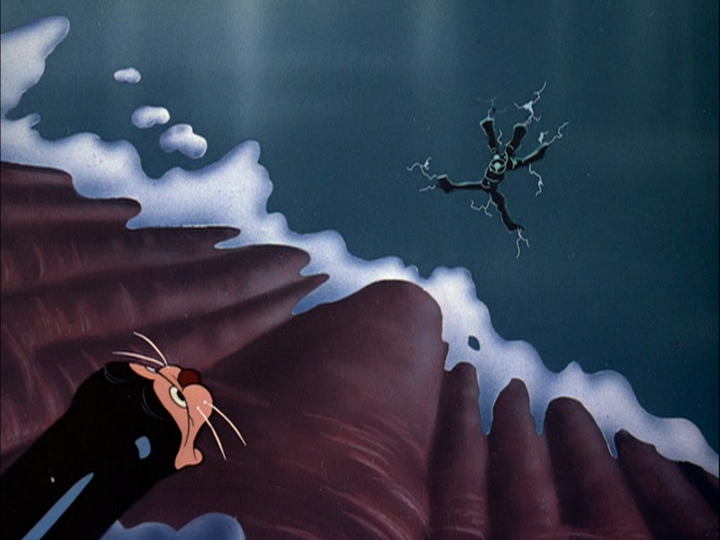
The seal watches as Pluto falls through the ice

As Pluto chases the seal, the seal drops the barrel onto the ice, and Pluto chases it into a cave, which turns into a game of keep-away with the seal holding on to the barrel. The game takes a bad turn when Pluto falls off the side of a cliff and breaks the ice below, falling into the water. Pluto is seen stuck under the ice, and the seal dives down to rescue the poor pup. Using the barrel to break a patch of ice, the seal dives in and pulls out the frozen dog, and warms him up with the brandy in the barrel. Grateful for the seal’s help, Pluto makes the seal an honorary rescue dog, and they end with the seal giving Pluto a huge hug.