RSS Feed

Tag Archives: 1930s

February 17

February 17, 1934 – Mickey Mouse Short Film Camping Out is Released to Theaters
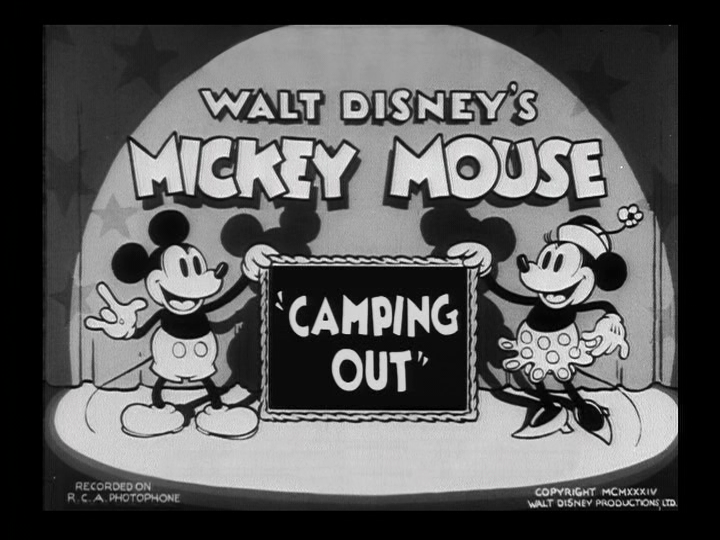
“Hey, Pop! I was having fun, and a big guy hit me!”

On February 17, 1934, the Disney Studios released the Mickey Mouse Short Camping Out, starring Mickey, Minnie, Horace Horsecollar, and Clarabelle Cow. Before the studio created and realized the individual star power of Mickey, Donald Duck, and Goofy, Mickey and Minnie were usually paired with Horace and Clarabelle, who were the major bit players in the short films of the ’30s. The short was directed by David Hand, with music by Bert Lewis.
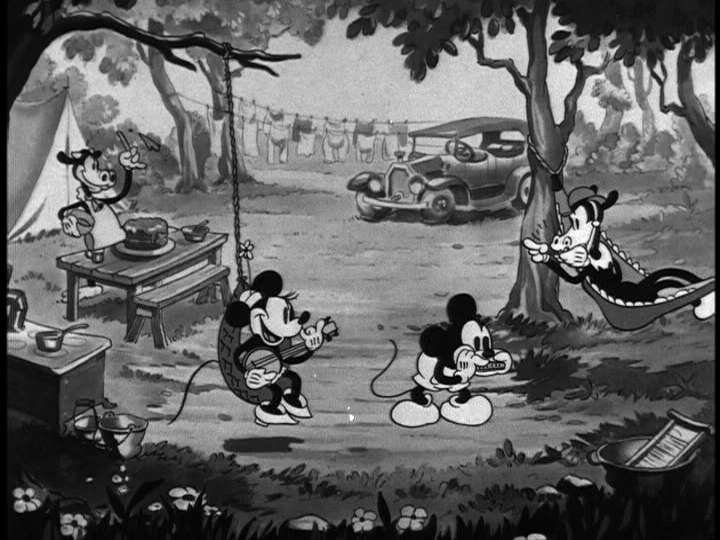
Mickey and the gang relaxing at their summer camp out

The scene opens on a lazy summer day, with the gang playing a joyful tune. Mickey is playing the harmonica, accompanied by Minnie on banjo and Horace on the mouth harp, and Clarabelle is in the background icing a couple of cakes. As they dance and play merrily, a lone mosquito flies into the picture, wanting to join in on the fun and landing on Mickey’s nose. Mickey tries to blow him away, only to end up getting stung on the nose. Angered, Mickey takes a frying pan, planning to squash the mosquito when he gets the chance. It lands on Clarabelle’s cake, and Mickey ends up flattening the cake and sending icing flying all over Clarabelle, while the mosquito flies away unscathed. Upset by Mickey’s ruining her hard work, Clarabelle takes the other cake and shoves it in Mickey’s face.

As Horace laughs at Mickey and Clarabelle, the mosquito sees an opportunity to give Horace a good sting. It winds up and flies like a fighter plane, sending Horace flying into the air from the impact. Horace swings wildly at it, and thinks he finally hit it, until he hears buzzing from inside his hat. When he removes it, he discovers a giant bump on his head from where the mosquito stung him. Completely angry at this point, Horace swats the mosquito, sending it flying to the ground with a bent nose. Shaking his fist in revenge and sobbing, he calls over his father and says that he was just having fun when a big guy hit him. Heroic music plays as the entire swarm of mosquitoes flies to seek vengeance for the poor little mosquito.
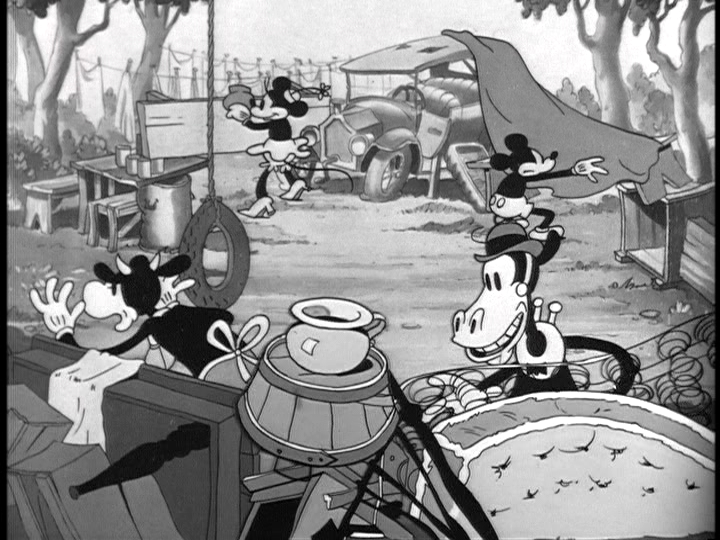
Seeing the swarm coming, the gang mans their battle stations

Minnie spies the swarm, cries out in alarm, and the gang sets up their battle stations. Horace decides to spray them with molasses, which effectively stops them and sticks them to a nearby tree. The second batch of molasses-drenched mosquitoes, however, is sent flying back to Horace, hitting him square in the face. Clarabelle takes the old fashioned method with a flyswatter, only to have the mosquitoes grab the netting and tear it apart. Minnie and Mickey team up, with Minnie opening cans of peas, and Mickey filling a bicycle pump with them, then using the pump as a sort of machine-gun with pea pellets. The mosquitoes catch the peas on their noses, causing them to fall to the ground with the weight. The swarm finds a hammer and uses it to remove the peas from their noses, then take to the air again. Horace uses corn to make his own shooter in order to break up the swarm. Believing him to be successful at driving the swarm away, everyone cheers, but the victory is short-lived as the bugs dive bomb the quartet. Horace, however, grabs an umbrella and pulls the gang to safety, with the swarm hitting the umbrella and sticking. Poor Horace is still holding on to the umbrella, and as the swarm flies away, he joins them. Mickey grabs on to try and pull him down, but is also taken away. The umbrella breaks from the weight, and Horace and Mickey crash to the ground.

The mosquitoes free themselves, pull together to form a giant mosquito, and angrily chase after the gang as they run to take refuge in their tent, with the only casualty being Horace’s hat. The swarm continues its attack, with the gang using all of their supplies as best they can to stop the menace. Mickey’s solution is to trap the mosquitoes in the only thing he can find: Clarabelle’s bloomers. As the mosquitoes buzz away, surrendering, the gang cheers at their victory.
February 10

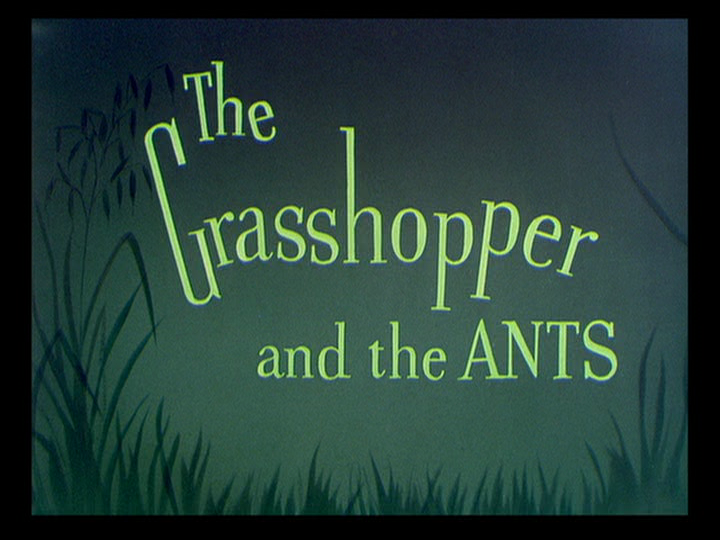
February 10, 1934 – The Silly Symphony The Grasshopper and the Ants is Released to Theaters

“Oh, the world owes me a living…”

In 1934, the Disney Studios released what was to become another wildly popular Silly Symphony, The Grasshopper and the Ants. Based on the fable by Aesop, it was adapted by William Cottrell, directed by Wilfred Jackson, and starred Pinto Colvig as the Grasshopper. Colvig is better known as the original voice of Goofy, and the song in this short, “The World Owes Me a Living,” would become a theme song for Goofy in later shorts. The song was composed by Larry Morey and Leigh Harline, and was so popular that sheet music for the piece was published. The short is also notable for being the first instance of a character turning blue from the cold. Although this is a common idea these days to show how cold the weather is, the Technicolor process was still new in 1934, therefore any color change to show emotion would have been relatively fresh.

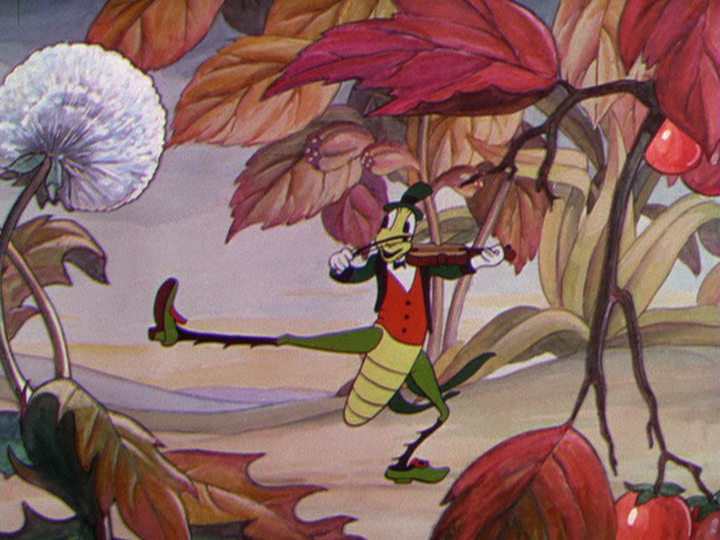
The first shot we see is of the Grasshopper skipping down a flower-filled path, playing his fiddle merrily. As he stops for something to eat and drink, we see that the Grasshopper is actually quite wasteful, taking one bite of a leaf before throwing it away to grab another. He becomes distracted, however, when he sees a hive of ants busily working to store food for the winter, doing such chores as picking off the individual kernels from an ear of corn to chopping up slices of carrots, making it easier to bring the food inside their hollow tree.

The Grasshopper gets a young ant to shirk his work to sing and dance

The Grasshopper begins to laugh at their efforts, and calls over an ant to join him. “Listen,” he tells the ant, “the Good Book says the Lord provides. There’s food on every tree. I see no reason to worry and work, no sir, not me.” With that, he goes into the theme song for this short, “The World Owes Me a Living,” enticing the ant to “play and sing and dance,” to which the impressionable ant agrees, imitating the Grasshopper’s dancing. Unfortunately for the ant, the Queen arrives, shocked to see an ant shirking its duty. The ant, embarrassed at being caught, rushes back to his work at breakneck speed.

The Grasshopper greets the Queen and tries to entice her the way he did the ant, but the Queen is firm. “You’ll change that tune when winter comes and the ground is covered with snow,” she warns him. But the Grasshopper assures her that winter’s a long way off, and begins to sing again. The Queen leaves him to his foolishness, and the Grasshopper continues to sing and dance, and not “spoil his Sunday pants like the other foolish ants.”

The Grasshopper begins to dance his way through the seasons, caring little for the upcoming winter

As he continues to fiddle and dance, the seasons quickly change from summer to autumn, with the leaves beginning to fall. The scene begins to grow more desolate, but the Grasshopper continues to blithely fiddle and dance, unaware that all he considers food is quickly disappearing with the changing of the seasons.

As heavy winds begin to blow, we see the ants finishing up their food gathering, and rushing inside their hollow tree for shelter before it begins to snow. The Grasshopper is seen wandering the snowy fields, searching for any morsel of food, but sadly, the trees are all bare. Finally, he spots one lone leaf on a branch, and just as he is about to grab and devour it, a strong gust of wind swoops in and blows it out of reach. He begins to turn blue from the cold as he keeps walking in the heavy snows, looking for food and shelter. At last, he spies the ants’ tree, and makes his way to the door, spying through the window.

The last piece of food the Grasshopper can find

Inside, every ant is well fed and merry, clinking glasses and enjoying the fruits of their labor. The Grasshopper knocks on the door, but is so weak from hunger and the cold that he faints just before they open the door. The ants carry him inside and warm him while feeding him soup. The Queen makes her way over to the Grasshopper, looking angry at his presence. He tries to make amends for his previous lackadaisical attitude, begging her to not throw him out. “With ants,” she tells him, “just those who work may stay. So take your fiddle.” The Grasshopper, visibly upset, takes his fiddle from her and begins to leave. But the Queen has other ideas: “And play,” she says, giving him the opportunity to earn his keep by entertaining the ants during the long winter. The Grasshopper is more than willing to meet her terms, adding a new verse to his song about his whole change of attitude.

February 6

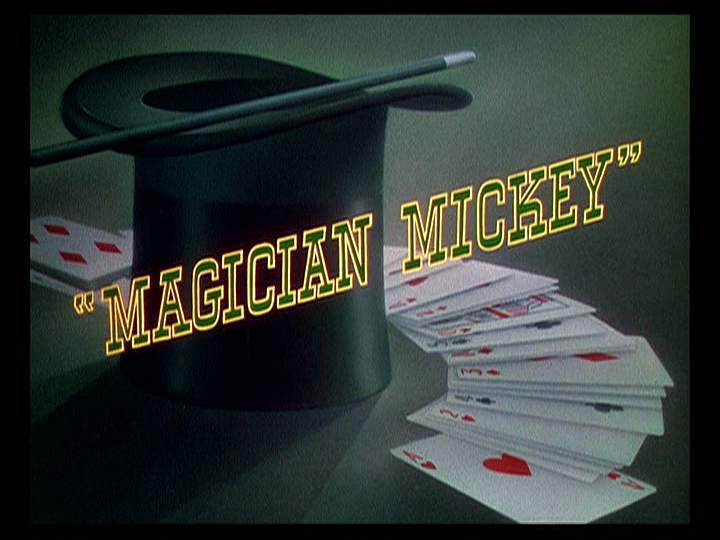
February 6, 1937 – Release of the Mickey Mouse Short Film Magician Mickey

“Aw, why don’t you go home? Phooey!”

On February 6, 1937, audiences were treated to a cartoon magic show called Magician Mickey, starring Mickey Mouse. Unfortunately for Mickey, Donald Duck decides to attend the show, heckling Mickey from beginning to end with a growing degree of cartoon violence, but Donald learns that Mickey will always get the best of him in the end. The short was directed by David Hand, and stars Walt Disney as Mickey Mouse, Clarence Nash as Donald Duck, and Pinto Colvig as Goofy. As with many of the shorts of this period, this one relies on the use of pantomime, as Mickey and Goofy only have one line each. The short has the added bonus of Donald throwing ten fits, including the ones where he is a kangaroo, a seal, and a monkey—it is a magic show—and with every fit, he spits out cards ending with the ace of hearts sticking out of his mouth.

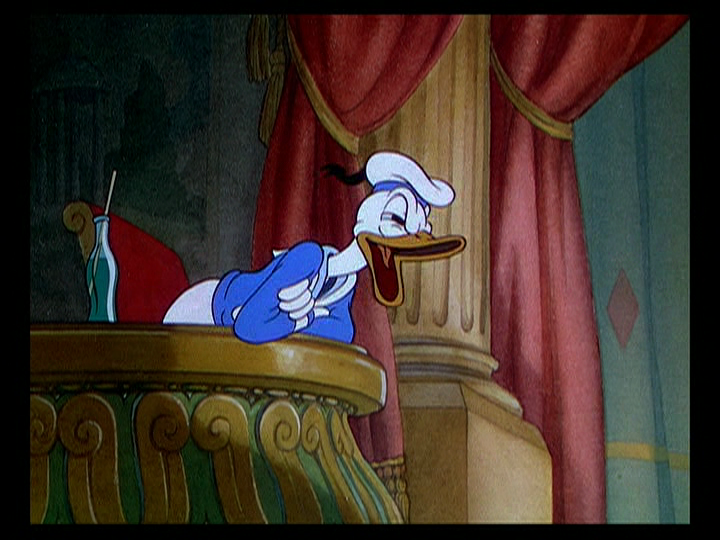
The short opens in a theater, and we see Goofy up in the rafters, setting up the ropes and lights for the show. We then hear applause as Mickey struts onto the stage. His first trick is making his table appear from his hat. He then turns his cloak into a crow, and as the crow flies away, Mickey is startled by hearing loud laughter. As he turns, he sees Donald Duck in a balcony seat, beginning his heckling as Mickey’s personal skeptic, crying, “Aw, phooey.”

Donald Duck, Mickey Mouse's personal heckler

Mickey’s next trick is to release a balloon from his hand, after showing that there was nothing up his sleeve. He releases another one, which suddenly pops over Mickey’s head, drenching him. He glares over at Donald, who spies the other balloon floating over and shoots it with a slingshot. Unfortunately, the balloon turns into a lobster, and begins to fight with Donald. As Donald throws it back at Mickey, Mickey catches it and turns it back into a balloon, which he pops with his magic wand.

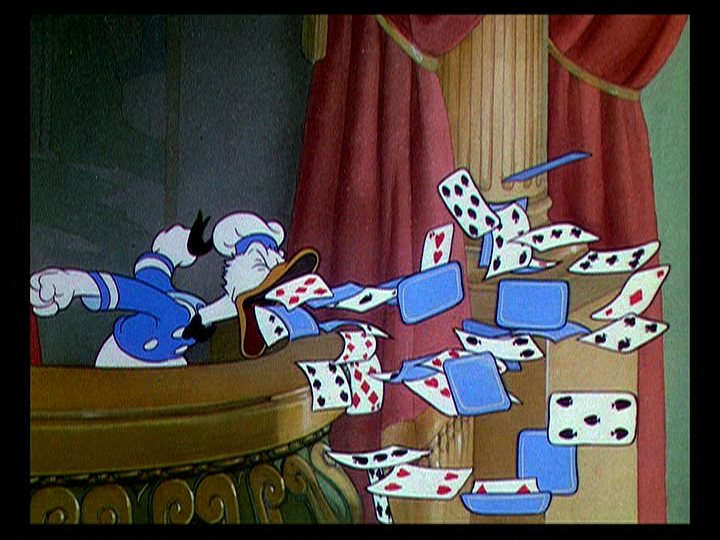
Mickey then begins a card trick, but Donald, ever up to mischief, pulls out a bellows and shoots the air in Mickey’s direction, causing the cards to fly all over the place. Mickey amazes the audience by turning the cards into flock of birds, which he then sends into a cage he makes appear out of thin air. He then makes the cage disappear, replacing it with a new deck of cards. Donald proclaims that anyone can do that trick, and as Mickey makes the cards disappear, they reappear shooting out of Donald’s mouth as he throws a fit. Humiliated, he throws his empty soda bottle at Mickey. Unfazed, Mickey makes the bottle float in midair and fill with water, which shoots back at Donald, causing another card-spitting fit.

Mickey makes the cards reappear through Donald's fits, a humiliation not even Donald expected

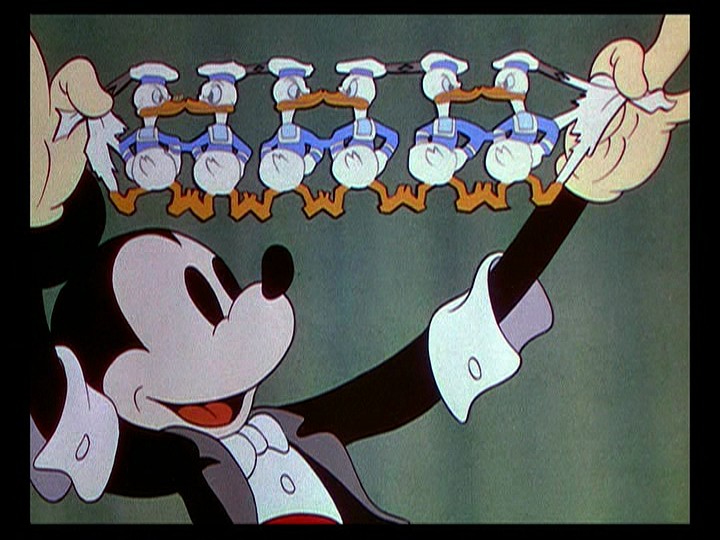
As Mickey bows to the audience, Donald jumps onto the stage and steals the magic wand, trying to use it on Mickey. The wand does give Donald a giant ice cream cone, which spits raspberry ice cream into the duck’s face, causing a third card-spitting fit. As he leaps at Mickey, Mickey catches him and makes him disappear in his hands, turning him into a set of Donald Duck paper dolls, and then into a twisted bullet, which Mickey places into a starter’s pistol. Mickey shoots Donald at an egg on the side table, and by the light of a candle, the audience sees Donald inside the egg, throwing another fit. Mickey grabs the egg and throws it into his hat, and makes Donald reappear by emptying the yolk from the hat.

Magician Mickey and his amazing Donald Duck paper dolls

Angered again, Donald steals the wand again, breaks it in half and throws it on the ground before having another tantrum; this tantrum, however, distracts him from seeing the wand pieces turning into a cactus equipped with boxing gloves. The cactus then begins to punch Donald, with one knockout punch sending him flying offstage. Having enough of the humiliation, but not knowing when to give up, Donald lunges onto the stage, sailing through a hoop Mickey holds up, turning into an assortment of animals as he goes through the hoop over and over. After getting himself back to normal, and seeing Mickey take another bow before the enthralled audience, he spies the pistol in Mickey’s back pocket rips it away and points it at Mickey, who becomes alarmed. “Look out! It’s loaded!” Mickey cries. Donald doesn’t care, but at least he provides the show with an explosive ending.


February 3

February 3, 1931 – Silly Symphony Birds of a Feather is Released to Theaters

Directed by Burt Gillett, the Silly Symphony Birds of a Feather was released to theaters on February 3, 1931. A black and white short, the story is of several types of birds and how they react around each other, especially when a hawk steals a chick, and a brave group of crows decides to fight back to rescue it.

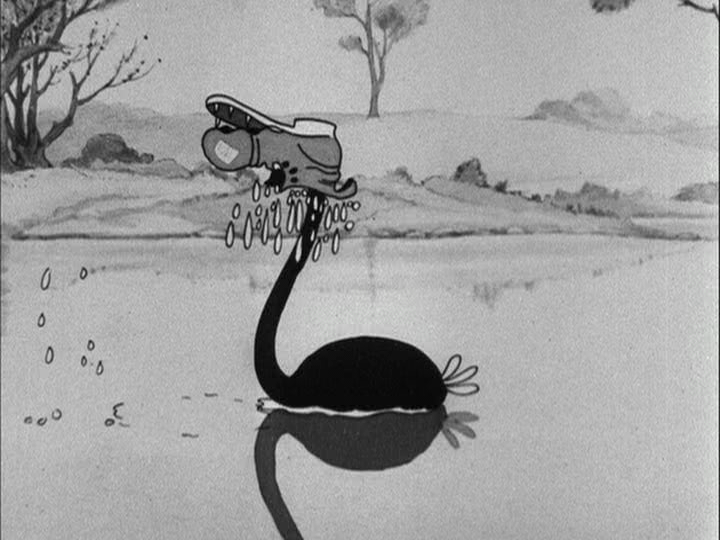
The short opens on a rather idyllic river scene, where three white swans are gliding down a river. They are followed by a black swan, which has two babies as passengers on its back. After the babies decide to swim away, the black swan dives into the water for something to eat, and devours a worm. When it dives again, instead of a worm, it has found a shoelace still attached to a boot, which then lands on its head. The next bird we see is a peacock, preening alongside the water’s edge. After spreading its tail feathers and admiring itself, a duck enters the picture. After observing the narcissistic peacock for a second, the duck sticks its tongue out at the bird, thoroughly distracting it before sailing away.

The swan that accidentally eats a shoelace

The scene then moves to two birds who appear to have harps for tails, beginning the symphony part of this Silly Symphony. The audience travels up a tree, stopping at certain moments to observe the musical habits of the occupants. First, there are several birds chirping the cheerful melody begun by the harp-tailed birds, and above them is a mother bird watching her three eggs hatching. Four hummingbirds buzz around the flowers above them, gathering nectar. The scene travels up a little more, where two birds are trying to continue the melody, but are interrupted by a cuckoo bird, who pops out of several different openings in the tree.

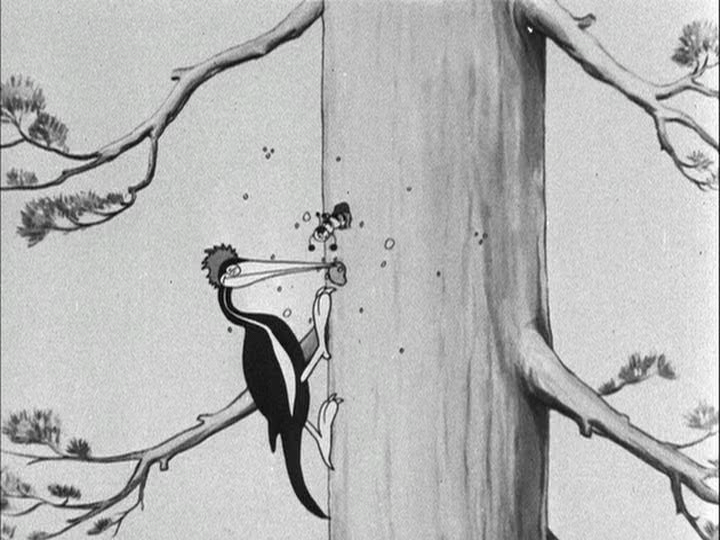
In another tree, a woodpecker tries to peck for food, disturbing a caterpillar that lives in the tree. Annoyed, the caterpillar knocks on the woodpecker’s head, which begins the woodpecker’s pursuit of its possible snack. The woodpecker wins the chase, eating the caterpillar segment by segment.

The woodpecker trying to find food. Little does he know that food is annoyed with his pecking.

A crow flies into the picture, observing another bird giving food to her babies. After the mother bird flies away, the crow climbs into the nest and steals the baby birds’ food, a worm, and flies back to her own nest in the backside of a scarecrow. Her baby crows fight over the worm, which escapes down the leg of the scarecrow and scampers away, only to be pursued by a chicken and her chicks. There are many great gags here, including the worm trying to throw the chickens off by crawling under boots, a pipe, and a can, only to have the hen lift them up with her head and have them land on her chicks. Eventually, the worm crawls into a hole, and the chickens pace and wait, but eventually give up and walk away, except for one chick, who grabs the worm by the end, only to have it crawl up through another hole and bite it on the tail.

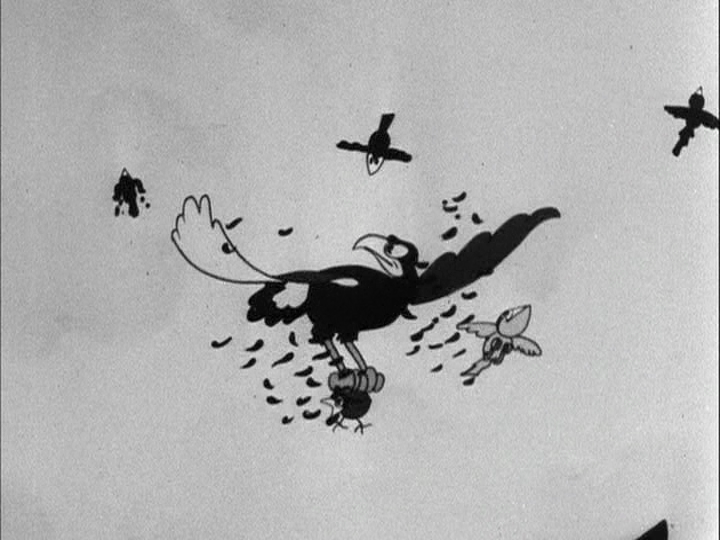
While the chickens look for food, the hen notices the shadow of a hawk circling around them. She desperately gathers her chicks together for safety, but misses the one chick who was still after the worm, who is caught by the hawk. After a crow notices what happens, he calls together his friends, who go after the hawk in formation, dive bombing and attacking it to save the chick.

The formation of crows dive bombing the hawk

Overall, the short isn’t that memorable of all the Silly Symphonies, but there are a few good gags that make it a good short to watch. If you watch them in chronological order, you’re able to see how the animation was improving, but this short still has the more cartoony style that was present in the earlier shorts.

January 22

January 22, 1930 – Carl Stalling Leaves Walt Disney Studios to Join Ub Iwerks

Musical Director, Carl Stalling

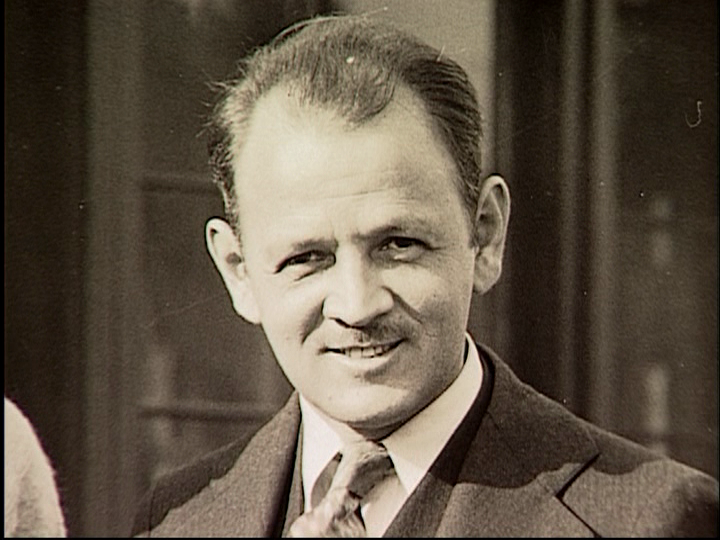
The January 21 entry credited Ub Iwerks as the man who invented the Xerox Process, eliminating the need for the Ink and Paint department, and saving the Disney’s animation department from financial ruin. However, 30 years before, Iwerks had decided that it would be best for him to leave the Disney Studio. He was privately approached by a representative of Pat Powers, the studio’s sound distributor, who offered Iwerks a chance to form his own studio. The morning of the 21st of January,1930, Iwerks approached Roy Disney, letting him know that he was leaving as soon as possible, citing personal problems with Walt as his reason. Iwerks’ departure was a sign of things to come, with the first consequence being the departure of the studio’s musical director, Carl Stalling.

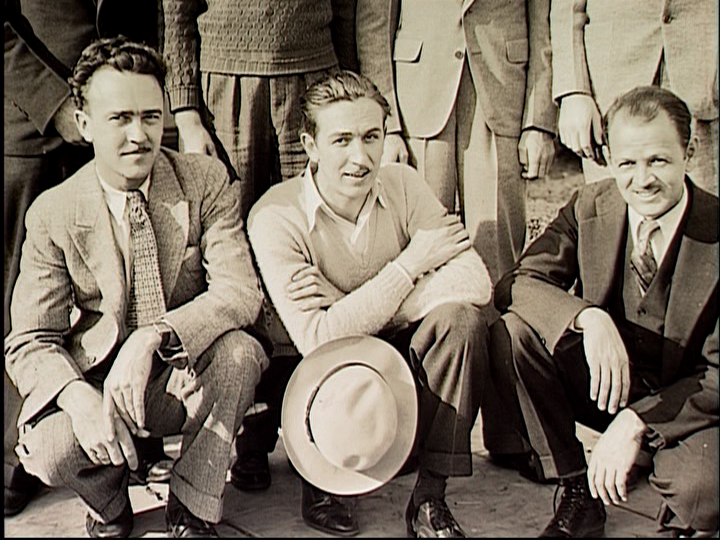
Happier times at the Disney Studios: Ub Iwerks (L), Walt Disney (C), and Carl Stalling (R)

Carl Stalling had been a good friend of Walt Disney’s when living in Kansas City, and had composed several scores for Disney’s cartoons, including Plane Crazy and the Gallopin’ Gaucho. Stalling’s biggest contribution to the studio, however, was the idea of the Silly Symphony. Stalling had approached Disney after the success of Steamboat Willie, proposing a cartoon short built on a music foundation. These shorts wouldn’t have a recurring character from short to short, but would tell a different story each time. Stalling also helped write the song “Minnie’s Yoo Hoo” with Walt (see January 11th entry), which ended up causing another problem for the studio once Iwerks decided to leave.

When Stalling heard that Iwerks had left, he assumed, as Pat Powers had, that the studio wouldn’t be able to survive. Stalling was uncomfortable with Iwerks’ leaving, and was upset with the way he perceived Walt was running the studio. Stalling, unfortunately, had underestimated Walt’s contribution to the popularity of Mickey Mouse and the success of the studio. The morning Iwerks left, Stalling approached Roy Disney (Walt was away in New York) and gave his grievances, which included royalties from “Minnie’s Yoo Hoo” and the liability in the recording studio. Roy gave Stalling an offer: Disney would buy Stalling’s share in the recording studio. Stalling agreed, but early the next morning he returned, saying he was very unhappy and had personal problems with Walt, and like Iwerks, needed to leave immediately. He demanded his back pay, brandishing legal notices he had written himself. Roy had no choice but to have the accounting office give Stalling a check and send him on his way.

Walt had been deeply stung by Iwerks’ and Stallings’ departures, as these men had been with him since the beginning. Powers had believed that Iwerks was the true talent behind the success of Mickey; indeed, Iwerks was responsible for the drawings and the design, but it was Walt who created the stories and helped with the character’s personality. For Powers, and Stalling, not realizing the importance of Walt’s contribution to the character was a grave mistake.

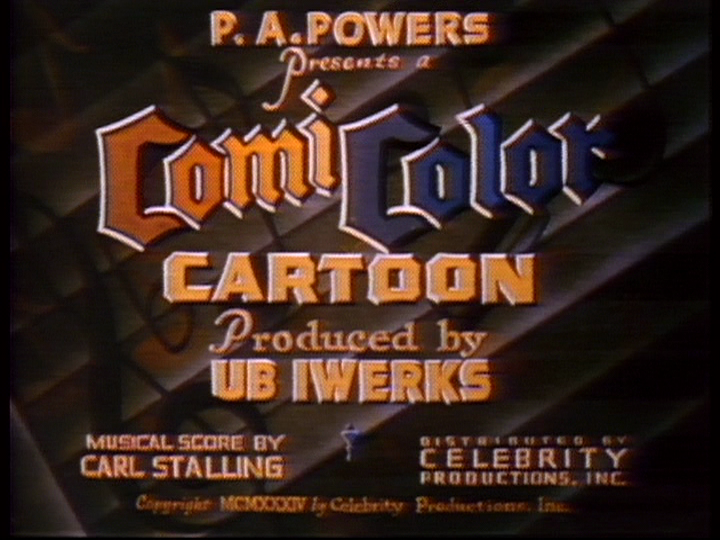
One of Iwerks' ComiColor shorts, with musical score by Carl Stalling

In retrospect, the dissolution of the Iwerks-Disney partnership was a good thing for Iwerks and for Stalling. Iwerks was able to express himself creatively with his studio and work on many new technical innovations to help create more believable animation; when his studio closed in 1938, Iwerks was able to go back to the Disney Studio and develop special effects, including the multiplane camera and the Xerox Process. Stalling joined the Warner Brothers Studio in 1936, becoming a full-time composer for the Looney Tunes. His most famous works for the studio were The Rabbit of Seville and A Corny Concerto. This bleak moment in the Disney Studio history led to the brilliant creative output of all three: Disney, Iwerks, and Stalling.

January 13

January 13, 1930 – The Mickey Mouse Comic Strip is Distributed by King Features Syndicate.

A preview of the Mickey Mouse comic strip.

On January 13, 1930, two newspapers in the United States, the New York Mirror and the Oakland Post-Enquirer, debuted a new comic strip featuring the popular movie character, Mickey Mouse. It was slow to gain popularity, as the strip was an ongoing story, rather than the usual practice of a gag per strip, but it became an enduring classic lasting for decades.

The first eighteen strips were drawn by famed Disney animator Ub Iwerks. Iwerks recalled that Disney’s original ambition was to become a cartoonist, which is likely the reason the early Mickey Mouse cartoons included the byline, A Walt Disney Comic. Disney decided to write the first four months of comics, although Iwerks had been contacted first about creating a comic strip about Mickey. As Joseph Connelly, the President of King Features Syndicate, wrote in a letter that reads almost like fanmail:

“I think your mouse animation is one of the funniest features I have

ever seen in the movies. Please consider producing one in comic strip

form for newspapers. If you can find time to do one, I shall be very

interested in seeing some specimens.”

Iwerks was already spread thin with other projects for the studio, and handed the letter to Walt, claiming it “wasn’t [his] business. Walt made the deal, and I did the drawings for a few strips.” Walt, on the other hand, had this to say when asked about the comic:

“[In 1929 we were looking for] ways to exploit characters like the

Mouse. The most obvious was a comic strip. So I started work on a

comic strip hoping I could sell it to one of the syndicates. As I was

producing the first one, a letter came to me from King Features

wanting to know if I would be interested in doing a comic strip

featuring Mickey Mouse. Naturally, I accepted their offer.”

As with the story of how Mickey Mouse came to be, there were discrepancies between the recollections of Disney and Iwerks. Although it may not be clear through their statements of who was accurate, it seems that Walt was always interested in doing a comic strip, but work had not started before Iwerks received the letter from Connelly.

But Iwerks did animate the strips, and then the project was given to Win Smith for three months. Smith butted heads with Walt over seniority and age; when Walt asked Smith to write the comic as well as animate it, Smith refused, telling Walt that “No goddamn young whipper-snapper’s going to tell me what to do.” Smith quit that day, and the strip was taken over by Floyd Gottfredson.

Floyd Gottfredson

Gottfredson was asked to take over the strip for a few weeks until a replacement was found, but ended up working on the comic for forty-five years, until he retired in 1975. While the early comics were based on the cartoons in theaters, Gottfredson put his own personal spin on the strip, using contemporary events like the Great Depression and World War II as backdrops for heroic adventures in which Mickey battled corrupt politicians and assorted villains to save his friends and country.

The first comic strip, entitled “Lost on a Desert Island,” is very reflective of the attitudes of the period, with exaggerated interpretations of anyone who wasn’t Anglo-Saxon. These clichés were commonplace, used when one didn’t have the time or patience to create a fully-formed character.

The comic itself is a dry run of the adventure comics that lay ahead in the strip’s future, but it is charming for what it is. It begins with Mickey in the barnyard, trying to fly a homemade plane, which is similar to the plot of the 1928 short film, Plane Crazy. Mickey gets the plane to fly (losing Minnie Mouse in the process, who lands to safety using her bloomers as a parachute), but ends up in the middle of a typhoon and crashes on a desert island. Although this is a continuous story, there are gags to end each strip, and it has a real charm about it. If one is able to look past the attitudes of the past that are heavily featured in the strip, it’s a good read overall.

January 11

January 11, 1929 – The First Mickey Mouse Club is Formed

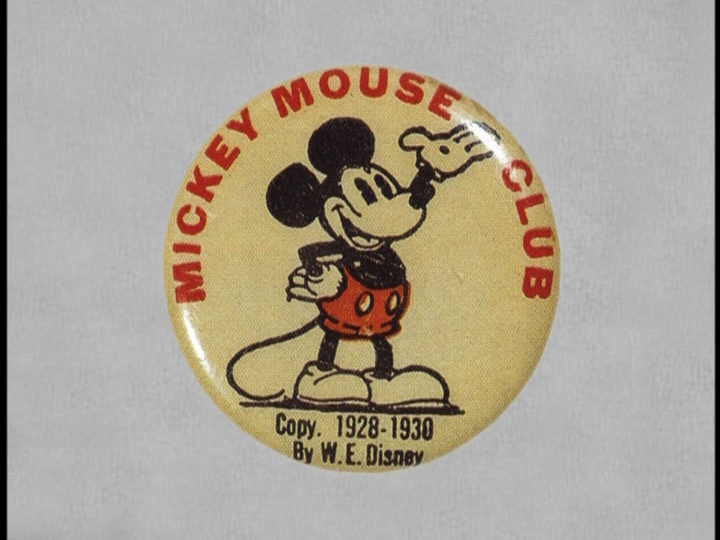
A promotional button from the original club

“Mickey Mice do not swear, smoke, cheat, or lie!”

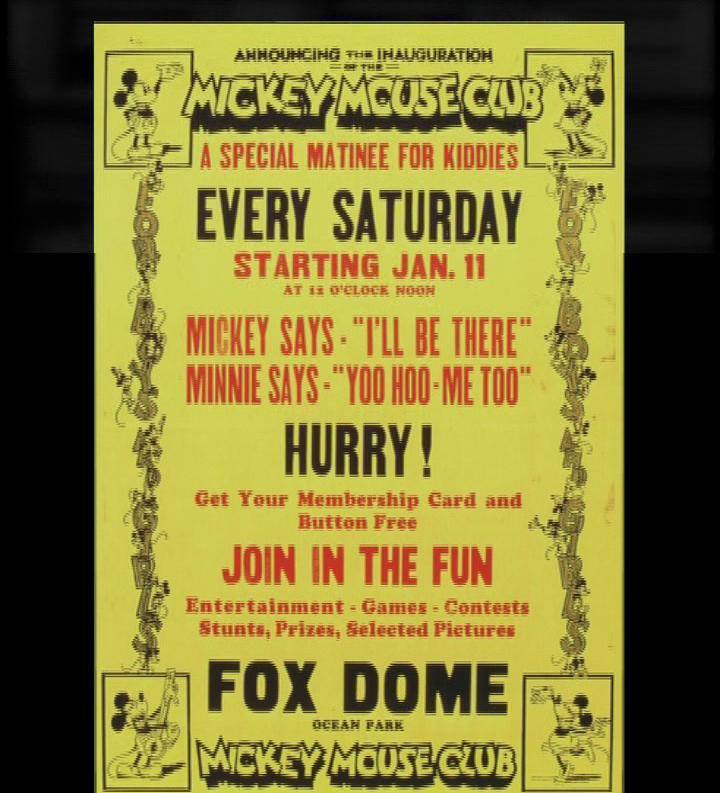
At noon on January 11, 1929, the first Mickey Mouse Club was called to order in the Fox Dome Theater in Ocean Park, California. The club was the idea of the theater’s manager, Harry W. Woodin, which he began during the children’s matinee shows on Saturdays. Soon, these clubs spread like wildfire, and by the height of their popularity in 1932, it was estimated that there were one million members worldwide, with many clubs meeting every week. During club meetings, children would watch Mickey Mouse cartoons, recite the Mickey Mouse credo, and elect a Chief Mickey and Chief Minnie Mouse.

A copy of the original flier for the Fox Dome Theater's first meeting of the Mickey Mouse Club

Intrigued with Woodin’s concept, Walt Disney saw that there were many opportunities for merchandising through the clubs, as well as convincing more children to attend the theater to see new Mickey Mouse shorts. Disney hired Woodin to be the general manager of these club gatherings. Woodin’s job included printing and sending fliers to theaters across the country, instructing them on how to develop the clubs and help local businesses through advertisements in the club bulletins. Business began to boom through the name of Mickey Mouse: Bakeries would offer free Mickey birthday cakes, banks gave away Mickey savings banks, and department stores would give away free Mickey toys to entice customers to look at their more expensive toys. Clubs were formed not only across the United States, but also in England and Canada, among other countries, by 1930. The Odeon Theatre chain in England had 160 clubs with 110,000 members by the peak of the club’s popularity.

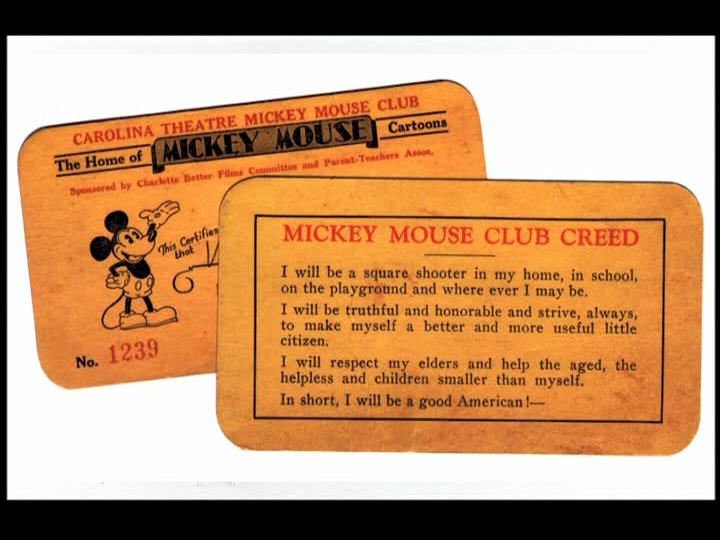
A card with the Mickey Mouse Club Creed

The club itself taught children how to be model citizens. Children would recite, “Mickey Mice do not swear, smoke, cheat, or lie!” Mickey himself would instruct the kids on topics such as how to brush their teeth and wash behind their ears, respect their parents, attend Sunday school, and on the virtues of honesty and honor. The creed of Mickey Mouse Club members was as follows:

I will be a square shooter in my home, in school, on the playground and where ever I may be.

I will be truthful and honorable and strive, always, to make myself a better and more useful little citizen.

I will respect my elders and help the aged, the helpless and children smaller than myself.

In short, I will be a good American!

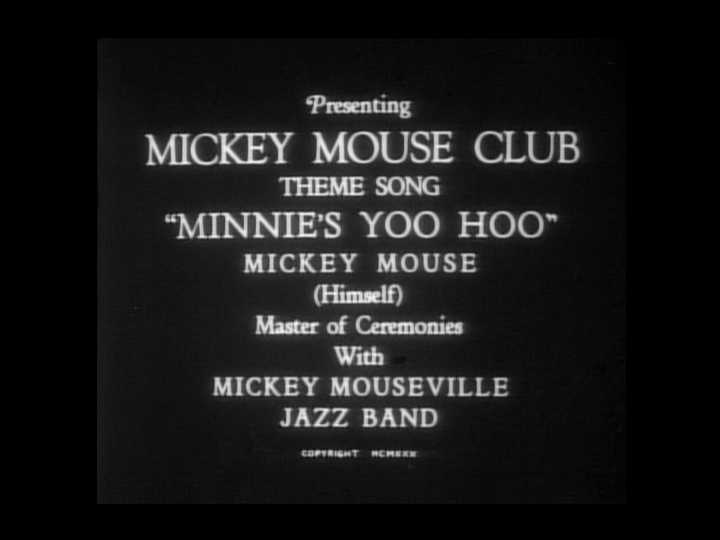
The highlight of these clubs, naturally, was the Mickey Mouse cartoons. To that end, Walt Disney had a special animated short for the club meetings of the club’s theme song, “Minnie’s Yoo-Hoo.” Written by Walt Disney and Carl Stalling, the song was the first Disney song released on sheet music. The animated short that accompanied the song had Mickey singing the first verse, before encouraging the children to sing as the lyrics would show up on the screen.

Title card for the Minnie's Yoo-Hoo short.

Mickey Mouse’s explosive popularity was a big part of American culture in the late ’20s and early ’30s. With the credo recited at these meetings, as well as the lessons Mickey would teach the children, it’s no wonder that Mickey was seen as a positive role model, and parents would object if Mickey was seen doing something reckless, as he did in many of his early shorts. The clubs held steady in their popularity with the Disney stamp of approval until 1935, when the popularity of these clubs began to wane. The clubs did continue unofficially through World War II, with Mickey and friends extolling the importance of planting Victory Gardens and donating old toys for scrap. It would be 23 years until the television version of the Mickey Mouse Club would appear in people’s homes.

January 9

January 9, 1937– Don Donald is Released to Theaters

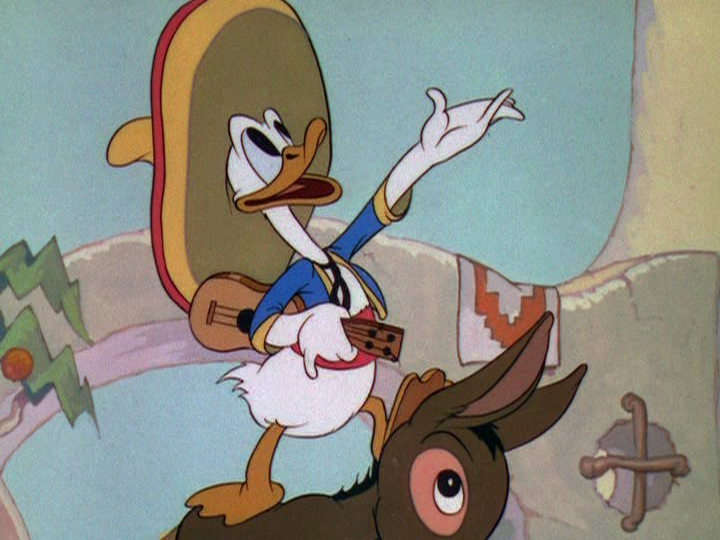
Don Donald

“Hi, toots!”

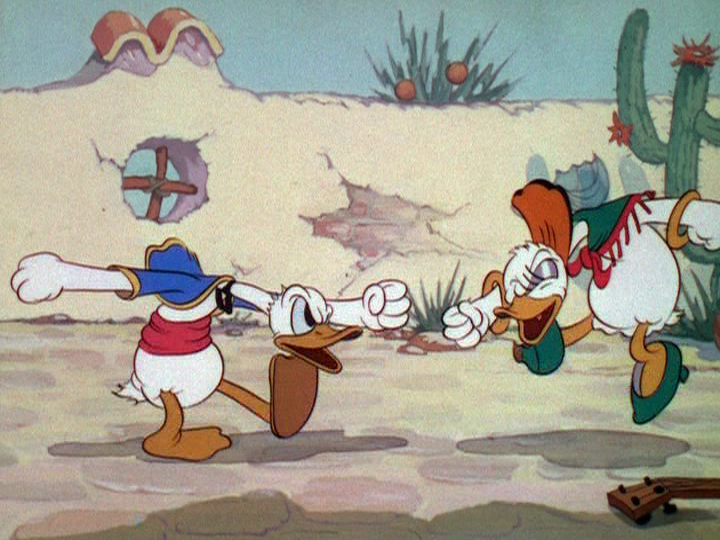
Directed by Ben Sharpsteen and featuring Clarence Nash as the voice of Donald and Donna Duck, this short features Donald riding a burro on his way to visit his girlfriend, Donna. Donna greets him with a Mexican Hat Dance – literally dancing on Donald’s large sombrero – which leads to her dancing while riding on the burro. When the burro bucks Donna off, she shows off a temper that is just as bad as Donald’s.

Donna exhibits the same behavior as Donald when her feathers are ruffled.

Donna is the first iteration of the character Daisy Duck, who will not appear by that name until the short Mr. Duck Steps Out, released in 1940. She is adventurous and short-tempered: When Donald begins to laugh at her misfortune, Donna not only reacts with the same arm-swinging anger that Donald is known for, but hits him over and over with his guitar, before she smashes it right over his head.

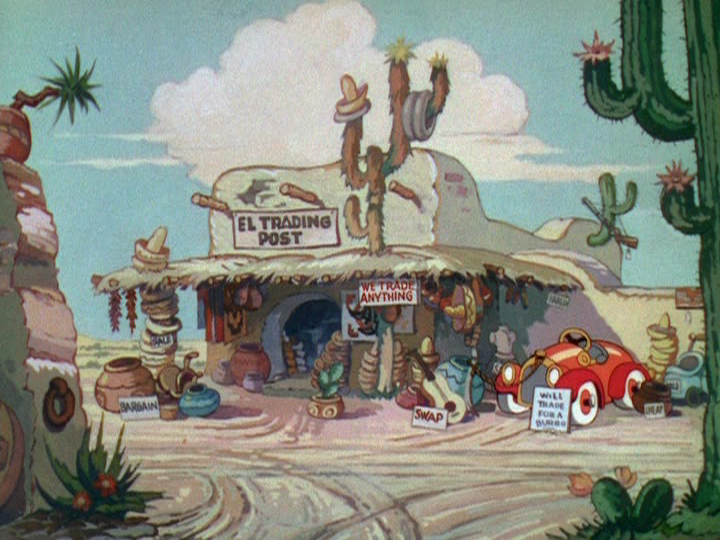
After this altercation with Donna, Donald stumbles upon “El Trading Post” and spies a car with the sign, Will Trade For A Burro. Not one to miss an opportunity, Donald trades the upset burro for the car to impress Donna.

Donald sees El Trading Post, with the car and its sign (R).

Still fuming, Donna is ready to throw a vase over Donald’s head, until she sees the car he’s driving. She immediately jumps down and kisses him, and urges him to take her for a drive. As they pass by the Trading Post, the burro is crying, and finally he breaks free from his bonds and begins to chase the two, catching up to them as trouble begins.

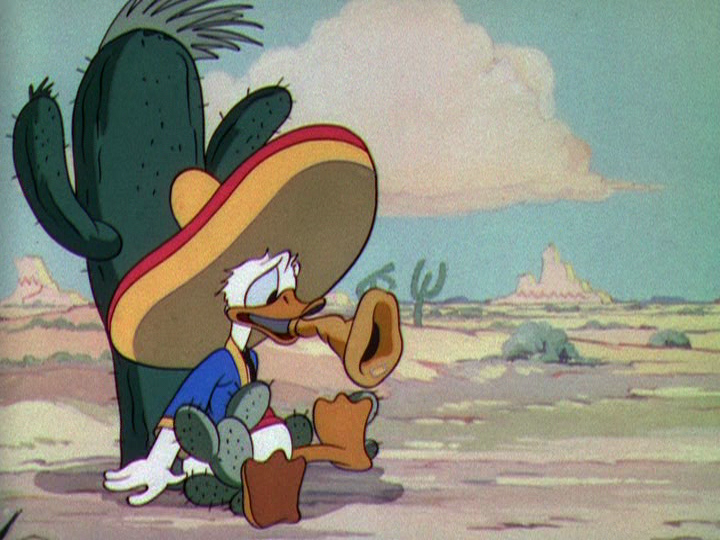
In the desert, the car sputters and breaks down, in the process throwing Donald out and trapping Donna in the back before it crashes, ejecting her. Donald, once again, makes the mistake of laughing at her misfortune, and she throws the car horn at him. She then pulls a unicycle from her purse and wheels away, leaving Donald alone with a horn in his mouth and the burro laughing at him.

Donald, once again, feeling the wrath of Donna.

Like many of the beginning shorts of Donald’s career, Clarence Nash’s pronunciation was still a bit unclear, which has sometimes caused censorship problems. A variation of Donald’s catchphrase, “Hiya, toots!” is used here, and is very understandable. Donald would use this catchphrase often, particularly when speaking to Daisy.

January 7

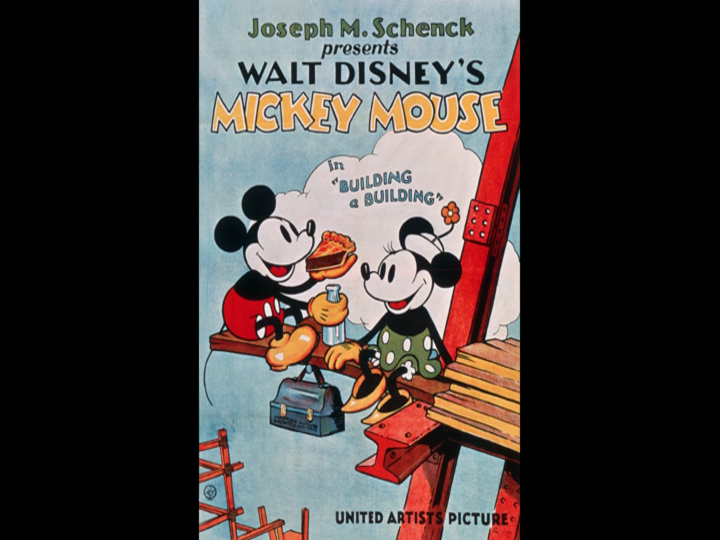
January 7, 1933 – Building a Building Released to Theaters

The film poster for the short 'Building a Building'

“Baloney, and macaroni, and a huckleberry pie”

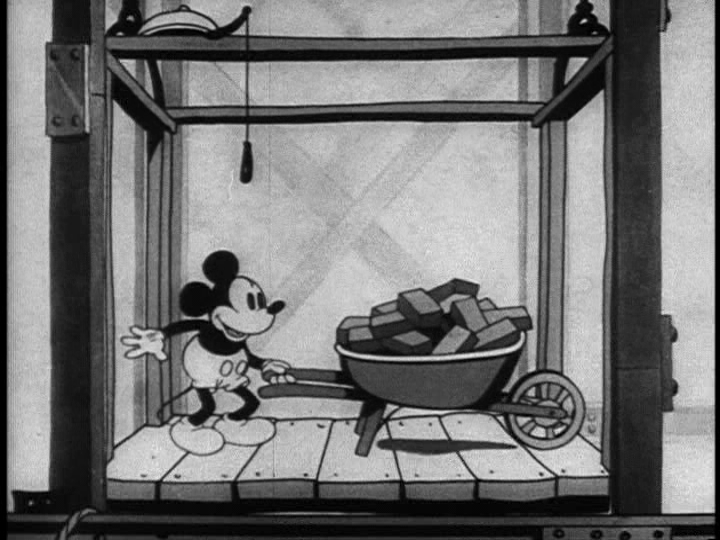
In this 1933 black-and-white short film – directed by David Hand, recorded on R.C.A. Photophone – Mickey is a construction worker on a building site, with Pegleg Pete as his foreman. Minnie comes by selling box lunches for only 15 cents (Pluto makes a cameo, pulling her lunch cart). Her presence soon attracts the attention of plucky young Mickey, who spills dirt and bricks on top of Pete and his blueprints, aggravating Pete’s already short fuse.

Mickey working on the building - also a good example of the "squash and stretch" method of animation.

Although Mickey’s actions in this era were described more as an homage to silent film star Charlie Chaplin, one can see that there are also nods to the physical comedy stylings of silent film star Harold Lloyd (see Jan. 4th entry – Mickey’s Polo Team), as Mickey falls head over heels – literally – for Minnie Mouse.

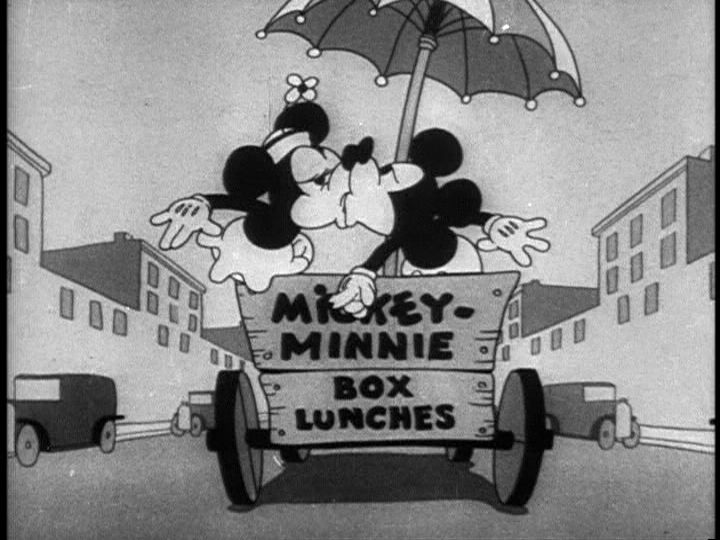
When Pete steals Mickey’s lunch, Minnie feels bad for Mickey and offers him a free lunch, which includes, as she often repeats, “Baloney, and macaroni, and a huckleberry pie,” with a corn cob as well, for only 15 cents, which is about $2.50 today – not a bad price for such a lunch. Not satisfied with stealing Mickey’s lunch, Pete tries to steal Minnie’s affections as well. This does not turn out well for Pete, as Mickey and Minnie use all available resources to outsmart the foreman, before sliding down a chute and riding off in Minnie’s lunch wagon, now co-owned with Mickey. They share a kiss while Pete ends up stuck in a tub of cement.

The kiss as the couple rides off together.

In this short, Pete was voiced by Billy Bletcher, Minnie by Marcellite Garner, and Mickey by Walt Disney. This short is entertaining, especially for the over-the-top physical comedy used to show Mickey’s affections and to outsmart Pete.

January 4

January 4, 1936 – Mickey’s Polo Team is released to theaters.

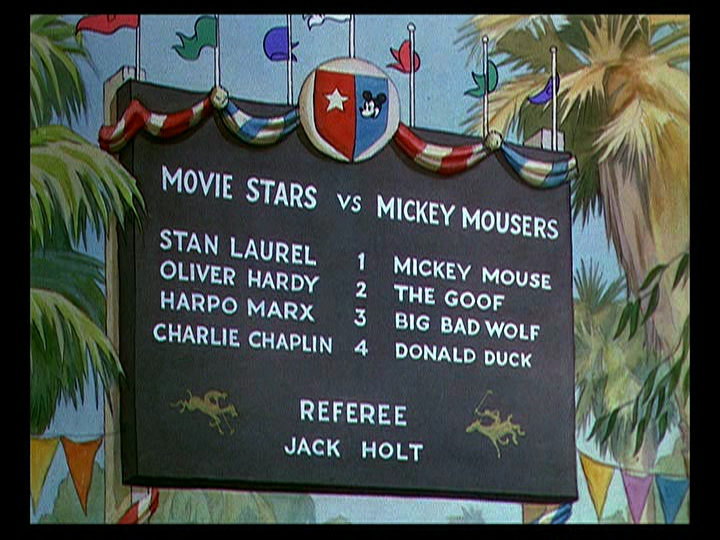
The Movie Stars versus The Mickey Mousers

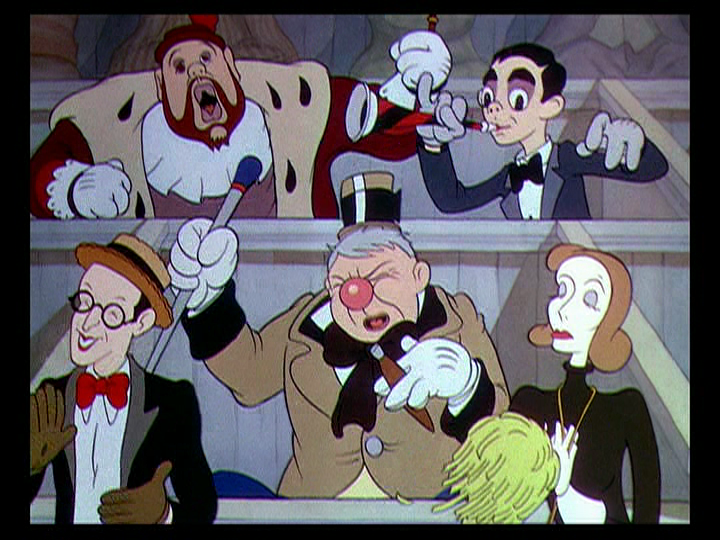
A good example of the popular culture of the 1930s, Mickey’s Polo Team was released to theaters on January 4th. It was directed by David Hand, produced by Walt Disney Productions, and released by United Artists. The short features Mickey leading a team called “The Mickey Mousers,” against a team called “The Movie Stars”, featuring popular 1930s celebrities Stan Laurel, Oliver Hardy, Harpo Marx (riding an ostritch), and Charlie Chaplin. The referee is famous leading man Jack Holt, and the audience features prominent 1930s entertainment stars. One of the running gags of the short is Hardy trying to stay on and control his horse, which shows off an example of Laurel and Hardy’s slapstick comedy.

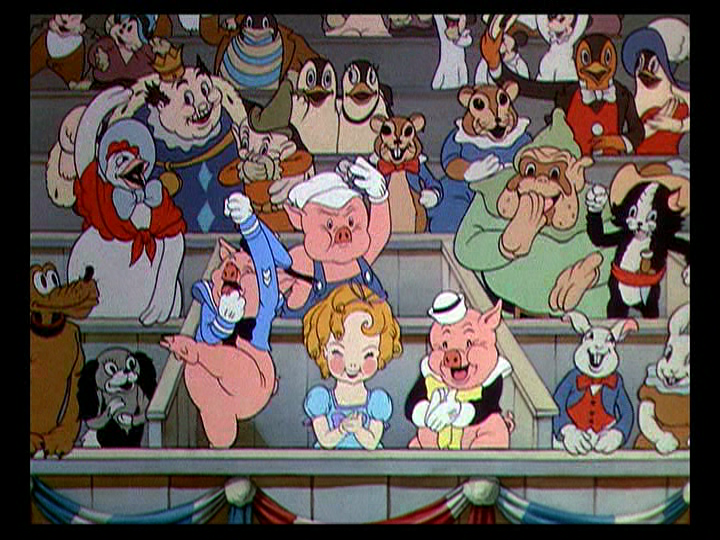
Characters from the Silly Symphonies and Shirley Temple

The short also has characters from the Silly Symphonies, including The Wise Little Hen (The Wise Little Hen), The Flying Mouse and his mother (The Flying Mouse), King Midas and Goldie (The Golden Touch), Peter and Polly (Peculiar Penguins), Ambrose and Dirty Bill (The Robber Kitten), two bunnies (Funny Little Bunnies), and Cock Robin with Jenny Wren (Who Killed Cock Robin?).

From top left going clockwise: Charles Laughton, Eddie Cantor, Greta Garbo, W.C. Fields, and Harold Lloyd.

Many famous personalities were caricatured in this short:

Stan Laurel and Oliver Hardy were an acclaimed double act in early Hollywood, mostly known for their slapstick comedy.

Harpo Marx was a member of the famous family comedy act, the Marx Brothers. Harpo never spoke, but communicated through whistling or blowing a horn – the ostrich Harpo rides in the polo match acts as his horn in this short.

Jack Holt, the referee, was Columbia Pictures’ most reliable leading man, because of his rugged personality. He was well known for staring in three Frank Capra action films: Submarine in 1928, Flight in 1929, and Dirigible in 1931.

Shirley Temple was a superstar in the 1930s, known for her work in the films Bright Eyes (featuring her signature song “On the Good Ship Lollipop”), Curly Top, and Dimples.

Charles Laughton was a British film actor, known at the time for his portrayal as the titular character in The Private Life of Henry VIII, which the animators capitalized on as they drew him.

Eddie Cantor was a Broadway star and singer turned Hollywood actor, known for his hit songs “Makin’ Whoopie” and “If You Knew Susie.” Cantor became a leading man after his work in the 1930 film Whoopee!

W.C. Fields was an American actor, known for his comic persona of a alcoholic egotist with contempt for dogs, women and children, yet was still seen as a sympathetic character to audiences. His films include David Copperfield, Alice in Wonderland, and The Fatal Glass of Beer, written by Fields himself.

Harold Lloyd was a popular silent film actor, ranked alongside Buster Keaton and Charlie Chaplin as the most popular and influential comedians in the silent era. The scene he’s most well known for is from Safety Last! in which he hangs from the hands of a clock above the city streets; this is a prime example of his daredevil physical feats.

Greta Garbo was a Swedish actress who was an international icon during the classic period of Hollywood. Her most well-known films were Anna Karenina and Camille.

Edna May Oliver was an American character actress, known for usually playing waspish spinsters. She is best known for her roles in Alice in Wonderland, A Tale of Two Cities, and David Copperfield.

Clark Gable was an American actor, known at that point for his role in the Academy Award winning film It Happened One Night, as well as his role is Mutiny on the Bounty. Nicknamed The King of Hollywood, Gable was also known for his ears, which were often caricatured by the likes of Disney and Warner Brothers.

This short is interesting for seeing what was popular in the 1930s. Polo was a popular sport with the Hollywood crowd, and Walt Disney was a fan, using the game to venture into Hollywood society. Although most of these actors would not be known by members of the general public these days, the people featured were huge stars. To be featured in a Disney short must have been seen as a form of flattery, or at least a sign that a star has “made it.” It’s a charming piece that gives the modern viewer insight to the cultural landscape of the 1930s in Hollywood.

If you are interested in seeing more Disney cartoons with caricatures of 1930s celebrities, please check out the following:

Mickey’s Gala Premiere

Mother Goose Goes Hollywood

The Autograph Hound