RSS Feed

Tag Archives: 1930s

May 11

Posted on

May 11, 1935 – The Silly Symphony, Water Babies, is Released to Theaters
“…it was inspired by the story Water-Babies, written in 1863 by Charles Kingsley, the great English writer and naturalist.” – Walt Disney

On May 11, 1935, the Silly Symphony Water Babies was released to theaters. It was loosely based on the children’s novel The Water-Babies, A Fairy Tale for a Land Baby by Reverend Charles Kingsley, which was published in 1863. The short was directed by Wilfred Jackson. Merbabies, released in 1938, is considered to be its sequel.

The short opens just as the sun is beginning to rise over a quiet pond. Two birds wake and begin to chirp, flying over the lilypads and trying to rouse the water babies sleeping inside. Once the water babies wake, the jump into the pond and begin to swim away. One baby has decided to remain sleeping, until the flower he’s sleeping in gives him a harsh slap to wake him. With a yawn, and trepidation over the temperature of the water, the baby joins the others as they splash and play around in the pond.
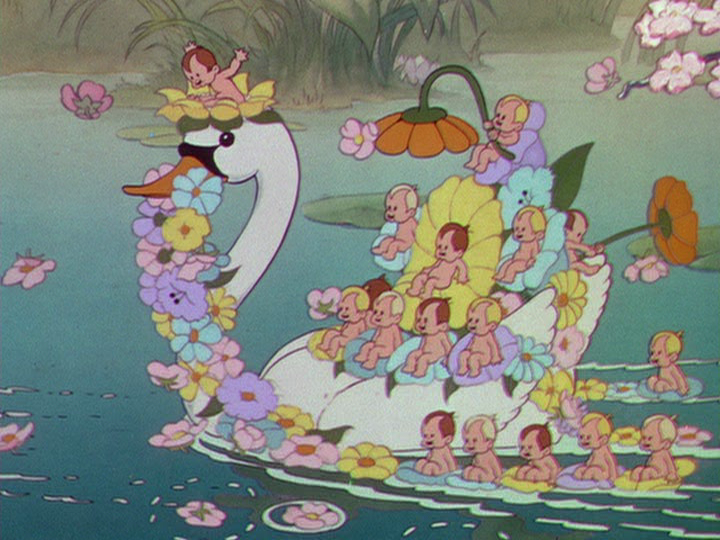
The Water-Babies riding of the back of a swan during a mini parade

As they play, they all hear the trumpets sound and excitedly swim in that direction. A parade has begun, with babies playing flower trumpets and ride on the backs of turtles and swans. Some travel on leaves, and a trio is seen riding on fish. The festival leads the babies to a patch of land where they begin to play in the weeds and with the frogs that live there. Three babies are seen using a spiderweb as a trampoline, and another trio are seen riding bullfrogs as if they were at a rodeo.

Another baby is seen preparing for a bull(frog) fight, pulling down a red petal to use as the red flag. The bullfrog gets his head caught in a flower, and uses the stem as a horn to try and attack the baby. Luckily, the baby sneaks back into the bullfrog’s cage before it can attack him.
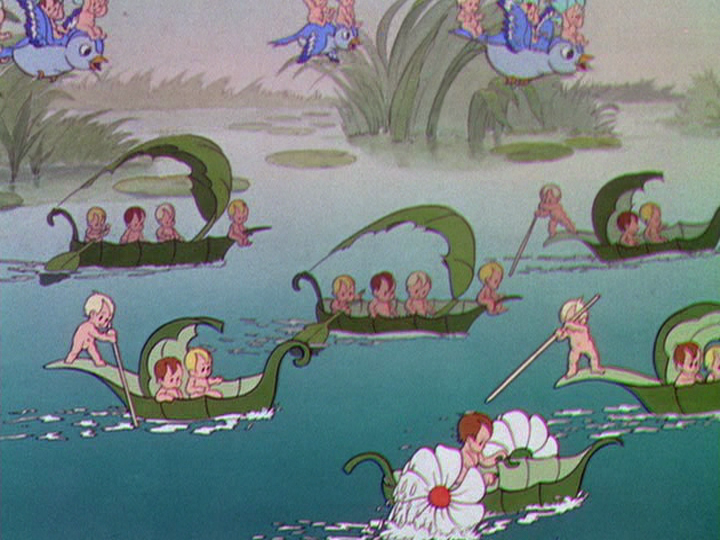
All the Water-Babies heading home after the day’s festivities

The trumpets sound again soon after the fight finishes, and the babies all head back to the pond to travel home at the end of a long eventful day. As the sun begins to set, the babies crawl into their lilypad beds after saying their prayers, and quickly fall asleep as the flower petals close up protectively, leaving the audience with a beautiful moonlit night on the pond.
May 6

Posted on

May 6, 1938 – The Mickey Mouse Short Film Mickey’s Trailer Premieres in Theaters

“The worst is over – it’s all downhill from here!”

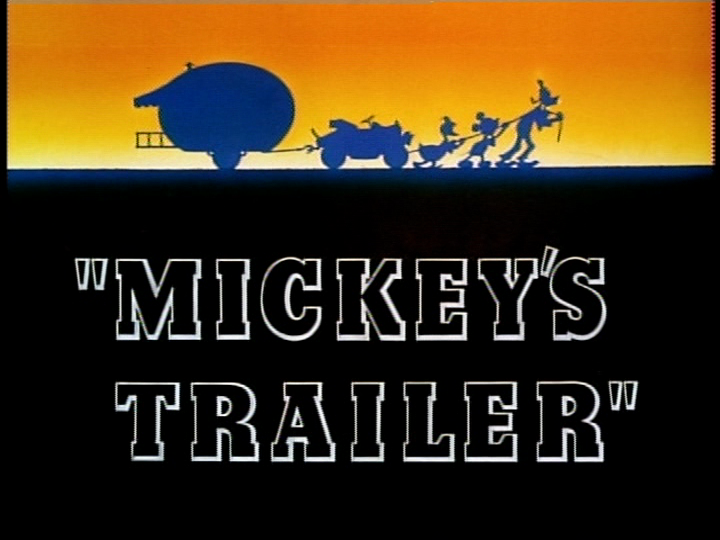
On May 6, 1938, the Mickey Mouse short Mickey’s Trailer was released to theaters. The short was directed by Ben Sharpsteen, and stars Walt Disney as the voice of Mickey Mouse, Clarence Nash as the voice of Donald Duck, and Pinto Colvig as the voice of Goofy. The short features many mechanical gags that are reminiscent of the early Mickey Mouse shorts.

The audience first sees Mickey’s trailer, in front of a picturesque background of the mountains. The door opens, and Mickey steps out in his nightgown, excited at the prospect of a beautiful day. He pulls a lever next to him, and the whole trailer begins to rattle as he goes back inside. Suddenly every bit of the trailer, from the white picket fence to the “lush green lawn”, folds back into the trailer. A car rolls out of the side, with Goofy sleeping in it; He awakens and slips into the front seat and gets ready to drive. The “picturesque” scenery folds up behind them and slips into the trailer, leaving behind a view of the city dump, with some refineries for good measure in the distance.

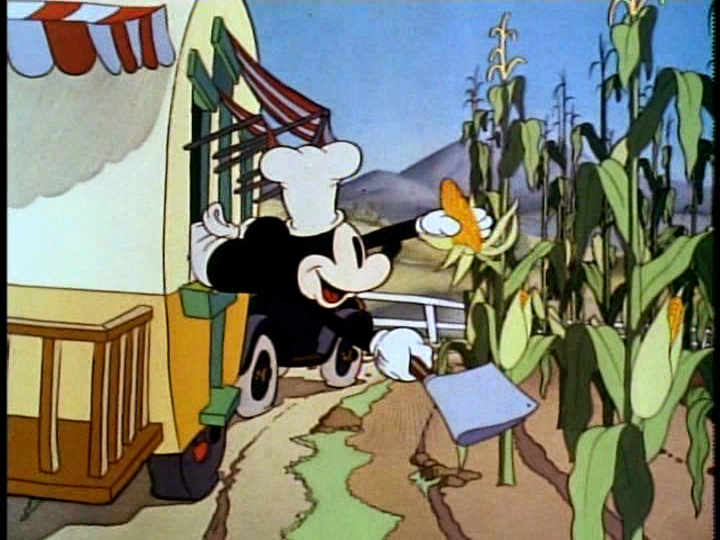
Mickey snatching some corn from a nearby field

As Goofy drives the trailer on a dirt road, he begins to sing “She’ll Be Comin’ Round the Mountain.” Inside the trailer, Mickey begins to fix breakfast, grabbing water from a nearby waterfall for the coffee, cutting some corn from nearby stalks, and, with Goofy tempting it with some hay, getting some milk from a wandering cow. Also inside the trailer is Donald, fast asleep on the top bunk. The alarm clock goes off, which is rigged to pull away his covers and force him to get up. Slowly he tries, but ends up falling back asleep. Mickey, from the kitchen, pushes a button, which turns the bedroom into a bathroom, and Donald excitedly enters the bathtub and begins to sing a nonsensical song as some robins watch at the window.

Mickey pushes another button, and the bathroom becomes a dining room, and Mickey sounds the alarm for breakfast. Goofy leaves his post as driver to get his food – with the car driving into an area marked with a “road closed” sign. As the car stumbles over several bumps in the road, each bump makes part of Goofy’s breakfast disappear. He watches Mickey and Donald enjoy their corn on the cob, and as he reaches for a cob, he accidentally sticks his fork in a light socket, which pops all the kernels from the cob. So he has popcorn for breakfast.

Donald clings to the phone for dear life as he is projected through the window

Mickey finally notices that there is nobody in the car, and turns to Donald, asking who is driving. Goofy responds that he is, and it suddenly dawns on him that he should be in the car driving. When he dives out the window to get back in the driver’s seat, he unwittingly knocks the connector loose from the trailer, sending Donald and Mickey flying the other way on the perilous path. Inside, the pair are knocked about as they continue sliding backwards on the one-way path. A truck slowly climbs its way up the mountain pass, but they fortunately miss it as the trailer uses the fence as a track. Donald tries to use the phone to call for help, only to have to cling to it for dear life as he is outside the window.

Just as the two think they’ve avoided trouble after a curve, they hear the sound of a train, and look out to see it fast approaching the bridge. Donald’s kneels to pray. They narrowly miss the train as they cross the bridge; both breathe a sigh of relief, only to see that they’ll be coming across it again, and again they narrowly miss it. As they fall off a curve and fly down the side of a mountain, they luckily get connected to the car again. Goofy informs them that he got them down safe and sound, unaware of the adventure they had without him.

May 3

Posted on

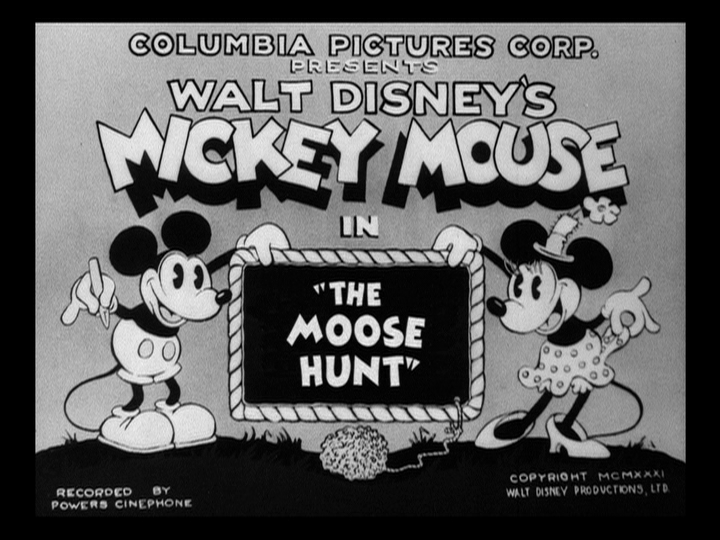
May 3, 1931 – The Mickey Mouse Short The Moose Hunt is Released to Theaters

“Old pal, old pal! What have I done? Oh, what have I done?”

On May 3, 1931, the Mickey Mouse short film The Moose Hunt was released to theaters. It was directed by Burt Gillett, and starred Walt Disney as the voice of Mickey, and Pinto Colvig as the voice of Pluto. This is the first film where Pluto is known by his name.

The short opens with Mickey and Pluto walking in the woods, with Mickey toting a shotgun and whistling “She’ll Be Comin’ ’Round the Mountain.” He trips over a rock, making the shotgun go off, but it doesn’t stop him from dancing down the path. He ends up falling into some tall grass, startling some birds that fly to safety in a tree. When he shoots at the tree, the only thing he’s able to hit are all the leaves. The birds sit safely, singing his song back to him.

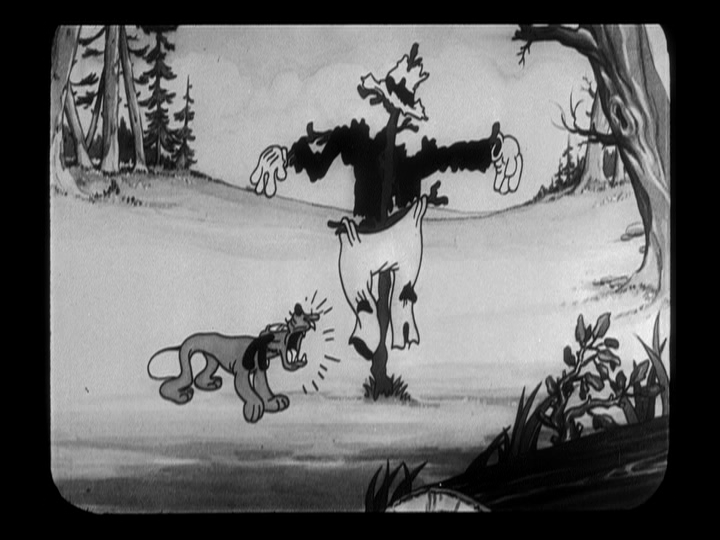
Pluto versus the scarecrow

Pluto, meanwhile, wanders away from Mickey, following a flea that he scratched off. When he comes across a scarecrow, the dog is frightened, and begins to bark at it. When he’s hit by one of the pant legs, Pluto takes off in fear, but ends up sneaking back to sniff and study the scarecrow again. One of the scarecrow’s gloves falls off and lands on Pluto’s tail, startling him and sending him scurrying off in a frenzy.

As Mickey is walking along, Pluto runs up behind him and pushes past, causing the shotgun to go off again as Mickey flies into the air. Pluto ends up flying into a river, with all the fleas he had abandoning ship, only to return once Pluto climbed up onto dry land. He ends up groveling back to an angry Mickey, who glares at him, tapping his foot. The mood quickly changes when Mickey asks Pluto to perform tricks. Mickey grabs a stick and begins to play fetch with Pluto, but unfortunately throws the stick into a pile of branches, and Pluto has to guess which one is the right one. The one he picks, however, makes him look like he has antlers.

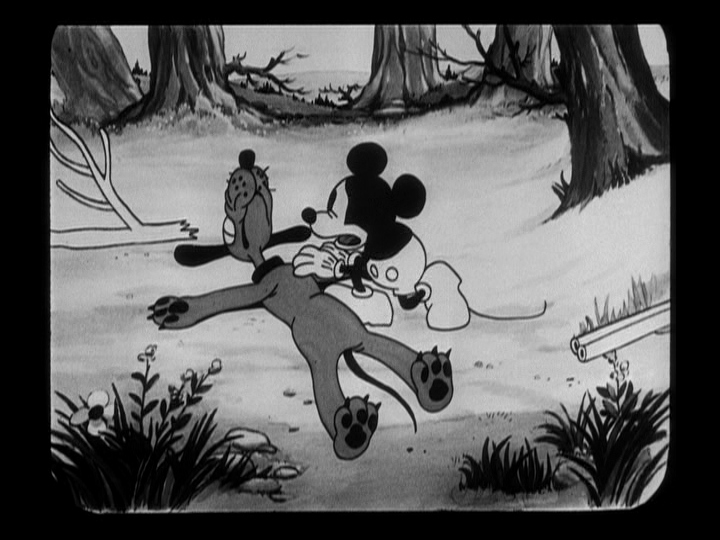
Mickey mourns over the body of his pal, thinking he’s killed him

As Pluto races back to his master, Mickey sees his shadow through the trees, and gets excited. He aims and fires twice, and a loud whimper is heard. As Mickey runs to see his kill, he stops, shocked, observing that the “moose” he shot was in fact his dog. Mickey cries over the body, but the audience sees that Pluto is just pretending to be dead, and he winks at the audience. As Mickey pleads for his dog to be alive and say something, Pluto “revives” and says, “Kiss me.” He then barks, and Mickey happily hugs his friend.

The mood is broken, however, when Mickey hears the call of a moose, and tells Pluto to be quiet. The two carefully sneak along, and Pluto tries to sniff the moose out. Circling around what he thinks are trees, the camera zooms out to show the audience that Pluto has, indeed, found the moose. Continuing to find the scent, Pluto keeps walking, unaware that the moose is copying him and following closely behind. The strange trio is then seen together, with Pluto following Mickey, and the moose following Pluto.

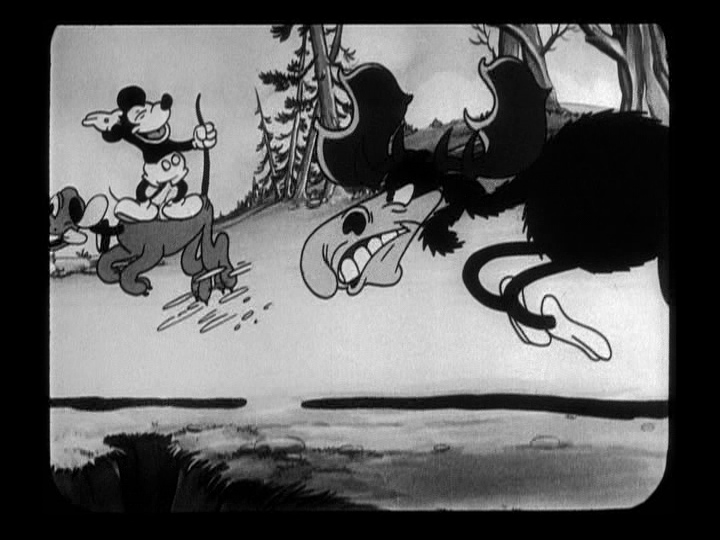
Mickey and Pluto fly away to safety from the clutches of the angry moose

Pluto finally gets the feeling that something strange is going on, and turns to see the moose, causing him to jump in fear. He taps Mickey to get his attention, but Mickey just rebuffs him. Finally, he turns and tries to shoot, only to have his shotgun break into pieces. Mickey and Pluto begin to run for their lives as the moose pursues them, and the day is saved when Pluto uses his ears to help the duo fly away to safety.

April 28

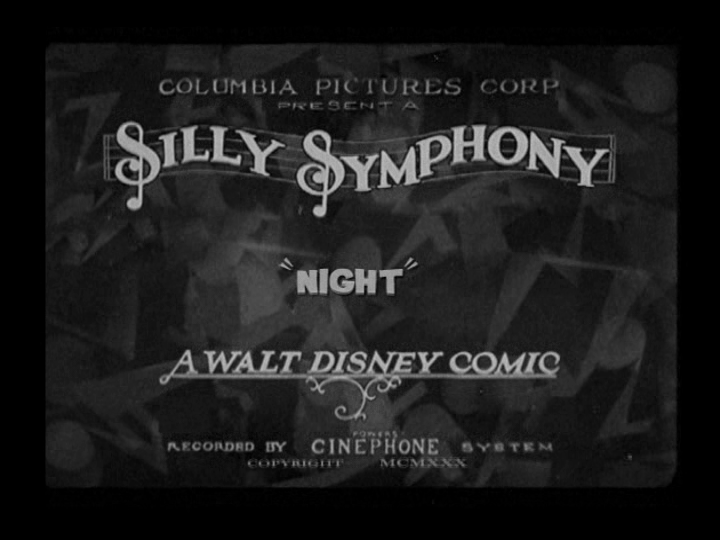
April 28, 1930 – The Silly Symphony Night is Released to Theaters.

On April 28, 1930, the Silly Symphony Night was released to theaters. Known as the early version of the award-winning short The Old Mill, the story set to music is of assorted animals in the evening near a river. It was directed by Walt Disney, and includes “Moonlight Sonata” by Beethoven among its collection of classical music used throughout the short.

The short opens on a moonlit night at a mill near a river, with the grass swaying in time to the background music. The moon gives the world a big smile, and begins singing along with the music playing. An owl flies past, flapping its wings in time with the tune, and calls out to his mate, who flies down to meet him on a branch. The two begin to dance; unfortunately, the male begins to kiss the female, who does not respond positively to his advances.

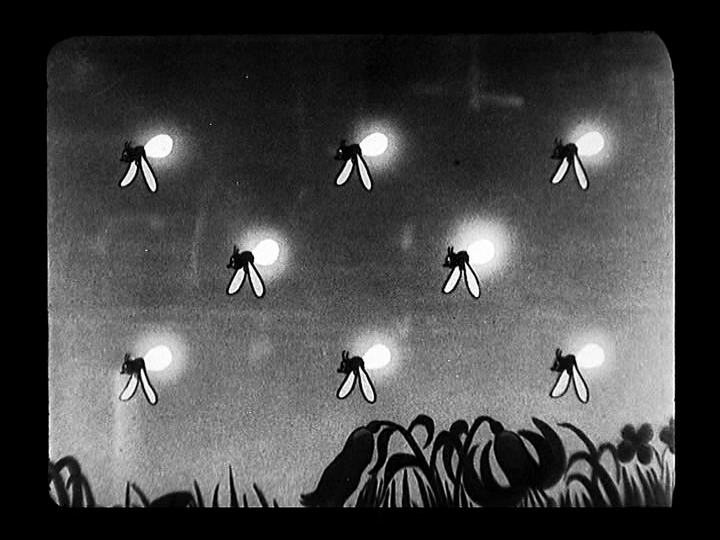
The fireflies lighting up the night in time with the music

The “bug ballet” begins with some bugs are flying around a lamp, with one teasing the candle’s flame, only to find itself burned. Fireflies begin to light up in rhythm to the new song playing, with two silly fireflies performing for the audience. Afterward, three mosquitoes begin some sort of skulking dance, which ends with them crossing over a stream and landing on a frog’s head, biting the poor frog before they fly away. The frog gets his revenge, however, by eating all mosquitoes in rhythm before dancing across the pond himself to meet his lady friend.

Around the mill’s wheel, the frog romantically rocks his lady frog while a group of other frogs croak a lullaby for the couple. The main male frog professes his love in song, while the female frog smiles and hides her face in cute embarrassment. The two begin to dance across the lily pads together, only to fall over the edge of a waterfall, ending the short with a loud, dramatic splash.

April 20

April 20, 1935 – The Silly Symphony, The Robber Kitten, is Released to Theaters

“I never took a bath, and I never will, oh, Dirty Bill!”

On April 20, 1935, the Silly Symphony, The Robber Kitten, was released to theaters. It was directed by Dave Hand, with the story written by William Cottrell; the short stars Billy Bletcher, best known as the voice of Pegleg Pete, as the voice of Dirty Bill the robber.

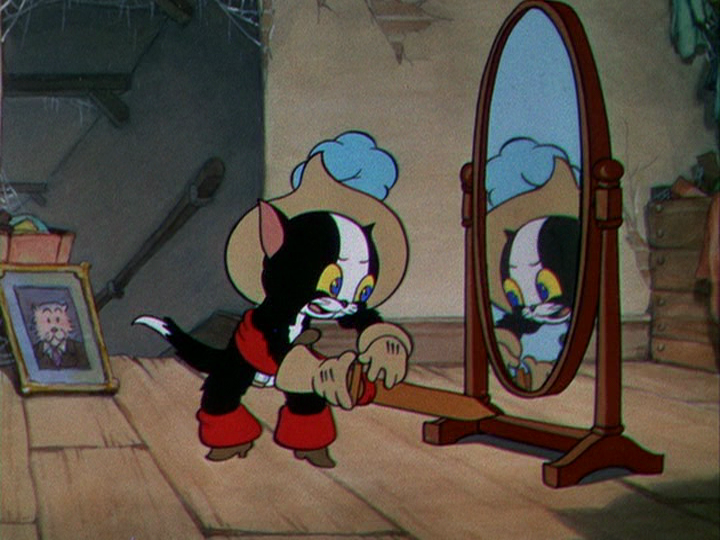
Ambrose continues his game of robber by threatening his own reflection

The Silly Symphony opens on a coach robbery, a voice telling the passengers to put their hands up. The camera zooms out to reveal a kitten named Ambrose holding two pop-guns, playing robbery with his toys. He continues to threaten his toys, and ends up shooting them because they won’t “give up the money.” Ambrose continues to play robber, until his mother is heard hollering his name from downstairs. Ambrose dismisses his mother’s call, telling no one in particular that Ambrose is no name for him, and from now on, his name is Butch.

Downstairs, his mother is preparing his bath. Ambrose sneers into the mirror and tells himself that robbers don’t take baths. He decides to run away to become a real robber, narrowly avoiding his mother as he steals cookies before heading out the open window to freedom from baths, only to land in a rain barrel. He shakes the water off before grabbing his hobby-horse and riding down the road. Unfortunately for Ambrose, his mother sees him through the kitchen window and demands that he come back, but he ignores her and rides away.

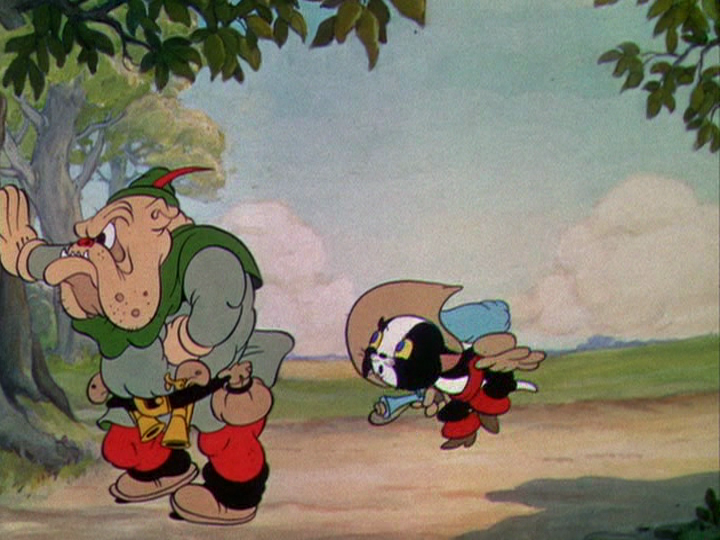
Ambrose sneaks up on Dirty Bill, attempting to rob the criminal

Meanwhile, the robber Dirty Bill is sitting in the woods, staring at his own face on a wanted poster and laughing. Ambrose spots him and attempts to rob him, but as Dirty Bill reaches for a real gun rather than Ambrose’s pop gun, Ambrose’s voice breaks. Dirty Bill turns around to see that Ambrose is only a kid, and asks Ambrose if he would really rob another robber. Ambrose is impressed that he’s really around a robber on a wanted poster.

Dirty Bill offers Ambrose a seat, and Ambrose copies the older robber exactly before asking if Dirty Bill’s mother ever made him take a bath. Dirty Bill brags in song that he’s never taken a bath, nor will he ever do so. Teasing him, Dirty Bill asks the kitten if he’s pulled any big jobs lately. Wanting to impress the robber, Ambrose tells him that of course he has, and begins to tell Dirty Bill about holding up a stagecoach (going back to the game of the morning). Unfortunately for Ambrose, his imagination and story-telling skills are too good, making the robber believe that the bag of cookies Ambrose is carrying is filled with treasure, and Dirty Bill attempts to steal it from the kitten.

Thinking the kitten is actually holding treasure, Dirty Bill suddenly turns violent

When Ambrose tries to convince Dirty Bill that he really is only holding cookies, Dirty Bill pulls out a knife, lusting for what he thinks is treasure. Scared out of his wits, Ambrose leaps out of his clothing, leaving the cookies behind as well, and sprints as fast as he can home and into the bathtub, where his mother is waiting to punish him. Sheepishly, he greets his mother, and plays with the bubbles in the tub, his robber days now behind him.

April 14

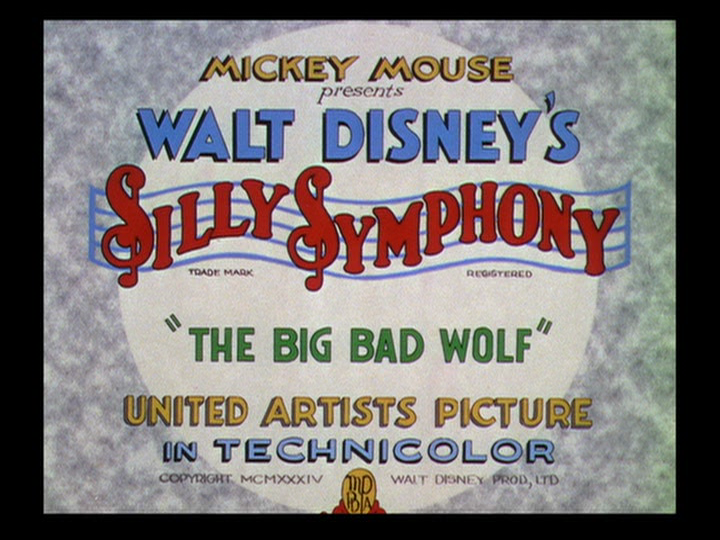
April 14, 1934 – The Silly Symphony, The Big Bad Wolf, is Released to Theaters

“There’s danger in them woods. Beware! The big Bad Wolf is lurking there!”

On April 14, 1934, the Silly Symphony, The Big Bad Wolf, was released to theaters. Capitalizing on the popularity of The Three Little Pigs Silly Symphony, it marks the return of the Three Little Pigs and the Big Bad Wolf, but the short was not nearly as successful as its parent Silly Symphony, and is today still considered inferior to the original, despite some clever gags. It was directed by Burt Gillett, and stars the vocals of Billy Bletcher as the Big Bad Wolf, Pinto Colvig as the Practical Pig, Dorothy Compton as the Fifer Pig, and Mary Moder as the Fiddler Pig.

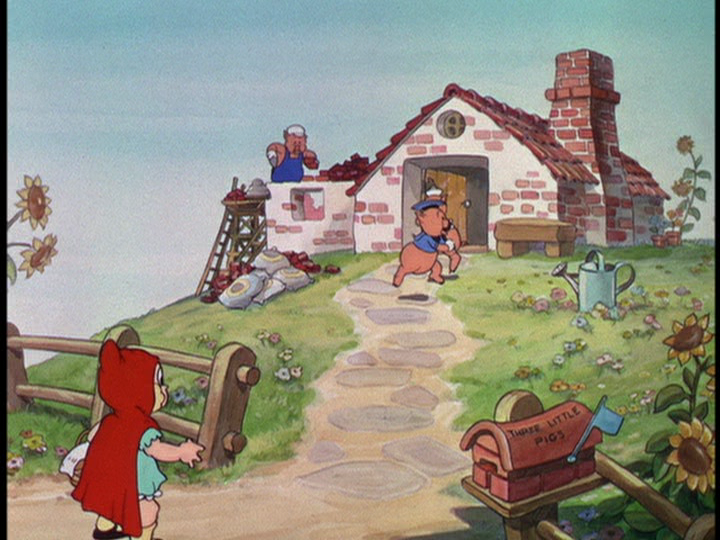
Little Red passes by the brick house of the Three Little Pigs

Little Red Riding Hood is skipping down the path to her grandmother’s house, and passes by the Three Little Pigs’ house, with the Practical Pig hard at work on an addition to the brick house, while his two brothers play their instruments and dance. The brothers greet Little Red Riding Hood, and when she explains that she is on her way to Grandma’s house, the two pigs tell her to take a shortcut through the woods. The Practical Pig, alarmed at their advice, tells her not to go through the woods, because the Big Bad Wolf is lurking there.

The two brothers begin to laugh at the Practical Pig’s advice, calling the wolf a sissy and offering to go along with Little Red to protect her before singing “Who’s Afraid of the Big Bad Wolf?” The Practical Pig just shakes his head at their folly, but continues to work on the house. Just as the three begin their journey on the short cut, the Big Bad Wolf is seen sneaking through the forest, disguised as a bush. He spies the three skipping merrily down the path, and leaves his disguise to climb up a tree and set his new plan in motion.

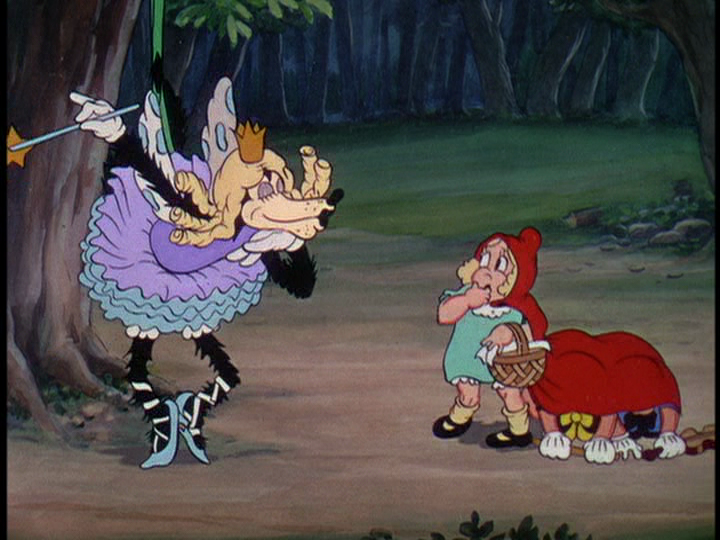
"Goldilocks, the Fairy Queen" lands in front of a frightened trio

The three are stopped suddenly by a “fairy” falling from the sky (the wolf in disguise), and the two pigs hide underneath the shivering Red’s cloak. The “fairy” introduces herself as Goldilocks, the fairy queen, and begins flying around, telling them that they’re safe with her. Unfortunately, the suspenders the Wolf used to help him fly are attached to a broken branch, which splits and lands on his head, knocking off his disguise. Alarmed, the three take off running but are separated, with the Wolf hot on Little Red’s tail. Fortunately for her, he gets stuck between two trees, giving her a chance to get away. The Wolf isn’t angry for long, for he comes up with another plan.

Using another shortcut, the Wolf reaches Grandma’s before Little Red, and peers through the window to see Grandma in bed, knitting. When she hears a knock at the door, she tells the visitor to come inside, and the Wolf enters, laughing menacingly. Grandma leaps out of bed and locks herself in the closet, with the Wolf trying to open the doors. Outside, Little Red is seen speeding through the front gate, stopping at the door to calm herself down before she enters what she thinks is the safety of Grandma’s house. Alerted by the knocking at the door, the Wolf quickly stops trying to get Grandma, and focuses his attention on getting the girl. He quickly disguises himself in Grandma’s robe and bonnet and slips into bed before calling Little Red in. Little Red notices what big eyes Grandma has, and what a big nose Grandma has (to which the Wolf looks at the audience and asks, “How am I doing?”). When Little Red points out the big mouth Grandma has, the Wolf strikes, chasing her around the room.

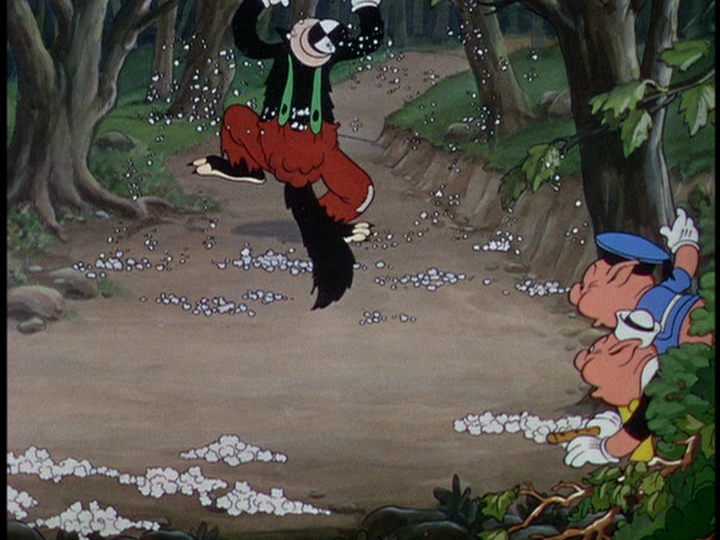
The two pigs watch the Wolf howling with pain back into the woods

Meanwhile, the two pigs have made it back home and alerted their brother about Little Red’s predicament. The Practical Pig runs to his collection of “Wolf Exterminators” and begins to load them into his bag before setting off for Grandma’s, leaving the two pigs cowering in the doorway. As the Wolf continues to chase Little Red, Grandma uses an umbrella to scoop the girl up and pull her into the closet for safety, with the Wolf once again trying to open the doors. The Practical Pig arrives just in time, and sneaks in while the Wolf isn’t noticing, and begins to place popcorn kernels down the Wolf’s pants, and then grabs some hot coals from the fire. Placing the shovel with coals in with the kernels, the Wolf cries out in pain and leaps through the ceiling of the house, and runs back into the woods, with the popcorn kernels popping wildly.

The two other pigs show up just in time to see the Wolf running away, and shake hands in happiness that the Wolf has been bested again. Inside Grandma’s house, Little Red and the Practical Pig are playing the piano while Grandma knits, with the two other pigs dancing and singing “Who’s Afraid of The Big Bad Wolf?” once more.

April 13

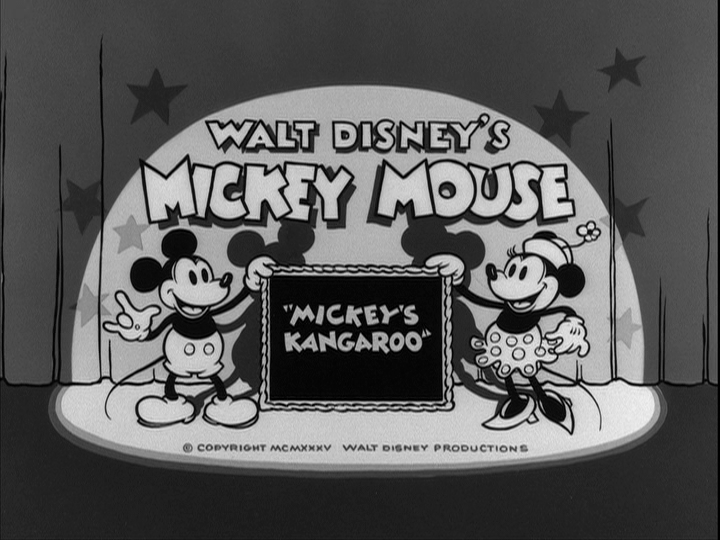
April 13, 1935 – The Mickey Mouse Short, Mickey’s Kangaroo, is Released to Theaters

“The nerve of that grasshopper! Busting up my house!”

On April 13, 1935, the Mickey Mouse short film, Mickey’s Kangaroo, was released. It was the last black-and-white Disney cartoon; the first Mickey Mouse color short had been released in February, but the studio released a few more black-and-white shorts before it realized that they had to be in color to continue Mickey’s popularity. The short was directed by David Hand, with Walt Disney providing the voice of Mickey Mouse. The short is also unusual for the fact that Pluto speaks to the audience, or at least lets the audience listen in on his thoughts.

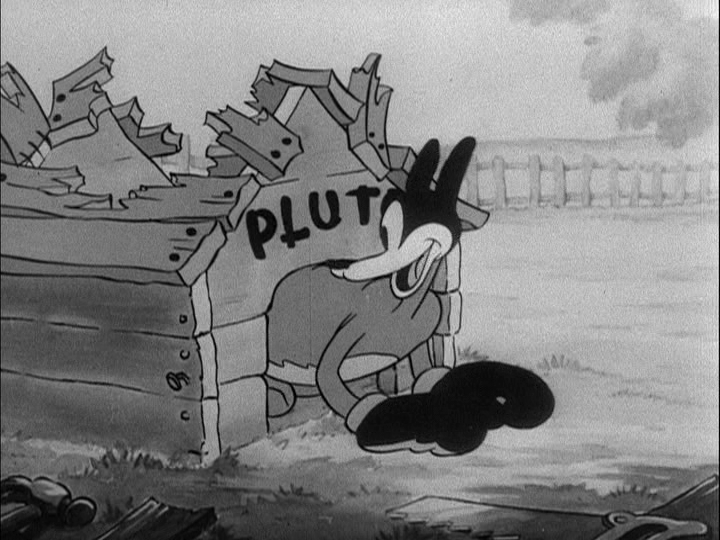
Pluto lets Mickey know how happy he is with the new doghouse

Mickey is seen painting Pluto’s name on a newly built doghouse, and Pluto barks excitedly, jumping around and leaping on Mickey, showering him with kisses. Suddenly, a whistle breaks up their happy moment as the mailman arrives with a large, unusually shaped package for Mickey. Mickey looks at the tag and sees that it’s from Australia. Curious, he decides to open it.

As Mickey tries to open the package, it hops away, and Mickey lands on his face. Pluto follows the bouncing crate, sniffing it until it jumps on his nose. Unfortunately for Pluto, after he frees his nose, the box jumps on his tail, and he lets out a loud howl of pain. The crate jumps around wildly, chasing Pluto around the yard and into the woodshed, where the crate bursts open, revealing a rather large kangaroo.

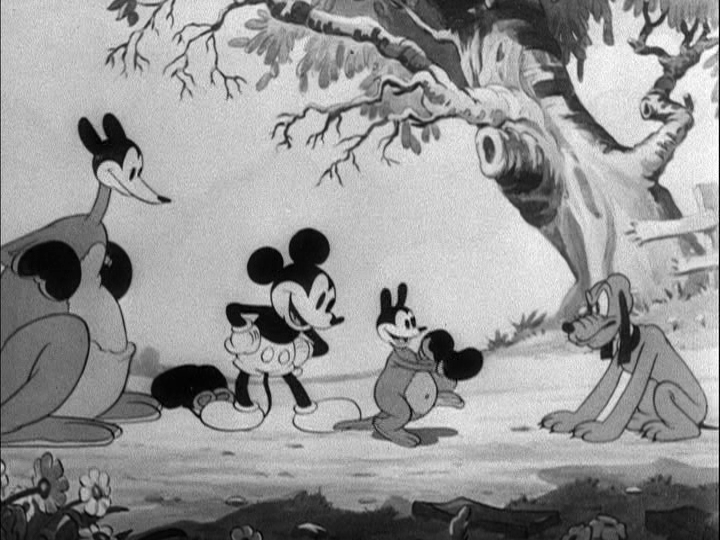
The kangaroo in the remains of Pluto's new doghouse

Mickey is excited upon seeing his new pal, shaking her hand. He runs to get his boxing gloves to spar with the kangaroo, and the kangaroo decides to make Pluto’s home her own. Pluto turns to the audience, snarling, and begins to vent before turning to see the kangaroo and the damage she’s done to the doghouse. Seeing Pluto’s name on the front, the kangaroo licks the letters off, infuriating Pluto. He runs full speed, only to meet with the kangaroo’s fist, and is thrown into a basket of clothespins.

Pluto tries again to attack, but is sucker-punched again –this time by the joey in the mother’s pouch. Pluto is confused at what had just happened, and when he sniffs at the pouch, he’s met with a harder blow to the head, sending him running to the chicken pen, howling all the way.

One kangaroo for Mickey, one joey for Pluto

Mickey runs out with his boxing gloves, and pulls out the joey, showing Pluto. The joey spars playfully with Mickey as Pluto carefully crawls back to meet the kangaroos and Mickey. Mickey then tells him, “One for you (the joey), and one for me (the mother).” Pluto is not amused at this situation, or that Mickey finds the joey cute. Mickey takes the mother to the gymnasium he has set up in the old barn, leaving Pluto and the joey behind.

Pluto again talks to the audience, telling them of his scheme to get rid of the joey first. He then begins to creep toward the water bowl, but is scared easily when the joey hiccups. Meanwhile, Mickey is sparring with the mother in the gym, and begins punching and teasing her, while she looks confused. Finally understanding, she lays one on him, with Mickey remarking, “Oh boy! What a wallop!” Although the kangaroo is easily winning, Mickey thinks it’s all in good fun and enjoys himself.

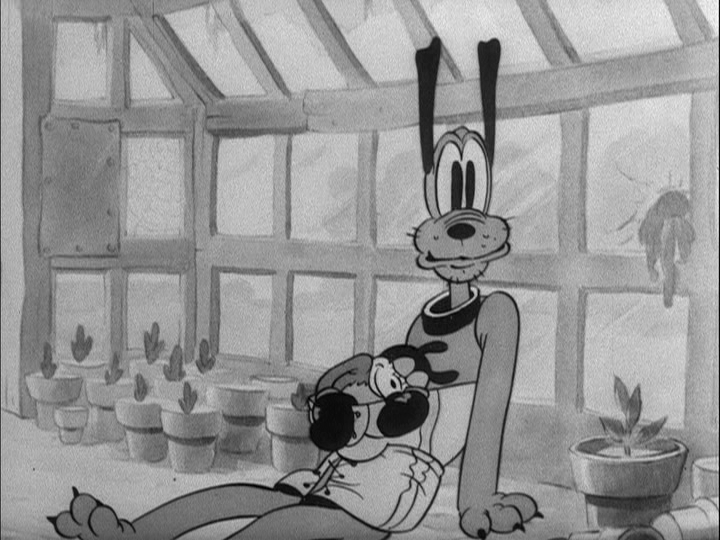
Pluto finally feels affection for the joey

Outside, Pluto is trying to go ahead with his plan to get rid of the joey, but with no success, as it outsmarts his every move just by jumping. After a particularly bad attempt, Pluto ends up in a scrap heap, with springs attached to his feet. Although he is able to jump, he isn’t able to do it well, and crash lands into a corset on the laundry line, and then falls through the ceiling of the greenhouse, where the joey finds him out cold. The joey then curls inside the corset, as if it were a pouch, and goes to sleep. Although angry when revived, Pluto is touched by the affections of the joey, and cuddles with him.

The moment is broken when they hear strange noises coming from the gymnasium, and the two rush to see the kangaroo giving Mickey a thorough walloping. With one particular hit, Mickey is sent flying into a hay baler, and when he comes out, trapped in a hay bale, he still wishes to fight. A bit later, the mother is seen reading the sports section in front of a roaring fire, with the joey and Pluto snug in her pouch, becoming one happy family.

April 8

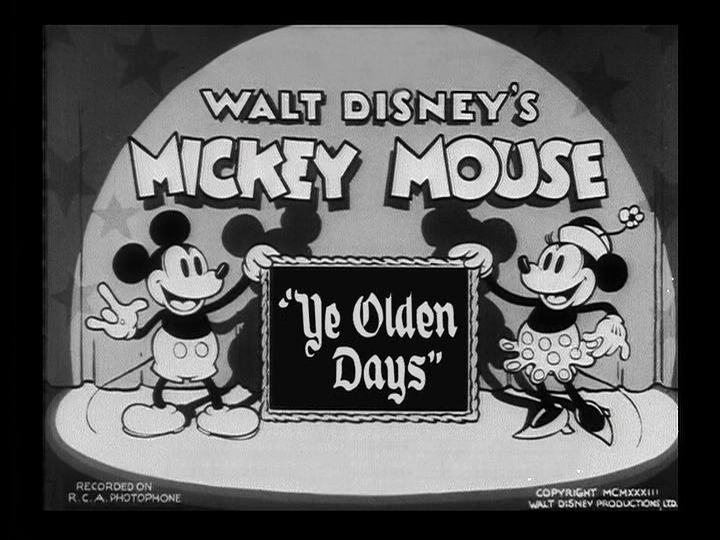
April 8, 1933 – The Mickey Mouse Short, Ye Olden Days, Premieres in Theaters

“I know you’ll learn to love me.”

On April 8, 1933, the Mickey Mouse short film, Ye Olden Days, premiered in theaters. It was directed by Burt Gillett, and starred Walt Disney as Mickey Mouse, Marcellite Garner as Minnie Mouse, and Pinto Colvig as Dippy Dawg. This is one of the few instances where the character of Dippy Dawg is referred to by that name. He grew to be an international star in his own right, but with a different moniker: Goofy.

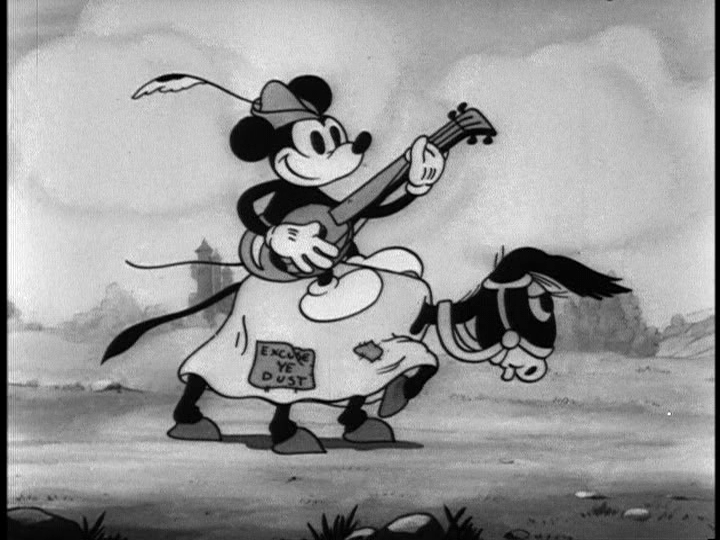
Mickey as The Wandering Minstrel, traveling from far away

The short opens with a cast list, with Mickey playing “Ye Wandering Minstrel,” Minnie as “Ye Princess,” and Dippy Dawg as “Ye Prince.” The name of the person playing “Ye Old King” is covered up by the end roll of parchment. We then see Mickey, riding on the back of a very tired-looking donkey, holding a lute and signing a song, introducing himself as a wandering minstrel from afar.

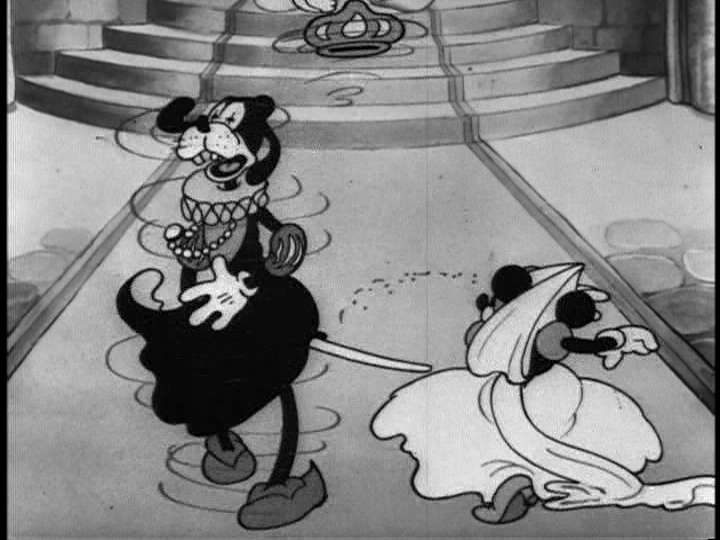
Inside the castle, all the members of the court are raising their glasses and cheering for the king. The king informs his subjects that his daughter, the Princess of Lalapazoo, will marry the Prince of Pupupadoo. Trumpets sound, and at the doorway stands Dippy Dawg, who gives his famous laugh. Minnie appears at the other doorway after the trumpets similarly announce her arrival.

Minnie emphatically slaps Dippy Dawg across the face, refusing to marry him

Mickey arrives at the castle, in time to see the wedding between the Prince and the Princess. The king demands that Minnie marry the prince, and Dippy Dawg grabs one of Minnie’s hands and begins kissing up and down her arm. She swears she will not marry the prince, and slaps him three times. The king, angered by his daughter’s behavior, sends her to be locked in the attic.

Seeing all this, Mickey decides to rescue the princess from her fate. He spots the tower where Minnie and her handmaiden (who appears to be played by Clarabelle Cow) are locked away. Inside the tower, Minnie and Clarabelle begin to cry at their fate, until interrupted by a song at the window. Mickey sings to her:

“Cheer up, oh lovely princess

For you’ll be rescued soon

I’ll take thee away

So ye won’t have to stay

And marry that silly baboon.”

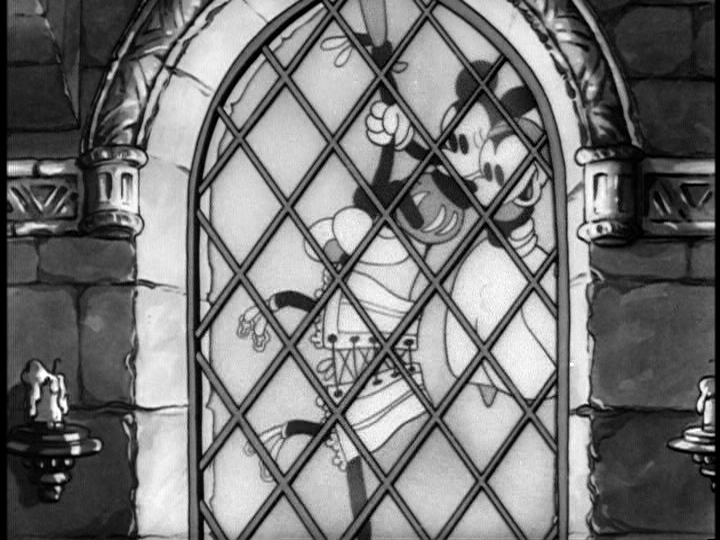
Impressed, Minnie  sends Mickey a flower from her hat with a kiss, and he jumps up from a tree branch to the window. He tells her that he’ll save her.

The king spies Mickey and Minnie trying escape through the window

The king continues the festivities, which includes a giant feast that everyone happily prepares and eats. Mickey and Minnie, however, using the handmaiden’s clothes as a crudely constructed rope, begin to rappel down the side of the tower. They are spotted by the king after the clips on the corset begin to tap against the window, and Mickey and Minnie are captured. Infuriated, the king orders Mickey’s head chopped off. As it looks like the end for Mickey, Minnie steps in front and declares her love for the minstrel. She suggests that there be a duel between Mickey and the prince instead.

Excited by this, the king agrees, and everyone busily prepares for the duel. With a loud clang, the duel begins. As Micky and the prince speed toward each other, both are thrown off their horses. Dippy Dawg chases Mickey around the room with his lance, but the mouse finds cunning ways to stay one step in front of him. Finally, Mickey chases the prince out the window, and is held by the crowd in victory, where he and Minnie share a kiss.

April 6

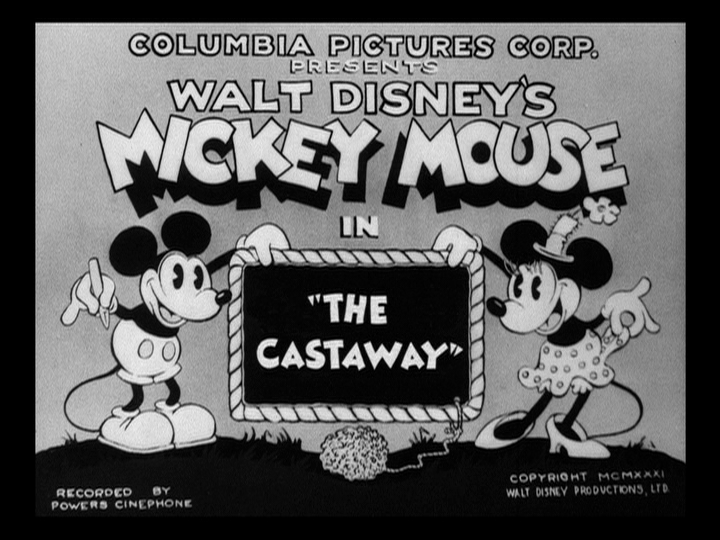
April 6, 1931 – The Mickey Mouse Short Film, The Castaway, is Released to Theaters

“Bananas! Am I hungry! Oh boy!”

On April 6, 1931, the new Mickey Mouse short film, The Castaway, was released to theaters. It was directed by Wilfred Jackson, with Walt Disney as Mickey. It’s one of the few shorts that uses the Mickey Mouse Club theme song, “Minnie’s Yoo-Hoo,” as the title and end music.

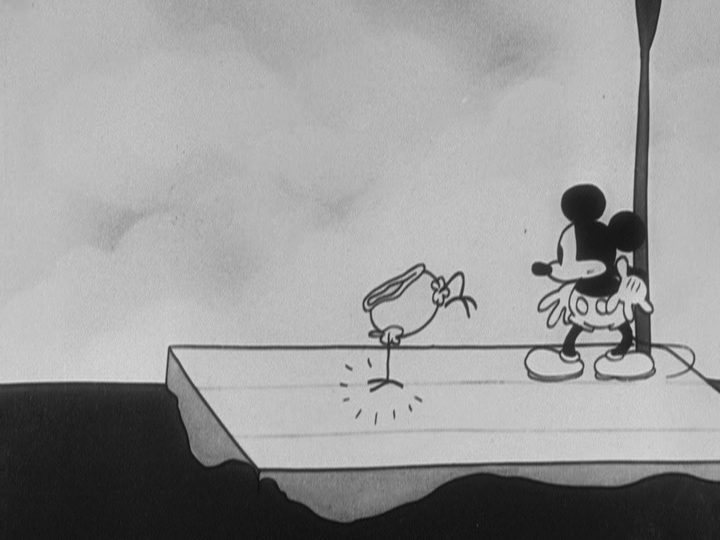
Mickey is stunned as his "sail" begins to perform a dance

The short opens with poor Mickey adrift at sea, the waves crashing wildly around him. Seagulls fly through the legs of his “sail” (a pair of bloomers), until one gets stuck and brings the sail to the boat, and Mickey watches the odd sight of dancing bloomers as the seagull tries to escape. As it flies away, Mickey spots land and tricks a swordfish into pushing his boat to shore.

Immediately after landing, Mickey spots food: he crashlanded into a banana tree. He shakes the tree, and then uses a stick to help him bring down the bananas, but the stick acts like a boomerang and sends Mickey flying into the tree, which, fortunately, brings the bananas to the ground. As Mickey tries to eat them, however, he accidentally knocks a spider from its web, and nearly into Mickey’s mouth. The mouse screams at the arachnid, and seemingly forgets about the bananas as he runs to the shoreline.

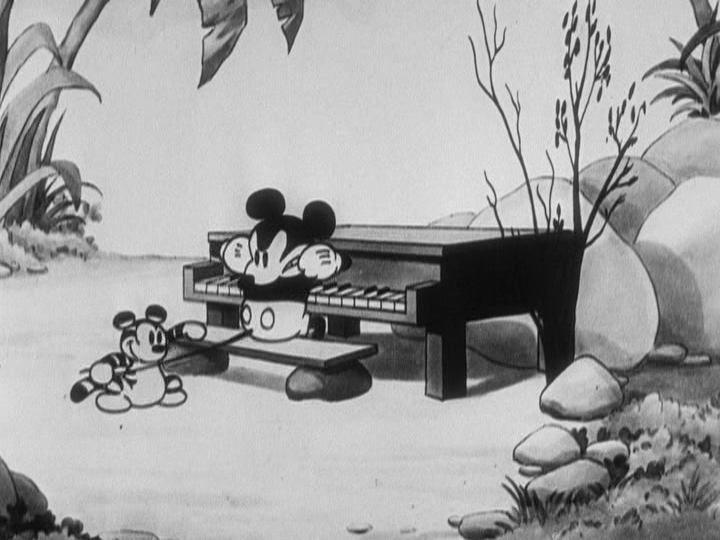
The cub continues to annoy Mickey as Mickey tries to keep playing the piano

Seeing a crate, Mickey tries to retrieve it before the tide comes in, but the tide ends up washing Mickey and the crate further inland. The crate breaks open on a rock, revealing a very soggy piano. Mickey empties the piano of the excess water, sits down, and begins to play, accompanied by three nearby seals. A tiger cub also hears the music and comes out to help Mickey play, but Mickey knocks the cub aside. The cub then tries to use Mickey’s tail as an instrument, but Mickey won’t have it and places the cub in a nearby tree.

The music also gets the attention of a gorilla nearby, and Mickey lets the gorilla play the piano with its feet. Unfortunately, the gorilla gets a little too rough with the piano, and Mickey tries to stop the animal from completely destroying it, with no success. As Mickey grabs a rock to throw at the gorilla, it turns around, and Mickey pretends to perform a few tricks with it before showing it a nervous smile.

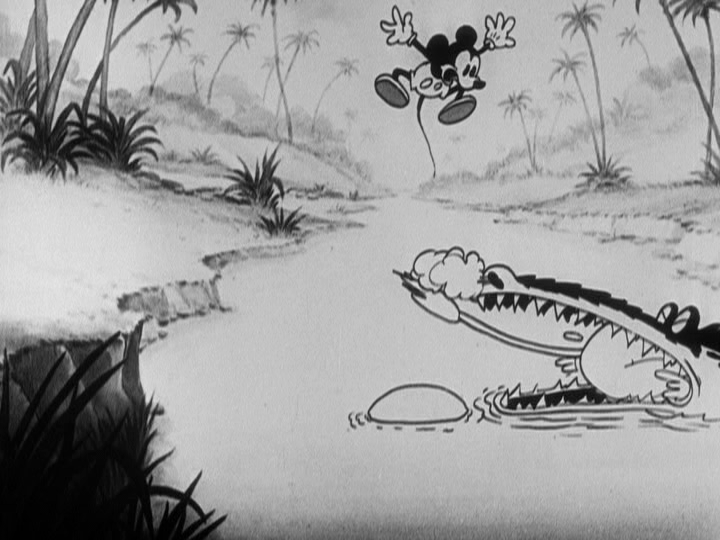
Mickey leaps into the air, as the lion leaps into the open mouth of the alligator

Mickey drops the rock onto the back of a sleeping lion, who begins to chase the frightened mouse. After jumping into a river and laughing at the roaring lion on the riverbank, Mickey thinks he’s home free, not spotting the alligator ready to eat him right behind his back. Stuck between the two dangers, Mickey leaps into the air as the lion leaps to attack. The lion ends up getting swallowed by the alligator, and Mickey cheers. The rock he’s standing on moves, however, and he finds himself riding downstream on the back of a tortoise. Mickey gives a friendly salute to the audience, and waves as he drifts away.

March 28

March 28, 1936 – The Silly Symphony, Elmer Elephant, is Released to Theaters

“Elmer’s got a funny nose, looks just like a rubber hose!”

On March 28, 1936, the Silly Symphony, Elmer Elephant, was released to theaters. Directed by Wilfred Jackson, the short film tells the story of an elephant named Elmer, who is cruelly teased about his appearance, particularly his nose, but is able to use his nose to save the day from a runaway fire. Elmer would go on to be a popular merchandising character, and even had his own short-running Silly Symphony comic.

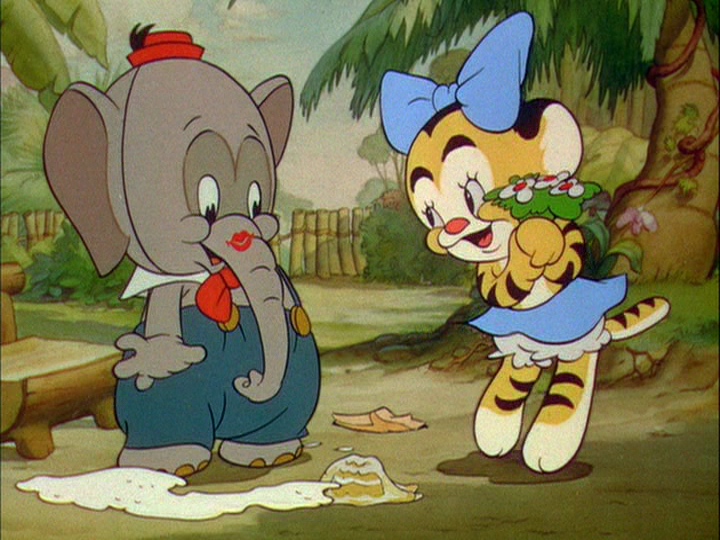
As the story opens, Elmer is seen skipping through the jungle, holding a bouquet of flowers, which he adds to as he passes by a flower bush. He knocks on the door to Tillie Tiger’s house, where the song “Happy Birthday” is heard being sung to Tillie. Elmer peeks in and sees the kids skipping in a circle around Tillie, and then they implore her to blow out the candles on her birthday cake. She agrees, but is unable to extinguish the birthday candles. Sweetly, she asks Joey the Hippo to do it for her, and he agrees.

Elmer and Tillie, with Tillie fawning over the flowers he brought for her

Just as Joey is preparing to let out massive breath of air, Elmer appears on the other side of the table, and is rewarded with Tillie’s cake in his face, as Joey left the candles on the plate, still burning brightly. While the kids laugh, Tillie pulls out a napkin and cleans away the cake from Elmer’s face. Tillie spots the flowers in Elmer’s hand, and begins to coo over them, calling them “the nicest present of all.” She gives him a kiss on the nose, which causes him to react comically.

Some of the boys get together and begin to whisper as Tillie scuttles up to her tree house, telling everyone to have a good time and that she will be right back. As Elmer sits down to wait, the boys appear, holding various long objects as “noses” and pretending they have big, floppy ears. Poor Elmer is so embarrassed that he tries to tuck away his nose. The boys bully him, pulling on his nose and sending him flying down a hill and back into the jungle, when all the party guests appear and begin to sing their taunts to him.

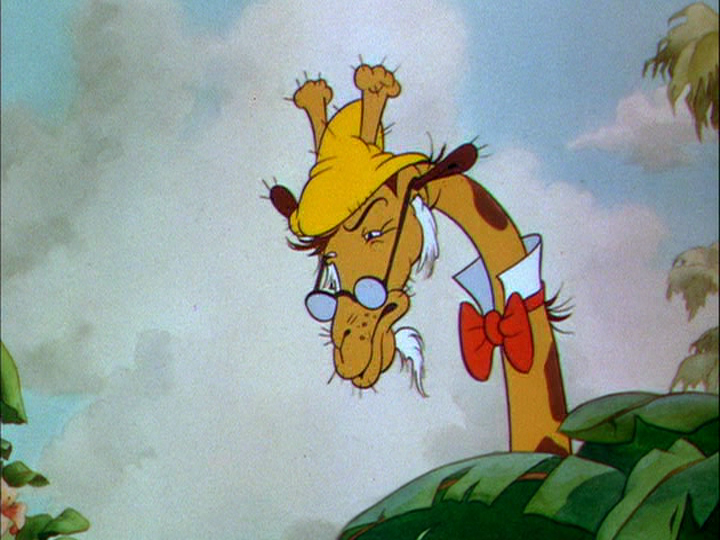
The kindly Old Giraffe, giving Elmer some well-needed advice

Elmer walks away from the party, very upset, when he runs into an elderly giraffe, who asks him what’s the matter. When Elmer explains, the giraffe tells him that “They used to make fun of me too, son, but I don’t care.” He then points out the pelicans nearby in an attempt to make Elmer feel better about his nose.

Just then, sirens are heard in the distance, with the crazy fire truck heading straight for Tillie’s. Tillie is seen trying to beat away the flames with a broom, yelling at her guests to help her get down from the tree house. The boys pull out a blanket for her to jump into, but the flames pull her back and they jump into the outstretched blanket, turning it to ashes. The fire team finally arrives at Tillie’s place, but can’t stop the flames from chasing them down the ladder. The flames trap Tillie up a pole, where she screams for help.

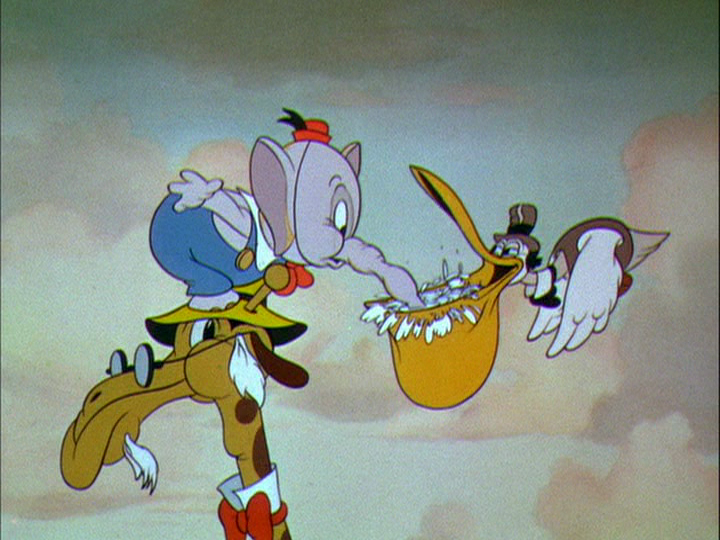
The Old Giraffe, Elmer, and the pelicans use their perceived flaws to work together and save the day

Having observed all of this from the Old Giraffe’s head, Elmer slides down his neck and begins to run at breakneck speed to save Tillie. The Old Giraffe follows, along with the pelicans, and they all work together to put out the flames: the Old Giraffe holds Elmer up to the top of the tree house, the pelicans provide the water, and Elmer uses his nose as a hose. Although the flames are stubborn, Elmer uses some fancy moves to extinguish the flames.

Stuck on her precarious perch, where four little flames are taking apart the pole one splinter at a time, Tillie calls out for Elmer. Elmer comes to her rescue, extinguishing the flames and grabbing the pole Tillie’s holding onto before it completely breaks apart. Tillie calls Elmer her hero, and the two share a kiss, with Elmer using his nose to pull her closer, and one of his ears to keep the moment a bit more private.