RSS Feed

Tag Archives: 1920s

April 30

April 30, 1928 – The Oswald Short Film, Ozzie of the Mounted, is Released to Theaters
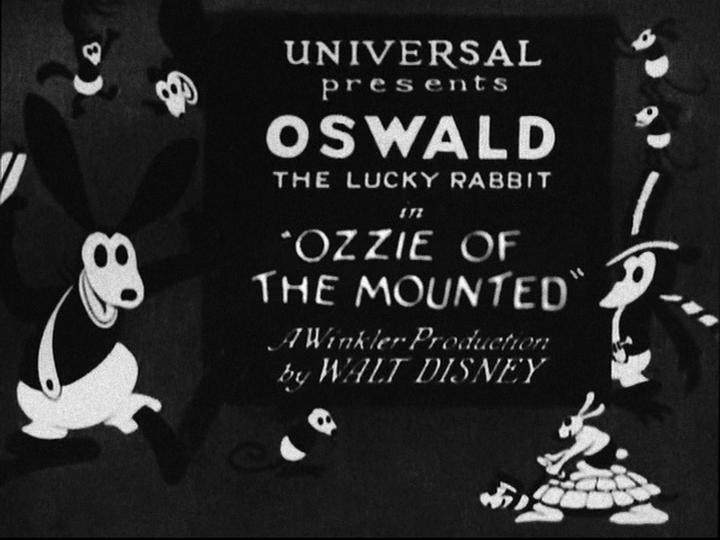
“This cartoon, as usual, is loaded with a lot of great gags. I love Oswald during this period – he looks great. He’s got lots of personality, and he was a very appealing character.” – Animation Expert Jerry Beck

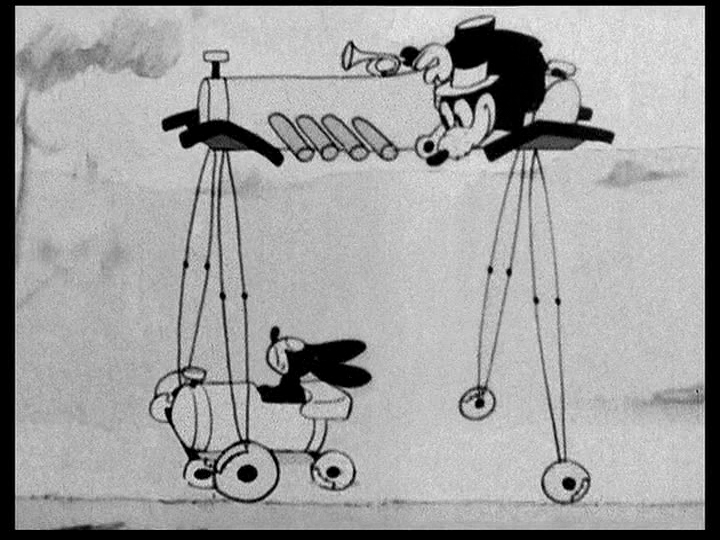
On April 30, 1928, the Oswald the Lucky Rabbit short, Ozzie of the Mounted, was released to theaters. This short would actually be remade later by Hugh Harman and Rudy Ising over at Warner Brothers, which was then titled Big Man from the North. Most scenes were redone shot by shot. This short also contains the element of a mechanical animal, which Iwerks and Disney used fairly often in the Oswald cartoons.
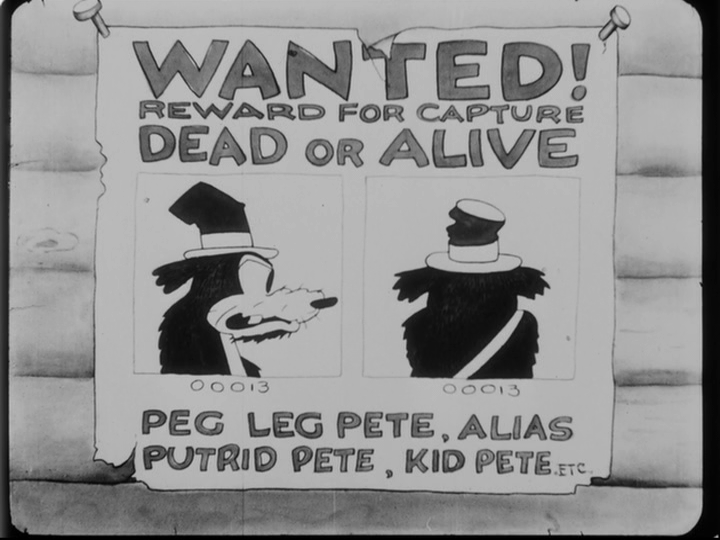
The wanted poster of Peg Leg Pete

The short opens on a blustery winter day in front of the headquarters of the Mounted Police. Inside, the police chief is pacing the floor, puffing on his corncob pipe. The door opens, and in slides Oswald, giving the chief a salute. The chief points out a wanted poster for Peg Leg Pete, which causes Oswald to shake from fear. The chief demands that Oswald go capture Pete, so Oswald screws up his courage and sets out into the blizzard.

Outside, Oswald winds up his mechanical horse and sets out to find Pete, who is then seen out in the snow with snowshoes, skulking around. Oswald, traveling the other direction, crashes into Pete around the corner of a bar, and is flung from his horse. He looks to see who he crashed into, and is surprised to see that it’s the villain he’s been looking for. He pulls out a gun and points it at Pete, who, by standing alone, is able to intimidate the rabbit. Oswald shoots the gun, only to have the bullet bounce off Pete’s stomach and knock Oswald over.
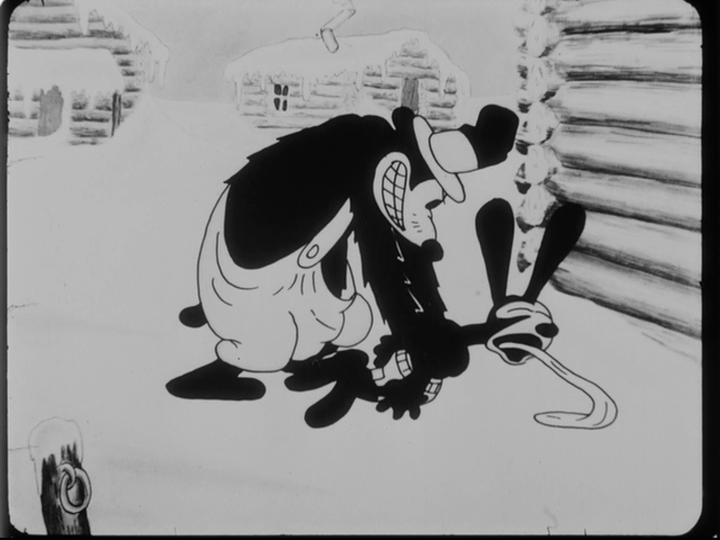
Peg Leg Pete strangling Oswald

Pete, seeing an opportunity, begins to strangle Oswald, squeezing the rabbit’s tongue out of his mouth. As Oswald appears to be dead, Pete looks up at the audience in horror and quickly slips away, hitching a ride on a nearby dogsled. Oswald finally gets up, pulls his tongue back in, and begins to fix his mechanical horse so he can give chase. After some disastrous results, Oswald finally fixes the horse, and begins to follow Pete.

Many gags ensue on this chase, including Oswald getting stuck in a loose spring from the body of his horse, and ending up flattened when the horse pulls him into a branch. Pete ends up losing his sled team and begins to slide down a hill, out of control, until he hits a rock. Unfortunately for Pete, the rock is actually a bear, who growls and runs after Pete. Oswald, seeing the bear, also tries to flee, but is caught by the pants by the bear, who sends Oswald flying to the nearby jail. Seeing his chance, Oswald flings open the door to the jail, telling Pete to run in for safety. Oswald traps Pete and the bear in the jail, and the short ends with Oswald laughing at his villain’s misfortune.
March 19

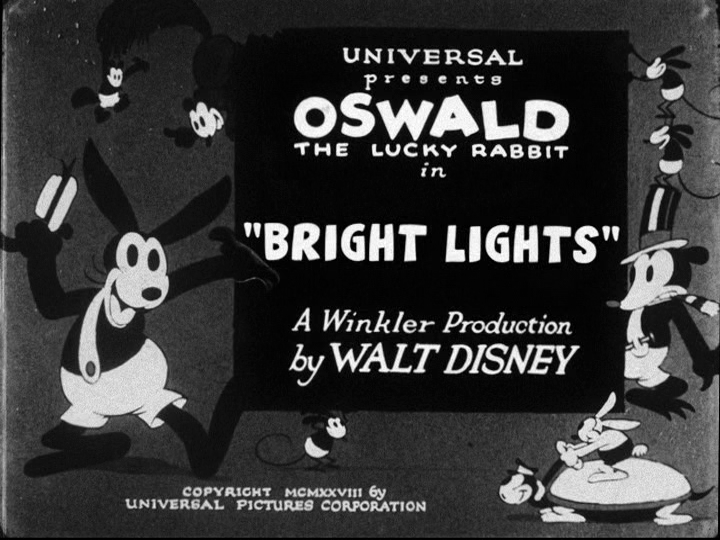
March 19, 1928 – The Oswald the Lucky Rabbit Short Film, Bright Lights, is Released to Theaters

On March 19, 1928, the 16th Oswald the Lucky Rabbit short film, Bright Lights, was released to theaters through Universal. The short itself is very different from the style of the Mickey Mouse shorts that were to follow: although Mickey Mouse cartoons contained the elements of stretching limbs and comical japes, the Oswald shorts were more brash in their day (as seen with Mlle. Zulu’s dancing), and the characters seem as if they were made out of clay with the way they can split themselves in two and wrap other characters’ limbs around solid objects.

The short opens with a bright light marquee parody of Vaudeville called “Vodvil,” advertising Mlle. Zulu, the Shimmy Queen, performing at a theater. The theater is packed with spectators, watching as a line of cats performs a variety of dances on stage. After a bit of the performance, most of the girls dance offstage, leaving Mlle. Zulu behind in the spotlight.

Oswald, dreamily staring at the picture of Mlle. Zulu

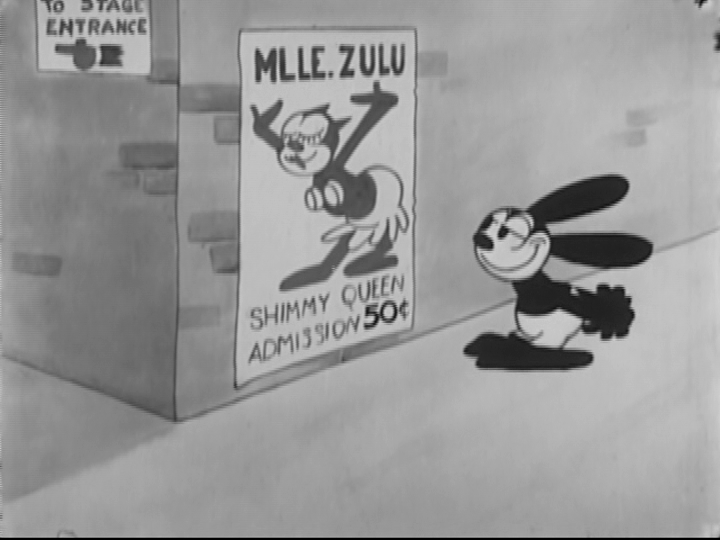
Outside, we see Oswald staring at a picture of Zulu, clearly smitten, with his heart beating right out of his chest. Oswald gets a shock, however, when he sees that the price of admission to the show is 50 cents, and he is saddened to realize he doesn’t have any money. He spots the stage entrance around the corner, and comes up with a plan to just walk right in. The guard stops Oswald at every turn, although Oswald is able to slip out of his grasp so he can try again. Comically, Oswald manages to tie the guard up to a lamppost with the guard’s own foot, and walks in confidently – only to be chased out a second later by other guards and thugs.

There’s a quick shot to Zulu still performing on stage, and then we go back to Oswald, who comes up with another plan to sneak inside: hiding under the shadow of a man in an oversized fur coat. The coat is taken away to reveal both the thin man inside it and Oswald. As the guard looms over the rabbit, Oswald scampers out on the stage in the middle of a performance, with the guard chasing him.

Oswald realizes that the box was not the best place to hide

Backstage again, Oswald jumps inside a box to hide, missing the clear sign on the side that says “Danger – Keep Away.” When the guard can’t find Oswald, and and continues searching in another direction, Oswald, thinking he’s won, laughs—until he discovers the cheetah in the box with him. Oswald escapes from the box, with the cheetah in pursuit, determined to eat the rabbit. Oswald once again rushes out onto the stage in the middle of a pole-balancing act and scrambles up the pole, with the cheetah jumping up, mouth wide open to catch his snack.

The performer and Oswald climb all the way up to the rafters, holding onto a backdrop for dear life. The performer, who had been holding on to Oswald’s shorts, falls as the cheetah waits for his prey. The performer is able to fly his way back up to where Oswald is dangling and grabs his foot, pulling the limb out several feet. With the use of a nearby mallet, Oswald gets rid of the performer, but realizes a bit too late that he’s lost his hold of the backdrop and falls to the stage, landing on the head of the cheetah.

Everyone stampedes out of the theater, pursued by hungry lions

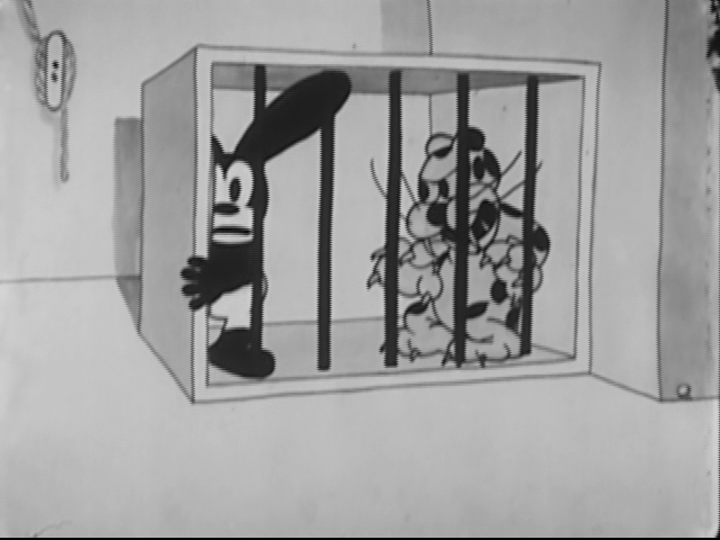
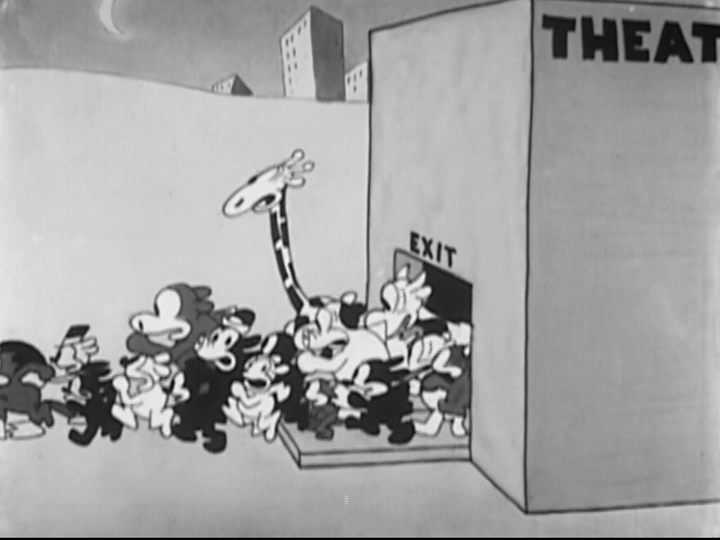
The audience and orchestra run for their lives as the cheetah goes on the rampage. Backstage, the lions break free from their cage and join the chase, scaring the performers out into the empty theater. The audience is seen breaking down the door and fleeing the theater, with the lions in close pursuit. Oswald finally appears in a nearby building, with the last lion spotting him and chasing him into town.

March 14

March 14, 1929 – The Mickey Mouse Short, The Barn Dance, is Released to Theaters

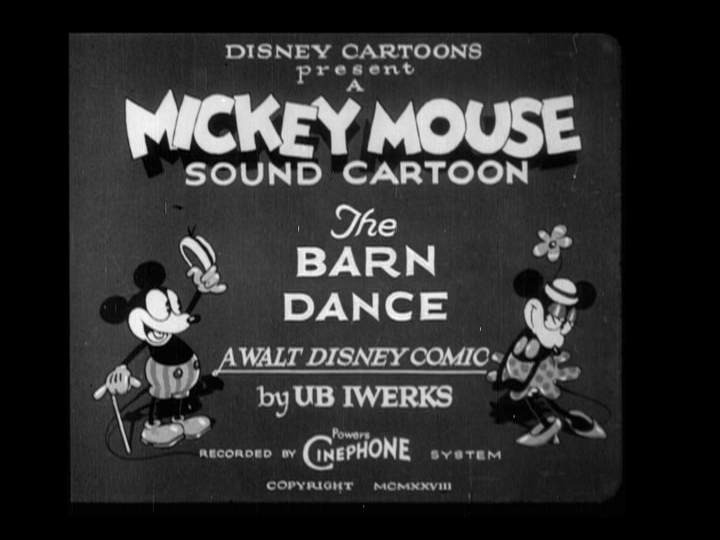
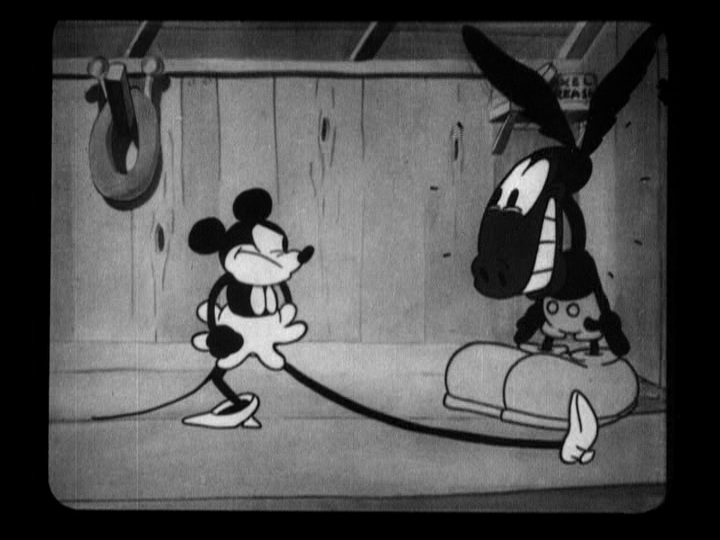
On March 14, 1929, the fourth Mickey Mouse short, The Barn Dance, was released to theaters. Directed by and using the vocal talents of Walt Disney (although this short continues to feature more “squawking” than actual dialogue), this short is one of the disastrous dates of Mickey and Minnie. Although not the first short where Minnie rebuffs Mickey’s advances, it is one of the more tragic ones, due to Mickey’s emotional outburst in the end.

Mickey is seen in the opening shot in a horse-drawn buggy, holding flowers for his sweetheart, Minnie Mouse. As he uses the whip to make the horse gallop faster, his buggy also begins to gallop, and Mickey has to hold onto his seat for dear life. They stop in front of Minnie’s house, where she is seen in the window, powdering her nose. Mickey’s heart pounds loudly before he whistles for her attention. Minnie appears in the window and waves before quickly pulling her bloomers on the laundry line inside. Mickey and his horse both look excitedly at the window, but Mickey pulled down a shade attached to the blinders on the horse, and the animal turns away to pout.

Pete arrives as a rival to Mickey for Minnie's affections

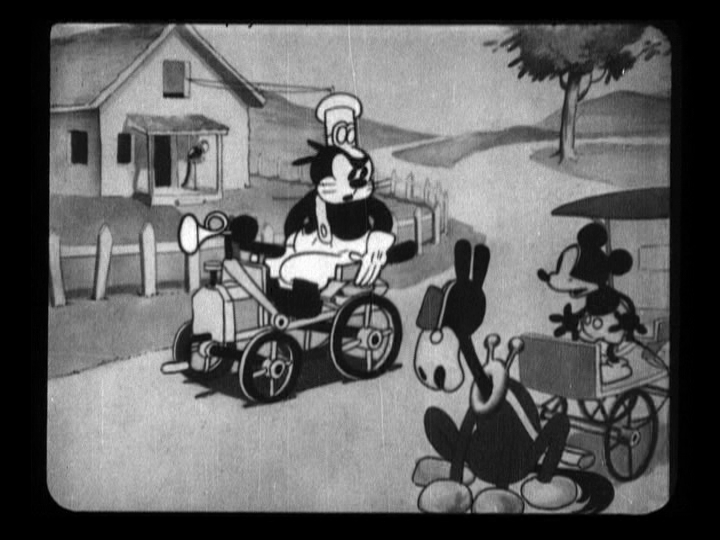
Meanwhile, Pete is driving up the road in his car, also on his way to see Minnie. He looks over at Mickey in his buggy and doesn’t think much of the mouse before he honks his horn for Minnie’s attention. Mickey is initially angered by Pete, but when he spies a duck on the road next to him, he picks up the bird and begins honking it like a horn to match Pete’s incessant honking.

Suddenly, Minnie appears, all dolled up for a night on the town. She stops at the gate while both of her admirers bow, and as she steps out to greet them, she spies Pete’s car and runs to it excitedly. As Pete starts up the car, it sputters and shakes, and Pete sends a stream of black smoke from the tailpipe in Mickey’s direction. Unfortunately, the car takes off and leaves Minnie and Pete behind before crashing into a tree and breaking into several car parts. Minnie rejects Pete and decides to go to the dance with Mickey, and the two flirt and kiss on the way there.

Mickey literally feels like a jackass for continually stepping on Minnie's feet and legs

The dance is already in full swing when the couple arrives. Unfortunately Mickey is so overzealous in his dancing that he keeps stepping on Minnie’s feet, with his feet growing in size for comic effect. At the end of the dance, Mickey is standing with both feet on Minnie’s leg, and she struggles to pull it out. Mickey finally notices that he’s on Minnie’s leg and gingerly steps off, with Minnie holding the limp limb sadly. As Minnie is furious and Mickey literally feels like a jackass, Minnie knots up her stretched leg just as a new dance begins. Although Mickey tries to dance with Minnie again, Minnie decides to dance with Pete, who is a much better dancer, instead.

Mickey stands in the corner, but gets the bright idea to be “light on his feet” by tucking a helium balloon into his shorts. He leaps gracefully over Pete, surprising the two, and Minnie begrudgingly agrees to dance with Mickey. Things go well for a while, until Pete realizes Mickey’s scheme and shoots a nail at the balloon in Mickey’s shorts, making Mickey fall on Minnie. Having had enough, Minnie decides to dance with Pete for the rest of the dance, leaving Mickey to cry in a corner.

March 5

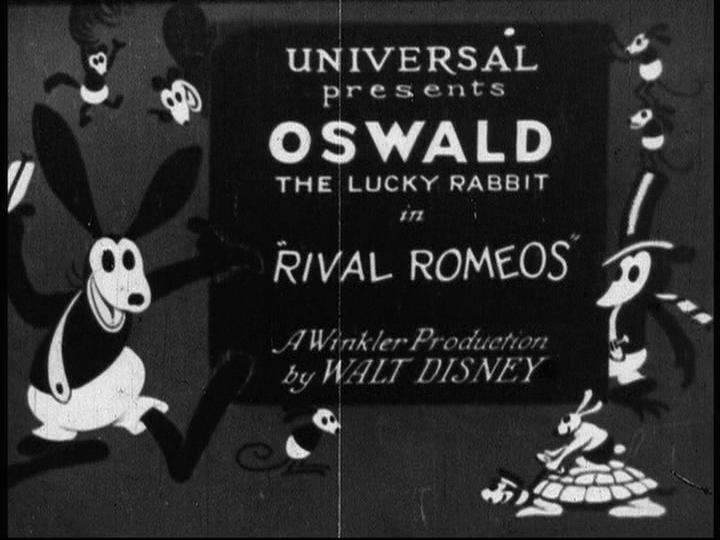
March 5, 1928 – The Oswald the Lucky Rabbit Short Film, Rival Romeos, is Released Through Universal Pictures

On March 5, 1928, Universal Pictures released a new Oswald the Lucky Rabbit short silent film entitled Rival Romeos. Oswald was Disney’s first animated hit after the Alice Comedies, and soon became very popular, along with such characters as Felix the Cat. Patterned after the leading swashbuckling actor of the day, Douglas Fairbanks, Oswald was an easily frustrated rabbit, and the shorts relied on slapstick and subtle humor: the sheet music Oswald produces, if one looks closely, include the names of Hot Lips and Hot Mama. This was the 15th of out 26 Oswald shorts created by the Disney Studios before Charles Mintz took Oswald away. Many elements in this short are seen in some of the early Mickey Mouse and Silly Symphony films, including the goat used as a gramophone (seen in Steamboat Willie), the main character fighting a rival for the lady’s affections (as seen in Mickey’s Rival), and the main characters kicking each other for being idiotic (as seen in The Wise Little Hen)

A clearly smitten Oswald is on his way to see his girlfriend, Ortensia the Cat, holding a bouquet of daisies and traveling slowly in his jalopy. He starts playing a game of “She Loves Me, She Loves Me Not” with the flowers, before dreaming of Ortensia again. Behind him, in a much nicer car, is Oswald’s rival, also armed with a bouquet, dreaming of Ortensia. His own lovestruck mood is broken by the sight of Oswald, and he angrily honks his horn at the rabbit.

The rival finds a way to get ahead of Oswald, for now

Oswald turns to see this rival, and turns up his nose at him, unconcerned. He continues at his leisurely pace, refusing to move, though his rival starts to throw a fit. The rival pulls a lever, which raises the car, allowing the rival to sail above Oswald and land comfortably in front of him, then he speeds off like a shot.

The rival is eventually stopped by giant patch of mud covering the road. The rival orders his car to go across, but the car refuses, allowing Oswald to catch up. Oswald and his car laugh at the rival, then jump into the puddle with enthusiasm, splashing around and sending mud flying toward the rival. Oswald and his car then take off to continue the trip to his girlfriend’s house. The rival’s car carefully hikes up its skirts and treads cautiously through the mud, with the rival determined not to be beaten. Unfortunately, the car slips on some mud, and they land in the puddle with a mighty splash.

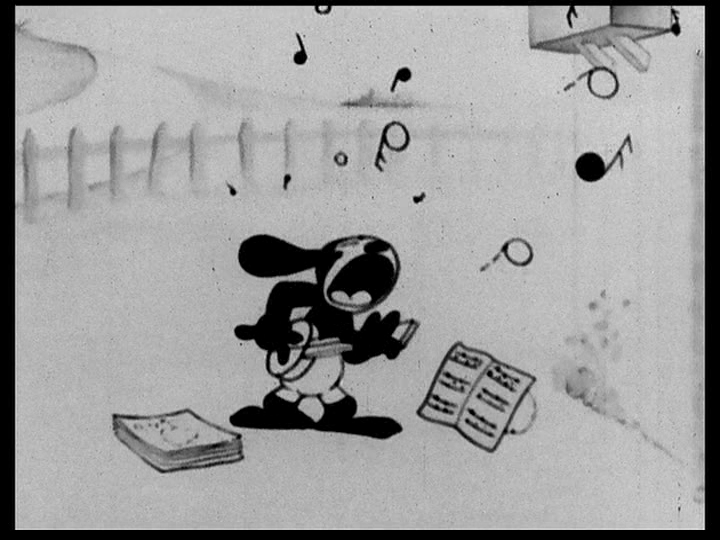
Oswald beginning to serenade Ortensia

Oswald arrives at Ortenisa’s house, heart aflutter, and begins to serenade her with on his banjo. She hears him and steps out onto the balcony, smitten by Oswald’s attempt at romance. While Oswald isn’t looking, however, a hungry goat steps into the front yard, salivating at the sheet music lying on the ground, and begins to snack on some of it, while meanwhile a gentle breeze blows around the sheet music Oswald is currently trying to play. The clearly frustrated rabbit takes out a pin to nail the music to the rock he’s using to prop the music up, only to find that the “rock” is a snoozing pig who, stabbed by the pin, runs off, taking the music with him.

Oswald then sees that the goat has eaten the rest of the music, and is now eyeing his banjo with great interest, before devouring it. Oswald grabs the bit of the banjo sticking out of the goat’s mouth to pull it out, but sends it flying down into the goat’s stomach. Oswald angrily tells off the goat, but the goat doesn’t seem to care, nor wish to give back the banjo. Oswald then tries begging and crying, explaining that he’s trying to woo Ortenisa, but the goat only laughs, infuriating the rabbit. As a last attempt, Oswald strangles the goat and sticks his hand down its throat in order to retrieve the instrument, only to get sucker-punched by the goat. He kicks the goat in the stomach, and notices that music notes come out. Inspired, he opens the goat’s mouth, pulls on his tail, and uses the goat as a sort of gramophone to play his love songs.

Poor Ortensia is caught in the middle of two unyielding suitors

Oswald’s attempts at romance are not beloved by all, for the music wakes up Ortensia’s father, who begins to throw things out the window to stop the noise. Oswald and the goat run for cover, and as Oswald hides behind his car, the rival finally makes it to Ortensia’s house and honks his horn to alert the girl. Ortensia steps outside and waves, and both suitors bow to her, but she stands between the two, with the “Romeos” pulling on her arms as they each try to convince her to date him instead of the other guy. Poor Ortensia stands there as they keep pulling and pulling out her arms like ropes, until they finally let her go. She yells at the two of them before angrily walking away, and the two suitors begin to argue. While arguing, which escalates into physical fighting, they don’t notice that Ortensia has been taken away by a third suitor, and as they watch her drive away, the two agree to kick each other for being so moronic.

March 1

March 1, 1924 – The First Alice Comedy, Alice’s Day at Sea, is Released to Theaters


“It would be a big opportunity for her and would introduce her to the profession in a manner that few children could receive.” – Walt Disney’s letter to Virginia Davis’ mother

On March 1, 1924, after a long process of putting all the pieces of the company in place, the Disney Brothers Studio had their first release of the first of the series of Alice Comedies, entitled Alice’s Day at Sea.

The first six Alice Comedies began with a long  live-action segment, then went into the cartoon. The seventh film had a change of format, when Disney scrapped the live-action introductions. In this first film, Alice goes to the seashore with her dog and falls asleep in a rowboat, and in her dreams, she battles marina wildlife and finds a shipwreck.

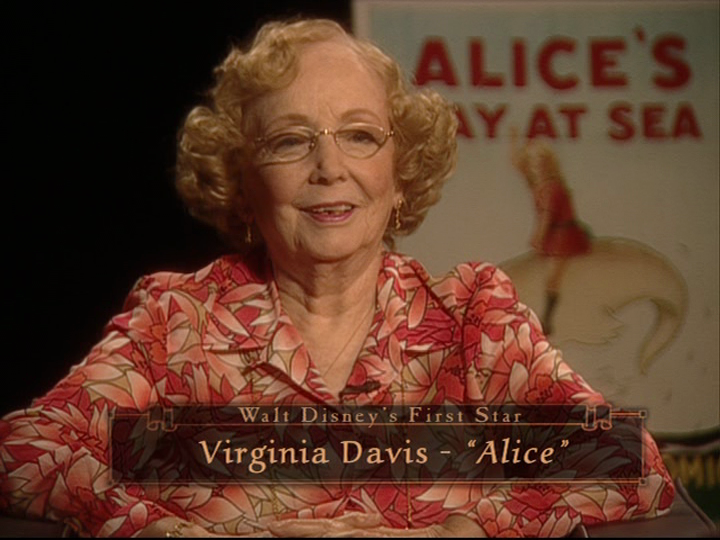
Disney's first star: Virginia Davis

Virginia Davis, the first actress to portray Alice in the Alice comedies, was still living in Kansas City, Missouri, when Walt made his way out to California to create his animation studio. Fortunately, Disney was able to convince her family to move out to California, with Virginia recalling, “Oh, what a salesman [Disney] was…my mother fell for it, but she liked him because she sensed a sincerity in his mind. She really liked him very much; she saw great things in Walt.” When they were ready to film Alice’s Day at Sea, Virginia recalled, “…that film, we came from Missouri, I had never seen the ocean, and all of a sudden there was that sand, and all the ocean…I loved it, I just loved it.”

Walt animated the films by himself, and was able to deliver the first film on December 26, 1923, ahead of schedule, and was able to collect on the offer from Margaret Winkler of $1500. However, Walt was not happy with how it had turned out, and Winkler agreed, telling him that it was only “satisfactory,” but she encouraged Walt by telling him to inject more humor into the shorts. Fortunately, Walt kept producing the shorts, and each one was better than the one preceding it.

January 11

January 11, 1929 – The First Mickey Mouse Club is Formed

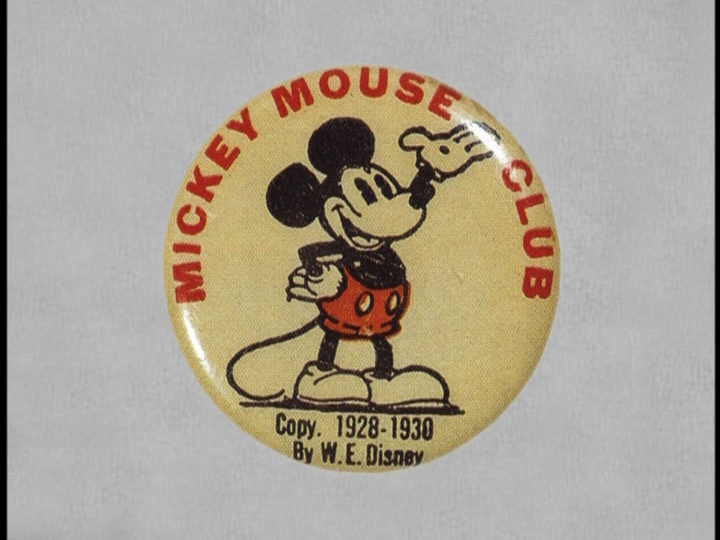
A promotional button from the original club

“Mickey Mice do not swear, smoke, cheat, or lie!”

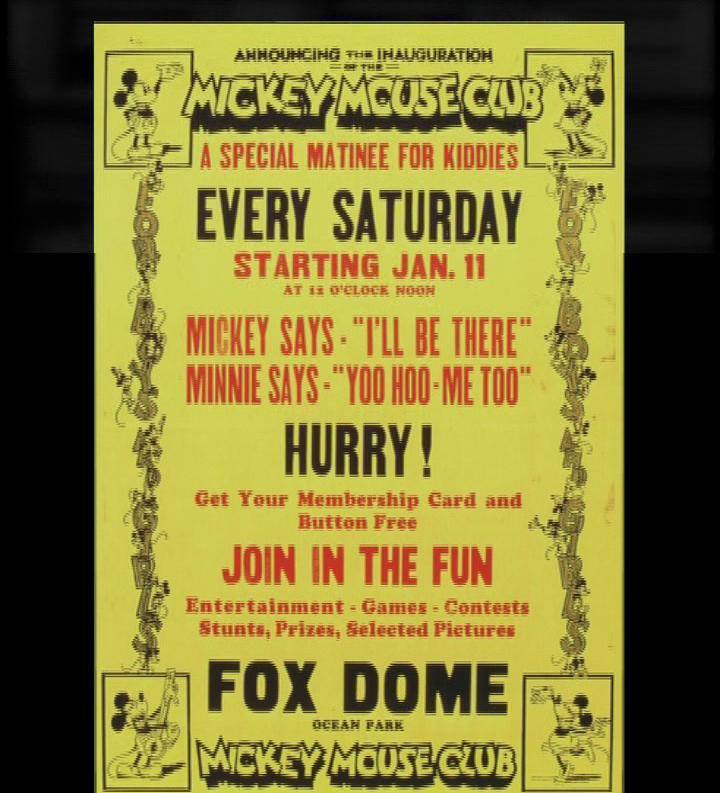
At noon on January 11, 1929, the first Mickey Mouse Club was called to order in the Fox Dome Theater in Ocean Park, California. The club was the idea of the theater’s manager, Harry W. Woodin, which he began during the children’s matinee shows on Saturdays. Soon, these clubs spread like wildfire, and by the height of their popularity in 1932, it was estimated that there were one million members worldwide, with many clubs meeting every week. During club meetings, children would watch Mickey Mouse cartoons, recite the Mickey Mouse credo, and elect a Chief Mickey and Chief Minnie Mouse.

A copy of the original flier for the Fox Dome Theater's first meeting of the Mickey Mouse Club

Intrigued with Woodin’s concept, Walt Disney saw that there were many opportunities for merchandising through the clubs, as well as convincing more children to attend the theater to see new Mickey Mouse shorts. Disney hired Woodin to be the general manager of these club gatherings. Woodin’s job included printing and sending fliers to theaters across the country, instructing them on how to develop the clubs and help local businesses through advertisements in the club bulletins. Business began to boom through the name of Mickey Mouse: Bakeries would offer free Mickey birthday cakes, banks gave away Mickey savings banks, and department stores would give away free Mickey toys to entice customers to look at their more expensive toys. Clubs were formed not only across the United States, but also in England and Canada, among other countries, by 1930. The Odeon Theatre chain in England had 160 clubs with 110,000 members by the peak of the club’s popularity.

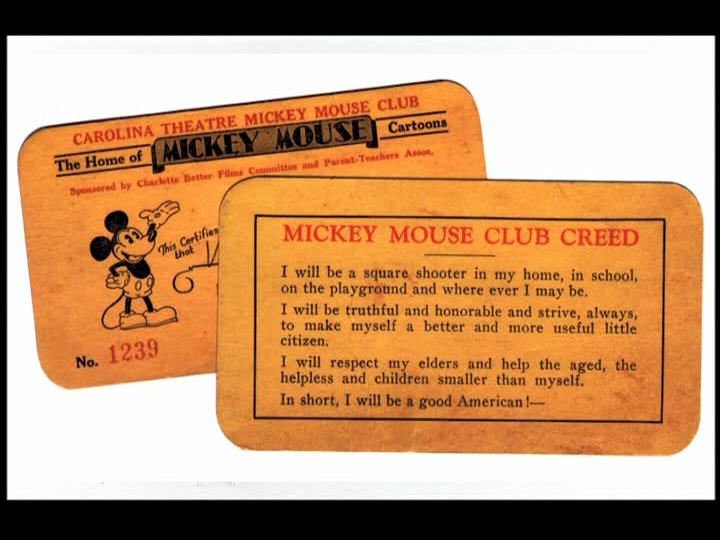
A card with the Mickey Mouse Club Creed

The club itself taught children how to be model citizens. Children would recite, “Mickey Mice do not swear, smoke, cheat, or lie!” Mickey himself would instruct the kids on topics such as how to brush their teeth and wash behind their ears, respect their parents, attend Sunday school, and on the virtues of honesty and honor. The creed of Mickey Mouse Club members was as follows:

I will be a square shooter in my home, in school, on the playground and where ever I may be.

I will be truthful and honorable and strive, always, to make myself a better and more useful little citizen.

I will respect my elders and help the aged, the helpless and children smaller than myself.

In short, I will be a good American!

The highlight of these clubs, naturally, was the Mickey Mouse cartoons. To that end, Walt Disney had a special animated short for the club meetings of the club’s theme song, “Minnie’s Yoo-Hoo.” Written by Walt Disney and Carl Stalling, the song was the first Disney song released on sheet music. The animated short that accompanied the song had Mickey singing the first verse, before encouraging the children to sing as the lyrics would show up on the screen.

Title card for the Minnie's Yoo-Hoo short.

Mickey Mouse’s explosive popularity was a big part of American culture in the late ’20s and early ’30s. With the credo recited at these meetings, as well as the lessons Mickey would teach the children, it’s no wonder that Mickey was seen as a positive role model, and parents would object if Mickey was seen doing something reckless, as he did in many of his early shorts. The clubs held steady in their popularity with the Disney stamp of approval until 1935, when the popularity of these clubs began to wane. The clubs did continue unofficially through World War II, with Mickey and friends extolling the importance of planting Victory Gardens and donating old toys for scrap. It would be 23 years until the television version of the Mickey Mouse Club would appear in people’s homes.