February 5, 2000 – The Disney Channel Original Movie The Color of Friendship Premieres
“Sweetheart, listen to me. I have been fighting bigotry my whole life – both here and overseas. It goes against everything I’m about to have a racist, white South African living in my house!”
On February 5, 2000, the Disney Channel Original Movie The Color of Friendship premiered. The film was based on a true short story written by Piper Dellums, who had a South African girl named Carrie stay with the family when she was young, although she lost touch with Carrie after she went back to South Africa. The film was met with much critical praise, and won several awards, including an Emmy for Outstanding Children’s Program. Congressman Ron Dellums’ son, Erik Dellums, plays a small role in the film. The film was written by Paris Qualles and directed by Kevin Hooks. It stars Shadia Simmons as Piper Dellums, Linsdey Haun as Mahree Bok, Carl Lumby as Ron Dellums, Penny Johnson as Roscoe Dellums, and Ahmad Stoner as Daniel.
The film is set mainly in Washington, D.C., in 1977. Piper Dellums is sitting in her bedroom, painting her face and waiting for her father, Congressman Ron Dellums, to come home from work. Piper has prepared an elaborate show, complete with costume and music, to ask about participating in a student exchange program with students from Africa. Piper sees it as an opportunity to “enrich [their] lives and form a kinship and bond between [their] black African brothers and sisters.” Her father has said no before, but she does wear him down, thinking it may be a good idea to “shorten the cultural divide between black Americans and black Africans.” Piper is overjoyed and already imagining what the student will be like.
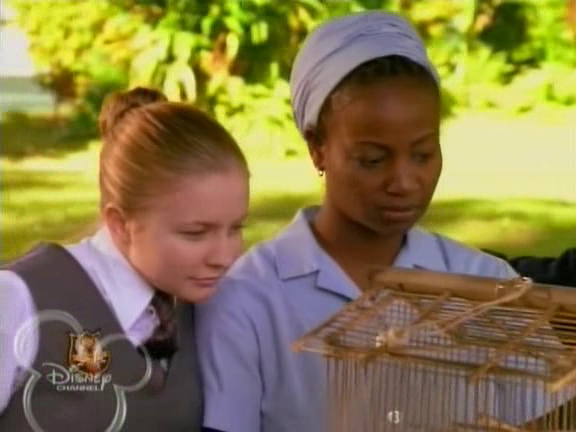
Mahree sits with Flora, learning about the story of the weaver bird
In Dundee, South Africa, white South African Mahree Bok is asking her mother for permission to participate in the exchange program. Her father is a police officer, who shares the news with his family that they have caught Stephen Biko, an anti-apartheid activist, who Mahree’s mother calls the “Black Agitator.” Mahree asks about the exchange program, and her father agrees to let her go. When a black waiter at their restaurant drops a tray of dirty dishes and splashes food on a customer, the customer kicks him while calling him a racial slur. However, Mahree and her family see this as the norm, and do not question it. Mahree then talks to her maid, Flora, whom she considers her best friend, although she remains ignorant about the apartheid situation. When Flora hears about the family she’ll be staying with, she suddenly pauses; Flora has heard about Dellums’ work against apartheid, but keeps this secret from the Bok family.
As Mahree prepares to leave, her brother runs to her, showing her a flag he’s found. Mahree quickly snatches it away, telling him sharply that it’s the flag of the anti-apartheid activists, and Flora quickly takes it away before their parents see. Later that evening, she keeps the flag with her personal belongings, and pulls out an article she saved about Congressman Dellums’ work against apartheid. Piper and her mother wait anxiously at the airport for Mahree, with Piper looking for a black girl in traditional clothes. Mahree, looking for a white family, walks right past the Dellums. When the two finally meet, Piper is disappointed, and Mahree treats the two like servants. Roscoe, Piper’s mom, rushes into Ron’s office to explain what happened. When Mahree enters the room to see all the black congressmen, she laughs, thinking this is all a joke, but is suddenly horrified.
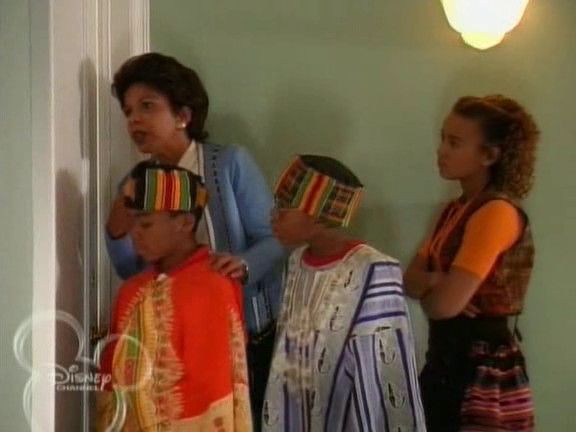
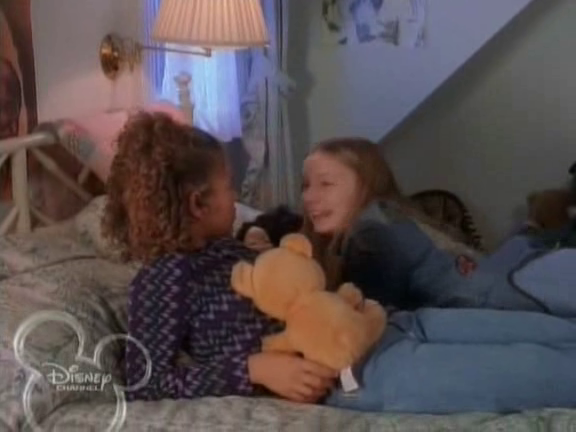
Mahree has locked herself in Piper’s room, having been overwhelmed by the entire situation
Roscoe thinks things will work out, but Piper is not sure, and neither is Mahree. When she arrives at their house, she runs to Piper’s room and locks the door, refusing to come out. When Ron arrives home, he is less than pleased about the situation. Later that evening, Mahree escapes the room to call home, ready to ask to come home, but after hearing her father teasing her about wanting to come home, she puts on a brave face and pretends everything is wonderful. Ron and Roscoe argue, with Roscoe claiming that things will turn around. Ron says that the girl obviously doesn’t want to be there and she should be sent home. Roscoe then stops by and says that she’s spoken with the coordinator of the exchange program. They’ll look for another host family, she says, but if they can’t, they’ll be sending her home. Piper is furious at Mahree’s behavior, and Roscoe reminds Piper that her behavior at the airport was just as bad, although Piper argues that she’s over it. Mahree then appears in the doorway, and says quietly that she would like to stay with the family.
Piper and Mahree start warming up to each other, although some of the terms Mahree uses are confusing. When Piper helps Mahree move to the guest room, Ron offers to help her “move,” although he thinks she’s leaving while she’s only moving to the guest room. Ron still doesn’t want Mahree to stay, as he is very against her politics. When they find out her father’s a cop, he’s even more determined to send her home. Roscoe, however, thinks that they can teach her that racism is wrong, and set a good example for their children. However, Mahree still has a few problems adjusting, as she is not used to life without a maid, and Piper learns more about some of the government regulations Mahree thinks are just normal in South Africa. She, Piper, and Roscoe then head to the mall to do some back-to-school shopping. The three have an enjoyable time, and head out for ice cream. When the black server accidentally spills an ice cream sundae on a white customer, Mahree tenses, praying that the customer won’t hit the server. The customer, however, reassures that everything’s okay, and orders the sundae that was spilled on him.
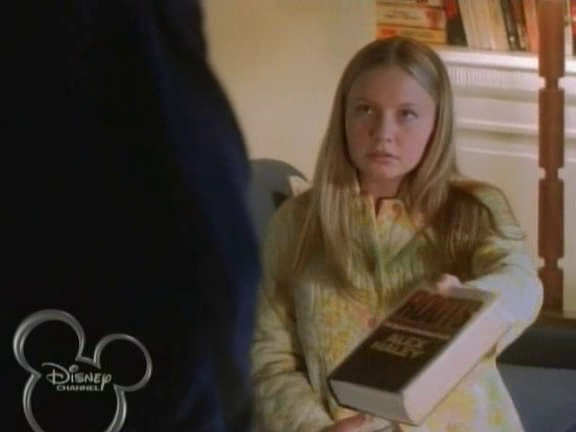
Mahree shows Ron what she’s been reading, and he starts explaining the book’s significance to her
At work, Ron receives an urgent call from the South African embassy, who wants to confirm that he’s hosting Mahree. Mahree and Piper learn more about each other’s school, and Piper then asks why Mahree keeps calling her “bantu.” Mahree explains that in Afrikaans, “bantu” means “negro,” “kaffir” being the racial slur, which she reassures Piper she would never say. Piper then talks to her mother and father about the differences in language, like calling a trunk of a car a boot. She mistakenly says that Mahree called her a “kaffir,” which riles up Ron, as he will not tolerate that sort of racist behavior under his roof. Piper quickly defuses the situation, as she accidentally mixed up the words. Late that evening, Mahree heads downstairs to read, and pulls out a copy of Roots by Alex Haley. She begins to read, but is interrupted by Ron. When he sees what she is reading, the two begin to talk and understand each other.
The next day is the first day of school for Piper and Mahree, and Mahree has to wait in line for her schedule. She is still adjusting to this life in America, where the schools are no longer segregated. She spends the rest of the day reading her assigned book Cry, the Beloved Country, by Alan Paton. Although the book is about South Africa, Mahree has never heard of it before, and admits that it’s probably banned. Piper then expresses confusion about how many things are banned in South Africa, and why the government has banned them (for “protection,” Mahree says). The two have quickly become best friends, going to the movies and exploring D.C. One day, when they arrive home, a strange car is in the driveway. They find out that members of the South African embassy are there to take Mahree back to the embassy and send her home. Mahree doesn’t want to leave, but they force her out, saying it’s for the “safety of the child.” Piper immediately calls her father to get this sorted. An anti-apartheid demonstration is in full swing when they reach the embassy, and Mahree finds out that Stephen Biko has been killed by the police. Mahree is horrified by the racist reactions of the members of the embassy.
Mahree celebrates her homecoming, but Piper is still distressed, thinking that Mahree still has her racist attitude
Piper is still upset after they took Mahree, and when her friend Daniel stops by, she explains that she’s gone. Daniel then laughs, and wonders aloud what took her so long. He believed her to be racist due to attitudes in South Africa, and then explains about the Stephen Biko situation, and pointedly asks Piper what she thinks Mahree thinks about it. When Mahree is sent to call her parents, she grabs a phone and calls Piper instead, but Piper misses the call. When she gets ready to call her parents, she is thrilled to see Ron at the door. He reassures her that things will be okay, and soon Mahree is on her way back to the Dellums’. Piper, however, isn’t thrilled to see her, wondering why she’s back, and if she understands what the death of Biko meant. The two get in an argument about Biko’s death, with Piper insulting Mahree’s father, and yelling at her about the racist attitudes in South Africa. Mahree flees the house, and Ron goes to talk with Mahree, while Roscoe goes to talk with Piper. Mahree admits that Piper couldn’t visit her in South Africa, and she hates it. Ron explains that racism is a nasty cycle, and it has to stop, and America has gone through the same struggle before.
Piper then appears outside, and Mahree explains the story of the weaver bird, the same story told to her by Flora, who explains that it lives in a huge nest with so many other birds of different colors, and they all help each other and never fight. Soon after, the Pan-Africa festival takes place in D.C., and the family runs into Daniel, who soon warms up to Mahree, thanks to her change in attitude. Ron gives a speech at the festival, and while he gives his speech, Mahree is seen returning home to South Africa. When she gets back, she greets her family warmly, and finds Flora. She shows Flora that she’s secretly sewn the anti-apartheid activist flag within her vest, showing her change of attitude, and Flora gives her a huge hug. The movie ends with Mahree freeing the pet weaver bird from its cage, watching it fly away.
 disneydetail