February 13, 1957 – The Disneyland Episode Tricks of Our Trade Premieres on ABC 
“Before our eyes, we have seen an entire industry grow literally from the ground up. And this growth was no accident. It was painstakingly built, step by step, by men with pioneering spirit, who loved this puzzling new art form, and believed in its future.”- Walt Disney.
On February 13, 1957, audiences were treated to a different kind of episode of Disneyland: one that focused on how animated films were able to capture things as realistically as they did. With our host, Walt Disney, we are taken through the “tricks of the trade,” where he explains some of the then-commonplace animation principles, as well as some of technical advances made in the studio, and why they needed to be created. The examples given are obviously staged, but they give the audience a great example of the process used to come to a solution. Animation examples are from Snow White and the Seven Dwarfs, Bambi, and Fantasia. The episode was written by animation veteran Dick Huemer and directed by Wilfred Jackson. It also includes cameos of four of the famed Nine Old Men: Frank Thomas, Ollie Johnston, Marc Davis, and Milt Kahl. The episode refers to the book, The Art of Animation, which was the book that inspired John Lasseter to want to be an animator (please see the January 12th entry for more information).
“Because the animated cartoon comes to life on the screen, it belongs in the field of the motion picture,” Walt explains, as he opens up the episode. “But because it is drawn and painted, it is also one of the graphic arts, like painting. As a matter of fact, it is often referred to as the last of the graphic arts.” Disney then goes to his desk and shows the audience the book The Art of Animation, which was written by Bob Thomas about the Disney Studios. Disney turns to chapter eight, entitled Tricks of Our Trade, and explains that the pupils were their own teachers when it came to the principles of animation. “They had to be, because no one in the world could give them the answer to what they wanted to know,” Disney says, adding that their overall question was: How could animation be improved?

The animators in a classroom after hours, learning more about their own medium by one of their own
The first segment shown is of a group of animators watching a film of overweight comedian Billy House performing a two-step. The animators note that an overweight man moves differently, and that the human body does not move all in one piece. When the film is slowed down, there are many details they recognize that cannot be seen at normal speed. We then see the animators use what they saw to create an animation of the dwarf Happy doing the two-step dance, with the animation principles of weight, contact, follow-through, squash and stretch, and overlapping actions being used effectively. Disney points out while it’s true that thoughts and emotions can be expressed through pantomime, who a character is and what they think can best be revealed by dialogue. The trick of using dialogue is shown through a clip from Show White and the Seven Dwarfs, where Snow White identifies which dwarf is which.
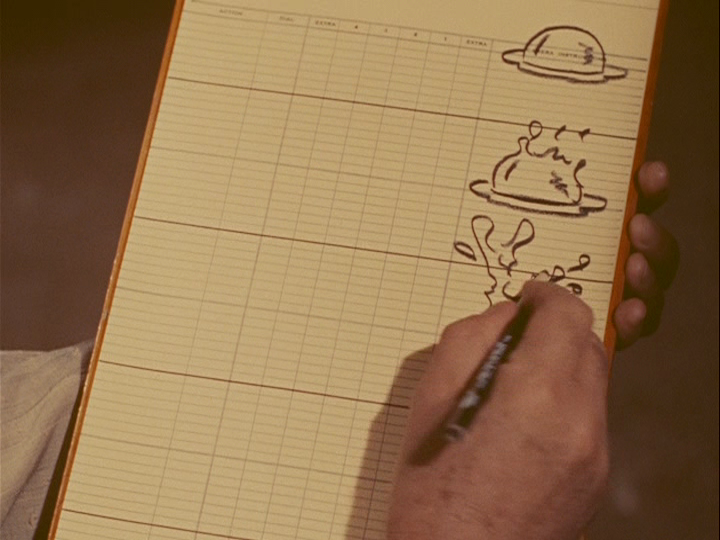
Dan MacManus sketching on an exposure sheet, trying to see how many frames it wll take to draw before the animator can draw the bubble bursting
The next animation technique we look at is effects animation: the trick of making the cartoon characters more believable by using extremely realistic animation of incidental action. There are many clips of animators watching various actions—including a baseball thrown through a window, or a bubble being blown from a pipe—and Disney explains that animating breakage required tremendous attention to detail. This leads into a clip of the earthquake from The Rite of Spring sequence in Fantasia. Continuing with that sequence, we see three effects animators looking at a tub of orange-colored mud, trying to solve three different problems for the creation of earth sequence in The Rite of Spring. Joshua Meador, head of the experiment, uses color chalks and pastels to render the sketch that would give an overall impression of the sequence. Jack Boyd’s assignment is to establish the individual action of a pair of bubbles, verifying his findings with the 2-drawing flipping action. Dan MacManus’s job is to see exactly how many drawings it would take to animate the bursting of a bubble, using an exposure sheet and a stopwatch. The audience then sees the clip from The Rite of Spring in its entirety.
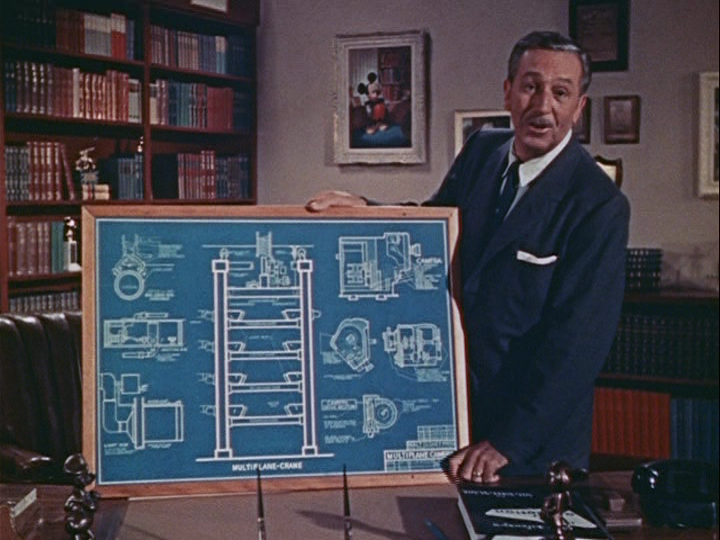
Walt with a blueprint of the Multi-Plane Camera, a Walt Disney Studios invention. Coincidentally, Ub Iwerks had created his own version at his own studio, only it was a horizontal camera
Walt pulls out a picture, calling it a different kind of drawing, which “also came out of our school of self-improvement here at the studio.” The blueprint is of the multi-plane camera, which was first used to great success in the Silly Symphony The Old Mill. Disney explains that the old process for animated films was fairly simple in construction and operation, but the biggest problem was that any dimension the character brought with him or her into the scene disappeared when the character left the frame. Another example used was a painting of a house on a moonlit night, and when the camera zoomed in on the scene, everything got larger, including the moon, which does not happen in reality. The use of the multi-plane camera shows the audience the big difference it makes in that scene. The audience next sees the opening scene of Bambi, and how the multi-plane camera works to give realism to the forest.
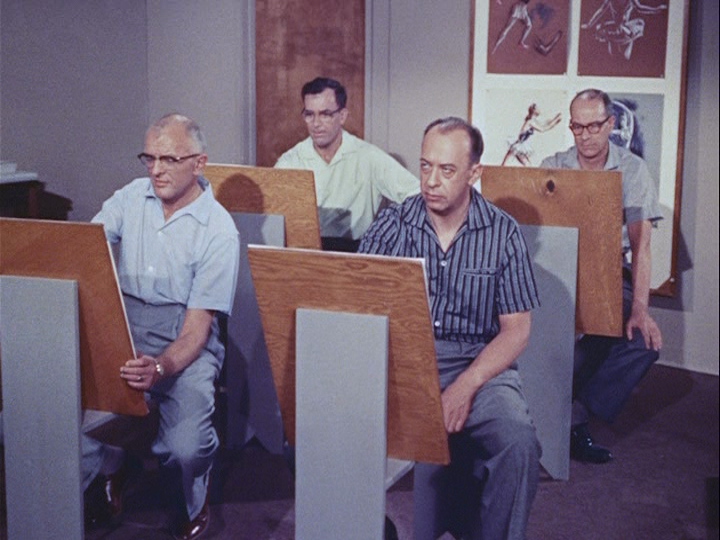
Four of the famous Nine Old Men, studying ballet moves. From Far Left: Milt Kahl, Frank Thomas, Marc Davis, and Ollie Johnston
“Perhaps the thing that distinguishes animated cartoons more than anything else is the trick of caricature,” Disney says. He tells the audience the story of the animation of Dance of the Hours from Fantasia, which involved the use of a live-action model to help the animators see the ballet movement of the dance. The ballet dancer they used was Helene Stanley, who was also the live-action model for Cinderella and Aurora in Sleeping Beauty. In this segment, we see the four of the famous Nine Old Men as they study Stanley’s movements. Kahl discovers that he may not be getting the kick right. Davis asks Stanley to perform it again, and as she does, Kahl makes a comment that the kick should be higher “in order to get all that weight off the ground. She’s no cream puff, you know.” Davis agrees, adding, “Yeah, that is a lot of beef.” These comments grab Stanley’s attention, but she keeps dancing. Thomas steps forward with his drawing and asks if he’s made the trunk too long: at this point, the audience sees that the drawings are those of the animals in the Fantasia sequence, although Stanley still thinks they are talking about her. Kahl responds to Thomas, “Oh, no, that’s what gives it that goofy look. Trunk’s way out of proportion to the rest of her body…it wouldn’t hurt to make [her legs] good and hairy.” These comments finally get the best of Stanley, who grabs her hat and cape and runs to the door, before turning around and seeing the animals they’ve been animating, and laughs before returning to the stage. The episode ends with the ballet segment from Fantasia, with all elephants, ostriches, and hippos.
The episode is wonderful for those who are fans of animation, and wish to see a dramatic look at how the animators were able to teach themselves and develop the new techniques to create better animation. Similar to “lessons learned” when creating computer animation in this generation, this highly recommended episode shows how the animators really had to, and did, step up to blaze a new trail.
 disneydetail