RSS Feed

Tag Archives: Births

January 10

January 10, 1930 – Disney Legend Roy Edward Disney is born.
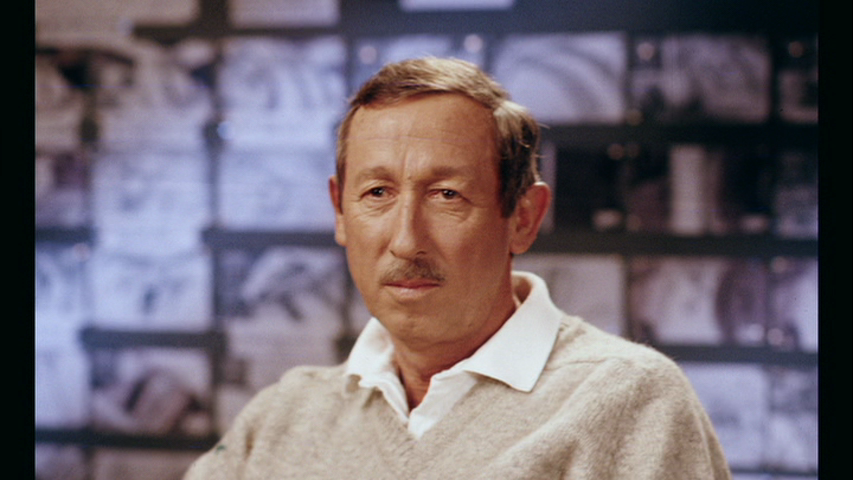
“Roy was, yes, a Disney, but he was remarkable because he lived his own life and was well-known for sailing around the world. And he certainly took us all on an adventure.” – Don Hahn, Producer of Beauty and the Beast.

Only child of Roy O. Disney (Walt Disney’s brother) and Edna Francis Disney, Roy Edward Disney was born in 1930. He grew up at the studio while his father dealt with the business side of running it. In 1951, Disney graduated from Pomona College with a degree in English, and began working in his uncle’s company in 1954 as an assistant film editor on the True-Life Adventure films. He worked in various roles within the company; as producer, writer, director, and production coordinator for episodes of Walt Disney’s Wonderful World of Color; as a writer for shows such as Zorro; and as a cinematographer for Perri.

In 1967, Disney joined the company’s Board of Directors. Ten years later, he resigned as an executive from the company because of disagreements over corporate decisions, but retained his seat on the Board. In 1984, however, Disney resigned as Chairman of the Board, citing decisions being made over a corporate takeover battle. “And we finally came to the conclusion that we can’t do anything on the inside because I’m the lone voice of dissent on this board,” Disney explained. “So I resigned from the board of directors. And it got enormous amounts of attention.” Indeed, Disney stock jumped 15 percent the week that Disney resigned, topping off at about $58 a share.

Disney’s resignation brought about a shift in the company, with Ron Miller stepping down from his role of CEO. The hostile takeover attempt involved taking the company apart and selling it off piecemeal, but Disney fought against this plan with a group of investors. Disney also helped bring Michael Eisner and Frank Wells to the company as CEO and President of the Walt Disney Company, respectively. Disney then came back to the company as vice chairman and head of the animation department. “I came back to the company in 1984 and, [in a] rather cavalier way at the time, said to Michael [Eisner], ‘Why don’t you let me have the Animation Department, because I may be the only guy right now, with all these new people coming in, who at least understands the process and knows most of the people.’”
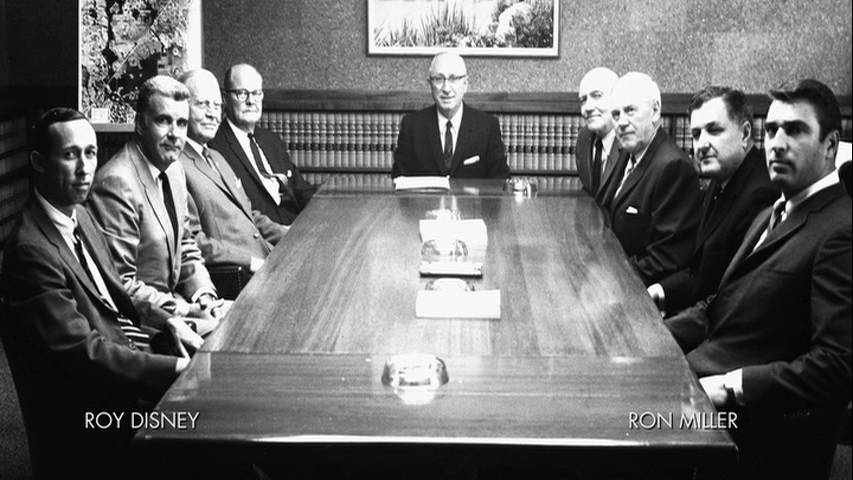
Roy (L) with the Board of Directors.

“We wouldn’t be watching movies from Pixar and Disney, or possibly Dreamworks for that matter, if it weren’t for a few amazing things that Roy Disney did during that time,” Don Hahn remarked. Disney helped to reinvigorate the then-failing Animation Department, beginning with the decision to release one new animated film a year, to helping bring in the Computer Animation Postproduction System (CAPS) to change the way films are animated.

One of Disney’s other projects was a sequel to his uncle’s 1940 film, Fantasia. Walt Disney had always planned to make a sequel, and Disney continued his work, acting as Executive Producer on the project. Production began in 1990, and the film was released in 2000. The film is a combination of the company’s past and its future, a sort of metaphor for Roy E. Disney’s time at the Walt Disney Corporation.

In 2003, Disney once again resigned from the board of directors because of tensions between him and Eisner, citing complaints of Eisner’s style of micromanagement, a refusal to create a successful succession plan, and the perception that Disney had become a soulless conglomerate. Disney then established the website SaveDisney.com to force Eisner out and replace him with new blood. Eisner stepped down on March 13, 2005, and Disney rejoined the company as the non-voting Director Emeritus and consultant.
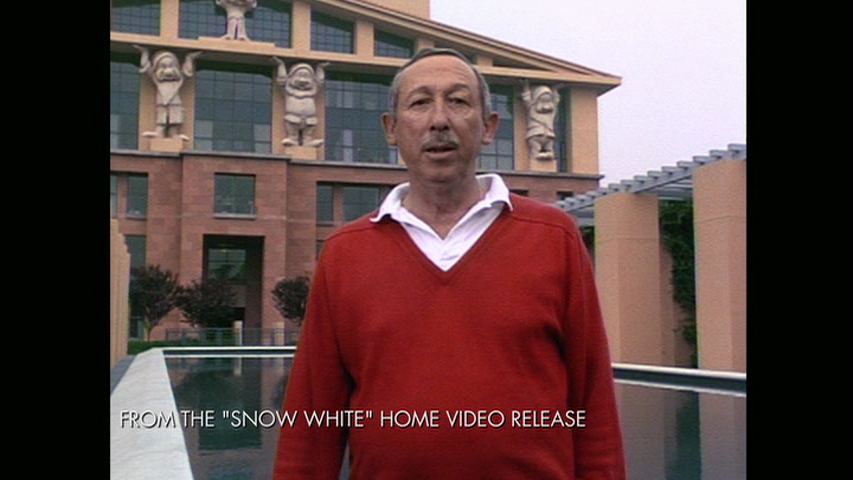
Roy introducing the Snow White home video in 1994.

Peter Schneider, Former President of Walt Disney Animation Studios, had this to say about Disney: “People always talked about Roy as the idiot nephew. That was his nickname. Nothing could be further from the truth. He was smart, unassuming, and powerful. You could easily underestimate him, but you did so at your own peril.” In fact, Disney did a lot to change the company during the period known as the Disney Renaissance. On October 16, 1998, Disney was inducted as a Disney Legend based on his long and varied work with the company. After a long battle with cancer, Disney passed away on December 16, 2009. An animation studio in Burbank was dedicated in his honor on May 7, 2010.

Writer Patrick Pacheco remarked about Disney, “I think he had a lot to prove and I think he proved it…He wasn’t the type of guy to go out and say, ‘Yeah, I’m the guy that did this.’ But on so many levels, he’s the guy that did this.” Disney was able to help change the animation landscape through the simple act of resigning from the board and bringing in Eisner, Wells, and Katzenberg. His dedication to the art of animation and the Disney name truly helped bring the company back from near demise in the late 1980s and the 1990s.
January 5

January 5, 1941 – Prominent Film Director and Animator Hayao Miyazaki is born.

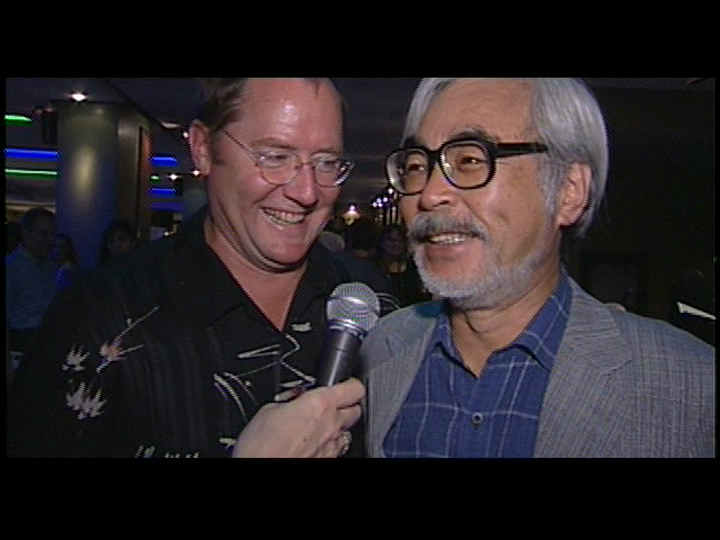
John Lasseter (L) and Hayao Miyazaki

“When you see a movie of his, you see something in film you’ve never seen before.” – John Lasseter, Chief Creative Officer of Walt Disney and Pixar Animation Studios.

If Japanese animation legend Tezuka Osamu is known as the Japanese Walt Disney, Hayao Miyazaki could be seen as the Japanese John Lasseter: both men’s works have changed the landscape of animation for future generations.

Miyazaki was born to a well-to-do family on the outskirts of Tokyo in 1941. He and his family were forced to evacuate their home during World War Two (although they were able to move back in 1950), and in 1947, Miyazaki began school as an evacuee. Wartime events would have an impact in his work, one example being his 2004 film Howl’s Moving Castle. Like many children in post-war Japan, Miyazaki was inspired by the works of Tezuka Osamu (best known for his work Astro Boy), who had just made a big impact with his comic New Treasure Island. In fact, most of Miyazaki’s early work was, as he acknowledged, heavily inspired by Osamu, even as Miyazaki struggled to develop his own artistic direction, and it was only when he became an animator at Toei Animation that he felt he had finally shaken off the influence.

Miyazaki had several other influences: He studied political science and economics at Gakushuin University, and was part of a children’s literature research society, where members read many stories, including European texts, exposing him to a wide range of fantasy and legends. After leaving university in 1963, he joined Toei Animation Studios, working as an inbetweener after three months’ training. He first gained recognition for his work on the film Gulliver’s Travels Beyond the Moon in 1965. He was able to pitch his own ending to the film when he found the original one unsatisfactory, and his ending was used in the final product. Miyazaki married fellow animator Akemi Ota in 1965.

Miyazaki continued to play important roles including animator, concept artist, and storywriter for various films, including Hols: Prince of the Sun (1968), Puss in Boots (1969), and Animal Treasure Island (1971). In 1971, Miyazaki left Toei and joined A Pro to work with Isao Takahata, and also worked for Nippon Animation, which he left in 1979 in order to direct his first feature animated film, The Castle of Cagliostro.

In 1984, Miyazaki had his big breakthrough in animated film with Nausicaä of the Valley of the Wind, based on the comic he had written (first published in 1982, and serialized until its completion in 1994). This film introduced many themes that occur frequently in his later films: environmental issues, feminism, pacifism, and an interest in flight and aircraft. The success of the film, and the need to establish a new production center, led Miyazaki and Isao Takahata, along with producer Toshio Suzuki, to form Studio Ghibli, a subsidiary of Tokuma Publishing.

In 1996, Disney made a deal with Tokuma to distribute the Studio Ghibli works, excluding Grave of the Fireflies, and Ocean Waves. Since then, Disney has released the films on DVD, with the likes of John Lasseter and Pete Docter from Pixar helping to create the English-dubbed version. Spirited Away, the only traditionally animated and foreign animated film to win the Academy Award for Best Animated Feature, brought Miyazaki and Studio Ghibli to the world stage. John Lasseter noted that “since Spirited Away was released in the United States, it has created a large following for Miyazaki-san’s work. Since then they’ve released on DVD most of Miyazaki-san’s films, so there’s a lot of people – a lot more Miyazaki fans in the United States now than there was when Spirited Away was released.” Studio Ghibli and Walt Disney Studios have also seen success with release of Howl’s Moving Castle and Ponyo.

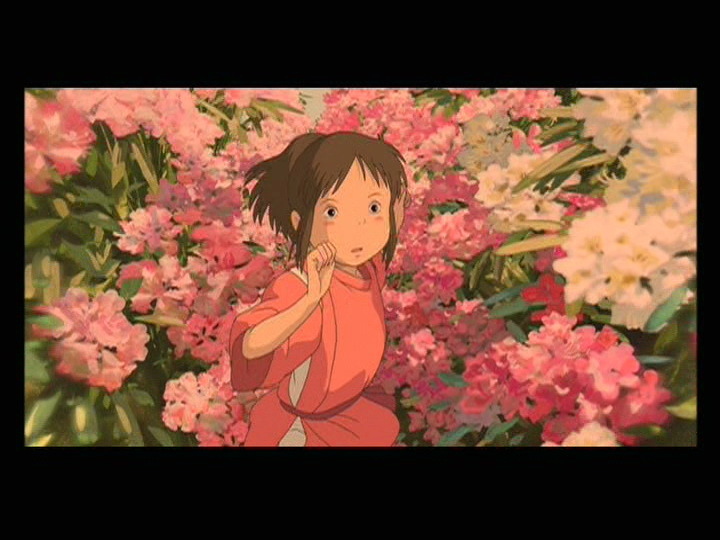
The main character of Spirited Away, Chihiro.

Miyazaki has been a great inspiration to many animators, from the staff at Pixar to the animators at Walt Disney Studios. John Lasseter is a close friend of Miyazaki’s, and has mentioned on numerous occasions how Miyazaki’s films inspire the animators at Pixar. “He is one of the great filmmakers living today,” says Lasseter. “When you see a movie of his, you see something in film you’ve never seen before. . . His films have always been inspirational for me and for everyone at Pixar…It’s interesting to talk to people and they have different interpretations of it. And that’s what’s so special about [Miyazaki’s] films…they make you think. Miyazaki’s films always make you think. And that’s what’s so special about them. And that’s why they get better. Just like a fine wine, they get better with age, because you keep watching them and you understand them more and more, and that’s what I just love about them. …[T]hey’ll live on forever.”

Animator Glen Keane (Beauty and the Beast, Aladdin, Tangled) has also been inspired by the animation style of Miyazaki and Studio Ghibli. “Well, it’s hard to ever separate the huge influence that Japanese animation has had on me,” he says. “I was just in awe of Miyazaki’s work, and have emulated his sensitivity, his approach to staging. That had a gigantic impact on our films, starting with Rescuers Down Under, where you saw the huge Japanese influence on our work. That’s part of our heritage now, which we don’t back away from.”

I included Miyazaki for several reasons: 1) Disney does have distribution rights to the Studio Ghibli films; 2) many animators in Pixar have worked on the English translation of the films; and 3) the influence the Studio Ghibli and Miyazaki has had on Disney and Pixar is unmistakable. Many people find the films inspirational both for the stories being told and the animation style. There is no denying the impact Miyazaki has had on the animation world.

January 2

January 2, 1898 – Birth of Disney Legend Dick Huemer

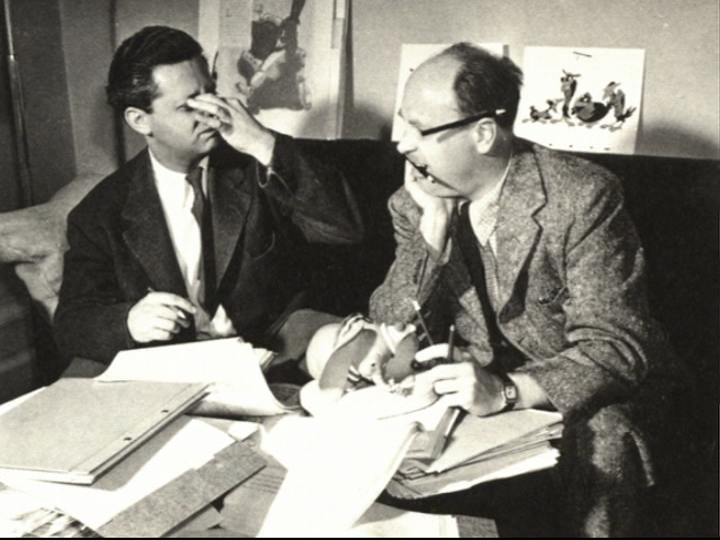
Disney Legends Joe Grant and Dick Huemer

“Meet Dick Huemer. He goes to operas.”

Dick Huemer, animator in the Golden Age of Animation, was a “jack-of-all-trades” within the Disney Company, but is best known for his work with Disney Legend Joe Grant on Fantasia and Dumbo. In 1916, as a student at the Art Students League and living in the Bronx, Huemer saw a help wanted sign on a door for the Barre Studio, one of the first film studios dedicated to animation. Huemer’s response:

“I had done a lot of illustrating, in yearbooks and things like that. One day, out of curiosity, I just walked upstairs and there was this plump little guy sitting there – a very genial character with a French accent. I told him I’d seen his sign and would like to be a cartoonist. He said, ‘All right – go into the next room, they’ll put you to work.’ And that’s how I got into the business. Because in those days, who knew about animated cartoons? I don’t believe the name had even been coined yet.”

Huemer then moved on to become the animation director at the Max Fleischer Studio and the Charles Mintz Studio, before joining the Walt Disney Studio in 1933 as an animator. He contributed to twenty-five cartoons as an animator before directing two classic shorts – The Whalers and Goofy and Wilbur – and then progressed to working on feature films.

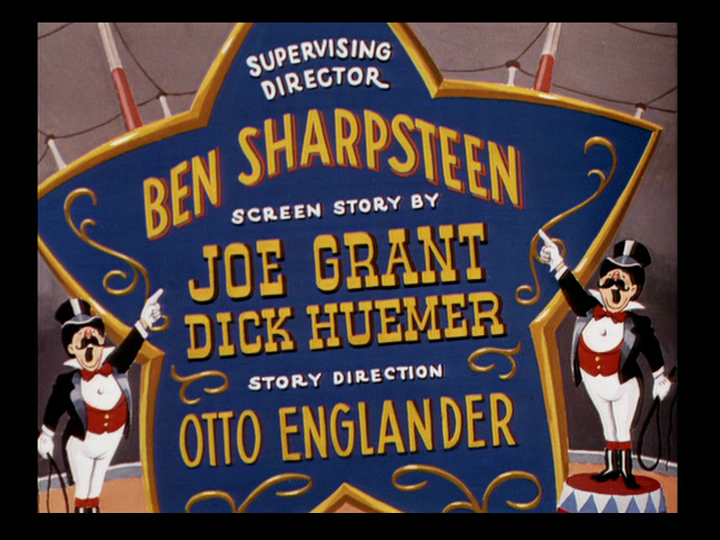
Disney assigned Huemer and Joe Grant to be the story directors on Fantasia because Huemer was an opera fan, and Grant had a lot of experience in character design. Ward Kimball recalled, “We owe it mostly to Dick Huemer for the fact that Walt Disney was weaned away from John Philip Sousa and introduced to the classics. Walt learned all about Beethoven, Tchaikovsky, and Stravinsky through Dick Huemer’s tutelage.” Huemer and Grant also adapted the screenplay for Dumbo, and Huemer continued his work on the story for the feature films Saludos Amigos, Make Mine Music, and Alice in Wonderland.

Huemer left the Disney Studios in 1948 to freelance on his own comic strip called Buck O’Rue, but returned to the studio in 1951 to work in early television shows and the story department until 1955. From 1955 to his retirement in 1973, Huemer wrote the True-Life Adventures comic strip. In 1978, in recognition of his contributions to the art of animation and his continued excellence, he received an Annie Award from the International Animated Film Society. Huemer passed away on November 30, 1979, and was inducted as a Disney Legend on October 10, 2007.

Writing about Dick Huemer is a pleasure, as he is one of the idols of the Golden Age of Animation. I grew up with and still enjoy watching Fantasia — it’s a treat to see how someone who appreciated opera and classical music used his love to create a wonderful film. It was interesting to read his thoughts on the film, especially when it wasn’t a huge hit with audiences upon its release. “Actually, we blamed the public,” Huemer said in an interview, explaining the shock the Studio felt when Fantasia didn’t do well. “What the hell’s the matter with them! This is a fine thing that will never be done again. It never was. It never will. It can’t be. You can’t afford to do that…I think somehow if we were to do it today that it would be an entirely different thing pictorially.” Through his words, you can tell that it was a labor of love for Huemer, and it’s a shame he isn’t around to see the following the film has today.

The most admirable trait I find in Huemer is how much he loved what he did, and how he transferred that love so smoothly into his work. He compared those involved in the Golden Age of Animation to the artist Rubens: “Rubens had a staff of about fifteen guys who were working on his paintings and they were dedicated people. They were artists, they loved doing it, and that’s why they were there. And they knew that they were doing the right thing.” Huemer, too, is a prime example of an artist who loved what he did and knew he was doing the right thing.

January 1

Welcome to 2012, the first post of the year as well as the first post of the blog! Of the many areas I could have spoken about today, I could not decide between these two. Read and enjoy!

January 1, 1904 – Birth of Disney Legend Grace Bailey

Disney Legend Grace Bailey Turner, born Elizabeth Grace Randall, is known for her work in the Ink and Paint department. She began working at Walt Disney Studios in 1932, rising through the ranks of the department to painting supervisor, then inking supervisor, and finally head of the department in 1954. She held this position until she retired in 1972, after 40 years of work with the company. She died on August 23, 1983, and was inducted posthumously into the Disney Legends on October 12, 2000.

After the success of Flowers and Trees, Disney’s first Technicolor animated short, Bailey was tasked with the important duty of expanding the studio’s catalog of colors. Walt had made a deal with Technicolor to have exclusivity of the three-color process in animation for two years, and one can only imagine the challenges Bailey faced when dreaming up new colors. Betty Kimball, former Studio painter, said in an interview that “[e]verything was so unscientific back then. We were just creating, and it was fun.”

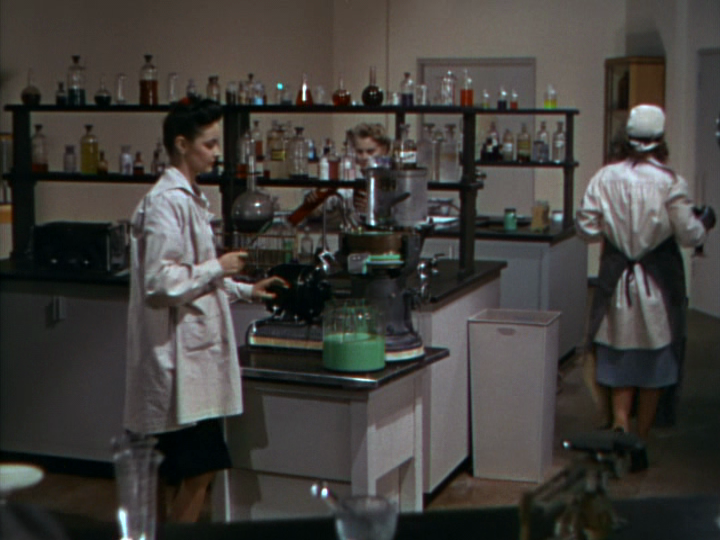
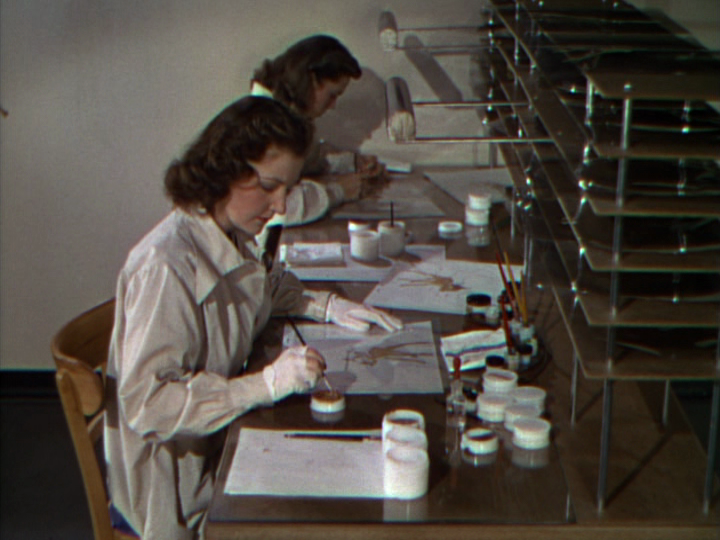
I was rather excited that my first post could be on Grace Bailey, for several reasons. Firstly, many people voiced complain that there are no important women in Disney’s history – my answer is that they’re not looking hard enough. Although the Ink and Paint Department was mostly, if not all, women, this does not mean their work was thought of as any less important. After watching scenes from The Reluctant Dragon, it’s easy to see that there was a lot of work that went into mixing and creating the new hues to bring animation to a higher level. The Ink and Paint department was highly important when it came to an animated film: inking could take about 12 months to learn properly, and one had to be very precise to preserve not only the animator’s original drawing, but also the emotion the animator wished to invoke.  To say that women did not have an important role, or that there were hardly any important women, seems to ignore all of the work these women did. Bailey was an important part of Disney history, and I’m proud to put her in the spotlight today.

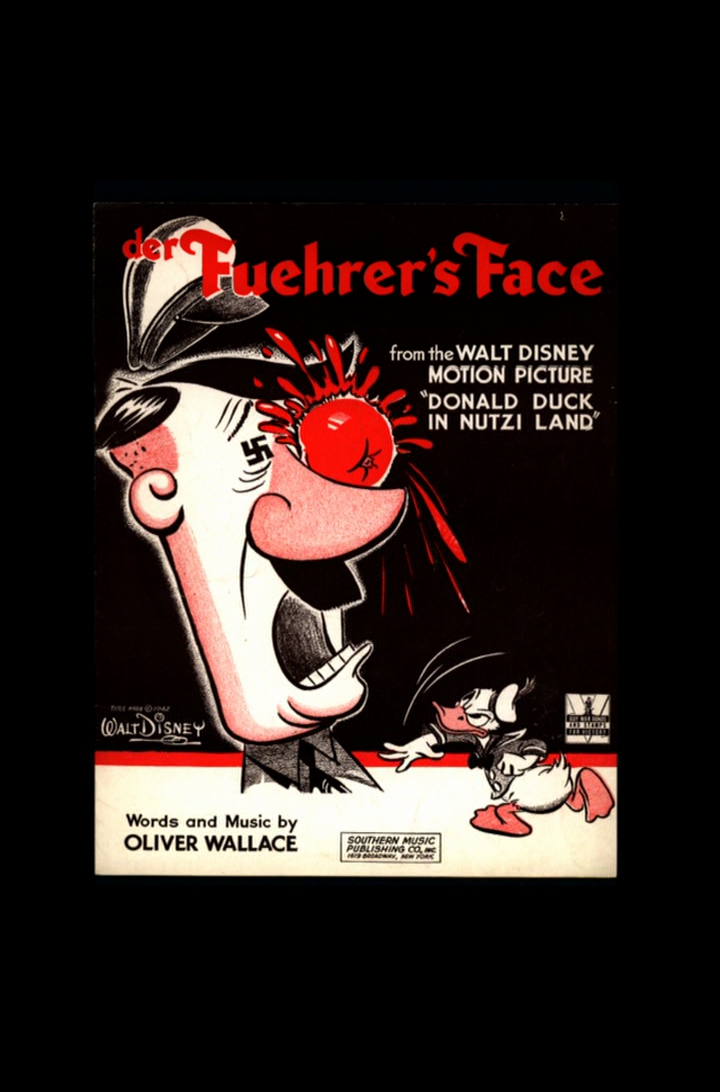
January 1, 1943 – Release of Der Fuhrer’s Face to Theaters

A prime example of homefront propaganda from World War II, Der Fueher’s Face was released to movie theaters on January 1st and was not only immensely popular, but it also won the Academy Award for Best Animated Short Film at the 15th Academy Awards. Directed by Jack Kinney, the short, in which Donald Duck has a nightmare that he resides in a country controlled by the Nazis, was originally called Donald Duck in Nutzi Land. The name was changed, however, when the title song for the short, written by Oliver Wallace, became a runaway hit after a record by Spike Jones was released (although the film preceded the record). According to Disney Legend Joe Grant, the short was inspired by the Charlie Chaplin film, Modern Times, especially the scene with Donald working on the belt line.

In this excerpt from the introduction to the short, film critic Leonard Maltin explains:

“It’s easy to see why the film was so popular. It’s very, very funny, reducing the serious tenets of Hitler’s Nazism to slapstick absurdities. And it gave audiences a chance to think, as Donald does, about the freedoms they might have taken for granted.”

As was common of propaganda films of the time, there are caricatures of Hirohito, Mussolini, and Nazi soldiers. This was a common tactic that is still seen today: the enemy is mocked to reduce the public fear and make the enemy less fear-inspiring. It was a good way to allow panicked Americans at that point a chance to laugh in the face of their fears.

One rumor that persisted about the film is that it was banned from being released to the public after the war. While the short was kept out of general circulation for many years because of its propagandistic content, it was released on the DVD set On the Front Lines in the third wave of Walt Disney Treasures, and was released again on the DVD set The Chronological Donald, Volume Two.

I find the work of the Disney Studios during WWII fascinating, from the propaganda shorts to the training films. All of these films helped Americans through their fear with laughter, and encouraged them to buy war bonds and support the troops through other methods. This short in particular conveys the message that Americans needed to be thankful for the freedoms they had and understand why they were fighting. America had been trying to stay out of the war until Pearl Harbor; these films helped rally the American Spirit.

One thing that also interests me about this short is the use of Donald Duck. Donald was an international star at this point, received well all over the world. Donald’s character works well for this kind of satire. His inability to keep from muttering under his breath as he deals with the insanity of Nutzi Land suits the story and creates a more humorous impact than if the usually cheerful, uncomplaining Mickey Mouse had been the main character. Audiences would have been sad to see our favorite mouse in Hitler’s clutches.

With grumpy, grousing Donald as the main character, Der Fueher’s Face allowed audiences to find humor in the face of fear.