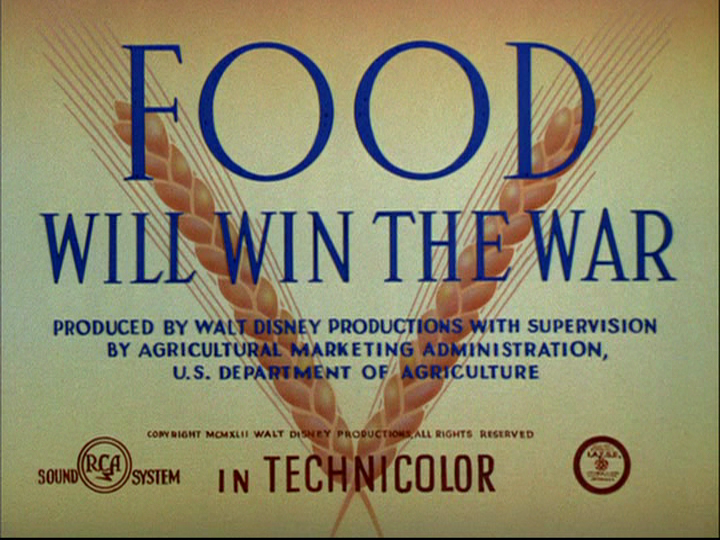
July 21, 1942 – The Animated Educational Film Food Will Win the War is Delivered to the Department of Agriculture
“In many lands, towns are ravaged – countrysides laid waste by ruthless Axis hordes. Farms, cattle, and crops have been destroyed. Ruin, destitution, hunger stalk the helpless victims of the cruel aggressor.”
On July 21, 1942, the Disney Studios delivered the animated educational film Food Will Win the War to the U.S. Department of Agriculture. At the time, the studios were producing many animated educational shorts, which still had the Disney touch in their animation and gags. These shorts, like this one, were also used to help build morale. The film was directed by Hamilton Luske, and is narrated by Fred Shields.
The film begins with the declaration that the world is aflame, as the members of the united nations are at war. Images cross the screen of war-torn towns, with a couple sitting, staring at what was once their home. However, a light of hope appears in the sky, called the Hope of American Agriculture. America is filled with abundant farmlands, and the animation shows that every single affected country can fit within the U.S., proving that there is enough abundant farmland and crops to help these crippled countries. There are 30 million farmers, with their wives and children, ready to help these countries in need, “twice as many as the Axis has soldiers,” the narrator states.
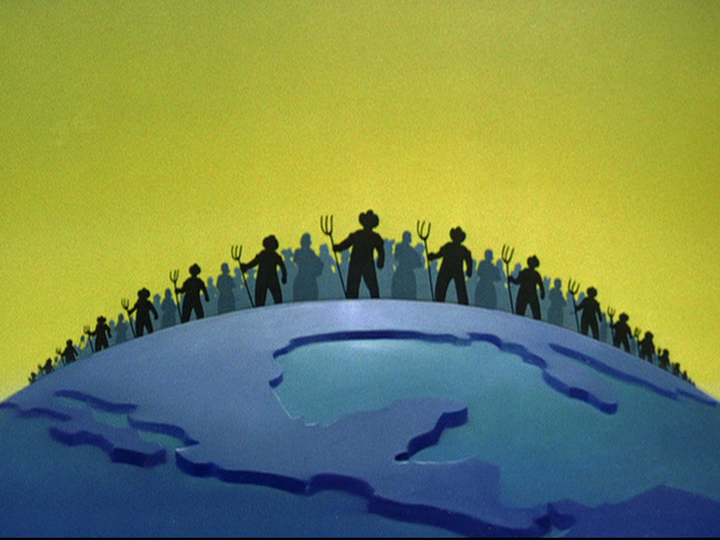
The farmers, their wives, and their children stand on the surface of the globe, ready to use their crops as weapons to help win the war
The farmers receive their own patriotic segment that portrays them as important soldiers in the battle, with tools (farm machinery), regiments of trucks, and divisions of corn pickers, all while working under the stress of war. One crop example is wheat; the narrator explains that the crop for the year is 52,800,000,000 pounds of wheat. “If all this wheat were made into flour,” he says, “there’d be enough to snow under the entire German Panzer Army.” The narrator moves on to the importance of corn, soybeans, potatoes, tomatoes, various vegetables and fruits, dairy, meat, and eggs, using humor for their examples. The farmers are then lauded for their important job, as a part of the war effort as much as any solider: Their food will help win the war.
 disneydetail