RSS Feed

Tag Archives: Director

November 4

November 4, 1895 – Director, Producer, and Disney Legend Ben Sharpsteen is Born

“Concerning Ben Sharpsteen and his contributions to the development of the Disney organization, I want to say he played a very important part.” – Walt Disney

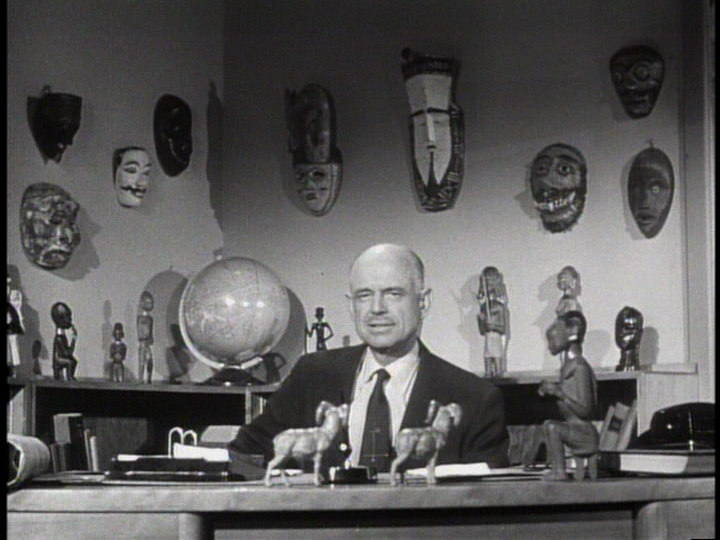
On November 4, 1895, Ben Sharpsteen was born in Tacoma, Washington, and was raised in Alameda, California. Sharpsteen attended the University of California at Davis to study agriculture, and joined the Marines in 1917 to serve during WWI. After the war, Sharpsteen worked at various studios as an animator, including Paramount, Jefferson Films, and Max Fleischer Studios. After his work was recommended to Disney, Sharpsteen flew from New York to Los Angeles; he was hired and paid one of the highest salaries in the studio, higher even than Disney’s top animator, Ub Iwerks.

For his first six years at Disney, Sharpsteen contributed animation on 97 Mickey Mouse short films and several Silly Symphonies. In 1933, Sharpsteen also established an animation training program within the studio, and began to recruit talented artists. In 1934, he moved to directing on the short films, which led to his role as a sequence director on Snow White and the Seven Dwarfs. He then became a supervising co-director on Pinocchio, and a production supervisor on Fantasia, Cinderella, and Alice in Wonderland. In the 1950s, Sharpsteen worked on several of the True-Life Adventure series, even presenting the series on television on the first episode of the Disney anthology series Disneyland. After working with the Disney Studios for 33 years, he retired in 1962, and passed away on December 20, 1980. He was inducted as a Disney Legend in 1998.

October 16

October 16, 1903 – Animator, Director, and Disney Legend Hamilton Luske is Born

Image credit: Disney Insider

“[Luske]’s expertise was evident, especially to Walt, where it mattered most, and it was thus into his lap Snow White, the most plum of all assignments, fell.” – David Johnson

On October 16, 1903, animator, director, and Disney Legend Hamilton S. Luske was born in Chicago, Illinois. Luske joined the Walt Disney Studios in 1931, and his first assignment was the animation of animals for the Mickey Mouse short The Barnyard Broadcast. He was then moved to more prominent assignments, including Max Hare in the Silly Symphony The Tortoise and the Hare, and Jenny Wren in Who Killed Cock Robin? Luske had no formal art education, but he had enough natural talent to give Walt the confidence to hire him as the supervising animator for what was considered Walt’s Folly: Snow White and the Seven Dwarfs. Luske was responsible for the animation of the title character of Snow White. To animate her properly, the technique of using live-action reference footage was soon adopted. Luske’s believable animation helped to make Snow White a box-office smash.

After the success of Snow White, Luske moved to directing during the World War II period, and continued to direct educational films, including Donald in Mathmagic Land and Donald and the Wheel. He also continued to be involved in the feature films as a sequence director on Fantasia, Cinderella, Alice in Wonderland, Peter Pan, Lady and the Tramp, 101 Dalmatians, and the animated sequences in Mary Poppins. Luske also moved into television as the associate producer and director for the Disneyland, Walt Disney Presents, and Walt Disney’s Wonderful World of Color series. Luske passed away on February 18, 1968; he was named a Disney Legend in 1999.

January 12

January 12, 1957 – John Lasseter is Born

“There’s something about John that you kind of get the feeling that [the fact that something’s never been done before] doesn’t matter. I mean, [just because it hasn’t] been done before, doesn’t mean it can’t be done.” – Glen Keane, animator (The Little Mermaid, Tangled)

John Lasseter was born on January 12, 1957, in Hollywood, California, and was raised in Whittier. When he was growing up, cartoons were seen as “kidstuff,” and part of growing up was to leave the childish things behind, but Lasseter refused to shed his love of animation. “I even watched them when it wasn’t cool in high school,” Lasseter reminisced. During his freshman year, Lasseter found a book in the library that would set him on the path of his passion: The Art of Animation, by Bob Thomas. “When I was growing up, I loved cartoons more than anything else. And when I was in high school, I found this book, this old, ratty book, called The Art of Animation. And it was about the Disney Studios and how they made animated films,” Lasseter said. “And it was one of those things that just dawned on me: people make cartoons for a living. They actually get paid to make cartoons. And I thought, ‘That’s what I wanna do.’ Right then, right there, it was like I knew that’s what I wanted to do.”

Soon after reading the book, Lasseter went to the movies to see a re-release of Disney’s The Sword in the Stone, and after seeing it, he proclaimed to his mother, an art teacher, that he wanted to be an animator for Disney. She encouraged his dream, and Lasseter began to send letters and drawings to the studio, receiving letters of support back. In 1975, Lasseter applied to the California Institute of the Arts (CalArts), was accepted into the first program that taught Disney-style character animation, taught by Disney’s great collaborators of the 1930s, the Nine Old Men. Lasseter found himself in an atmosphere where he didn’t have to hide his love of animation anymore, and was surrounded by those who had the same passion. His classmates included Brad Bird (director of The Incredibles), John Musker (co-director of The Little Mermaid), and Tim Burton.

Lasseter's class at CalArts, dated March 1976

There was no denying Lasseter’s talent at CalArts. Two of his student films won back-to-back Student Academy Awards: Lady and the Lamp in 1979, and Nitemare in 1980. His success brought him his dream job: he became a junior animator at the Disney Studios. Animator Glen Keane remarked that it was “. . . so great to meet John. There was this immediate sharing of information of your passion and excitement for animation, and he knew a lot about the history and the past.” To outsiders, Lasseter was touted as a new rising star. But inside the studio, animation had grown dormant. Budget cuts were taking their toll on animated films, leaving Lasseter brokenhearted. “This was not what I always dreamed Disney was,” he remembered.

The turning point came when employees of the studio were shown a screening of the 1982 film Tron. Lasseter and Keane became excited about the potential they saw in the use of computers for animation. They were able to get approval to experiment with a combination of computer background and 2D animated characters, first working on a 30-second test clip based on Maurice Sendak’s Where the Wild Things Are. Soon after, Lasseter got approval to work with his story team on a feature film based on the short story The Brave Little Toaster, which would mark his feature directorial debut. After eight months of development, Lasseter had a pitch meeting with the then-head of the studio, Ron Miller. Miller didn’t react favorably to the story, telling Lasseter that “[t]he only reason to do computer animation is if [they] could do it faster or cheaper.” A few mintues later, Lasseter was called down to a manager’s office with this simple but staggering message: “Well, John, your project is now complete, so your employment with the Disney Studios is now terminated.”

Don Hahn (producer for Beauty and the Beast) remarked, “He got fired, because, honestly, the studio didn’t know what to do with him. Even at that early day, this Disney Studio that he dreamed about working at, turned out to be a really dysfunctional place, in reality. And he was a born director, he was a born leader, and his expectation and passion excelled what the studio was doing then.” In 1983, while attending a computer conference in Long Beach, Lasseter ran into Ed Catmull, a speaker at the conference, and a comrade in the passion for 3D computer animation. Lasseter didn’t have the heart to tell Catmull he’d been fired from Disney, but did admit that Brave Little Toaster had been shelved. This was a great opportunity for them both, as Catmull, then working at Lucasfilm, needed to bring on someone who was a real animator. John was hired on the spot under the title of “interface designer,” so as not to alarm George Lucas, as they weren’t sure he would approve of hiring an animator for the technical team.

The Lucasfilm group.

Lasseter inspired the team to create software that would imitate the squash and stretch technique that had been taught in traditional animation courses. Inspired by the design of Mickey Mouse, as well as the limitations of what the computer could do, Lasseter created a character named Andre, made entirely of geometric shapes. The group at Lucasfilm’s first short film, The Adventures of Andre and Wally B, was premiered at the 1984 SIGGRAPH computer convention, and the crowd went wild over it. Lasseter made his way into the spotlight in 1989, when he and Bill Reeves won Oscars for Best Animated Short Subject for Tin Toy, the first ever awarded to a computer-animated film. “With each subsequent short film,” Steve Jobs explained, “John got more ambitious, and the team got more experience, and the software got better.”

To save Pixar, Lasseter pitched to Disney an idea for a half-hour Christmas special based on the award-winning short. Disney, on the other hand, was trying to lure Lasseter back to direct a feature film. But Lasseter was determined to stay with the struggling company. Eventually, Pixar and Disney reached a deal for a full-length animated feature: a story from a toy’s point of view, done in a 3D plastic world. The Pixar staff was elated, and Lasseter later recalled, “Ignorance is bliss. We did not know what we didn’t know.” After many trials and tribulations, including an entire scrapping of the “jumped-through-Disney’s-hoops” version of the film, Toy Story was released in theaters on Thanksgiving Weekend, 1995. Lasseter was awarded a special achievement Oscar for creating the first computer-animated feature film. The animation community was blown away, and audiences fell in love with the story.

Lasseter being presented with a special achievement Oscar.

Lasseter continued to push his animators with the next film, A Bug’s Life. Determined to beat the “second-product syndrome,” the animators pulled out all of the stops, and A Bug’s Life became the highest grossing animated film of 1998. After the international promotional tour of the film, Lasseter came home for a well-deserved break, while a secondary team began work on a direct-to-video sequel to Toy Story, which would be the first project not supervised by Lasseter. However, the film was not very good, although Disney had said it was good enough to release theatrically, and Lasster was asked to come in and help fix it. Nine months before its release, Lasseter scrapped the entire film over the course of a weekend and rewrote it. Jim Murphy, an animator at Pixar, had this to say about the rewrite: “John came back and pitched the story to the animation department. Just in that pitch, he totally fired everyone up and inspired everyone to really do the impossible.” In the end, Toy Story 2 was another success for Lasseter and Pixar, becoming one of those rare sequels considered as good as, or better, than the first film.

With Disney’s acquisition of Pixar in 2006, Disney finally got Lasseter back, only this time Lasseter was named the Chief Creative Officer of both studios, as well as the Principal Creative Advisor at Walt Disney Imagineering. He has acted in many roles since then, including executive producer for films including WALL-E and Tangled, director for Ponyo and Cars 2, and creative consultant on The Muppets. In 2007, Lasseter was inducted into the American Academy of Arts and Sciences, in honor of all of his achievements in the field of computer animation.

"So it’s become this way of working that the art challenges technology, technology inspires the art."

John Lasseter is one of my heroes, and a true example of why you should never let go of your dreams. There is so much to say on Lasseter’s influence, and it was hard to not start to write the entire history of Pixar, as the two go hand in hand. It’s interesting to see the development of a kid who tried to not be seen going to see a Disney film as a teenager, to one of the most influential people in the field of animation. The amount of dedication he and the other members of Pixar have put in their films, including their focus on story as much as their focus on the medium, is truly inspirational.

January 5

January 5, 1941 – Prominent Film Director and Animator Hayao Miyazaki is born.

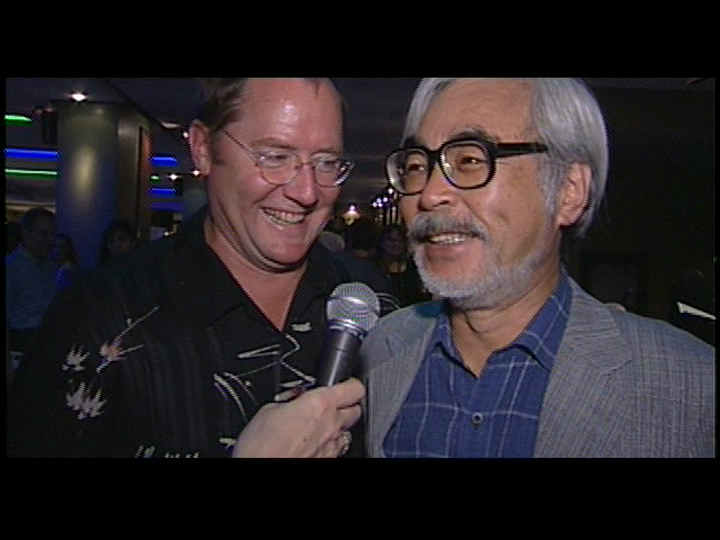
John Lasseter (L) and Hayao Miyazaki

“When you see a movie of his, you see something in film you’ve never seen before.” – John Lasseter, Chief Creative Officer of Walt Disney and Pixar Animation Studios.

If Japanese animation legend Tezuka Osamu is known as the Japanese Walt Disney, Hayao Miyazaki could be seen as the Japanese John Lasseter: both men’s works have changed the landscape of animation for future generations.

Miyazaki was born to a well-to-do family on the outskirts of Tokyo in 1941. He and his family were forced to evacuate their home during World War Two (although they were able to move back in 1950), and in 1947, Miyazaki began school as an evacuee. Wartime events would have an impact in his work, one example being his 2004 film Howl’s Moving Castle. Like many children in post-war Japan, Miyazaki was inspired by the works of Tezuka Osamu (best known for his work Astro Boy), who had just made a big impact with his comic New Treasure Island. In fact, most of Miyazaki’s early work was, as he acknowledged, heavily inspired by Osamu, even as Miyazaki struggled to develop his own artistic direction, and it was only when he became an animator at Toei Animation that he felt he had finally shaken off the influence.

Miyazaki had several other influences: He studied political science and economics at Gakushuin University, and was part of a children’s literature research society, where members read many stories, including European texts, exposing him to a wide range of fantasy and legends. After leaving university in 1963, he joined Toei Animation Studios, working as an inbetweener after three months’ training. He first gained recognition for his work on the film Gulliver’s Travels Beyond the Moon in 1965. He was able to pitch his own ending to the film when he found the original one unsatisfactory, and his ending was used in the final product. Miyazaki married fellow animator Akemi Ota in 1965.

Miyazaki continued to play important roles including animator, concept artist, and storywriter for various films, including Hols: Prince of the Sun (1968), Puss in Boots (1969), and Animal Treasure Island (1971). In 1971, Miyazaki left Toei and joined A Pro to work with Isao Takahata, and also worked for Nippon Animation, which he left in 1979 in order to direct his first feature animated film, The Castle of Cagliostro.

In 1984, Miyazaki had his big breakthrough in animated film with Nausicaä of the Valley of the Wind, based on the comic he had written (first published in 1982, and serialized until its completion in 1994). This film introduced many themes that occur frequently in his later films: environmental issues, feminism, pacifism, and an interest in flight and aircraft. The success of the film, and the need to establish a new production center, led Miyazaki and Isao Takahata, along with producer Toshio Suzuki, to form Studio Ghibli, a subsidiary of Tokuma Publishing.

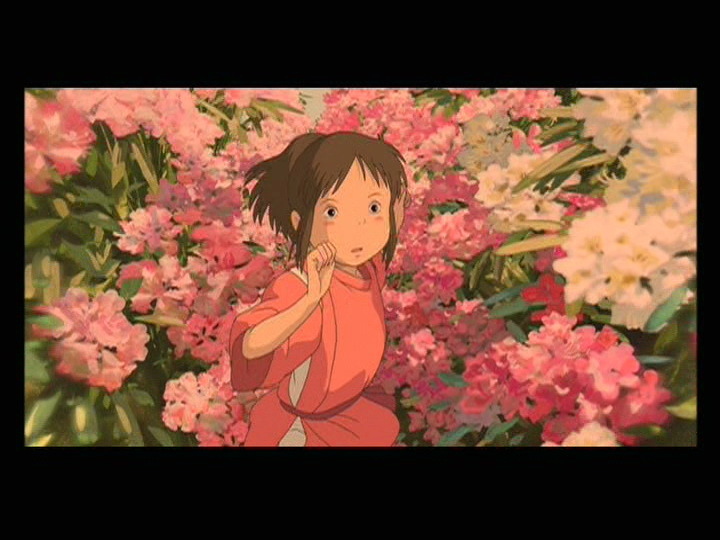
In 1996, Disney made a deal with Tokuma to distribute the Studio Ghibli works, excluding Grave of the Fireflies, and Ocean Waves. Since then, Disney has released the films on DVD, with the likes of John Lasseter and Pete Docter from Pixar helping to create the English-dubbed version. Spirited Away, the only traditionally animated and foreign animated film to win the Academy Award for Best Animated Feature, brought Miyazaki and Studio Ghibli to the world stage. John Lasseter noted that “since Spirited Away was released in the United States, it has created a large following for Miyazaki-san’s work. Since then they’ve released on DVD most of Miyazaki-san’s films, so there’s a lot of people – a lot more Miyazaki fans in the United States now than there was when Spirited Away was released.” Studio Ghibli and Walt Disney Studios have also seen success with release of Howl’s Moving Castle and Ponyo.

The main character of Spirited Away, Chihiro.

Miyazaki has been a great inspiration to many animators, from the staff at Pixar to the animators at Walt Disney Studios. John Lasseter is a close friend of Miyazaki’s, and has mentioned on numerous occasions how Miyazaki’s films inspire the animators at Pixar. “He is one of the great filmmakers living today,” says Lasseter. “When you see a movie of his, you see something in film you’ve never seen before. . . His films have always been inspirational for me and for everyone at Pixar…It’s interesting to talk to people and they have different interpretations of it. And that’s what’s so special about [Miyazaki’s] films…they make you think. Miyazaki’s films always make you think. And that’s what’s so special about them. And that’s why they get better. Just like a fine wine, they get better with age, because you keep watching them and you understand them more and more, and that’s what I just love about them. …[T]hey’ll live on forever.”

Animator Glen Keane (Beauty and the Beast, Aladdin, Tangled) has also been inspired by the animation style of Miyazaki and Studio Ghibli. “Well, it’s hard to ever separate the huge influence that Japanese animation has had on me,” he says. “I was just in awe of Miyazaki’s work, and have emulated his sensitivity, his approach to staging. That had a gigantic impact on our films, starting with Rescuers Down Under, where you saw the huge Japanese influence on our work. That’s part of our heritage now, which we don’t back away from.”

I included Miyazaki for several reasons: 1) Disney does have distribution rights to the Studio Ghibli films; 2) many animators in Pixar have worked on the English translation of the films; and 3) the influence the Studio Ghibli and Miyazaki has had on Disney and Pixar is unmistakable. Many people find the films inspirational both for the stories being told and the animation style. There is no denying the impact Miyazaki has had on the animation world.